INTRODUCTION
One of the most critical moments in the life cycle of many marine invertebrates with a pelagic larval phase is settlement in the benthic habitat. Settlement and metamorphosis in some species of marine invertebrates are triggered by specific cues (Crisp, Reference Crisp, Gran and Mackie1974; Forward et al., Reference Forward, Tankersley and Rittschof2001), such as the type of substratum and/or the presence of conspecifics; the latter is especially identified in gregarious species. The absence of cues can lengthen larval development, ending with the spontaneous metamorphosis or death of the larvae (Gebauer et al., Reference Gebauer, Paschke and Anger2003).
The presence of conspecifics during settlement and metamorphosis in species with gregarious habits exacerbates the formation of aggregations (Pineda, Reference Pineda2000). Gregarious settlement has been described in several decapods (Gebauer et al., Reference Gebauer, Paschke and Anger2003; O'Connor & Van, Reference O'Connor and Van2006; Steinberg et al., Reference Steinberg, Krimskry and Epifanio2008) and specifically in the porcelain crab Petrolisthes cinctipes (Jensen, Reference Jensen1989; Donahue, Reference Donahue2006), P. eriomerus (Jensen, Reference Jensen1989, Reference Jensen1991). Moreover, the presence of conspecifics may be an indication of the quality of the habitat (Donahue, Reference Donahue2006).
Settling together with conspecifics could present advantages, such as increased potential for mating, improved foraging, reduced predation and stress etc. (Bertness, Reference Bertness1989; Leslie, Reference Leslie2005), however, it can also present disadvantages, including increased competition for food and/or space (Donahue, Reference Donahue2004). Despite these disadvantages, the organisms maintain their aggregations, probably because the advantages produced by gregarious habits are greater than the disadvantages produced by intraspecific competition (Luppi et al., Reference Luppi, Spivak, Anger and Valero2002).
Porcelain crabs are abundant in the intertidal zones of boulder beaches in Chile, where they form dense aggregations (Emparanza, Reference Emparanza2007; Gebauer et al., Reference Gebauer, Paschke and Moreno2007). The species of the genus Petrolisthes have an important trophic role as prey for fish, birds and crabs that inhabit the coast (Castilla & Paine, Reference Castilla and Paine1987; Berríos & Vargas, Reference Berríos and Vargas2004), as suspension-feeders transferring material and energy from pelagic to benthic zones (Steger & Gardner, Reference Steger and Gardner2007), and as predators of marine invertebrates in their early stages (Hollebone & Hay, Reference Hollebone and Hay2008).
Petrolisthes laevigatus (Guérin, 1835) is a typical inhabitant of the rocky upper and middle intertidal zone. It is found from the south of Peru to southern Chile (Carvacho, Reference Carvacho1980; Emparanza, Reference Emparanza2007) and is characterized by dense aggregations under boulders in which the whole size-distribution is present (Gebauer et al., Reference Gebauer, Paschke and Moreno2007). The settlement of this species extends from October until March in southern Chile, with the density and size-distribution of the population varying during the settlement season (Gebauer et al., Reference Gebauer, Paschke and Moreno2007).
The objective of this research was to evaluate the effect of the presence of conspecifics on the settlement of the porcelain crab P. laevigatus through two independent experiments: (1) under constant density and size-distribution of conspecifics during the settlement season; and (2) under density and size-distribution of conspecifics presented in three periods (beginning, middle and end) of the settlement season in southern Chile.
MATERIALS AND METHODS
Study area
The experiments were carried out on the northern coast of Seno de Reloncaví, Puerto Montt (Pelluhuín), Chile (41°45′S 72°70′W). This area is characterized by the presence of sand, small boulders and ‘Cancagua’, an immature sandstone, ranging in size from 500 to 1000 cm−2. ‘Cancagua’ stones were used as settlement substratum (experimental units) since it is a natural substratum on which P. laevigatus settles and lives, and is easy to handle. No enclosures or fences were used since preliminary experiments showed that 90% of the marked crabs stayed in their stone during 3 days.
Effect of constant conspecifics density on the settlement of P. laevigatus during the settlement season
Twenty experimental units of similar areas (640 ± 164 cm2) were installed and distributed randomly in the mid-intertidal zone at distances of 1.5 m. Subsequently, crabs were placed in the experimental units at the densities and sizes determined in a sampling at the beginning of the settlement season (October) (see Gebauer et al., Reference Gebauer, Paschke and Moreno2007). The densities used in this experiment were: (a) density 1: 190 ind*m−2, defined as the mean minus a standard deviation (SD); (b) density 2: 493 ind*m−2, mean density of the sampling; and (c) density 3: 796 ind*m−2, defined as the mean plus a standard deviation. A size-range of 2.5 to 16 mm carapace length was used, consistent with that found in the field. Five experimental units (replications) were used for each density treatment and one condition without conspecifics (density 4) with its respective replications.
The settlement of P. laevigatus was monitored every three days during low tide, from the beginning (October) until the end of settlement season (March). The recently settled megalopae were removed and counted in situ. Every six days the experimental densities were controlled and randomly reassigned to experimental units. Animals that were lost were replaced; this occurred on only three occasions (10–28 December: density 1 in a replication; 28 December: density 2 in a replication). During the study period no juveniles and adult conspecifics were found in the density 4 treatment, corresponding to a condition without conspecifics.
Effect of conspecifics density in the three periods (beginning, middle and end) of the settlement season
During the second settlement season, the effect of conspecifics density was evaluated on the basis of the density and size-distribution in three periods during the season: beginning (October), middle (December) and end (February).
The densities used were calculated according to the densities found in the beginning, middle and end periods respectively, as follows: saturation (defined as the maximum density plus a standard deviation): 1859, 4508 and 2448 ind*m−2; maximum: 1009, 3207 and 1861 ind*m−2; mean: 491, 1860 and 588 ind*m−2; minimum: 58, 230 and 102 ind*m−2.
The effect of conspecifics density on settlement was evaluated three times per period (I, II and III, every 15 days) in 25 experimental units in the mid-intertidal zone. Four treatments with the densities previously described and one without conspecifics were used to evaluate the effect of conspecifics density in the different periods. The treatments and their respective replications (5) were distributed randomly in the field. Three days prior to quantifying the megalopae, the densities were placed in the corresponding treatments. The megalopae were counted three days after the installation of conspecifics and their density was checked.
Statistical analysis
The effect of constant conspecifics density on the settlement was tested with a two-way analysis of variance (ANOVA) considering as factors the treatments (density) and the sampling day. The first season presented a long period without settlement in the intertidal zone, consequently the season was divided into two periods. The data from each period were transformed into ln (n + 1) to comply with the assumptions of normality (Kolmogorov–Smirnov test) and homogeneity of variance (Levene test). Subsequent to ANOVA, a posteriori comparisons were made using Tukey's test (Quinn & Keough, Reference Quinn and Keough2002).
The effects of conspecifics density on settlement in each period (beginning, middle and end) of the second season were analysed separately with a two-way ANOVA considering the density treatments and the sampling day as factors. The effect of the period (beginning, middle and end) and the presence of conspecifics in the settlement in the second season were evaluated using a two-way ANOVA (Quinn & Keough, Reference Quinn and Keough2002) for similar conspecifics densities, which were: beginning: saturation (1859 ind*m−2); middle: mean (1860 ind*m−2); and end: maximum (1861 ind*m−2). Additionally, to test the effect of the seasons and the presence of conspecifics, settlement at the beginnings of the two seasons was compared under conditions of mean conspecifics density and without conspecifics with a two-way ANOVA. The size- distribution and mean density were similar in both seasons.
RESULTS
Effect of constant conspecifics density on the settlement of P. laevigatus
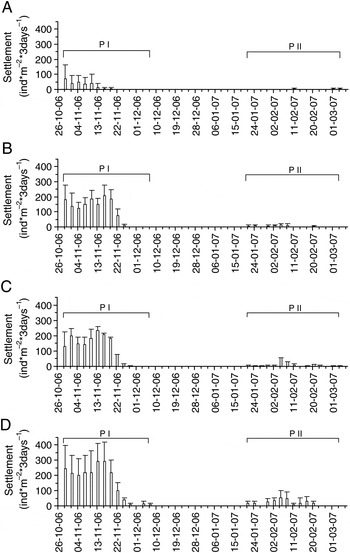
Settlement of P. laevigatus extended from the end of October to the beginning of March, but from approximately December to January no megalopae were found in the intertidal in any of the conditions studied (Figure 1A–D). Consequently, two periods of analysis were considered (P I and II). Period I was from the beginning of the settlement season (29 October 2006) until early December (7 December 2006) and Period II was from 21 January 2007 to 4 March 2007 (Figure 1A–D). There was a higher mean rate of settlement in Period I than in Period II (93.86 ± 111.18 versus 7.91 ± 18.53 megalopae*m−2*3 days−1).
Settlement rate of Petrolisthes laevigatus every three days (mean +SD) under different constant conspecifics density during first settlement season (A) without conspecifics (B) density 1 (190 ind*m−2), (C) density 2 (493 ind*m−2), (D) density 3 (796 ind*m−2).

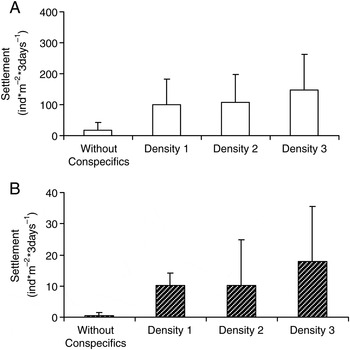
The settlement rate of P. laevigatus was affected by the conspecifics density, the sampling day and the interaction of these factors (P < 0.001) in both periods (Figure 1A–D). The highest settlement rate for both periods was recorded for the treatment with the highest conspecifics density (147.93 ± 138.93 and 17.79 ± 26.79 megalopae*m−2*3 days−1) and the lowest was in the treatment without conspecifics (18.59 ± 40.91 and 0.47 ± 2.36 megalopae *m−2*3 days−1, periods I and II, respectively) (Figure 2A, B).
Mean settlement rate (+SD) of Petrolisthes laevigatus under different densities during (A) Period I and (B) Period II (see Figure 1 for more details).

The analysis of the effect of the treatments on the settlement rate for the sampling day in the two periods allowed some patterns to be distinguished (a posteriori comparisons): (a) densities 1, 2 and 3 were different from the treatment without conspecifics when the settlement rate was higher than 29.72 megalopae *m−2*3 days−1; (b) no differences were found between the pairs: density 1 and without conspecifics, densities 1 and 2, and densities 2 and 3 when the mean settlement rate varied from 15.55 to 21.97 megalopae *m−2*3 days−1; (c) only density 3 and without conspecifics differed when the settlement rate was varied between 7.2 and 12.58 megalopae *m−2*3 days−1; and (d) no differences were detected between the treatments when the settlement rate fluctuated between 0 and 4.86 megalopae*m−2*3 days−1.
Effect of conspecifics density in the three periods (beginning, middle and end) of the settlement season
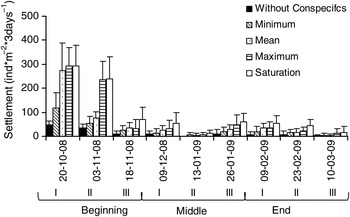
The differences in the settlement rate of P. laevigatus among densities and sampling days for each period (beginning, middle and end) were statistically significant. The interaction of these factors was significant only at the beginning of the settlement season (F: 5.3; P < 0.001) (B I–III) (Figure 3). The saturation treatment showed higher settlement rates than that without conspecifics (Figure 3). In the particular case of the first sampling at the beginning of the season (B I), there were no differences between the three highest densities (294.57 ± 85.22, 292.44 ± 75.92 and 273.52 ± 115.79 megalopae*m−2*3 days−1 respectively). Similarly, in the second sampling (B II), no differences were detected between the saturation and the maximum treatments (238.89 ± 91.22 and 234.08 ± 78.34 megalopae *m−2*3 days−1 respectively); the highest settlement rates of the season were during this period (beginning). Only in the cases of the second sampling in the middle period of the season (M II) and the last two samplings in the end period of the season (E II–III respectively) no significant differences were detected among the treatments. The lowest mean settlement rates were during these samplings (2.78 ± 6.64 and 7.97 ± 14.04 megalopae *m−2*3 days−1; Figure 3), as was also observed in the previous season.
Mean settlement rate (+SD) of Petrolisthes laevigatus under 5 densities and 3 sampling periods: without conspecifics, minimum (58, 230 and 102 ind*m−2), mean (491, 1860 and 588 ind*m−2), maximum (1009, 3207 and 1861 ind*m−2) and saturation (1859, 4508 and 2448 ind*m−2); beginning, middle and end periods of the second settlement season; each period comprised 3 samples (I–II–III).

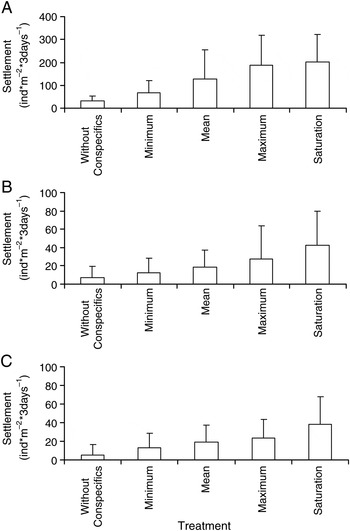
During the beginning period of the season, the settlement rate was similar between the saturation and maximum densities (200.75 ± 122.91 and 186.55 ± 130.30 megalopae*m−2*3 days−1 respectively), and between maximum and mean densities (127.35 ± 106.28 megalopae*m−2*3 days−1). No differences were found in settlement rates between minimum density and absence of conspecifics (66.06 ± 55.25 and 30.27 ± 21.88 megalopae*m−2*3 days−1 respectively), but there were differences between them and the three highest densities used in this period (Figure 4A).
Mean settlement rate (+SD) of Petrolisthes laevigatus under different densities during the (A) beginning (B) middle, and (C) end of the settlement season (see Figure 3 for more details).

During the middle period of the settlement season, no differences were found between the saturation, maximum and mean densities (42.64 ± 37.10; 27.80 ± 35.84 and 18.78 ± 19.49 megalopae*m−2*3 days−1 respectively), although a reduction in settlement was observed in relation to conspecifics density (Figure 4B). The two maximum densities for this same period presented different settlement from the minimum density and without conspecifics (12.56 ± 16.05 and 6.72 ± 12.63 megalopae*m−2*3 days−1, respectively) (Figure 4B).
No significant differences were detected between the settlement rates of the three lowest densities, and between them and the absence of conspecifics (23.73 ± 19.90, 18.78 ± 19.49, 12.64 ± 16.09 and 5.58 ± 10.61 megalopae m−2*3 days−1 respectively) during the end period of the season, but a difference was detected with the highest density used (saturation: 38.69 ± 29.23 megalopae*m−2*3 days−1) (Figure 4C).
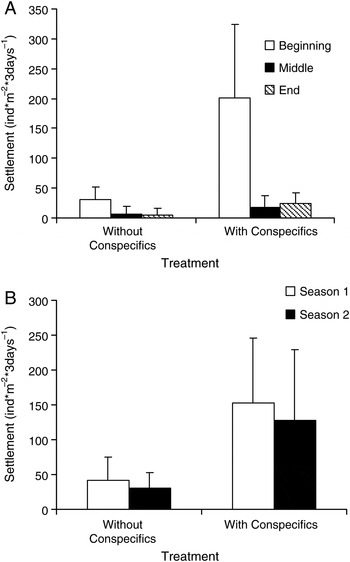
The settlement rate in the second season was affected by the period (beginning, middle and end) and by the presence of conspecifics (F: 37.5 and F: 36.31, respectively; P < 0.001). Settlement at the beginning of the season under the same conspecifics density was approximately ten times higher than in the middle and end of the season (Figure 5A).
Variability and effect of presence of conspecifics on the settlement rate of Petrolisthes laevigatus (A) within the second settlement season (beginning, middle and end) and (B) between first and second settlement season.

The settlement seasons studied did not show significant differences (F: 0.22; P = 0.651) in the settlement rate, although the first season presented a 20% higher settlement rate than the second season (Figure 5B). The settlement rate in the presence of conspecifics was significantly higher than without conspecifics (mean density versus the absence of conspecifics) (P < 0.001; Figure 5B).
DISCUSSION
The settlement of P. laevigatus is consistently affected by the presence of conspecifics, as occurs in other species of decapod crustaceans (Forward et al., Reference Forward, Tankersley and Rittschof2001; Gebauer et al., Reference Gebauer, Paschke and Anger2003; O'Connor & Van, Reference O'Connor and Van2006; Steinberg et al., Reference Steinberg, Krimskry and Epifanio2008), and specifically in porcelain crabs like P. cinctipes (Jensen, Reference Jensen1989; Donahue, Reference Donahue2006). There is evidence in the present study of ‘saturation’ or a deceleration of settlement at the higher conspecifics densities used, with a stabilization of the positive effect of conspecifics density on settlement being observed mainly at the beginning of the season, when 80% of settlement occurred. Independent of saturation, the treatments with conspecifics presented higher rates of settlement than without conspecifics. Donahue (Reference Donahue2006) observed a similar pattern for P. cinctipes, where the experimental evidence indicated that this species, like P. laevigatus, uses conspecific attraction as a settlement strategy across the range of densities present in nature.
Thus the settlement differential across the range of conspecifics density could determine the distribution and abundance of P. laevigatus at different spatial scales, both within and among coastal areas, as has been suggested for cirripedia (Jenkins, Reference Jenkins2005; Blythe & Pineda, Reference Blythe and Pineda2009).
In both the middle and end periods of the second season and Period II of the first season, there was a positive but weak effect of conspecifics density on settlement, probably due to the lower availability of competent larvae in the coastal zone and/or the absence of mechanisms favouring transport to the coast (Gebauer, Reference Gebauer2004; Gebauer et al., Reference Gebauer, Paschke and Moreno2007). Additionally, another factor that could act together with the effect of the presence and density of conspecifics is the significant increases in the number of individuals between 2–3 mm carapace length (Juvenile I and Juvenile IV) during season. This could have an unfavourable effect on the settlement of following cohorts. Negative effects of the first settlers on following cohorts have also been detected in other crustacean species, due to cannibalism in Cancer magister (Fernández, Reference Fernández1999) and Cyrtograpsus angulatus (Luppi et al., Reference Luppi, Spivak, Anger and Valero2002), and competition for food in P. cinctipes. These effects occur mainly in smaller organisms, thus the cost of aggregation could be higher on recruits than adults, although these costs could be minimized if settlement with conspecifics occurs in sites with a greater availability of food (Donahue, Reference Donahue2004). Future studies related to gregarious settlement in suspension-feeding species should consider the consequences of aggregations of multiple sizes in the population and the effect of the density of early juveniles on settlement. Settlement may respond differently to density depending on the size of the conspecifics in a patch.
Independent of the possible disadvantages presented by gregarious settlement, in general or in a particular period in the season, settling together with conspecifics should still be an advantage for P. laevigatus and for many other species of invertebrates presenting dense aggregations, through reduced rates of predation (Bertness & Grosholz, Reference Bertness and Grosholz1985; Jensen & Armstrong, Reference Jensen and Armstrong1991; Ray & Stoner, Reference Ray and Stoner1994), increased success in foraging (Clark & Mangel, Reference Clark and Mangel1984), reduced environmental stress (Bertness, Reference Bertness1989) and increased reproductive success.
In general, the disadvantages described for gregarious settlement have been associated with increased competition and cannibalism, but other disadvantages of a high dependence on settlement density are the limits it imposes on the colonization of new areas and the recovery of populations that have been reduced by natural and/or anthropogenic disturbances.
ACKNOWLEDGEMENTS
The authors thank Andrés Surot for support given during the development of the experiments. This work was financed by Fondecyt (1080157) and DI-Universidad de Los Lagos (0707).