Introduction
Keratin-associated proteins (KAPs) and keratin intermediate filaments (KIFs) are the main structural components of wool and hair fibres, accounting for 0.90 of the total weight of the fibre (Powell and Rogers, Reference Powell, Rogers, Leigh, Watt and Lane1994). The KAPs form a matrix that cross-links the KIFs through extensive disulphide bonding and they are therefore also called matrix proteins (Powell and Rogers, Reference Powell, Rogers, Jollès, Zahn and Höcker1997). The KAPs are rich in cysteine or contain a high content of glycine and tyrosine residues, and they have been classified into three broad groups: high sulphur (HS; ⩽30 mol% cysteine), ultra-high sulphur (UHS; >30 mol% cysteine) and high glycine-tyrosine (HGT; glycine-tyrosine ranges from 35 to 60 mol%) KAPs (Gong et al., Reference Gong, Zhou, Forrest, Li, Wang, Dyer, Luo and Hickford2016).
The KAPs are encoded by small intron-less genes and over 80 functional KAP genes (KRTAPs) have been identified in the human genome (Rogers and Schweizer, Reference Rogers and Schweizer2005; Gong et al., Reference Gong, Zhou, McKenzie, Hickford, Yu, Clerens, Dyer and Plowman2010a). In sheep, only a few KAP genes have been characterized (Gong et al., Reference Gong, Zhou, Forrest, Li, Wang, Dyer, Luo and Hickford2016) and new KAP genes continue to be identified, including KRTAP15-1 (Wang et al., Reference Wang, Zhou, Zhu, Hu, Liu, Li, Luo and Hickford2017), KRTAP20-2 (Bai et al., Reference Bai, Gong, Zhou, Tao and Hickford2018), KRTAP22-1 (Li et al., Reference Li, Zhou, Gong, Zhao, Wang, Liu, Luo and Hickford2017a) and KRTAP26-1 (Li et al., Reference Li, Zhou, Gong, Zhao, Hu, Luo and Hickford2017b). The genes KRTAP15-1 and KRTAP26-1 encode HS-KAPs, whereas KRTAP20-2 and KRTAP22-1 encode HGT-KAPs. KRTAP20-2 is reported to affect wool curvature (Bai et al., Reference Bai, Gong, Zhou, Tao and Hickford2018), KRTAP22-1 is found to affect wool yield (Li et al., Reference Li, Zhou, Gong, Zhao, Wang, Liu, Luo and Hickford2017a) and KRTAP26-1 affects wool fibre diameter and length (Li et al., Reference Li, Zhou, Gong, Zhao, Hu, Luo and Hickford2017b).
Despite variation in ovine KRTAP15-1 having been reported in Chinese sheep breeds (Wang et al., Reference Wang, Zhou, Zhu, Hu, Liu, Li, Luo and Hickford2017), the gene has not been investigated in European sheep breeds and the effect of variation in the gene, should it occur in those breeds, has not been investigated.
The current study used a polymerase chain reaction-single stranded conformational polymorphism (PCR-SSCP) approach to search for KRTAP15-1 variation in New Zealand (NZ) sheep, and to investigate whether this variation is associated with particular wool traits.
Materials and methods
Sheep blood and wool sample collection and preparation
Seventy-nine Merino sheep and 68 Romney sheep, with each group being sourced from seven farms in NZ, were used initially to screen for variation in KRTAP15-1. Subsequently, 396 Merino × Southdown-cross sheep, derived from six sire-lines, were used for the association study. Sheep blood samples were collected onto TFN paper (Munktell Filter AB, Sweden), and genomic DNA for PCR amplification was purified using the method of Zhou et al. (Reference Zhou, Hickford and Fang2006).
Wool samples from the Merino × Southdown-cross sheep were collected from the mid-side of the animals at 12 months of age (first shearing). Greasy fleece weight (GFW) was measured at shearing, while wool yield (Yield), mean fibre diameter (MFD), fibre diameter standard deviation (FDSD), coefficient of variation of fibre diameter (CVFD), mean staple length (MSL), mean fibre curvature (MFC), mean staple strength (MSS) and prickle factor (PF) were measured by the NZ Wool Testing Authority Ltd (Ahuriri, Napier, NZ). Clean fleece weight (CFW) was calculated from the GFW and Yield measurements.
Polymerase chain reaction-single stranded conformational polymorphism analysis
A 495-bp fragment spanning the entire ovine KRTAP15-1 coding region was amplified using two PCR primers (Forward: 5′-GAACTCAGAACTCCCAACAG-3′ and Reverse: 5′-TAACCATGGGTGACTGGAG-3′) that were described in Wang et al. (Reference Wang, Zhou, Zhu, Hu, Liu, Li, Luo and Hickford2017). Polymerase chain reaction amplification was performed in a 15-μl reaction consisting of the genomic DNA from one 1.2-mm punch of TFN card, 0.25 µM of each primer, 150 µM of each dNTP (Bioline, London, UK), 2.5 mM of Mg2+, 0.5 U of Taq DNA polymerase (Qiagen, Hilden, Germany) and 1 × reaction buffer supplied with the enzyme. The thermal profile consisted of an initial denaturation for 2 min at 94 °C, followed by 35 cycles of 30 s at 94 °C, 30 s at 59 °C and 30 s at 72 °C and with a final extension step of 5 min at 72 °C.
A 1 µl aliquot of PCR product was mixed with 7 µl of loading dye (98% formamide, 10 mM EDTA, 0.025% bromophenol blue, 0.025% xylene-cyanol) and after denaturation at 90 °C for 5 min, the samples were rapidly cooled on wet ice and then loaded on 16 × 18 cm2, 12% polyacrylamide (acrylamide:bisacrylamide – 37.5:1) gels. Electrophoresis was performed for 18 h at 310 V and 18 °C in 0.5 × TBE buffer, and the gels were silver-stained by the method of Byun et al. (Reference Byun, Fang, Zhou and Hickford2009).
Sequencing of the keratin-associated protein 15-1 gene variants and sequence analyses
Polymerase chain reaction amplicons representing different PCR-SSCP banding patterns from sheep that appeared to be homozygous were sequenced in both directions at the Lincoln University DNA Sequencing Facility, NZ. Banding patterns that were only found in apparently heterozygous sheep were sequenced using an approach described by Gong et al. (Reference Gong, Zhou and Hickford2011a). In this approach, a band corresponding to the variant was excised as a gel slice from the polyacrylamide gel, macerated and used as a template for re-amplification with the original primers. This second amplicon was then sequenced three times in both directions.
Sequence alignments and translations were carried out using DNAMAN (version 5.2.10, Lynnon BioSoft, Vaudreuil, Canada). The BLAST algorithm was used to search the NCBI GenBank (http://www.ncbi.nlm.nih.gov/) databases for similar sequences.
Statistical analyses
Statistical analyses were performed using Minitab version 16 (Minitab Inc., State College, PA, USA). General linear mixed-models (GLMMs) were used to assess the effect of the presence/absence of the KRTAP15-1 variants on the various wool traits that were measured. Single-variant presence/absence models were used initially to determine which variants should be included in subsequent multi-variant models. These multi-variant models included any variant from the single-variant models where the association with a trait had a P value <0.200, and which could therefore also potentially influence the trait being analysed.
For genotypes with a frequency >0.05 (and thus that had an adequate sample size), GLMMs were used to compare the various wool traits between sheep with these genotypes. A Bonferroni correction was applied in these models to reduce the chances of obtaining false positive results during the multiple comparisons.
Sire and gender were found to affect the wool traits, and thus they were fitted as random and fixed factors, respectively, in all the models.
Results
Variation in keratin-associated protein 15-1 gene detected in New Zealand sheep
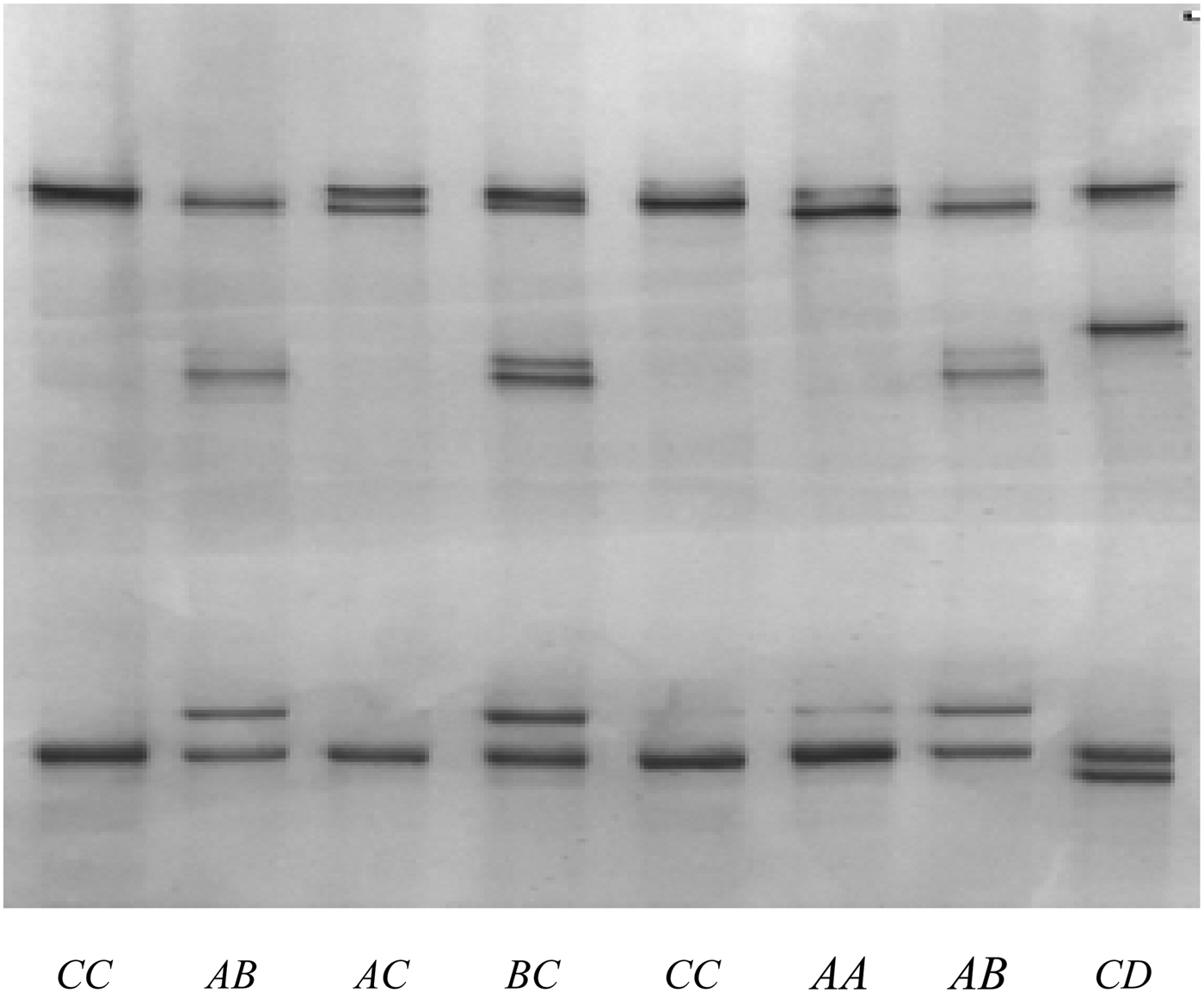
Four unique PCR-SSCP banding patterns (Fig. 1), representing four different DNA sequences, were detected in the original group of NZ Romney and Merino sheep. All of these sequences were different to the known KRTAP sequences, but the highest sequence similarity was with the KRTAP15-1 sequences reported in Chinese sheep (Wang et al., Reference Wang, Zhou, Zhu, Hu, Liu, Li, Luo and Hickford2017), humans (Rogers et al., Reference Rogers, Langbein, Winter, Ehmann, Praetzel and Schweizer2002) and mice (Pruett et al., Reference Pruett, Tkatchenko, Jave-Suarez, Jacobs, Potter, Tkatchenko, Schweizer and Awgulewitsch2004). This suggested that these sequences were variants of ovine KRTAP15-1. These variants were named SHEEP-KRTAP15-1*A, SHEEP-KRTAP15-1*B, SHEEP-KRTAP15-1*C and SHEEP-KRTAP15-1*D (and abbreviated to A - D), according to the nomenclature described by Gong et al. (Reference Gong, Zhou, McKenzie, Yu, Clerens, Dyer, Plowman, Wright, Arora, Bawden, Chen, Li and Hickford2012). Variant A had a sequence identical to the sheep genome assembly (NC_019458.2), while the remaining variants were novel, and four single nucleotide polymorphisms (SNPs: c.40C/T, c.58G/A, c.206C/T, and c.357T/C) were detected. All of these SNPs were located in the coding region and three of them (c.40C/T, c.58G/A, and c.206C/T) were non-synonymous, potentially resulting in the amino acid changes p.Leu14Phe, p.Val20Ile, and p.Phe69Ser, respectively.
PCR-SSCP of the ovine KAP15-1 gene (KRTAP15-1). Four unique banding patterns corresponding to four variant sequences (A-D) are shown in either homozygous or heterozygous forms.

These variants occurred at different frequencies in the original group of NZ Merino and Romney sheep. In the NZ Romney sheep, the frequencies of A to D were 0.588, 0.118, 0.272, and 0.022, respectively; while in the Merino sheep, A was the most common with a frequency of 0.917. All of the other KRTAP15-1 variants were rare with a frequency <0.05 in the first group of Merino sheep tested, but in the 396 Merino × Southdown-cross sheep, three of the variants were found, and these occurred at a frequency of 0.763, 0.091 and 0.146 for A, B, and C respectively. These variants were found in five different genotypes in these Merino sheep, with frequencies of 0.601, 0.134, 0.189, 0.048 and 0.028 for AA, AB, AC, BC and CC, respectively.
Presumed amino acid composition of ovine keratin-associated protein 15-1 gene
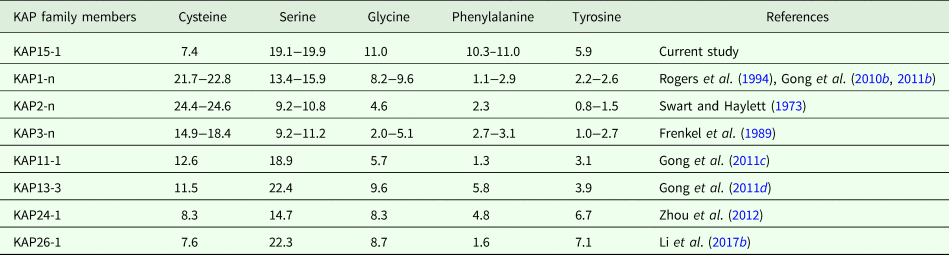
The ovine KRTAP15-1 sequences all contained a 411-bp open reading frame that would encode a protein of 136 amino acids. The putative protein would contain a low level of tyrosine, a moderate level of cysteine, glycine and phenylalanine, and a high level of serine (Table 1).
Comparison of ovine KAP15-1 amino acid content (mol%) with other ovine HS-KAP family members. All of the amino acid sequences are predicted from the gene sequences, except for the KAP2-n sequences which are protein sequences

The effect of variation in keratin-associated protein 15-1 gene on wool traits
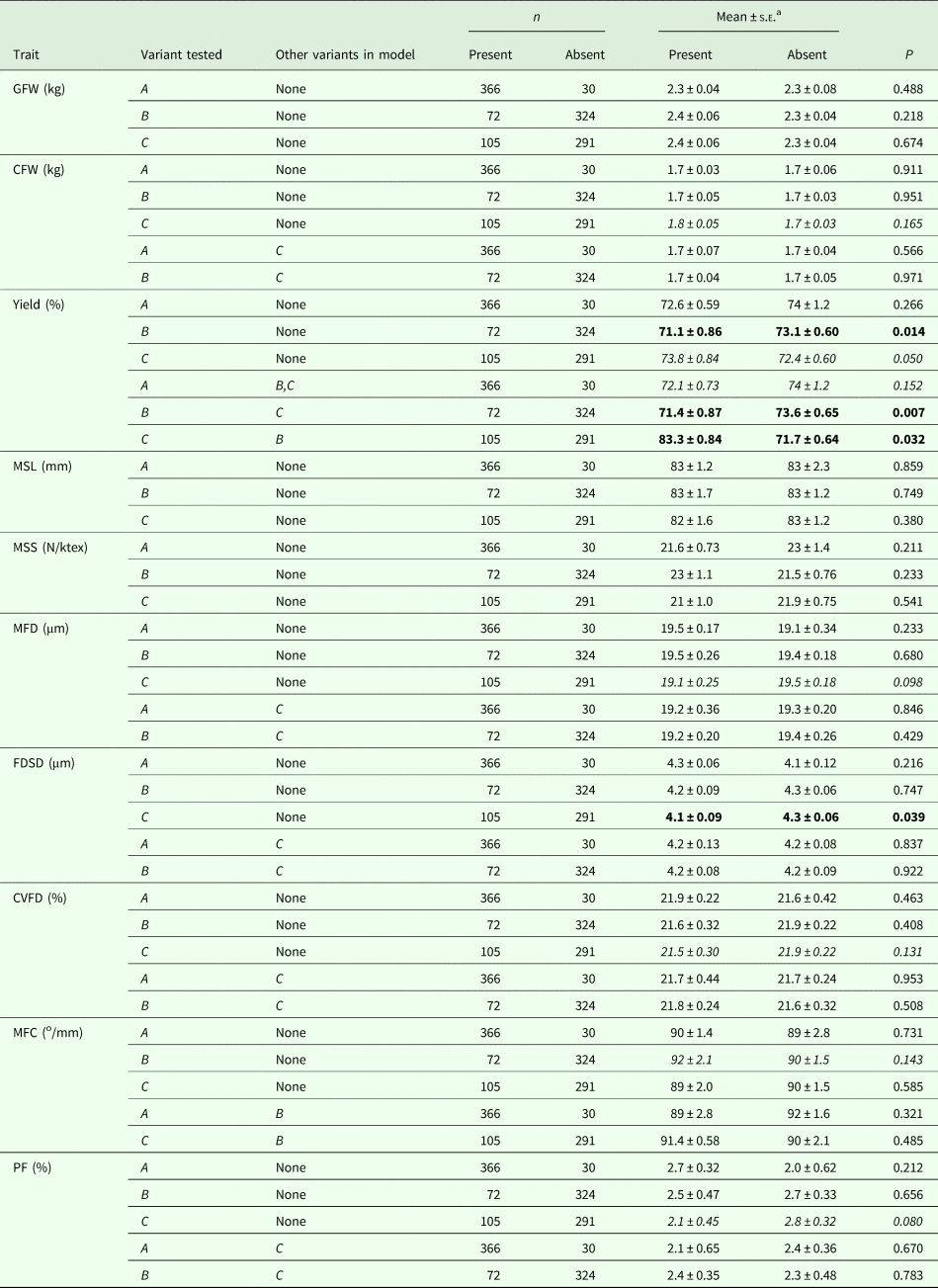
The presence of variant B was found to be associated with decreased wool yield in the single-variant GLMMs, and this association persisted when corrected for other variants in the multi-variant GLMMs (Table 2). Variant C had a tendency towards being associated with increased wool Yield in the single-variant GLMMs, and this became significant in the multi-variant model (Table 2). Variant C was also found to be associated with lower FDSD and it tended to be associated with a decrease in MFD and PF (Table 2).
Association of KRTAP15-1 variants with various wool traits
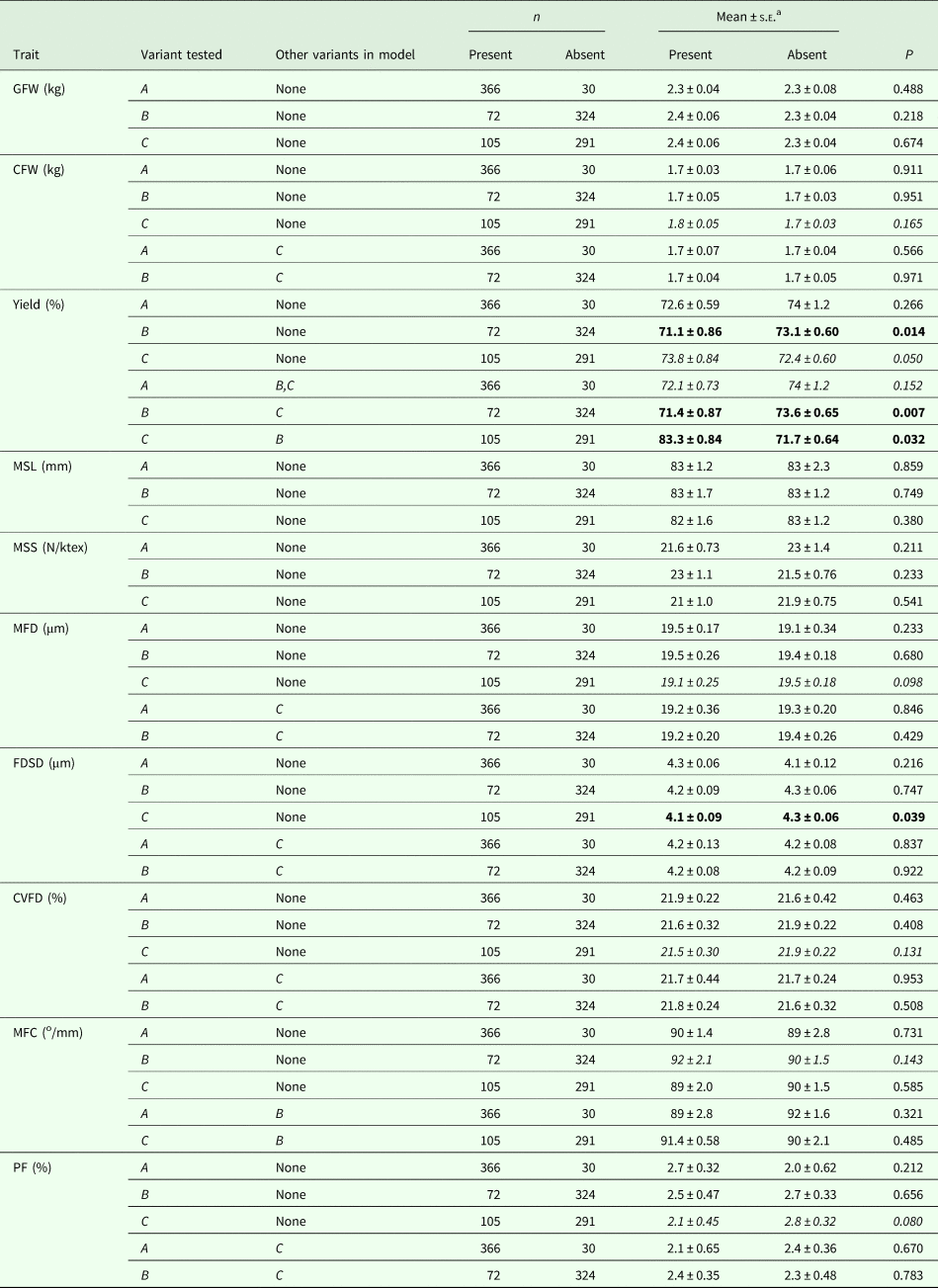
GFW, Greasy Fleece Weight; CFW, Clean Fleece Weight; MFD, Mean Fibre Diameter; FDSD, Fibre Diameter Standard Deviation; CVFD, Coefficient of Variation of Fibre Diameter; MSL, Mean Staple Length; MSS, Mean Staple Strength; MFC, Mean Fibre Curvature; PF, Prickle Factor (percentage of fibres over 30 µm).
a Predicted means and standard errors of those means derived from GLMs, with P < 0.05 being in bold and 0.05 ⩽ P < 0.20 being in italicized.
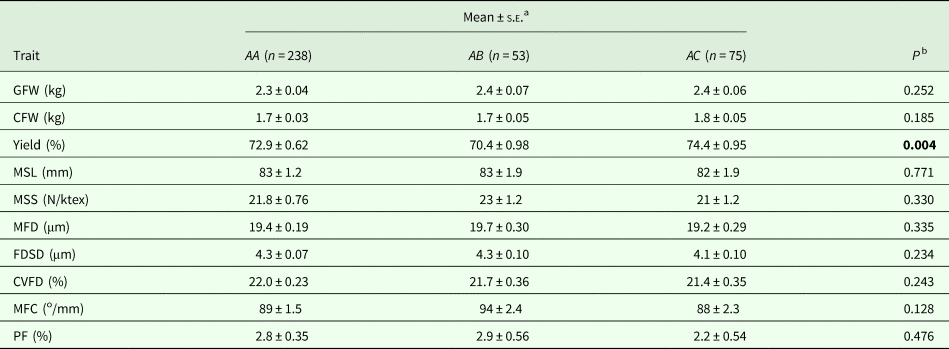
With the three genotypes (AA, AB and AC) that occurred at a frequency greater than or equal to 0.05 in these Merino × Southdown-cross sheep, an effect of genotype was detected for wool yield (Table 3). Sheep of genotype AC had a lower wool yield than those of genotype AA, or AB.
The effect of KRTAP15-1 genotype on various wool traits
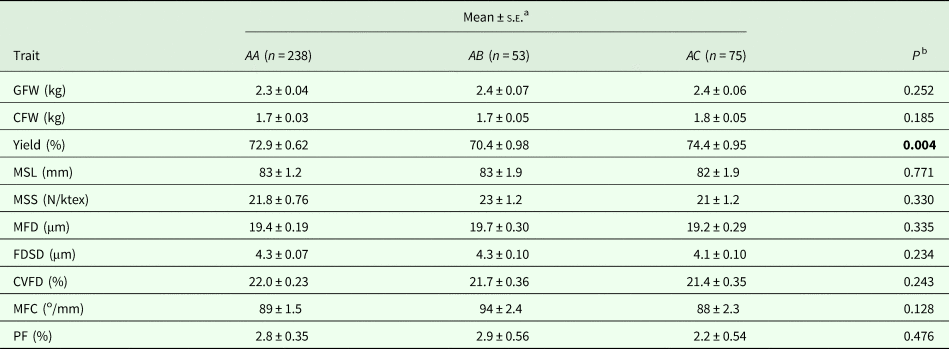
GFW, Greasy Fleece Weight; CFW, Clean Fleece Weight; MFD, Mean Fibre Diameter; FDSD, Fibre Diameter Standard Deviation; CVFD, Coefficient of Variation of Fibre Diameter; MSL, Mean Staple Length; MSS, Mean Staple Strength; MFC, Mean Fibre Curvature; PF, Prickle Factor (percentage of fibres over 30 µm).
a Estimated marginal means, standard errors of those means and P values derived from GLMs.
b P values <0.05 are in bold.
Discussion
Despite belonging to the HS-KAP group, ovine KAP15-1 would appear to exhibit some unusual features in respect of its amino acid composition. Firstly, the putative protein would have a lower content of cysteine than other HS-KAPs and a higher level of serine. This is not unprecedented, as having a lower level of cysteine and a higher content of serine has also been reported for KAP24-1 (Zhou et al., Reference Zhou, Gong, Yan, Luo and Hickford2012) and KAP26-1 (Li et al., Reference Li, Zhou, Gong, Zhao, Hu, Luo and Hickford2017b). The cysteines in KAPs are thought to form disulphide bridges to cross-link the KIFs and they are therefore thought to play an important role in stabilizing fibre structure. A reduction in the amount of cysteine might suggest a reduction in cross-linking and thus it might have a functional effect on fibre structure. The putative KAP15-1 also contains a high level of glycine. Glycine is the smallest amino acid with a side chain that is a single hydrogen atom. This enables glycine to provide much more conformational freedom to a polypeptide chain than any other amino acid and thus having higher levels of glycine may enable this HS-KAP to have increased ease in adopting different conformations in wool fibre, and with associated effects on fibre structure and characteristics. Lastly, it is notable that the putative ovine KAP15-1 is rich in phenylalanine. Having a high phenylalanine content has not been reported for other KAPs, with phenylalanine usually being absent, or present at low levels. Phenylalanine possesses an aromatic side chain and is able to form a stacking interaction with other residues that have aromatic side chains. The possession of high levels of phenylalanine may therefore facilitate different interactions between KAP15-1 and the KIFs, but confirmation of this and the above effects from variation in glycine and cysteine levels will require a lot more investigation.
The finding that variant B was associated with decreased wool yield and that C was associated with increased yield suggests a direct effect of KAP15-1 on this trait. However, given that yield is the ratio of CFW to GFW, then one might also therefore expect KRTAP15-1 variation to be associated with these weight traits. The fact that this was not found in the current study would suggest, at face-value, that the gene is then in some way directly affecting the quantity of non-fibre wool components, such as the amount of wool wax, suint, contaminating vegetable matter or dirt, these being the components that are usually removed as wool is scoured. However, it is hard to comprehend how this might arise. Instead, it seems more plausible that some intrinsic fibre property that has not been measured is affecting yield and doing so without affecting the wool weight traits. Two wool fibre characteristics may meet these criteria: first, variation in the ability of the fibre from sheep of differing genotype to absorb water; and second, variation in the shape of the fibre, including potentially the frequency of crimps and variation in ellipticity.
Wool is hygroscopic and the fibres gain or lose water as atmospheric conditions change. At 65% relative humidity, wool will hold 0.14-0.15 of its own weight in water: as humidity increases it will absorb > 0.30 of its weight before it begins to feel wet. This variation in moisture content affects fibre weight, so International Wool Testing Organization (IWTO) standards have been set to take account of this potential source of weight variation. In this respect, the wool yield measurements used in the current study meet the specification of the IWTO-33 testing standard. The ability of individual wool fibres to absorb water is not uniform, with a number of factors affecting this property.
Among the properties that may affect absorption is the ratio of paracortex to orthocortex in individual fibres. Horio and Kondo (Reference Horio and Kondo1953) first noted that the cortex of fine wool fibres had a bilateral structure, with about one-half of the cortex always absorbing a given type of dye more intensely than the other half. The more reactive side always lay on the convex side of the crimp wave. The side with greater reactivity is called the orthocortex and that with lower reactivity is called the paracortex. This asymmetry between the orthocortex and paracortex has been revealed as differences in morphological appearance (Kassenbeck and Leveau, Reference Kassenbeck and Leveau1957; Rogers, Reference Rogers1959) and in various chemical and physical properties. In these bilateral wool fibres, the sulphur content of the paracortex is appreciably higher than that of the orthocortex (Kassenbeck, Reference Kassenbeck1965) and there are more cysteine, proline and glutamic acids, but less glycine, phenylalanine and tyrosine in the paracortex than in the orthocortex (Parisot and Derminot, Reference Parisot and Derminot1971). The presence of a higher content of the cross-linking cysteine accounts for the lower degree of swelling in the paracortex when wet, its greater resistance to acid hydrolysis and its slower rate of cysteine reduction (Kulkarni et al., Reference Kulkarni, Robson and Robson1971).
Whether the variation found in KRTAP15-1 affects the ability of wool fibres to absorb water can only be speculated upon, as this trait was not measured in the current study.
Variation in the shape of the wool fibres might also affect the yield. While some individual wool fibres are close to cylindrical, or circular in cross-section, others are elliptical, or ribbon-like. Fibres that are more elliptical in cross-section will have an increased length per unit and surface area to volume ratio. This increased surface area, relative to volume, may therefore provide more surface area for wool wax, suint and vegetable matter to accumulate on, thereby affecting yield, possibly without MFD being majorly affected. Unfortunately, cross-sectional fibre shape cannot be assessed easily or cost-effectively for large numbers of fibres, as the best method for assessing the trait is electron microscopy.
In the context of fibre shape, while no association was found between KRTAP15-1 variation and variation in CVFD (although a trend was found with MFD and PF), the presence of variant C was associated with variation in FDSD. Variant C was therefore associated with lower FDSD but higher yield, suggesting that wool from sheep with C was possibly more cylindrical or circular in cross-section. As stated above, this hypothesis could possibly be tested using electron microscopy to assess wool fibre cross-sectional shape from sheep with and without C, but it may be impractical to do this on sufficient numbers of fibres to provide robust proof, especially if a precise measurement of surface area to volume ratios along the full length of multiple fibres is needed to confirm this possibility.
In the current study, variants B and C were relatively common (with frequencies of 0.118 and 0.272, respectively) in the NZ Romney sheep, but rarer (0.091 and 0.146) in the Merino × Southdown-cross sheep, where A was the common variant. While no absolute standard exists, Merino wool is typically of an MFD under 24.5 micron, while NZ Romney wool is called ‘coarse wool’ or ‘strong cross-bred wool’ and has a MFD of greater than 35.4 micron. Merino sheep tend to have higher follicle densities and secondary to primary follicle ratios, with follicles of even depth clustered in large groups (Hynd et al., Reference Hynd, Ponzoni, Grimson, Jaensch, Smith and Kenyon1996), while coarse wool breeds such as the Romney have lower follicle densities and lower secondary to primary ratios. Romney wool also tends to have a larger range of wool yield, with one study (Ross, Reference Ross1965) citing ranges from 61.6 to 87.8% reflecting seasonal variation, with production of grease and suint being higher in the winter than in the summer months. Merino sheep tend to have lower yields.
In this context, it may also then be hypothesized that the variation observed in KRTAP15-1 is affecting ratios of primary to secondary follicles and thus yield, as a consequence of having more or less secondary follicles. While if true, this does not appear to have a major effect on MFD in the current study, it could nevertheless affect FDSD, the effect being most pronounced with the presence/absence of C. Whether follicle types and ratios are affected could be determined by counting follicles of the two types in skin sections retrieved from sheep with and without KRTAP15-1 C. The current results would suggest this would not affect wool fleece weight traits.
Keratin-associated protein 15-1 gene is clustered with HGT-KAP genes and some HS-KAP genes on sheep chromosome 1, including KRTAP6-1, KRTAP6-3, KRTAP20-2, KRTAP22-1 and KRTAP26-1, for which effects on wool traits have been described. The effects described here for KRTAP15-1 are similar to those reported for KRTAP22-1 (Li et al., Reference Li, Zhou, Gong, Zhao, Wang, Liu, Luo and Hickford2017a), but different to those for KRTAP6-1, KRTAP6-3, KRTAP20-2 and KRTAP26-1, where the effect is observed with either fibre diameter-associated traits (Zhou et al., Reference Zhou, Gong, Li, Luo and Hickford2015; Li et al., Reference Li, Zhou, Gong, Zhao, Hu, Luo and Hickford2017b, Reference Li, Zhou, Gong, Zhao, Wang, Luo and Hickford2017c) or MFC (Bai et al., Reference Bai, Gong, Zhou, Tao and Hickford2018). Given that KRTAP15-1 is positioned closer to KRTAP26-1 and KRTAP6-3, than to KRTAP22-1, it is therefore suggested that the effect described here for KRTAP15-1 is not due to its proximity to KRTAP22-1 but is instead the result of its independent action or linkage to variation closely proximal to the gene in the upstream or downstream regions.
In conclusion, the current study used a PCR-SSCP approach to search for variation in KRTAP15-1. It revealed variation in the gene and this variation was associated with some important wool traits. The study should be repeated in more sheep of differing breed to ascertain how robust this result is.
Author ORCIDs
H. Zhou 0000-0001-7620-3160.
Financial support
This work was financially supported by the fund of College of Animal Science and Technology, Gansu Agricultural University (XMXTSXK-02).
Conflict of interest
None.
Ethical standards
This study was carried out in accordance with the Animal Welfare Act 1999 (NZ Government), and the collection of sheep blood drops by nicking sheep ears is covered by Section 7.5 Animal Identification, of the Animal Welfare (Sheep and Beef Cattle) Code of Welfare 2010; a code of welfare issued under the Animal Welfare Act 1999 (NZ Government).