One of the most remarkable aspects of human language is that it can be used innovatively to fulfill an extensive range of communication needs. Given the proper context and background, adults have no difficulty understanding utterances they have never heard before (Clark & Clark, Reference Clark and Clark1979). For example, English-speaking adults can respond appropriately to requests such as “Can you Facebook me?” or “Did you Google it?” even though the verbs to Facebook and to Google do not actually exist in the English dictionary. In many languages, deriving nouns from verbs and verbs from nouns is a common way to form new words. For instance, in French, nouns referring to objects (e.g., Donne moi la brosse [give me the brush]) can form verbs that refer to the actions associated with those objects (e.g., Brosse mes cheveux [brush my hair]). Similarly, verbs referring to actions (e.g., Je scie le bois [I saw the wood]) can form nouns that refer to the objects associated with those actions (e.g., Donne moi la scie [give me the saw]). Nouns that are derived from verbs are referred to as deverbal nouns, and the verbs from which they are derived are called the parent verbs. Similarly, verbs that are derived from nouns are referred to as denominal verbs, and the nouns from which they are derived are called the parent nouns.
There are several different processes in which denominal verbs and deverbal nouns can be formed, and these processes vary according to language. In Hebrew, new words can be formed by combining consonantal roots with fixed affixal patterns. For instance, the consonant pattern g-d-l means “grow,” and the affixal pattern CaCCan is the typical pattern used to form agent nouns (Berman, Reference Berman, Menn and Berstein-Ratner2000). In English and French, however, new denominal verbs and deverbal nouns are usually formed by affixation or conversion. With affixation, the new word is derived from the parent word by adding a suffix to the parent word (il aroseV → un arosoirN [he watersV → a watering canN]). With conversion, however, the new word is derived from the parent word without the addition of a suffix (un trouN → il troueV [a holeN → make a holeV]).Footnote 1 Thus, the derived word shares the same phonological form as its parent word.
Denominal verbs and deverbal nouns in French and English are similar in the sense that they are commonly formed using conversion. Children acquiring these languages can often rely only on syntactic cues to differentiate between the parent and the derived words. Unlike English, however, French noun–verb pairs have no contrastive lexical stress between them (e.g., reCORD vs. a REcord; Shi & Moisan, Reference Shi and Moisan2009). Thus, new words formed by conversion may be even more similar to their parent words in French compared to English. In addition, it has been reported that the creation of new nouns from verbs in French is as productive as the creation of new verbs from nouns (Guilbert, Reference Guilbert1975, p. 135), whereas in English the process of creating verbs from nouns is more productive than the process of creating nouns from verbs (Marchand, Reference Marchand1969). Thus, French-speaking children may hear a more balanced amount of deverbal nouns and denominal verbs than do English-speaking children.
Hebrew almost never relies on conversion to form new words, and thus Hebrew-speaking children can use both syntactic and morphological cues to determine the grammatical class of a new word. These language-specific differences in the manner in which new words can be formed may result in discrepancies in the age at which children can understand and produce these types of words. Children acquiring Hebrew may have an easier time understanding novel denominal verbs and deverbal nouns than do English- or French-acquiring children, because they can rely on morphological cues as well as syntactic cues to interpret these new words. In contrast, Hebrew-speaking children may encounter difficulties producing novel denominal verbs and deverbal nouns compared to their French or English counterparts, because they first need to acquire the appropriate derivational rules.
Correctly interpreting and producing novel deverbal nouns and denominal verbs requires knowledge of class extension rules, where a word belonging to one form class (e.g., noun) can be used as an instance of another form class (e.g., verb). Furthermore, it requires an understanding that these derived words have meanings related to their parent words. For example, the denominal verb to saw refers to the function of the object referred to by the parent noun a saw (Clark, Reference Clark, Wanner and Gleitman1982; see also Oshima-Takane, Barner, Elsabbagh, & Guerriero, Reference Oshima-Takane, Barner, Elsabbagh and Guerriero2001, for further discussion of related meanings of noun–verb pairs). The goal of the present study was to investigate the age at which French-speaking children acquire class extension rules.
Studies of children's spontaneous speech have reported that children as young as 2 years of age use nouns as denominal verbs and verbs as deverbal nouns, suggesting that children acquire class extension rules from an early age (Barner, Reference Barner2001; Bowerman, Reference Bowerman, Wanner and Gleitman1982; Clark, Reference Clark, Wanner and Gleitman1982, Reference Clark1993; Conwell & Morgan, Reference Conwell and Morgan2012; Oshima-Takane et al., Reference Oshima-Takane, Barner, Elsabbagh and Guerriero2001; Oshima-Takane, Miyata, & Naka, Reference Oshima-Takane, Miyata and Naka2000). Barner (Reference Barner2001) found that seven out of nine 1- to 2-year-old children (mean length of utterance = 1.00–1.99) used at least some words as both a noun and a verb. These words included both deverbal nouns (e.g., “a bite”) and denominal verbs (e.g., “to crayon”). Oshima-Takane et al. (Reference Oshima-Takane, Barner, Elsabbagh and Guerriero2001) reported that Sarah, one of the participants in Brown (Reference Brown1973), used the verb cut as an innovative deverbal noun to refer to a knife at 2 years, 3 months (2;3). Clark (Reference Clark, Wanner and Gleitman1982) also reported various examples of children's innovative use of nouns as denominal verbs, such as a child's use of the noun broom as a denominal verb (e.g., “Don't broom my mess”) to refer to sweeping at 2;11. Her data demonstrate that English-speaking children begin coining denominal verbs as early as 2;3, French-speaking children as early as 2;0, and German-speaking children as early as 1;11.
Clark (Reference Clark, Wanner and Gleitman1982) proposed that, much like adults, children coin novel words as a means of filling lexical gaps in their vocabularies (Clark & Clark, Reference Clark and Clark1979). However, owing to their limited vocabulary size, young children at early stages of language development have higher communicative pressure to coin novel words than do older children and adults, and thus do so more frequently. In support of this proposal, Clark found that illegitimate innovations (e.g., coining the verb to scale from the noun scale instead of using the existing verb to weigh; Clark, Reference Clark, Wanner and Gleitman1982, p. 402) decrease with age and are much less frequent in the speech of school-aged children. She also reported that children produce innovative denominal verbs more often than innovative deverbal nouns. Clark argued that this difference stems from children's need to coin more verbs than nouns, as a result of the fewer number of verbs in their vocabularies (Clark, Reference Clark, Farkas, Jacobsen and Todrys1978; Gentner, Reference Gentner1978).
Clark further argued that children coin novel denominal verbs by forming a simple class extension rule that “any noun denoting a concrete entity can be used as a verb for talking about a state, process, or activity associated with that entity” (Clark, Reference Clark, Wanner and Gleitman1982, p. 417). Similarly, based on their analysis of the flexible use of existing deverbal noun–verb pairs in the spontaneous speech of three English-speaking children and their caregivers, Oshima-Takane et al. (Reference Oshima-Takane, Barner, Elsabbagh and Guerriero2001) proposed that 2- to 3-year-old children first acquire simple class extension rules for words referring to artifact objects and their functions. These simple rules gradually become more sophisticated, like those of older children and adults, as children acquire more experience with denominal verbs and deverbal nouns. However, because the data from these studies are based on case studies of only a few children in each language group, it is difficult to conclude that all or even most 2- to 3-year-olds have acquired class extension rules.
Several researchers have attempted to use experimental procedures to elicit deverbal nouns and denominal verbs derived from familiar verbs and nouns in larger samples of young children (Berman, Reference Berman, Menn and Berstein-Ratner2000; Bushnell & Maratsos, Reference Bushnell and Maratsos1984; Clark & Berman, Reference Clark and Berman1984; Clark & Hecht, Reference Clark and Hecht1982; LoDuca, Reference LoDuca1990; Mulford, Reference Mulford1983; Seidler, Reference Seidler1988). Most of these studies investigate children's mastery of language-specific derivational rules involving suffixation or semitic root-and-pattern structures with consonantal roots combined with affixal patterns, as opposed to zero-marked converted forms. Clark and Hecht (Reference Clark and Hecht1982) asked English-speaking 3- to 6-year-olds to coin novel deverbal nouns from familiar verbs in their vocabularies. In order to elicit nouns referring to instruments, participants were asked questions such as “I've got a picture here of something that burns things. What could we call something that burns things? Something that burns things is a ____.” The results indicated that 3-year-olds coined novel deverbal nouns referring to instruments only about 42% of the time, whereas older children did so approximately 70% to 72% of the time (4-year-olds = 71%, 5-year-olds = 70%, 6-year-olds = 72%). However, one of the reasons why the 3-year-olds did not coin many novel deverbal nouns is that they often (28% of the time) answered the test questions using words already present in their vocabularies. For instance, they used words such as “knife” or “scissors” in response to “a thing that cuts” instead of coining the word “cutter.” Older children only did this about 3% to 10% of the time (4-year-olds = 8%, 5-year-olds = 10%, 6-year-olds = 3%). Thus, it remains unclear whether the 3-year-old children in this study showed low coinage rates because they had not acquired class extension rules or simply because they did not understand that the task required them to form new deverbal nouns from the given verbs. Clark (Reference Clark, Menn and Bernstein Ratner2000) reports similar results for children acquiring Icelandic (Mulford, Reference Mulford1983), French (Seidler, Reference Seidler1988), and Italian (LoDuca, Reference LoDuca1990).
Although no study has attempted to elicit denominal verbs in English-speaking children, elicitation studies with Hebrew-speaking children provide some evidence that they acquire class extension rules for deverbal nouns earlier than for denominal verbs. Berman and Clark (Berman, Reference Berman, Menn and Berstein-Ratner2000; Clark & Berman, Reference Clark and Berman1984) tested 3- to 9-year-old Hebrew-speaking children's acquisition of class extension rules using an elicitation task. To coin new denominal verbs, children had to combine a consonantal root pattern with one of the five verb-pattern binyan conjugations, whereas to coin new deverbal nouns, children had to choose between several dozen root plus affixal patterns, as well as suffixation (Berman, Reference Berman, Menn and Berstein-Ratner2000). Hebrew-speaking children were able to consistently coin novel deverbal nouns derived from familiar verbs from 3 years of age (3-year-olds = 83%, 4-year-olds = 88%, 5-year-olds = 87%, 7-year-olds = 89%, 9-year-olds = 86%). However, they did so at a very high error rate until about 9 years of age (3-year-olds = 19%, 4-year-olds = 32%, 5-year-olds = 18%, 7-year-olds = 17%, 9-year-olds = 4%). This suggests that Hebrew-speaking children may begin acquiring class extension rules for deverbal nouns around 3 years of age but may not master them until 9 years of age. In contrast, Hebrew-speaking children were able to coin novel denominal verbs derived from familiar nouns only 55% of the time when they were 3 years of age. However, by 4 years of age, they were able to do so consistently (4-year-olds = 87%, 5-year-olds = 89%, 7-year-olds = 98%, 11-year-olds = 96%) and with low error rates (4-year-olds = 9%, 5-year-olds = 1%, 7-year-olds = 3%, 11-year-olds = 2%). This suggests that Hebrew-speaking children acquire class extension rules for denominal verbs around 4 years of age. Thus, it seems that Hebrew-speaking children begin acquiring class extension rules for deverbal nouns earlier than for denominal verbs, but they make more errors doing so.
One of the problems with the production tasks used in these studies is that they not only require children to understand simple class extension rules that a noun can be used as a verb and vice versa but also require children to produce proper derivational morphemes. For instance, a Hebrew-speaking child asked to coin a novel verb from the noun madaf (shelf) must choose between five different nonpassive verb patterns, including three transitive verb patterns (modef, midef, and himdif) signifying “to shelve something,” and two nontransitive verb patterns (nimdaf and hitmadef) signifying “to be shelved” (Berman, Reference Berman, Menn and Berstein-Ratner2000). It is possible that language-specific differences in the class extension rules for deverbal nouns and denominal verbs may result in differences in children's ability to apply these rules in a production task. For instance, in Hebrew, verbs follow a restricted number of morphological patterns, although nouns can follow a much larger set of patterns (Berman, Reference Berman, Menn and Berstein-Ratner2000). Thus, Hebrew-speaking children may find it harder to accurately coin new deverbal nouns than new denominal verbs, because they need to learn and choose from a larger number of patterns. Differences in the reliability (Albright, Reference Albright2002), consistency, or frequency (Armon-Lotem & Chiat, Reference Armon-Lotem and Chiat2012) of the patterns may also affect children's ability to coin new denominal verbs and deverbal nouns.
Children may also interpret the goal of elicitation tasks differently for denominal verbs and deverbal nouns. For example, researchers using production tasks are often unable to elicit novel denominal verbs, because children are likely to rely on the generic verb “do” rather than coin a novel verb (Clark, Reference Clark, Menn and Bernstein Ratner2000). Therefore, the results of the production tasks may not accurately reflect the age at which children acquire simple class extension rules.
Comprehension tasks may avoid some of the issues described above, because the ability to interpret novel derived words does not require children to select which language-specific derivational morpheme they must use. Thus, comprehension tasks may provide a more sensitive measure of young children's ability to interpret these forms and allow us to determine the age at which children acquire simple class extension rules. Clark and Hecht's (1982) and Clark and Berman's (1984) studies each included a comprehension task, where children were asked to identify the root verbs that novel deverbal nouns were derived from (e.g., “I've got a picture of a thing called a stopper. What is a stopper used for?”). The results with English-speaking children (Clark & Hecht, Reference Clark and Hecht1982) demonstrated that they were able to identify the root verb 79% of the time at 3 years of age. By 4 years of age, they were able to do so 81% of the time, and by 5 and 6 years of age, they reached ceiling levels (5-year-olds = 97% and 6-year-olds = 96%). In contrast, Hebrew-speaking children demonstrated that they were able to succeed at the task much later in development (Clark & Berman, Reference Clark and Berman1984). Even by 7 years of age, they were only able to successfully identify the root verb 76% of the time.
Although Clark and Hecht's (1982) and Clark and Berman's (1984) comprehension tasks were simpler than their production tasks, they still required children to produce a verbal response to the questions. Using an acting-out procedure instead of an elicitation procedure, Bushnell and Maratsos (Reference Bushnell and Maratsos1984) investigated the acquisition of class extension rules for denominal verbs in children under 3 years of age. They asked 2-, 5-, and 7-year-old English-speaking children to act out one of two possible variations of a set of reversible sentences containing nouns used as denominal verbs (e.g., “Can you broom the spoon?” or “Can you spoon the broom?”). They found that the 5- and 7-year-old children were able to correctly act out the test sentences the majority of the time (75% and 82%, respectively), but the 2-year-old children only did so about 50% of the time. Further analyses revealed that although the 5- and the 7-year-old children relied on the word order of the sentences as a basis for their actions, the 2-year-old children acted out the correct and reverse word orders at random. Bushnell and Maratsos (Reference Bushnell and Maratsos1984) argue that the 2-year-olds were unable to use the syntax in the sentences to determine their meanings. Rather, they used immature strategies for understanding the sentences by simply piecing together the most probable interpretation from the meanings of the individual words present in the sentences. They claim that the use of nouns as denominal verbs and vice versa reported in the spontaneous speech of young 2- and 3-year-old children may also stem from related immature sentence production strategies and may thus be examples of erroneous word usage as opposed to genuine class extensions (Bushnell & Maratsos, Reference Bushnell and Maratsos1984). Other studies have shown similar syntactic difficulties in ordering nouns relative to verbs with pictures (e.g., garçon pousser fille [boy push girl]) with French-speaking children at 3 and 4 years of age (Sutton, Trudeau, Morford, Rios, & Poirier, Reference Sutton, Trudeau, Morford, Rios and Poirier2009; Trudeau, Morford, & Sutton, Reference Trudeau, Morford and Sutton2010).
However, the 2-year-old children's difficulty in Bushnell and Maratsos's (1984) comprehension task could have stemmed from the use of familiar nouns as the parent nouns for the novel denominal verbs, because the meanings of some denominal verbs in the task were derived from their parent nouns in nonobvious or nonstandard ways. For example, the denominal verb “to circle” was used to refer to placing a paper ring around an object, as opposed to its more standard meaning of drawing a circle around something. In addition, some of the novel usages that were presented in the reversible sentences were preempted by other words. Some of the children remarked that the experimental sentences (e.g., “basket a truck”) were “unusual” and simply rephrased the experimental sentences in a way that made sense to them (e.g., “put a basket in a truck”). Therefore, it is possible that the 2-year-olds in Bushnell and Maratsos's (1984) study had difficulty with the comprehension task because they did not understand the purpose of the task or because the meanings of the new derived words were not transparent.
The elicitation and acting-out procedures used in past experimental studies may have been too cognitively demanding for young children. Two- to 3-year-old children in these studies may have acquired simple class extension rules, but they were unable to demonstrate this knowledge owing to the high demands of the tasks. Before making any conclusions about 2- to 3-year-olds’ knowledge of class extension rules, a study using a less demanding comprehension task is needed.
In addition, past experimental studies focused on English- and Hebrew-speaking children's acquisition of class extension rules, especially those used to form new words using derivational rules such as suffixation or root and affixal pattern combinations. However, a language such as French may be better suited for studying children's early class extension rules, because, as mentioned above, new words formed by conversion in French are more similar to their parent words compared to English, because there is no difference in the stress pattern between them (Shi & Moisan, Reference Shi and Moisan2009). By using a language such as French, where the processes of creating verbs from nouns and nouns from verbs are similarly productive (Guilbert, Reference Guilbert1975, p. 135), we were also able to minimize differences in the frequency of denominal verbs and deverbal nouns in children's daily input. In this way, we could ensure that any differences between children's ability to succeed in our denominal verb and deverbal noun tasks could not merely be explained by the frequency of opportunities during which children could have heard each type of word in their daily input.
The purpose of the present study was to investigate whether 2.5- to 3-year-old children have acquired class extension rules. If Bushnell and Maratsos's (1984) claim that young children's class extensions are a result of immature sentence production strategies is correct, then 2.5- and 3-year-old French-speaking children should have difficulty understanding novel denominal verbs and deverbal nouns when they are only taught the novel parent nouns and parent verbs. However, if they have acquired class extension rules, then they should be able to understand novel denominal verbs and deverbal nouns. We investigated this question by examining 2.5- and 3-year-old French-speaking children's ability to comprehend novel deverbal nouns and denominal verbs referring to instrument objects and their functions. We used instrument nouns and verbs because Clark (Reference Clark, Wanner and Gleitman1982) found that denominal verbs referring to instruments made up the largest category of innovative denominal verbs in young French-, English-, and German-speaking children's spontaneous speech.
We also investigated whether children acquire class extension rules at different times for deverbal nouns and denominal verbs, because previous studies have produced mixed findings with regard to the age of the acquisition of the class extension rules for these lexical items (e.g., Berman, Reference Berman, Menn and Berstein-Ratner2000; Clark, Reference Clark, Wanner and Gleitman1982; Clark & Berman, Reference Clark and Berman1984). In order to reduce possible confounding factors associated with the tasks used in previous studies, we controlled for consistency of the derived forms and children's prior knowledge of the parent words. We used noun–verb pairs formed by conversion in order to ensure that the noun and verb forms of the words would be consistent across two types of extension: noun to verb and verb to noun. We used novel parent nouns and verbs instead of familiar ones in order to avoid several difficulties associated with tasks using familiar parent words. First, there may be individual differences in children's knowledge of familiar parent words, leading to individual differences in their ability to readily interpret verbs and nouns derived from these parent words. This is particularly important when we examine whether children acquire the class extension rules for denominal verbs and for deverbal nouns at different times, because children's performance in the comprehension task may be influenced by differences in their familiarity with the parent nouns and verbs. Second, in order to directly compare the age of acquisition of class extension rules for denominal verbs and deverbal nouns, it is preferable to use the same words referring to the same instruments and their actions. This is not possible with familiar words, because at least one form of the word (i.e., noun or verb) already exists or is more frequent than the other. Third, using familiar words in an unconventional and novel manner may be confusing for young children, leading them to have difficulty with the task. The use of novel words instead of familiar words is a well-established procedure for word learning studies and has been used extensively by other researchers (Berko, Reference Berko1958; Brown, Reference Brown1957; Tomasello, Strosberg, & Akhtar, Reference Tomasello, Strosberg and Akhtar1996).
Two experiments are reported. Experiment 1 investigated whether 2.5- and 3-year-old French-speaking children have acquired class extension rules for denominal verbs, and Experiment 2 investigated whether they have acquired class extension rules for deverbal nouns. Although the direction of specific conversions is often debated among researchers studying word formation (Jacquey & Namer, Reference Jacquey, Namer, Pustejovsky, Bouillon, Isahara, Kanzaki and Lee2013), for the purpose of the present study we defined the parent word as the one children are first introduced to, and the derived word as the one children hear after the parent word.
We used the intermodal preferential looking paradigm (IPLP; Hirsh-Pasek & Golinkoff, Reference Hirsh-Pasek, Golinkoff, McDaniel, McKee and Grains1996) because this paradigm is ideal for studying comprehension in younger children; it relies on their eye gaze behavior in response to test questions and does not require them to respond explicitly by acting out sentences or by pointing to or touching the target objects. This paradigm has been used extensively to study noun and verb learning in young children up to 3.5 years of age (e.g., Roseberry, Hirsh-Pasek, Parish-Morris, & Golinkoff, Reference Roseberry, Hirsh-Pasek, Parish-Morris and Golinkoff2009). In addition, studies have demonstrated that by 2 years of age, children can learn novel nouns and verbs after hearing only a small amount of examples (i.e., two) using this paradigm (e.g., Arunachalam & Waxman, Reference Arunachalam and Waxman2011; Golinkoff, Hirsh-Pasek, Bailey, & Wenger, Reference Golinkoff, Hirsh-Pasek, Bailey and Wenger1992; Waxman, Lidz, Braun, & Lavin, Reference Waxman, Lidz, Braun and Lavin2009). By using this paradigm, we ensured that our results would reflect young children's ability to comprehend the deverbal nouns and denominal verbs more accurately than those reported in previous studies.
EXPERIMENT 1
In this experiment we first taught children novel parent nouns referring to unfamiliar instruments. We then tested the children on their interpretation of these parent nouns as well as their denominal verbs. We reasoned that if children have already acquired class extension rules for denominal verbs, then they should be able to derive the meaning of the denominal verbs from the parent nouns. That is, they should understand that the denominal verbs can be used to refer to the functions of the objects referred to by the parent nouns. If they have not acquired these rules, then they should not be able to comprehend the denominal verbs even if they are able to learn the parent nouns.
Method
Participants
A total of 16 2.5-year-old (mean age = 2;8.56, range = 2;6–2;11) and 16 3-year-old children participated in this study (mean age = 3;3.31, range = 3;0–3;5). The children were all French monolinguals, living in Montreal, Quebec. The final sample consisted of an equal number of girls and boys in each age group. The children had on average 96% (range = 70%–100%) of their weekly language input in French according to parental reportsFootnote 2 and came from middle- and upper-middle-class families. Nine additional 2.5-year-olds and 6 additional 3-year-olds were tested but excluded from the final sample for one of the following reasons: (a) inattentiveness during one of four test trials (<35%, or 4.2 s of the two 6-s test videos), (b) looking away during the entirety of one of the four control videos, (c) inattentiveness during at least one of the attention-getting videos of a puppet saying “regarde” (look; <10% of the 3-s video), which were presented between each of the four control and test videos, or (d) failure to complete the task.Footnote 3 Participants were recruited from a database containing the names of parents who had agreed to participate in developmental studies with their children.
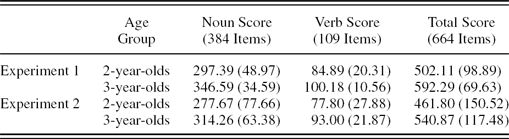
We assessed the children's vocabulary development using the Quebec French version of the MacArthur Inventory, titled Inventaire MacArthur du Développement de la Communication: Mot et Énoncés (Fenson et al., Reference Fenson, Dale, Reznick, Bates, Thal and Pethick1994; Frank, Poulin-Dubois, & Trudeau, Reference Frank, Poulin-Dubois and Trudeau1997), which measures productive vocabulary. The inventory consists of 22 different categories of words. Based on the total number of words produced for each category, we calculated a noun score, a verb score, and a total vocabulary score for each child. The noun score was the total number of words that fell in the 12 categories containing nouns (animals, vehicles, toys, food and drink, clothes, body parts, small household items, furniture and rooms, outdoor items, places, people, and games and routines). The verb score was the total number of words in one category: action words. The total vocabulary score was the total number of words in all 22 categories. The mean noun, verb, and total vocabulary scores (see Table 1) of the 3-year-olds were significantly higher than those of the 2.5-year-olds, total nouns: t (30) = –3.413, p = .001Footnote 4; total verbs: t (30) = –3.068, p = .003; total vocabulary: t (30) = –3.250, p = .002, one tailed.Footnote 5 This indicates that the 3-year-olds had a larger vocabulary size overall, as well as a larger number of verbs and nouns compared to the 2.5-year-olds.
The mean (standard deviations) of noun, verb, and total vocabulary scores by age group in Experiments 1 and 2

Materials
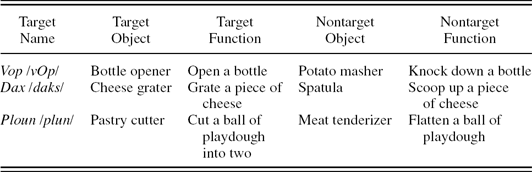
The objects used in the present experiment were selected based on the results of a preliminary survey of parents with 2.5- and 3-year-old children. These objects included three sets of kitchen utensils (bottle openers, cheese graters, and pastry cutters) that would most likely be unfamiliar to 2.5- and 3-year-olds. The set of bottle openers was used as a practice set, whereas the sets of cheese graters and pastry cutters were used as test sets. Each object set consisted of five target objects and three nontarget objects (see Figure 1). The target objects included different exemplars of the same utensil (e.g., five bottle openers). They were chosen to be distinct from each other in terms of color, size, and shape. The target function for each set was the intended function of the target objects. The nontarget objects were chosen so that they would be distinct from the target objects, while retaining a certain degree of similarity in appearance. The nontarget function was an action that could be performed by all three nontarget objects and was chosen to be distinct from the target function (see Table 2).
Pictures of the target and nontarget objects in the vop (practice), dax, and ploun object sets in Experiments 1 and 2.
Object sets and their respective target and nontarget functions used in movie
The linguistic stimuli were recorded by a native female Quebecois-French speaker using child-directed speech. The target objects were labeled with novel nouns plausible in French (vop /vop/, dax /daks/, and ploun /plun/). The objects’ functions were referred to by the generic verb faire (do/make). For example, children heard “look at what the vop can do.”Footnote 6 In French, new denominal verbs are added to the first conjugation pattern (i.e., –er), which is the most frequent and also the default regular verb pattern (Royle, Beritognolo, & Bergeron, Reference Royle, Beritognolo, Bergeron, van der Auwera, Stolz, Urdze and Otsuka2012). Therefore, we used denominal verbs that followed the first conjugation pattern in the denominal verb test (e.g., voper). Because we used these new verbs in the third-person singular of the present tense, they had the same phonological form as the nouns (e.g., c'est un vop, /vop/ [this is a vop] and trouve celui qui voppe /vop/ [look at the one who vops]). In French, the present tense usually has aspectual meaning equivalent to the present progressive in English.
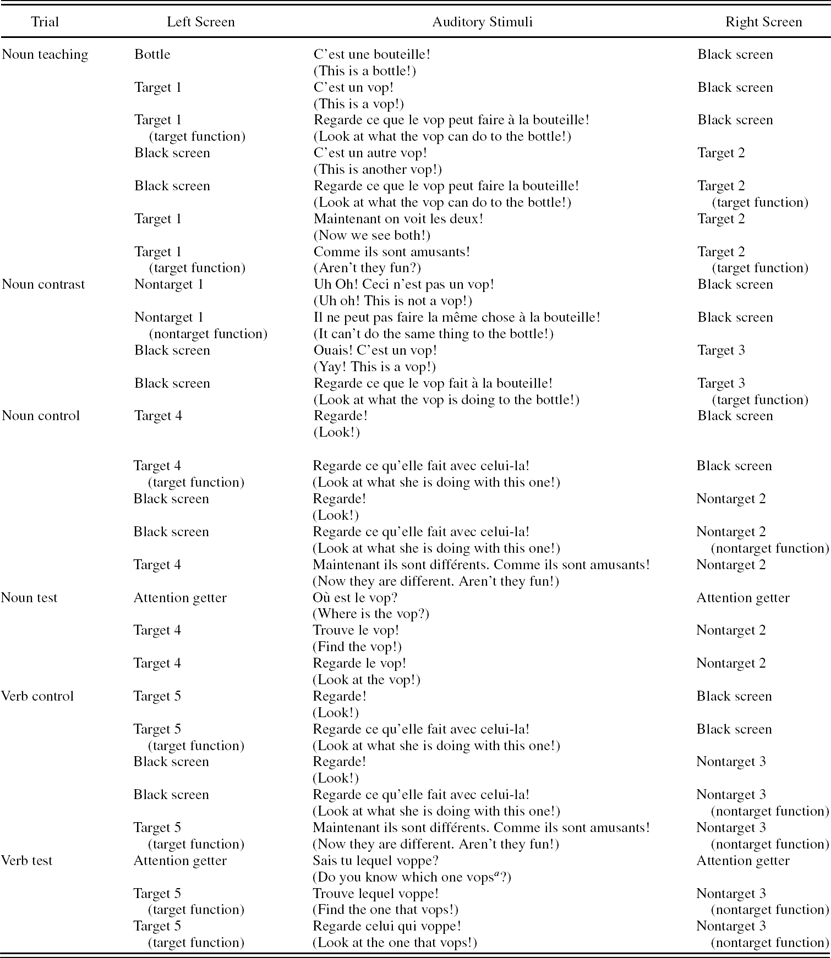
We created still videos of the objects alone, as well as animated videos of the experimenter manipulating the objects. Only the objects and the experimenter's hands were visible. The videos and linguistic stimuli for each of the three object sets were presented to children in the form of a QuickTime movie. The movie was created using the Apple iMovie Software and the Splitscreen Preferential Looking Paradigm for QuickTime Pro (Hollich, Reference Hollich2003). The practice object set was always presented first, whereas the order of the two test object sets was counterbalanced across participants. Three-second animated videos of animal puppets in a circle at the center of the screen were presented as attention-getters between the experimental videos, as a means of directing the children's eye gaze onto the center of the screen (see Appendix A for a sample of what the children saw and heard during the movie).
The entire length of the movie was about 8 min and 12 s. For each of the three object sets, the movie consisted of three phases: (a) a noun familiarization phase (consisting of a noun teaching and noun contrast trial), (b) a noun assessment phase (consisting of a noun control and noun test trial), and (c) a verb assessment phase (consisting of a verb control and verb test trial). In the noun teaching trial of the noun familiarization phase, the children were first taught a novel noun referring to two novel target objects (Targets 1 and 2 in Figure 1) performing a target function (see Table 2 for the target and nontarget functions). In the following noun contrast trial, the children were taught that the novel noun could not be extended to objects performing functions other than the target function. In this trial, the children were first shown a novel nontarget object (Nontarget 1) performing the nontarget function and told that the object could not be labeled by the novel noun (i.e., “This is not a vop! It can't do the same thing to the bottle!”). They were then shown a novel target object (Target 3) performing the target function and told that this object could be labeled by the novel noun (i.e., “This is a vop! Look at what the vop can do to the bottle!”).
Following the noun familiarization phase, the children were tested on their knowledge of the novel nouns in the noun assessment phase. This began with a noun control trial, which introduced the children to the test objects and their functions. In this trial, the children were first presented with two novel test objects performing their respective functions one by one (Target 4 performing the target function and then Nontarget 2 performing the nontarget function) coupled with neutral linguistic stimuli (i.e., “Look at what she is doing with this one!”). This was followed by a 6-s noun control video during which still frames of the two test objects were presented side by side. The children's gaze behavior during this control video was later used in the analysis as a measure of their visual or side preference. In between the noun control and the noun test trials, the children's eye gaze was redirected to the center of the screen by a 3-s attention-getter video in which an animal puppet asked them to identify the object labeled with the novel noun (i.e., “Where is the vop?”). Finally, in the noun test trial, the children were shown two 6-s noun test videos that were visually identical to the noun control video. In each test video, they were asked to identify the object that could be labeled with the novel noun (noun test questions 1 and 2). In the noun test question 1, the children were asked to “find the vop.” In the noun test question 2, they were asked to “look at the vop.”Footnote 7 The second question enabled us to examine whether the children would show better performance when they had more time to respond, as has been previously demonstrated in a noun-learning study using a similar design (Lippeveld & Oshima-Takane, Reference Lippeveld and Oshima-Takane2008). In order to eliminate the possibility that the children would look at the target screen because they interpreted the novel words as referring to the target functions and not the target objects, still frames were used in both the control and the test videos of the noun test trial.
Directly following the noun assessment phase, children were tested on their knowledge of the denominal verb in the verb assessment phase. This began with a verb control trial, in which the children were introduced to the novel test objects. They were first shown two novel objects and their functions (Target 5 performing the target function and Nontarget 3 performing the nontarget function) along with neutral linguistic stimuli (i.e., “Look at what she is doing with this one!”). They were then shown a 6-s verb control video during which they were presented with videos of both objects performing their respective functions side by side, while they heard neutral linguistic stimuli words (i.e., “Now they are different! Aren't they fun?”). In between the verb control and the verb test trials, the children's eye gaze was redirected to the center of the screen with a 3-s attention-getter video in which an animal puppet asked them to identify the object performing the action that could be labeled with the denominal verb form of the parent noun (i.e., “Where is the one that vops?”). Finally, in the verb test trial, children were shown two 6-s verb test videos that were visually identical to the control video. In each video, they were asked to identify the object performing the action that could be labeled with the denominal verb form of the novel noun (verb test questions 1 and 2). In the verb test question 1 video, they were asked to “find the one that vops.” In the verb test question 2 video, they were asked to “look at the one that vops.” The position of the target objects (left and right screen) during the noun and the verb assessment phases were counterbalanced across children.
Design
We used the IPLP to determine children's interpretation of the novel words (Hirsh-Pasek & Golinkoff, Reference Hirsh-Pasek, Golinkoff, McDaniel, McKee and Grains1996). This paradigm has been used extensively to study noun and verb learning in young children up to 3.5 years of age (Golinkoff et al., Reference Golinkoff, Chung, Hirsh-Pasek, Liu, Bertenthal and Brand2002; Roseberry et al., Reference Roseberry, Hirsh-Pasek, Parish-Morris and Golinkoff2009). Previous studies using this paradigm have shown that when presented with two visual scenes side by side, young children tend to look longer at the scene that is consistent with an audiotaped utterance (Hirsh-Pasek & Golinkoff, Reference Hirsh-Pasek, Golinkoff, McDaniel, McKee and Grains1996). If the children do not understand the utterance, they tend to look randomly at both scenes.
Procedure
On the day of the appointment, caregivers were first asked to read and sign a consent form, while the experimenter played with the children. The children were then asked to sit on their parent's lap in a beach chair, which was placed 112 cm away from a 60 × 45 cm screen. The lights in the room were dimmed so that only the screen was salient. Parents were asked to avoid talking, pointing, and/or giving any form of approval or disapproval in response to their child's behavior during the presentation of the movie. The movie was then played, and the children's eye gaze was video-recorded while they watched the movie. At the end of the movie, the parents filled out a demographic questionnaire, and the children received a small gift bag to thank them for their participation.
Data analysis
The direction of the children's eye gaze (i.e., left, right, center, or away) during the two assessment phases was coded frame-by-frame (30 frames/s) using SuperCoder software (Hollich, Reference Hollich2003) by a coder who was blind to the child's condition. For each child, proportion scores for each control and test video were calculated by dividing the number of frames during which the child was looking at the matching screen (the one containing the target object/action) by the number of frames during which the child was looking at either the matching or the nonmatching screen (the one containing the nontarget object/action). These proportion scores were calculated based on the children's gaze behavior during the entire 180 frames (6 s at 30 frames/s) of each video. Two 2.5-year olds in the second test object set looked away during the entirety of one of the two test videos of a test trial. For these children, the average score for their age group was used as their score for that test video as in previous studies with an IPLP (e.g., Naigles, Bavin, & Smith, Reference Naigles, Bavin and Smith2005).
The reliability was calculated for six participants (three 3-year-olds and three 2.5-year-olds) chosen randomly from the final sample. A second coder who was blind to the child's condition independently coded the gaze behavior of the participants during the control and test videos of the two test object sets. The average agreement rate between coders was 95.20% (median = 98.33%, range = 77.22%–100%). Because reliability between the two coders was high, we used the original coder's data for the purposes of the analysis.
Predictions
To be able to comprehend the denominal verbs, the children first needed to understand the meaning of the novel parent nouns. We examined this knowledge in the noun test trials, after the children were taught the nouns in the familiarization phase. We expected the children to demonstrate their knowledge of the parent nouns by looking longer at the target objects than at the nontarget objects during the noun test trials. If 2.5- and 3-year-old children have acquired class extension rules for denominal verbs, then they should be able to derive the meaning of the denominal verbs from the parent nouns. They will demonstrate their understanding of the denominal verbs by looking longer at the target action during the verb test trials. However, if they have not yet acquired class extension rules, they will not understand that the same word can be used as a noun to refer to an object and a verb to refer to an action. Thus, they should be confused to hear the novel word as a verb (i.e., find the one that vops) and will demonstrate this confusion by looking equally at both test actions.
Results and discussion
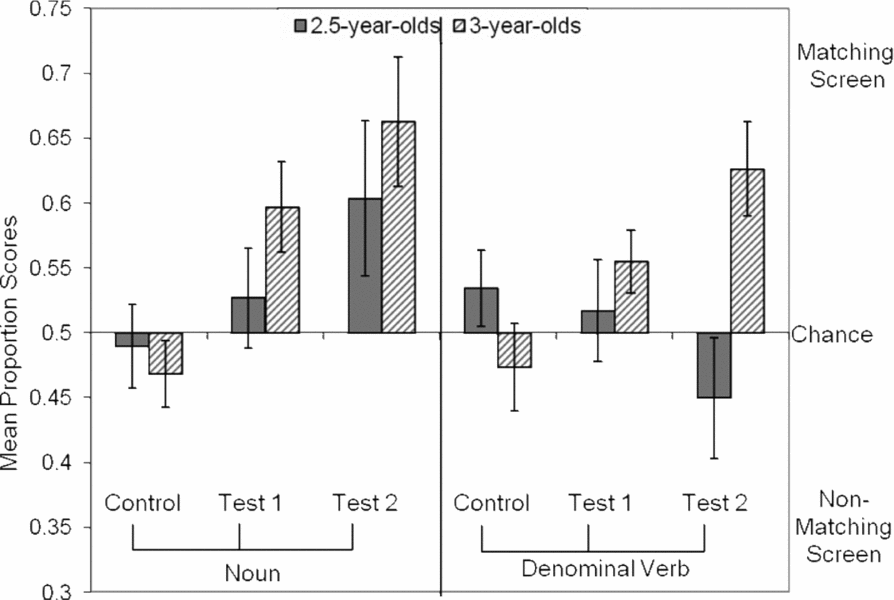
Figure 2 shows the mean proportion scores and the standard errors for the control and test videos of the two test object sets combined (dax and ploun).
Mean proportion scores for the control and test videos of the two combined test object sets by age group in the Experiment 1 video. Proportion scores above .5 indicate a preference for the matching screen, whereas proportion scores below .5 indicate a preference for the nonmatching screen. A score close to .5 indicates no preference toward any of the screens. Error bars represent standard errors.
Noun results
The mean proportion scores of the 2.5-year-olds in the control, test question 1, and test question 2 videos were .49, .53, and .60, respectively. The proportion scores of the 3-year-olds in the control, test question 1, and test question 2 videos were .47, .60, and .66, respectively. We performed a two-way mixed analysis of variance (ANOVA) with age (2.5-year-olds vs. 3-year-olds) as a between-subject factor and trial (control, test question 1, and test question 2) as a within-subject factor. The result yielded only a significant main effect of trial, F (2, 60) = 10.624, p < .001, indicating that there was no difference between the 2.5- and the 3-year-olds’ ability to learn the parent nouns. Post hoc tests indicated that children looked significantly longer at the target screen in response to the noun test question 1 and 2 videos when compared to the control ones, t (31) = –2.780, p = .005; t (31) = –4.396, p < .001; one tailed, respectively. Children also looked significantly longer at the target screen in response to the noun test question 2 video when compared to the test question 1 video, t (31) = –2.011, p = .027, one tailed.
Single sample t tests were also performed on the children's proportion scores to determine whether they differed significantly from chance (.5) in the control and test question videos of the noun test trials. The results indicated that for the 2.5-year olds, the mean proportion scores were higher than chance in the noun test question 2 video, t (15) = 1.728, p = .052, one tailed, and this difference was marginally significant. For the 3-year-olds, the mean proportion scores were significantly higher than chance in the noun test question 1 and 2 videos, t (15) = 2.777, p = .007; t (15) = 3.251, p = .003; one tailed, respectively. These results provide evidence that both the 3-year-olds and the 2.5-year-olds were able to interpret the novel parent nouns correctly, although evidence for the 2.5-year-olds was not as strong as for the 3-year-olds.
Denominal verb results
The mean proportion scores of the 2.5-year-olds in the control, test question 1, and test question 2 videos were .53, .52, and .45, respectively. The proportion scores of the 3-year-olds in the control, test question 1, and test question 2 videos were .47, .55, and .63, respectively. A two-way mixed ANOVA with age (2.5-year-olds vs. 3-year-olds) as a between-subject factor and trial (control, test question 1, and test question 2) as a within-subject factor yielded a significant interaction between trial and age group, F (2, 60) = 6.121, p = .004, but no significant main effects. Post hoc tests revealed that the proportion scores of the 2.5-year-olds in the two test question videos did not differ significantly from their proportion scores in the control video, whereas the 3-year-olds looked significantly longer at the target screen in response to the verb test question 1 and 2 videos when compared to the control one, t (15) = –2.545, p = .011; t (15) = –3.452, p = .002; one tailed, respectively. Furthermore, they looked significantly longer at the target screen in the test question 2 video compared to the test question 1 video, t (15) = –1.812, p = .045, one tailed. Single sample t tests also indicated that the mean proportion scores for the 3-year-olds were significantly higher than chance in the verb test question 1 and 2 videos, t (15) = 2.246 p = .020; t (15) = 3.456, p = .002; one tailed, respectively. The mean proportion scores of the 2.5-year-olds were not significantly higher than chance in either the verb question 1 or 2 video (ps > .1). These results indicate that only the 3-year-olds were able to comprehend the denominal verbs.
However, it is possible that the 2.5-year-old children did not understand the denominal verbs because they did not have a good understanding of the parent nouns; their performance in the parent noun test was weaker than the 3-year-olds’ (i.e., only marginally significant). To investigate this possibility, we classified the 2.5-year-olds into two groups: the successful noun learners, who looked longer at the target screen during either the noun test question 1 or 2 video when compared to the control one (12 out of 16 children, or 75%), and the unsuccessful noun learners, who did not do so (4 out of 16, or 25%). The mean proportion scores of the successful noun learners in the control, test question 1, and test question 2 videos of the noun test trial were .46, .55, and .65, respectively, whereas those of the unsuccessful noun were .57, .44, and .46, respectively. As expected, the successful noun learners looked longer at the target screen in the noun test questions 1 and 2 videos when compared to the control one, t (11) = –2.194, p = .025; t (11) = –3.119, p = .005; one tailed; respectively. Furthermore, they looked significantly longer than chance at the target screen in the noun test question 2 video, t (11) = 2.067, p = .032, one tailed. In contrast, unsuccessful noun learners did not look significantly longer at the target screen in the noun test question 1 or 2 video when compared to the control one (ps > .1).
The mean proportion scores of the successful noun learners in the control, test question 1, and test question 2 videos of the denominal verb test trial were .53, .52, and .45, respectively, whereas those of the unsuccessful noun learners were .55, .50, and .45, respectively. Neither the successful noun learners nor the unsuccessful noun learners looked significantly longer at the target screen in the test question 1 and 2 videos of the denominal verb test when compared to the control one (ps > .10). This indicates that even the 2.5-year-olds who successfully learned the parent nouns were not able to correctly interpret the denominal verbs.
The results from Experiment 1 showed that the 3-year-olds, and most of the 2.5-year-olds, were able to extend the newly learned parent nouns to new instances of the same kind, suggesting that the 3-year-olds, and most of the 2.5-year-olds, learned the novel parent nouns. However, only the 3-year-olds were able to interpret the novel denominal verbs correctly, indicating that only the 3-year-olds had acquired class extension rules for denominal verbs.
EXPERIMENT 2
In this experiment, we first taught children novel parent verbs referring to the functions of unfamiliar instruments. We then tested the children on their interpretation of these parent verbs as well as their deverbal nouns. We reasoned that if children have already acquired class extension rules for deverbal nouns, then they should be able to derive the meaning of the deverbal nouns from the parent verbs. In other words, they should be able to understand that the deverbal nouns can be used to refer to the objects performing the functions referred to by the parent verbs. If they have not acquired these rules, then they should not be able to comprehend the deverbal nouns even if they are able to learn the parent verbs.
Method
Participants
The participants were 16 French monolingual 2.5-year-olds (mean = 2;8.25, range = 2;6–2;11) and 16 French monolingual 3-year-olds (mean = 3;2.31, range = 3;0–3;5) who did not participate in Experiment 1. The final sample consisted of an equal number of girls and boys in each age group. The children had on average 96.42% (range = 80%–100%) of their weekly language input in French according to parental reports and came from middle- and upper-middle-class families. Eight additional 2.5-year-olds and 5 additional 3-year-olds were tested but excluded from the final sample for one of the following reasons: (a) inattentiveness during one of four test trials (<35%, or 4.2 s of the two 6-s test videos), (b) looking away during the entirety of one of the four control videos, (c) inattentiveness during at least one of the attention-getting videos of a puppet saying “regarde” (look; less than 10% of the 3-s video), which were presented between each of the four control and test videos, or (d) failure to complete the task.
The verb scores and the total vocabulary scores of the 3-year-olds were significantly higher than those of the 2.5-year-olds, verb score: t (28) = –1.789, p = .042; total vocabulary: t (28) = –1.734, p = .047; one tailed. The 3-year-olds’ noun scores were higher than those of the 2.5-year-olds, but the difference was not significant, noun score: t (28) = –1.519, p = .070, one tailed. This indicates that the 3-year-olds had a larger overall vocabulary size, as well as a larger number of nouns and verbs compared to the 2.5-year-olds.
Materials
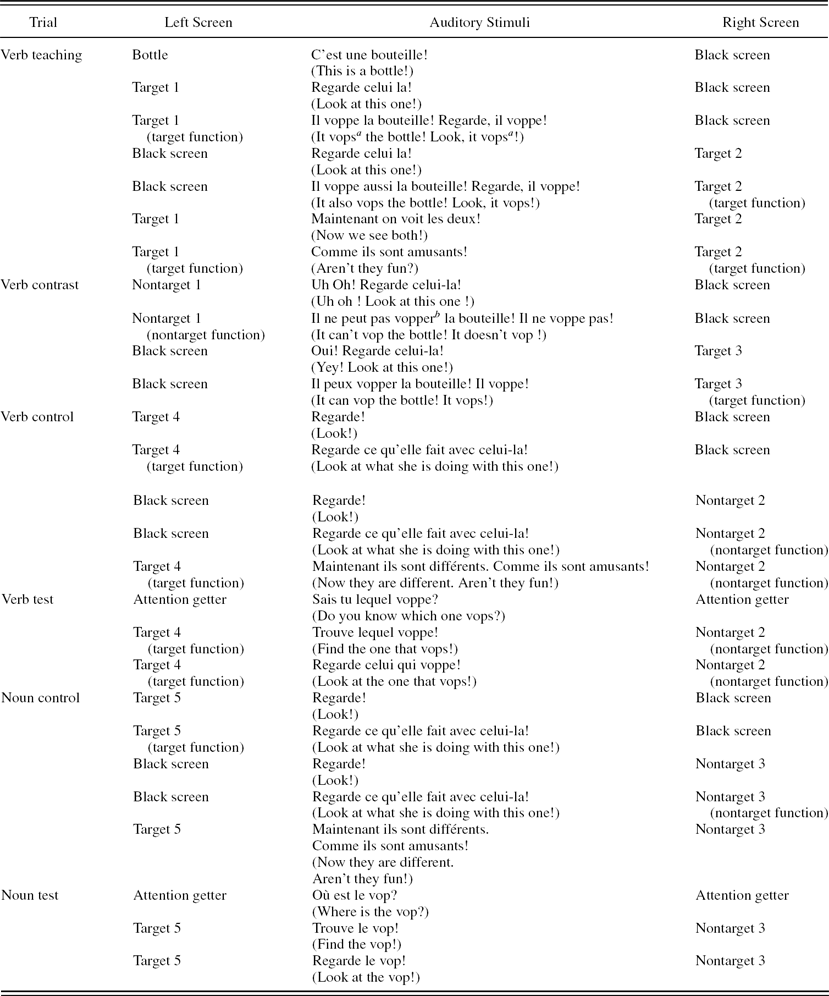
The videos used in Experiment 2 were visually identical to those used in Experiment 1. However, the linguistic stimuli that accompanied the videos, as well as the order in which the videos were presented, differed (see Appendix B for a sample of what the children saw and heard during the movie). For the linguistic stimuli, the functions of the objects were referred to by the novel parent verbs (e.g., voppe /vop/, daxe /daks/, ploune /plun/), and the objects were referred to by the pronoun il, “it.m” (the masculine form of it). For example, children heard “look, it vops.” Each object set in Experiment 2 began with a verb familiarization phase, which taught the children the parent verb. The verb familiarization phase consisted of a verb teaching and a verb contrast trial. In the verb teaching trial, the children were introduced to two novel target objects (Targets 1 and 2 in Figure 1) performing the target function and were taught a novel verb to refer to the functions of these objects. Then, in the verb contrast trial, they were shown a novel nontarget object (Nontarget 1) performing the nontarget function, followed by a novel target object (Target 3) performing the target function. This verb contrast trial taught them that the novel verbs they had been taught in the verb teaching trial could not be extended to functions that were different from the target function.
The verb familiarization phase was followed by the verb assessment phase, and then the (deverbal) noun assessment phase. The verb and noun assessment phases for Experiment 2 differed only in terms of the objects presented in each phase. In this experiment, the children were presented with Target 4 and Nontarget 2 in the verb assessment phase, and Target 5 and Nontarget 3 in the noun assessment phase.
Design and procedure
The experimental procedure and the criteria for excluding participants from the final analysis for Experiment 2 were identical to those used in Experiment 1. One 2.5-year-old in the first test object set and two 2.5-year olds in the second test object set looked away during the entirety of one of the two test videos of a test trial. As in the previous experiment, the average score for the children's age group was used as their score for that test video. Reliability was calculated for 6 participants (three 3-year-olds and three 2.5-year-olds) chosen randomly from the final sample. A second coder blind to the hypothesis independently coded the gaze behavior of the participants during the control and test videos of the two test object sets. The average agreement rates between coders were 95.25% (median = 98.06%, range = 70.56%–100%). Because reliability between the two coders was high, we used the original coder's data for the purposes of the analysis.
Predictions
As in Experiment 1, we expected the children to demonstrate their knowledge of the parent verbs by looking longer at the target actions than at the nontarget actions during the verb test trials. Furthermore, we expected that if the children have acquired class extension rules for deverbal nouns, they will look longer at the target object during the deverbal noun test trials. However, if they have not yet acquired class extension rules, they will look equally at both test objects in the deverbal nouns test trial.
Results and discussion
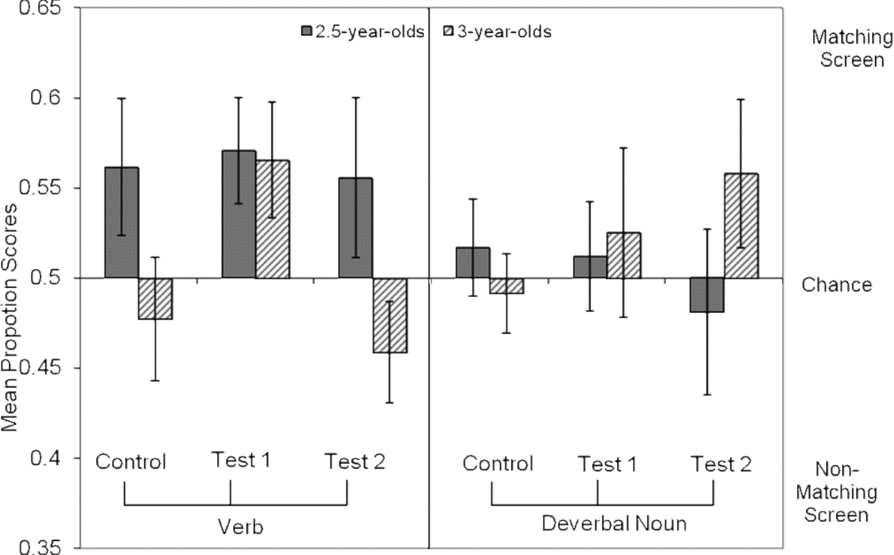
Figure 3 shows the mean proportion scores and the standard errors for the control and test videos of the two test object sets combined (dax and ploun).
Mean proportion scores and standard errors for the control and test videos of the combined test object sets by age group in Experiment 2. Proportion scores above .5 indicate a preference for the matching screen, whereas proportion scores below .5 indicate a preference for the nonmatching screen. A score close to .5 indicates no preference toward any of the screens. Error bars represent standard errors.
Verb results
The mean proportion scores of the 2.5-year-olds in the control, test question 1, and test question 2 videos of the verb test trial were .56, .57, and .56, respectively. The proportion scores of the 3-year-olds in the control, test question 1, and test question 2 videos of the verb test trial were .48, .57, and .46, respectively. A two-way mixed ANOVA with age group (2.5-year-olds vs. 3-year-olds) as a between-subject factor and trial (control, test question 1, and test question 2) as a within-subject factor yielded only a significant main effect of age group, F (2, 60) = 7.475, p = .010. This main effect of age was because the 2.5-year-olds looked longer at the target object than did the 3-year-olds during the control and the test question 2 videos, t (30) = 1.651, p = .055; t (30) = 1.844, p = .038, one tailed, respectively. These results indicate that the children did not learn the parent verbs when visual preference was controlled for.
Deverbal noun results
The mean proportion scores of the 2.5-year-olds in the control, test question 1, and test question 2 videos of the deverbal noun test trial were .52, .51, and .48, respectively. The proportion scores of the 3-year-olds in the control, test question 1, and test question 2 videos of the verb test trial were .49, .53, and .56, respectively. A two-way mixed ANOVA with age group (2.5-year-olds vs. 3-year-olds) as a between-subject factor and trial (control, test question 1, and test question 2) as a within-subject factor did not yield any significant main or interaction effects. These results indicate that neither age group was able to interpret the novel deverbal nouns correctly, suggesting that 2.5- and 3-year-old children have not acquired class extension rules for deverbal nouns.
A study by Royle (Reference Royle2007) has shown that French-speaking children have trouble fully learning low-frequency verbs until 3;6. Thus, it is possible that the 2.5- and 3-year-old children did not understand the deverbal nouns because they did not have a good understanding of the novel parent verbs. To investigate this possibility, we classified the children into two groups: the successful verb learners, who looked longer at the target screen during either the test question 1 or 2 video when compared to the control one, and the unsuccessful verb learners, who did not do so. The results of this analysis revealed that 10 out of 16 2.5-year-olds (62.5%) and 12 out of 16 3-year-olds (75%) were successful verb learners.
The mean proportion scores of the 2.5-year-old successful verb learners in the control, test question 1, and test question 2 videos of the verb test trial were .50, .60, and .63, respectively, whereas those of the unsuccessful verb learners were .51, .55, and .50. The mean proportion scores of the 3-year-old successful verb learners in the control, test question 1, and test question 2 videos of the verb test trial were .44, .61, and .47, respectively, whereas those of the unsuccessful verb learners were .60, .44, and .42. As expected, the 2.5-year-old successful verb learners looked longer at the target screen in the verb test question 1 and 2 videos when compared to the control one, although the difference between the control and test question 2 was only marginally significant, test question 1: t (9) = –2.180, p = .029; test question 2: t (9) = –1.743, p = .058; one tailed. Furthermore, they looked significantly longer than chance at the target screen in the verb test questions 1 and 2 videos, t (9) = 2.443, p = .019; t (9) = 3.473, p = .018; one tailed, respectively. In contrast, the 2.5-year-old unsuccessful verb learners did not look significantly longer at the target screen in the verb test question 1 or 2 video when compared to the control one (ps > .1). As expected, the 3-year-old successful verb learners looked significantly longer at the target screen in the verb test question 1 video when compared to the control one, t (11) = –2.976, p = .007, one tailed, and they also looked significantly longer than chance at the target screen in the verb test question 1 video, t (11) = 3.203, p = .004, one tailed. However, the 3-year-old unsuccessful verb learners did not look significantly longer at the target screen in the verb test questions 1 or 2 video when compared to the control one (ps > .1).
The mean proportion scores of the 2.5-year-old successful verb learners in the control, test question 1, and test question 2 videos of the deverbal noun test trial were .51, .55, and .50, respectively, whereas those of the unsuccessful verb learners were .53, .44, and .45. The mean proportion scores of the 3-year-old successful verb learners in the control, test question 1, and test question 2 videos of the deverbal noun test trial were .49, .54, and .57, respectively, whereas those of the unsuccessful verb learners were .51, .47, and .53. Neither the 2.5-year-old successful verb learners nor the unsuccessful verb learners looked significantly longer at the target screen in the test question 1 and 2 videos of the deverbal noun test compared to the control one (ps > .10). This indicates that even the 2.5-year-old successful verb learners were not able to correctly interpret the deverbal nouns. In contrast, the 3-year-old successful verb learners looked significantly longer at the target screen in the test question 2 video of the deverbal noun test when compared to the control one, t (11) = –1.878, p = .044, one tailed. In addition, their proportion scores in the test question 2 video of the deverbal nouns were greater than chance, although this difference was marginally significant, t (11) = 1.579, p = .072, one tailed. The 3-year-old unsuccessful verb learners did not look significantly longer at the target screen in the test question videos of the deverbal noun test when compared to the control ones (ps >.10). This indicates that only the 3-year-old successful verb learners were able to understand the deverbal nouns. Based on these results, the 3-year-olds’ problem understanding the deverbal nouns as a group is likely a result of some 3-year-olds’ inability to quickly learn the parent verbs, rather than a result of them not having acquired class extension rules for deverbal nouns.
GENERAL DISCUSSION
The present study investigated when French-speaking children acquire class extension rules. Of particular interest was whether 2.5- and 3-year-old children's innovative use of nouns as verbs and vice versa reported in previous case studies reflect their knowledge of class extensions rules (Clark, Reference Clark, Wanner and Gleitman1982) or whether they simply reflect children's immature production strategies (Bushnell & Maratsos, Reference Bushnell and Maratsos1984). In addition, we investigated whether French-speaking children acquire class extension rules for denominal verbs and deverbal nouns at different times as has been reported by previous studies (Berman, Reference Berman, Menn and Berstein-Ratner2000; Clark, Reference Clark, Wanner and Gleitman1982; Clark & Berman, Reference Clark and Berman1984; Clark & Hecht, Reference Clark and Hecht1982), while maintaining task difficulty constant by using the same novel words and the same instruments for both tasks. We expected that if 2.5- and 3-year-old French-speaking children have acquired class extension rules, then they should be able to understand the meaning of novel denominal verbs and deverbal nouns derived from novel parent nouns and verbs, respectively.
The results from Experiment 1 indicate that although the 3-year-old children were able to understand the novel denominal verbs based on their knowledge of the novel parent nouns, the 2.5-year-olds were not. Although some of the 2.5-year-olds were not able to learn the novel parent nouns, an analysis of the children who learned the parent nouns revealed that they could not correctly interpret the denominal verbs. This finding demonstrates that French-speaking children acquire simple class extension rules for denominal verbs by 3 years of age. This is at least a full year earlier than the ages of acquisition reported in previous experimental studies with Hebrew-speaking children (4 years; Berman, Reference Berman, Menn and Berstein-Ratner2000) and English-speaking children (5 years; Bushnell & Maratsos, Reference Bushnell and Maratsos1984). The discrepancy between the present and previous findings is likely due to methodological differences in the tasks used. Previous studies used elicitation or acting-out procedures to test children's production and comprehension of denominal verbs and deverbal nouns. In addition, the majority of these studies involved word formation using derivational rules such as suffixation or root and pattern processes. In contrast, the present study used looking times to determine children's interpretation of denominal verbs and deverbal nouns formed by conversion. Looking time measures have been reported to provide a more sensitive measure of young children's linguistic knowledge than acting-out or verbal-response measures (Hirsh-Pasek & Golinkoff, Reference Hirsh-Pasek, Golinkoff, McDaniel, McKee and Grains1996). Furthermore, the present study used novel parent words instead of familiar words as were used in previous studies. This allowed us to control for children's past experience with the parent words and avoid confusion resulting from the use of familiar words in an unconventional way. Thus, the present finding provides some evidence that the innovative denominal verbs found in the spontaneous speech of 3-year-old children are not likely to be a result of immature sentence production strategies, as suggested by Bushnell and Maratsos (Reference Bushnell and Maratsos1984).
The results from Experiment 2 indicated that neither the 2.5-year-old nor the 3-year-old children as a group were able to understand the deverbal nouns. Although this finding suggests that children acquire class extension rules for deverbal nouns later than for denominal verbs, the results of further analyses suggest another possible explanation. When the children in Experiment 2 were classified into two groups according to whether they had learned the parent verbs, the 3-year-olds who learned the parent verbs were able to understand the deverbal nouns. In contrast, the 2.5-year-olds were not able to do so, despite having learned the parent verbs. Thus, it is possible that the 3-year-old children had acquired class extension rules for deverbal nouns, but they failed to demonstrate this knowledge as a group, because of their difficulty in learning the parent verbs. Future studies should include a longer teaching phase for the verbs, with more examples and counterexamples, to ensure that the children's knowledge of the parent verbs is adequate before proceeding to the deverbal noun tests.
The present finding that 3-year-old children were able to understand the deverbal nouns around the same age as they understood the denominal verbs, as long as they understood the parent verbs, is inconsistent with the previous findings in Clark (Reference Clark, Wanner and Gleitman1982), Berman (Reference Berman, Menn and Berstein-Ratner2000), and Clark and Berman (Reference Clark and Berman1984) that children acquire class extension rules for denominal verbs and deverbal nouns at different times. However, the children in Berman's and Clark's studies may have been influenced by other factors such as differences in motivation to create new nouns and verbs, as well as differences in the derivational processes required to form new nouns and verbs. For example, children may prefer to use preexisting words in their vocabularies such as scissors or knife for something that cuts (Clark & Hecht, Reference Clark and Hecht1982) or general verbs such as do or make, rather than coining new nouns or verbs. In addition, depending on the language they are acquiring, children may have more difficulty selecting the appropriate derivational morpheme to form either deverbal nouns or denominal verbs. The present study used a comprehension task to minimize the influence of these factors. In addition, because French contains approximately equal numbers of denominal verbs and deverbal nouns (Guilbert, Reference Guilbert1975), it is possible that, unlike English-speaking children, French-speaking children hear similar numbers of denominal verbs and deverbal nouns in their daily input. However, future studies are needed to confirm this by analyzing the actual number of denominal verbs and deverbal nouns used in child-directed speech.
Why did the 2.5-year-olds in the present study fail to show evidence that they had acquired class extension rules, even though previous case studies have reported numerous examples of innovative denominal verbs and deverbal nouns in the spontaneous speech of 2-year-olds (Bowerman, Reference Bowerman, Wanner and Gleitman1982; Clark, Reference Clark, Wanner and Gleitman1982, Reference Clark1993; Oshima-Takane et al., Reference Oshima-Takane, Miyata and Naka2000, Reference Oshima-Takane, Barner, Elsabbagh and Guerriero2001)? One may argue that, unlike 3-year-olds, these 2.5-year-olds’ use of nouns as verbs and vice versa reflects immature sentence production strategies (Bushnell & Maratsos, Reference Bushnell and Maratsos1984). However, it is possible that the 2.5-year-olds failed to comprehend the deverbal nouns and denominal verbs as a group because of individual differences in the age at which children acquire class extension rules. Studies have reported large individual differences in both the grammatical development (e.g., Arriaga, Fenson, Cronan, & Pethick, Reference Arriaga, Fenson, Cronan and Pethick1998) and the vocabulary development (e.g., Bates, Bretherton, & Snyder, Reference Bates, Bretherton and Snyder1988; Fenson et al., Reference Fenson, Dale, Reznick, Bates, Thal and Pethick1994; Huttenlocher, Haight, Bryk, Seltzer, & Lyons, Reference Huttenlocher, Haight, Bryk, Seltzer and Lyons1991) of children in their first 3 years. Because case studies only reported data from children who were using nouns as verbs and vice versa (Bowerman, Reference Bowerman, Wanner and Gleitman1982; Clark & Hecht, Reference Clark and Hecht1982; Oshima-Takane et al., Reference Oshima-Takane, Miyata and Naka2000, Reference Oshima-Takane, Barner, Elsabbagh and Guerriero2001), it could be that these children were more advanced than the majority of the children in the present study. An analysis of individual data supports this interpretation. Eight out of 16 2.5-year-olds in Experiment 1 and 6 out of 16 2.5-year-olds in Experiment 2 looked longer at the target screen in either the test question 1 or 2 video of the denominal verb or the deverbal noun test when compared to both the control one and chance (0.5), suggesting that these children have acquired class extension rules for both types of words. Future studies looking at the relationship between children's spontaneous use of deverbal nouns and denominal verbs, and their performance in a task similar to the one used in the present study, would help us determine whether young children's use of verbs as nouns and vice versa reflects their knowledge of class extension rules.
The present study investigated children's ability to understand novel denominal verbs and deverbal nouns referring to instrument objects and their functions. However, many denominal verbs refer to noninstrumental actions, such as actions performed by specific agents (e.g., he authored the books) and actions performed during specific periods of time (e.g., he summered in Canada; Clark, Reference Clark, Wanner and Gleitman1982). Likewise, many deverbal nouns refer to an action (e.g., give me a kiss) or to the agent performing an action (e.g., he is a kicker). Future studies should investigate whether children are able to understand noninstrumental deverbal nouns and denominal verbs at the same age as they understand deverbal nouns and denominal verbs referring to instruments and their functions.
The present study also only examined denominal verbs and deverbal nouns that were formed by conversion (i.e., they shared the same form as their parent noun or verb). However, denominal verbs and deverbal nouns in French can also be formed via suffixation. Future studies should examine whether children can understand new words formed by suffixation at a different age than they understand those formed by conversion.
In sum, the present study provides the first experimental evidence that French-speaking children acquire class extension rules by 3 years of age. Furthermore, the results show no difference in the age at which French-speaking children are able to understand novel denominal verbs and deverbal nouns, as long as they understand the parent words from which they were derived. Although further work is needed to obtain more direct evidence that the innovative denominal verbs and deverbal nouns observed in the spontaneous speech of 2.5-year-olds reflects their knowledge of class extension rules, the present findings suggest that this innovative use is not merely a result of immature sentence production strategies. Rather, children form simple class extension rules in order to fill gaps in the lexicon as suggested by Clark (Reference Clark, Wanner and Gleitman1982). Exactly how children acquire these rules is a question for future research.
Crucial sequence of videos and linguistic stimuli for Experiment 1
Crucial sequence of videos and linguistic stimuli for Experiment 2
ACKNOWLEDGMENTS
This research was supported by a grant from the Natural Sciences and Engineering Research Council of Canada and from the Social Sciences and Humanities Research Council. We thank Meghan Zvaigzne, Simcha Samuel, Thomas Shultz, Fred Genesee, and Yoshio Takane for their feedback on the many drafts of this paper and Kristina Maiorino, Katherine Milette, Maria Kavvadias, Sariné Willis-O'Connor, Marissa Lapedis, Charlotte Raoult, and Sarah Hausman for their assistance in recording the auditory stimuli, filming the visual stimuli, testing, and coding. Finally, we thank the children and their parents who participated in this study.