INTRODUCTION
Radiocarbon (14C) dating has undergone continuous development since the introduction of Libby and coworkers’ techniques in the 1940s. Given the potential in various disciplines, several institutions in Mexico tried to set up radiocarbon dating laboratories. Remarkably, in 1954 the Institute of Physics (IF) of the National Autonomous University of Mexico (UNAM, Universidad Nacional Autónoma de México) installed the first radiocarbon laboratory based on Libby’s original technique, mainly to support archaeological research and to develop radioisotope applications.
Since 1980, three liquid scintillation (LSC) spectrometers have remained in operation at different scientific and cultural institutions in Mexico: one at the National Institute of Anthropology and History (INAH, Instituto Nacional de Antropología e Historia), the second at the Institute for Anthropological Research (IIA, Instituto de Investigaciones Antropológicas) of UNAM, and the third at the Mexican Institute of Water Technology (IMTA, Instituto Mexicano de Tecnología del Agua). Additionally, in 2013, an accelerator mass spectrometry laboratory (LEMA, Laboratorio de Espectrometria de Masas con Aceleradores) was established at the IF, with the most modern technique for radiocarbon analysis and sample preparation equipment.
At present, the archaeological community has full access to one of the most valuable tools in archaeological research for determination of chronologies. This paper presents a research note from a brief historical recount of the first radiocarbon laboratory established in Mexico.
The Institute of Physics of UNAM and the INAH
With the foundation of UNAM in 1910, the modernization of scientific education in Mexico began. However, during the armed period of the Mexican Revolution from 1910 to 1914, all scientific activity was interrupted in the country, while science worldwide experienced a period of significant progress. In addition to the economic destruction, Mexico suffered the First World War’s economic ravages (1914–1918), the 1918 Health Crisis, and the World Economic Crash of 1929 (Hobsbawm Reference Hobsbawm1995).
In the post-revolutionary era, in the 1930s, Mexico began its reconstruction with a slow economic recovery and a new science and technology impetus (Dutrénit and Zuñiga 2013). The 1930s were a decade of huge social changes, which incorporated an important educational, scientific, and technological reform, where the teaching of science and technology had a strategic value. Following this motivation, the IF was created in 1938, with Professor Alfredo Baños as its first director. The study of cosmic rays was among the initial research lines, which allowed a robust scientific exchange between researchers from Mexico and the United States (Mateos and Minor Garcia Reference Mateos and Minor García2013).
The INAH, an institution dedicated to the study of Mexican history and anthropology, was created in 1939, supported by President Lázaro Cárdenas. Archaeologist Alfonso Caso was its first director. This institution played a crucial role in the Mexican government for the construction of a cultural and historical discourse of post-revolutionary Mexico (López Hernández Reference López Hernández2018).
During World War II and with the beginning of the Atomic Era, Mexico experienced a period of economic and industrial growth that gave new impetus to investment in science and technology (Minor Garcia Reference Minor García2016). Thus, in 1950, the IF acquired a Van de Graaff accelerator dedicated to the study of the atomic structure (Cruz Manjarrez Reference Cruz Manjarrez1976).
Willard Libby and the Mexican Academy
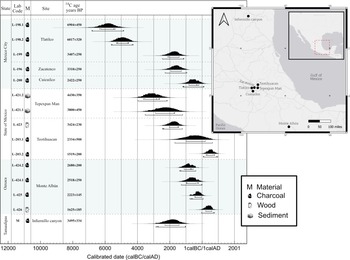
In the history of Mexican archaeology, radiocarbon dating was initially applied to Prehistory research. Among the first dated samples are those from the geologist Helmut de Terra, found around the 1940s in several archaeological sites: Mexico City (Tlatilco, Zacatenco, Cuicuilco), state of Mexico (Teotihuacan, Tepexpan Man), and Oaxaca (Monte Albán) (Figure 1). The samples were sent to the University of Chicago by archaeologist Daniel Rubin de la Borbolla of the National Museum of Mexico, and they were dated by W. Libby (Reference Libby1955).
On the left, some of the first datings of archaeological samples from Mexico; L (Libby Reference Libby1955); M (Moreno Reference Moreno1955), calibrated with OxCal 4.4 (Ramsey Reference Ramsey2009), using the IntCal20 curve (Reimer et al. Reference Reimer, Austin, Bard, Bayliss, Blackwell, Ramsey, Butzin, Cheng, Edwards, Friedrich, Grootes, Guilderson, Hajdas, Heaton, Hogg, Hughen, Kromer, Manning, Muscheler, Palmer, Pearson, van derPlicht, Reimer, Richards, Scott, Southon, Turney, Wacker, Adolphi, Büntgen, Capano, Fahrni, Fogtmann-Schulz, Friedrich, Köhler, Kudsk, Miyake, Olsen, Reinig, Sakamoto, Sookdeo and Talamo2020). On the right, a map with the location of the archaeological sites.

Later, in the early 1950s, the INAH Prehistory Direction planned to set up a radiocarbon laboratory to support prehistoric research; one of the main purposes was to date some relevant samples as the recently discovered mammoths in central Mexico (Villaruel Reference Villaruel2009). However, the laboratory could not be established, and the samples were dated by Robert Heizer and W. Libby at the University of California (Bernal Reference Bernal1965) and Alex D. Krieger at the University of Texas (Aveleyra Reference Aveleyra1964).
Contemporaneously, between 1953 and 1954, Mexican physicist Augusto Moreno made a research stay at the Institute for Nuclear Studies at the University of Chicago, where he was instructed by W. Libby and E. Martell about the new radiocarbon dating method. During his stay, Moreno prepared and dated a charcoal sample from Tamaulipas (Infiernillo Canyon) (Figure 1). This sample was sent by Richard MacNeish, an American archaeologist who was conducting archaeological excavations for his work on early agriculture in America (Moreno Reference Moreno1955). After his return to Mexico in 1954, Moreno joined the IF staff as a researcher.
The First Radiocarbon Laboratory in Mexico
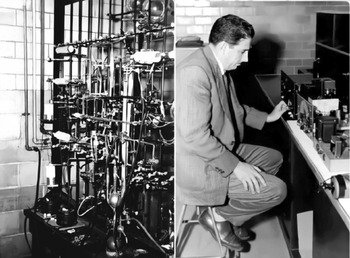
In the early 1950s, archaeologist Alfonso Caso—the former UNAM rector, and the first INAH director—discussed with physicist Carlos Graef, director of the IF, about the convenience of creating a laboratory that specialized in dating organic archaeological samples, based on the recently developed radiocarbon method. The project was finally achieved in 1954 when the Tritium and Radiocarbon laboratories were set up at the IF Radiochemistry section (Alcántara Reference Alcántara2021). For the radiocarbon laboratory installation, Caso offered economic aid from a donation made by the Wenner-Gren Foundation for Anthropological Research. Together with the funding from the IF and a donation from the Rockefeller Foundation, the laboratory equipment was purchased. Vacuum lines and electronic circuits were supplied to set up a laboratory with the original Libby’s technique, under Moreno’s leadership (Figure 2) (Cruz Manjarrez Reference Cruz Manjarrez1976).
On the left, some instruments of the first Mexican radiocarbon laboratory. On the right, Augusto Moreno teaching nuclear instrumentation, both from 1958 (Aguilera Ríos and Garza Hernández Reference Aguilera Ríos and Garza Hernández2002).

Concurrently, in response to a call from the Scientific Committee for the study of atomic radiation effects from the United Nations in 1956, Moreno and his colleagues from the IF conducted the first studies in Mexico about radioactive rain due to artificial radioactivity by nuclear explosions and nuclear power plants. The obtained results of rain samples from several Mexican cities revealed activity peaks due to the drop of radioactive material produced by nuclear explosions that occurred at that time, in Bikini Atoll and the Australian Sea (Alba et al. Reference Alba, Vázquez Barete, Brody, Lezama, Tejera, Moreno and Beltrán1956; Moreno and Ramirez Reference Moreno and Ramírez1961). Moreno also designed a 2π detector that was used to measure low levels of uranium in air and urine samples of personnel exposed to uraniferous materials (Moreno et al. Reference Moreno, Archundia, Nava and Garza1964).
In 1963, Moreno went to the British Museum to work on very low-level radioactivity. Upon his return to Mexico and with the new knowledge acquired in England, he began the renovation of the radiochemical laboratory, with the acquisition of a proportional gas counter (Moreno Reference Moreno1965). Finally, the IF concentrated the radiochemical laboratories’ research in studies of environmental radioactivity, mainly, tritium of low-level determination. The radiocarbon studies were abandoned, according to Moreno, because the laboratory could not compete with the new laboratories using the LSC technique (Moreno Reference Moreno1990), postponing the archaeological application of radiocarbon in Mexico several decades.
On the other hand, the INAH did not promote the IF radiocarbon laboratory among Mexican archaeologists. It was mentioned only once in a publication from archaeologist Eduardo Noguera (Reference Noguera1963), where several radiocarbon laboratories are listed. However, the IF laboratory did not produce any radiocarbon dates from archaeological contexts during the time it was active.
Despite the ending of radiocarbon research at the IF laboratory after 1965, it continued to have an active role in the scientific community. Since 1958, researchers from different Mexican states were trained through courses on radioisotopes basic techniques and nuclear instrumentation, led by Augusto Moreno; the courses continued annually until 1968 (Bulbulian Reference Bulbulian2012; Alcántara Reference Alcántara2021). However, no archival evidence was found to indicate the involvement of archaeologists, because these courses were more focused on training physicists and chemists.
The INAH’s prehistory direction continued working actively, with the incorporation of different archeometric techniques since the 1960s, mainly in the laboratories under the charge of archaeologist Jose Luis Lorenzo. It was not until the 1980s that a scintillator for radiocarbon dating was acquired using the LSC technique.
Some Archaeological Radiocarbon Projects in the 1960s
From an extensive compilation of Radiocarbon-published results in the 1960s, there is a record of 400 Mexican samples, mainly processed by American laboratories. There is also a Venezuelan and a German laboratory. However, only 39 of the 400 samples belong to projects funded and led by Mexican institutions.
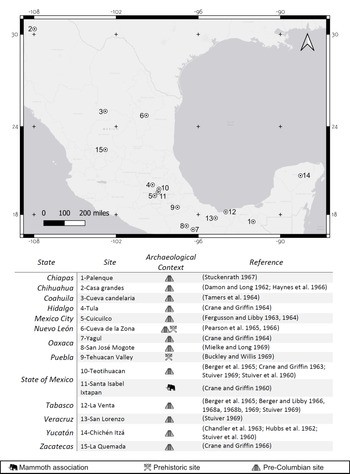
Mexican projects from INAH and UNAM, appeared in Radiocarbon, where charcoal or wood dates associated with mammoths remains were analyzed. Researchers from INAH had their samples dated at the University of Michigan and Teledyne Isotopes Inc. (Crane and Griffin Reference Crane and Griffin1960; Buckley and Willis Reference Buckley and Willis1970). Researchers of the UNAM’s Institute for Anthropological Research sent samples from Chichén Itzá, Yucatán (Deevey et al. Reference Deevey, Gralenski and Hoffren1959; Fergusson and Libby Reference Fergusson and Libby1962); Tula, Hidalgo; and Yagul, Oaxaca, to the laboratory of the University of Michigan (Crane and Griffin Reference Crane and Griffin1964). Samples from Teotihuacan were dated at the University of California UCLA (Berger et al. Reference Berger, Fergusson and Libby1965). The rest of the samples include, among others, samples from the Mayan area of Dzibichaltún, Chichén Itzá, and Cancún (Chandler et al. Reference Chandler, Kinningham and Massey1963; Hubbs et al. Reference Hubbs, Bien and Suess1963); from the coast of the Gulf of Mexico in La Venta (Berger and Libby Reference Berger and Libby1968a, Reference Berger and Libby1968b, Reference Berger and Libby1969) and San Lorenzo (Stuiver Reference Stuiver1969) sites from Olmec culture (Figure 3).
Some archaeological sites dated in the 1960s that appear in Radiocarbon.

In summary, radiocarbon dating, together with the projects carried out in the 1960s, were essential to understand Mexico’s past. It was not until the 1970s when several publications emerged such as the analysis of the Tehuacan Valley (Johnson Reference Johnson1967), the chronological proposal for northern Mexico (Di Peso et al. Reference Di Peso, Rinaldo and Fenner1974), or the studies in the basin of Mexico (Sanders et al. Reference Sanders, Parsons and Santley1979). Radiocarbon dating, along with other dendrochronological, palynological, and stratigraphic works, resulted in the building of robust chronologies for different areas of Mexico.
DISCUSSION
Despite the interest of the Mexican archaeological community, and the initiative of the IF in establishing a radiocarbon laboratory, it was not until the 1980s that it began its consolidation in Mexico with three laboratories based on the LSC technique. The first radiocarbon laboratory’s operation lasted briefly, but the training received by Moreno and other researchers on radioactivity issues was the basis for future generations of researchers in radioactive studies and Mexican experimental physics.
In the first contacts between Mexican physicists and archaeologists, we can also recognize the beginning of interdisciplinary research with the radiocarbon technique, nowadays very well consolidated in our country. New impetus in this regard was introduced in 2013, when an AMS laboratory (LEMA) was established at the IF, with the most modern equipment for radiocarbon analysis and sample preparation (Solís et al. Reference Solís, Chávez-Lomelí, Ortiz, Huerta, Andrade and Barrios2014). With this new facility, the IF has contributed to establish the occupation chronology of some of the pre-Columbian cultures throughout Mexican territory (Gómez-Chávez et al. Reference Gómez-Chávez, Solís, Gazzola, Chávez-Lomelí, Mondragón, Rodríguez-Ceja and Martínez-Carrillo2017; Solís et al. Reference Solís, Pérez-Andrade, Rodríguez-Ceja, Solís-Meza, Méndez, Chávez-Lomelí, Martínez-Carrillo and Mondragón2017, Reference Solís, Rodríguez-Ceja, Chávez-Lomelí, Alcántara, Gazzola, Balcells, Jiménez, Rosa and Martínez-Carrillo2020; Balcells et al. Reference Balcells, Solís and Rodríguez-Ceja2019; Alcántara et al. Reference Alcántara, Solís, Aguilar, Rodríguez-Ceja, Linares, Guadarrama and Nuñez2020). One example is the Mayan Codex of Mexico, dated at LEMA and considered the oldest document in the Americas (Solís et al. Reference Solís, Martínez, Rodríguez Ceja, Chávez and Christen2018, Reference Solís, Martínez-Carrillo, Rodríguez-Ceja, Chávez, Christen and Jull2021). Likewise, LEMA has participated in the research about the earliest evidence of human presence in Mexico around the Last Glacial Maximum (Ardelean et al. Reference Ardelean, Becerra-Valdivia, Pedersen, Schwenninger, Oviatt, Macías-Quintero, Arroyo-Cabrales, Sikora, Ocampo-Díaz, Rubio-Cisneros, Watling, de Medeiros, De Oliveira, Barba-Pingarón, Ortiz-Butrón, Blancas-Vázquez, Rivera-González, Solís-Rosales, Rodríguez-Ceja, Gandy, Navarro-Gutiérrez, De Las Rosa-Díaz, Huerta-Arellano, Marroquín-Fernández, Martínez-Riojas, López-Jiménez, Higham and Willerslev2020).
ACKNOWLEDGMENTS
This research is part of A. Alcántara’s dissertation, titled “Entre tepalcates. Hacia una comprensión historiográfica de la datación arqueométrica en la arqueología Mexicana,” for his archeology degree at the National School of Anthropology and History (ENAH). A. Alcántara acknowledges Ma. Esther Ortiz support through a CONACyT grant. The primary sources consulted were the José Luis Lorenzo Fund from the Alfonso Caso Archive at the Institute of Anthropological Research, UNAM and the Historical Archive of the General Personnel Department, UNAM.