Implications
This study shows that juvenile blue foxes utilise various resources while simultaneously available. The foxes choose to rest on the cage floor, inside the nest box or on an elevated location, preferably in social contact with a sibling. Of the five evaluated resources, that is, platform, nest box, sand, wooden block and social contact, the nest box is utilised the most. On the basis of behavioural observations, it is proposed that, in addition to the required elevated location and activity object, access to a nest box would serve best behavioural repertoire of blue foxes.
Introduction
In commercial fur farms, blue foxes (Vulpes lagopus) are housed in cages made of wire mesh, measuring ∼1 × 1.2 × 0.7 m (length × width × height). The European Convention (1999) recommends that the cages should be furnished with an elevated platform and an activity object. Legislation in some countries go beyond these recommendations by making the above resources compulsory (e.g. Finland and Norway) and by adding some supplemental requirements, for example, protection against wind in Norway. However, in the case of platform, scientific studies have failed to show consistent positive effects on foxes’ welfare in the means of prevalence of stereotypic behaviour, fearfulness of the animals and adrenal function (see discussion in Mononen et al., Reference Mononen, Møller, Hansen, Hovland, Kostinen, Lidfors, Malmkvist, Vinke and Ahola2012). Instead, access to an activity object improve foxes’ welfare by improving dental health (wooden block: Korhonen et al., Reference Korhonen, Jauhiainen, Niemelä and Sauna-aho2002; bone: Ahola et al., Reference Ahola, Turunen, Mononen and Koistinen2010) and possibly also breeding success (wooden block: Korhonen and Niemelä, Reference Korhonen and Niemelä2000) and by decreasing prevalence of stereotypic behaviour (wooden block: Korhonen et al., Reference Korhonen, Jauhiainen, Niemelä and Sauna-aho2002; bone: Koistinen et al., Reference Koistinen, Turunen, Kiviniemi, Ahola and Mononen2009b), but no consistent effects on foxes’ welfare have been found by using physiological measures like blood parameters or adrenal function (wooden block: Korhonen et al., Reference Korhonen, Jauhiainen, Niemelä and Sauna-aho2002; bone: Ahola et al., Reference Ahola, Turunen, Mononen and Koistinen2010). One way of enriching the housing environment is social housing of juvenile foxes, which is typically applied on commercial farms. The pair- or group housing has proved beneficial for the welfare of juvenile blue foxes (Ahola et al., Reference Ahola, Mononen, Pyykönen, Mohaibes and Hänninen2005) and silver foxes (V. vulpes: Ahola Reference Ahola2002; Hovland et al., Reference Hovland, Mason, Kirkden and Bakken2008), although not in all group compositions and not necessarily throughout the production period. Instead, social housing of adult foxes induces aggression (silver foxes: Hovland et al., Reference Hovland, Akre and Bakken2010a and Reference Hovland, Akre and Bakken2010b).
There has been a vigorous debate about whether the current housing conditions of farmed foxes’ are too barren to ensure a sufficient level of welfare (e.g. Nimon and Broom, Reference Nimon and Broom2001; Akre et al., Reference Akre, Hovland, Bakken and Braastad2008). Major concerns are the lack of general complexity of the housing environment, the foxes’ possible need for a solid floor material or digging substrate and the possible need for a year-round nest box. Although provision of a year-round nest box has been recommended (European Convention, 1999), typically a nest box is available only for breeding vixens a few weeks before expected delivery and it is removed, at latest, when the cubs are weaned at the age of 6 to 10 weeks. On commercial farms, foxes are not routinely provided with a solid floor material or digging substrate, except the solid wooden floor and roof of the above mentioned whelping nest box during the cub nursing period. Studies show that when blue foxes can choose between a solid sand floor and mesh floor, they prefer to stay on the mesh floor, but they are still motivated to work for access to a sand floor from a mesh floor (Koistinen, Reference Koistinen2009). Digging activity increases after a deprivation from a sand floor/digging substrate (e.g. Koistinen et al., Reference Koistinen, Ahola and Mononen2008). Access to a sand floor decreases prevalence of stereotypic behaviour, but physiological welfare measures, for example, blood parameters and adrenal function, show contradictory or no welfare effects (see review in Koistinen, Reference Koistinen2009). Blue foxes use both the interior and the roof of a year-round nest box for observing surroundings, resting, scratching and gnawing, but they tend to soil the interior of the nest box by defecating and fearfulness towards human may increase as the animals can hide human contact into the nest box (e.g. Korhonen et al., Reference Korhonen, Jauhiainen and Rekilä2006). The physiological welfare indicators, that is, blood parameters and adrenal function, do not indicate any clear welfare effect (Korhonen et al., Reference Korhonen, Jauhiainen and Rekilä2006).
Typically, the use or welfare effects of resources have been studied by providing the foxes with only one resource at a time. It has been suggested that even resources are made of different materials and perhaps originally designed for different purposes; they can partially enable similar behaviours in the housing environment of farm animals (e.g. Williams et al., Reference Williams, Riddell and Scott2008). This is the case also with the above listed resources devised for farmed blue foxes. For example, both the mesh platform and the wooden roof of a nest box enable observation of the surroundings from an elevated location, and the wooden block, the nest box and the sand floor represent a substrate for oral activities. In only one study, where all of the resources were not actually simultaneously available, the relative attractiveness of the nest box was evaluated as being higher than that of empty extra space or a sand floor, and no clear preference between the roof of the nest box and platform was observed (Koistinen et al., Reference Koistinen, Jauhiainen and Korhonen2009a). Thus, it is quite unclear whether the foxes would utilise all the resources when they are available simultaneously, and whether the suggested nest box and sand floor, would be used when the required platform and activity object, are already available.
Here we have measured farmed blue foxes’ use of platform, wooden block, nest box, sand floor and social companionship, while they are simultaneously available in a complex housing environment. We evaluated which of these resources are preferred for certain behaviours, such as staying on a solid floor, residing on an elevated location and nesting. This experimental setting also allows us to evaluate whether some of these resources substitute for each other. If the resources obviously substitute each other and one of the resources is preferred over the other, the less preferred resource should be used much less than in studies where this resource was provided solely. In the present study, we first assess the use of the resources by using the simply time-budget, as it provides important aspects of the overall value of resources, differing from the measures of motivation (see e.g. Elmore et al., Reference Elmore, Garner, Johnson, Kirkden, Patterson-Kane, Richert and Pajor2012).
Material and methods
The animals and experimental design
The subjects of the experiment were 12 sibling pairs of blue foxes. The foxes were born in May in cages (115 × 105 ×70 cm, L × W × H) furnished with a platform, a wooden block and a wooden nest box (70 × 45 × 40 cm, L × W × H) with a solid wooden floor. At the cubs’ age of 3 weeks (June), each litter, including mother and the natal nest box, was transferred to an experimental cage in another outdoor shed. Each experimental cage consisted of two sections (á 115 × 105 × 70 cm, L × W × H) connected together with an opening (20 × 28 cm, W × H) through the walls between the sections. In addition to the natal nest box, each experimental cage was furnished with two platforms (á 105 × 30 cm, L × W; one in each section) elevated 42 cm from the cage floor level, a wooden block (30 cm long, 7 to 10 cm in diameter) and a shallow box (80 × 40 × 14 cm, L × W × H) filled with sand (particle size up to 12 mm), that is, sand box. The nest box was never placed in the same section with the sand box, and the sand box was never placed under the platform, in order to permit proper digging in the sand. The wooden block was the only resource, which could be situated in either of the sections, as the foxes could carry it in their mouth from one section to another. Originally, the wooden block was placed in the section with the nest box. The experimental cages were arranged in an outdoor two-row shed on both sides of a middle aisle. In every second experimental cage, the section with the nest box was closer to the main entrance of the shed, and in every second experimental cage the section with the sand box was closest to the main entrance.
In order to prevent the foxes from reducing the resting comfort of their nest box by soiling it with faeces; at the cub's age of 5 weeks, the roof was removed from each nest box, and the nest box was turned upside down, so that there was no solid floor on the nest box. At 7 weeks of age (July), the mother and siblings except for two male cubs and one female cub were removed from each experimental cage, and later at 12 weeks of age, one of the male cubs was further removed from each cage. Thus, one male and one female cub remained in each experimental cage from the age of 12 weeks (August) onwards until the end of the experiment in December.
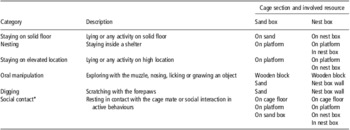
The behaviour of the 12 sibling pairs was recorded for 24 h at three time points; after every 5 weeks starting at the foxes’ age of 18 weeks, that is, in late September (SEP), early November (NOV) and mid-December (DEC). The behaviour was analysed from the recordings by using instantaneous sampling (Martin and Bateson, Reference Martin and Bateson1993) with a sampling interval of 5 min, as has been recommended for farmed blue foxes (Jauhiainen and Korhonen, Reference Jauhiainen and Korhonen2005). In the behavioural analysis, the foxes’ location (section) and interaction with the resources were recorded (Table 1). In addition, also the general level of resting (lying down), activity and any possible stereotypic activity were recorded. The sibling pair was considered as an experimental unit, that is, no individual data of the foxes were recorded. One person performed all of the behavioural analysis.
The analysed behaviours, their description and locations in the sections of the experimental cage where the behaviours were observed

*Note that a social contact could also occur without a resource use involved.
Management of the housing environment
The foxes were fed with fresh fox feed once a day (portion size 500 g per fox). The feed was produced by a local feed manufacturer (Kannus Minkinrehu Ltd, Kannus, Finland) according to the recommendations of the Finnish Fur Breeders’ Association. The feed included mainly fish, slaughterhouse offal and cereals. Water was available ad libitum from an automatic watering device in each cage section.
As it was expected that the foxes would eliminate on the sand boxes (see e.g. Korhonen et al., Reference Korhonen, Jauhiainen and Rekilä2003; Koistinen et al., Reference Koistinen, Ahola and Mononen2008), each sand box was removed and replaced with a new sand box filled with clean sand once a week. Blue foxes also soil nest boxes by eliminating (e.g. Korhonen et al., Reference Korhonen, Jauhiainen and Rekilä2006), but the present design without a solid floor in the nest box did not allow this behaviour. However, at least in theory, the foxes could defecate on the roof of the nest box, but the roof of the nest box was so close to the roof of the cage, that there was no sufficient space to take the typical defecation posture.
Statistical analysis
Because one recording was accidentally destroyed, data of four sibling pairs were lost in the last recording (DEC). Furthermore, because of occasional failures in recording, some data were missing from one sibling pair in NOV (a total of 3 h).
The analysis of the use of resources was based on a linear mixed model (SPSS for Windows). The effects of the month (SEP, NOV, DEC), time (00-08, 08-16, 16-00 h) and their interaction were analysed. The covariance structure of the repeated measurements was modelled as Toeplitz, because of the smallest Akaike's information criterion. In order to ensure the normal distribution of the residuals, the data were analysed after log10 + 2 or Box cox (λ value of 0.3) transformation. The interaction with the wooden block could not be analysed, because in 60% of cases, no interaction occurred with the wooden block.
The analysis of the preferred resource for each behaviour of interest (Table 1) was based on a linear mixed model, with the month, resource and their interaction as fixed effects. The covariance structure of the repeated measures was modelled as Compound symmetric. The data were analysed after a log10 transformation (observation) or Box cox transformation with a λ value of 0.5 (social contact) or 0.3 (solid floor, oral manipulation, nesting). Scratching could not be analysed because in 80% of cases no scratching was observed.
In the present experimental set-up, there were five different locations, differing in area: inside part of the nest box: 0.292 m2 (0.68 × 0.43 m), roof of the nest box: 0.315 m2 (0.7 × 0.45 m), mesh platforms: 0.6 m2 (2 × 1.05 × 0.3 m), sand box: 0.32 m2 (0.8 × 0.4 m) and the remaining empty mesh floor area: 1.18 m2 (2 × 1.15 × 1.05 m − (0.32 + 0.315 m2)). The foxes’ preferences to reside in these different locations were analysed by comparing the percentage of observations of activity or resting on these locations to the relative area of the location from the total available area by utilising the Sign test.
Results
Management of the resources
The mean outdoor temperature during the behavioural recordings was +8°C in SEP, −8°C in NOV and +3°C in DEC. Thus, the sand was deeply frozen in NOV but not in SEP and DEC. The sand boxes could be replaced with clean sand weekly only when the outdoor temperature stayed above 0°C, because the defrosting of the frozen sand box proved to take more than 24 h instead of the sanitation of the sand box, which required 10 to 15 min on temperatures above 0°C. The foxes, however, tended to eliminate on the newly sanitised sand box, which meant that the sand became fouled very soon after being replaced with clean sand. Thus, in practice, the sand was fouled throughout the study irrespective of the sanitation frequency. The faeces and wet sand tended to become stuck to the paws of the foxes, which then fouled the experimental cages and all the resources throughout the study. Furthermore, whenever the foxes carried the wooden block to the sand box in subzero temperatures, the block tended to freeze solidly to the sand.
Interaction with the resource
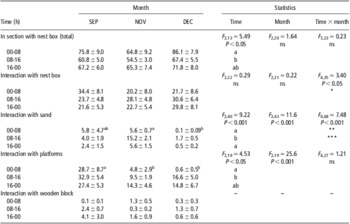
The foxes stayed more in the section with the nest box than in the section with the sand box (Table 2). This preference was most evident during night-time (00-08 h) and least evident during working hours (08-16 h) in all recordings. The nest box was also the most extensively used resource. The interaction with the nest box decreased as the autumn proceeded, but only in night hours. The second most widely used resource were the platforms. The foxes utilised the platforms more in SEP than in NOV and DEC. The platforms were used more during working hours than during evenings and the night-time. The sand box was utilised more in NOV (when it was frozen) than in DEC, with the duration in SEP being in between these two recording times (Table 2). The higher level of sand box use in NOV was most evident in the working hours. In general, the foxes utilised the sand box more during working hours than in the evening or the night-time. The least widely used resource was the wooden block. The interaction with the wooden block decreased as the autumn proceeded (no statistics available because of the low number of observations).
The interaction with the resources (mean % of all observations ± s.e.) in SEP, NOV and DEC at different times of the day (at 0008, 0816, 1600 h), and the related statistics

SEP = September; NOV = November; DEC = December; ns = not significant.
Because of the small number of observations, the interaction with the wooden block could not be statistically analysed.
The months or times of the day with different superscripts differ in the pair-wise comparison at the level P < 0.05.
Interaction between month and time: *P < 0.05, **P < 0.01, ***P < 0.001.
Behaviours
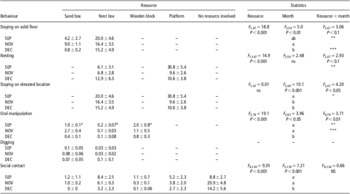
The foxes preferred the roof of the nest box to the sand as a solid floor material (Table 3). The foxes spent less time on the solid floor material in DEC than in NOV, this being more apparent in the case of the sand box. The platform was preferred over the nest box as a nesting site in SEP but not in NOV and DEC. In general, month did not affect the percentage of observations spent nesting. No preference between elevated locations, that is, the platform or the roof of the nest box, was found. The foxes utilised the elevated locations more in SEP than in NOV and DEC, this being most clear in the case of the platform. The sand box and the wooden block elicited more oral activities than the nest box. Less oral activities were observed in DEC than in SEP and NOV. The foxes preferred the wooden block in SEP and the (frozen) sand in NOV for oral activities. Scratching was very seldom observed in any of the recording months. The sand box was preferred to the nest box as a scratching site. In general, the available resources were not often involved in social contact, but if a resource was involved, most often it was the nest box. The wooden block and the sand were least often involved in social activities. Less social interaction was observed in DEC than in SEP and NOV, this being especially evident in the case when it involved the nest box. Stereotypic pacing was recorded on two occasions: once in SEP (cage no. 8) and once in NOV (cage no. 4).
The observations of different behaviours with the available resources (mean % of all observations ± s.e.) in SEP, NOV and DEC

SEP = September; NOV = November; DEC = December; ns = not significant.
Note that some of the behaviours are not mutually exclusive (e.g. staying on elevated location and social contact). Because of low number of observations, digging could not be statistically analysed.
The months with different letters and the resources with different superscripts differ in the pair-wise comparison at the level P < 0.05.
Interaction between resource and month: *P < 0.05, **P < 0.01, ***P < 0.001.
Resting and activity
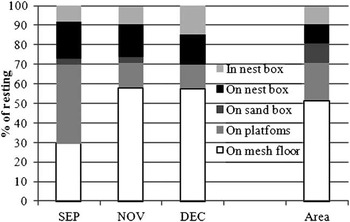
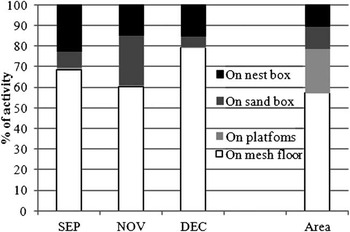
The foxes rested less in the sand box (P < 0.001, Sign test) and more on the roof and inside the nest box (P < 0.001) than could have been expected by chance (Figure 1). The foxes rested on the cage floor and on platforms as much as could have been expected (P > 0.05). While active, the foxes stayed more on the cage floor (P < 0.01, Sign test) and on the roof of the nest box (P < 0.01) and less on the platforms (P < 0.001) than could have been expected by chance (Figure 2). When the months were analysed separately, the foxes were active in the sand box in NOV more than could have been expected (P < 0.001), but not in SEP or DEC (P > 0.05).
The distribution of the daily resting of the bue fox sibling pairs in September (SEP), November (NOV) and December (DEC) in the different locations of the experimental cage, and the relative area of the different locations in the experimental cage.

Distribution of the daily activity of the blue fox sibling pairs in September (SEP), November (NOV) and December (DEC) in the different locations of the experimental cage, and the relative area of the different locations in the experimental cage.

Discussion
Our foxes interacted with all available resources. This cannot be considered self-evident, as, for example, in a study where mink had various resources available simultaneously, use of one resource (a table tennis ball) was never observed (Hansen et al., Reference Hansen, Malmkvist, Palme and Damgaard2007). Furthermore, our foxes used all of available resources at a similar extent than in earlier studies where the resources have been typically provided one at a time (see detailed comparisons below). Thus, our results indicate that each of the resources provided some distinct value to our foxes, meaning that, the suggested nest box and sand floor, provide some additional enrichment value to blue foxes besides the required platform and activity object.
Our foxes interacted most with the nest box and they also often remained in the vicinity of the nest box. The animals spent 6% to 13% of their time inside the nest box and 15% to 20% of their time on its roof, which both are within the ranges of 3% to 26% (Mononen et al., Reference Mononen, Harri and Rekilä1996a; Harri et al., Reference Harri, Mononen, Rekilä, Korhonen and Niemelä1998) and ∼20% (Mononen et al., Reference Mononen, Harri and Rekilä1996a), respectively, reported earlier. Also the blue foxes’ willingness to remain in the vicinity of the nest box has been earlier documented (Mononen et al., Reference Mononen, Harri and Rekilä1996b). We proposed that the time inside the nest box was spent resting; in fact the only available information about blue foxes’ behaviour inside the nest box, even though it concerns a few days before delivery, indicate that majority of the time inside the nest box is spent resting (Pyykönen et al., Reference Pyykönen, Mononen, Ahola and Rekilä2005). As also the majority of the time spent on the roof of the nest box was resting, it is obvious that the nest box represents an important resting site for juvenile blue foxes; the roof being preferred more than the interior of the nest box. However, one must bear in mind that blue foxes prefer an unobstructed view (Mononen et al., Reference Mononen, Harri and Rekilä1996b; Alakylmänen et al., Reference Alakylmänen, Mononen, Kasanen and Harri2001), and as the in-cage nest box obviously obstructs the view to the surroundings, the foxes may have simply ensured their view of the surroundings by staying on the roof of the nest box while in that section of the cage.
In contrast to the proposal that farmed foxes remain close to the nest box in order to hide from human contact (e.g. Akre et al., Reference Akre, Hovland, Bakken and Braastad2008), our data indicate that the vicinity of the nest box provides safety during night-time and is not a refuge from human contact, as our foxes remained in the vicinity of the nest box especially during night hours when there were no humans on the farm.
The platforms were used for 10% to 30% of the time and the usage decreased with the advancing autumn, which corresponds to the results from earlier studies (e.g. Korhonen et al., Reference Korhonen, Niemelä and Tuuri1996). Platforms were typically used during the daytime, and for resting. The wooden roof of the nest box provided another elevated location differing from the material of the platform. As no clear preference between these two elevated locations was found in terms of total usage, it seems that the floor material did not affect the attractiveness of the elevated location. However, in contrast to the low level of activity on platforms, some activity was observed on the roof of the nest box. The foxes could possibly move more freely on the roof of the nest box, which was situated at a 2 cm lower level than the platform and not along the cage wall like the platform, or the floor material affected the choice of the elevated location only while active.
Our foxes spent 0.8% to 9% of the observations, that is, 12 to 130 min in 24 h, in the sand box, which is around the same magnitude as the use of a similar-sized sand box in an earlier study (38 to 66 min in 24 h in Korhonen et al., Reference Korhonen, Jauhiainen and Rekilä2003). The foxes may have considered the frozen sand more comfortable and/or more hygienic than the unfrozen sand, because the sand box was used most while it was frozen in NOV. As reported in earlier studies (e.g. Koistinen et al., Reference Koistinen, Ahola and Mononen2008), the sand box was not a favoured resting site; our foxes rested on the sand only on a few occasions in SEP and NOV, and no resting at all was observed in this site in DEC. In the present study, the sand box cannot be considered as a preferred location while active, and if one compares the solid floor materials, then the wooden floor of the nest box was preferred over the sand.
Oral manipulation and digging were rarely recorded activities. However, the present result, may be biased because of the sampling method, which may not capture behaviours of short duration (Martin and Bateson, Reference Martin and Bateson1993), for example, the bouts of interaction with the wooden block, include carrying, gnawing, poking, sniffing (Korhonen and Niemelä, Reference Korhonen and Niemelä2000) play and urination (Korhonen et al., Reference Korhonen, Jauhiainen, Niemelä and Sauna-aho2002), which are all very short in duration, but frequent (Korhonen and Niemelä, Reference Korhonen and Niemelä2000). More oral manipulation was directed towards the movable objects, that is, wooden block and sand that can be utilised for different kinds of activities, than the walls of the nest box. In particular, the frozen sand elicited oral activities, as the foxes tried to remove different items (e.g. pebbles and wooden block) from the frozen sand. In general, oral manipulation was observed more often than digging on the sand box. Digging on sand occurred only in 0.07% to 0.1% of the observations, which corresponds to 1 to 2 min in a day, meaning that our foxes dug for almost exactly the same daily duration as has been reported earlier in a similar-sized sand box in October and November (Korhonen et al., Reference Korhonen, Jauhiainen and Rekilä2003). However, earlier in autumn (July and August), the foxes studied by Korhonen et al. (Reference Korhonen, Jauhiainen and Rekilä2003) dug for about 6 to 7 min in a day and 12 min in a later study (August and September: Korhonen et al., Reference Korhonen, Eskeli and Huuki2012). In SEP and NOV, our foxes spent more time digging in the sand box than they used scratching the wall of the nest box, but in DEC no clear preference between these two sites was found. This is in contrast to the study of Korhonen et al. (Reference Korhonen, Eskeli and Huuki2012), where more digging (scratching) of a solid metal plate was observed than digging on sand (in August and September). Thus, our result supports only partially the conclusion of Korhonen et al. (Reference Korhonen, Eskeli and Huuki2012) that a vertically situating plate is a better digging site than a sand box.
As in earlier studies (Koistinen, Reference Koistinen2009), less social contacts were observed in DEC than earlier in the autumn. The social contact seems to be more valuable for the younger foxes. Social contacts often occurred during resting. Resting close to the cage mate and/or inside the nest box obviously affect the microclimate around the fox and may also provide safety while resting, which may be key factors when a juvenile blue fox is choosing a resting place. Very similar results have been documented in juvenile silver fox vixens: they are motivated to social contact with a same-age vixen and they utilise much of their time to synchronous resting (Hovland et al., Reference Hovland, Mason, Kirkden and Bakken2008), but not in close contact as our blue foxes did.
The available resources were not often involved in active behaviours. Most activity was observed on the empty cage floor area. This shows that the larger area for walking and running is also used in a complex housing environment. In fact, incorporating too much complexity into small cage might hinder this kind of locomotor behaviour. It has been suggested that increased environmental complexity, rather than increased cage size, can improve welfare in farmed silver foxes (Ahola, Reference Ahola2002) and in mink (Hansen et al., Reference Hansen, Malmkvist, Palme and Damgaard2007). Some complexity may also be beneficial for blue foxes, but based on the present data, some ‘empty’ area for locomotion must also be available. It must bear in mind that in the wild, V. lagopus dwell mainly on large open areas (Audet et al., Reference Audet, Robbins and Lariviére2002) instead of habitats with dense vegetation.
In contrast to the earlier studies dealing with sand floor (e.g. Korhonen et al., Reference Korhonen, Jauhiainen and Rekilä2003; Koistinen et al., Reference Koistinen, Ahola and Mononen2008), the sand box was regularly cleaned in the present study. The weekly sanitation, however, turned out to be insufficient to keep the sand clean. Actually, the foxes urgently eliminated on the recently cleaned sand, which ensured that the sand remained fouled and wet throughout the study. If a solid floor material is provided on commercial farms, it must be hygienic and easily sanitised, in order to maintain good health of the foxes and to avoid worsening of the fur quality. Therefore, the presently used sand box cannot be used as such on commercial farms.
In conclusion, even the present resources enable partially same behaviours, they may not substitute each other; instead all resources provide some distinct value to juvenile farmed blue foxes. The results suggest that juvenile blue foxes use a shelter with the possibility for social contact for night-time resting and an elevated location with a view to the surroundings for day-time resting. However, this concerns only approximately half of their daily resting time; the other half of resting occurs on the cage floor even though various resting sites are available. The foxes use all available resources for various activities, but while active, they remain mainly on the larger, open cage floor area. On the basis of the foxes’ time allocation, the wooden roof of the nest box is preferred to sand as a solid floor material, the platform is preferred to the nest box as a nesting site, but no clear preference between the platform and roof of the nest box as an elevated location could be detected. On the basis of the present results, it would be tempting to conclude that some kind of nest box, perhaps with partially open walls, mounted high in the cage could best serve the behavioural repertoire of juvenile blue foxes, besides the already required resources. If a nest box is used, the design must minimise the potential negative welfare effects, for example, soiling of the nest box and the foxes’ possible decreased confidence towards human.
Acknowledgements
The authors are grateful to Pekka Eskeli, Aimo Joki-Huuki, Hanna Huuki, Martti Koskinen, Ewen MacDonald, Paula Martiskainen, Elina Reinikainen and Eero Uunila for animal care and for practical assistance. The authors also want to thank the two anonymous referees for their constructive criticism of the manuscript. The study was financially supported by Ministry of Agriculture and Forestry and MTT Agrifood Research Finland and Finnish Cultural Foundation, North Savo Regional Fund.