Introduction
Impaired awareness of altered functioning after traumatic brain injury (TBI) can dramatically compromise the process of recovery. Clinicians and caregivers have highlighted poor self-awareness (SA) or reduced insight as a critical factor in predicting compliance with treatment, length of stay in post‐acute rehabilitation programs, and the level of caregiver distress (Prigatano, Reference Prigatano2005).
A commonly used approach to measure SA in brain injury is to compare a patient’s report with that of a significant-other (Fleming, Strong, & Ashton, Reference Fleming, Strong and Ashton1998; Prigatano, Reference Prigatano1991; Sherer et al., Reference Sherer, Boake, Levin, Silver, Ringholz and High1998). A discrepancy in the direction of the patient reporting fewer difficulties than the informant provides an indirect measure of impaired SA. Since it is common for patients who underestimate their deficits to do so across a range of domains including cognitive, affective, and social capabilities (Prigatano and Altman, Reference Prigatano and Altman1990; Smeets, Ponds, Verhey, & van Heugten, Reference Smeets, Ponds, Verhey and van Heugten2012), self-other discrepancies provide a general index of metacognitive knowledge available to a patient. If this knowledge is limited, it signifies a reduced level of recognition that there has been a detrimental change in function after injury.
To further understand impaired SA as a clinical phenomenon one must also examine the presence or absence of emergent awareness that punctuates the stream of everyday decision-making. For example, an insight that your level of fatigue is affecting your concentration can prompt an activity break, whereas a lack of insight that your concentration is waning can lead to goal neglect and error. In experimental contexts, emergent awareness after brain injury has been measured through reporting of errors during simple go/no-go tasks (McAvinue, O’Keeffe, McMackin, & Robertson Reference McAvinue, O’Keeffe, McMackin and Robertson2005; O’Keeffe, Dockree, Moloney, Carton, & Robertson, Reference O’Keeffe, Dockree, Moloney, Carton and Robertson2007; O’Keeffe, Dockree, & Robertson, Reference O’Keeffe, Dockree and Robertson2004) and during naturalistic activities (Hart, Giovannetti, Montgomery, & Schwartz, Reference Hart, Giovannetti, Montgomery and Schwartz1998). In both contexts, TBI patients fail to report as many of their errors as controls do.
A clinical model of awareness (Toglia & Kirk, Reference Toglia and Kirk2000) proposes that instances of emergent awareness should feedback to enhance metacognitive knowledge after brain injury. So, detecting everyday cognitive failures, such as proneness to inattention or acting impulsively, may contribute to a growing realization that one has impairments that necessitate a change of strategy and therefore one becomes more self-aware.
Surprisingly, there is no evidence that emergent and metacognitive awareness are related in TBI patients. In studies that have used a multidimensional approach, there was no relationship between the two levels of measurement (Hoerold, Pender, & Robertson, Reference Hoerold, Pender and Robertson2013; O’Keeffe, Dockree, Moloney, Carton, & Robertson, Reference O’Keeffe, Dockree, Moloney, Carton and Robertson2007). In the current study, our primary aim is to assess in more detail the relationship between these different levels of awareness in TBI patients, since the online breakdown of error detection mechanisms may impose limitations on the recovery of SA in general.
Recent evidence (Ham et al., Reference Ham, Bonnelle, Hellyer, Jilka, Robertson, Leech and Sharp2014) suggests that TBI patients who are poor at monitoring their errors show abnormal connectivity between the dorsal anterior cingulate cortex (ACC) and both the anterior insulae and parietal control networks indicating a breakdown in the typical functional interactions between these regions. The location of focal brain injury or extent of diffuse axonal injury could not predict emergent awareness in these TBI patients; instead the breakdown of interactions within the fronto-parietal control network was key to understanding poor awareness of errors.
TBI patients who show SA deficits also exhibit impairments of attention. Research in our laboratory has focused on understanding impairments of sustained attention in TBI patients as an important precursor to unawareness of errors (McAvinue et al., Reference McAvinue, O’Keeffe, McMackin and Robertson2005; O’Keeffe, Dockree, Moloney, Carton, & Robertson, Reference O’Keeffe, Dockree, Moloney, Carton and Robertson2007a; O’Keeffe, Murray, et al., Reference O’Keeffe, Murray, Coen, Dockree, Bellgrove, Garavan and Robertson2007). Therefore, it is important to establish whether any relationship between emergent awareness of errors and metacognitive awareness remains after the effects of other correlated variables (e.g., sustained attention) are held constant. We address this potential confound in the current study.
Another potential influence on the extent of SA impairment is the severity of injury as measured by common indexes including the Glasgow Coma Scale (GCS) and Post Traumatic Amnesia (PTA). Previous research investigating these clinical metrics have yielded mixed results with some studies reporting no association between severity and SA impairments (Anson & Ponsford, Reference Anson and Ponsford2006; O’Keeffe, Dockree, Moloney, Carton, & Robertson, Reference O’Keeffe, Dockree, Moloney, Carton and Robertson2007) and others reporting a relationship with SA on at least one clinical measure (Ciurli et al., Reference Ciurli, Bivona, Barba, Onder, Silvestro, Azicnuda and Formisano2010; Prigatano & Altman, Reference Prigatano and Altman1990). The current study examines whether severity measures show different relationships with different levels of awareness to help refine their value in predicting neuropsychological outcome in TBI patients.
Additionally, we assess the validity of measuring metacognitive knowledge. It is important to examine how significant-other reports relate to both post-injury cognitive ability and premorbid function. If informant reports are reliable, they should correlate with the former rather than the latter. In the current study, we also use two discrepancy methods to index awareness. In keeping with the aforementioned TBI studies, we have used a simple subtraction of “self” minus “other” ratings to derive a metacognitive estimate of awareness. However, such an approach, although intuitive, does not take into account between-group differences in ratings. For instance, significant-others may hold biases or stereotypes that pertain to the nature of brain injury in general, which are separate from an accurate and valid appraisal of the brain-injured person as an individual. Clare, Whitaker, and Nelis (Reference Clare, Whitaker and Nelis2010) advocated the use of corrected discrepancy score, which divide the self-other discrepancy by the mean of the two ratings. In this study, we also adopt this approach to control for between-group differences in the ratings of patients and their significant-others.
Finally, the relationship between awareness and executive function is not fully understood. Dysexecutive syndrome represents a major challenge to recovery after brain injury and it reflects persistent problems with self-organized behavior such as poor planning, monitoring and execution of goals. Both executive control and metacognitive awareness processes are often conceived as sharing a common role in exerting higher order control over “lower” aspects of cognition (Nelson & Narens, Reference Nelson and Narens1990; Shimamura, Reference Shimamura2008). However, where some studies have reported relationships between executive measures and different aspects of awareness (Bivona et al., Reference Bivona, Ciurli, Barba, Onder, Azicnuda, Silvestro and Formisano2008; Ciurli et al., Reference Ciurli, Bivona, Barba, Onder, Silvestro, Azicnuda and Formisano2010; Morton & Barker, Reference Morton and Barker2010;) others have not (Chiou, Carlson, Arnett, Cosentino, & Hillary, Reference Chiou, Carlson, Arnett, Cosentino and Hillary2011; O’Keeffe, Dockree, Moloney, Carton, & Robertson, Reference O’Keeffe, Dockree, Moloney, Carton and Robertson2007). This lack of consensus may be attributable to varied and dissociable aspects executive control being measured, largely with traditional laboratory based tasks.
Here, we examine relationships between awareness and performance on an open-ended, ecologically valid test of executive function—the modified six elements test (M-SET)—that requires monitoring and cognitive flexibility, and is representative of complex situations analogous to daily life challenges faced by TBI patients. We ask whether different levels of awareness measured in the laboratory are related to the kind of complex regulatory control called upon in a clinically relevant test that is highly generalizable to executive problems outside of the laboratory (Burgess, Veitch, de Lacy Costello, & Shallice, 2006).
To summarize, the aims of this study are threefold. First, to examine the hypothesized relationship between impaired metacognitive knowledge and emergent levels of awareness in TBI patients. Second, to account for the role of mediating factors, including sustained attention capacity and injury severity, in terms of their influence on SA impairments. Third, to assess whether simple indices of awareness in the laboratory can predict performance on an ecologically valid test of executive function that is sensitive to dysexecutive syndrome in TBI patients.
Methods
Participants
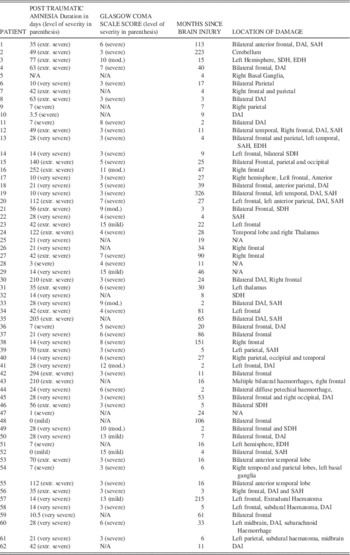
All patients were recruited from the National Rehabilitation Hospital (NRH), Dun Laoghaire, Co Dublin. One-hundred twenty patients with acquired brain injury were initially screened and selected for the study. All patients that were included showed no evidence of visual or hearing impairments, no history of major psychiatric disorders, no previous history of a neurological condition, no drug or alcohol abuse, and no learning disability. 120 patients were recruited from a larger study of acquired brain injury. 23 patients were excluded for brain injury resulting from non-traumatic reasons (i.e., stroke); 20 patients did not complete the neuropsychological measures due to discharge from the hospital and busy rehabilitation schedules; 10 patients were unable to travel to the test center; and 5 patients were unable to comply with the instructions during the computer-based go/no-go tests. Therefore, 62 patients were included for analysis. Neuroanatomical evidence of damage and level of consciousness measurements (PTA and GCS ratings) were gathered from the NRH healthcare records for each patient and is presented in Table 1. Table 2 notes n values on each measure since some patients were unable to complete all tests due to their busy rehabilitation program. Significant-others showed the following relationship to the patients: Parent (n=23), Spouse/Partner (n=18), Sibling (n=10), Friend (n=2), Offspring (n=1), and Cousin (n=1). The ethical review board of the School of Psychology, Trinity College Dublin, and the National Rehabilitation Trust Ethics Committee approved procedures, and all participants gave written, informed consent.
Traumatic Brain Injury patient characteristics (n=62) including duration and severity of Post Traumatic Amnesia (PTA) derived from Lezak et al (Reference Lezak, Howieson and Loring2004) (Mild: <1 hour; Moderate: 1–24 hours; Severe: 1–7 days; Very Severe: 7–28 days; Extremely Severe: >28 days), Glasgow Coma Scale (GCS) score and severity derived from Teasdale & Jennet (1974) (Mild: score of 13–15; Moderate: score of 9–12; Severe: ≤8), months since brain injury and location of damage. DAI: Diffuse Axonal Injury. SAH: Subarachnoid Haemorrhage; EDH: Extradural Haematoma; SDH: Subdural Haematoma; N/A: Information is Not Available.

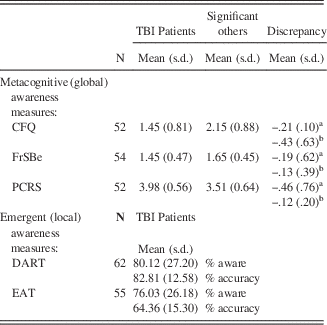
Mean, and standard deviation in parentheses, for each metacognitive (global) awareness measure for patients and their significant others (Cognitive Failures Questionnaire, CFQ; Frontal System Behavioural Scale, FrSBe; Patient Competency Rating Scale, PCRS). Discrepancy measures (a=uncorrected discrepancy; b=corrected discrepancy). Mean percentage aware and mean percentage accuracy are presented for each local awareness measures completed by the patients (Dual Attention to Response Test, DART; Error Awareness Test, EAT).

Background Measures of Cognitive and Emotional Functioning
National Adult Reading Test (NART) (Nelson, Reference Nelson1982). This test is used to estimate premorbid IQ.
Modified Six Elements Test (M-SET) from the Behavioral Assessment of the Dysexecutive Syndrome (BADS, Wilson, Alderman, Burgess, Emslie, & Evans, Reference Wilson, Alderman, Burgess, Emslie and Evans1996). The Modified Six Elements Test requires participants to do three tasks (dictation, arithmetic, and picture naming) each of which is sub-divided into two parts (A & B). Therefore, participants do two types of dictations, two types of mental calculations, and two kinds of picture naming. Participants are told that they are not permitted to complete A and B of the same type of task (e.g., dictation) in succession and they must attempt at least something from each of the six subtests. The test provides a good index of how well participants can organize themselves within a ten minute period and is therefore sensitive to planning, scheduling and monitoring behavior.
Sustained Attention to Response Test (SART) (Robertson, Manly, Andrade, Baddeley, & Yiend, Reference Robertson, Manly, Andrade, Baddeley and Yiend1997). Digits were presented sequentially from “1” through “9”. Participants were instructed to respond with a left mouse button press with their right forefinger upon presentation of each digit (go-trials) with the exception of the 25 occasions when the digit “3” (target) appeared, where they were required to withhold their response. False presses on the target were defined as commission errors. The numbers were presented in white on a grey background, and the size of the font varied in height from 12 mm to 29 mm. Stimulus duration was 900 ms followed by an inter-stimulus interval of 500 ms. Participants completed one block of 25 runs of 1–9.
Hospital Anxiety and Depression Scale (HADS) (Zigmond & Snaith, Reference Zigmond and Snaith1983). This scale is used to assess symptoms associated with anxiety and depression.
Awareness Measures
Online Emergent Awareness
The Dual-task Attention to Response Test (DART) (Dockree et al., Reference Dockree, Bellgrove, O’Keeffe, Moloney, Aimola, Carton and Robertson2006) introduces a secondary target embedded within the basic design of the SART. In addition to pressing the left mouse button to go-trials and withholding a response to no-go targets (“3s”), participants were also required to make a right button press upon detection of grey-colored digits. To challenge available processing resources during the test but not to challenge performance in the period before and immediately after the presentation of a no-go target (during the presentation of 1 through 4) the presentation of grey-colored digits was restricted to numbers 5 through 9. Participants completed two blocks of 25 runs of 1–9 including 22 pseudorandom appearances of a grey number (or “distractor” target). Error awareness was measured by asking participants to verbally indicate their awareness when they had made a false press by saying the word “hit” following an error of commission on the no-go target, 3. Percentage awareness was calculated for the DART by dividing the total aware errors of commission by the total actual errors of commission during the test.
The Error Awareness Task (EAT, Hester, Foxe, Molholm, Shpaner, & Garavan, Reference Hester, Foxe, Molholm, Shpaner and Garavan2005). The EAT is a Go/No-go response inhibition task. Participants were instructed to press the left mouse button for all word stimuli that were congruent with the font color (“go” targets), and to withhold when the word and font did not match or when the same word was presented on two consecutive trials (“no-go” targets). Erroneous responses to the no-go targets were recorded as errors of commission. In the same way as the DART, participants were asked to verbally signal their error by saying “hit” immediately after the error. Stimuli were presented on a black background for 900 ms followed by a 600 ms inter-stimulus interval.
Metacognitive Knowledge
The Cognitive Failures Questionnaire (CFQ) (Broadbent, Cooper, FitzGerald, & Parkes, Reference Broadbent, Cooper, FitzGerald and Parkes1982) measures the propensity for everyday failures in memory, perception, and action slips. The self-report version completed by participants comprises 25 items answered using a 5-point Likert scale. The significant-other consists of 8 items answered on the same scale. Average ratings were calculated for self- and other- reports.
The Frontal Systems Behaviour Scale (FrSBe) (Grace & Malloy, Reference Grace and Malloy2001) is a 46-item scale, which assesses behavioral symptoms experienced by individuals who have sustained brain damage affecting frontal systems. Patients and significant-others rate each statement by indicating how often they engage in a particular behavior, both before and after the onset of the injury. Responses are measured on a 5-point Likert scale. The FrSBe is comprised of three sub-scales; Apathy, Disinhibition and Executive Dysfunction, and an average score was calculated for patients and their significant-others.
The Patient Competency Rating Scale (PCRS) (Kolakowsky-Hayner, Reference Kolakowsky-Hayner2010; Prigatano & Altman, Reference Prigatano and Altman1990) provides self-ratings and significant-other ratings of day-to-day competency as a guide to patients’ awareness of their own difficulties. Self- and other-ratings are given on a 30-item questionnaire that measures competency to perform various behavioral, cognitive, and emotional tasks. Participants rate how easy or hard it is to perform various tasks on a 5-point Likert scale and an average score for patients and their informants generated.
Metacognitive discrepancy scores. Discrepancy between patients’ ratings and those of a significant-other, family, caregiver, or friend on the CFQ, FrSBe and the PCRS were used as indicators of metacognitive accuracy. The discrepancy scores were calculated for each metacognitive measure correcting for differences in direction of scoring (CFQ, FrSBe, PCRS). Two methods were used: a simple difference measure between the participants’ self-rating and their informant rating and a corrected discrepancy method in which the difference is divided by the mean of the two sets of scores [e.g.,((Self-Rating – Other-Rating)/((Self-Rating+Other−Rating)/2))] to equally weight both sets of ratings (Clare et al., Reference Clare, Whitaker and Nelis2010; Harty, O’Connell, Hester, & Roberston, Reference Harty, O’Connell, Hester and Robertson2013). The corrected discrepancy scores close to zero were taken as an indication of good agreement between the participant and the informant. Negative score arise when patients underestimate their difficulties (CFQ, FrSBe) or overestimate their competency (PCRS) compared to significant-others. Positive score arise when patients overestimate their difficulties (CFQ, FrSBe) or underestimate their competency (PCRS) compared to significant-others.
Procedure
Participants completed the assessments over two 45-min sessions at the National Rehabilitation Hospital (NRH). Consent was obtained during the first session. The SART, DART, and EAT were performed in one session and all other measures were administered in a second session. Participants were given practice blocks to ensure they fully understood the requirements of each task. During each session, participants were given an opportunity to rest to offset the effects of fatigue.
Statistical Analysis
To examine the extent of neuropsychology impairment in the TBI sample we used a one-sample t-test to compare their performance on a sensitive test of executive function, the M-SET, with a normative mean from a healthy control sample reported in the BADS manual (Wilson et al, Reference Wilson, Alderman, Burgess, Emslie and Evans1996, section 3.1, page 8). We used two-sample t-tests to compare questionnaire reports of patients and their significant-others, and to compare patients with frontal versus non-frontal damage on the awareness measures. All ordinal-scale questionnaire data met the assumptions of normality required for parametric analysis. To examine interrelationships between different levels of awareness and cognitive performance, we conducted one-tailed Bonferroni-corrected bivariate and partial correlations. We reduced correlated awareness variables to mean composite scores to represent metacognitive and emergent awareness separately. For the questionnaire measures, composite scores was derived from averaging ratings from standardized 5-point Likert scaled scores from each of the three measures [(CFQ+FrSBe+PCRS)/3)]. Discrepancies (simple and corrected) were then calculated to form two composite scores. For the error awareness variables, the composite was the average percentage awareness of the two measures [(EAT+DART)/2]. Multiple linear regression was used to predict performance on the M-SET from the composite awareness measures.
Results
Neuropsychological Characterization of the TBI Patients
Sixty-two TBI patients (female: n=13; mean age=34.37 years, SD=11.85) were included for analysis. The sample exhibited average premorbid IQ as measured by the NART FSIQ (mean=101.28; SD=12.43).
Performance on the six elements test yielded a mean profile score of 3.13 (SD=1.00) for the TBI patient sample. This TBI sample was comparable to a neurologically healthy control sample (n=216) reported in the BADS manual (Wilson et al., Reference Wilson, Alderman, Burgess, Emslie and Evans1996) in terms of IQ (mean NART FSIQ=102.7; SD=16.2) but slightly younger in age than the control sample (mean age=46.6 years; SD=19.8). A one-sample t-test demonstrated that the patients performance on the six elements test was significantly poorer than the control sample mean of 3.52, t(54)=2.91, p<.01, d=0.49.
The mean level of anxiety (mean=6.68; SD=3.45) and depression (mean=5.25; SD=3.63) as measured by the HADS subscales were both categorized within the normal range for severity (0–7).
Do Reports of Daily Functioning Differ between Patients and Their Significant-Others?
The mean ratings for patients and their significant-others for the CFQ, FrSBe and PCRS are presented in Table 2. Significant-others reported that patients exhibited more cognitive failures, t(102)=13.26, p<.0001, d=2.6, more impaired frontal system behaviors, t(106)=2.16, p<.05, d=0.4, and less competency of daily functioning, t(102)=3.92, p<.0001, d=0.8, compared to reports by the TBI patients themselves, suggesting that the patients are under-reporting their cognitive failures and frontal system behaviors, and over-reporting their functional competency.
Do Reports of Daily Functioning Relate to Cognitive Performance Measured in the Laboratory?
Mean ratings for self- and other-reports from the CFQ, FrSBe, and PCRS were examined in relation to sustained attention performance on the SART. There were no significant relationships between patient self-reports and SART no-go errors (all p>.1). However, there was a positive relationship between significant-other CFQ ratings and SART errors (r=.31; p=.01) that survived Bonferroni correction. The relationships between FrSBe other reports and SART errors (r=.18; p=.1) and PCRS other reports and SART errors (r=−.19; p=.08) were both short of significance. Furthermore, there was no significant relationship between other-reports from the CFQ and patient’s performance on the NART, an estimate of premorbid intelligence (r=.12; p=.21), suggesting that awareness of cognitive difficulties in significant-others is sensitive to post-injury performance as opposed to more general premorbid cognitive factors.
Is There a Relationship between Self-Other discrepancies and Emergent Awareness of Errors?
Self-other discrepancy measures derived from the CFQ, FrSBe & PCRS were inter-correlated (CFQ-FrSBe: r=.48; CFQ-PCRS: r=.51; FrSBe-PCRS: r=.61, all p<.0005). Inter-relationships were also apparent between the corrected discrepancy scores (CFQ-FrSBe: r=.47; CFQ-PCRS: r=.63; FrSBe-PCRS: r=.62, all p<.0005) and the error awareness measures (EAT-DART: r=.58; p<.0005). Given the above relationships, three composite scores were created through averaging these inter-correlated variables to create 1/ a simple discrepancy composite score, 2/ a corrected discrepancy composite score and 3/ an Error Awareness composite score.
As depicted in Table 3 there are significant positive correlations between the error awareness composite measure and both types of self-other discrepancy measure indicating that patients who show less awareness of laboratory errors report fewer daily difficulties compared to significant-others.
Correlation matrix showing inter-relationships between local error awareness measures (composite of EAT and DART), global self-other simple discrepancy measures and corrected discrepancy measures (both composites of CFQ, FrSBe & PCRS). **p<.008 (Bonferroni correction); *p<.05 (one-tailed). r=Pearson’s bivariate correlation; partial r=Pearson’s partial correlation, controlling for accuracy on the EAT and DART and mean commission errors on an independent test of sustained attention (SART).

To test the robustness of the above relationships, we conducted a partial correlation analysis to control for secondary correlations between the awareness measures and (1) accuracy on the error awareness tasks and (2) sustained attention performance on a separate test (the SART). After controlling for these secondary correlations, the relationships remained (see Table 3). However, the relationship between error awareness and the simple discrepancy score did not survive Bonferroni correction.
Is There a Relationship between Awareness, Injury Severity, and Time Since Injury?
Four measures of injury severity [GCS severity, GCS total score, PTA severity, and PTA duration (in days)] were examined. Both GCS measures showed non-significant trends toward a relationship with PTA severity (GCS severity – PTA severity: r=−.24; p=.058; GCS scaled score – PTA severity: r=−.24; p=.051). There was no relationship between either GCS measure and PTA duration (GCS severity – PTA duration: r=.07; p=.311; GCS total score – PTA duration: r=−.09; p=.281). PTA showed no relationship with any of the awareness measures (all p>.2). Only the GCS severity showed a small, non-significant relationship with both discrepancy composite scores (corrected composite: r=−.25; p=.065; simple composite: r=−.24; p=.069). In regard to time since injury, larger discrepancy scores were associated with fewer months from injury for the simple discrepancy composite only (r=−28; p=.022). Time since injury was not associated with the other awareness variables (all p>.1).
Is There a Relationship between Awareness and Location of Damage?
We also compared patients who sustained frontal damage (n=26) versus patients with non-frontal damage (n=29). We found no differences for the error awareness composite score, t(53)=.21, p=.84 [frontal group mean=78.97 (28.23) vs. non-frontal group mean=77.61 (19.42)]; for the corrected discrepancy score, t(31.54)=1.29, p=.21, [frontal group mean=−.31 (.44) vs. non-frontal group mean=−.17 (.25)]; or the simple discrepancy score, t(35.42)=1.29, p=.08, [frontal group mean=−.41 (.50) vs. non-frontal group mean=−.19 (.35)].
Which Variable(s) Best Predict Performance on an Ecologically Valid Measure of Executive Function?
All awareness, attention, and accuracy variables in Table 3 were examined in relation to performance on the six elements test. Only the corrected discrepancy composite score (r=.33; p=.01) and the error awareness composite score (r=.41; p=.001) significantly correlated with M-SET performance after Bonferroni correction. These two awareness measures were entered as predictors in a linear regression analysis to account for performance on the modified six elements test. The model significantly predicted M-SET performance, F(5,68)=6.5, p=.003, R 2 =.21. Only error awareness predicted performance (β=.36; p=.014). The corrected composite score did not reach significance (β=.18; p=.205).
Discussion
This study examined different indices of metacognitive knowledge and emergent awareness in TBI patients. It was found that patients markedly under-reported cognitive, affective and social difficulties in daily life compared to their significant-others. Reports from significant-others, in contrast to patients’ self-reports, were correlated with the laboratory errors made by patients, substantiating the accuracy of the other-reports. Furthermore, there was no relationship between significant-other ratings and an estimate of the patients’ intellectual function suggesting that these informant ratings are specific to appraisal of post-injury functioning, as opposed to more general premorbid cognitive factors.
We found a linear relationship between metacognitive discrepancy scores and emergent awareness, indicating that patients who reported fewer daily life difficulties compared to significant-others, were less likely to show online awareness of laboratory errors. This relationship remained even after partialing out the secondary effects introduced by correlations between awareness and measures of accuracy and attention. Thus, the signaling of errors during task performance, as opposed to more subordinate cognitive processes measured in the laboratory, appears to have unique correspondence with SA as reported in daily life, supporting Toglia and Kirk’s (Reference Toglia and Kirk2000) interactional model of awareness.
With respect to clinical measures in the current sample, the influence of injury severity on impaired SA was negligible, possibly because the range of PTA and GCS scores were limited to the more severe end of the scale. It therefore remains to be seen whether these results will generalize to populations with shorter duration PTA and less severe GCS. Location of damage had no influence on awareness and this is consistent with the findings of Ham et al. (Reference Ham, Bonnelle, Hellyer, Jilka, Robertson, Leech and Sharp2014) showing that impaired SA in TBI patients could not be explained by the location of focal brain injury but rather reflects abnormal interactions between nodes in the fronto-parietal control network.
Several theoretical frameworks have been proposed to understand the neural substrate of self-awareness (FitzGerald, Carton, O’Keeffe, Coen, & Dockree, Reference FitzGerald, Carton, O’Keeffe, Coen and Dockree2012). A useful distinction between these, highlighted by Phillippi et al. (Reference Phillippi, Feinstein, Khalsa, Damasio, Tranel, Landini and Rudrauf2012), contrasts SA as an emergent property of core prefrontal executive control processes, and SA as a result of more distributed cortical-subcortical systems. The former class of theory is supported by evidence from fMRI during performance on a similar version of the error awareness task to that used in the current study. On this task, Orr and Hester (Reference Orr and Hester2012) report that activity within the dorsal anterior cingulate cortex (ACC) is predictive of conscious error awareness, supporting the proposal that awareness emerges from the engagement of effortful executive control when there is an interruption to routine action. However, in the current study, SA is impaired in TBI patients with typically diffuse damage, in which the prefrontal lobes are damaged in some cases but spared from direct insult in others. Accordingly, diffuse damage to cortical-subcortical systems is likely to also contribute to impaired SA in this patient group.
The current findings are consistent with a recent study in the aging literature (Harty et al., Reference Harty, O’Connell, Hester and Robertson2013), which reports a relationship between diminished awareness in older adults in daily life and reduced error monitoring in the laboratory. In keeping with Harty and colleagues, we have used corrected discrepancy scores as advocated by Clare et al. (Reference Clare, Whitaker and Nelis2010) to control for between-subject differences in the ratings by weighting both sets of rating equally. Such an approach may more accurately capture impairments of self-awareness in daily life in the elderly and in brain injury patients.
The use of simple discrepancy scores also correlated with error awareness (albeit with smaller r values) unlike previous investigations with TBI patients. However, the current study also differs in two important ways from previous multidimensional investigations of awareness in brain injury patients. First, the use of tasks that yielded more online errors resulted in a more robust manifestation of emergent awareness. Second, the tests in which errors were reported were sensitive to different types of action error. For instance, the DART provides a good assay of sustained attention errors (Dockree et al., Reference Dockree, Bellgrove, O’Keeffe, Moloney, Aimola, Carton and Robertson2006) and the EAT is sensitive to failures of inhibitory control (O’Connell et al., Reference O’Connell, Dockree, Bellgrove, Kelly, Hester, Garavan and Foxe2007). In keeping with questionnaire studies of metacognitive knowledge, in which multiple measures are used to assess awareness of functioning, the present study expands the conditions under which emergent awareness is assessed thereby increasing the validity of the construct.
Consistent with previous findings (Harty et al., Reference Harty, O’Connell, Hester and Robertson2013; McAvinue et al., Reference McAvinue, O’Keeffe, McMackin and Robertson2005; O’Keeffe, Dockree, Moloney, Carton, & Robertson, Reference O’Keeffe, Dockree, Moloney, Carton and Robertson2007) we show that sustained attention capacity and error awareness are correlated, supporting the argument that optimal levels of vigilance is an important precursor for recognizing errors in the moment. We also found that emergent awareness was the sole predictor of performance on the modified six-element test (M-SET). The M-SET requires adherence to plans and rules as well as self-initiated switches to different elements of the test over a 10-min period. Burgess et al. (Reference Burgess, Veitch, de Lacy Costello and Shallice2000) have shown that realizing delayed intentions or prospective remembering is an important construct underlying performance on the M-SET. It is likely that remembering to signal one’s error is a class of delayed intention that is particularly challenging since the cue to realize this intention is self-imposed (i.e., an error) and is most often elicited when cognitive resources are diminished (i.e., reduced sustained attention capacity). Therefore, the degree of impaired error awareness in the laboratory may be a useful indicator of dysexecutive behaviors in patients with brain injury. Poor emergent awareness will compromise multiple goals when several elements of an activity need to be monitored, coordinated, and executed. In this regard, impaired error awareness may be a simple index that can be derived from assessment, for predicting patient coping in daily situations, especially where complex executive control demands are imposed. Such patients could then be targeted for appropriate interventions that help resolve these problems such as goal management training (Levine et al., Reference Levine, Robertson, Clare, Carter, Hong, Wilson and Stuss2000)
Manly, Hawkins, Evans, Woldt, and Robertson (Reference Manly, Hawkins, Evans, Woldt and Robertson2002) have shown that providing brief periodic auditory alerts for TBI patients while they perform a variant of the six elements test has the effect of reducing goal neglect. The authors argue that this simple intervention may upregulate the attention-arousal system and facilitate goal management when there are multiple goals to content with. Given the relationship between error awareness and the M-SET in the current study, it is possible that error-contingent feedback during the task might also help resolve dysexecutive problems. Feedback may improve performance monitoring during key transition points during the task so to keep track of multiple intentions and sub-goals.
In conclusion, this is the first study, to our knowledge, to show a clear relationship between metacognitive and emergent levels of awareness in TBI patients. This relationship supports the idea that the monitoring of errors in daily tasks will foster a growing self-awareness of daily functioning after brain injury, which, in turn, may necessitate a change in strategy or a commitment to rehabilitation to accomplish daily tasks more efficiently. Moreover, the evidence that emergent awareness of errors is predictive of performance on an ecologically valid test of executive function supports its validity for further paradigmatic investigations of the emergent awareness construct. For example, the neural underpinning of error awareness has been well characterized in healthy individuals but less so in brain injury patients. Two well-known error-related ERP components—the error related negativity (ERN) and error positivity (Pe) have different properties. Extensive research has suggested that the ERN signal may reflect an early detection mechanism sensitive to response conflict (van Veen & Carter, Reference van Veen and Carter2002; Yeung, Botvinick, & Cohen, Reference Yeung, Botvinick and Cohen2004). By contrast, the Pe varies as a function of error detection such that aware errors elicit robust Pe amplitudes compared to erroneous responses that go undetected (Nieuwenhuis, Ridderinkhof, Blom, Band, & Kok, Reference Nieuwenhuis, Ridderinkhof, Blom, Band and Kok2001; O’Connell et al., Reference O’Connell, Dockree, Bellgrove, Kelly, Hester, Garavan and Foxe2007). Tracing the temporal properties of neural signals such as the ERN and Pe offers an important means of exploring mechanisms of awareness on a continuum that can be perturbed by the effects of brain injury. The heterogeneity of injury is such that it is likely that different stages of error processing will be affected in different patients helping elucidate the critical processes underlying impaired self-awareness.
Acknowledgments
The authors are extremely grateful to the patients from the National Rehabilitation Hospital and their families for taking part in this research. The data analyzed for this study was collected as part of Mary FitzGerald’s PhD, awarded by Trinity College Dublin, Ireland. This work was supported by grants from the Health Research Board (PA-06-17) of Ireland, the National Rehabilitation Hospital Trust, University College Dublin Seed funding, and the National Disability Authority awarded to Dr. Simone Carton and provided to Dr. Mary FitzGerald to conduct the research. There are no actual or potential conflicts of interest.