Schizophrenia is a severe, chronic psychiatric disorder with an estimated lifetime prevalence between 0.30% and 0.66% (Saha, Chant, Welham, & McGrath, Reference Saha, Chant, Welham and McGrath2005; van Os & Kapur, Reference van Os and Kapur2009). It is characterized by positive symptoms (such as hallucinations, delusions, and disorganized speech), negative symptoms (decreased range of emotions, decreased pleasure in everyday life, and poverty of speech), and/or grossly disorganized or catatonic behavior (American Psychiatric Association, 2013; Tandon et al., Reference Tandon, Gaebel, Barch, Bustillo, Gur and Heckers2013). Typically, the age of onset of schizophrenia is between 20 and 35, peaking in the mid-20s, with somewhat earlier onset (3–4 years) in males than in females (Hafner & an der Heiden, Reference Hafner and an der Heiden1997; Jones, Reference Jones2013). Schizophrenia can also develop in adolescents (Joa et al., Reference Joa, Johannessen, Langeveld, Friis, Melle and Opjordsmoen2009) but rarely in children (Eggers, Bunk, Volberg, & Ropcke, Reference Eggers, Bunk, Volberg and Ropcke1999; Nicolson & Rapoport, Reference Nicolson and Rapoport1999; Russell, Reference Russell1994). A history of a prodromal period prior to the onset of psychosis is often described (Goulding et al., Reference Goulding, Holtzman, Trotman, Ryan, MacDonald and Shapiro2013).
The prodromal period can have variable course and set of symptoms (Hafner et al., Reference Hafner, Riecher-Rossler, Hambrecht, Maurer, Meissner and Schmidtke1992) and can last for months to years (Goulding et al., Reference Goulding, Holtzman, Trotman, Ryan, MacDonald and Shapiro2013). Various research and clinical tools have been developed to better characterize the prodromal period prior to the development of psychosis (Goulding et al., Reference Goulding, Holtzman, Trotman, Ryan, MacDonald and Shapiro2013; Hafner et al., Reference Hafner, Riecher-Rossler, Hambrecht, Maurer, Meissner and Schmidtke1992). The Structured Interview for Prodromal Syndromes (SIPS) is a widely used assessment method for the prodromal phase (Miller et al., Reference Miller, McGlashan, Rosen, Somjee, Markovich and Stein2002, 2003). The interview is conducted by a clinician, who evaluates for the presence of attenuated positive symptoms such as suspiciousness, unusual perceptual experiences, disorganized communication, as well as subclinical negative symptoms (Miller et al., Reference Miller, McGlashan, Rosen, Cadenhead, Ventura and McFarlane2003). The SIPS can identify individuals at clinical high risk for the development of psychosis, with relatively high positive predictive values (43% or 67% for 6 or 24 months of follow-up, respectively; Miller et al., Reference Miller, McGlashan, Rosen, Cadenhead, Ventura and McFarlane2003).
Some cognitive and neuromotoric dysfunction as well as impairments in social, academic, and/or occupational functioning can be seen even prior to the prodromal period of subthreshold positive symptoms (Cannon-Spoor, Potkin, & Wyatt, Reference Cannon-Spoor, Potkin and Wyatt1982; Haas & Sweeney, Reference Haas and Sweeney1992). During this premorbid period, the person may become more withdrawn and socially isolated and may have decreased scholastic performance. An important measure characterizing the clinical features prior to the onset of prodromal or overt psychosis is the premorbid adjustment scale (PAS; Cannon-Spoor, Potkin, & Wyatt, Reference Cannon-Spoor, Potkin and Wyatt1982; Haas & Sweeney, Reference Haas and Sweeney1992). The PAS was originally developed as a retrospective rating scale, evaluating social and academic functioning, including peer relationships, level of functioning outside the nuclear family, and ability to form intimate sociosexual relationships. It covers the developmental periods prior to the onset of psychotic symptoms, including up to four periods: childhood, early adolescence, late adolescence, and adulthood. Since its development, the PAS has been widely used and found to be associated with multiple subsequent clinical characteristics (Haas & Sweeney, Reference Haas and Sweeney1992; Levine & Rabinowitz, Reference Levine and Rabinowitz2010; Rabinowitz, Harvey, Eerdekens, & Davidson, Reference Rabinowitz, Harvey, Eerdekens and Davidson2006; Strous et al., Reference Strous, Alvir, Robinson, Gal, Sheitman and Chakos2004). For example, individuals with chronically poor premorbid adjustment experience psychotic symptoms and first psychiatric hospitalization at an earlier age, as compared to individuals with better, stable PAS scores (Haas & Sweeney, Reference Haas and Sweeney1992; Levine & Rabinowitz, Reference Levine and Rabinowitz2010). Individuals with good premorbid trajectories have better treatment response (Levine & Rabinowitz, Reference Levine and Rabinowitz2010). Poor PAS scores for “sociability and withdrawal” have been linked with longer treatment response times, increased severity of negative symptoms, and increased medication side effects (Strous et al., Reference Strous, Alvir, Robinson, Gal, Sheitman and Chakos2004). The PAS has been used more recently in prospective studies of individuals at high risk of developing schizophrenia (Nieman et al., Reference Nieman, Dragt, Soen, Van Tricht, Velthorst and Becker2014; Tarbox, Brown, & Haas, Reference Tarbox, Brown and Haas2012; Tarbox et al., Reference Tarbox, McGlashan, Woods, Addington, Cadenhead and Tsuang2013) and has shown promise in predicting which individuals may be at an even higher risk of developing psychosis, with high positive predictive power (59%) and specificity (92.1%; Tarbox et al., Reference Tarbox, McGlashan, Woods, Addington, Cadenhead and Tsuang2013). Namely, 59% of the individuals who had poor PAS scores (i.e., early adolescent social maladjustment and baseline suspiciousness) later developed psychosis. In contrast, a specificity of 92.1% suggests that among individuals who did not subsequently develop psychosis, the majority (92.1%) did not have poor PAS scores in the early adolescent social adjustment domain and baseline suspiciousness.
Overall, significant variability has been described in the length and clinical characteristics of the prodromal phase (Walker et al., Reference Walker, Trotman, Goulding, Holtzman, Ryan and McDonald2013), age of onset of positive symptoms (Jones, Reference Jones2013), and the constellation of clinical symptoms, course (Tandon et al., Reference Tandon, Gaebel, Barch, Bustillo, Gur and Heckers2013), and outcome (van Os & Kapur, Reference van Os and Kapur2009) of schizophrenia in the general population. This heterogeneity has prompted clinicians and researchers to consider schizophrenia as part of schizophrenia spectrum disorders. As early as 1911, Dr. Eugen Bleuler introduced the term the group of schizophrenias (Bleuler, Reference Bleuler1911; Bleuler & Bleuler, Reference Bleuler and Bleuler1986), as he described in detail a diverse set of clinical cases. The high heterogeneity in schizophrenia has prompted a search for more etiologically homogeneous subtypes of the disorder (Takahashi, Reference Takahashi2013), including genetic subtypes such as schizophrenia in the context of 22q11.2 deletion syndrome (22q11DS, also known as velocardiofacial syndrome; Bassett & Chow, Reference Bassett and Chow1999, 2008; Bassett et al., Reference Bassett, Chow, AbdelMalik, Gheorghiu, Husted and Weksberg2003; Takahashi, Reference Takahashi2013).
22q11.2DS
22q11DS is a genetic disorder caused by the deletion of the 22q11.2 region of one copy of chromosome 22. Individuals with 22q11DS can present with a variety of clinical features, including cardiac malformations, palatal abnormalities, immune problems, cognitive deficits, and psychiatric disorders (Shprintzen & Golding-Kushner, Reference Shprintzen and Golding-Kushner2008). An increased risk of psychiatric disorders, including attention-deficit/hyperactivity disorder (35%–55% of children with velocardiofacial syndrome; Aneja et al., Reference Aneja, Fremont, Antshel, Faraone, AbdulSabur and Higgins2007; Antshel et al., Reference Antshel, Fremont, Roizen, Shprintzen, Higgins and Dhamoon2006; Feinstein, Eliez, Blasey, & Reiss, Reference Feinstein, Eliez, Blasey and Reiss2002; Green et al., Reference Green, Gothelf, Glaser, Debanne, Frisch and Kotler2009), mood disorders (40%; Green et al., Reference Green, Gothelf, Glaser, Debanne, Frisch and Kotler2009), anxiety disorders (25%–50%; Green et al., Reference Green, Gothelf, Glaser, Debanne, Frisch and Kotler2009; Schneider et al., Reference Schneider, Debanne, Bassett, Chow, Fung and van den Bree2014), and psychosis (as high as 42% by the age of 35; Schneider et al., Reference Schneider, Debanne, Bassett, Chow, Fung and van den Bree2014) has been described. The prevalence of schizophrenia in the 22q11DS population is 25%–30% (Drew et al., Reference Drew, Crabtree, Markz, Stark, Chaverneff and Xu2011), which is much higher than the 0.30%–0.66% schizophrenia prevalence in the general population (van Os & Kapur, Reference van Os and Kapur2009). Thus, the 22q11.2 deletion constitutes the highest known genetic risk factor for the development of schizophrenia, second only to family history of schizophrenia in both parents or in a monozygotic twin (Murphy, Reference Murphy2002). Furthermore, the 22q11.2 deletion has been found with increased frequency among individuals with schizophrenia in the general population: namely, in 4.2%–5.3% of childhood-onset schizophrenia cases (Addington & Rapoport, Reference Addington and Rapoport2009; Sporn et al., Reference Sporn, Addington, Reiss, Dean, Gogtay and Potocnik2004) and 1% of adult sporadic schizophrenia cases (Bassett & Chow, Reference Bassett and Chow2008), as compared to 0.0007% (1 in 2,000) of the general population (Botto et al., Reference Botto, May, Fernhoff, Correa, Coleman and Rasmussen2003; Grati et al., Reference Grati, Malvestiti, Maggi, Simoni, Molina Gomes and Herve2015). It has been proposed that 22q11DS schizophrenia may represent an important genetic subtype of schizophrenia (Bassett & Chow, Reference Bassett and Chow1999). Lower clinical heterogeneity has been described in adolescents at ultrahigh risk for psychosis, who carry the 22q11.2 deletion, as compared to those without 22q11DS (Armando et al., Reference Armando, Girardi, Vicari, Menghini, Digilio and Pontillo2012).
While the risk of psychosis in 22q11DS is relatively high, not all individuals with the syndrome develop psychosis. An important area of research focuses on the identification of biomarkers and additional risk factors (beyond the 22q11.2 deletion) for the development of psychosis in individuals with 22q11DS. A longitudinal study of 22q11DS found that parent-rated childhood odd/eccentric symptoms and performance on an executive functioning test during childhood were good predictors of subsequent development of prodromal psychotic symptoms during adolescence (Antshel et al., Reference Antshel, Shprintzen, Fremont, Higgins, Faraone and Kates2010). Additional risk factors for subsequent development of (prodromal) psychosis include baseline subthreshold psychotic symptoms, baseline symptoms of anxiety or depression, genotype of catechol-O-methyltransferase (COMT), deteriorating verbal IQ, and volumetric changes in the mesial temporal lobe and prefrontal cortex, and more specifically in the medial prefrontal cortex and dorsal cingulum (Gothelf et al., Reference Gothelf, Eliez, Thompson, Hinard, Penniman and Feinstein2005, Reference Gothelf, Feinstein, Thompson, Gu, Penniman and Van Stone2007, Reference Gothelf, Hoeft, Ueno, Sugiura, Lee and Thompson2011, Reference Gothelf, Schneider, Green, Debbane, Frisch and Glaser2013; Kates et al., Reference Kates, Antshel, Faraone, Fremont, Higgins and Shprintzen2011; for a review, see Jolin, Weller, & Weller, Reference Jolin, Weller and Weller2009).
More specifically, COMT, a gene located in the 22q11.2 region, codes for catechol O-methyltransferase. COMT is an enzyme involved in the degradation of catecholamines and controls dopamine levels in the prefrontal cortex (Tunbridge, Harrison, & Weinberger, Reference Tunbridge, Harrison and Weinberger2006). It contains a functional polymorphism (COMT Val158Met, rs4680) that results in structural variation of the COMT enzyme, such that the methionine (Met) allele has lower activity than the valine (Val) allele. It has been demonstrated that the relationship between dopamine and cognitive performance follows an inverted U, such that too little or too much dopamine in the prefrontal cortex can affect optimal functioning. In this model, homozygosity for the methionine allele is thought to result in optimal functioning in the general population (Goldman-Rakic, Muly, & Williams, Reference Goldman-Rakic, Muly III and Williams2000). The relation between allelic variation in COMT and psychiatric disease is less clear. Although some studies have linked idiopathic schizophrenia with the presence of the valine allele (Egan et al., Reference Egan, Goldberg, Kolachana, Callicott, Mazzanti and Straub2001), these findings have not been supported by large-scale genome-wide association studies. In 22q11DS, in contrast, it has been hypothesized that the inverted U is shifted to the right, such that the low-activity (methionine) COMT variant poses a risk factor for cognitive decline and psychosis in this syndrome (Gothelf et al., Reference Gothelf, Eliez, Thompson, Hinard, Penniman and Feinstein2005), although this has not been reported consistently (Furniss, Biswas, Gumber, & Singh, Reference Furniss, Biswas, Gumber and Singh2011). Furthermore, the effects of COMT may become more prominent with increasing age (Barnett et al., Reference Barnett, Heron, Ring, Golding, Goldman and Xu2007), especially during puberty and early adulthood. This is due to an interaction between hormones (e.g., estrogen) and COMT activity level (Jiang, Xie, Ramsden, & Ho, Reference Jiang, Xie, Ramsden and Ho2003; Xie, Ho, & Ramsden, Reference Xie, Ho and Ramsden1999), such that estrogen downregulates COMT activity (Jiang et al., Reference Jiang, Xie, Ramsden and Ho2003), putatively resulting in increasingly higher levels of dopamine in the prefrontal cortex during adolescence. This may be particularly true for individuals with 22q11DS who are hemizygous for the methionine allele, which as noted above, may result in excessive levels of prefrontal dopamine and less than optimal cortical function (Gothelf et al., Reference Gothelf, Eliez, Thompson, Hinard, Penniman and Feinstein2005).
Premorbid adjustment has been studied retrospectively in 22q11DS (Baker, Baldeweg, Sivagnanasundaram, Scambler, & Skuse, Reference Baker, Baldeweg, Sivagnanasundaram, Scambler and Skuse2005; Baker & Skuse, Reference Baker and Skuse2005; Yuen, Chow, Silversides, & Bassett, Reference Yuen, Chow, Silversides and Bassett2013). A cross-sectional study of adolescents and young adults found a significant correlation between total PAS score and age, such that greater impairments were seen in older participants, regardless of psychiatric diagnosis (Baker & Skuse, Reference Baker and Skuse2005). This study also reported a significant correlation between schizotypy scores and premorbid adjustment, with higher schizotypy scores correlating with poorer premorbid adjustment (Baker & Skuse, Reference Baker and Skuse2005). A cross-sectional study of adults with 22q11DS with and without schizophrenia compared the premorbid adjustment in childhood through late adolescence (studied retrospectively) and its association with psychosis (Yuen et al., Reference Yuen, Chow, Silversides and Bassett2013). The authors found that deterioration of social and academic functioning from childhood to early adolescence was associated with an increased risk for psychosis in adulthood. However, both PAS studies in 22q11DS were cross-sectional and PAS data was collected retrospectively (Baker et al., Reference Baker, Baldeweg, Sivagnanasundaram, Scambler and Skuse2005; Baker & Skuse, Reference Baker and Skuse2005; Yuen et al., Reference Yuen, Chow, Silversides and Bassett2013). While these are important initial steps in characterizing premorbid adjustment and its relationship to schizoytpy and psychosis risk, longitudinal studies with prospectively collected PAS data could further delineate the neurodevelopmental trajectory preceding the onset of psychotic symptoms in 22q11DS.
Current Project
We prospectively evaluated social, academic, and total premorbid adjustment in children, adolescents, and young adults participating in a longitudinal study of 22q11DS, and assessed the association of PAS scores with subsequent development of psychotic symptoms. Our project had four goals. First, we wanted to characterize the premorbid adjustment developmental trajectories in 22q11DS, as compared to controls without the 22q11.2 deletion. Based on the literature (Armando et al., Reference Armando, Girardi, Vicari, Menghini, Digilio and Pontillo2012), we predicted that individuals with 22q11DS would have more impaired premorbid adjustment when compared to typically developing controls. Second, we wanted to determine what proportion of the participants with 22q11DS follow “good,” “deteriorating,” or “chronically poor” PAS trajectories, and assess which developmental periods may show the most prominent decline in the “deteriorating” PAS group. We hypothesized that a significant proportion of individuals with 22q11DS would have chronically poor or deteriorating PAS trajectories. Third, another goal was to evaluate whether specific developmental PAS trajectories are associated with increased risk of subclinical or overt psychosis. Fourth, we wanted to explore whether premorbid adjustment scores could predict the development of (prodromal) psychosis and whether the combination of PAS scores and COMT genotypic information may improve the prediction accuracy.
Methods
Participants
Participants were drawn from a larger longitudinal study of 22q11DS and included 96 individuals with 22q11DS, 40 unaffected siblings, and 50 community controls. The individuals with 22q11DS, and their siblings, were recruited from an urban medical center. The 22q11.2 deletion had been confirmed by fluorescence in situ hybridization prior to enrollment in the study. In the majority of cases, 22q11DS is caused by a de novo mutation. The siblings of individuals with 22q11DS included in the study and their parents did not have apparent features of 22q11DS (including specific facial features, cardiac malformations, palatal abnormalities, and/or immune deficiencies). Therefore, even though the siblings had not undergone genetic testing, it is unlikely that they have 22q11DS. The community controls were recruited through local public schools. Some of the community controls had attention-deficit/hyperactivity disorder and learning disabilities, and were recruited in an attempt to match more closely our 22q11DS group (which has a high prevalence of both conditions). Exclusion criteria for all participants were identifiable neurological conditions (including traumatic brain injury with loss of consciousness lasting more than 15 min or seizure disorder), fetal exposure to alcohol or drugs, low birth weight (<2500 g), or elevated lead, as reported by the parent(s). One control participant was excluded from the current analysis because she had developed psychosis after enrollment in the study.
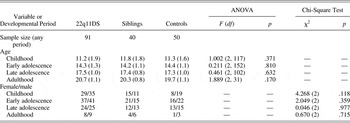
The majority of participants (87 of 96 individuals with 22q11DS) were evaluated at multiple time periods between 2002 and 2012, although we allowed the inclusion of participants with a single PAS datapoint (n = 9) in order to increase the sample size. The age ranges for the three periods across all participants were between 8.9 and 16.0 (Time 1), 12.1 and 19.9 (Time 2), and 15.1 and 24.1 (Time 3). There were no significant differences in the baseline age, full-scale IQ (FSIQ), childhood total PAS, or gender of participants with 22q11DS who returned for subsequent visits compared to those who did not come back for follow-up: Time 2: age, t (79) = 0.118, p = .906; gender, χ2 = 0.865, p = .352; childhood total PAS, t (62) = 0.549, p = .585; or FSIQ, t (79) = –1.069, p = .288; Time 3: age, t (82) = –0.289, p = .773; gender, χ2 = 1.391, p = .238; childhood total PAS, t (62) = 0.274, p = .785; or full-scale IQ, t (82) = –1.065, p = .290. This indicates that our Time 1 sample is broadly representative of our later samples on clinical and demographic variables. Table 1 shows the demographic characteristics of the participants.
Demographics

Note: The data were organized according to developmental periods, as defined in the PAS. The 22q11DS sample excludes participants who presented with prodromal or overt psychosis at baseline. ANOVA, Analysis of variance.
Measures
Premorbid adjustment
Premorbid adjustment was assessed with the PAS (Strous et al., Reference Strous, Alvir, Robinson, Gal, Sheitman and Chakos2004). The PAS was conducted at every time point by two experienced doctoral-level clinicians. The intraclass correlation coefficient between the two raters was 0.97 across seven participants. Four developmental periods were assessed: childhood (through age 11), early adolescence (ages 12–15), late adolescence (ages 16–18), and adulthood (age 19 and above). The social domain of the PAS included items related to sociability, withdrawal, and peer relationships (during all four periods), and social–sexual aspects (during and after early adolescence). The academic domain focused on scholastic performance and adaptation to school from childhood through late adolescence. The adulthood PAS includes general items, covering topics such as education, employment, establishment of independence, social–personal adjustment, degree of interest in life, and global assessment of highest level of functioning achieved thus far. These items contributed to the adulthood total PAS score. The current report analyzes total, social, and academic domain scores. General items were not analyzed separately in the present study because most participants had not reached adulthood.
Intelligence
Participants who were 16 years old or younger completed the Wechsler Intelligence Scale for Children, third edition (Wechsler, Reference Wechsler1991). The Wechsler Adult Intelligence Scale, Third Edition (Wechsler, Reference Wechsler1997), was administered to participants 17 years of age or older.
Psychiatric evaluation
Psychotic symptoms were evaluated with the SIPS and the Kiddie Schedule for Affective Disorders and Schizophrenia for School-Age Children—Present and Lifetime Version (K-SADS-PL; Kaufman, Birmaher, Brent, Rao, & Ryan, Reference Kaufman, Birmaher, Brent, Rao and Ryan1996). The psychiatric data reported here was collected through the end of March 2014 as part of an ongoing (Time 4) evaluation of the longitudinal study of 22q11DS. When available, the Time 4 psychiatric data was included in the current report in order to maximize the accuracy of the diagnostic classification, because some participants in the study may have developed psychosis after the Time 3 assessment (i.e., in late adolescence or adulthood). If participants had not come for their fourth time point by March 2014, their Time 3 psychiatric data was used.
Genotyping
COMTVal158Met (rs4680) was genotyped in individuals with 22q11DS as previously described (Coman et al., Reference Coman, Gnirke, Middleton, Antshel, Fremont and Higgins2010). Briefly, the genotyping was conducted by ABI PRISM 5′ nuclease assay TaqMan®, or sequencing. The sequencing was completed via polymerase chain reaction, and the following primers were used: 5′ctcatcaccatcgagatcaa (forward) and 5′gatgaccctggtgatagtgg (reverse; Lachman et al., Reference Lachman, Veit, Faedda, Papolos, Morrow and Goldberg1996). The reactions included 5–20 ng DNA, 1 × TaqMan® universal PCRmaster mix (No Amp-erase UNG), 900 nM forward and reverse primers, 200 nM of the FAM labeled probe, and 200 nM of the VIC labeled probe in a 5 μl reaction volume. The polymerase chain reaction protocol included the following steps: 1 cycle of 95 °C for 10 min, followed by 50 cycles of 92 °C for 15 s and 58 °C for 1 min (on an ABI 9700 dual plate thermal cycle; Applied Biosystems, Foster City, CA).
Statistical analysis
PAS: General analysis approach
Each item of the PAS is rated on a 7-point Likert-type scale, ranging between 0 and 6, with 6 signifying the greatest impairments. The number of total items varies across the developmental periods, from four (in childhood) to nine items (in adulthood). In accordance with previous studies, ratio scores were calculated for each developmental period, taking into account the number of items for each period. For example, the total ratio for the childhood period was calculated as the sum of the scores across all four items, divided by the maximum possible total PAS score (in this case 24, based on 6 points for four items). For several participants, information for one or two of the items (for a given developmental period) was not available. In such cases, we adjusted the total possible score, and calculated the ratio only based on the available items, as in previous studies.
As part of the longitudinal study, participants came for evaluation up to four times. However, because the Time 4 evaluations are still ongoing, we analyzed only the Time 1, Time 2, and Time 3 PAS data (although, as described above, we drew upon subsequent Time 4 psychiatric diagnoses). In order to be consistent with previous literature on the PAS, we organized the participant data based on the four PAS-defined developmental periods (childhood, early adolescence, late adolescence, and adulthood) rather than on the time point during which the participants returned for evaluation. We adhered to the following rules when organizing data based on the developmental periods: (a) if a participant had scores for the same developmental period at two different time points (e.g., both Time 2 and Time 3), we only included the data from the latest time point (this was done in order to incorporate as much information as possible for a given developmental period); (b) for the participants who had enrolled in the study during the early adolescence period (after 11 years of age), we had obtained both childhood (i.e., retrospective) and early adolescence (i.e., current) PAS data at their first time point. In order to utilize as much information as possible, we included the childhood premorbid adjustment scores in further analysis, even though they were obtained for a developmental period that had already ended at the time of assessment.
The 22q11DS sample was subdivided into three groups: chronically poor, deteriorating, or good premorbid group, in accordance with the criteria developed by Haas and Sweeney (Reference Haas and Sweeney1992). Only participants with PAS scores for more than one developmental period were classified into a developmental trajectory group. Participants were included in the deteriorating PAS group if their total PAS ratio deteriorated more than 0.33 across the four developmental periods (from childhood to adulthood) and their final available PAS score was greater than 0.41. For participants with data from fewer than four developmental periods, proportional thresholds of 0.25 or 0.167 (for three or two developmental periods, respectively) were used. Participants who did not meet criteria for the deteriorating group were classified into the chronically poor or good PAS group. Participants with average total PAS scores (across all available developmental periods) greater than the median for the 22q11DS group (0.4167) and with baseline total PAS scores equal to or greater than 0.29 were categorized in the chronically poor premorbid adjustment group. The remaining participants comprised the good premorbid adjustment group.
Prodromal/overt psychosis classification
Participants were classified as having prodromal or overt psychosis if they had either prodromal symptoms (subthreshold psychosis) or a psychotic disorder. The diagnosis of psychosis was based on evaluation with the K-SADS-PL for all participants who had been evaluated through the end of March 2014. Seven participants with 22q11DS met criteria for a psychotic disorder. One additional participant with 22q11DS, who had not yet come back for Time 4 evaluation, had developed psychosis based on parental report (of hospitalization and diagnosis of psychosis), and was included in the group. Participants were classified as having prodromal symptoms if (a) they had a score of 3 or above on any of the five positive SIPS items (unusual thought content/delusional ideas; suspiciousness/persecutory ideas; grandiose ideas; perceptual abnormalities/hallucinations; and disorganized communication) at Times 2, 3, or 4 (if available); or (b) they had current or prior threshold psychotic symptoms based on the K-SADS-PL at Time 1 (because the SIPS was published subsequent to Time 1). In order to increase the sample size and statistical power, the participants with prodromal symptoms (subthreshold psychosis) and overt psychosis were combined into a single group, referred to as the prodromal/overt psychosis group (n = 20). Five additional participants met criteria at their initial assessment.
For participants in the prodromal/overt psychosis group, only PAS data collected prior to the development of the prodromal or overt psychotic symptoms was analyzed. This was done in accordance with previous research using the PAS, with the goal of avoiding potential confounding effects that psychiatric illness could have on the social and academic adjustment scores. A separate exploratory analysis described the PAS trajectories of the five participants with 22q11DS who had prodromal or overt psychosis at baseline.
Comparison of the PAS scores in 22q11DS, siblings, and community controls
To compare the PAS ratios across the three groups, we conducted univariate analyses of variance with independent factor Group (22q11DS, sibling, or community control) and dependent variable PAS Ratio (total, academic, or social domain) at each developmental level. Tukey post hoc tests were used to compare the PAS scores of pairs of groups.
PAS trajectories in the 22q11DS group
The participants were classified into each of three groups as described above (chronically poor, deteriorating, or good premorbid group). The number and percentage of individuals in the groups were summarized. The total PAS scores were averaged for each group at each developmental level to obtain the average group trajectory. In order to further characterize the timing and specific domain(s) of decline in the deteriorating group, paired t tests were conducted on the academic, social, and total PAS scores between (a) childhood and early adolescence and (b) early adolescence and late adolescence.
PAS scores and subsequent (prodromal) psychosis in 22q11DS
Univariate logistic regressions were used to test the association between PAS scores at each developmental level and subsequent (prodromal) psychosis. For each regression, the independent variable was PAS ratio (social, academic, or total at each developmental level) and the dependent variable was (prodromal) psychosis. Stepwise, multivariate logistic regression with PAS total, social, and academic domain ratios across childhood, early adolescence, or late adolescence as independent variables and (prodromal) psychosis as a dependent variable was conducted in order to evaluate which variable may be the best predictor of (prodromal) psychosis. A second stepwise, multivariate logistic regression was conducted in which we incorporated FSIQ at baseline and FSIQ change (along with the variables included in the original regression). The goal of this analysis was to evaluate whether IQ (rather than PAS scores) may be associated with conversion to (prodromal) psychosis. The association between PAS developmental trajectory (chronically poor, good, vs. deteriorating trajectory) and (prodromal) psychosis was evaluated with a Pearson chi-square test.
Furthermore, we wanted to explore the potential clinical utility of using PAS scores as predictor(s) to (prodromal) psychosis. Therefore, we conducted a receiver operating characteristic (ROC) curve analysis (Hanley & McNeil, Reference Hanley and McNeil1982), selected several thresholds for the variable that had emerged as best predictor from the stepwise, multivariate logistic regression described above, and calculated the corresponding sensitivity, specificity, positive predictive value (PPV), and negative predictive value (NPV).
COMT Val158Met genotype, PAS scores, and (prodromal) psychosis
The effect of COMT genotype on PAS trajectories in individuals with 22q11DS was evaluated using linear mixed-models analysis. The dependent variable was academic domain, social domain, or total PAS ratio. Independent variables included developmental period (childhood, early adolescence, and late adolescence), COMT, and Period × COMT interaction. Any significant interactions were followed up with independent samples or paired samples t tests.
Given the previously reported association of COMT and psychotic symptoms in 22q11DS, we also conducted ROC analyses and compared the areas under the curve (AUCs) for the PAS scores in the COMT genotype subgroups, and calculated the sensitivity, specificity, PPV, and NPV accordingly. The significance of the difference between the areas under the ROC curves for the two genotypic groups was evaluated via http://vassarstats.net/roc_comp.html.
Exploratory analyses
PAS scores and overt psychosis in 22q11DS
A secondary analysis, using overt psychosis as a group-defining characteristic, was also conducted in order to explore any associations with overt psychosis. However, it should be noted that this analysis is limited by the small number of participants in the overt psychosis group. The methods and results of these analyses are presented in the online-only Supplementary Materials.
Morbid adjustment scores
The PAS scores of individuals with 22q11DS who had psychotic symptoms at baseline were considered as morbid adjustment scores. Their scores at each developmental period were averaged and summarized separately. Because of the small number of individuals in this category (n = 5), no further statistical analyses were conducted.
Results
PAS scores in individuals with 22q11DS, siblings, and community controls
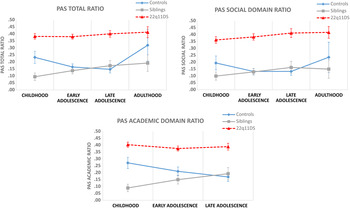
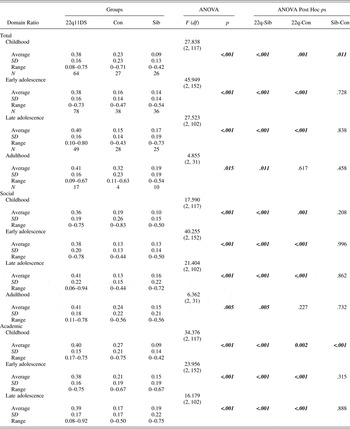
Univariate analyses of variance showed that total, social, and academic domain PAS ratios (Figure 1) differed significantly across the groups at all developmental levels (Table 2). The total, social, and academic domain ratios of individuals with 22q11DS were significantly higher than the PAS ratios of community controls and unaffected siblings (Tukey post hoc tests, Table 2). The childhood total and academic domain ratios were significantly higher in the community controls as compared to the siblings.
(Color online) PAS trajectories. Error bars indicate standard errors. The sample sizes (N) are listed in Table 2.

Premorbid Adjustment Scale scores
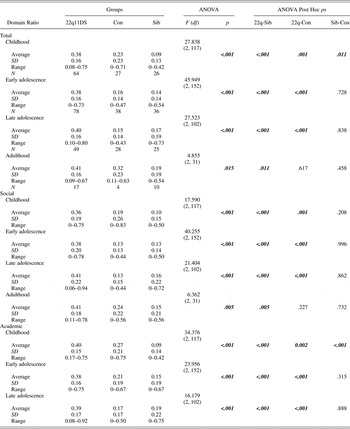
Note: Univariate analyses of variance (ANOVAs) with dependent variable: ratio (social, academic, or total at each developmental level), and independent factor group (22q11DS, sibling or control). Tukey post hoc p values show the differences between the groups (22q-Sib, 22q-Con, and Sib-Con). Significant p values (<.05) are in bold italic.
PAS trajectories in the 22q11DS group
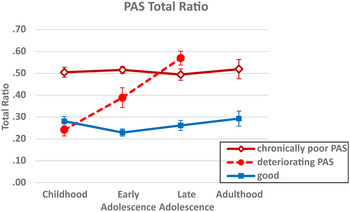
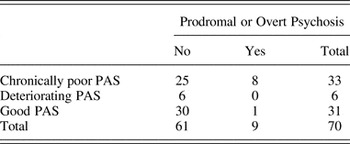
The majority of the participants with 22q11DS were categorized as having either chronically poor PAS scores (n = 33) or good PAS scores (n = 31). The deteriorating PAS group consisted of six individuals. The average total PAS trajectories for the three groups are shown in Figure 2. The deteriorating group had significantly higher total and social domain scores during late adolescence as compared to early adolescence as shown by paired t tests: total PAS, t (4) = –3.0, p = .040; social domain PAS, t (4) = –3.0, p = .039.
(Color online) PAS trajectories in 22q11DS. Error bars indicate standard errors.

PAS scores and subsequent (prodromal) psychosis in 22q11DS
PAS scores
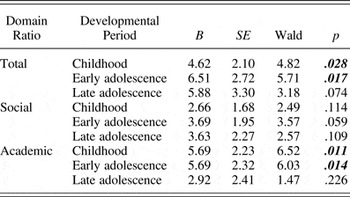
Univariate logistic regressions were used to test the association between social/academic/total ratios at each developmental level and subsequent prodromal or overt psychosis. Childhood and early adolescence total and academic domain scores were significant predictors of (prodromal) psychosis (Table 3). Stepwise, multivariate logistic regression with PAS total, social, and academic scores across the childhood, early adolescence, and late adolescence periods as independent variables, and (prodromal) psychosis outcome as a dependent variable was significant, and the early adolescence academic ratio was the only variable that remained in the model (p = .027). Childhood and early adolescence academic ratios are correlated (online-only supplementary Table S.3); thus, the results from the univariate analyses should not be discounted. The results of the stepwise, multivariate logistic regression remained significant even after FSIQ at baseline and FSIQ change were included in the model as independent variables (p = .043).
Univariate logistic regressions of Premorbid Adjustment Scale scores predictive of prodromal or overt psychosis

Note: Significant p values (<.05) are in bold italic.
PAS trajectories
The three PAS groups (chronically poor, good, and deteriorating) differed significantly in the rate of subsequent (prodromal) psychosis: Pearson χ2 (2) = 7.270, p = .026; Table 4). Individuals with chronically poor PAS scores had the highest rates of psychotic symptoms or psychosis at follow-up (24%), as compared to the deteriorating (0%) and the good (3%) PAS groups (Table 4).
Prodromal or overt psychosis in the Premorbid Adjustment Scale (PAS) trajectory groups

Note: Pearson χ2 = 7.270, df = 2, p = .026. Note that although a total of 20 participants with 22q11DS had (prodromal) psychosis at some point during the study, only individuals with at least two PAS data points prior to the development of psychotic symptoms could be included in this table because at least two PAS data points are needed in order to classify an individual into a PAS trajectory group. Thus, the following participants were not included here: 5 who had psychotic symptoms at baseline and 6 who had only one PAS data point prior to the visit at which they were found to have psychotic symptoms. This left 9 participants with 22q11DS and prodromal or overt psychosis group in the table.
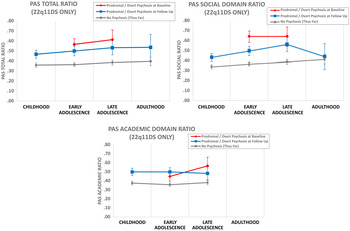
The PAS trajectories of individuals with 22q11DS who developed psychotic symptoms compared to individuals with 22q11DS who have not shown prodromal/overt psychosis thus far are shown in Figure 3.
(Color online) PAS scores in 22q11DS based on prodromal/overt psychosis. Error bars indicate standard errors.

Sensitivity/specificity/PPV/NPV
ROC curve analysis of the early adolescence academic domain ratio and prodromal/overt psychosis outcome was significant (AUC = 0.732, p = .018). Based on the ROC curve analysis in the overall 22q11DS sample, 0.4583 and 0.6250 were selected as thresholds for the early adolescence academic domain ratio. If the academic domain ratio was equal to or greater than 0.4583 during early adolescence, the sensitivity and specificity for subsequent development of prodromal or overt psychosis were 0.70 and 0.75, respectively, the PPV was 29.2%, and the NPV was 94.4%. Using the higher threshold of 0.6250 yielded a sensitivity of 0.30, a specificity of 0.97, a PPV of 60.0%, and an NPV of 90.4%.
COMT Val158Met genotype, PAS scores, and (prodromal) psychosis
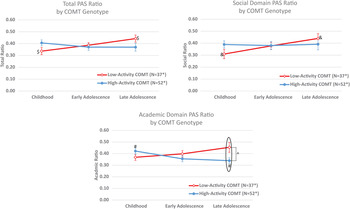
Linear mixed-models analyses in individuals with 22q11DS were significant (p < .001). There was a main effect of developmental period on the social domain PAS score (p = .040), and interactions between developmental period and COMT for the academic domain (p = .031) and total (p = .042) PAS scores. The interactions were followed up with independent samples or paired-samples t tests, and the significant findings are summarized in Figure 4. Briefly, the academic domain scores improved in the high-activity COMT group but not in the low-activity COMT group, and the PAS scores were poorer in the low-activity as compared to the high-activity COMT group during the late adolescence period. The social domain and total PAS scores deteriorated from childhood to late adolescence in the low-activity COMT group, while remaining stable in the high-activity COMT group.
(Color online) PAS trajectories based on the COMT genotype. *Each allele group has a different number of participants during the different developmental periods; the total number (N) includes the number of participants contributing data to at least one developmental period; p values of <.05 for the following comparisons: academic ratio: ^late adolescence A versus G allele: t = 2.302, p = .027; #childhood G allele versus late adolescence G allele: t = 2.210, p = .031. Social ratio: &childhood A allele versus late adolescence A allele: t = –2.370, p = .022. Total ratio: $childhood A allele versus late adolescence A allele: t = –2.500, p = .016.

Further ROC curve analysis showed that when the 22q11DS sample was divided based on COMT genotype, the ROC curve analysis of the valine (high-activity) COMT group (AUC = 0.858, p = .002) showed significantly higher AUC than the methionine (low-activity) COMT group (AUC = 0.397, p = .629; AUCVal–AUCMet = 0.461, z = 2.1, p = .03). Thus, sensitivity, specificity, PPV, and NPV were calculated for the high-activity COMT subgroup as well. Sensitivity and specificity analyses of the high-activity COMT allele subgroup resulted in the following values: for the threshold of 0.4583 (of early adolescence academic domain ratio): sensitivity = 0.75, specificity = 0.86, PPV = 54.6%, NPV = 94.1%; for the threshold of 0.6250: sensitivity = 0.38, specificity = 0.97, PPV = 75.0%, NPV = 87.8%.
Exploratory analyses
PAS scores and overt psychosis in 22q11DS
The results of analyses using overt psychosis group (vs. the rest of the individuals with 22q11DS, including participants both with and without prodromal symptoms) are described in the online-only Supplementary Materials.
Morbid adjustment scores
Five individuals with 22q11DS had psychotic symptoms at baseline. Their PAS scores were therefore considered as morbid adjustment scores and analyzed separately. The individual trajectories are summarized in the online-only supplementary Figure S.1, and the average is shown in Figure 3 (as the Prodromal/Overt Psychosis at Baseline group).
Discussion
In summary, we found impairments in the social and academic premorbid adjustment in youth with 22q11DS, and characterized the premorbid adjustment trajectories from childhood into adulthood. Furthermore, chronically poor premorbid adjustment in childhood and early adolescence was associated with subsequent risk of development of psychosis in youth with 22q11DS.
Previous studies of premorbid adjustment in individuals with 22q11DS have been conducted retrospectively, using cross-sectional samples. For example, Yuen et al. (Reference Yuen, Chow, Silversides and Bassett2013) studied adults with 22q11DS with and without schizophrenia, at an average age of 33.6, ranging between 18 and 58 years. PAS assessments were completed retrospectively with the information gathered from relatives of the individuals and prior medical and academic records. The authors found that deteriorating social and academic domain scores (from childhood to early adolescence) were associated with schizophrenia in adulthood. This finding differs from our current results, which suggest that chronically poor PAS scores in childhood and early adolescence are associated with a subsequent risk of subthreshold or overt psychosis. There are several experimental differences between the study of Yuen et al. (Reference Yuen, Chow, Silversides and Bassett2013) and our current study, which may contribute to the differing results, including: (a) experimental design (cross-sectional vs. longitudinal design), (b) participant exclusion criteria, (c) age of psychiatric assessment of the participants, and (d) psychiatric classification (overt psychosis only in Yuen et al., Reference Yuen, Chow, Silversides and Bassett2013, vs. both subthreshold and overt psychosis in the current study). The study of Yuen et al. (Reference Yuen, Chow, Silversides and Bassett2013) was cross-sectional and collected PAS data retrospectively. It is possible that the retrospective assessment of PAS may have been affected by recall bias or inaccuracy, especially because many years may have passed between the childhood period (5–11 years of age) and the time of the interview of the relatives regarding childhood symptomatology (e.g., up to 47 years later for the participant who was 58 at the time of assessment).
Another notable difference is that Yuen et al. (Reference Yuen, Chow, Silversides and Bassett2013) excluded 12 individuals with 22q11DS who had developed psychosis prior to the age of 16 (who comprise 22% of the individuals with psychosis in their study). This was done in order to avoid confounding of the PAS scores by symptoms of early onset psychotic illness. This exclusion criterion may have introduced bias toward studying individuals with later onset psychosis. In contrast, in our current study, we were able to include several participants (n = 6) with age of onset of prodromal/psychotic symptoms before the age of 16 (though it should be noted that we still were not able to include PAS data from five additional youths with 22q11DS who had already developed prodromal or psychotic symptoms at baseline). Thus, overall, our sample includes participants with earlier onset psychosis. This may account for the association that we found between chronically poor premorbid adjustment (in childhood and early adolescence) and prodromal/overt psychosis. It is interesting that childhood and early adolescence PAS scores were correlated. While the early adolescence scores were a stronger predictor for later conversion to prodromal/overt psychosis, the univariate logistic regressions suggest that both childhood and early adolescence are significant predictors of subsequent psychosis, so it is important not to discount the association between childhood scores and subsequent psychosis. Previous studies of childhood-onset (Eggers et al., Reference Eggers, Bunk, Volberg and Ropcke1999; Nicolson & Rapoport, Reference Nicolson and Rapoport1999; Russell, Reference Russell1994) and adolescent-onset (Joa et al., Reference Joa, Johannessen, Langeveld, Friis, Melle and Opjordsmoen2009) schizophrenia have suggested more protracted poor premorbid adjustment with insidious development of psychosis (as contrasted to adulthood-onset schizophrenia).
It is interesting that we found a significant effect of COMT and interactions between developmental period and COMT genotype on the PAS scores in individuals with 22q11DS through the linear-mixed models analysis. The total and social domain PAS scores deteriorated significantly in the low-activity COMT group from childhood to late adolescence. Furthermore, the academic domain PAS was significantly poorer in the low-activity (as compared to the high-activity) COMT group specifically during late adolescence, but not during prior developmental periods.
Because these findings are based on a relatively small sample and because previous studies of the role of the COMT gene in 22q11DS have yielded inconsistent results (Gothelf et al., Reference Gothelf, Eliez, Thompson, Hinard, Penniman and Feinstein2005; Monks et al., Reference Monks, Niarchou, Davies, Walters, Williams and Owen2014), the current finding of age effects on COMT, though intriguing and worthy of further discussion, are preliminary and will need to be replicated in a larger sample (Tandon et al., Reference Tandon, Gaebel, Barch, Bustillo, Gur and Heckers2013). Potential mechanisms underlying more pronounced effects of COMT genotype with increasing age may be related to interactions between COMT and sex hormones (Jiang et al., Reference Jiang, Xie, Ramsden and Ho2003; Xie et al., Reference Xie, Ho and Ramsden1999), and to increases in prefrontal cortical dopamine (Lambe, Krimer, & Goldman-Rakic, Reference Lambe, Krimer and Goldman-Rakic2000) and COMT enzyme activity (Tunbridge et al., Reference Tunbridge, Harrison, Weickert, Klienman, Herman and Chen2007) that have been observed during adolescence in both primate (Lambe et al., Reference Lambe, Krimer and Goldman-Rakic2000) and human (Tunbridge et al., Reference Tunbridge, Harrison, Weickert, Klienman, Herman and Chen2007) studies. Overall, the effects of COMT genotype on PAS were more pronounced during the late adolescence stage. It is conceivable that individuals with 22q11DS, the low-activity allele of COMT, and deteriorating PAS scores (in late adolescence) may be at an increased risk of developing subsequent psychosis during adulthood. However, this is speculative; follow-up into adulthood would be needed to determine if deterioration of PAS scores during late adolescence in the setting of the low-activity COMT allele may increase the risk of subsequent adulthood-onset psychosis. If this finding is confirmed, and replicated, it would suggest that COMT may be a differential risk factor based on age. That is, the high-activity allele may be more of a risk factor in childhood/early adolescence when accompanied by poor academic domain PAS, while the low-activity allele may be a risk factor in late adolescence/early adulthood. In line with this, our ROC analysis showed that poor early adolescence academic domain scores among the high-activity COMT allele group was associated with subsequent emergence of psychosis. In other words, if a participant had poor PAS scores despite having a potentially protective COMT allele (in the sense that the overall PAS trajectory for this genetic subgroup shows improvement according to our data), such a participant had an elevated psychosis risk. It is possible that in such cases, additional genetic or environmental risk factors may also contribute to poor PAS, and subsequent prodromal/overt psychosis. As discussed earlier, it is also conceivable that poor PAS scores in late adolescence in the low-activity COMT group may be associated with adult-onset psychosis, but the current longitudinal study would need to be expanded further into the future in order to address this question.
Our current study suggests that childhood and early adolescence premorbid adjustment could be a useful marker of subsequent prodromal/overt psychosis in youth with 22q11DS, and may be even more sensitive and specific when combined with COMT genotypic data. Several other variables have been associated with the risk of psychosis in 22q11DS. These range from additional genetic risk factors (hyperprolinemia in the setting of the low-activity allele of COMT), neuroimaging markers (volumetric changes in the temporal lobe, prefrontal cortex, and/or the dorsal cingulum), cognitive (decline in verbal IQ and childhood executive functioning), and behavioral factors (childhood odd/eccentric symptoms), to clinical psychiatric factors (such as depression, anxiety disorders, and/or transient psychotic symptoms at baseline; Antshel et al., Reference Antshel, Shprintzen, Fremont, Higgins, Faraone and Kates2010; Gothelf et al., Reference Gothelf, Eliez, Thompson, Hinard, Penniman and Feinstein2005, Reference Gothelf, Feinstein, Thompson, Gu, Penniman and Van Stone2007, Reference Gothelf, Hoeft, Ueno, Sugiura, Lee and Thompson2011, Reference Gothelf, Schneider, Green, Debbane, Frisch and Glaser2013; Kates et al., Reference Kates, Antshel, Faraone, Fremont, Higgins and Shprintzen2011; Raux et al., Reference Raux, Bumsel, Legallic, Bou, Drouin-Garraud and Lemarchand2007). Our current study adds the PAS as a valuable behavioral marker of subsequent prodromal/overt psychosis. However, the sensitivity and specificity of our best PAS predictor (early adolescence academic domain PAS) were not ideal: 0.70 and 0.75, respectively for a threshold of 0.4583, which increased to 0.75 and 0.86, when applied in the high-activity COMT subgroup. Ultimately, it may be most beneficial to incorporate multiple predictors in the same model. This approach could yield even better sensitivity and specificity. Such analyses may be best done in the context of larger longitudinal studies, with long follow-up times.
Limitations
Our results should be viewed in the context of potential limitations. Due to the relatively small number of participants who developed psychosis, we predicted to a combined sample of individuals with either prodromal or overt psychosis. Accordingly, the combined sample was heterogeneous. Another limitation is that we were unable to follow the scoring guidelines of the PAS that suggests excluding a period of 6 months prior to the onset of psychotic symptoms. Because children with 22q11DS often begin to exhibit very transient psychotic symptoms at an early age, it would have been difficult to know at what point they crossed a threshold of symptom severity to warrant the 6-month exclusion period. Accordingly, a potential limitation is that the presence of early symptoms may have confounded scores of functioning.
Our longitudinal study of 22q11DS is still ongoing. Based on a very large, multicenter, cross-sectional sample of individuals with 22q11DS, the prevalence of psychotic disorders seems to be the highest by the age of 35 (Schneider et al., Reference Schneider, Debanne, Bassett, Chow, Fung and van den Bree2014). Therefore, some of the participants in the current study may develop psychosis in the future, and follow-up evaluations would be invaluable. As noted earlier, none of the youth with “deteriorating” PAS scores in our current study have developed psychosis. Nevertheless, in light of the findings of Yuen et al. (Reference Yuen, Chow, Silversides and Bassett2013), these individuals may be still at risk for developing later onset psychosis. It would be important to continue to follow their premorbid adjustment trajectories and assess for possible association with the development of psychosis.
Conclusions
In summary, our current longitudinal study found impairments in the social and academic premorbid adjustment in youth with 22q11DS, with a large number of participants with 22q11DS with chronically poor PAS trajectories. Chronically poor childhood and early adolescence premorbid adjustment was predictive of subsequent development of prodromal symptoms or overt psychosis, especially in individuals with the high-activity COMT allele. Thus, PAS scores in combination with COMT genotype may be helpful in identifying individuals with 22q11DS, who are at higher risk for psychosis (although the influence of allelic variation of COMT will need to be replicated with larger samples). In addition, the low-activity COMT allele was associated with deterioration of social and total premorbid adjustment from childhood to late adolescence, and poorer academic premorbid adjustment in late adolescence. Future follow-up studies could evaluate whether the low-activity COMT genotype along with worsening PAS scores in late adolescence may be a risk factor for adulthood-onset schizophrenia in 22q11DS. Longitudinal studies of 22q11DS can contribute to the better understanding of the neurodevelopmental trajectory preceding the onset of psychosis, additional risk factors and biomarkers of psychosis, and can present a unique opportunity for early intervention prior to the onset of overt psychotic symptoms.
Supplementary Materials
To view the supplementary material for this article, please visit http://dx.doi.org/10.1017/S0954579416000018.