INTRODUCTION
Conversation analysis (CA) has become a powerful methodology for studying social interaction and its sequential organization in the social sciences and beyond, including sociology, anthropology, linguistics, communication, information, and computer sciences, as well as in applied linguistics. Over five decades of interactional research, the discoveries of the classical studies have been confirmed time and again. Their robustness is unusual in the social sciences and bears witness to the quality of CA's rigorous methodology. The perseverance of its foundational studies has enabled the field to develop a cumulative body of results that serves as an analytical resource to describe the lived social order. Over the years, its scope has broadened considerably with respect to
• Language. CA is now a well-established method of analysis for a large number of languages, including interlanguages. Many studies of second language use and acquisition have emerged in the last decade (Gardner & Wagner, Reference Gardner and Wagner2004; Hall, Hellermann, & Pekarek-Doehler, Reference Hall, Hellermann and Pekarek-Doehler2011; Nguyen & Kasper, Reference Nguyen and Kasper2009; Pallotti & Wagner, Reference Pallotti and Wagner2011). Likewise, studies of child interactions (Gardner & Forrester, Reference Gardner and Forrester2010; Kidwell, Reference Kidwell, Sidnell and Stivers2013) and of speakers with speech impairments (Antaki & Wilkinson, Reference Antaki, Wilkinson, Sidnell and Stivers2013) are becoming more frequent. Methodologically, this expansion of CA's object of study raises issues of comparison and comparability (Sidnell, Reference Sidnell2010), which we will discuss in section 3.
• Modality. Contemporary CA makes increasingly use of video recordings to expand the analysis of talk to embodied actions, participants’ mobility, spatial arrangements, and the role of the material environment (Goodwin, Reference Goodwin1981; Heath, Hindmarsh, & Luff, Reference Heath, Hindmarsh and Luff2010; Streeck, Goodwin, & LeBaron, Reference Streeck, Goodwin and LeBaron2011). Methodologically, the study of multimodality in interaction raises issues of transcription and coding, which will be explored in section 4.
• Social structure and psychological matters. While CA's object remains the organization of interaction as a social order sui generis, a growing body of research investigates dimensions of social context that standard sociology regards as interaction-external and matters of knowledge, cognition, and emotion that standard psychology considers as internal to individual minds. With respect to methodology, CA rejects causal or correlational models that treat social context and psychological matters as independent variables and interaction as the dependent variable. Instead, research interest focuses on the interactional methods through which participants make social context relevant (Heritage & Clayman, Reference Heritage and Clayman2010) and manage cognition (te Molder & Potter, Reference te Molder and Potter2005), epistemics (Heritage, Reference Heritage2012a, Reference Heritage2012b; Stivers, Mondada, & Steensig, Reference Stivers, Mondada and Steensig2011), and emotion (Peräkylä & Sorjonen, Reference Peräkylä and Sorjonen2012) as their local and situated concerns. These topics will be discussed in section 5.
BASICS OF CA
In this section we will introduce CA's methodological program. As in any proper CA contribution, we will base our argument on a recording of an interaction. Extract 1 is a transcription of a call to a movie theatre in which the caller inquires about the evening's program. The call was taped in the early 1970s and transcribed by Gail Jefferson. We have inserted a translation into normal orthography below the Jeffersonian transcription lines. For transcript conventions, see Appendix 1.
American Elephant, transcription by Gail Jefferson

The Sequentiality of Actions
CA's central interest is to describe and explain how participants achieve the organization of social action step by step in real time. Most seminal studies in first-generation CA (Lerner, Reference Lerner2004) built on telephone conversations, which allowed a sharp focus on the practices used for turn-taking and turn design.
• The call taker starts her turn in line 1 by self-identifying as a business, not as a person. DES does not wait for a caller identification (which is done in private calls), but proceeds immediately to offer her service. A contingent response by the caller is a response to this offer and not, for example, to self-identify in response to DES's self-identification. Of course, the next speaker is not bound to produce a contingent utterance. But if a next speaker produces a noncontingent utterance, this is regularly done in a recognizable and accountable way (e.g., saying “Hi mom” and redressing the call as private).
By designing the two first turn-constructional units in the way she does, DES sets the agenda for the talk (business), sets the type of relation that is expected (not personal), and creates the contingency for the next action.
• The second turn in line 2 latches on to line 1. This is marked in the transcription by equal signs at the end of line 1 and the beginning of line 2. Latching means that the next turn is not produced after one beat of silence (which is what speakers usually do) but starts precisely after DES has stopped talking. To be able to do this, the caller must project what DES is going to say and when her talk will end. Otherwise, we would either hear a delay or an overlap.
Note that the caller first acknowledges the question format in which the service has been offered (“yes”). Then the caller states her business, asking for the evening's movie program. At this point, the turn is given back to DES, and the delivery of information will be the next expected action.
The sequential structure of talk has a strong impact on sense-making. But how does a participant know what sense has been made? CA solves this issue by taking the viewpoint of the participants. How a previous turn has been understood becomes available in the next turn. Participants show their understanding of previous turns and actions in the way the next action is packaged. CA refers to this as “next turn proof procedure,” a core resource for the participants and equally for the analyst.
• In turn 3 (lines 4 and 5) DES delivers the requested information after a short delay and a lengthened speech perturbation uh::, which can be heard as the speaker having started on the response action but being presently unable to proceed with it. The turn proper is formatted in two parts, such that the first part is produced with rising intonation (indicated in the transcription by the question mark) and the second part with falling intonation (indicated by a full stop at the end of line 5). This format is a variety of what Jefferson (Reference Jefferson and Psathas1990) identified as a “list,” the common format for enumerations. Frequently, lists have three parts, of which the first two are produced with rising intonation and the last with falling intonation, which marks the end of the list. If DES had produced the second list part with rising intonation, a third part would have been expected.
A list is a prosodic practice for enumerations. CA is interested in a robust description of practices that participants use in regular ways in any interaction and that are expected to be recognized as what they are by other speakers. Interactions proceed by speakers deploying practices that are tailored (recipient-designed) for specific other participants, allowing them to make sense of the ongoing action and project the ongoing turn's further course. In line 5, the caller could take the falling intonation of the list as indication that this is what is “playing tonight” and that DES had delivered the information that the caller had asked for. In this case, however, the speech delivery by DES has consequences for what comes next.
Repairing Trouble in the Talk
Although the design of a turn and the sequential environment in which it appears narrow down possible meanings, understanding (intersubjectivity) can still fail. Participants have systematic procedures at their command to repair intersubjectivity. In line 7, the caller formulates precisely where her understanding has faltered An’ ih- merican what? She repeats DES's previous utterance (line 5) up to the word she did not understand. With this turn format, the caller puts it to DES to repair.
Line 9 shows the repair proper, followed by the current speaker's self-repair. Both repair initiations in lines 7 and 9 are slightly delayed, which CA has shown to be common. The preference for self-repair is indicated by a delay between a trouble source and a repair initiation to give the current speaker a possibility to repair him- or herself.
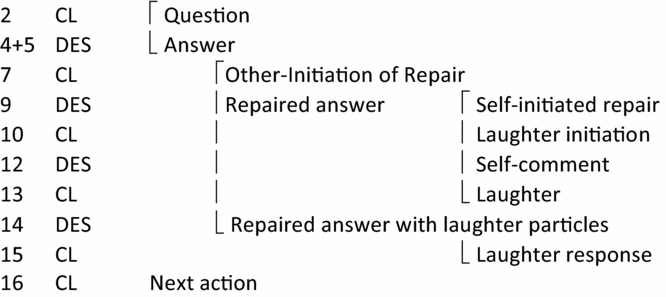
Sequentially, DES's answer in lines 4 and 5 is challenged by CL's repair initiative. The repair proper is then self-repaired in line 9, followed by laughter. DES reestablishes the main business of the talk by finishing the repaired version of the answer in line 14, after which the caller can do a next action or end the business. Structurally, the sequence looks like the diagram in Figure 1.
Development of the repair sequence

Repair activities establish side sequences through which a new version of the preceding action is established.
Figure 1 also shows the architecture of laughter that Jefferson described in several publications (Jefferson, Reference Jefferson and Psathas1979, Reference Jefferson, Atkinson and Heritage1984, Reference Jefferson and van Dijk1985; Jefferson, Sacks, & Schegloff, Reference Jefferson, Sacks, Schegloff, Button and Lee1987). Jefferson has shown that certain forms of laughter are built as laughing with each other, while laughter in relation to troubles telling is not responded to by the other participants.
The caller starts laughing exactly at the point where DES has repaired the trouble source.

Note that DES's first repair uses the format that CL produced in her repair initiation (An’ ih- merican what? — American Elephint). DES's following self-repair ties back to the format of her answer in line 4 by starting the unit with the definite article. She thereby reestablishes what she is going to say as a repaired version of what she had said in lines 4 and 5. Caller's laughter is responded to in line 14 by DES producing laughter particles in her answer.
Analytic Practices in CA Research
In the preceding section we have illustrated the main topics in basic CA (Sidnell, Reference Sidnell, Sidnell and Stivers2013)—turn-taking, turn design, sequence organization, repair, and preference structure. Preference structure is a technical term that refers to the next actions, for example, responses to a previous utterance. Preferred utterances align with the project established by the immediately preceding turn (such as accepting a request, offer, or invitation) and are (in the case of actions with polar question format) type conforming (Raymond, Reference Raymond2003). They are normally produced without delay, whereas dispreferred second actions are delayed and mitigated (Heinemann, Landgrebe, & Matthews, Reference Heinemann, Landgrebe and Matthews2012; Schegloff, Reference Schegloff2007).
CA's program is to understand order in talk as brought about by the participants as a situated accomplishment. Participants use generic methods for organizing turn production and turn allocation and to secure intersubjectivity through repair procedures. The research procedure follows several well-defined methodological steps:
• CA collects naturally occurring data, that is, data in which participants do whatever consequential business they do. The price for studying the living social order in situ is low standardization and comparability on the level of the interaction. However, CA is very concerned about standards and comparability on the level of social practices (see section 3).
• Collected data are transcribed according to notation rules, which have become increasingly detailed in order to support an expanding range of analytic projects (see section 4).
• Data analysis typically starts in data sessions (Antaki, Biazzi, Nissen, & Wagner, Reference Antaki, Biazzi, Nissen and Wagner2008; Bushnell, Reference Bushnell2012) where data segments are discussed in great detail after viewing and listening to them repeatedly. Typically, data segments are broken down into actions, and close attention is given to how actions are packaged and turns designed. Data sessions serve to search for new phenomena (Schegloff, Reference Schegloff1996) or for instances in which well-known phenomena are used in a specific (e.g., institutional) environment. This is often referred to as unmotivated looking.
• Following a data session, the researcher will build up a collection of comparable instances and develop a precise description of the phenomenon. In order to achieve analytic generalization (ten Have, Reference ten Have2007, pp. 149–151), collections need to draw on a variety of data. The size of the collections varies depending on the frequency of particular actions or practices in available corpora. In recent years, CA has achieved more solid data support, especially in specific fields such as health care. This allows researchers to use statistical methods in the descriptions of more frequent interactional phenomena. Deviant cases that run against what has been described generate special interest for the understanding of the phenomenon and may lead to radical changes of the description.
CA TRANSCRIPTIONS: FEATURES OF TURN DELIVERY
In many social sciences, transcription of data is common. Most often, researchers are interested in what is said in the interview or in the focus group interaction. CA transcriptions are principally different since they are equally concerned with how something is said (Hepburn & Bolden, Reference Hepburn, Bolden, Sidnell and Stivers2013; Jenks, Reference Jenks2011).
CA transcribers annotate interactional details of turn delivery and turn reception in the transcription, which is the basis for working systematically with these interactional details. As we will show in this section, transcriptions have evolved from capturing details of speech delivery to relating speech delivery to embodied features and features in the environment. From describing “talk in interaction” (Psathas, Reference Psathas1994), CA has moved to analyze interaction in its ecological situatedness. Transcripts should be seen as consistent field notes of interactional features.
Features of speech delivery have been mentioned several times in the previous discussion. A comparison of Jefferson's transcription in Extract 1 and the added orthographic version shows a range of features of speech delivery that are not represented in standard orthography, for instance, lengthening, latching, pitch, loudness, intonation contours, cutoffs, sublexical elements such as uh or uhm, and laughter tokens.
In her last article, Jefferson described her work procedure in detail. She took her point of departure in a transcription of a therapy session produced by Harvey Sacks. Here is a segment of Sacks's transcript and Jefferson's commentary.
Now, one of Sacks’ themes was a notion of “interactional machinery”; of assembling complex activities out of “standardized parts” (Sacks, 1995, vol. I, lecture 5:159). And he offered an image, that of a “culture as a warehouse” (Sacks, 1995, vol. I, lecture 21:425) where, then, to assemble this or that interactional machine, one would go through the warehouse picking up the various parts one needed.
As it happens, laughter was not something Sacks spoke of as one of those assembled machines. So, e.g., the reference to the ‘machinery’ occurs in a discussion of such ‘tying rules’ as ‘lister terms’ (“first of all,” “secondly,” etc.). The ‘warehouse’ reference occurs in a consideration of the systematic ways in which ‘discussion’ can lead to ‘argument.’ And he certainly never spoke about how or why he transcribed laughter as he did; it was just something he did. But when I saw his transcripts, there it was: The laughter machine! Especially in that “ha”+ “ha”+ period (line 12 above).
What an image! Moving through the warehouse, picking up a “heh” here, a “ha” there. That transcript did it for me! Thereafter, in my own transcripts, I sought to capture the various ‘parts’ out of which some actually-occurring spate of laughter had been assembled. (Jefferson, Reference Jefferson2010, p. 1477)
Jefferson has shown in her own work how detailed transcripts allow the understanding of specific interactional practices: Detailed transcription makes available how the architecture of laughter is built by the co-participants in producing, monitoring, and coordinating the production of laughter tokens element by element.
The main role of detailed transcription is to make features noticeable.
The level of granularity at which noticing is done matters not only for the social actors being studied, but for us as investigators as well; so too at what level the observed or noticed world is being described. . . . Knowing how granularity works matters then not just substantively, but methodologically. (Schegloff, Reference Schegloff2000, p. 719)
For CA research, transcriptions are obviously not what is studied. Transcriptions are coding and noting devices to access information about the recordings. The critical stance to the “objectivity” of transcriptions taken by Ochs (Reference Ochs, Ochs and Schieffelin1979) and Bucholtz (Reference Bucholtz2000, Reference Bucholtz2007, Reference Bucholtz2009) is shared by CA practitioners who would argue that the availability of the recording at least partly balances the choices made in the setup of the transcription. A number of tools have been developed to allow the researcher to listen to and view the recordings at any time. Modern electronic transcription (MacWhinney & Wagner, Reference MacWhinney and Wagner2010) editors, such as CLAN, ELAN, EXMARaLDA, and Transana, link segments of the transcription to the corresponding segments of the audio and/or videofile. By clicking on the transcript, the data file will be played.
The main development in recent years has to do with how mobility and embodiment are related to the transcript. The complexity of fully embodied interactions is so great that not everything can be added to the transcription without compromising the transcript's value as research tool, but no standard solution has been reached at this point.
Goodwin and Goodwin (Reference Goodwin and Goodwin2012) have illustrated seating and movement as part of the transcription for many years. In the example below, interaction in a car is transcribed with references to the seating order in the car, video frames, and transcriber comments.
Goodwin, M. H., & Goodwin, C., “Car talk: Integrating texts, bodies, and changing landscapes”; in: Semiotica, vol. 191, 2012, pp. 257–286.
More detailed is Nevile (Reference Nevile2012), who uses the transcript of the talk as the backbone for showing visual frames and comments. In the following example we see comments to the transcription, relations between the picture and the transcriptions, and stylized movements represented by arrows in the picture (p. 187).
Nevile, M., “Interaction as distraction in driving: A body of evidence”; in: Semiotica, vol. 191, 2012, pp. 169–196.
Laurier's (Reference Laurier, Haddington, Mondada and Nevile2013, p. 219) solution follows conventions known from graphic novels and comics. The protagonists’ talk is in a bubble, and the transcriber comments are in the corners of the pictures. Not all the details of speech delivery, for example, pauses, gaps and, overlaps—as known from the Jefferson tradition—can be shown in this format.
Laurier, E., “Before, in and after: Cars making their way through roundabouts”; in P. Haddington, L. Mondada, & M. Nevile (Eds.), Interaction and mobility. Berlin, Germany: DeGruyter, 2013, pp. 210–242.
COMPARISON IN CA
As suggested in the previous section, comparison is a fundamental analytical strategy in CA, as it is in other sciences. Comparing and contrasting objects allow us to establish patterns, regularities, or rules and to find out which patterns are stable and which are more sensitive to local particulars. Through comparing individual instances, the structure of the object becomes increasingly sharper, so that it is possible to determine which cases are members of a more distinctly defined collection and which are not, and to identify subcategories of the phenomenon. Deviant cases—instances that cannot be subsumed under the proposed regularity—are compared to the good exemplars of the provisional pattern to probe whether the tentative account can be confirmed or needs to be expanded or revised. The analytical strategy bears similarities to theoretical sampling, analytic induction, and the constant comparative method in grounded theory (for a recent update, see Charmaz, Reference Charmaz2014; for application to CA, see ten Have, Reference ten Have2007).
Comparison in CA is distinctive in that objects are considered in their sequential contexts, that is, in their position in a turn, sequence, or larger activity. An example from basic CA will serve as illustration. The response particle oh, either as free-standing or followed by other turn components, works as a generic practice to mark the speaker's change of epistemic state (Heritage, Reference Heritage, Atkinson and Heritage1984). When preceding responses to questions, oh casts the question as inapposite (Heritage, Reference Heritage1998), while in responses to assessments, oh indexes the speaker's independent epistemic access to the matter that is being evaluated (Heritage, Reference Heritage, Ford, Fox and Thompson2002). The practice of oh as an epistemic stance marker gains further analytical contour when compared with response tokens that are used in the same sequential position but do different interactional work, such as Yeah and Mm, which register acknowledgment of the prior turn (Gardner, Reference Gardner2001), or Right, which marks an epistemic dependency between two chunks of information (Gardner, Reference Gardner2007). Comparison of the phonetic shapes of oh in the interactional contexts described above shows that the practices of oh as a cognitive and epistemic state marker (Heritage, Reference Heritage, te Molder and Potter2005) are associated with distinct segmental and prosodic configurations. In contrast, when signaling that the received information is unexpected, oh receipts occur in different local contexts and have a different prosodic format. Local (Reference Local, Couper-Kuhlen and Selting1996) observed that when working as a marker of surprise, oh is formatted with high, wide-range, rising-falling pitch and prefaces an explicit formulation of how the received information was unexpected. Wilkinson and Kitzinger (Reference Wilkinson and Kitzinger2006) showed how displays of surprise with oh and other tokens are set up through prior talk. Comparative analysis of linguistic forms in their positions in sequences and turn structure, and of their phonetic shapes in these environments, reveals the kind of interactional work that such resources do to accomplish actions and stances—in other words, how they work as social practices.
Several current lines of research exemplify CA's trademark spin on comparative analysis. In the study of action formation in first-pair parts, comparison of morphosyntactic request formats in personal telephone calls and calls to physicians shows that the distribution of the forms Can/Could you and I wonder if displays speakers’ orientation to entitlements and contingencies for granting the request (Curl & Drew, Reference Curl and Drew2008). Research on social epistemics (e.g., Stivers et al., Reference Stivers, Mondada and Steensig2011) has drawn attention to the epistemic stances embodied in alternative formats of polar questions and their implications for sequence development. Questions (aside from display or known answer questions) construct the recipient as knowing and the questioner as not knowing regarding the matter addressed in the question. But questions with different syntactic formats construct the epistemic gap as wider or narrower and project different types of uptake. The unknowing stance indexed with interrogative syntax (do you smoke?) projects an elaborated response and possible sequence expansion, whereas formats displaying greater commitment to an expected answer, such as declarative syntax + question tag (You smoke, don't you?/You don't smoke, do you?) and declarative syntax (You smoke) tend to generate confirmation and sequence closure (Heritage, Reference Heritage2012a; Heritage & Raymond, Reference Heritage, Raymond and de Ruiter2012). Studies examining how emotion and affect are constructed in interaction (Peräkylä & Sorjonen, Reference Peräkylä and Sorjonen2012) have contributed new insights on the role of prosody as a marker of affective stance. Maynard and Freese (Reference Maynard, Freese, Peräkylä and Sorjonen2012) compared the prosodic formats with which good and bad news is delivered and responded to in several corpora of telephone conversations. They found characteristic (but not determinative) feature clusters that embody a stance of happiness in the delivery and receipt of good news and a stance of sorrow in bad news sequences. Comparative analysis of action formats reveals how morphosyntax and prosody work to construct social, epistemic, and affective stance in talk and participate in advancing the interaction.
Cross-Linguistic and Cross-Cultural Comparison
Conversation analysts have been reluctant to take up a cross-cultural and cross-linguistic approach because CA does not share the premise of standard social science that interaction varies fundamentally according to sociostructural and cultural context, a key difference between cross-cultural pragmatics and comparative CA (Schegloff, Reference Schegloff, Luke and Pavlidou2002, Reference Schegloff and Sidnell2009; Sidnell, Reference Sidnell2009). However, when Zimmerman (Reference Zimmerman1999), in a programmatic proposal for CA in the new millennium, called for “horizontal comparison,” he specifically advocated the development of cross-linguistic and cross-cultural directions in CA. These lines of comparison bring to light how participants solve generic interactional problems with different linguistic and cultural resources. They offer evidence of interactional practices that are universal and variable across languages and cultures, and critically contribute to building a theory of interaction that is both robust and rich in detail.
In his commentary on a recent collection of cross-linguistic and cross-cultural CA studies, Schegloff (Reference Schegloff and Sidnell2009, p. 378) recommended the following analytical steps for comparative CA:
1. State explicitly your understanding of what the target phenomenon or practice is.
2. Ask whether the same features that constitute the phenomenon or practice can plausibly be expected to hold in the new environment(s) in which you will be examining it/them; if not, say what should be taken as recognition criteria in the new environment.
3. Describe the ways in which the new environment(s) are like, or different from, the environment(s) in which the target of inquiry has previously been examined, and assess whether there is a robust basis for comparability.
4. Specify what makes the phenomenon or practice to be examined of interest, and what is to be gained by pursuing it/them in these different environments.
Most, but not all, of the published comparative studies implement these criteria.
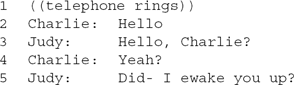
In the earliest cross-cultural study, Moerman (Reference Moerman1977) found “detailed, systemic, and massive parallels” (p. 875) in the organization of repair in Thai–Lue interaction and the repair organization that had been established on the basis of American and British English data (Schegloff, Jefferson, & Sacks, Reference Schegloff, Jefferson and Sacks1977). Several books compare the openings and closings of telephone calls across languages and settings (Hopper, Reference Hopper1992; Luke & Pavlidou, Reference Luke and Pavlidou2002; Thüne & Leonardi, Reference Thüne and Leonardi2003). The methodological challenge of such work is to maintain CA's emic perspective, that is, to ground analytical claims in the participants’ visible orientations. To take telephone openings as an example, the problem for the participants is how to get from a state of no contact to talk about the purpose of the call. The earliest CA work established the generic solution to this generic interactional problem—a progression through summons-answer, identifications, greetings, and how-are-you sequences (Schegloff, Reference Schegloff1968, Reference Schegloff and Psathas1979, Reference Schegloff1986). As we saw in Excerpt 1, participants calibrate the generic, context-free opening organization in context-sensitive ways that orient to the purpose of the call (and possibly other matters). From a cross-linguistic and cross-cultural perspective, the analytical task is to show how the participants achieve to open the call (a) while hearably orienting to the local contingencies—the task for any CA—and (b) how they do so with linguistically and culturally distinctive resources—the specific task for comparative analysis. For instance, in the standard opening for personal phone calls in the United States, answers to the summons (line 2) and call taker identification (lines 3 and 4) are done in separate turns:
(Schegloff, 2002, p. 267)
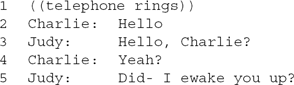
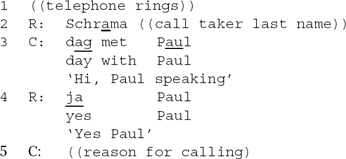
In other cultural settings, as in the Dutch segment below, the called party answers the phone by saying his or her name. The two actions of answering the summons and call taker identification are wrapped into one (here a one-word) practice.
(adapted from ten Have, 2002, p. 236)
In both the English and Dutch openings, the caller shows in line 3 that he or she recognizes the call taker, but how the caller does so is based on different kinds of evidence. In the English data, the evidence available to Judy is Charlie's voice in his initial “hello,” while in the Dutch data, the evidence is Mr. Schrama's self-identification with his last name.
Recent cross-linguistic and cross-cultural CA extends to studies with anthropological, interactional linguistic, and sociological orientations, such as work on person reference across a range of cultural settings (Enfield & Stivers, Reference Enfield and Stivers2007). Two methodological directions can be seen in this growing body of literature. The first, more prevalent approach is to select for comparison a practice or action and investigate how the phenomenon is implemented in two or more different languages. Researchers conduct separate collection-based analyses of the object, with CA's mandatory attention to the sequential environment(s) in which the object occurs; its formal features, such as lexical forms, syntactic properties, prosodic contours, and temporal features of turn composition; and the interactional consequences that the action or practice has for the participants. The outcomes of the emic analyses are then brought together in an etic analysis that enables researchers to demonstrate—and document in detail in the research report—how participants accomplish the action or practice with the resources of the different languages, and what cross-linguistic or cross-cultural variation may be in evidence. Earlier comparative analysis in this vein includes studies of causal markers (Ford & Mori, Reference Ford and Mori1994) and same-turn self-repair (Fox, Hayashi, & Jasperson, Reference Fox, Hayashi, Jasperson, Ochs, Schegloff and Thompson1996) in English and Japanese, and contrastive connectives in the organization of dispreference in Korean, Japanese, and English (Park, Reference Park, Jucker and Ziv1998). Current work targets phenomena in more narrowly circumscribed sequential contexts. Examples are minimal acknowledgment tokens in Korean and Japanese that are produced in response to a preceding minimal acknowledgment token (Hayashi & Yoon, Reference Hayashi, Yoon and Sidnell2009); repair initiations that target underspecified nonpersonal reference and are implemented with Was denn. Was. in German and What. in English (Egbert, Golato, & Robinson, Reference Egbert, Golato, Robinson and Sidnell2009); and sentence-final particles in polar questions as displays of epistemic stance in Dutch, Lao, and Tzeltal Mayan (Enfield, Brown, & de Ruiter, Reference Enfield, Brown, de Ruiter and de Ruiter2012). In the most comprehensive comparative CA study to date, Dingemanse, Torreira, and Enfield (Reference Dingemanse, Torreira and Enfield2013) examined open-class other-initiations of repair (huh? What?) in 12 languages. They found that an interjection such as huh in English is used in all languages and has a very similar phonetic shape: a monosyllable with an open back vowel and (mostly) rising intonation. Question words similar to what are another prevalent practice, but their grammatical constraints and phonetic shapes differ substantially across languages, as does repair initiation with nonvocal bodily conduct.
The other, still emerging research direction seeks – through quantitative, possibly large-scale investigations – to establish to what extent an interactional practice is universal or linguistically and culturally variable. The quantitative analysis is built on the outcomes of prior standard CA that analyses the practice in corpora of each of the participating languages. In some sense, the two main steps resemble a sequential mixed-method design (e.g., Teddlie & Tashakkori, Reference Teddlie and Tashakkori2006). In a cross-cultural study examining how gaze direction is coordinated with vocal conduct in question-answer sequences, Rossano, Brown, and Levinson (Reference Rossano, Brown, Levinson and Sidnell2009) compared video-recorded dyadic interactions among acquainted participants in Italian, Yéli Dnye, and Tzeltal. Data were coded for participant role as speaker or recipient, main action done by the question, question type, presence or absence of a vocal and/or nonvocal response, and detailed features of gaze. Descriptive statistics and logistic regression revealed that question speaker gaze is far more consistent across the three cultural groups than question recipient gaze. The study offers evidence against the prevailing view that gaze is a cross-culturally valid indicator of recipiency. At the same time, Tzeltal participants, who do not use gaze as a consistent recipiency marker, draw on repetition response instead. The study thus confirms that recipient response systems are universally available interactional organizations that are implemented with culturally variable resources.
Fox et al. (Reference Fox, Wouk, Hayashi, Fincke, Tao, Sorjonen, Laakso, Fincke, Flores Hernandez and Sidnell2009) compared the site where same-turn self-repair is initiated in seven typologically diverse languages: Bikol, English, Finnish, Indonesian, Japanese, Mandarin Chinese, and Sochiapam Chiantec. For each language, instances of “simple” same-turn self-repair, that is, recyclings (“the biggest debate i- in our department”, Fox et al., Reference Fox, Wouk, Hayashi, Fincke, Tao, Sorjonen, Laakso, Fincke, Flores Hernandez and Sidnell2009, p. 66) and replacements (“I wish I’d had m- a camera earlier today”, Fox et al., Reference Fox, Wouk, Hayashi, Fincke, Tao, Sorjonen, Laakso, Fincke, Flores Hernandez and Sidnell2009, p. 66) without any further repair operation, were identified in existing corpora of natural spoken interaction. While simple recycling is much more prevalent than simple replacement across languages, their initiation sites were found to vary widely across languages. Using frequencies and chi-square statistics, the authors attribute the observed variation to differences in word length and syllable structure, which pose different structural opportunities for speakers’ self-initiation of repair (see also commentary by Schegloff, Reference Schegloff and Sidnell2009).
Stivers et al. (Reference Stivers, Enfield, Brown, Englert, Hayashi, Heinemann, Hoymann and Levinson2009) examined whether the norm for turn transitions with minimal gap and minimal overlap (Sacks, Schegloff, & Jefferson, Reference Sacks, Schegloff and Jefferson1974) applies to turn-taking in informal conversation in 10 languages: Danish, Dutch, English, Italian, Japanese, Korean, Lao, Tzeltal, Yéli-Dnye, and ≠Akhoe Hai//om. Multivariate analysis of response latencies in answers to polar questions showed that speakers in these languages generally avoid overlap and minimize silence between turns, with a unimodal response peak of 200 ms. The same factors account for turn delay (answering vs. not answering, confirming vs. disconfirming, visible vs. vocal-only responses, questioner gaze vs. no gaze) across languages. Cultural elaborations appear to be related to differences in overall conversational rhythm but not to typological differences in language structure. The findings strongly support the notion that the temporal characteristics of turn-taking are independent of language and cultural arrangements.
In sum, the body of comparative CA research with a major quantitative component is still small, and this is not surprising. The input for the statistical analysis requires robust CA findings from all included languages. Much work remains to be done to carry out such studies. At the same time, cross-linguistic and cross-cultural evidence is urgently needed in order to enhance our understanding of how social members around the world accomplish their interactional projects with their linguistic and cultural resources.
APPLIED CA
In an applied linguistics context, the term applied CA raises the question whether applied means the same as in applied linguistics. Applied linguistics is interdisciplinary: It draws on a range of other sciences and the humanities for theoretical and methodological resources and calibrates these resources to investigate its defining object, “language-related real-life problems” (Brumfit, Reference Brumfit, Cook and Seidlhofer1995; Bygate, Reference Bygate2005). CA, whether basic or applied, is not interdisciplinary but transdisciplinary. In applied CA, we do not see the diversity of epistemological perspectives and research methodologies that is characteristic of applied linguistics as a discipline. CA offers researchers across the social sciences and beyond a coherent, integrated theory and methodology of interaction, and a large body of research findings, that these researchers can take to investigate their discipline-specific topics and problems. Applied CA brings the principles, methods, and achievements of basic CA to bear on these concerns. For some applied research purposes, CA is combined with other methodologies.
Some types of applied CA have been practiced for several decades, and others are more recent arrivals. In the introductory chapter to his edited volume Applied Conversation Analysis, Antaki (Reference Antaki2011) proposed six types:
1. Foundational: respecifying an intellectual field of study
2. Social problem oriented: a perspective on macro-societal issues
3. Communicational: a complementary or alternative analysis of “disordered” talk
4. Diagnostic: correlating sequential features of talk with clinical disorders
5. Institutional: an illumination of routine institutional work
6. Interventionist: solving preexisting problems collaboratively
These strands are “applied” in two senses of the word (ten Have, Reference ten Have, McHoul and Rapley2001, Reference ten Have2007). The first five strands apply CA to explicate social phenomena with CA's conceptual and methodological apparatus (discussed below). They enable researchers to understand through CA's lens some aspect of social life that is conventionally studied in another discipline. The sixth strand applies CA's methods and findings to social intervention with the intent of improving current (mostly, professional) practices. The three most established strands—foundational, social problem oriented, and institutional applied CA—are discussed below.
Foundational Applied CA
Foundational applied CA brings CA's epistemology and its analytical principles and practices to bear on theories and concepts developed in other research traditions. CA “respecifies” these topics through detailed empirical studies of practical actions (Garfinkel, Reference Garfinkel and Button1991). (In section 6 we will describe how CA's perspective on language learning and development offers a noncognitivist approach to second language acquisition.)
The only institutionalized respecification program is discursive psychology (DP), a field that reconceptualizes psychology from several discourse-analytical perspectives. DP's most prolific branch applies CA to study standard cognitive and social-psychological topics such as memory, attribution, intention, emotions, attitudes, and social relations as actions and stances that people construct through their talk, whether or not they expressly talk about such matters (e.g., Edwards, Reference Edwards1997; Potter & Edwards, Reference Potter, Edwards, Sidnell and Stivers2013). This epistemological outlook has direct methodological consequences. Since psychological states and processes are not assumed to be hidden in people's minds, they need not, and indeed cannot, be made inferentially available through experiments or through elicited self-report in think-aloud protocols, survey questionnaires, or interviews. Rather, they are directly observable in the “rich surface of language and social interaction” (Edwards, Reference Edwards2006) in people's ordinary activities. Extract 1 shows how the participants together produce the “rich surface” of their talk as they pursue a transactional activity, and how a misspeaking transforms the matter-of-fact transaction into an occasion for shared laughter as a display of “positive affect.” Analytic attention to the “fine granularity” of talk (Schegloff, Reference Schegloff2000), not elicited from individual speakers under laboratory conditions but produced in naturally occurring interaction, reveals how exhibits of cognitive states and processes are interactionally generated and serve as interactional resources (te Molder & Potter, Reference te Molder and Potter2005).
An ongoing research program on social epistemics investigates how participants handle knowledge distributions among themselves through sequence organization and action formation (Heritage, Reference Heritage2012a, Reference Heritage2012b). This line of research brings into view the nexus of knowledge, social organization, and morality (Stivers et al., Reference Stivers, Mondada and Steensig2011). Based on substantial interactional evidence, Heritage (Reference Heritage2012a) proposed that the omnipresent knowledge asymmetries among participants work as an “epistemic engine” that propels sequences forward. At the same time, by managing epistemic status and stance, access, rights, and obligations in their activities, participants produce identities and social relations and reflexively invoke moral accountability (Heritage & Raymond, Reference Heritage and Raymond2005; Raymond & Heritage, Reference Raymond and Heritage2006; Wilkinson & Kitzinger, Reference Wilkinson, Kitzinger, Harré and Moghaddam2003). A parallel respecification project centers on emotion and affect in interaction. It advances insights into how lexical and grammatical resources, prosody, posture, facial expression, and body alignments contribute to producing emotional valence and intensity. Studies collected by Peräkylä and Sorjonen (Reference Peräkylä and Sorjonen2012) demonstrate that affective displays are thoroughly interactional, that is, they are bound up with action and activities, locally occasioned, and consequential for the subsequent talk.
Social-Problem-Oriented Applied CA
In social problem–oriented CA, the analytical focus turns to the interactional practices through which the participants treat social categories as relevant and asks how the participants produce power relations, inequality, and ideologies through their interactional practices. Earlier research showed how participants in different kinds of institutional talk constructed power imbalances through their actions and practices in courtrooms (Drew, Reference Drew, Drew and Heritage1992) and phone-in radio shows (Hutchby, Reference Hutchby1996). Recent studies on race in interaction investigated how participants reproduce and resist racial categorization in everyday talk (Whitehead & Lerner, Reference Whitehead and Lerner2009), manage reference to race in antiracist training sessions (Whitehead, Reference Whitehead2009), and construct and report racial insults in neighbor disputes and police interrogations (Stokoe & Edwards, Reference Stokoe and Edwards2007). A study of a related theme analyzed how friends in casual multiparty talk in Japanese invoke the category of foreigner and the ideology of nihonjinron (“theory of Japaneseness”) to account for whether people are expected to know their blood types (Suzuki, Reference Suzuki, Nguyen and Kasper2009).
A prominent area of social problem oriented CA is feminist CA, the application of CA to feminist scholarship on gender, sexuality, and discourse. Early CA studies under the sex difference approach to language and gender found correlations between gender and interactional practices, in particular asymmetrical distributions of interruptions, overlaps, and topic shifts in mixed-gender conversations (West & Garcia, Reference West and Garcia1988; Zimmerman & West, Reference Zimmerman, West, Thorne and Henley1975). This work is seen as problematic by contemporary feminist theory and CA, as both are critical of associating discursive practices with essentialist gender concepts. Poststructuralist and performative theories view gender and sexuality as social constructions and situated performances, yet neither group of theories comes with an associated methodology for analyzing in detail how gender and sexuality are discursively accomplished in everyday life. For a growing number of social scientists, CA offers a method of inquiry that enables them to pursue a feminist agenda in an accountable, rigorously empirical fashion (Ford, Reference Ford2008; Kitzinger, Reference Kitzinger2000, Reference Kitzinger2005, Reference Kitzinger2008; McIlvenny, Reference McIlvenny2002; Speer, Reference Speer2005; Speer & Stokoe, Reference Speer and Stokoe2011). Yet how exactly feminist CA practitioners may reconcile their sociopolitical interests with CA's requirement to bracket researchers’ preoccupations and ground analytical claims in the observable details of participants’ talk is a matter of ongoing debate. Speer (Reference Speer2005) recommended that feminist CA observe CA's requirement to ground analytical claims in participants’ visible orientations. Against the charge by poststructuralist discourse analysts that CA is unsuitable to explicate how ideology and power relations enter into talk (e.g., Billig, Reference Billig1999; Wetherell, Reference Wetherell1998), Speer adopted standard CA to examine how British young men (in interviews) construct different versions of masculinity from moment to moment as a matter of identity management. In an analysis of heterosexist talk (as a form of prejudicial talk more broadly), Speer showed how the participants use a range of interactional practices in order to defend their heterosexist comments from disaffiliative uptake, such as disclaimers (“I don't want to be a gay basher but”), retracting from an extreme case formulation, often attributed to third parties (“and there's sort of the erm (.6) presumption that they’re all gonna be butch and (0.4) stuff, but they’re not, a lot of them”), or showing concession (Speer, Reference Speer2005, chap. 6). By using these methods, the participants reflexively construct themselves as rational persons who orient to their own prejudicial talk as problematic. But the mundane heterosexism of everyday talk often goes unnoticed by participants. Stokoe and Smithson (Reference Stokoe and Smithson2001 turned to membership categorization analysis (e.g., Sacks, Reference Sacks, Gumperz and Hymes1972; Hester & Eglin, Reference Hester and Eglin1997; Hester & Hester, Reference Hester and Hester2012; Stokoe, Reference Stokoe2012a, Reference Stokoe2012b) to illuminate how participants construct heteronormative gender categories as part of their taken-for-granted cultural knowledge. Kitzinger (Reference Kitzinger2005) demonstrated how heteronormative assumptions become visible in alternative practices of person reference as a matter of recipient design. Kitzinger found that in medical after-hour calls, the physician, after agreeing to make a home visit, asked the caller for the patient's address by saying “Where do you live?” when the caller formulated the patient as “my husband” or “my wife.” When the caller referred to the patient as “my friend,” the physician said, “Where does she (or he) live?” The doctor's person reference in the question thus presumed that the patient and caller cohabited when they had been formulated as part of a family, and it did not presume coresidence when family relations had not been indicated.
Ford (Reference Ford2008) took feminist CA into a different direction. Her study on women's turn-taking in professional multiparty meetings is motivated by the observation that women's career advancement in traditional male settings is strongly skewed in their disfavor, and by the popular narratives that blame women's “communicative style” for their lack of success. The study makes no assumption that the women speak as women, and it does not examine the discursive construction of gender identity. Rather, it documents how the women in the meetings use multiple methods for gaining turns, manage multiturn units and disaffiliative actions, and coordinate vocal and nonvocal actions in their bids to speak. As Ford emphasized, the women's artful interactional practices are generic rather than gender specific. By gaining turns and shaping the course of the meeting through their actions, the women exert power in the local management of the setting. Ford's study contributes to feminist CA and offers a resource for feminist activism against workplace discrimination and the myth of women as different or deficient communicators. It also adds new knowledge of how multiparty meetings are organized, a topic of institutional CA.
Feminist CA contributes back to basic CA as well. Kitzinger (Reference Kitzinger2008) reported that she first noticed a particular turn shape that had not been reported in the CA literature in a seminar participant's coming-out action. In this turn format, parenthetical information is inserted between the “if” and “then” components of a compound turn-constructional unit.
(Kitzinger, 2008, p. 191)
The coming out (at the arrow) received no response from other participants. In Kitzinger's analysis, since the turn only reaches possible completion after the then-component, the embedded coming out is protected from getting a response. Based on the initial observation, Kitzinger assembled a collection of 300 instances of if-then structures from several UK and U.S. corpora. The data confirmed her analysis: in 90% of the cases, the next speaker took a turn just before or after the end of the then-component; that is, participants oriented to the trajectory of the compound structure. Kitzinger's observations in the context of feminist CA resulted in new findings on the relation between grammar and interaction. It illustrates that the traffic between applied CA and basic CA goes in both directions.
Finally, Kitzinger (Reference Kitzinger2008) also suggested how feminist CA practitioners can use feminist theory and concepts in their research while observing CA's requirement to ground analytical claims in the participants’ visible realities. The approach involves three stages:
1. Pre-analytic observations guided by feminist and LGBT concepts such as coming out or heteronormativity. The outcome of this process is a collection of candidate sequences that show evidence for the concept in the participants’ conduct.
2. Standard CA of the material in the collection. The outcome is a detailed account of the interactional practice or practices, for instance, when, how, and with what interactional consequences a speaker reveals that she is attracted to other women, or how participants show their normative assumptions about intimate relations and residential arrangements through their referential practices, as quoted above.
3. Post-analytic connections of the CA findings to feminist theory and political agendas.
When the research process is organized in this way, exogenous theory and sociopolitical objectives do not enter the data analysis, but they guide the building of a relevant data corpus, and they allow researchers to connect the outcomes of analysis with broader sociological and political themes. There is also a direct gain for feminist theory construction and social activism because the CA findings allow researchers to show that their concepts are alive in members’ ordinary social practices and so are demonstrably real for them.
The three-stage approach is transportable to other social domains. Talmy (Reference Talmy, Nguyen and Kasper2009) advocated engaging CA in critical research on second language education. In a study examining how the category of ESL student is produced in routine classroom interactions between students and the teacher, Talmy argued for “motivated looking” from a cultural studies perspective. Membership categorization analysis and sequential analysis bring to light how students and teacher construct and transform institutionally valued and rejected identities through recurrent interactional practices. The analysis is connected to language socialization theory and theories of cultural production through educational institutions, and supports and strengthens these theories by grounding them in the participants’ visible discursive practices. As Talmy commented,
M/CA can expand the critical agenda itself as these approaches provide the analytic frame and methodological means to investigate how racism, sexism, classism, homophobia, heterosexism, and ageism are variously instantiated, resisted, accommodated, reproduced, and/or transformed in the unfolding details of everyday life, that is, how power is interactionally achieved rather than an a priori given or foregone conclusion. (Talmy, Reference Talmy, Nguyen and Kasper2009, p. 206)
Institutional CA
Institutional CA examines how institutions are produced, maintained, and transformed through participants’ routine interactional work. This large body of research focuses on talk between professionals and lay clients and among professionals. More recently, studies have also turned to ask how novices develop professional interactional competencies. CA work on institutional interaction goes back to the late 1970s and 1980s. It includes seminal studies on classrooms (McHoul, Reference McHoul1978), courtrooms (Atkinson & Drew, Reference Atkinson and Drew1979), and medical consultations (Heath, Reference Heath, Atkinson and Heath1981). This early research and its offshoots laid some of the methodological groundwork to what became later known as the institutional talk program. Based on his studies of courtroom interaction, Atkinson (Reference Atkinson1982) showed how the dimensions of formality and informality are generated by the participants through distinct interactional practices. Atkinson's (Reference Atkinson, Atkinson and Heritage1984) analysis of political speeches brought to light how politicians methodically generate audience applause at specific moments in their speeches through finely coordinated vocal actions and shifts in gaze direction. Heath's work on doctor–patient interaction (Reference Heath1986) was the first to demonstrate how bodily action participates in the sequential and categorial organization of the medical consultation. But it was the publication in the early 1990s of two seminal edited volumes, Talk and Social Structure (Boden & Zimmerman, Reference Boden and Zimmerman1991) and Talk at Work (Drew & Heritage, Reference Drew and Heritage1992), that launched institutional CA as a distinct direction of inquiry. Since then, research under the institutional talk program has investigated how participants do the institutional work of the broadcast media; of legal, medical, and educational institutions; of various call centers and service providers; and of a range of workplaces (Heritage & Clayman, Reference Heritage and Clayman2010). Increasingly, institutional CA includes studies of multilingual workplaces (e.g., Vöge, Reference Vöge, Pallotti and Wagner2011), but this body of research is small and in urgent need of expansion.
The institutionality of talk becomes apparent when talk that pursues some institutional business is compared to ordinary conversation. In conversation, turn-taking is locally managed and party administered (Sacks et al., Reference Sacks, Schegloff and Jefferson1974); that is, the participants assume and assign speaker and recipient identities contingently as their talk unfolds. Whatever asymmetrical participation frameworks may emerge in concrete instances, the turn-taking system provides for equal access to speaking opportunities (Schegloff, Reference Schegloff1999). Actions are constrained by the interaction-internal context rather than external social structural factors. Conversationalists can address a wide, and in principle unpredictable, range of topics. Topic selection may be constrained by cultural, religious, political, and other considerations that participants orient to in choosing appropriate topics for their talk, but such constraints are not native to the generic activity of conversation. Finally, ordinary conversation requires competence in nonspecialized spoken language(s) as its primary linguistic repertoire. Although conversationalists do use registers associated with specialized topics and participant identities on occasion, such specialized talk is incidental to conversation as such.
Against the backdrop of ordinary conversation, institutional talk can be characterized as a distinct mode of interaction. Across a wide range of settings and activities, institutional talk shares three key properties (Drew & Heritage, Reference Drew and Heritage1992; Heritage & Clayman, Reference Heritage and Clayman2010):
1. Goal-orientation: Participants’ situated identities are relevant to the institutional purpose (doctor and patient, teacher and student, etc.).
2. Special constraints on allowable contributions: Speech exchange systems are highly variable across institutional activities. In formal meetings, the moderator allocates turns; in nonformal meetings at the workplace, access to turns may be organized in the same way as in ordinary conversation. In any form of interview, the interviewer asks the questions and the interviewee gives the answers; departures from the pre-allocated distribution of actions change the activity and require special dispensation (such as in employment interviews, where interviewers may ask the applicant towards the end of the interview, “Do you have any questions for us?”). Regardless of the speech exchange system, topics must be relevant to the meeting's agenda or the type and purpose of the interview.
3. Institution-specific inferential frameworks and procedures: The same interactional conduct may generate different inferences. In news interviews, medical consultations, or legal contexts, professionals tend not to display an affective or epistemic stance towards their clients’ contributions. In ordinary conversation, such withholdings would be seen as lack of attention, interest, or empathy, whereas in the institutional contexts, they are taken as proper displays of epistemic caution and professional neutralism.
CA of institutional talk observes the principles and procedures for analyzing ordinary conversation, but with the additional aim of demonstrating how participants orient to the specifically institutional properties of the interaction. In order to establish how the work of the institutional event under study gets done, analysts inspect the following places for whether and how the participants organize their conduct in institution-specific ways (Drew & Heritage, Reference Drew and Heritage1992; Heritage & Clayman, Reference Heritage and Clayman2010).
• Turn-taking organization: Is the distribution of turns participant-managed or pre-allocated? Is turn allocation tied to institutional identities? Is access to turns available to all participants or asymmetrically structured? The pre-allocation of turns to participants with particular institutional identities is a defining organizational feature of formal institutional talk. It has been documented extensively in studies of courtrooms (Atkinson & Drew, Reference Atkinson and Drew1979; Drew, Reference Drew, Drew and Heritage1992), teacher-fronted classrooms (Mehan, Reference Mehan1979; Seedhouse, Reference Seedhouse2004), and interviews conducted for a large range of institutional purposes, including news interviews (Clayman & Heritage, Reference Clayman and Heritage2002), medical interviews (Heritage & Maynard, Reference Heritage and Maynard2006), oral proficiency interviews (Ross & Kasper, Reference Ross and Kasper2013; Young & He, Reference Young and He1998), and standardized survey interviews (Houtkoop-Steenstra, Reference Houtkoop-Steenstra2000; Maynard & Schaeffer, Reference Maynard, Schaeffer, Mortensen, Wagner and Chapelle2012). In nonformal institutional talk, turn-taking is managed by the participants regardless of their institutional identities, for example, in unmoderated team meetings (Bilmes, Reference Bilmes2008; Vöge, Reference Vöge, Pallotti and Wagner2011) and conversations-for-learning (Hauser, Reference Hauser2008; Kasper & Kim, in press).
• Overall structural organization: Does the activity progress serially through particular ordered phases? For instance, primary care visits are organized into opening (problem presentation), data gathering (diagnosis), and treatment (closing) (Heritage & Maynard, Reference Heritage and Maynard2006). Pharmacy patient consultations advance through opening (greeting), orientation (advice giving), and preclosing (closing) (Nguyen, Reference Nguyen2008). The overall organization of the activity (prescribed in training manuals for medical and pharmacy students) is designed to get successive tasks done in an efficient and timely manner. CA research shows that the stages of the activities are an achieved order that the participants accomplish through their practical reasoning and coordinated actions.
• Sequence organization: Are there activity-specific sequences, such as the initiation–response–follow-up sequence in teacher-fronted classroom interaction (McHoul, Reference McHoul1978; Mehan, Reference Mehan1979)?
• Turn design: What actions are done in the turns, how are they implemented through linguistic and other resources, and what institutional relevancies do these turn shapes index? Robinson (Reference Robinson, Heritage and Maynard2006) showed that even ostensibly minor differences in physicians’ solicitations of patients’ medical problems display the physician's orientation to different reasons for the visit. Questions designed for soliciting new problems typically have the form “What can I do for you today?” Questions initiating a follow-up consultation are predominantly formulated with “How are you feeling?”, which requests that the patient evaluates the status of the follow-up complaint. For initial questions in chronic routine visits, the common format is “(so) what's new,” which allows the patient to report on the status of the routine concern but also bring up a new complaint if relevant.
• Lexical choices: How do participants make selections from institution-specific registers? Institution-specific registers are associated with professional identities and with epistemic access and authority. In interaction between professionals and members of the lay public, access to the institutional register is typically and often normatively limited to the professional. The epistemic status differential between professionals and lay participants is in no small measure reflected in and constituted through asymmetric access to the institutional register. Mishler's (Reference Mishler1984) early study of medical interaction pointed out that in the problem presentation phase, physicians have to reformulate the patients’ complaints from the “voice of the life world” to the “voice of medicine.” One of the difficult tasks for novice health care professionals is to learn how to recipient-design their turns to accommodate their patients’ understanding competencies. Nguyen (Reference Nguyen2012b) showed in a study of pharmacy consultations how pharmacy interns over time learned to use their pharmacological register sparingly and constantly monitored what the patient they were currently serving showed to understand or not to understand. Antaki et al. (Reference Antaki, Biazzi, Nissen and Wagner2008) and Bushnell (Reference Bushnell2012) examined how the participants in CA data sessions used CA register—in Bushnell's study, CA terminology in Japanese, Japanese-English, and English—to do the work of the activity and manage their institutional identities and community membership.
The places for probing institutionality enable analysts to identify in an empirically rigorous manner how institutions are “talked into being” (Heritage, Reference Heritage1984b, p. 290). When participants share a visual space, semiotic affordances in any kind of interaction expand dramatically to include vocal and nonvocal resources. In institutional activities, generic nonvocal devices such as gaze, gesture, body movement, and facial expression are also configured for doing specific institutional work. Objects, documents, and spatial arrangements add further complexities to the “contextures” (Goodwin, Reference Goodwin, Streeck, Goodwin and LeBaron2011) of institutional embodied interaction.
LEARNING AND DEVELOPMENT
As a second direction for comparative CA, Zimmerman (Reference Zimmerman1999) recommended vertical comparison, “studies of the acquisition of conversational structures” that aim to discover “the process and stages by which interactive talk emerges” (p. 198). The project is based on the premise that “acquiring a language is an irremediably social enterprise” that takes place in the presence of people and objects as co-participants and shapes the novice's emerging interactional competencies. There is no learning mechanism separate from or in addition to the sense-making procedures and interactional competencies through which social members, including very young children, manage their participation in social life. Language, culture, and interaction are learnable because they are on constant public exhibition in the “objective production and objective display of commonsense knowledge of everyday activities as observable and reportable phenomena” (Garfinkel & Sacks, Reference Garfinkel, Sacks, McKinney and Tiryakian1970, p. 342) and the “inferential visibility of moral conduct” (Edwards, Reference Edwards1997). Specifically, participants display their understanding to each other through the sequential emergence of turns. Wootton (Reference Wootton1997) therefore highlighted the crucial role of “sequential knowledge” in the development of action formats. Because participants unavoidably make their activities mutually intelligible moment by moment, interaction comes with a built-in learning mechanism that is visible to participants and analysts alike (Kasper, Reference Kasper2009).
Just as interactional competence can only be investigated through the close analysis of interaction that we described in sections 2 and 3, how children and other novices become interactionally competent in a language, culture, or social domain has to be documented in the details of participants’ talk and other conduct. In the first decade since CA's appearance in second language acquisition (SLA) in the mid-1990s (Firth & Wagner, Reference Firth and Wagner1997; Markee, Reference Markee, Tarone, Gass and Cohen1994, Reference Brumfit, Cook and Seidlhofer1995; Wagner, Reference Wagner1996), the dominating concerns were to show that second language (L2) speakers are normal speakers rather than deficient communicators (Firth, Reference Firth1996; Wagner & Gardner, Reference Wagner, Gardner, Gardner and Wagner2004) and to locate category incumbencies as “L1 [first language] speaker,” “L2 speaker,” and “L2 learner” in participants’ visible orientations (Brouwer, Reference Brouwer2003; Hosoda, Reference Hosoda2006; Kasper, Reference Kasper2004). With a critical impetus vis-à-vis interactional modification under the interactionist hypothesis (Long, Reference Long, Ritchie and Bhatia1996), studies predominantly focused on repair and correction in talk among L1 and L2 speakers in everyday activities (Brouwer, Reference Brouwer, Gardner and Wagner2004; Brouwer, Rasmussen, & Wagner, Reference Brouwer and Wagner2004; Egbert, Niebecker, & Rezzara, Reference Egbert, Niebecker, Rezzara, Gardner and Wagner2004; Kurhila, Reference Kurhila2001) and instructional settings (Hauser, Reference Hauser2005; Koshik, Reference Koshik2005; Markee, Reference Markee2000; Mori, Reference Mori2004; Seedhouse, Reference Seedhouse2004). In the main, recent studies aim to describe how participants accomplish learning as a social activity and how interactional competencies develop over time. These topics are investigated in L2 speakers’ interactions in three broad categories of setting: ordinary conversation and institutional encounters outside of language instruction (Biazzi, Reference Biazzi, Pallotti and Wagner2011; Ishida, Reference Ishida, Nguyen and Kasper2009; Reference Ishida, Pallotti and Wagner2011); instructional settings, including language classrooms and tutorials (Hellermann, Reference Hellermann2008, Ikeda & Ko, Reference Ikeda, Ko, Pallotti and Wagner2011; Mortensen, Reference Mortensen, Pallotti and Wagner2011; Seo, Reference Seo, Pallotti and Wagner2011); and hybrid forms such as conversations arranged for language learning (Hauser, Reference Hauser2008; Kasper & Kim, in press). In keeping with CA's stance on the analytical treatment of social context, settings and their potential as sites for learning and development are topics rather than resources for analysis.
Learning as a Social Activity
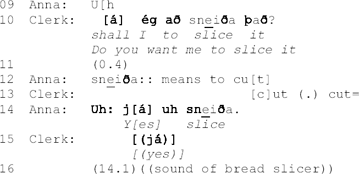
Studies under this rubric examine moments where the participants make learning the focal concern of their interaction (Koschmann, Reference Koschmann, Mortensen, Wagner and Chapelle2013; Lindwall & Ekström, Reference Lindwall and Ekström2012; Zemel & Koschmann, Reference Zemel and Koschmann2014) and where the learning activity is publicly displayed (Nishizaka, Reference Nishizaka2006, Reference Nishizaka2011). L2 speakers’ interactions in everyday encounters allow us to observe how the participants contingently generate learning opportunities while pursuing the activity at hand. Such observations require that (a) close attention be given to the detailed composition of the talk and other conduct and (b) analytical claims be grounded in the participants’ visible orientations. The L2 speaker of Icelandic in Extract 5 is studying abroad in Iceland. She has just made a successful request for a loaf of bread at a bakery.
Sliced bread (Theodórsdóttir, Reference Theodórsdóttir, Hall, Hellermann and Pekarek-Doehler2011b, p. 102)
In line 10, the clerk makes a routine offer to slice the bread. Rather than accepting or rejecting the offer as projected, Anna's next turn comes with a delay and does not respond to the offer. Instead she repeats the critical action verb, followed by a switch to English, in which she provides her understanding of the Icelandic word in English sneiða:: means to cut. With the standard definition format “X means Y,” Anna shows that she has some knowledge of the Icelandic syntax and word meaning, but that her knowledge is uncertain and in need of confirmation. By using a declarative polar question format, she constructs a shallower epistemic gradient (Heritage, Reference Heritage2012a) between herself and the clerk than she would have with a question such as “what does sneiða:: mean?”, which would show that she did not know the word. The clerk treats Anna's turn as a knowledge check and responds by repeating “cut” twice, as the first instance is produced in partial overlap with Anna's saying of “cut” as the turn-final element. Anna, but not the clerk, produces “cut” in the citation form that shows its grammatical category as a verb, “to cut.” By using the standard classroom practice of referring to English verbs with the infinitive marker to, Anna orients to language learning rather than only to clarifying an uncertain understanding. Following the clerk's confirmation, Anna's next turn reorients to the service transaction. After a turn-initial hesitation marker that provides Anna a moment to decide whether or not to accept the offer, she responds affirmatively with an acceptance token já, which gets an immediate confirmation from the clerk (line 15). Although the participants have collaboratively reoriented to moving the service transaction forward, Anna continues her turn by repeating sneiða. With the repetition, Anna may be taking another opportunity for practicing the lexical item, but the repeat also reaffirms her acceptance of the offer (cf. Kim, Reference Kim2012).
The main activity is structured as an offer–response adjacency pair. When Anna has trouble responding to the clerk's offer, she initiates a knowledge check sequence that is inserted into the base adjacency pair and is itself organized as an adjacency pair.
The completion of the insertion sequence solves Anna's understanding problem
and enables her to provide a relevant response to the offer. With the response to the offer, the participants transition back to the main activity and close the base adjacency pair. The orientation to learning is organized as an insertion sequence (Schegloff, Reference Schegloff2007) that puts the progress of the service transaction on hold. The excerpt shows that the orientation to learning is made possible through the need for participants to understand one another's actions in order to move forward with the ongoing activity. In this case, the insertion sequence is initiated by the L2 speaker with a check on her uncertain knowledge of a key lexical item in the main language of interaction and completed by the L1 speaker by confirming Anna's hypothesis. The sequence is driven by the L2 speaker's local needs for understanding the co-participant's prior turn and her wider interest in learning the second language.
Theodórsdóttir (Reference Theodórsdóttir, Hall, Hellermann and Pekarek-Doehler2011b) shows how L1 speakers of Icelandic use the same method to get ahead with their purchases of bakery goods, but their insertion sequences are inquiries into various topical matters rather than language-related. The analysis of the insertion sequence in interaction between an L2-speaking customer and an L1-speaking salesperson illustrates the general point that L2 speakers engage generic, content-free, and context-independent interactional organizations to handle local matters at hand and accomplish learning. Beyond the earlier focus on repair and word searches, recent work shows how L2 speakers and their co-participants orient to learning through practices for establishing initial reference (Kim, Reference Kim2012) or insisting on turn completion after mutual understanding has been reached (Theodórsdóttir, Reference Theodórsdóttir, Pallotti and Wagner2011a). An increasing body of research investigates how participants use nonvocal action not only to achieve intersubjectivity (Markee & Seo, Reference Markee and Seo2009; Mori & Hasegawa, Reference Mori and Hasegawa2009; Seo & Koshik, Reference Seo and Koshik2010 but also L2 learning, for instance, in responses to embodied completions (Mori & Hayashi, Reference Mori and Hayashi2006) and by coordinating bodily conduct and material objects (Eskildsen & Wagner, Reference Eskildsen and Wagner2013; Seo, Reference Seo, Pallotti and Wagner2011).
Development of Interactional Competence over Time
CA research on the development of L2 speakers’ interactional competence over time began a decade ago and is growing fast. Contrary to the wider domain of SLA, most developmental CA studies are based on longitudinal data. The few cross-sectional studies compare how lower-intermediate and advanced students of L2 French produce disagreement sequences in group work (Pekarek-Doehler & Pochon-Berger, Reference Pekarek-Doehler, Pochon-Berger, Hall, Hellermann and Pekarek-Doehler2011), how L2 speakers of Korean at different proficiency levels use the discourse markers -nuntey and -kuntey in ordinary conversations with Korean L1 speakers (Kim, Reference Kim, Nguyen and Kasper2009), and how patients who are speakers of L2 Italian at different stages of grammatical development coconstruct turns with the physician and participate in the openings of medical consultations (Biazzi, Reference Biazzi, Pallotti and Wagner2011). In different ways, Kim's and Biazzi's studies connect the CA of their data with linguistic theories of language development. Based on the patterned uses of the discourse markers in different turn positions, Kim described a developmental trajectory that corresponds to the diachronic grammaticalization process shown for these discourse markers. Kim theorized the developmental process as an instance of acquisitional grammaticalization. While Kim made post-analytic connections between CA and exogenous theory, Biazzi applied the concept of learner variety (Perdue, Reference Perdue2000) in conjunction with CA to the analysis of the L2 speakers’ talk. A key difference in data type between cross-sectional CA research and standard cross-sectional designs in SLA is that the data in CA are natural data, whereas cross-sectional designs in other SLA traditions are mostly though not necessarily based on various forms of elicited data. Cross-sectional CA studies therefore do not face the problems of external validity that research based on elicited data confront.
In contrast, longitudinal CA research aligns itself with SLA's well-established tradition of longitudinal case studies of L2 development in natural settings. Such milestones in the history of SLA as Schumann's study of Alberto (Schumann, Reference Schumann and Gringas1978) Schmidt's studies of Wes (Schmidt, Reference Schmidt, Wolfson and Judd1983), and Schmidt's own acquisition of Brazilian Portuguese (Schmidt & Frota, Reference Schmidt, Frota and Day1986) not only generated theory (acculturation model, Schumann, Reference Schumann and Gringas1978; noticing, Schmidt & Frota, Reference Schmidt, Frota and Day1986) but also tested theory (acculturation model, Schmidt, Reference Schmidt, Wolfson and Judd1983). Because longitudinal CA of L2 interactional competencies is bound by CA's theoretical premises and analytical requirements, generalizing claims have to be made with caution.
Longitudinal CA research addresses two categories of learning objects. Studies of interactional practices examine how L2 speakers and novices to a professional setting change how they accomplish the practice over time. Topics investigated include openings in business phone calls (Brouwer & Wagner, Reference Brouwer, Rasmussen, Wagner, Gardner and Wagner2004), initiations and responses to topic proffers in writing tutorials (Nguyen, Reference Nguyen, Hall, Hellermann and Pekarek-Doehler2011, Reference Nguyen2012a), alignment as recipient of a telling in ordinary conversation (Ishida, Reference Ishida, Pallotti and Wagner2011), openings, storytellings, and disengagements in classroom peer work (Hellermann, Reference Hellermann2008), preclosings and closings in the dialogic lectures of an international teaching assistant in training (Rhine & Hall, Reference Rhine, Hall, Hall, Hellermann and Pekarek-Doehler2011), and action sequencing, topic management, and recipient design of formulations in patient pharmacy consultations (Nguyen, Reference Nguyen2012a). Studies of linguistic resources trace changes in the use of lexical and grammatical forms. Hauser (Reference Hauser, Greer, Tatsuki and Roever2013a) described how an L2 speaker marks direct represented speech with an expanding repertoire of resources including prosody, L1 and L2 quotatives, and person reference. Other authors focused on the use of single lexical items (Ishida, Reference Ishida, Nguyen and Kasper2009; Markee, Reference Markee2008), multiword units (Eskildsen, Reference Eskildsen, Pallotti and Wagner2011; Reference Eskildsen2014), and syntactic devices such as negation (Eskildsen, Reference Eskildsen2012; Hauser, Reference Hauser2013b) and motion constructions (Li, Eskildsen, & Cadierno, Reference Li, Eskildsen and Cadierno2014). In Eskildsen's studies, CA joins forces with usage-based linguistics (UBL; Tomasello, Reference Tomasello2003). For CA and UBL, language use and development are inseparable, anchored in and emerging from interaction. In UBL, constructions of varying complexity sediment into an experientially driven language resource that successively incorporates new form–function connections. UBL has a good fit with CA's praxeological stance on interaction, learning, and development and offers useful conceptual and descriptive tools for the analysis of emerging linguistic resources in the development of interactional competence.
Longitudinal developmental CA relies on vertical comparison as an essential analytical strategy. It therefore confronts many of the methodological challenges that we discussed in section 4—and then some. Most fundamentally, developmental CA has to come to terms with the nature of interactional competence as a competence that cannot be reduced to an individual participants’ competence. Analysis cannot abstract from the co-participants’ conduct. Carroll (Reference Carroll, Gardner and Wagner2004) showed that novice L2 speakers’ turn beginnings were only delayed when disfluencies in the previous speaker's turn made it difficult for the next speaker to anticipate the completion of that turn. But since developmental CA conducts analyses of each case in the collection prior to the comparison, it will become apparent how the co-participant shapes the L2 speaker's doing of a practice or use of a recourse. In addition, the co-participant's responses to the L2 speaker's turns furnish an important analytical resource because delays and repair initiations can offer emic evidence for the L2 speaker's nonnormative behavior.
Another challenge is that in some settings, interactional competence development cannot be separated from the development of the participants’ social relations (Brouwer & Wagner, Reference Brouwer, Rasmussen, Wagner, Gardner and Wagner2004; Ishida, Reference Ishida, Pallotti and Wagner2011). It is well documented that unacquainted participants establish a shared knowledge base about each other in early encounters (Mori, Reference Mori2003; Svennevig, Reference Svennevig1999). Together with other practices, that knowledge base provides a resource for affirming and constructing affiliation (Lindström & Sorjonen, Reference Lindström, Sorjonen, Sidnell and Stivers2013) in later interactions. Consequently, at the same moment in their learning biography, an L2 speaker's interaction with different co-participants may look quite different. While such diversity would compromise theories for which competence is context-independent, L2 speakers’ orientations to their social relations with co-participants, displayed in interactional practices and selections of resources, is built into interactional competence under the fundamental interactional principle of recipient design. As a displayed sensitivity to the “particular other(s)” with whom a speaker is interacting, recipient design provides “a major basis for that variability of actual conversation glossed by the notion “context-sensitive” (Sacks et al., Reference Sacks, Schegloff and Jefferson1974, p. 727). In better known SLA terms, recipient design accounts for systematic variability (Ellis, Reference Ellis1994) in talk and is a topic rather than an obstacle for analysis. Longitudinal L2 CA illuminates the reflexive relationship between L2 speakers’ development of social relations and interactional competence over time.
Recipient design is also in evidence when the participants do not have a personal relationship. Nguyen (Reference Nguyen, Hall, Hellermann and Pekarek-Doehler2011) examined how a novice pharmacy intern redesigned his talk with patients over time so that it included less medical register and fewer technical explanations unless the patient requested more technical language. The intern's changes in recipient design show increasing sensitivity to the patients’ displayed understanding at specific moments in the consultation. While recipient design, according to Sacks et al., relates to “particular other(s),” Nguyen's study shows that the “recipient” may encompass “members of the same category” (p. 200) rather than specific individuals. Although the patient consultations are inescapably coconstructed as all talk, the professional is charged with meeting the institutional goals and delivering the consultation effectively and in a timely manner. Novice professionals interacting with the lay public therefore face the moral obligation to improve their interactional practices. In addition, Nguyen's finding that improved interaction with patients often required that the intern replaced his medical register and long explanations by everyday expressions and simpler descriptions calls into question the standard SLA assumption that linguistic complexity is an adequate measure of competence development.
LOOKING AHEAD
The recent Handbook of Conversation Analysis by Sidnell and Stivers (Reference Sidnell and Stivers2013) documents the widespread use of CA research across topics and disciplines. As a field devoted to the investigation of language-related real-life problems, applied linguistics includes among its domains language and social interaction; professional and workplace interaction; and the learning, teaching, and assessment of language and other matters. As the study of social interaction, CA is therefore not only relevant to applied linguistics—it is applied linguistics (Ford, Reference Ford2008). Although, for sure, it is one of many ways of doing applied linguistics.
At the same time, applied linguistics contributes its own disciplinary concerns and knowledge domains to CA. Most importantly, applied linguistics offers a corrective to classic CA's entrenched monolingualism, a limitation that CA shares with most social sciences outside of linguistic anthropology, sociolinguistics, and applied linguistics. Since Auer's (Reference Auer1984) Bilingual Conversation, CA studies of the practices of multilingual interaction have substantially increased. This literature predominantly examines code-switching and similar forms of language alternation in a range of settings (Auer, Reference Auer1998; Gafaranga, Reference Gafaranga2007; Gafaranga & Torras, Reference Gafaranga and Torras2002; Greer, Reference Greer, Kasper, Nguyen, Yoshimi and Yoshioka2010; Reference Greer2013b; Higgins, Reference Higgins, Nguyen and Kasper2009; Li Wei, Reference Li2002, Reference Li2005; Nevile & Wagner, Reference Nevile, Wagner, Pallotti and Wagner2011; Sebba & Wootton, Reference Sebba, Wootton and Auer1998), including L2 and heritage language classrooms (Cheng, Reference Cheng2013; He, Reference He2013; Liebscher & Dailey-O’Cain, Reference Liebscher and Dailey–O’Cain2005; Li Wei, Reference Li2011; Li Wei & Wu, Reference Li Wei and Wu2009; Üstünel & Seedhouse, Reference Üstünel and Seedhouse2005). Recent CA research has highlighted other forms of hybridity and linguistic heterogeneity as participants’ methods. Firth (Reference Firth2009) reanalyzed lingua franca talk as locally instantiated interactional practices. He (Reference He2013) elaborated upon the notion of multicompetence by illuminating heritage language speakers’ “multiperformances” as they simultaneously drew on various resources from their multilingual repertoires. Greer (Reference Greer2013a) uncovered how multilingual participants with limited productive ability in their co-participants’ language practice “dual-receptive language alternation” to achieve understanding. CA as the study of talk in interaction has successfully transitioned to the study of interaction with multimodal resources. Applied linguistics offers the empirical research and conceptual tools that can move multilingual CA into CA's mainstream.
Methodological innovation in CA will partly be fueled by the research concerns of (social) scientists who engage CA for their discipline-specific purposes. New technologies will be another likely engine of methodological development, both as objects and tools for CA investigation. Efforts to expand applied CA's traditional critical perspective on standard social science concepts to standard social science methods are underway (Drew, Raymond, & Weinberg, Reference Drew, Raymond and Weinberg2006). Most advanced is CA research on standardized survey interviews (Houtkoop-Steenstra, Reference Houtkoop-Steenstra2000; Maynard & Schaeffer, Reference Maynard, Schaeffer, Mortensen, Wagner and Chapelle2012), but CA has also began to expose the organization of qualitative research interviews (Talmy & Richards, Reference Talmy and Richards2011) and focus groups (Wilkinson, Reference Wilkinson and Silverman2011).
The application of CA to standard social science research methods illustrates another important advancement, the movement of CA beyond critique and respecification to intervention. Antaki's collection (Reference Antaki2011) offers examples of using CA to improve institutional practices in diverse settings, including telephone help lines, medical consultations, psychoanalysis, programs for people suffering from aphasia, and user-centered designs. On CA's potential for intervention in institutional contexts, Heritage and Clayman (Reference Heritage and Clayman2010) commented that “showing participants recorded data and pointing out the relevance of particular interactional practices . . . could be revelatory for participants and introduced new potentials for institutional reflexivity and organizational change” (p. 281). In second language education, CA is used in classroom teaching (Félix-Brasdefer, Reference Félix-Brasdefer, Bardovi-Harlig, Félix-Brasdefer and Omar2006; Huth & Taleghani-Nikazm, Reference Huth and Taleghani-Nikazm2006) and for test validation, rater training, and scale development in oral language tests (Lazaraton, Reference Lazaraton2002; Ross & Kasper, Reference Ross and Kasper2013).
Finally, as discussed in section 3.1, cross-linguistic and cross-cultural studies have begun to connect CA with quantitative analyses. In research on interaction in organizations, large data sets make it possible to combine the fine-grained analysis of social action with statistical procedures, as in studies of health communication (Heritage & Robinson, Reference Heritage and Robinson2006; Stivers, Reference Stivers2007) and journalism (Clayman, Elliott, Heritage, & McDonals, Reference Clayman, Elliott, Heritage and McDonals2007). Such sequential mixed-method designs widen the scope of questions that can be asked when classic CA joins forces with statistical methods.
ACKNOWLEDGMENT
We would like to thank ARAL editor Charlene Polio and two anonymous reviewers for their helpful comments on an earlier version.
APPENDIX 1
Transcript Conventions