1. Introduction
Rayleigh–Bénard (RB) convection, a fluid layer heated from below and cooled from above and Taylor–Couette (TC) flow, the flow driven by two independently rotating concentric cylinders, are two canonical models in fluid dynamics. Owing to their simple configurations but abundant connotations, RB and TC systems have been significantly investigated in the last few decades, including early experimental (Taylor Reference Taylor1923; Andereck, Liu & Swinney Reference Andereck, Liu and Swinney1986; Koschmieder Reference Koschmieder1993) and theoretical works (Chandrasekhar Reference Chandrasekhar1981; Grossmann & Lohse Reference Grossmann and Lohse2000; Eckhardt, Grossmann & Lohse Reference Eckhardt, Grossmann and Lohse2007) and recent direct numerical simulations (Froitzheim et al. Reference Froitzheim, Merbold, Ostilla-Mónico and Egbers2019; Blass et al. Reference Blass, Zhu, Verzicco, Lohse and Stevens2020), as reviewed by Ahlers, Grossmann & Lohse (Reference Ahlers, Grossmann and Lohse2009), Lohse & Xia (Reference Lohse and Xia2010), Chillà & Schumacher (Reference Chillà and Schumacher2012), Fardin, Perge & Taberlet (Reference Fardin, Perge and Taberlet2014) and Grossmann, Lohse & Sun (Reference Grossmann, Lohse and Sun2016). As the twins of turbulence research (Busse Reference Busse2012), the analogy between RB convection and TC flow has been discovered explicitly by Dubrulle & Hersant (Reference Dubrulle and Hersant2002), and then extended to the formal form (Eckhardt et al. Reference Eckhardt, Grossmann and Lohse2007) which describes the analogy between the global transport of heat and angular velocity from a unified viewpoint.
Both paradigmatic systems, RB convection and TC flow, present many important features for large-scale flows in geophysical and astrophysical systems (Ji et al. Reference Ji, Burin, Schartman and Goodman2006; King & Aurnou Reference King and Aurnou2015). In these interdisciplinary areas, one of the key issue is to understand the turbulent transport processes, such as the predictions of heat transport in the Earth's atmosphere and ocean, and the angular momentum transport in an accretion disk.
For many turbulent systems, coherent structures are known to play crucial roles in heat, mass and momentum transport (Bergman et al. Reference Bergman, Incropera, DeWitt and Lavine2011). For the example of turbulent RB convection, heat transport is implemented by convective plumes and large-scale circulation (LSC) in the bulk flow. Accordingly, previous studies have considered several mechanisms, such as the Coriolis force by global rotation (Zhong et al. Reference Zhong, Stevens, Clercx, Verzicco, Lohse and Ahlers2009) and the Lorentz force by imposed magnetic field (Lim et al. Reference Lim, Chong, Ding and Xia2019), showing the pathway to achieving heat-transfer enhancement based on plume manipulation (Chong et al. Reference Chong, Yang, Huang, Zhong, Stevens, Verzicco, Lohse and Xia2017).
Different types of coherent structures may also exist in TC flow. In the low-Reynolds-number regime just above the onset of the first instability, the steady Taylor vortex (TV) has a very small axial dispersion rate until the appearance of waviness, when the molecular diffusion between adjacent vortices is replaced by axially-chaotic advection (Kataoka & Takigawa Reference Kataoka and Takigawa1981; Akonur & Lueptow Reference Akonur and Lueptow2002, Reference Akonur and Lueptow2003). At high Reynolds number, analogous to RB convection, the turbulent bulk consists of large-scale TVs and small-scale plumes, which take over the radial transport of angular momentum (Ostilla-Mónico et al. Reference Ostilla-Mónico, Van Der Poel, Verzicco, Grossmann and Lohse2014; Van Der Veen et al. Reference Van Der Veen, Huisman, Merbold, Harlander, Egbers, Lohse and Sun2016; Froitzheim et al. Reference Froitzheim, Merbold, Ostilla-Mónico and Egbers2019). However, the axial transport of heat and mass has rarely been discussed in turbulent TC systems, and the performance of TVs on axial turbulent transport is still unclear. It is reported in the experiments by Lathrop, Fineberg & Swinney (Reference Lathrop, Fineberg and Swinney1992a, Reference Lathrop, Fineberg and Swinneyb), that the axial dispersion of a passive scalar is dictated by the same scaling as that of angular momentum flux. This study, therefore, suggests the potential of significant heat-transfer enhancement in TC systems. It is desirable to potentially graft the rotation-induced TV-like structures to a thermal convection and utilise their properties of effective transport to achieve high performance in heat transfer.
Heat transport in turbulent RB convection is carried out mostly by thermal plumes that self-organise into LSCs, and  $Nu$ exhibits scaling dependence on
 $Ra$ which is well predicted by the Grossman–Lohse (GL) theory (Grossmann & Lohse Reference Grossmann and Lohse2000). This scaling dependence of
 $Nu(Ra)$, however, is scarcely affected when the conventionally control parameters (e.g.
 $Ra$ and
 $Pr$) vary, because the primary flow structures remain. In this paper, we present a numerical study of rotation-induced heat-transport enhancement by RB convection in an annular cell, with the inner cylinder rotating about the central axis. We demonstrate that, thanks to the formation of TVs, the global axial heat transfer can be largely controlled by the inner cylinder, and achieve a steep power-law scaling in the TC-dominated regime. We find a transition from the RB-type (buoyancy-dominated) convection to the TC-type (shear-dominated) turbulence, occurring with a noteworthy change of heat-transfer properties. When the TVs become the dominant coherent structures, their meridional rotations sweep away the thermal boundary layers (TBLs) and pump the hot/cold fluids into the bulk that enhances the heat exchange between boundary layers and bulk, leading to the prominent heat-transport enhancement.
In a similar annular system, the flow in a vertical TC flow with radial heating is also a popular research topic, owing to broad practical applications in industry, such as the studies of stability analysis (Yoshikawa, Nagata & Mutabazi Reference Yoshikawa, Nagata and Mutabazi2013; Kirillov & Mutabazi Reference Kirillov and Mutabazi2017), flow regime (Guillerm et al. Reference Guillerm, Kang, Savaro, Lepiller, Prigent, Yang and Mutabazi2015), radial buoyancy (Kang et al. Reference Kang, Meyer, Mutabazi and Yoshikawa2017), large aspect ratio effect (Kang, Yang & Mutabazi Reference Kang, Yang and Mutabazi2015) and recently experimental works at high Reynolds number (Singh et al. Reference Singh, Bonnesoeur, Besnard, Houssin, Prigent, Crumeyrolle and Mutabazi2019). However, unlike the radial temperature gradient that appears in the previously mentioned cases, we consider an axially-destabilised temperature gradient and investigate axial heat, and radial momentum transport simultaneously. To our knowledge, this is the first attempt to study the turbulent transport of heat and angular momentum in such a flow configuration.
The remainder of this paper is organised as follows. Section 2 provides a brief description of the physical model and numerical technology. Section 3 presents results and discussions of the global heat transfer, the angular velocity transport and the diagnosis of flow regime transition. The conclusions and remarks are in § 4.
2. Numerical model
2.1. Physical model
The considered three-dimensional flow of an incompressible viscous fluid is contained between two concentric cylinders of radii  $r_1$,
 $r_2$ and height
 $h$. The inner wall is rotating about
 ${z}$ axis
 $(e_{z})$, pointing vertically upward, while gravity
 ${g}$ points downwards. The kinematic viscosity
 $\nu$, thermal expansion coefficient
 $\beta$ and thermal diffusivity
 $\kappa$ are assumed to be constant. At the point of RB convection, the height of the cylinders, imposed temperature difference of endwalls
 $\varDelta$ and free fall velocity
 $u_f=\sqrt {\beta {g} \varDelta {h}}$ are introduced as the length, temperature and velocity scales, respectively. Therefore, within the Boussinesq approximation and neglecting viscous heating, the dimensionless Navier–Stokes equations are
 \begin{gather} \frac{\partial\boldsymbol{U}}{\partial{t}}+({\boldsymbol{U}}\boldsymbol{\cdot}\boldsymbol{\nabla}){\boldsymbol{U}}={-}\boldsymbol{\nabla}{p}+\sqrt{{\frac{Pr}{Ra}}}{{\nabla}}^2\boldsymbol{U} +T{{e_z}} +F_{CB},\quad\boldsymbol{\nabla}\boldsymbol{\cdot}{\boldsymbol{U}}=0, \end{gather}
 \begin{gather} \frac{\partial{T}}{\partial{t}}+({\boldsymbol{U}}\boldsymbol{\cdot}\boldsymbol{\nabla}){T}= \frac{1}{\sqrt{{{Pr}{Ra}}}}{{\nabla}}^2{T}, \end{gather}
where  ${t}$,
 ${p}$ and
 ${T}$ are, correspondingly, time, pressure and temperature. And
 $\boldsymbol {U}$ (
 ${U_r}$,
 ${U_\theta }$,
 ${U_z}$), are the components of velocity in radial, azimuthal and axial directions for cylindrical coordinates (
 ${R}$,
 ${\varTheta }$,
 ${Z}$) respectively. The lower case letters (
 ${r}$,
 ${\theta }$,
 ${z}$) denote the dimensional coordinates. In (2.1), the term
 $F_{CB}=-(\beta \varDelta ){{U_{\theta }^2}}T{{e_r}}/{R}$ is the centrifugal buoyancy (Yoshikawa et al. Reference Yoshikawa, Nagata and Mutabazi2013; Guillerm et al. Reference Guillerm, Kang, Savaro, Lepiller, Prigent, Yang and Mutabazi2015), and it is demonstrated in Appendix B that this term does not change the results of heat transport in our parameter space. Therefore, in the following analysis, centrifugal buoyancy is neglected.
The Rayleigh number is  ${Ra}=\beta {g}\varDelta {h}^3/{(\nu \kappa )}$, and the Prandtl number
 ${Pr}=\nu /\kappa$ is fixed at 4.38. The bottom and top endwalls are maintained at fixed temperatures
 $T_1=1$ and
 $T_2=0$, and the two cylinders are set to be thermally insulating where the radial temperature gradients are zero, i.e.
 $\partial {T}/\partial {R}|_{R_1,R_2}=0$. No-slip boundaries are applied for velocities at all walls.
When the inner wall is rotating, to facilitate the comparison with a pure TC problem, the gap width  $d=r_2-r_1$ and the azimuthal velocity of inner wall
 ${u_1}= \omega {r_1}$ are also introduced, and the Reynolds number is given by
 ${Re}=\omega {r_1}d/ \nu$. The rotation number, defined as the ratio of the inner wall velocity to the free fall velocity
 ${R_f}=\omega {r_1}/ \sqrt {\beta {g}\varDelta {h}}$, is adopted here to measure the relative strength of RB convection and TC flow.
We use a wide gap with the radius ratio  $\eta =r_1/r_2=0.5$ and the aspect ratio is
 $\varGamma =h/d=4$. In response to the input parameters, the global heat flux (Nusselt number) from the hot bottom to the cold top plates is defined as
 ${Nu}=\sqrt {{Ra\,Pr}} \langle U_zT \rangle +\partial \langle {T} \rangle / \partial {Z}$. The friction Reynolds number is defined as
 $Re_\tau =0.5u_\tau d/\nu$, where the friction velocity is
 $u_\tau ^2=-\nu r (\partial \langle u_{\theta }/r \rangle _{\theta z,t}/ \partial r)$ at the inner wall. Hereafter, the chevrons stand for the averaging process, e.g. the volume- and time-averaging
 $\langle \ \rangle$ or
 $\langle \ \rangle _{V,t}$ and the azimuthal- and time-averaging
 $\langle \ \rangle _{\theta ,t}$. The chosen four sets of
 $Ra$ are
 $10^6$,
 $5\times 10^6$,
 $4\times 10^7$ and
 $3\times 10^8$, whereas
 ${Re}$ varies in the range of
 $0 \leq {Re} \leq 10^4$.
2.2. Numerical method
The equation system is solved using the finite-difference scheme developed by Krasnov, Zikanov & Boeck (Reference Krasnov, Zikanov and Boeck2011) and Krasnov et al. (Reference Krasnov, Thess, Boeck, Zhao and Zikanov2013) and modified for the cylindrical coordinate (Leng et al. Reference Leng, Kolesnikov, Krasnov and Li2018; Akhmedagaev et al. Reference Akhmedagaev, Zikanov, Krasnov and Schumacher2020). The numerical scheme is a second-order approximation based on the spatial discretisation, which is nearly fully conservative with regard to mass, momentum and kinetic energy. The second-order explicit Adams–Bashforth/backward-differentiation scheme is employed for the time discretisation. The viscous terms are treated explicitly, and implicit treatment is applied for the diffusion term. At every time step, two Poisson equations, the projection method equation for pressure and the equation for temperature are solved using fast-Fourier transforms in the azimuthal direction and the cyclic reduction direct solver (Adams, Swarztrauber & Sweet Reference Adams, Swarztrauber and Sweet1999). Towards the walls, a clustered grid is implemented using the hyperbolic tangent coordinate transformation.
For each set of simulations we adopt the gradual increasing strategy, which means that, the pure RB convection is used as the initial condition of the rotating case, and then the low- $Re$ flow is used as the initial field for the following high-
 $Re$ case. All the results presented hereafter are calculated after excluding the initial stage before reaching statistically steady state. The time convergence is checked by comparing the time averages over the whole (
 $Nu$) and the last halves (
 $Nu_h$) of the simulation; the resulting deviation is less than
 $3\,\%$. For the temporal resolution, the chosen time step
 $\varDelta t$ satisfies the Courant–Friedrichs–Lewy (CFL) condition, where the CFL number remains less than 0.5. The total run time for each case (including the initial and averaging stages) is three times greater than the averaging time.
As our considered RB convections include the weakly nonlinear ( $Ra = 10^6$) and turbulent regimes (
 $Ra = 3 \times 10^8$), we use various grids according to the Rayleigh number. For high
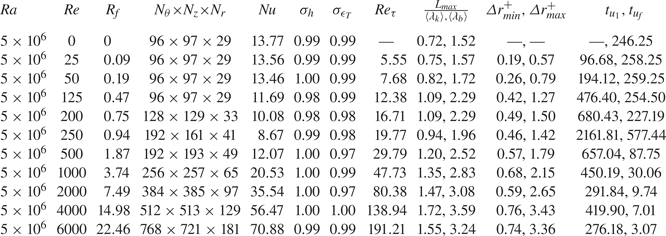
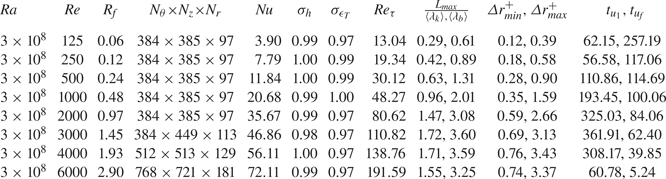
 $Re$, the flows enter the TC-dominated regime, and the grids are determined by the Reynolds number. The results of the grid sensitivity study are listed in table 1 in Appendix A. It is shown that, when the meshes double in three directions, the heat transfer
 $Nu$ and the friction Reynolds number
 $Re_{\tau }$ change by less than
 $2\,\%$.
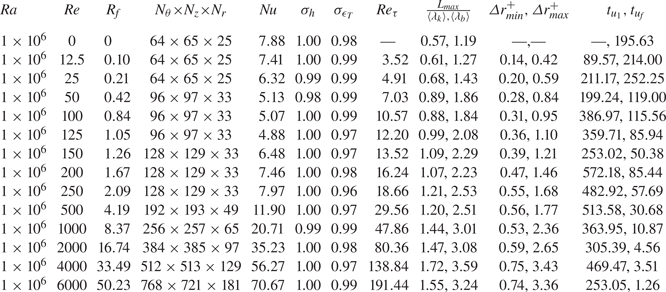
Summary of results for the grid sensitivity study.

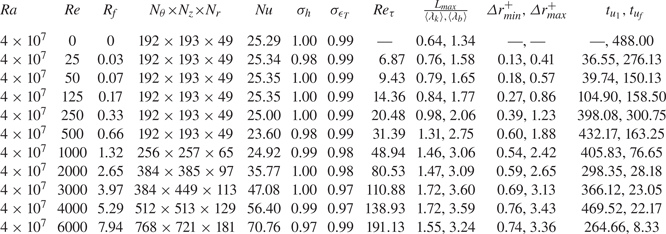
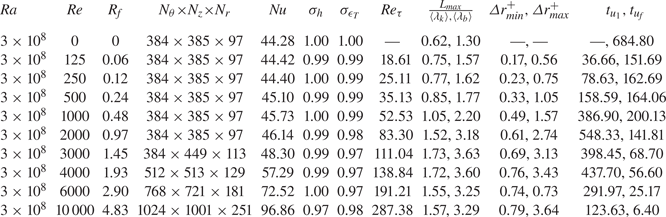
The main results are listed in tables 2–5 in Appendix A. For all our runs, the smallest mean scale is determined by the Batchelor scale of the temperature field (Batchelor Reference Batchelor1959). The mean Kolmogrov and Batchelor scales, respectively, are given by  $\langle \lambda _k \rangle = (\nu ^3/\langle {\epsilon _\nu }\rangle )^{1/4}$ and
 $\langle \lambda _b\rangle =(\kappa ^2\nu /\langle {\epsilon _\nu }\rangle )^{1/4}$, where
 $\langle {\epsilon _\nu }\rangle$ is the mean of the turbulent-kinetic-energy dissipation rate (Pope Reference Pope2000; Stevens, Verzicco & Lohse Reference Stevens, Verzicco and Lohse2010; Scheel, Emran & Schumacher Reference Scheel, Emran and Schumacher2013). Here, with or without weak imposed shear, our cases satisfy the global resolution criterion proposed by Grötzbach (Reference Grötzbach1983), that
 $({L_{max}} / \langle \lambda _b \rangle ) < {\rm \pi}$, where
 $L_{max} = Max \sqrt [3] {{L_r(r,\theta ,z)} {L_\theta (r,\theta ,z)} {L_z(r,\theta ,z)}}$ is the maximum of the geometric mean of the grid spacing (Emran & Schumacher Reference Emran and Schumacher2008) and
 $L$ denotes the grid spacing in each direction. However, at high Reynolds number, the flow enters the TC-dominated regime,
 $\langle \lambda _b\rangle$ decreases rapidly with increasing kinetic-energy dissipation. Therefore, we increase this criterion to a larger value that does not exceed 3.7 as a concession. This guarantees the ratio of resolution to
 $\langle \lambda _k \rangle$ is always less than 1.8. Furthermore, at least ten grid points are arranged in the TBLs for all cases, satisfying the grid requirement of TBL for pure RB flow (Shishkina et al. Reference Shishkina, Stevens, Grossmann and Lohse2010). In addition, the exact relation between the thermal dissipation and the global heat transfer is
 $\langle \epsilon _T \rangle (hu_f^{-1} \varDelta ^{-2}) = Nu(Ra\,Pr)^{-1/2}$ (Shraiman & Siggia Reference Shraiman and Siggia1990), where
 $\langle \epsilon _T \rangle$ is the mean thermal dissipation rate. This yields the definition of the relative error measurement
 $\sigma _{ \epsilon _T} = { \langle \epsilon _T \rangle } (hu_f^{-1} \varDelta ^{-2})(Ra\,Pr)^{1/2}/Nu$ (Stevens et al. Reference Stevens, Verzicco and Lohse2010; Scheel et al. Reference Scheel, Emran and Schumacher2013).
Summary of results at  $Ra = 1\times 10^6$.

3. Results
3.1. Global heat transport
Our numerical results of the Nusselt number without rotation,  $Nu_0$ is well described by a power-law scaling
 $Nu_0 \sim Ra^{0.30}$, which is in agreement with previous experimental results in an annular cell (Zhu et al. Reference Zhu, Jiang, Zhou and Sun2019), and agrees with the GL theory (Stevens et al. Reference Stevens, Van der Poel, Grossmann and Lohse2013) over the range of
 $4\times 10^7 \leq {Ra} \leq 3\times 10^8$ (see inset in figure 1a).
(a) Global heat transfer  $Nu$ as a function of
 $Re$. The orange dashed line denotes a power-law scaling of
 $Re^{0.578}$. Inset: the non-rotating Nusselt number
 $Nu_0$ as a function of
 $Ra$. The purple dashed line is the fitting line of
 $Ra^{0.3}$. (b) Compensated
 $Nu$ as a function of
 $Re$. The dotted line is the auxiliary line for
 $Nu/Re^{0.578}=0.476$. Inset: an expanded view of the data in the range of
 $1000 \le Re \le 10\,000$.

Data of  $Nu$ obtained for various
 $Ra$ are presented as functions of
 $Re$ in figure 1(a). With increasing
 $Re$, we see that for low
 $Ra$ the Nusselt number first decreases in the flow regime of weak rotations (low
 $Re$). The minimum of heat transport,
 $Nu_{m}$, occurs at a transitional Reynolds number
 $Re^*$ that depends on
 $Ra$. The maximum reduction rate of
 $Nu$,
 $\varDelta _{Nu} = 1-Nu_{m} / Nu_0$, can be as large as
 $38\,\%$ for the lowest
 $Ra =10^6$ used in this study. A decrease in
 $\varDelta _{Nu}$ is found when
 $Ra$ increases and it becomes nearly zero for
 $Ra= 3\times 10^8$. In fact for this
 $Ra$,
 $Nu$ becomes nearly independent of
 $Re$ in this buoyancy-dominated regime (
 $Re< Re^*$). When
 $Re \ge Re^*$, flows turn into the shear-dominated regime, where
 $Nu(Re)$ increases prominently with increasing
 $Re$. When
 $Re > 2000$, we note that the heat-transport scaling approaches a steep power-law
 $Nu\sim Re^{\gamma }$ with
 $\gamma =0.578\pm 0.018$, and both the scaling exponent and prefactor are independent of
 $Ra$, as shown in figure 1(b). Such a power-law scaling of heat transport persists up to the maximum Reynolds number
 $(Re = 10^4)$ in the present study. As discussed in § 3.3 and shown by figures 5 and 6, the flow enters the turbulent Taylor vortex flow (TTVF) directly when
 $Re>2000$, thus we infer that this power law typifies the properties of heat transport in the TTVF state. Meanwhile,
 $Re=2000$ should be the demarcation point dividing the shear-dominated regime into the sub-ranges of weakly nonlinear TV flow (
 $Re^*(Ra) \le Re \le 2000$) and turbulent TV flow (
 $2000 < Re \le 10\,000$). The present scaling exponent is much less than that of the wall-normal heat transfer
 $(Nu \sim 0.0013Re)$ in plane Couette–RB flow (Blass et al. Reference Blass, Zhu, Verzicco, Lohse and Stevens2020). To interpret this difference, further comparisons of the transport properties between TC and plane Couette flows are necessary in the future work.
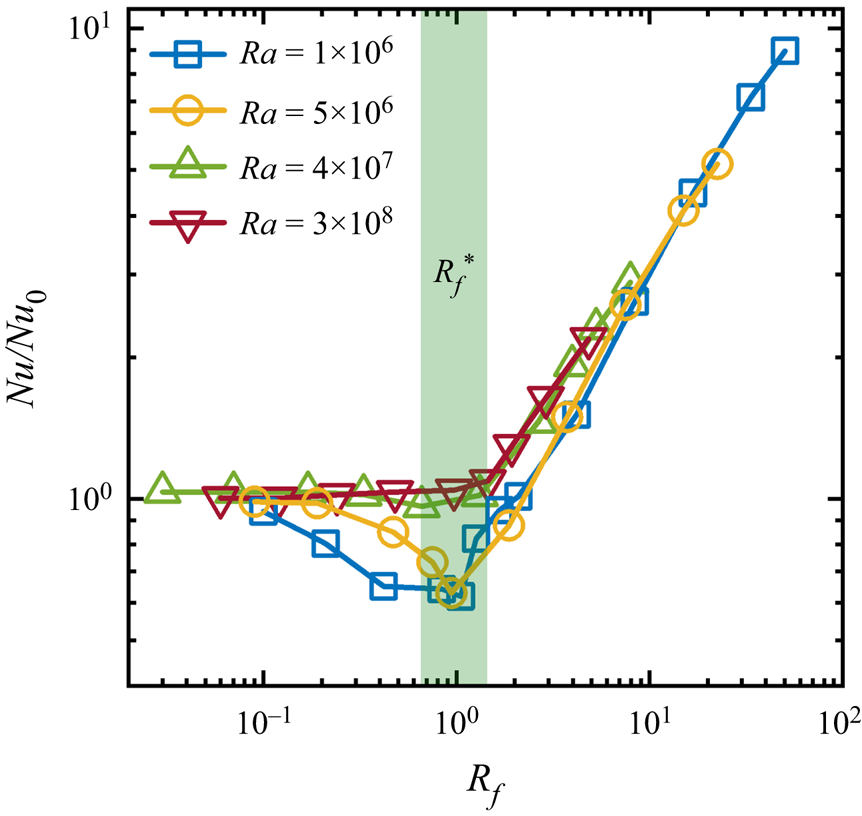
In figure 2, we present  $Nu/Nu_0$ as a function of
 $R_f$. Such a rescaling leads to the converging of the transitional values of the four cases at
 $R_f^*\approx 1$ where
 $Nu$ is minimum. For
 $R_f>1$,
 $Nu/Nu_0$ starts to increase, suggesting a flow regime transition from buoyancy-dominated to shear-dominated convection. Results of
 $Nu(R_f)/Nu_0$ in figure 2 also suggest the flow transition is gradual for low
 $Ra$, whereas it becomes sharp with increasing
 $Ra$.
Plot of  $Nu/Nu_0$ as a function of
 $R_f$ for various
 $Ra$. The shaded area indicates the approximate transitional region
 $0.7\leq R_f^* \leq 1.4$.

We show in figure 3  $Nu$ as a function of
 $Ra$ for various
 $Re$. In the TC-dominated regime,
 $Nu$ changes slightly with varying
 $Ra$, and
 $Nu(Ra)$ collapses to the profile of pure RB convection with decreasing
 $Re$. The
 $Ra$ range of the transitional regime (between the buoyancy- and shear-dominated regimes) is not as broad as that shown in plane Couette–RB flow (Blass et al. Reference Blass, Zhu, Verzicco, Lohse and Stevens2020), and we find the heat-transport scaling exponents exceed 0.3 for low
 $Re \le 500$ and
 $Ra \le 4\times 10^7$. We infer that for low
 $Ra$ it is the thermal plumes being swept away by the TVs that leads to the reduction of heat transport (see discussions in § 3.3). With increasing
 $Ra$, the plume structures become robust owing to strong buoyancy, and the sweeping away processes are weakening, leading to the rapid increasing in
 $Nu$, and the steep heat-transport scaling with a local exponent greater than 0.3.
Plot of  $Nu$ as a function of
 $Ra$ for various
 $Re$. The purple dashed line denotes a power-law scaling of
 $Ra^{0.3}$.

3.2. Angular velocity transport
Annular velocity flux is another important transport quantity in the present system (Eckhardt et al. Reference Eckhardt, Grossmann and Lohse2007). The angular velocity current is given as  $J_\omega =[r^2 \langle {u_r} {u_{\theta }} \rangle _{\theta z,t} - \nu r^3 \partial {{( \langle {u_{\theta }}\rangle _{\theta z,t} }/r)}/\partial {r}]$, with the first and second terms being the convective and diffusive fluxes, respectively. In circular Couette flow (CCF), the flow is laminar and has purely azimuthal velocity
 $u_{\theta }=A r+{B}/{r}$, with
 $A=({r_2 u_2-r_1 u_1})/({r_2^2-r_1^2})$ and
 $B=({r_2^2 r_1 u_1-r_2 r_1^2 u_2})/({r_2^2-r_1^2})$. This flow produces an angular velocity current
 $J_{ccf}=2\nu B$. By analogy with RB convection, the radial transport of angular velocity flux can be expressed by the
 $\omega$-Nusselt number
 $Nu_{\omega }={J_\omega }/{J_{ccf}}$ (Eckhardt et al. Reference Eckhardt, Grossmann and Lohse2007; Ostilla-Mónico et al. Reference Ostilla-Mónico, Huisman, Jannink, Van Gils, Verzicco, Grossmann, Sun and Lohse2014). In the axially periodical domain or very long cylinders,
 $Nu_{\omega }$ remains radially constant. However, owing to the braking effect of the fixed endwalls,
 $Nu_{\omega }$ decreases along the radial direction in our system. Here, we consider the flux at the inner cylinder
 \begin{equation} Nu_{\omega} =\frac{J_{\omega,r_1}}{J_{ccf}}= {\frac{r_1^2u_1}{2Bd}} \frac{(2Re_\tau)^2}{Re}. \end{equation}
The dimensional torque at the inner cylinder reads
 \begin{equation} G_{r_1}=2{\rm \pi} r_{1}^3h\rho\nu \frac{\partial}{\partial r} \left(\frac{\left\langle u_{\theta}\right\rangle_{\theta z,t}}{r} \right) = 2{\rm \pi} r_{1}^2h \frac{\rho \nu^2}{d^2} (2Re_\tau)^2, \end{equation}
where  $\rho$ is the fluid density. Following Lathrop's estimation (Lathrop et al. Reference Lathrop, Fineberg and Swinney1992a,Reference Lathrop, Fineberg and Swinneyb), we define the effective viscosity (owing to turbulent transport) as
 $\nu _{t}=G_{r_1}/(2{\rm \pi} \rho u_{1}r_{1}^2h{d^{-1}})$. Thus, we obtain the equation of the dimensionless effective viscosity
 \begin{equation} \frac{ \nu_{t}}{\nu}=\frac{(2Re_\tau)^2}{Re}. \end{equation}
Based on the friction Reynolds number, we find that  ${ \nu _{t}}/{\nu }$ has the same scaling with
 $Nu_{\omega }$,
 \begin{equation} Nu_{\omega}\sim \frac{ \nu_{t}}{\nu} \sim \frac{Re_\tau^2}{Re} \sim Re ^{\gamma}. \end{equation}
The results of  ${\nu _{t}}/{\nu }$ as a function of
 $Re$ are shown in figure 4(a). We see that, when
 $Ra$ is fixed,
 ${\nu _{t}}/{\nu }$ decreases first to a minimum with increasing
 $Re$, after which the radial transport starts to increase. Further increasing the Reynolds number, all curves converge to a unifying transport scaling with
 $\gamma =0.581\pm 0.026$ for
 $Re > 2000$ (see the compensated plot in figure 4b). This scaling exponent is similar to that observed in TC flows by Merbold, Brauckmann & Egbers (Reference Merbold, Brauckmann and Egbers2013) at the same
 $Re$ range and with the same radius ratio. Interestingly, here we find that the both scalings of axial heat and radial angular velocity transport coincide approximately with each other for
 $2000< Re \le 10\,000$.
(a) Dimensionless effective viscosity  $\nu _{t}/ \nu$ as a function of
 $Re$. The purple dashed line denotes a power-law scaling of
 $Re^{0.581}$. (b) Compensated
 $\nu _{t}/\nu$ as a function of
 $Re$. The dotted line is the auxiliary line for
 $(\nu _{t}/\nu )/Re^{0.581}=0.156$. Inset: an expanded view of the data in the range of
 $1000 \le Re \le 10\,000$.

For the lowest  $Re$ for each
 $Ra$, we find
 ${\nu _{t}}/{\nu }$ increases monotonically with increasing
 $Ra$, indicating that the energetic structures in RB-type convection could contribute more momentum to the radial transport process (see detailed discussions about the contribution of RB flow to the radial transport in Appendix C). It is the structures of thermal plumes and LSC that govern the heat and momentum transport processes in pure RB convection (
 $Re = 0$). When weak rotations are present, we suggest that with increasing
 $Ra$ these structures become more vigorous and provide the system with more efficient radial angular velocity transport.
3.3. Flow morphology
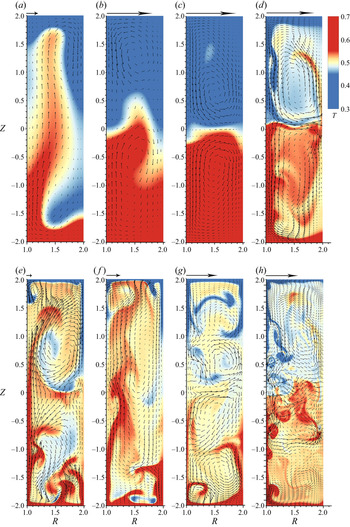
To gain some insights into the transitional behaviour of  $Nu(Re)$ and its pronounced enhancement in the shear-dominated regime, we visualise the flow fields of the instantaneous temperature
 $T(R,Z)$ and velocity
 $\boldsymbol {U}(R,Z)$ in the vertical cross-sections in figure 5. The four panels in figures 5(a)–5(d) present results for
 $Ra=10^6$ with
 $Re$ increasing from left to right. Figure 5(a) shows that for low Ra
 $=10^6$ and
 $Re = 12.5$, the flow field and local heat transfer are dominated by large-scale vertical plumes emanating from TBLs. We see that for this
 $Re$ the imposed rotation is too weak to influence the flow organisation in the bulk, thus the main flow features are analogous to those in non-rotating RB convection. For
 $Re = 50$, figure 5(b) shows that the thermal plumes are organised into TVs. We find in this state a reduction of 30 % in
 $Nu$ as shown in figure 1. In our system with finite axial length, the strong inward shears of TVs at the endwalls disperse the thermal plumes, and prevent them from traversing through the fluid layer, leading to a prominent reduction of heat transfer. A similar mechanism of heat-transfer reduction is also found in other shear convection systems (Scagliarini, Gylfason & Toschi Reference Scagliarini, Gylfason and Toschi2014; Blass et al. Reference Blass, Zhu, Verzicco, Lohse and Stevens2020), where the flow sweeps away the thermal plumes and inhibits the turbulent heat transfer.
Distributions of instantaneous temperature and velocity fields in a meridional plane. (a–d) Results for  $Ra = 10^6$ and
 $Re$ = 12.5, 50, 125 and 1000, respectively. (e–h) Results for
 $Ra = 3\times 10^8$ and
 $Re$ = 125, 500, 1000 and 4000, respectively. In each panel, the left and right sides denote the inner and outer cylinders. To facilitate visualisation, the arrow lengths are plotted in various scales in different panels, with the arrows on the top indicating the velocity scale of the inner cylinder. See Supplementary Movies 1–4 available at https://doi.org/10.1017/jfm.2021.430 for the three-dimensional temperature fields corresponding to panels (e–h).

When  $Nu$ reaches a minimum at
 $Re = 125$ (
 $R_f = 1$, figure 5c), the flow field is dominated by two nearly symmetric TVs which occupy the entire domain. Owing to the prominent intra-vortex mixing (Kataoka & Takigawa Reference Kataoka and Takigawa1981; Akonur & Lueptow Reference Akonur and Lueptow2002, Reference Akonur and Lueptow2003), we find that the axial heat transport between adjacent TVs is severely restricted at this configuration.
Further increasing  $Re$, results in the emergence of chaotic flow (
 $Re = 1000$, figure 5d) promotes large heat and mass exchanges between vortices. This could be explained by the further development of TV flow towards a more disordered state (Andereck et al. Reference Andereck, Liu and Swinney1986), providing a higher axial mixing efficiency over the stacked vortices, namely, in the form of inter-vortex mixing (Kataoka & Takigawa Reference Kataoka and Takigawa1981; Akonur & Lueptow Reference Akonur and Lueptow2002, Reference Akonur and Lueptow2003).
Figure 5(e–h) present the evolution of flow structures with increasing  $Re$ at
 $Ra = 3\times 10^8$. At low
 $Re = 125$ and 500, the plumes are rising up (falling down) from the bottom (top) boundary layers. Since the plumes become robust in the presence of strong buoyancy (high
 $Ra$), they are hardly disturbed by rolls, unlike the flow of figure 5(b) in which the plumes are much more easily entrained. When
 $Re = 1000$, we observe that these plumes become distorted by the shear flows and evolve into rolls (figure 5g). In this high
 $Ra$ turbulence, the bulk flows consist of rich small-scale structures (e.g. plumes and vortices) which in general cannot be degraded by the imposed shear, preventing the formation of laminar TVs. The robust thermal plumes emanating from the boundary layers may sustain the global heat transfer at a high level. For this reason, we find with increasing
 $Re$ only a weak reduction of
 $Nu$ for
 $Ra = 4\times 10^7$, and even no reduction of
 $Nu$ for
 $Ra = 3\times 10^8$ in figure 1. Further increasing
 $Re$, the flow system jumps over the state of laminar TV flow characterised by the regular two-vortex structure (figure 5c), and directly enters the TTVF at
 $Re = 4000$ (figure 5h).
As demonstrated in figures 1, 2 and 4, with high enough  $Re$ the convection system enters a shear-dominated regime where heat and angular velocity transport are highly intensified and governed by a power-law scaling of approximately
 $Re^{0.58}$ irrespective of
 $Ra$ for
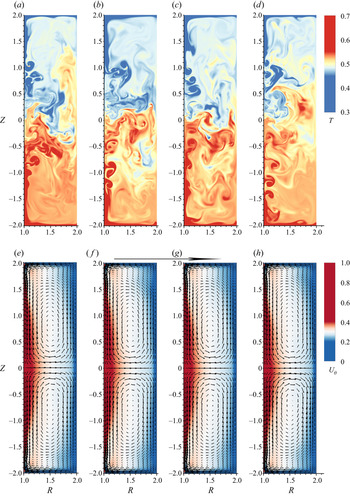
 $Re > 2000$. To further characterise this flow state, we show in figure 6 representatively instantaneous temperature and mean velocity fields. Here, for different
 $Ra$, they promote very similar flow structures typified by small-scale eddies (figure 6a–d), and the common structures of TTVF are raised and recognised by the two-roll structures in the mean flow field (figure 6e–h). In this turbulent state, the transport of heat and angular velocity fluxes is independent of
 $Ra$ and completely governed by turbulent TVs.
Distributions of the instantaneous temperature  $T(R,Z)$ (a–d) and the time-averaged azimuthal velocity
 $U_{\theta }(R,Z)$ (e–h) with
 $Ra = 10^6$ (a,e),
 $5\times 10^6$ (b,f),
 $4\times 10^7$ (c,g) and
 $3\times 10^8$ (d,h) for
 $Re = 6000$. The arrow on the top indicates the velocity scale of the inner cylinder.

We suggest that the comparable transport of heat and angular momentum can be understood through the hypothesis that in turbulent TC flow the axial transport for passive scalar should share the same scaling behaviours as the radial transport of angular momentum (Lathrop et al. Reference Lathrop, Fineberg and Swinney1992a), based on the Reynolds analogy (Kays & Crawford Reference Kays and Crawford1980). The underlying physics of the analogous scaling forms of heat and angular momentum transport remains to be further explored. Moreover, in the present small- $\varGamma$ geometry where the endwall flows inevitably influence both the heat and angular momentum transport, we find their scaling exponents remain still comparable. How the endwall effects modify the scaling of turbulent transport is a challenge for future studies.
Visualisation of the temperature fields (figure 6a–d) illustrates clearly how heat is transported axially. The inward flows induced by the pressure imbalance at the endwalls sweep away TBLs. Consequently, the hot and cold fluids therein are driven away rapidly and feed the axial flows along the inner wall into the bulk. The outward jets usually play important roles in the radial transport of angular momentum (Van Der Veen et al. Reference Van Der Veen, Huisman, Merbold, Harlander, Egbers, Lohse and Sun2016), and here, they act on enhancing the axial mixing of the hot and cold fluids, accompanying the  ${\rm \pi}$-shaped Görtler vortices (Dong Reference Dong2007). Finally, the mixed fluids follow the upward/downward flows of rolls along the outer cylinders, returning to TBLs. This resembles a high efficiency thermal pump providing the steep heat-transfer scaling of our cases.
3.4. Regimes transition
We have shown the different properties of heat transport and flow structures in both the RB- and TC-dominated regimes. In general, the main flow structures in RB and TC flows are characterised by small-scale plumes and large-scale vortices, respectively. In the following analysis, we decompose the flow field into mean TV flow ( ${m}$TVF) and the fluctuations (Bilson & Bremhorst Reference Bilson and Bremhorst2007; Froitzheim et al. Reference Froitzheim, Merbold, Ostilla-Mónico and Egbers2019), i.e.
 $\boldsymbol {U}= \boldsymbol {U}'+ \langle \boldsymbol {U} \rangle _{\theta ,t}$ and
 ${T}=T'+ \langle {T}\rangle _{\theta ,t}$, in order to identify their individual contributions to the global heat transport. The convective Nusselt number reads
 $Nu_{c}=Nu-1=Nu_{TV}+Nu_{fl}$, with its contribution from large-scale structures of the
 ${m}$TVF, namely,
 $Nu_{TV}=\sqrt {Ra\,Pr} \langle \langle {U_z}\rangle _{\theta ,t} \langle {T-T_0}\rangle _{\theta ,t}\rangle$, and the contribution from turbulent fluctuations,
 $Nu_{fl}=\sqrt {Ra\,Pr} \langle U_z'T'\rangle$, where
 $T_0$ is the mean fluid temperature.
Figure 7(a–d) show the ratios  $Nu_{TV}/Nu$ and
 $Nu_{fl}/Nu$ as functions of
 $Re$. In the buoyancy-dominated regime, we see that heat transport through turbulent fluctuations is dominant. For
 $Ra = 10^6$,
 $Nu_{TV}/Nu$ increases while
 $Nu_{fl}/Nu$ decreases gradually with increasing
 $Re$. Curves of
 $Nu_{TV}(Re)$ and
 $Nu_{fl}(Re)$ intersect at
 $Re^* \approx 100$ indicating a smooth transition. However, at larger
 $Ra \geq 5\times 10^6$,
 $Nu_{TV}/Nu$ decreases slightly and then starts to increase steeply, while
 $Nu_{fl}/Nu$ undergoes variations in the opposite direction. They meet and cross sharply at a transitional point
 $Re^*$ which increases with increasing
 $Ra$. These results indicate the fading away of thermal plumes in the RB-type convection and newly forming TVs in the TC-type turbulence. The
 $Ra$-dependence of
 $Re^*$ suggests that stronger buoyancy delays transition. Furthermore, the flow transition changes from smooth at low
 $Ra$ to sharp at high
 $Ra$, which is consistent with the observation in figure 2. Interestingly, we find that for
 $Ra \leq 5\times 10^6$, the global heat transfer consists mostly of
 $Nu_{TV}$ in the range of
 $250 \leq Re \leq 500$, where the main flow structures are laminar TVs as shown in figure 5(c). For
 $Ra \geq 4 \times 10^7$, we have seen in figure 5 that with increasing
 $Re$ the RB-type flows evolve into TTVF. For this reason we see that in the TC-dominated convection the percentage of heat transport by turbulent fluctuations (
 $Nu_{fl}$) remains at
 $30\,\%$. For the range of largest
 $Re > 2000$, the four sets of data curves at various
 $Ra$ converge to a unique state with
 $Nu_{TV}/Nu\approx 0.7$ and
 $Nu_{fl}/Nu \approx 0.3$.
Heat transport by the mean TV flow  $Nu_{TV}$ and by turbulent fluctuations
 $Nu_{fl}$, as functions of
 $Re$ at (a)
 $Ra = 10^6$, (b)
 $5 \times 10^6$, (c)
 $4 \times 10^7$ and (d)
 $3 \times 10^8$. (e)
 $Nu_{TV}$ and
 $Nu_{fl}$ as functions of
 $R_f$. Open symbols: data of
 $Nu_{TV}$. Solid symbols: data for
 $Nu_{fl}$. The shaded area indicates the transitional region.

Data curves of  $Nu_{TV}(Re)$ and
 $Nu_{fl}(Re)$ in figure 7(a–d) exhibit a genetic crossover from RB-type convection to another type of convection dominated by the turbulent TC flow, although the transitional value
 $Re^*$ depends on
 $Ra$. To examine the universal transitional behaviours, we present in figure 7(e) the results of
 $Nu_{TV}/Nu$ and
 $Nu_{fl}/Nu$ as functions of
 $R_f$. Notably, one sees that the crossovers of both
 $Nu_{TV}/Nu(R_f)$ and
 $Nu_{fl}/Nu(R_f)$ occur at the same transitional regime with
 $R_f \approx 1$. The shaded area denotes the transition region of the minimum heat transport
 $Nu_{m}(R_f^*)$ as plotted in figure 2. The data thus suggest that in the flow regime where the buoyancy is dominant (
 $R_f<1$), the temporal fluctuations of the flows associated with the buoyancy-driven thermal plumes play the leading role in determining
 $Nu$. Whereas in the shear-dominated regime (
 $R_f > 1$), the large-scale mean flows, i.e. the turbulent TVs, provide the large contribution to the global heat transport. In the balance of buoyancy and shear effects (
 $R_f \approx 1$) we observe the crossovers of these two regimes coinciding with the transitional value of the global heat transport as shown in figure 2.
We suggest that it is the force balance between inertia and buoyancy that governs the transition from RB- to TC-type convection. We compare in figure 8 the volume- and time-averaged root mean square (r.m.s.) forces of inertia  $F_i=\sqrt { \langle [ ({\boldsymbol {U}}\boldsymbol {\cdot }\boldsymbol {\nabla }){\boldsymbol {U}} ]^2 \rangle _{V,t} }$, viscous
 $F_v=\sqrt { \langle (Pr^{0.5}Ra^{-0.5} {{\nabla }}^2\boldsymbol {U} )^2 \rangle _{V,t} }$ and buoyancy
 $F_b=\sqrt { \langle ( T{{e_z}} )^2 \rangle _{V,t} }$ in (2.1), as functions of
 $R_f$ for
 $Ra=4\times 10^7$ and
 $3\times 10^8$. With increasing
 $R_f$, although the buoyancy remains approximately constant (
 $F_b\approx 0.5$), both
 $F_i$ and
 $F_v$ increase from the buoyancy-dominated regime (
 $R_f\ll 1$) where they are one order of magnitude below
 $F_b$.
 $F_i$ and
 $F_v$ cross the value of
 $F_b$ in the vicinity of
 $R_f=1$, i.e. the transitional region shown in figures 2 and 7(e). In the shear-dominated regime with
 $R_f\gg 1$, we see that
 $F_i$ exceeds
 $F_v$ and both dominate
 $F_b$, indicating that the flows in this regime are in a highly turbulent state and that buoyancy becomes negligible. Similar
 $R_f$-dependence of the various force components are observed for all
 $Ra$ studied. And we conclude that it is the interior force balance that provides a quantitative constraint for determining the flow-regime transition.
The r.m.s. forces as functions of  $R_f$ for (a)
 $Ra= 4\times 10^7$ and (b)
 $Ra= 3\times 10^8$. Here
 $F_i$,
 $F_v$ and
 $F_b$ denote inertia, viscous and buoyant forces, respectively. The shaded area indicates the transitional region.

4. Conclusion and discussion
In the present study, we investigate the effects of TC flow on the heat transport by thermal convection in an annular domain driven by an axially-imposed temperature gradient. For weak rotations ( $R_f < 1$), the fluid system inherits the main flow features of ordinary RB convection with thermal plumes emanating from the TBLs. In this buoyancy-dominated regime, the thermal plumes are more easily dispersed by shear flows if
 $Ra$ is low (
 $Ra \leq 5 \times 10^6$), leading to a reduction of the global heat transport. For high
 $Ra \geq 4 \times 10^7$, the vigorous thermal plumes maintain their vertical motion under the strong buoyancy and traverse deeply into the bulk fluid, thus
 $Nu$ becomes independent of the applied rotations. In the shear-dominated regime (
 $R_f > 1$), the flow features and heat transport are dominated by TVs. The transition between the RB-type convection to the TC-type occurs at a critical value
 $R_f \approx 1$. We report that the main heat carriers change from small-scale thermal plumes to large-scale
 ${m}$TVF. Meanwhile, the flows evolve from the state where the fluid motion is dominated by the buoyancy to another state by the inertia force. The transition is found to be gradual for low
 $Ra$ but becomes sharp at high
 $Ra$.
In our study, the TVs are introduced by immersing the rotating inner cylinder into the flow field. In the shear-dominated flow regime where these turbulent structures are prominent, a new power-law scaling of the effective heat transport ( $Nu\sim Re^{0.578\pm 0.018}$) is found for
 $2000 < Re \le 10\,000$, and it shows the strong similarity with the scaling of the angular velocity flux (
 $Nu_{\omega }\sim Re^{0.581\pm 0.026}$). This result is consistent with the early work of Lathrop et al. (Reference Lathrop, Fineberg and Swinney1992a). We infer that in this turbulent state it is the coherent structures in the form of turbulent TVs that provide the efficient mechanism for both the axial heat transport and radial momentum transport simultaneously.
The analogy between heat and momentum transport in rotating flow has been derived by Bradshaw (Reference Bradshaw1969), and one may think that our system should relate to this analogy. However, our axial heat transport is perpendicular to the momentum transfer direction, differing from the simplified model of wall-normal direction in Bradshaw's analogy, which means that, in our system the meridional advection governs both transport processes. Hence, we cannot make a direct connection of the present cases with this analogy. Further work and analysis of the two-dimensional turbulent-kinetic-energy budgets are necessary.
By controlling the rotating conditions, the TC flow may bifurcate to various cell modes and have different transport behaviours (Wen et al. Reference Wen, Zhang, Ren, Bao, Dini, Xi and Hu2020). In our study, in addition to the commonly observed two-cell mode, convection in a four-cell mode can be seen occasionally when diverse initial conditions are used. In the four-cell convection mode we find the main results discussed heretofore unchanged.
This study, where  $Re = 10^4$ is the largest value used, is still in the classical regime of turbulent TC flow, thus our obtained scaling exponent does not exceed the well-accepted value (
 $\leq 2/3$) for the angular velocity flux in the classical turbulent regime (Grossmann et al. Reference Grossmann, Lohse and Sun2016). Extending the present studies to the ultimate turbulent regime (
 $Re > 10^5$) remains an interesting challenge. Furthermore, the effects of the radius ratio, the axial domain boundaries (the endwalls), and also the Prandtl number are intriguing subjects for future studies.
Supplementary movies
Supplementary movies are available at https://doi.org/10.1017/jfm.2021.430.
Funding
This work was supported by the National Natural Science Foundation of China under grant numbers 11902224, 51976021 and 11772235, and the China Postdoctoral Science Foundation (No.2019M651572).
Declaration of Interests
The authors report no conflict of interest.
Appendix A. Numerical details
The results of the grid sensitivity study are listed in table 1. Tables 2, 3, 4 and 5 list the main results for  $Ra = 10^6, 5\times 10^6, 4\times 10^7$ and
 $3 \times 10^8$ respectively. In the tables,
 $N_{\theta }{\times }{N_z}{\times }N_r$ are the numbers of grid points in three directions;
 $\sigma _h$ is the time convergence of the Nusselt numbers averaged over the whole and the last half simulation periods;
 $\sigma _{ \epsilon _T}$ is the relative error measured by
 $Nu$ and the thermal dissipation rate;
 ${L_{max}}/({ \langle \lambda _k \rangle , \langle \lambda _b \rangle })$ are the maximal grid spacings compared with the Kolmogrov and Batchelor scales;
 $\varDelta r^+_{min}, \varDelta r^+_{max}$ are the minimal and maximal grid sizes in wall units;
 $t_{u_1}$is the averaging time normalised by the large-eddy turnover time unit
 $d/u_1$; and
 $t_{u_f}$ is the averaging time normalised by the free fall time unit
 $h/u_f$.
Summary of results at  $Ra = 5\times 10^6$.

Summary of results at  $Ra = 4\times 10^7$.

Summary of results at  $Ra = 3\times 10^8$.

Appendix B. Validation of the centrifugal buoyancy
The additional simulations considering the effect of centrifugal buoyancy are performed for  $Ra = 10^6$ and
 $3 \times 10^8$, by using the realistic condition with
 $\varDelta =10\;\textrm {K}$ and
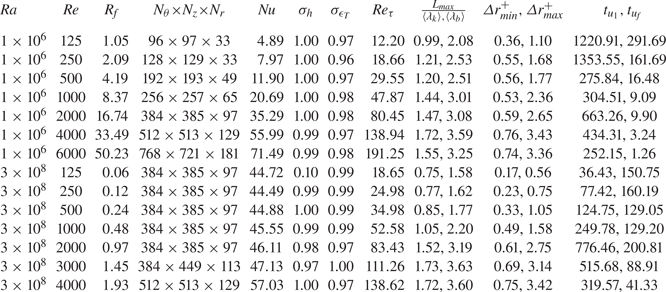
 $\beta =0.00038\;\textrm {K}^{-1}$. The main results are listed in table 6. As shown in figure 9, for both the lowest and highest
 $Ra$ considered here, we find that including the centrifugal buoyancy does not change the results of heat transport.
Comparison of heat transfer between the flows without and with the centrifugal buoyancy ( $F_{CB}$) for
 $Ra=10^6$ and
 $3\times 10^8$.

Summary of results with centrifugal buoyancy at  $Ra = 1\times 10^6$ and
 $3\times 10^8$.

Appendix C. Flows as passive scalar
The additional simulations for the passive scalar in TC systems are performed at  $Ra = 3\times 10^8$, where the temperature is treated as a passive scalar by removing the buoyancy term from the momentum equation (2.1) numerically. The main results are listed in table 7 and shown in figures 10(a) and 10(b) respectively.
(a) Heat transfer  $Nu$ and (b) dimensionless effective viscosity
 $\nu _{t}/\nu$ of the flows when the temperature fields are treated as active and passive scalars respectively for
 $Ra = 3\times 10^8$.

Summary of results for passive scalar at  $Ra = 3\times 10^8$.

We find that, both  $Nu$ and
 ${ \nu _{t}}/{\nu }$ in the flows of the active scalar diverge from those of the passive scalar at low
 $Re$, and then they converge gradually with the increasing
 $Re$. Beyond
 $Re >2000$, the curves of the passive scalar coincide with those of the active scalar, indicating that the temperature in the TC-dominated regime acts like a passive scalar.
Furthermore, in figure 10(b), in the flows where the temperature is treated as a passive scalar,  ${ \nu _{t}}/{\nu }$ increases monotonically with increasing
 $Re$, while it decreases firstly at low
 $Re$ for the active-scalar cases. We observe that in our system, the coherent structures in the RB-type convection could provide higher radial transport in the lowest
 $Re$ flows. And these structures are destroyed with increasing
 $Re$, resulting in the local minimum of
 ${ \nu _{t}}/{\nu }$ for
 $Re = 500$. Further increasing
 $Re$,
 ${ \nu _{t}}/{\nu }$ starts to increase and then, thanks to the formation of TVs, the curve coincides with the curve of the passive scalar (pure TC flow) for
 $Re> 2000$, when the flows are dominated by turbulent TVs completely.