Syncope is a common clinical problem in children and adolescents.Reference Driscoll, Jacobsen, Porter and Wollan1 Approximately 15% of all children experience a syncopal episode before the end of the second decade, and the chief complaint of syncope accounts for 1% of all paediatric Emergency Department visits.Reference Scott2, Reference Pratt and Fleisher3 Although frequently benign in aetiology, recurrent syncope may lead to trauma or injury and may induce anxiety.
Neurally mediated hypotension, leading to neurocardiogenic syncope, accounts for most paediatric cases of loss of consciousness.Reference Chen, Wang and Wang4 Neurocardiogenic syncope is characterised by systemic hypotension resulting in inadequate cerebral blood flow from a reflex-mediated combination of inappropriate vasodilatation and/or bradycardia. Orthostatic intolerance is observed in some patients with recurrent neurocardiogenic syncope. Features of orthostatic intolerance include symptoms of presyncope: lightheadedness, “dizziness”, blurred vision, exercise intolerance, and chronic fatigue.Reference Stewart, Gewitz, Weldon, Arlievsky, Li and Munoz5, Reference Martin, Bates and Whitehouse6 Owing to the combination of more common presyncope and less common frank syncope, in the few patients with recurrent or difficult-to-control neurocardiogenic syncope there may be a period of persistent symptoms, similar to other chronic diseases. Standard initial management of neurocardiogenic syncope includes reassurance, education, increased fluid intake, and behaviour modification such as positional adjustments when symptoms start.Reference Wieling, Ganzeboom and Saul7
Health-related quality of life is defined as the influence of a specific disease or medical therapy on a person to function and derive satisfaction from participation in various physical and psychosocial contexts.Reference Drotar8 Health-related quality of life encompasses the areas of physical health status and physical functioning, social functioning, or psychological status. Although the relationship between syncope and health-related quality of life has not been explored among children, an association between syncope and health-related quality of life is well established in adults.Reference Rose, Koshman, Spreng and Sheldon9, Reference van Dijk, Sprangers, Colman, Boer, Wieling and Linzer10
The PedsQL™ 4.0 quality of life inventory is a reliable and valid health-related quality of life measurement tool in the paediatric population.Reference Varni, Burwinkle, Seid and Skarr11, Reference Varni, Burwinkle and Seid12 The PedsQL™ 4.0 Generic Core Scales comprise child self-report and parent proxy-report formats. The purpose of this study was to assess health-related quality of life in children presenting to a specialised syncope clinic with the chief complaint of syncope. Specifically, we hypothesised that patients with syncope presenting to a specialised syncope clinic have a lower health-related quality of life than healthy counterparts and similar health-related quality of life to children with other chronic medical conditions. We also evaluated patient and physiologic variables to determine whether there were findings associated with worse health-related quality of life.
Materials and methods
Study design
This was a retrospective case series of all patients seen in the Syncope Clinic in the Heart Institute at Cincinnati Children's Hospital Medical Center from July, 2009 to June, 2010. This research was approved by the Institutional Review Board at Cincinnati Children's Hospital Medical Center (No. 2010-0974).
Patient population
The Syncope Clinic evaluates children from 8 to 21 years of age who have experienced a syncopal event. Patients were either self-referred or referred by general paediatricians, family practitioners, general paediatric cardiologists, or neurologists. Patients with major chronic medical problems including moderate to severe reactive airway disease, seizure disorder, moderate to severe congenital heart disease,Reference Warnes, Liberthson and Danielson13 human immunodeficiency virus, sickle cell disease, and cystic fibrosis were excluded from this study. These patients were excluded as it was felt that their other chronic illnesses may be the primary drivers of their quality of life. Patients with other common conditions including attention deficit and hyperactivity disorder, mild reactive airway disease, history of anxiety or depression symptoms, or connective tissue disorder were included for analysis. Records were reviewed from the initial visit in Syncope Clinic.
Data collection
Study data were collected from Heart Institute outpatient records, as well as exercise test and electrocardiogram reports. Demographic and clinical data, including current and past medical history, frequency of syncopal events and timing to clinic visit from first syncopal event, family history, and medication regimen at the time of the visit, were obtained from outpatient records.
Clinical evaluation
As part of standard clinical care, each patient undergoes complete history and physical examination, orthostatic vital sign measurement, electrocardiogram, and graded exercise testing. Manual orthostatic vital signs are performed by a single paediatric nurse for all patients in the study. Vital signs are taken with the patient in the supine position, repeated after the patient has been in the sitting position for 5 minutes, and repeated again after the patient has been standing for 5 additional minutes. Orthostatic vital signs are considered positive if there is either a drop in systolic blood pressure of greater than 20 millimetres of mercury or increase in heart rate of greater than 20 beats per minute when moving from a supine to a standing position.Reference Medow, Stewart, Sanyal, Mumtaz, Sica and Frishman14
Graded exercise testing is performed using the James protocol with continuous electrocardiogram monitoring and blood pressure measurements every 60 seconds. Following exercise testing, patients are immediately placed in the supine position. After 1 minute, they are asked to stand for 15 minutes in an attempt to provoke neurally mediated hypotension. During the post-exercise period, electrocardiogram monitoring is continued and blood pressure measurements are taken every 60 seconds to evaluate for development of hypotension, defined as a drop in systolic blood pressure of greater than 20 millimetres of mercury from baseline measurements, consistent with a depressed vasomotor response. Heart rate is monitored for the development of abrupt bradycardia in the post-exercise period, defined as a drop in heart rate of greater than 30 beats per minute over less than 30 seconds, consistent with a cardioinhibitory response. On the basis of the experience of our exercise lab over the past decade, we designated either or both of these findings in the post-exercise period as consistent with a diagnosis of neurocardiogenic syncope.
Health-related quality of life assessment
As part of our standard clinical evaluation in this clinic, each patient completes the PedsQL™ 4.0 generic core scale at each new and follow-up visit. Each patient and proxy reporter completed an age-appropriate PedsQL™ 4.0 generic core scale.Reference Varni, Burwinkle, Seid and Skarr11 Patients and proxy reporters complete the 8–12-year-old Child, 13–18-year-old Teen, or 19–25-year-old Young adult forms. The PedsQL™ is self-administered in all patients. The PedsQL™ 4.0 generates a Total score, a Physical Health Summary score, a Psychosocial Health Summary score, as well as subscale scores for Emotional Functioning, Social Functioning, and School Functioning.
Statistical analyses
The primary outcome variable was the PedsQL™ 4.0 Total score. Secondary outcome variables were the PedsQL™ 4.0™ Physical Health Summary score, Psychosocial Health Summary score, as well as subscale scores for Emotional Functioning, Social Functioning, and School Functioning. Paired patient and proxy scores from each visit were compared for concordance using the Wilcoxon Signed-Rank Test. Patient scores were compared with validated historical normal controlsReference Varni, Burwinkle, Seid and Skarr11 and historical controls with other chronic illnessesReference Varni, Limbers and Burwinkle15 including diabetes mellitus, asthma, obesity, and end-stage renal disease, as well as structural heart disease, using Student's t-test. Controls with structural heart disease came from a cohort of patients that was categorised in the following groups: “1 = mild disease requiring no therapy or effectively treated non-operatively; 2 = moderate disease surgically corrected or requiring no therapy; 3 = surgical correction with significant residua or need for further surgery; 4 = complex or severe disease, uncorrectable or palliated”.Reference Varni, Limbers and Burwinkle15 Our patients were compared with those with any cardiac disease, as well as those with mild disease (group 1) and those with complex or severe disease (group 4).Reference Varni, Limbers and Burwinkle15
The primary predictors of lower PedsQL™ scores included patient factors such as age, gender, concomitant treatment for other medical problems, and frequency of syncopal symptoms in the 6 months before the visit. Physiologic variables were also assessed including positive orthostatic results on vital signs or a depressed vasomotor/cardioinhibitory response on exercise testing. Each physiologic variable was assessed individually and patients with any positive physiologic finding indicative of neurocardiogenic syncope were assessed for association with outcome variables. Analyses for potential predictors of lower quality of life scores were performed using the Wilcoxon Rank-Sum test for continuous variables and Fischer's Exact test for dichotomous variables.
Statistical analysis was performed using Stata™ 10.0 analysis software (Stata Corporation, College Station, Texas, USA). All continuous variables were described and tested for central tendency to determine the normality of the data distribution. Continuous variables are expressed as mean plus or minus standard deviation for normally distributed data and median and range for non-normally distributed data. A p-value less than 0.05 was considered statistically significant.
Results
Patient demographics and clinical evaluation
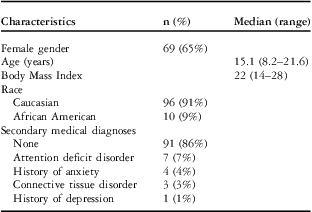
A total of 115 new patients were seen over the study period. However, nine patients with a previous diagnosis of seizure disorder were excluded and 106 patients were included for analysis. Patient characteristics are shown in Table 1. There were no patients with known congenital heart disease. There were no patients with family history of known structural cardiac disease, channelopathies, or sudden or unexpected death. Most patients had only one syncopal episode (39%), while fewer had experienced one to three episodes (32%), three to six episodes (19%), or more than six episodes (10%). Most patients presented within 6 months of their first episode (62%) and 32% presented within a month of their first episode.
Patient characteristics.
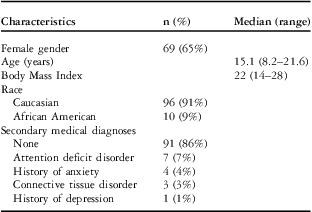
The median supine systolic blood pressure for the group was 104 millimetres of mercury (76–138) and the median supine diastolic blood pressure for the group was 58 millimetres of mercury (38–86). On orthostatic vital sign measurement, there were five patients (5%) who had a drop in their systolic blood pressure of greater than 20 millimetres of mercury when moving from a supine to standing position and 48 patients (45%) with an increase of greater than 20 beats per minute in their heart rate. All patients had an electrocardiogram performed and there was a single patient with previously undiagnosed ventricular pre-excitation; no other abnormalities were noted. In all, 102 patients (96%) had a graded exercise test performed; four patients were not able to perform the exercise test – one patient refused, two had injured legs, and one patient was wheelchair bound. There were 34 patients (32%) who had a depressed vasomotor and/or cardioinhibitory response following exercise consistent with a diagnosis of neurocardiogenic syncope. There was one patient who developed non-sustained atrial fibrillation during the exercise test. There were no other heart rhythm or haemodynamic abnormalities identified during exercise testing. There were 68 patients (64%) who had either positive orthostatic measurements or an exercise test consistent with neurocardiogenic syncope.
Health-related quality of life scores
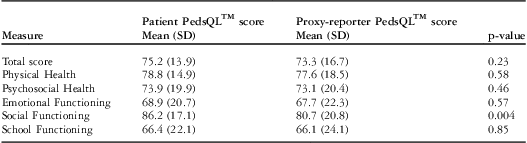
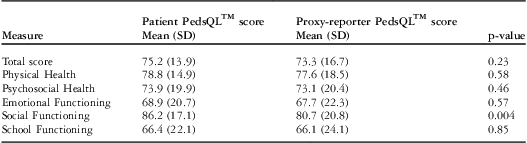
PedsQL™ Total score, Physical Health Summary score, Psychosocial Health Summary score, as well as subscale scores for Emotional Functioning, Social Functioning, and School Functioning from patients and proxy reporters are shown in Table 2. The only difference noted between patient-reported scores and proxy-reported scores was in Social Functioning, in which proxies reported a lower mean score, 80.7, than patients, 86.2 (p = 0.004).
PedsQL™ scores and subscores in patients presenting with syncope (n = 106).
Comparison between syncope and other populations
Compared with healthy controls, patients with syncope had significantly lower PedsQL™ scores: Total score (75.2 versus 83.8, p < 0.0001); Physical Health Summary (78.8 versus 87.5, p < 0.0001); Psychosocial Health Summary (73.9 versus 81.9, p < 0.001), Emotional Functioning (68.9 versus 79.3, p < 0.001); and School Functioning (66.4 versus 81.1, p < 0.001). There was no difference between this cohort and healthy controls in Social Functioning (86.2 versus 85.2, p > 0.1). Patients with syncope had worse PedsQL™ Total scores than patients with diabetes mellitus (p > 0.0001) and similar Total scores to patients with asthma, end-stage renal disease, obesity, and structural heart disease. Comparison of PedsQL™ scores in this population and normal subjects, as well as scores in children with other chronic illnesses is shown in Table 3. No patient or clinical variables, including findings on orthostatic measurement or graded exercise testing, were significantly associated with any PedsQL™ scores. The frequency of syncopal symptoms in the 6 months before their visit was not associated with lower PedsQL™ scores. Patients with a history of attention deficit disorder, anxiety, depression, or connective tissue disorder (a total of 15 patients) had similar PedsQL™ Total score and subscores to the remainder of the cohort.
Patient self-report: means and standard deviations for the PedsQL™ by disease.

*Less than 0.0001
**Less than 0.001
***Less than 0.01
****Less than 0.05
Discussion
We found that children presenting with syncope to a specialised syncope clinic have lower health-related quality of life than healthy children. In addition, we found that patients with syncope have similar health-related quality of life scores to those with chronic illnesses including asthma, end-stage renal disease, obesity, and structural heart disease.
Our study demonstrates similar findings to adult studies that have looked at the relationship between syncope and health-related quality of life.Reference van Dijk, Sprangers, Colman, Boer, Wieling and Linzer10, Reference Linzer, Gold, Pontinen, Divine, Felder and Brooks16, Reference Linzer, Pontinen, Gold, Divine, Felder and Brooks17 The impact of syncope on health-related quality of life in adults ranges from inconvenience and embarrassment to activity restrictions, which may in turn result in an inability to work. In a large study of adult patients presenting with transient loss of consciousness, van Dijk et al Reference van Dijk, Sprangers, Colman, Boer, Wieling and Linzer10 found that patients had significantly lower health-related quality of life, especially in areas of physical and mental functioning, than their healthy counterparts. Rose et al Reference Rose, Koshman, Spreng and Sheldon9 found a similar relationship between symptoms of syncope and lower health-related quality of life in adults. In addition, she found that there was a relationship between more frequent episodes of syncope and lower health-related quality of life. Activity restrictions in children may impair school attendance and performance and the ability to participate in activities such as athletics.
In this study, we were surprised to find that there were no patient-related or physiologic variables that were associated with lower health-related quality of life. In adults, an increased frequency of syncope and pre-syncopal symptoms has been shown to be associated with this finding.Reference van Dijk, Sprangers, Colman, Boer, Wieling and Linzer10 We did not find similar patient or clinical characteristics to assist in identifying those children with syncope who might have lower quality of life scores. This finding may indicate that physical symptoms and findings are less important factors affecting quality of life than the psychological and social aspect of this medical problem. Owing to the fact that children with syncope have lower health-related quality of life than their healthy counterparts, it is important to assess each patient for the effect of their symptoms on this important measure, regardless of their presenting clinical findings. Only by performing a formal assessment will the relationship between individual patient symptoms and quality of life be fully understood.
Children with syncope presenting to this specialised syncope clinic had quality of life scores that were lower than healthy subjects in total scores, as well as areas of physical, emotional, and school functioning. Interestingly, patients had normal scores in the area of social functioning. Although this finding was surprising, it may be partially explained by the current nature of social relationships among adolescents. It has been shown that not only do adolescents utilise online communication as an alternative to “face-to-face” time with their peers, but that frequent use of online social networking sites have a positive impact on self-esteem in some adolescents.Reference Bonetti, Campbell and Gilmore18, Reference Valkenburg, Peter and Schouten19 It may be that although syncope limits physical and school activity in children, there is some compensation in the area of social functioning because of online peer communication.
The comparison of health-related quality of life between children with syncope and those with other chronic illnesses helps illustrate the relative potential magnitude of impairment patients with syncope experience. The impact on the life of a patient experiencing symptoms from this problem or its related symptoms may be significant and should not be ignored.
The treatment of children presenting with recurrent presyncope and syncope can be difficult in a minority of cases. For patients with neurocardiogenic syncope, the mainstays of therapy include adequate hydration, increased salt intake, and regular exercise.Reference Wieling, Ganzeboom and Saul7 For patients who continue to have symptoms despite these measures, several different mediations have been utilised with mixed results including beta-blockers, fludrocortisone, midodrine, selective-serotonin reuptake inhibitors, and multiple other mediations.Reference Brignole20–Reference Flevari, Livanis, Theodorakis, Zarvalis, Mesiskli and Kremastinos22 One problem in determining effectiveness of treatment strategies in paediatric syncope is that end-points for successful management can often be vague. There are no validated symptom scales for syncope among children. The findings of this study would suggest that quality of life scores may be potential indicators of symptom improvement in this population. In fact, attention to proper management has been shown to improve PedsQL™ scores in children with other chronic medical problems including obesity, diabetes, and cerebral palsy.Reference Yackobovitch-Gavan, Nagelberg, Phillip, Ashkenazi-Hoffnung, Hershkovitz and Shalitin23–Reference Cuomo, Gamradt and Kim25 Similarly, attention to proper medical management of children presenting with syncope may attenuate or even improve the effect this problem has on health-related quality of life measures. In addition, using these measures as an indicator of treatment success may help answer questions regarding which therapies are actually effective in this group of patients.
This study is limited by its retrospective nature. There may be factors associated with impaired quality of life that were not captured in our clinical review, such as socio-economic status and home environment. The lower quality of life scores seen in these patients may be related to underlying pathology leading to stress-related syncope, rather than the syncope itself. Finally, the quality of life scores seen in this group may have been affected by the process of evaluation during the clinic itself; performance of multiple tests, as well as an extended history and examination may have given patients and their families concern leading to lower quality of life scores. Finally, although historical control patients provided a large sample with which to compare our patients, ideally we would have had control subjects who had health-related quality of life scoring performed along with our patients in a prospective manner. Further prospective work in this area should include a simultaneous control group. Finally, this was a group of patients presenting to a specialised syncope clinic. Many children with syncope may never seek medical attention or may be cared for by their primary care physician. These results may not be generalisable to this larger group of patients.
Children presenting for evaluation of syncope to a specialised syncope clinic have lower health-related quality of life compared with healthy subjects. They also have similar health-related quality of life compared with patients with other chronic medical conditions. Measurement of health-related quality of life may provide a tool needed to understand the best treatment strategies for children with this problem.