Introduction
Strategies that minimize the risk of seed germination failure are important for the successful regeneration of plants, especially in seasonal or unpredictable environments (Donohue et al., Reference Donohue, de Casas, Burghardt, Kovach and Willis2010; Ramos et al., Reference Ramos, Diniz, Ooi, Borghetti and Valls2017). Seed dormancy is an adaptive trait that matches seed germination with favourable environmental conditions, thus enhancing seedling survival in the field (Jurado and Moles, Reference Jurado, Moles, Nicolás, Bradford, Côme and Pritchard2003). Seeds may exhibit primary dormancy, when they are dispersed in a dormant state, and/or secondary dormancy, which is acquired after dispersal (Baskin and Baskin, Reference Baskin and Baskin1985; Bewley, Reference Bewley1997). The degree of primary dormancy of a seed is influenced by both genetic factors and the environmental conditions experienced by the seed during maturation (Fernández-Pascual et al., Reference Fernández-Pascual, Jiménez-Alfaro, Caujapé-Castells, Jaén-Molina and Díaz2013; Baskin and Baskin, Reference Baskin and Baskin2014). Due to the heterogeneity of natural environmental conditions, variation in the germination behaviour of seeds among populations, among years of collection and even among individuals is frequent (Andersson and Milberg, Reference Andersson and Milberg1998; Gutterman, Reference Gutterman and Fenner2000). The environment under which seeds mature is commonly referred to as their maternal environment (Fenner, Reference Fenner1991).
Secondary dormancy is induced by environmental conditions unfavourable to seed germination, or by conditions preceding unfavourable periods (Vleeshouwers et al., Reference Vleeshouwers, Bouwmeester and Karssen1995; Vázquez-Yanes and Orozco-Segovia, Reference Vázquez-Yanes, Orozco-Segovia, Mulkey, Chazdon and Smith1996). The acquisition and release of secondary dormancy can follow a cyclic pattern driven by environmental seasonality – a mechanism called cyclic dormancy or seed dormancy cycling (Baskin and Baskin, Reference Baskin and Baskin1985). Seeds with cyclic dormancy exhibit changes in dormancy status in response to changes in temperature and/or humidity (Karssen, Reference Karssen1980/1981; Baskin and Baskin, Reference Baskin and Baskin1985; Duarte and Garcia, Reference Duarte and Garcia2015). Conditional dormancy is a transition between the non-dormant state and the dormant state, during which seeds germinate under a limited set of environmental conditions (Baskin and Baskin, Reference Baskin and Baskin1985). Seed dormancy cycles are known for buried seeds of some species (mainly annual species, but also in some perennials) and represent a strategy for synchronizing seed germination with periods favourable for seedling establishment (Schütz, Reference Schütz1997; Garcia et al., Reference Garcia, Oliveira and Duarte2014; Copete et al., Reference Copete, Herranz, Ferrandis and Copete2015; Oliveira et al., Reference Oliveira, Diamantino and Garcia2017).
In general, there is a higher proportion of dormant seed producing plant species in seasonal environments than in more climatically stable environments (Jurado and Flores, Reference Jurado and Flores2005; Baskin and Baskin, Reference Baskin and Baskin2014). The Brazilian campo rupestre, however, is an exception, as most of the plant species that inhabit this seasonal ecosystem disperse seeds without dormancy (Dayrell et al., Reference Dayrell, Garcia, Negreiros, Baskin, Baskin and Silveira2017). On the other hand, cyclic dormancy has been reported for some species typical of the campo rupestre, particularly those of the families Xyridaceae and Eriocaulaceae, which are dispersed in a non-dormant state and acquire dormancy to avoid germination during unfavourable periods, thus contributing to their successful regeneration (Garcia et al. Reference Garcia, Giorni, Müller and Munné-Bosch2012, Reference Garcia, Oliveira and Duarte2014; Duarte and Garcia, Reference Duarte and Garcia2015; Oliveira et al., Reference Oliveira, Diamantino and Garcia2017). Further studies are needed to determine whether cyclic dormancy is a common pattern within these families and whether it can be found in other representative groups of this ecosystem.
Xyris longiscapa L. A. Nilsson (Xyridaceae) is a perennial herb endemic to the Brazilian campo rupestre and distributed along the Espinhaço mountain range in the states of Minas Gerais and Bahia, Brazil (Wanderley, Reference Wanderley2011). The species produces very small seeds that have an absolute requirement for light to germinate (Abreu and Garcia, Reference Abreu and Garcia2005). In this work, we investigated the ecology of seed germination of a natural population of X. longiscapa in order to: (i) determine the temperature requirements for seed germination; (ii) investigate inter-annual variation in seed germination patterns; and (iii) verify the existence of seasonal dormancy cycling in buried seeds. We hypothesized that the buried seeds of X. longiscapa present changes in their dormancy status over time.
Materials and methods
Seed collection
Mature fruits were collected from at least 50 individuals of the same population of X. longiscapa in Serra do Cipó National Park, Minas Gerais, Brazil, in May/June of each year from 2014 to 2017. Fruits were processed manually and the seeds were separated with the aid of sieves.
Germination requirements and inter-annual variation in seed germination
Germination tests were conducted immediately after seed collection. Seeds collected in 2014 were placed to germinate in germination chambers at constant temperatures from 10 to 40°C (with intervals of 5°C), under a 12 h photoperiod (~40 μmol m–2 s–1) or continuous darkness. Seeds collected in 2015, 2016 and 2017 were placed to germinate at constant temperatures from 15 to 30°C (with intervals of 5°C) only under 12 h photoperiod. For all collection years, six replicates with 25 seeds each were placed in Petri dishes containing a double sheet of filter paper, which was irrigated with nystatin solution (0.5%) to prevent fungal contamination (Oliveira et al., Reference Oliveira, Diamantino and Garcia2017). To reproduce the dark condition, the dishes were covered with black plastic bags. Germination was evaluated daily for 50 days or until stabilization (three consecutive equal evaluations). Germination in the dark condition was evaluated under green light (Abreu and Garcia, Reference Abreu and Garcia2005). Seeds were considered germinated by the cotyledon emergence (Oliveira et al., Reference Oliveira, Diamantino and Garcia2017).
Seed dormancy cycles
Seeds of X. longiscapa collected in 2014 were placed in nylon bags (0.1 mm mesh) and buried in the soil at a depth of 5 cm in the same area of the studied population (1369 m altitude). The seeds (approximately 250 per bag) were buried in September 2014, which coincides with the beginning of spring in the Southern Hemisphere. For a duration of 18 months, six sample bags containing the seeds were exhumed every 2 months for evaluation of germination in the laboratory. Each exhumed bag corresponded to one replicate in all the tested constant temperatures of 15, 20, 25 and 30°C, under 12 h photoperiod (based on germination requirements of the newly collected seeds). Germination was conducted and evaluated as described above.
Climatic data
Changes in soil moisture and temperature were monitored by sensors (5TM Soil Moisture & Temperature Sensor), buried in the same place that the seeds were buried, connected to a data-logger (EM50, Decagon). Data of mean monthly rainfall, mean monthly air temperature (maximum and minimum) and potential evapotranspiration were obtained from the Conceição do Mato Dentro meteorological station, Minas Gerais (663 m altitude), located approximately 30 km from the study site (INMET – Instituto Nacional de Meteorologia, 2017). The drought index was calculated as the ratio between precipitation and potential evapotranspiration of each month (Vicente-Serrano et al., Reference Vicente-Serrano, Beguería and López-Moreno2010). Drought index values below 1 mean that the loss of water by evapotranspiration was greater than the rainfall, indicating water deficit. The drought index was calculated to assess whether water availability may be related to the degree of seed dormancy.
Data analysis
A two-way ANOVA was used to analyse seed germination among temperatures and years of collection, after testing the data for normality (Shapiro–Wilk test) and homoscedasticity (Bartlett's test). Means were compared using Tukey's test at 5% probability.
Results
Germination requirements and inter-annual variation in seed germination
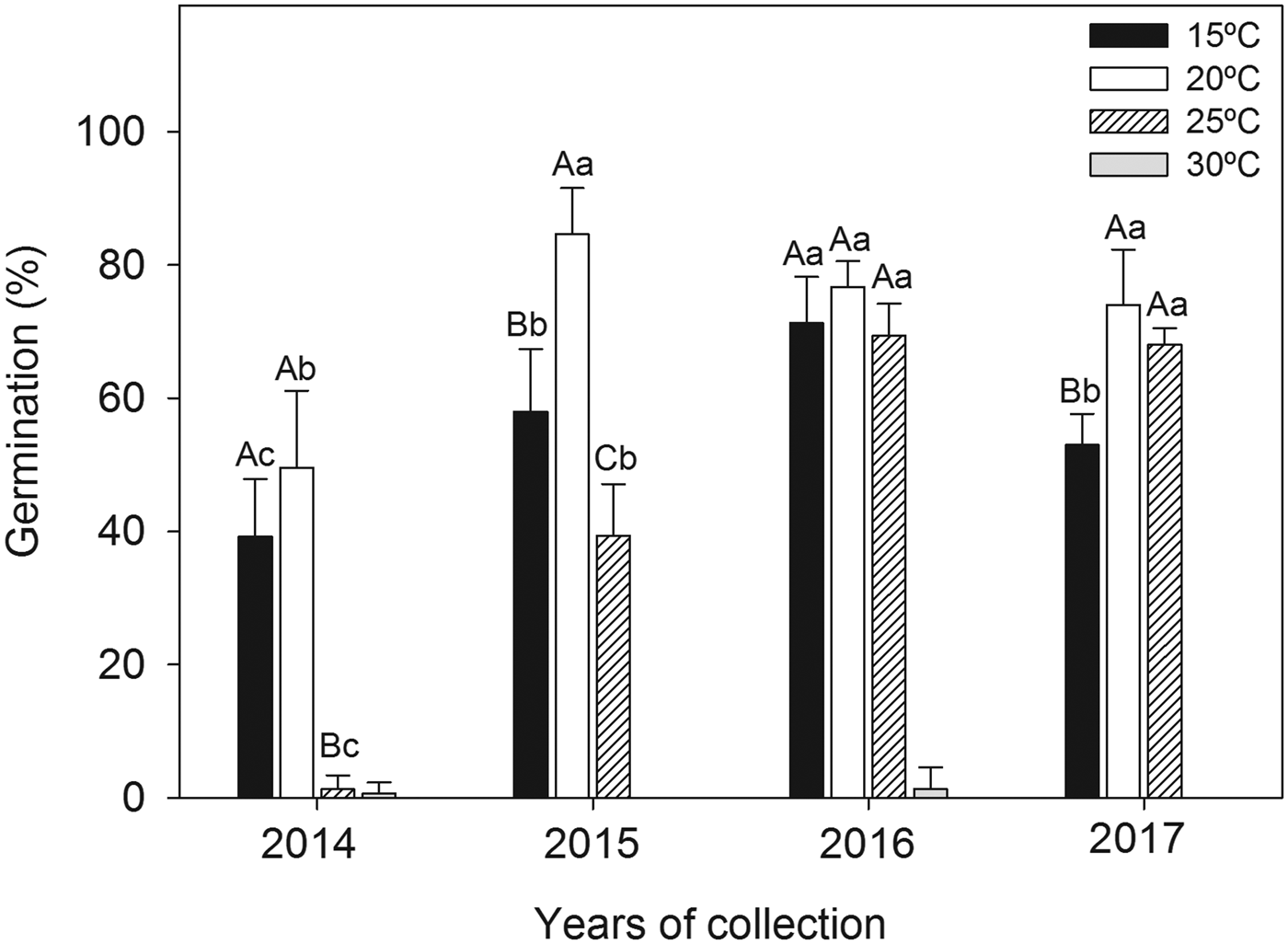
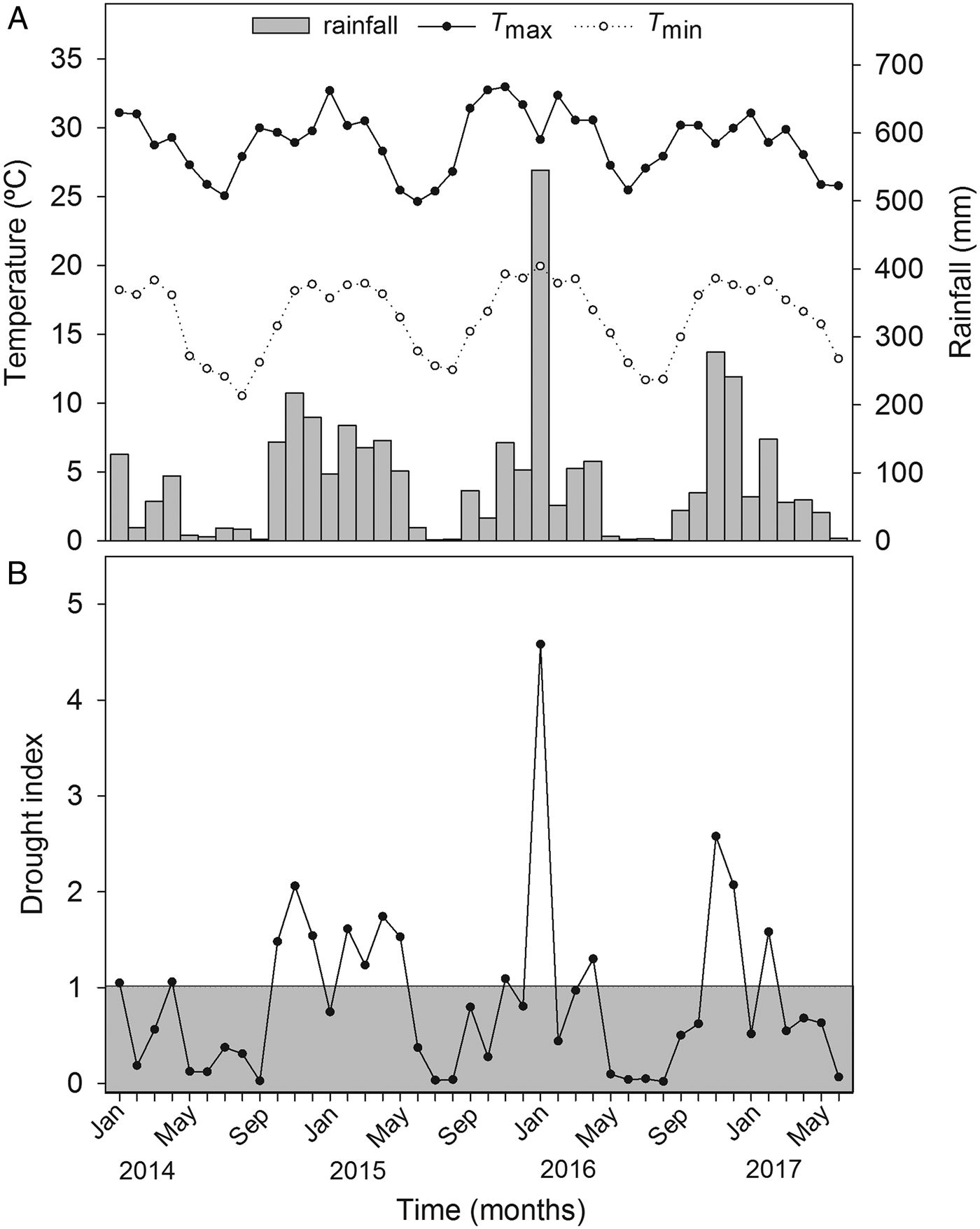
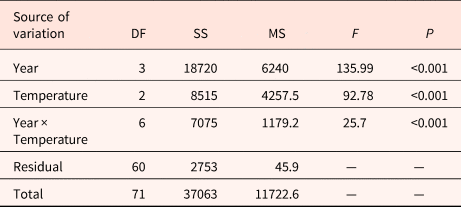
Germination temperature and year of seed collection had significant effects on seed germination, with an interaction between factors (Table 1). The temperature range for germination was 15–20°C for seeds collected in 2014 and 15–25°C for seeds collected in 2015, 2016 and 2017 (Fig. 1). At 15°C, higher germination was observed for seeds collected in 2016 (71%), than for seeds collected in the other years. No differences in germination were found among seeds collected in 2015, 2016 and 2017 at 20°C (germination percentages above 70%). The highest germination percentages at 25°C were for seeds collected in 2016 and 2017 (≥68%). Germination at 30°C was very low (below 2%) in all treatments, and no germination was observed at 10, 35 and 40°C. The rainfall patterns were quite irregular during the four years of study (Fig. 2). The months that preceded the collection of seeds in 2014 presented the lowest values of rainfall and drought index.
Inter-annual variation in seed germination of X. longiscapa seeds at different temperatures. The same upper case letters indicate no significant differences within each year of collection, while the same lower case letters indicate no significant differences among the same germination temperature in different years of collection, by Tukey's test at a 5% level of probability. Seed germination at 30°C was not included in the analysis. Values are means ± standard error.

Monthly rainfall, mean maximum and mean minimum air temperatures (A), and drought index (B) in the period between January 2014 and June 2017. Data were obtained from the Conceição do Mato Dentro meteorological station, MG, Brazil (INMET, 2017).

Summary of the two-way ANOVA for the effect of collection year and temperature on seed germination of X. longiscapa

DF, degrees of freedom; SS, sum of squares; MS, mean squares.
Seed dormancy cycles
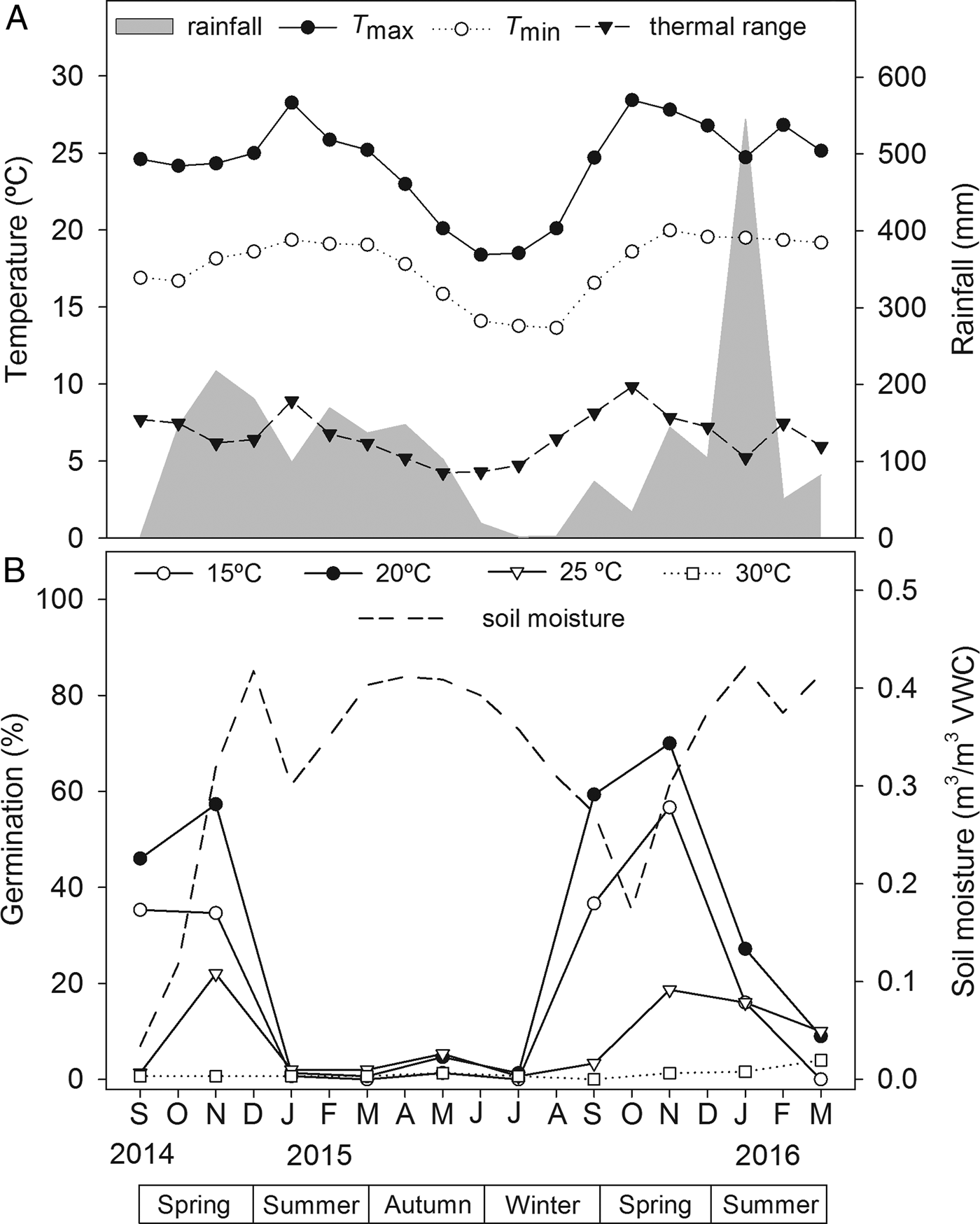
Buried seeds of X. longiscapa exhibited dormancy cycles that were strongly influenced by seasonal changes in water availability in the soil (Fig. 3). Secondary dormancy was induced in the rainy season (spring/summer) and alleviated during the dry season (autumn/winter). Seeds exhumed after 4 months (January) showed absolute dormancy (absence of germination at all temperatures). After 12 months of burial, seeds reacquired germinability, reaching the highest germination percentages after 14 months of burial (November). Seeds of X. longiscapa remained viable in the soil for at least 14 months. Seed germination was not observed in the soil during the burial experiment because of the requirement for light. The dormancy cycle found for X. longiscapa can be classified as a conditional dormant–dormant cycle.
(A) Monthly rainfall, and mean maximum and mean minimum soil temperatures in Serra do Cipó, Brazil, during the seed burial experiment. (B) Soil moisture and germination percentages for X. longiscapa seeds at different temperatures under a 12 h photoperiod and during burial for 18 months.

Discussion
Germination of X. longiscapa seeds collected in 2014 exhibited marked differences from those of seeds collected in 2015, 2016 and 2017. The absence of germination at 25°C for seeds collected in 2014 indicates that these seeds were dispersed with dormancy, since seeds collected in subsequent years germinated at this temperature. The environmental factors that affect the degree of primary dormancy include temperature, water availability, photoperiod and nutritional status of the mother plant (Fenner, Reference Fenner1991). The response of seeds to each environmental factor is variable. For example, seed dormancy increases with increasing maturation temperature in some species (Hume, Reference Hume1994), while in other species higher temperatures decrease the degree of seed dormancy (Fenner, Reference Fenner1991; Sharif-Zadeh and Murdoch, Reference Sharif-Zadeh and Murdoch2000). In the present study, there was no clear correspondence between climatic variables (precipitation and temperature) and the highest degree of dormancy for seeds collected in 2014, although the extended water stress experienced by seeds during maturation in this year (evidenced by the drought index) may have contributed to this behaviour.
The highest germination percentage observed during the burial experiment was for seeds exhumed at 14 months (spring). Thus, at least 70% of the seeds collected in 2014 were viable at the beginning of the experiment. In this sense, a fraction of the seeds was dormant at dispersal. Seed dormancy is not crucial for seed bank formation (Thompson et al., Reference Thompson, Ceriani, Bakker and Bekker2003; Honda, Reference Honda2008); however, it prevents seed germination shortly after dispersal and thus favours seed burial in the soil (Schütz, Reference Schütz1997). Once buried, seeds of X. longiscapa will not germinate because of their light requirement. Thus, the proportion of primarily dormant seeds (which can vary among years) probably influences the amount of seeds incorporated into the soil seed bank (seed burial). Seeds produced in 2015, 2016 and 2017 exhibited a lower degree of dormancy and, therefore, could germinate after an untimely rain, resulting in a lower chance of seedling survival.
Buried seeds of X. longiscapa form at least a short-term persistent soil seed bank (sensu Walck et al., Reference Walck, Baskin, Baskin and Hidayati2005); that is, seeds remain viable in the soil for more than a year. Other species of Xyris from the Brazilian campo rupestre are known to have the capacity to form a persistent seed bank (Garcia et al., Reference Garcia, Giorni, Müller and Munné-Bosch2012; Oliveira et al., Reference Oliveira, Diamantino and Garcia2017), which may be associated with the high desiccation tolerance of imbibed seeds. It has been demonstrated that imbibed seeds of two tropical species of Xyris (X. asperula Mart. and X. trachyphylla Mart.) can be dehydrated without decreases in survival and germination (Oliveira et al., Reference Oliveira, Souza and Garcia2018). Seed persistence in the soil is important for spreading germination out over time and, thus, enhancing the chance of seedling survival (Long et al., Reference Long, Gorecki, Renton, Scott, Colville, Goggin, Commander, Wescott, Cherry and Finch-Savage2014). This trait is particularly important for species that inhabit seasonal environments. The longevity of at least 14 months for Xyris seeds in the field (uncontrolled conditions) indicates that seeds could be stored in controlled conditions for use in restoration programmes.
Seeds of X. longiscapa exhibited seasonal changes in dormancy status while in the soil seed bank. Dormancy cycle patterns for X. longiscapa seeds are like those of the seeds of other species of the Brazilian campo rupestre (Garcia et al., Reference Garcia, Oliveira and Duarte2014; Duarte and Garcia, Reference Duarte and Garcia2015), including species of Xyris (Garcia et al., Reference Garcia, Giorni, Müller and Munné-Bosch2012; Oliveira et al., Reference Oliveira, Diamantino and Garcia2017). Secondary dormancy is acquired in the middle of the rainy season and is alleviated throughout the dry season. This pattern avoids the occurrence of seed germination very late in the rainy season and allows seeds to germinate at the beginning of the rainy season. Soil moisture has been suggested as the main factor modulating the cyclical dormancy in tropical species (Duarte and Garcia, Reference Duarte and Garcia2015; Oliveira et al., Reference Oliveira, Diamantino and Garcia2017). This idea is supported by the limited range of temperature variation in tropical environments compared with temperate or desert environments. Soil moisture, on the other hand, exhibits broad seasonal variation, with periods of high soil moisture coinciding with periods of lower seed germination and periods of lower soil moisture coinciding with higher seed germination. In addition, seed drying (45°C for 48 h) is known to partially overcome secondary dormancy in X. trachyphylla, a species with cyclic dormancy (Oliveira et al., Reference Oliveira, Diamantino and Garcia2017), which reinforces the role of soil moisture in the acquisition and overcoming of secondary dormancy.
In summary, seeds of X. longiscapa exhibited different strategies for persisting in the Brazilian campo rupestre. The role of environmental factors in determining the degree of seed dormancy (effects of maternal environment) needs to be better investigated. Differences in seed germination behaviour provide relevant information for conservation efforts. To determine whether seed dormancy is innate (genetic factors) or environmentally regulated, it is recommended that future studies make collections in different years and even in different populations of a species. The results of the present study demonstrate that another species of Xyris forms persistent soil seed banks and exhibits seasonal dormancy cycles. All tropical species of Xyris inhabiting the Brazilian campo rupestre investigated to date have these traits, indicating a pattern for this group (Garcia et al., Reference Garcia, Giorni, Müller and Munné-Bosch2012; Oliveira et al., Reference Oliveira, Diamantino and Garcia2017). Seasonal dormancy cycles match seed germination with favourable conditions, and therefore contribute to the successful regeneration of X. longiscapa in this seasonal environment.
Acknowledgements
The authors thank N.F.O. Mota for identifying plants.
Financial support
The authors thank Fundação de Amparo à Pesquisa do Estado de Minas Gerais (FAPEMIG, APQ-01176-14) for financial support for the project. T.G.S. Oliveira thanks Coordenação de Aperfeiçoamento de Pessoal de Nível Superior (CAPES) and Conselho Nacional de Desenvolvimento Científico e Tecnológico (CNPq) for the scholarship. Q.S. Garcia received a research productivity scholarship from CNPq.