Introduction
The Aegean archipelago comprises more than 7000 islands and islets (Triantis & Mylonas, Reference Triantis, Mylonas, Gillespie and Glague2009) and has long attracted the attention of botanists (Turrill, Reference Turrill1929; Rechinger, Reference Rechinger1943; Rechinger & Rechinger-Moser, Reference Rechinger and Rechinger-Moser1951; Greuter, Reference Greuter1970; Runemark, Reference Runemark1970; Raus, Reference Raus1986, Reference Raus2012; Livaniou-Tiniakou et al., Reference Livaniou-Tiniakou, Christodoulakis, Georgiou and Artelari2003; Panitsa et al., Reference Panitsa, Trigas, Iatrou and Sfenthourakis2010), partially due to its complex palaeogeographical history (for a review see Anastasakis & Dermitzakis, Reference Anastasakis and Dermitzakis1990). The entire Aegean region is characterised by high levels of diversity and endemism (Strid, Reference Strid1996) and several of its large islands – especially those lying in the southern and eastern parts of the Aegean archipelago – are rather well floristically explored. Nevertheless, our knowledge of the flora of one of the most significant geological structures of the Mediterranean area, namely the South Aegean Volcanic Arc (SAVA), is still not complete.
Fifteen islands and islets comprise the SAVA, the vast majority of them located in the southern Kikladic Islands. The SAVA is the result of subduction of the African plate beneath the Aegean-Anatolian microplate (Anastasakis & Piper, Reference Anastasakis and Piper2005) and is located about 130–150 km above the seismically defined Benioff zone (Makropoulos & Burton, Reference Makropoulos and Burton1984; for more information regarding the SAVA see Francalanci et al., Reference Francalanci, Vougioukalakis, Fytikas, Beccaluva, Bianchini and Wilson2007). Fewer than half the islands comprising the SAVA are floristically well known (Papatsou, Reference Papatsou1974; Burton, Reference Burton1991; Vallianatou, Reference Vallianatou2005; Kougioumoutzis et al., Reference Kougioumoutzis, Tiniakou, Georgiadis and Georgiou2012a,Reference Kougioumoutzis, Tiniakou, Georgiou and Georgiadisb; Raus, Reference Raus2012). In an attempt to fill this gap we carried out a thorough investigation of the flora of Kimolos Island.
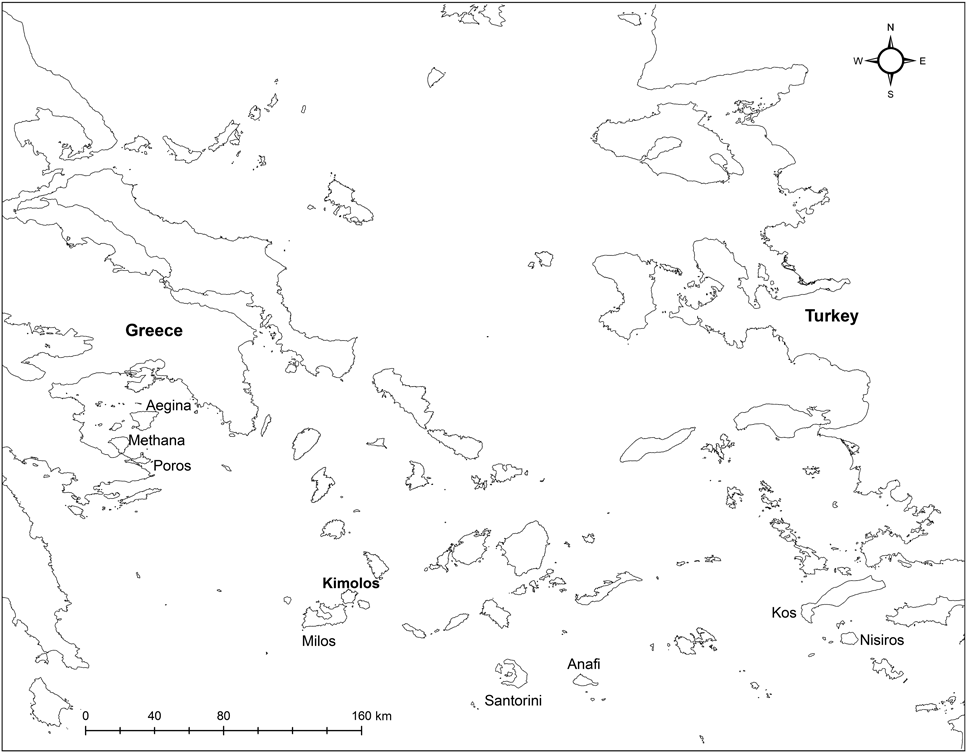
Kimolos Island, located in the southwestern part of the phytogeographical area of the Kiklades (Fig. 1), is a small compound volcano made mainly of lava domes, which intrude thick volcanoclastic deposits and, together with Milos, Polyaegos, Antimilos and the Ananes islets, belongs to the Milos volcanic field (Francalanci et al., Reference Francalanci, Vougioukalakis, Fytikas, Beccaluva, Bianchini and Wilson2007), which is part of the SAVA. The geology and geochemistry of the aforementioned islands are well known (Francalanci et al., Reference Francalanci, Vougioukalakis, Fytikas, Beccaluva, Bianchini and Wilson2007 and references therein). Volcanic activity in Kimolos occurred during the Upper and Lower Pleistocene, ranging in age between 3.5 and 0.9 Ma (Fytikas & Vougioukalakis, Reference Fytikas and Vougioukalakis1993). Despite its small size (c.36 km2), Kimolos is characterised by a variety of substrates and is built up of nine major tectono-stratigraphic units, according to Fytikas & Vougioukalakis (Reference Fytikas and Vougioukalakis1993) and Francalanci et al. (Reference Francalanci, Vougioukalakis, Fytikas, Beccaluva, Bianchini and Wilson2007), most of them being of volcanic origin (lavas and tuffs); schists, conglomerates, sandstones and granodiorites also exist.
The South Aegean Volcanic Arc.

The study area is mainly hilly with sharp relief, the highest peak being Paleokastro hill (364 m). Several gravelly and sandy beaches can be found by the coast. The hydrographical network is rather limited, with no obvious runoff. Kimolos hosts one active and several abandoned chalk quarries, owing its name to that rock type (chalk = κιμωλία in Greek).
The nearest meteorological station to Kimolos lies in Milos island; according to Gouvas & Sakellariou (Reference Gouvas and Sakellariou2011), this station, and therefore the study area, belongs to the arid bioclimatic zone with a mild winter and also to the Thermo-mediterranean zone, with a long dry period.
Most records are from Rechinger (Reference Rechinger1943), and in more recent times from Snogerup (Reference Snogerup, Kamari, Felber and Garbari1994), Runemark (Reference Runemark, Kamari, Felber and Garbari1996, Reference Runemark, Kamari, Felber and Garbari2000, Reference Runemark, Kamari, Felber and Garbari2006), Strid & Tan (Reference Strid and Tan1997, Reference Strid and Tan2002), Delforge (Reference Delforge2002), Thanopoulos (Reference Thanopoulos2007) and Biel & Tan (Reference Biel, Tan, Vladimirov, Dane and Kit2008). Information on some endemic taxa occurring in the area is given by Tan & Iatrou (Reference Tan and Iatrou2001). From a phytogeographical point of view, however, the interesting flora of the island of Kimolos has not yet received the attention it deserves in spite of these earlier records.
Therefore the present study aims at thoroughly investigating the flora of Kimolos by examining the floristic affinities of the study area to the large islands and peninsulas of the South Aegean Volcanic Arc, namely Aegina (Vallianatou, Reference Vallianatou2005), the Methana Peninsula (Kougioumoutzis et al., Reference Kougioumoutzis, Tiniakou, Georgiadis and Georgiou2012a), Milos (Rechinger, Reference Rechinger1943; Browicz, Reference Browicz1997; Strid & Tan, Reference Strid and Tan1997, Reference Strid and Tan2002; Tan & Iatrou, Reference Tan and Iatrou2001; Raus, Reference Raus2012), Santorini (Hansen, Reference Hansen1971; Raus, Reference Raus1988; Tan & Iatrou, Reference Tan and Iatrou2001), Anafi (Biel, Reference Biel2005; Kougioumoutzis et al., Reference Kougioumoutzis, Tiniakou, Georgiou and Georgiadis2012b) and Nisiros (Papatsou, Reference Papatsou1974; Burton, Reference Burton1991; Strid & Tan, Reference Strid and Tan1997, Reference Strid and Tan2002).
Materials and Methods
Several collection and field observation trips to the study area were carried out in spring and autumn of 2012 in order to acquire an integrated knowledge of the flora and vegetation of Kimolos. Herbarium specimens are deposited at the Botanical Museum of the University of Patras (UPA). Species identification and nomenclature are according to Tutin et al. (1964–1980, 1993), Davis (1965–1985), Pignatti (Reference Pignatti1982), Greuter et al. (1984–1989), Strid & Tan (Reference Strid and Tan1997, Reference Strid and Tan2002), Tan & Iatrou (Reference Tan and Iatrou2001) and Greuter & Raab-Straube (2008). Species identification and nomenclature of the genera Anthemis L., Astragalus L., Anchusa L., Crepis L., Cyclamen L., Dittrichia Greuter, Reichardia Roth, Tordylium L. and Trifolium L. are according to Georgiou (Reference Georgiou1990), Podlech (Reference Podlech2008), Selvi & Bigazzi (Reference Selvi and Bigazzi2003), Kamari (Reference Kamari1976), Grey-Wilson (Reference Grey-Wilson1988), Brullo & de Marco (Reference Brullo and de Marco2000), Gallego et al. (Reference Gallego, Talavera and Silvestre1980), Al-Eisawi & Jury (Reference Al-Eisawi and Jury1988) and Zohary & Heller (Reference Zohary and Heller1984), respectively. For family delimitation we follow APG III (2009). The nomenclature and status of the endemic taxa recorded from Kimolos is based on Tan & Iatrou (Reference Tan and Iatrou2001) and Georghiou & Delipetrou (Reference Georghiou and Delipetrou2010). The status of the alien taxa occurring in the study area is according to Arianoutsou et al. (Reference Arianoutsou, Bazos, Delipetrou and Kokkoris2010). The life-form categories follow Raunkiaer (Reference Raunkiaer1934), while Pignatti’s (Reference Pignatti1982) classification is used for the chorological analysis (see Appendix for abbreviations used). Sørensen’s index (Sørensen, Reference Sørensen1948), as well as the statistical software SPSS 20, were used for the cross-correlation between the islands.
Results
Flora
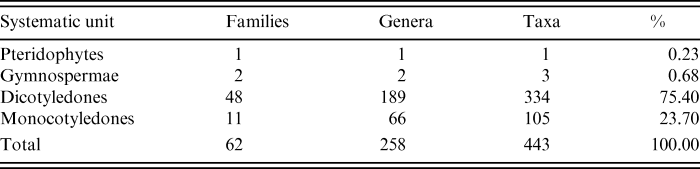
The vascular flora of Kimolos comprises 443 taxa, belonging to 258 genera and 62 families (Table 1). Seven alien taxa are included in the plant list, but have not been considered in the floristic analysis.
Number of vascular plant taxa in the flora of Kimolos Island
The literature survey revealed 218 bibliographical reports for the study area (Rechinger, Reference Rechinger1943; Snogerup, Reference Snogerup, Kamari, Felber and Garbari1994; Runemark, Reference Runemark, Kamari, Felber and Garbari1996, Reference Runemark, Kamari, Felber and Garbari2000, Reference Runemark, Kamari, Felber and Garbari2006; Strid & Tan, Reference Strid and Tan1997, Reference Strid and Tan2002; Tan & Iatrou, Reference Tan and Iatrou2001; Delforge, Reference Delforge2002; Thanopoulos, Reference Thanopoulos2007; Biel & Tan, Reference Biel, Tan, Vladimirov, Dane and Kit2008). We report 225 taxa as new to Kimolos (see Appendix). Thirty taxa are Greek endemics, 15 of which are new records for the study area. Twenty-five of the new records and 70 taxa overall are protected by law.
The most species-rich families in the flora of Kimolos are the Fabaceae (73 taxa), followed by the Asteraceae (53 taxa) and Poaceae (47 taxa). These three families account for more than one third of the total flora (39.77%). Caryophyllaceae (29 taxa), Brassicaceae (23 taxa), Orchidaceae (18 taxa) and Apiaceae (12 taxa) are also well represented.
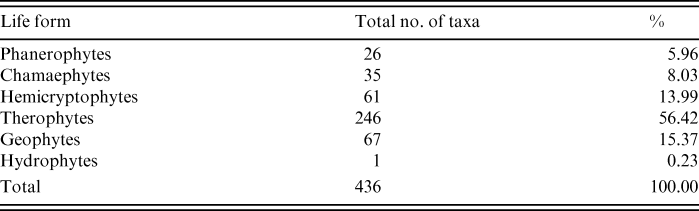
In life forms (Table 2) therophytes dominate, followed by geophytes, hemicryptophytes, chamaephytes and phanerophytes.
Life forms in the flora of Kimolos Island
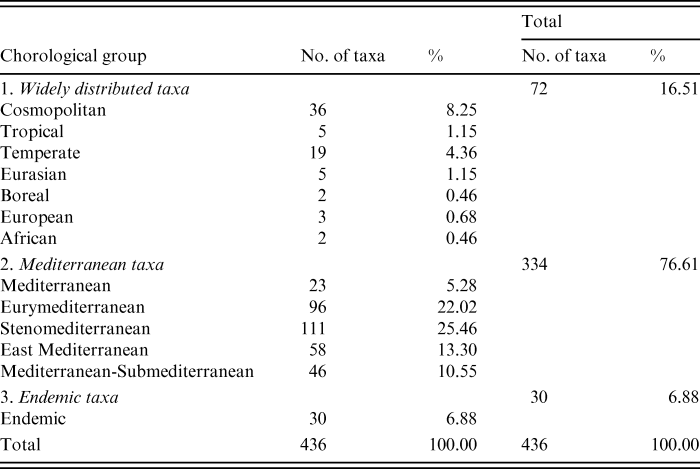
According to their general distribution, the local vascular flora can be classified into 13 main chorological groups (Table 3).
Chorological groups in the flora of Kimolos Island
The endemic group represents 6.88% of the total flora with 30 taxa. Phytogeographically, the endemic element is the most important group and is discussed separately. The Mediterranean chorological group predominates, highlighting the geographical position and climatic characteristics of the study area. Within this group, the Stenomediterranean elements are dominant. The other elements are represented in lower percentages, with a relatively high portion of cosmopolitan and subcosmopolitan elements, and also of invasive elements, indicating intense human impact in the study area.
The alien flora of Kimolos comprises seven taxa (1.58%), belonging to seven genera and six families. The neophytes amount to 57.14% of Kimolos’ alien flora and the most prominent among the invasive species are Opuntia ficus-indica (L.) Mill., Agave americana L. and Oxalis pes-caprae L. which occupy large areas.
Endemism
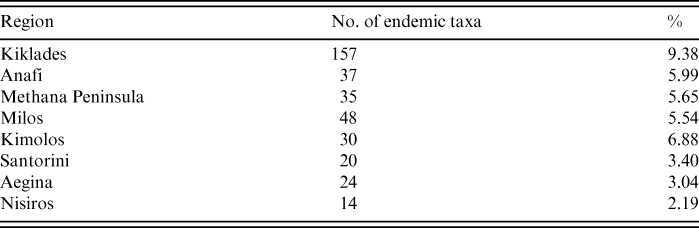
According to Tan & Iatrou (Reference Tan and Iatrou2001), 1640 taxa are found in the phytogeographical region of the Kiklades, 157 of which are considered endemics (9.38%) according to Georghiou & Delipetrou (Reference Georghiou and Delipetrou2010). In Kimolos, 30 endemic taxa were found (Table 4), making up 6.88% of its flora. The number of endemic taxa is low compared to the total but, taking into consideration the small size of the study area (c.36 km2), its geographic position not close to known areas of high endemism, the unfavourable climate, as well as the intense human pressure present on Kimolos (i.e. chalk quarries), this amount is rather significant. Furthermore, compared to the levels of endemism in other parts of the SAVA, yet with larger size than that of the study area, such as Aegina, Anafi, the Methana Peninsula, Milos, Nisiros and Santorini (3.04%, 5.99%, 5.65%, 5.54%, 2.19% and 3.40%, respectively; Table 4), the level of endemism in Kimolos is rather high, even appearing to be the highest in the SAVA.
Endemism in the phytogeographical area of the Kiklades, Anafi, the Methana Peninsula, Milos, Santorini, Aegina, Nisiros and the study area
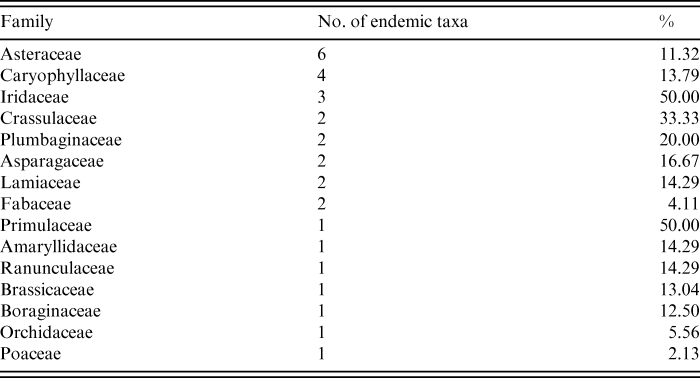
The endemic species belong to 15 families and 22 genera. Families rich in endemic species in absolute numbers are Asteraceae, Caryophyllaceae and Iridaceae (Table 5), their degree of endemism (11.32%, 13.79% and 50.00%, respectively) being higher than that of the general flora (6.88%). These results agree with the trend observed in the whole Greek endemic flora (Georghiou & Delipetrou, Reference Georghiou and Delipetrou2010).
Families with endemic taxa and their degree of endemism
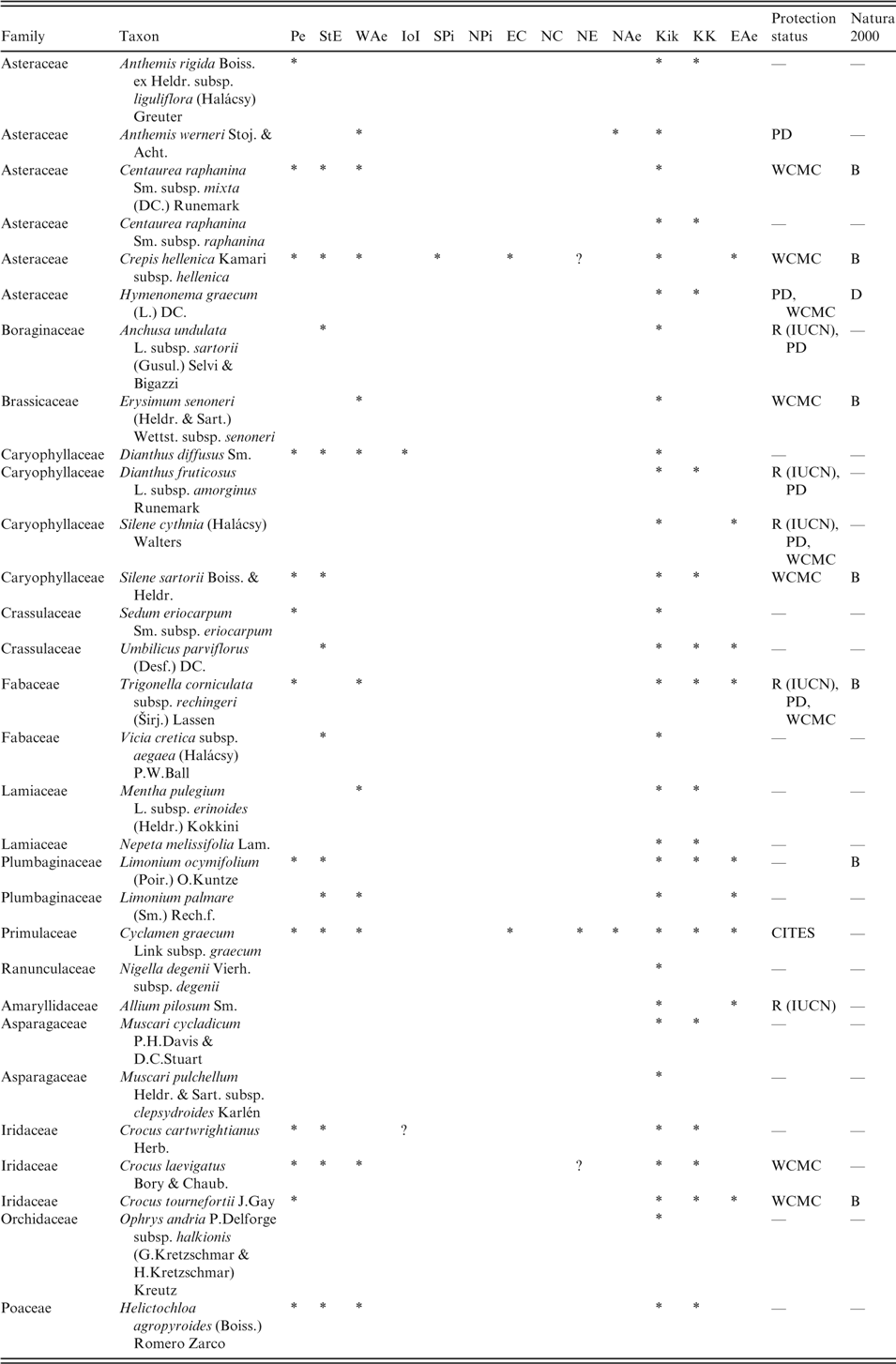
Nearly half (14) of the endemic taxa found on Kimolos correspond to one or two phytogeographical areas (Table 6), thus providing valuable information regarding the phytogeographical position of the study area, as the existence of biregional endemics is a good indication of phytogeographical connections between regions (Georghiou & Delipetrou, Reference Georghiou and Delipetrou2010). Kimolos would be expected to show higher affinities with the phytogeographical area of the East Aegean Islands (EAe) since, according to Georghiou & Delipetrou (Reference Georghiou and Delipetrou2010), the phytogeographical area of the Kiklades (Kik) is chorologically more closely connected to EAe than to that of Kriti and Karpathos (KK). While this may be true for the majority of the Kikladic islands, our results demonstrate that Kimolos is phytogeographically closer to KK, as we recorded five endemic taxa (Centaurea raphanina Sm. subsp. raphanina, Hymenonema graecum (L.) DC., Dianthus fruticosus L. subsp. amorginus Runemark, Nepeta melissifolia Lam. and Muscari cycladicum P.H.Davis & D.C.Stuart) occurring exclusively in Kik and KK and only two taxa (Silene cythnia (Halácsy) Walters and Allium pilosum Sm.) that occur exclusively in Kik and EAe. Therefore we argue that Kimolos seems to be more closely connected to KK, concurring with previous studies in the southeastern part of the phytogeographical area of Kiklades (Kougioumoutzis et al., Reference Kougioumoutzis, Tiniakou, Georgiou and Georgiadis2012b). It could be argued that the southern Kiklades as a whole have higher phytogeographical affinities with Kriti and this may be attributed to the close palaeogeographical distance between the southern Kiklades and Kriti during the Messinian salinity crisis (Hsü, Reference Hsü1972).
Greek endemic taxa in Kimolos, their geographical distribution and their protection and evaluation status according to European and national legislation and lists
Abbreviations:
Pe, Peloponnisos; StE, Sterea Hellas; WAe, West Aegean Islands; IoI, Ionian Islands; SPi, South Pindhos; NPi, North Pindhos; EC, East Central; NC, North Central; NE, North East; NAe, North Aegean Islands; Kik, Kiklades; KK, Kriti and Karpathos; EAe, East Aegean Islands.
CITES: Convention on International Trade in Endangered Species of Wild Fauna and Flora.
IUCN: Red List of Threatened Plants (IUCN, 2010), with the following classification system: R: the species population is rare.
Natura 2000 (Dafis et al., Reference Dafis, Papastergiadou, Georghiou, Babalonas, Georgiadis, Papageorgiou, Lazaridou and Tsiaoussi1996): The database created after the Directive 43/1992, where the plants are evaluated as: B: Greek endemics; D: Other.
PD: Greek Presidential Decree 67/1981 (1981), on the protection of the native flora and wild fauna of Greece.
WCMC: The directive for the Threatened (Endangered, Vulnerable, Rare or Data Deficient) taxa according to the World Conservation Monitoring Centre.
Among the 30 Greek endemic taxa, Sedum eriocarpum Sm. subsp. eriocarpum and Anthemis rigida Heldr. subsp. liguliflora (Halácsy) Greuter are the most interesting ones as they are found for the first time not only in Kimolos Island, but in the entire phytogeographical area of Kiklades. Sedum eriocarpum subsp. eriocarpum was thought to be confined to the Peloponnese. Its occurrence in Kimolos Island may reflect the close palaeogeographical proximity of the study area with the Peloponnese since, during the Last Glacial Maximum (LGM, c.20,000 years BP), the archipelago of Milos was separated from the Peloponnese by a marine area of ∼85 km width (Kapsimalis et al., Reference Kapsimalis, Pavlopoulos, Panagiotopoulos, Drakopoulou, Vandarakis, Sakelariou and Anagnostou2009). Anthemis rigida subsp. liguliflora was thought to occur only in the phytogeographical areas of the Peloponnese and Kriti-Karpathos. One more endemic Anthemis species found for the first time in Kimolos Island is Anthemis werneri Stoj. & Acht. which, according to Georgiou (Reference Georgiou1991), was considered an Aegean endemic with coherent distributional area in the W and N Aegean (from Samothraki to Andros) and an isolated occurrence on Santorini. Quite recently its distributional area has been significantly expanded to the southwest as it was found on Milos (Raus, Reference Raus2012), Sifnos (GBIF, 2012) and quite unexpectedly on Elafonissos Island (NW of Cape Maleas) and on the opposite Peloponnesian coast (near the Strogylli Lagoon) (Zarafoniti, unpublished diploma thesis, University of Patras 2012). The occurrence of this taxon in the phytogeographical region of the Peloponnese reinforces the abovementioned aspect of its close palaeogeographical proximity with the study area.
According to Rukšāns (2010), on eastern Crete, in the Lassithi plain, Crocus tournefortii J.Gay sometimes hybridises with Crocus laevigatus Bory & Chaub. Several specimens demonstrating intermediate characteristics between the two taxa, in filament length and pubescence, were found on Kimolos. To our knowledge, this is the first time that such a hybridisation event has been reported outside the Cretan area.
The nature conservation status of the Greek endemic taxa of Kimolos and their evaluation status within the Natura 2000 Network are shown in Table 6. Fourteen out of 30 endemic taxa are legally protected.
Phytogeographical relationships within the SAVA
The active volcanic arc consists of several centres situated along a west–east extending belt between the Saronic Gulf and the island of Nisiros. The Methana Peninsula, together with Aegina, Anafi, Milos, Santorini and Nisiros, constitute a large part of the SAVA and are floristically well known. Therefore, we focus on these six areas in order to examine the phytogeographical affinities of Kimolos Island within the SAVA.
Milos, Santorini and Anafi are in the same bioclimatic zone and phytogeographical region (Kik) as the study area. The Methana Peninsula and Aegina are in the same bioclimatic zone as Kimolos, but in a different phytogeographical region (Pe), while Nisiros has a more humid climate and is situated in the eastern part of the Aegean Sea (EAe).
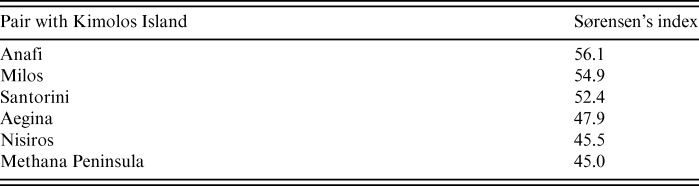
In Table 7 Sørensen’s index values for each island pair show that Anafi has the strongest phytogeographical affinity with the study area.
Sørensen’s index values for each area compared to Kimolos Island
Discussion
The high percentages of therophytes (56.42%) and of leguminous taxa (16.78%) indicate disturbance in Mediterranean ecosystems (Naveh, Reference Naveh, Kozlowski and Ahlgren1974; Arianoutsou & Margaris, Reference Arianoutsou, Margaris, Margaris and Mooney1981; Barbero et al., Reference Barbero, Bonin, Loisel and Quézel1990; Panitsa et al., Reference Panitsa, Dimopoulos, Iatrou and Tzanoudakis1994, Reference Panitsa, Snogerup, Snogerup and Tzanoudakis2003; Panitsa & Tzanoudakis, Reference Panitsa and Tzanoudakis1998). Although intense stock farming and other agricultural activities have now ceased in Kimolos, the floristic character of the island has clearly been altered due to the high local amount of cosmopolitan elements (8.25%).
According to Arianoutsou et al. (Reference Arianoutsou, Bazos, Delipetrou and Kokkoris2010), the total number of alien taxa accounts for c.5% of the native flora of Greece and is significantly higher than that of Kimolos (1.58%). Nevertheless, in Kimolos where abandoned grazing grounds and farm lands occupy large areas, Opuntia ficus-indica, Oxalis pes-caprae and Agave americana have heavily contaminated and altered these habitats which would otherwise be colonised by native pioneer herbs and shrubs. This phenomenon is also observed in other Aegean islands (Arianoutsou et al., Reference Arianoutsou, Bazos, Delipetrou and Kokkoris2010; Kougioumoutzis et al., Reference Kougioumoutzis, Tiniakou, Georgiou and Georgiadis2012b).
The high percentages of chamaephytes and hemicryptophytes depend on the frequency of limestone cliffs which very often harbour endemic taxa (Kypriotakis, Reference Kypriotakis1998; Kypriotakis & Tzanoudakis, Reference Kypriotakis and Tzanoudakis2001; Tzanoudakis et al., Reference Tzanoudakis, Panitsa, Trigas and Iatrou2006). In Kimolos, more than one third (40.00%) of the endemic flora are chamaephytes or hemicryptophytes, which are scattered in the numerous steep volcanic cliffs present on the island.
Kimolos seems to be floristically less diverse than the other parts of the SAVA, probably because of the intense human presence on the island (i.e. quarries) and the quite low habitat diversity it presents, since Kimolos is topographically rather homogeneous, a factor not promoting species richness (Whittaker & Fernández-Palacios, 2007; Sfenthourakis & Triantis, Reference Sfenthourakis and Triantis2009). The number of species per unit area of surface is an important parameter of Aegean vascular plant diversity, in relation to the conservation of the diversity of the Aegean area (Panitsa & Tzanoudakis, Reference Panitsa and Tzanoudakis2010). Kimolos in this context seems to be a biodiversity hotspot, at least for the phytogeographical region of Kiklades, in spite of the quite low number of plant taxa present on the island, as it hosts more than twice (12.31 species/km2) the taxa per unit area of surface than Milos (5.85 species/km2), 30 times the taxa compared to the whole East Aegean area (0.4 species/km2; Panitsa & Tzanoudakis, Reference Panitsa and Tzanoudakis2010) and 20 times the taxa compared to the Kiklades (c.0.54 species/km2; Phitos et al., Reference Phitos, Strid, Snogerup and Greuter1995).
The existence of biregional endemics is a good indication of phytogeographical connections between regions (Georghiou & Delipetrou, Reference Georghiou and Delipetrou2010). Three endemic taxa found in the study area – namely Centaurea raphanina subsp. raphanina, Dianthus fruticosus subsp. amorginus and Nepeta melissifolia – provide useful information regarding the biogeographical position of Kimolos, as they are exclusively found in the phytogeographical regions of Kiklades and Kriti-Karpathos; these taxa demonstrate a convex distribution in the southern Kiklades, as they are found from Kimolos to Amorgos through Folegandros, Sikinos and Astypalaea. More specifically, Centaurea raphanina subsp. raphanina is found only in Kriti and in the Milos archipelago, Dianthus fruticosus subsp. amorginus is distributed in Kriti and Amorgos, Astypalaea, Folegandros, Kimolos, Milos and Sikinos while Nepeta melissifolia is found outside Kriti, only in Amorgos, Kimolos, Milos and Sifnos. The evidence presented here suggests a close phytogeographical relationship between Kimolos and Kriti, as well as between southern Kiklades and Kriti since, according to Strid & Tan (Reference Strid and Tan1997), the phytogeographical region of Kriti and Karpathos has strong connections to that of the Kiklades, especially as far as the dry southeastern islands are concerned. Two more biregional endemics found in the study area, namely Hymenonema graecum and Muscari cycladicum, with a wider Kikladic distribution, provide further support to the close phytogeographical affinities between Kimolos and Kriti.
The flora of Kimolos is more similar to that of Anafi, and then to Milos and Santorini (Kik) than to that of Aegina (Pe), Nisiros (EAe) and the Methana Peninsula (Pe). According to Snogerup et al. (Reference Snogerup, Snogerup, Stamatiadou, von Bothmer and Gustafsson2006) all Kiklades islands have their main floristic connections towards the west, i.e. to the European mainland, and the floristic divide between Europe and Asia (‘Rechinger’s line’) falls between the Kiklades and the East Aegean islands. Kimolos, just like Anafi (Kougioumoutzis et al., Reference Kougioumoutzis, Tiniakou, Georgiou and Georgiadis2012b), has high floristic affinities with Aegina as expected, but then, surprisingly, with the East Aegean island of Nisiros instead of the Methana Peninsula on the east coast of the Greek mainland.
Acknowledgements
The authors are much indebted to Georgios Ampatzidis and Paraskevas Vasilakopoulos for their invaluable assistance in the field. Cordial thanks are also due to Dr Sofia Spanou for her critical editing of the manuscript and to Dr Leonardos Tiniakos for his help and comments regarding the geology of Kimolos Island.
Appendix
Notes
• Only taxa new to the investigated area appear in the catalogue below.
• Names of taxa not native to the area are in square brackets.
Abbreviations used
KK: K. Kougioumoutzis observations and/or vouchers
Obs.: Field observation
Phot.: Photograph
Collection dates
a: 21/3/2012–24/3/2012
b: 17/4/2012–21/4/2012
c: 18/5/2012–19/5/2012
d: 24/11/2012–25/11/2012
Collection sites
LIFE FORMS
Therophytes (T)
Tcaesp T. caespitose
Tpar T. parasite
Tros T. rosulate
Tscap T. scapose
Geophytes (G)
Gbulb G. bulbous
Grad G. radicose
Grhiz G. rhizomatous
Hydrophytes (I)
Irad I. radicose
Hemicryptophytes (H)
Hbienn H. biennial
Hcaesp H. caespitose
Hros H. rosulate
Hscand H. scandent
Hscap H. scapose
Chamaephytes (Ch)
Chfrut Ch. fruticose
Chrept Ch. reptant
Chsuffr Ch. suffruticose
Phanerophytes (P)
Pcaesp P. caespitose
Psucc P. succulent
Mega-phanerophytes (MP)
Nano-phanerophytes (NP)
CHOROLOGICAL GROUPS
Widely distributed taxa
Cosmopolitan (Subcosmop., Cosmop.)
Paleosubtropics (Paleosubtrop.)
Paleotropics (Paleotrop.)
Neotropics (Neotrop.)
Subtropics (Subtrop.)
Paleotemperate (Paleotemp.)
Subatlantic (Subatl.)
Eurasian (Euras.)
Eurosiberian (S-Europ.-Sud.-Sib.)
European (Centro-Europ.)
Mediterranean taxa
Mediterranean (Med.-Mont., NE-Med.-Mont., Med.-Kont.)
South Mediterranean (S-Med.)
East Mediterranean (E-Med.)
Eurymediterranean (Eurymed.)
Western Eurymediterranean (W-Eurymed.)
South Eurymediterranean (S-Eurymed.)
Stenomediterranean (Stenomed.)
East Stenomediterranean (E-Stenomed.)
West Stenomediterranean (W-Stenomed.)
Mediterranean – Atlantic (Med.-Atl.)
Mediterranean – Subatlantic (Med.-Subatl.)
Mediterranean – Submediterranean (Med.-Submed., Euras.-Subozean.-Med.)
Mediterranean – Turanian (Med.-Turan.)
East Mediterranean-Pontic (E-Med.-Pont.)
Endemic (Endemic)
Adventive (Adv.)
Cultivated (Cult.)
FERNS
Aspleniaceae
Asplenium ceterach L. – Hros, Paleotemp.; 61, d, KK Phot.
GYMNOSPERMAE
Cupressaceae
Juniperus oxycedrus L. subsp. macrocarpa (Sm.) Ball – Pcaesp, Stenomed.; 11, a, KK 2057; 9, a, KK 2185
ANGIOSPERMAE
Amaryllidaceae
Allium ampeloprasum L. – Gbulb, Eurymed.; 54, c, KK 2751; 53, c, KK 2764
Narcissus tazetta L. – Gbulb, Stenomed.; 58, d, KK 2769; 60, d, KK 2793
Pancratium maritimum L. – Gbulb, Stenomed.; 43, b, KK 2491
Apiaceae
Ammi majus L. – Tscap, Eurymed.; 28, b, KK 2327; 46, b, KK 2368
Crithmum maritimum L. – Chsuffr, Med.-Atl.; 12, a, KK 2073; 14, a, KK 2208
Eryngium maritimum L. – Grhiz, Med.-Atl.; 4, a, KK 2096
Ferula communis L. – Hscap, S-Eurymed.; KK Obs.
Foeniculum vulgare Mill. – Hscap, Stenomed.; KK Obs.
Scandix pecten-veneris L. – Tscap, Subcosmop.; 1, a, KK 1938; 10, a, KK 2299
Tordylium apulum L. – Tscap, Stenomed.; 9, a, KK 2150; 13, a, KK 2218; 10, a, KK 2267
Torilis leptophylla (L.) Rchb.f. – Tscap, Med.-Turan.; 34, b, KK 2387; 41, b, KK 2461; 51, c, KK 2759
Apocynaceae
Nerium oleander L. – Pcaesp, Stenomed.; KK Obs.
Araceae
Arisarum vulgare O.Targ.Tozz. – Grhiz, Stenomed.; KK Obs.
Asparagaceae
[Agave americana L.] – MPsucc, Adv.; 57, d, KK Obs.
Charybdis maritima (L.) Speta – Gbulb, Stenomed.; KK Obs.
Muscari commutatum Guss. – Gbulb, E-Stenomed.; 7, a, KK 2127; 9, a, KK 2180; 13, a, KK 2223
Muscari comosum (L.) Mill. – Gbulb, Eurymed.; 5, a, KK 1993; 6, a, KK 2119
Muscari cycladicum P.H.Davis & D.C.Stuart – Endemic; 7, a, KK 2128
Muscari weissii Freyn – Gbulb, E-Med.; 8, a, KK 2101; 10, a, KK 2283; 29, b, KK 2450; 28, b, KK 2524
Ornithogalum montanum Cirillo – Gbulb, NE-Med.-Mont.; 1, a, KK 1889; 5, a, KK 1989; 8, a, KK 2102; 24, a, KK 2191
Prospero autumnale (L.) Speta – Gbulb, Eurymed.; 57, d, KK 2796; 60, d, KK 2794
Asteraceae
Anthemis rigida Boiss. ex Heldr. subsp. liguliflora (Halácsy) Greuter – Tscap, Endemic; 27, b, KK 2576; 31, b, KK 2420; 35, b, KK 3652; 36, b, KK 2470
Anthemis werneri Stoj. & Acht. – Tscap, Endemic; 28, b, KK 2516; 49, c, KK 2768
Carduus pycnocephalus L. subsp. albidus (M.Bieb.) Kazmi – Tscap, Med.-Turan.; 12, a, KK 2066; 33, b, KK 2424
Carthamus creticus L. – Tscap, Eurymed.; 46, b, KK 2364; 54, c, KK 2749; 51, c, KK 2761
Centaurea raphanina Sm. subsp. mixta (DC.) Runemark – Hros, Endemic; KK Obs.
Cichorium intybus L. – Hscap, Cosmop.; KK Phot. 2395; 36, b, KK 2471; 27, b, KK 2577; 49, c, KK 2771
Crepis foetida L. – Tscap, Eurymed.; 46, b, KK 2367; 35, b, KK 2665; 28, b, KK 2560
Crupina crupinastrum (Moris) Vis. – Tscap, Stenomed.; 9, a, KK 2144; 28, b, KK 2538; 35, b, KK 2673
Dittrichia viscosa (L.) Greuter – Hscap, Eurymed.; 10, a, KK 2292
Echinops spinosissimus Turra subsp. spinosissimus – Hscap, E-Med.; 22, a, KK 2201
[Erigeron canadensis L.] – Tscap, Cosmop.; 39, b, KK 2379; 26, b, KK 2635
Filago aegaea Wagenitz subsp. aristata Wagenitz – Tscap, E-Med.; 35, b, KK 2649
Filago eriocephala Guss. – Tscap, E-Stenomed.; 28, b, KK 2528
Filago pygmaea L. – Trept, Stenomed.; 10, a, KK 2266
Glebionis coronaria (L.) Spach – Tscap, Stenomed.; 1, a, KK 1912
Glebionis segetum (L.) Fourr. – Tscap, Eurymed.; 5, a, KK 2015; 28, b, KK 2556
Helichrysum italicum (Roth.) G.Don – Chsuffr, Eurymed.; 13, a, KK 2236
Leontodon tuberosus L. – Hros, Stenomed.; 1, a, KK 1926; 5, a, KK 2014; 11, a, KK 2055; 9, a, KK 2173; 10, a, KK 2249; 28, b, KK 2525
Matricaria chamomilla L. – Chsuffr, E-Med.; 1, a, KK 1931; 11, a, KK 2036; 10, a, KK 2303
Notobasis syriaca (L.) Cass. – Tscap, Stenomed.; 31, b, KK 2415; 28, b, KK 2521
Pallenis spinosa (L.) Cass. – Tscap, Eurymed.; 28, b, KK 2519
Phagnalon rupestre (L.) DC. subsp. graecum (Boiss. & Heldr.) Batt. – Chsuffr, E-Med.; 1, a, KK 1898; 9, a, KK 2151
Podospermum laciniatum (L.) DC. – Hscap, Paleotemp; 29, b, KK 2448; 36, b, KK 2467; 32, b, KK 2502; 27, b, KK 2581
Rhagadiolus stellatus (L.) Gaertn. – Tscap, Eurymed.; KK Obs.
Scorzonera mollis M.Bieb. – Hcaesp, E-Med.-Pont.; 13, a, KK 2222; 41, b, KK 2459
Senecio leucanthemifolius Poir. subsp. vernalis (Waldst. & Kit.) Greuter – Tscap, Med-Submed.; 1, a, KK 1932; 2, a, KK 1948; 9, a, KK 2156; 35, b, KK 2684
Sonchus asper (L.) Hill subsp. glaucescens (Jordan) Ball – Tscap, Paleotemp.; 8, a, KK 2105; 28, b, KK 2541; 27, b, KK 2594; 26, b, KK 2634; 35, b, KK 2682
Sonchus bulbosus (L.) N.Kilian & Greuter subsp. microcephalus (Rech.f.) N.Kilian & Greuter – Tscap, E-Med.; 29, b, KK 2449; 9, a, KK 2177
Sonchus oleraceus L. – Tscap, Subcosmop.; 1, a, KK 1945; 5, a, KK 2016; 19, a, KK 2078; 29, b, KK 2452; 26, b, KK 2620; 25, b, KK 2734; 48, c, KK 2783
Taraxacum aleppicum Dahlst. – Hros, E-Med.; 61, d, KK 2800
Taraxacum minimum (Guss.) N.Terracc. – Hros, Stenomed.; 14, a, KK 2202; 15, a, KK 2324
Tolpis umbellata Bertol. – Tscap, Stenomed.; 46, b, KK 2362; 35, b, KK 2663; 48, c, KK 2786
Tragopogon porrifolius L. subsp. porrifolius – Hbienn, Eurymed.; 24, a, KK 2193; 22, a, KK 2198; 10, a, KK 2257; 27, b, KK 2592; 35, b, KK 2681; 25, b, KK 2732; 28, b, KK 2533
Urospermum picroides (L.) F.W.Schmidt – Tscap, Eurymed.; 14, a, KK 2203; 29, b, KK 2434; 25, b, KK 2735
Boraginaceae
Anchusa azurea Mill. – Hscap, Eurymed.; 2, a, KK 1952; 10, a, KK 2244; 28, b, KK 2546
Echium diffusum Sm. – Tscap, Stenomed.; 11, a, KK 2044
Echium plantagineum L. – Tscap, Eurymed.; 1, a, KK 1897; 10, a, KK 2284; 11, a, KK 2063; 44, b, KK 2404; 25, b, KK 2725
Heliotropium hirsutissimum Grauer – Tscap, E-Med.; 48, c, KK 2779
Brassicaceae
Clypeola jonthlaspi L. subsp. microcarpa (Moris) Arcang. – Tscap, Stenomed.; 9, a, KK 2133
Draba praecox Steven – Tscap, Eurymed.; 9, a, KK 2131
Matthiola incana (L.) R.Br. – Chsuffr, Stenomed.; 40, b, KK 2413
Sinapis arvensis L. – Tscap, Eurymed.; KK Obs.
Cactaceae
[Opuntia ficus-indica (L.) Mill.] – Psucc, Neotrop.; 55, c, KK Obs.
Caryophyllaceae
Spergularia media (L.) C.Presl – Chsuffr, Subcosmop.; 3, a, KK 1968; 4, a, KK 2093; 15, a, KK 2329; 37, b, KK 2482
Chenopodiaceae
Salicornia perennans Willd. subsp. perennans – Tscap, Cosmop.; 18, a, KK 2109
Cistaceae
Tuberaria guttata (L.) Fourr. – Tscap, Eurymed.; 55, c, KK Obs.
Colchicaceae
Colchicum cupanii Guss. – Gbulb, Stenomed.; 57, d, KK 2799; 58, d, KK 2790
Convolvulaceae
Convolvulus althaeoides L. subsp. althaeoides – Hscand, Stenomed.; 36, b, KK 2468; 35, b, KK 2669; 25, b, KK 2726; 28, b, KK 2530
Convolvulus arvensis L. – Grhiz, Cosmop.; 50, c, KK 2766
Crassulaceae
Sedum eriocarpum Sm. subsp. eriocarpum – Tscap, Endemic; 35, b, KK 2653
Umbilicus horizontalis (Guss.) DC. – Gbulb, Stenomed.; 35, b, KK 2676
Umbilicus parviflorus (Desf.) DC. – Gbulb, Endemic; 9, a, KK 2175
Cucurbitaceae
Ecballium elaterium (L.) A.Rich. – Gbulb, Eurymed.; KK Obs.
Cyperaceae
Carex flacca Schreb. – Grhiz, Europ.; 36, b, KK 2465
Eleocharis palustris (L.) R.Br. – Grhiz, Subcosmop.; 2, a, KK 1953; 26, b, KK 2621
Scirpoides holoschoenus (L.) Soják – Grhiz, Eurymed.; 43, b, KK 2497
Cytinaceae
Cytinus hypocistis (L.) L. subsp. clusii Nyman – Grad, W-Stenomed.; 9, a, KK 2187
Euphorbiaceae
Euphorbia exigua L. – Tscap, Eurymed.; 41, b, KK 2456
Euphorbia helioscopia L. – Tscap, Cosmop.; 10, a, KK 2285
Euphorbia peplus L. – Tscap, Cosmop.; 11, a, KK 2020; 9, a, KK 2143
Mercurialis annua L. – Tscap, Paleotemp.; 2, a, KK 1954; 1, a, KK 1963; 3, a, KK 1972; 11, a, KK 2061; 13, a, KK 2229
Fabaceae
Anthyllis vulneraria L. subsp. rubriflora (DC.) Arcang. – Hscap, Stenomed.; 29, b, KK 2438
Astragalus hamosus L. – Tscap, Med.-Turan.; 10, a, KK 2263; 46, b, KK 2357; 29, b, KK 2435; 35, b, KK 2638
Astragalus pelecinus (L.) Barneby – Tscap, Stenomed.; 35, b, KK 2639
Bituminaria bituminosa (L.) C.H.Stirt. – Hscap, Eurymed.; 6, a, KK 2117; 35, b, KK 2641
Coronilla scorpioides (L.) W.D.J.Koch – Tscap, Eurymed.; 41, b, KK 2458
Hippocrepis ciliata Willd. – Tscap, Eurymed.; 47, b, KK 2390
Lathyrus annuus L. – Tscap, Eurymed.; 1, a, KK 1902
Lotus cytisoides L. – Chsuffr, Eurymed.; 4, a, KK 2085; 47, b, KK 2394; 43, b, KK 2494; 27, b, KK 2584; 49, c, KK 2773
Lotus peregrinus L. – Tscap, E-Med.; 1, a, KK 1913
Lupinus angustifolius L. subsp. angustifolius – Tscap, Stenomed.; 6, a, KK 2114; 10, a, KK 2247; 28, b, KK 2536; 26, b, KK 2609
Medicago disciformis DC. – Tscap, Stenomed.; 10, a, KK 2293; 28, b, KK 2523
Medicago marina L. – Chrept, Eurymed.; 4, a, KK 2098; 43, b, KK 2489
Medicago murex Willd. – Tscap, Stenomed.; 4, a, KK 2086
Medicago polymorpha L. – Tscap, Subcosmop.; 1, a, KK 1934; 2, a, KK 1958; 42, b, KK 2710; 11, a, KK 2023; 10, a, KK 2288; 26, b, KK 2607
Melilotus indicus (L.) All. – Tscap, Med.-Turan.; 42, b, KK 2712
Melilotus siculus (L.) All. – Tscap, S-Med.; 42, b, KK 2716
Onobrychis caput-galli Lam. – Tscap, Eurymed.; 17, a, KK 2340; 46, b, KK 2359; 32, b, KK 2500
Trifolium angustifolium L. var. angustifolium – Tscap, Med.-Subatl.; 44, b, KK 2405; 41, b, KK 2462; 28, b, KK 2529; 27, b, KK 2582; 35, b, KK 2637; 25, b, KK 2723
Trifolium arvense L. var. arvense – Tscap, Euras.-Subozean.-Med.; 26, b, KK 2603
Trifolium campestre Schreb. var. lagrangei (Boiss.) Zoh. – Tscap, Paleotemp.; 27, b, KK 2588; 26, b, KK 2600
Trifolium grandiflorum Schreb. – Tscap, E-Med.; 35, b, KK 2655
Trifolium lappaceum L. – Tscap, Eurymed.; 7, a, KK 2123
Trifolium nigrescens Viv. subsp. petrisavii (Clem.) Holmboe – Tscap, Eurymed.; 2, a, KK 1956; 11, a, KK 2038; 9, a, KK 2163; 26, b, KK 2612
Trifolium scabrum L. – Tscap, Med.-Submed.; 27, b, KK 2585; 35, b, KK 2679
Trifolium spumosum L. – Tscap, Med.; 28, b, KK 2540; 35, b, KK 2643
Trifolium stellatum L. var. stellatum – Tscap, Med.; 9, a, KK 2172; 27, b, KK 2583; 35, b, KK 2654
Trifolium tomentosum L. var. tomentosum – Trept, Med.; 9, a, KK 2181; 27, b, KK 2570
Trifolium uniflorum L. – Hcaesp, Med.; 5, a, KK 2003; 11, a, KK 2064
Trigonella corniculata subsp. balansae (Boiss. & Reuter) Lassen – Tscap, E-Med.; 3, a, KK 1978; 7, a, KK 2130; 15, a, KK 2326; 27, b, KK 2586; 42, b, KK 2704
Trigonella corniculata subsp. rechingeri (Širj.) Lassen – Tscap, Endemic; 5, a, KK 2004
Trigonella monspeliaca L. – Tscap, Eurymed.; 46, b, KK 2358
Vicia bithynica (L.) L. – Tscap, Eurymed.; 6, a, KK 2116; 7, a, KK 2129; 27, b, KK 2595
Vicia cretica Boiss. & Heldr. subsp. aegaea (Halácsy) P.W.Ball – Tscap, Endemic; 1, a, KK 1914; 5, a, KK 1999; 11, a, KK 2024; 9, a, KK 2161; 26, b, KK 2618; 35, b, KK 2701
Vicia cretica Boiss. & Heldr. subsp. cretica – Tscap, E-Med.; 48, c, KK 2784; 28, b, KK 2564
Vicia hybrida L. – Tscap, Eurymed.; 1, a, KK 1891
Vicia sativa L. subsp. cordata (Hoppe) Asch. & Graebn. – Tscap, Med.-Kont.; 26, b, KK 2617
Vicia sativa L. subsp. nigra (L.) Ehrh. – Tscap, Cosmop.; 6, a, KK 2115
[Vicia sativa L. subsp. sativa] – Tscap, Subcosmop.; 26, b, KK 2622; 35, b, KK 2698
Frankeniaceae
Frankenia hirsuta L. – Chsuffr, Med.-Turan.; 19, a, KK 2081; 7, a, KK 2124; 10, a, KK 2297; 27, b, KK 2574
Gentianaceae
Centaurium tenuiflorum (Hoffmans. & Link) Fritsch subsp. acutiflorum (Schott) Zeltner – Tscap, Eurymed.; 49, c, KK Phot.
Geraniaceae
Erodium cicutarium (L.) L’Hér. subsp. cicutarium – Tcaesp, Subcosmop.; 9, a, KK 2154
Erodium gruinum (L.) L’Her. – Tscap, Med.-Turan.; 23, a, KK 2100
Erodium moschatum (L.) L’Her. – Tscap, Eurymed.; 2, a, KK 1960
Geranium dissectum L. – Tscap, Subcosmop.; 39, b, KK 2378; 26, b, KK 2629
Geranium molle L. – Tscap, Subcosmop.; 26, b, KK 2608; 9, a, KK 2154
Hypericaceae
Hypericum triquetrifolium Turra – Hscap, Eurymed.; 10, a, KK 2253; 56, c, KK 2746; 55, c, KK 2755
Iridaceae
Crocus cartwrightianus Herb. – Gbulb, Endemic; 61, d, KK 2792
Crocus laevigatus Bory & Chaub. – Gbulb, Endemic; 57, d, KK 2797; 58, d, KK 2789
Crocus tournefortii J.Gay – Gbulb, Endemic; 59, d, KK 2791; 60, d, KK 2795
Iris tuberosa L. – Grhiz, Stenomed.; 11, a, KK 2054; 35, b, KK 2650
Romulea bulbocodium (L.) Sebast. & Mauri – Gbulb, Stenomed.; 9, a, KK 2137
Juncaceae
Juncus acutus L. – Hcaesp, Subcosmop.; 43, b, KK Phot.
Juncus bufonius L. – Tcaesp, Cosmop.; 43, b, KK Phot.
Juncus maritimus Lam. – Grhiz, Subcosmop.; 4, a, KK 2090; 15, a, KK 2321; 47, b, KK 2398; 40, b, KK 2410; 33, b, KK 2425; 43, b, KK 2483; 16, a, KK 2611; 42, b, KK 2708
Juncus subulatus Forssk. – Grhiz, S-Med.; 3, a, KK 1971; 42, b, KK 2709; 16, a, KK 2069
Lamiaceae
Ballota acetabulosa (L.) Benth. – Chfrut, E-Med.; 44, b, KK 2407; 35, b, KK 2683; 54, c, KK 2747; 55, c, KK 2753; 51, c, KK 2758
Lamium amplexicaule L. – Tscap, Paleotemp.; 11, a, KK 2042
Mentha pulegium L. subsp. erinoides (Heldr.) Kokkini – Hscap, Endemic; 39, b, KK 2380; 34, b, KK 2389; 51, c, KK 2757; 50, c, KK 2767
Nepeta melissifolia Lam. – Chsuff, Endemic; 29, b, KK 2445; 35, b, KK 2675
Phlomis fruticosa L. – NP, Stenomed.; 28, b, KK 2522; 35, b, KK 2685
Salvia verbenaca L. – Hscap, Med.-Atl.; 5, a, KK 1997; 24, a, KK 2197; 10, a, KK 2304; 28, b, KK 2539
Satureja thymbra L. – Chfrut, Stenomed.; 17, a, KK 2352
Sideritis curvidens Stapf – Tscap, E-Med.; 29, b, KK 2443
Linaceae
Linum bienne Mill. – Hscap, Med.-Atl.; 24, a, KK 2192; 46, b, KK 2360; 49, c, KK 2776
Linum strictum L. subsp. strictum – Tscap, Stenomed.; 41, b, KK 2460; 36, b, KK 2476; 27, b, KK 2572
Malvaceae
Malva multiflora (Cav.) Soldano, Banfi & Galasso – Tscap, Stenomed.; 1, a, KK 1894; 3, a, KK 1973
Malva neglecta Wallr. – Tscap, Paleotemp.; 37, b, KK 2479
Malva nicaeensis All. – Tscap, Med.; 12, a, KK 2076
Oleaceae
Olea europaea L. var. sylvestris (Mill.) Lehr – Pcaesp/Pscap, Stenomed.; KK Obs.
Orobanchaceae
Orobanche nana (Reut.) Beck – Tpar, Paleotemp.; KK Phot.
Oxalidaceae
[Oxalis pes-caprae L.] – Gbulb, Cosmop.; 61, d, KK Obs.
Papaveraceae
Fumaria bastardii Boreau – Tscap, Subatl.; 41, b, KK 2453
Fumaria kralikii Jord. – Tscap, E-Med.; 11, a, KK 2033; 35, b, KK 2678
Fumaria officinalis L. subsp. officinalis – Tscap, Subcosmop.; 13, a, KK 2228
Papaver rhoeas L. var. rhoeas – Tscap, E-Med.; 17, a, KK 2352; 54, c, KK 2748
Papaver rhoeas L. var. strigosum Boenn. – Tscap, Paleotemp.; 28, b, KK 2531
Plantaginaceae
Plantago amplexicaulis Cav. – Tros, Med.; 21, a, KK 2561
Plantago bellardii All. subsp. deflexa (Pilg.) Rech.f. – Tros, E-Med.; 9, a, KK 2141; 29, b, KK 2432
Plantago coronopus L. – Tscap, Eurymed.; 4, a, KK 2091; 14, a, KK 2215; 15, a, KK 2319; 39, b, KK 2372; 32, b, KK 2501; 27, b, KK 2590
Plantago lagopus L. – Tscap, Eurymed.; 1, a, KK 1937; 3, a, KK 1974; 11, a, KK 2037; 9, a, KK 2159; 14, a, KK 2205; 36, b, KK 2466; 28, b, KK 2526; 5, a, KK 1991; 10, a, KK 2270; 25, b, KK 2727
Plantago lanceolata L. – Hros, Cosmop.; 11, a, KK 2059
Plantago weldenii Rchb. – Tscap, Eurymed.; 9, a, KK 2167; 35, b, KK 2691
Plumbaginaceae
Limonium palmare (Sm.) Rech.f. – Chsuffr, Endemic; 13, a, KK 2237; 19, a, KK 2080
Limonium roridum (Sm.) Brullo & Guarino – Chsuffr, E-Med.; 29, b, KK 2451; 33, b, KK 2505
Limonium sinuatum (L.) Mill. – Hscap, Stenomed.; 1, a, KK 1933; 12, a, KK 2074
Limonium virgatum (Willd.) Fourr. – Chsuffr, Eurymed.; 16, a, KK 2112; 19, a, KK 2079; 47, b, KK 2402
Poaceae
Aegilops biuncialis Vis. – Tscap, Eurymed.; 28, b, KK 2537
Aegilops triuncialis L. – Tscap, Eurymed.; 46, b, KK 2354
Aira elegantissima Schur – Tscap, Eurymed.; 34, b, KK 2385; 26, b, KK 2601
Anisantha rigida (Roth) Hyl. – Tscap, Paleosubtrop.; 14, a, KK 2212
Anisantha sterilis (L.) Nevski – Tscap, Paleotemp.; 28, b, KK 2518
Avena barbata Link – Tscap, Eurymed.; 1, a, KK 1936; 3, a, KK 1964; 5, a, KK 1983; 26, b, KK 2616; 14, a, KK 2206
Avena sterilis L. – Tscap, Med.-Turan.; 1, a, KK 1924; 10, a, KK 2312; 11, a, KK 2041; 15, a, KK 2320
Briza maxima L. – Tscap, Paleosubtrop.; 1, a, KK 1930; 28, b, KK 2515; 25, b, KK 2739
Bromus hordeaceus L. – Tscap, Subcosmop.; 9, a, KK 2166; 35, b, KK 2693
Bromus scoparius L. – Tscap, Stenomed.; 10, a, KK 2313
Catapodium marinum (L.) C.E.Hubb. – Tscap, Med.-Atl.; 9, a, KK 2146; 40, b, KK 2408
Catapodium rigidum (L.) C.E.Hubb. – Tscap, Eurymed.; 28, b, KK 2520; 25, b, KK 2788
Cutandia maritima (L.) Benth. – Tscap, Stenomed.; 43, b, KK 2486; 4, a, KK 2084
Cynosurus echinatus L. – Tscap, Eurymed.; 46, b, KK 2365; 35, b, KK 2686
Dactylis glomerata L. – Hcaesp, Paleotemp.; 11, a, KK 2060; 35, b, KK 2690; 10, a, KK 2248
Elytrigia sartorii (Boiss. & Heldr.) H.Scholz – Grhiz, E-Med.; 46, b, KK 2366; 39, b, KK 2376; 47, b, KK 2399; 31, b, KK 2414; 36, b, KK 2473; 27, b, KK 2575; 26, b, KK 2632; 35, b, KK 2696; 42, b, KK 2715; 25, b, KK 2736; 43, b, KK 2493; 28, b, KK 2532
Hordeum marinum Huds. – Tscap, W-Eurymed.; 39, b, KK 2373; 42, b, KK 2718
Hordeum murinum L. subsp. leporinum (Link) Arcang. – Tscap, Eurymed.; 3, a, KK 1963; 5, a, KK 1996; 11, a, KK 2049; 8, a, KK 2104; 6, a, KK 2119; 7, a, KK 2122; 9, a, KK 2162; 24, b, KK 2196; 13, a, KK 2233; 10, a, KK 2246; 28, b, KK 2548; 35, b, KK 2680
Hyparrhenia hirta (L.) Stapf – Hcaesp, Paleotrop.; 1, a, KK 1899
Lagurus ovatus L. – Tscap, Eurymed.; 10, a, KK 2271
Melica minuta L. – Hcaesp, Stenomed.; 9, a, KK 2147
Ochlopoa annua (L.) H.Scholz – Tcaesp, Cosmop.; 3, a, KK 1965
Parapholis incurva (L.) C.E.Hubb. – Tscap, Med.-Atl.; 3, a, KK 1966; 19, a, KK 2077; 15, a, KK 2323; 37, b, KK 2480; 43, b, KK 2485; 42, b, KK 2714
Phalaris paradoxa L. – Tscap, Med.; 26, b, KK 2631
Phleum arenarium L. – Tscap, Med.-Atl.; 40, b, KK 2412
Phragmites australis (Cav.) Steud. – Grhiz, Subcosmop.; 3, a, KK 1970; 12, a, KK 2072; 15, a, KK 2327; 47, b, KK 2400
Piptatherum coerulescens (Desf.) Beauv. – Hcaesp, Stenomed.; 1, a, KK 1986; 11, a, KK 2065; 17, a, KK 2343; 28, b, KK 2514
Piptatherum miliaceum (L.) Coss. – Hcaesp, Med.-Turan.; 22, a, KK 2199
Polypogon monspeliensis (L.) Desf. – Tscap, Subtrop.; 33, b, KK 2422; 26, b, KK 2605
Sporobolus pungens (Schreb.) Kunth – Grhiz, Subtrop.; 12, a, KK 2071
Stipa capensis Thunb. – Tscap, Stenomed.; 10, a, KK 2259
Trachynia distachya (L.) Link – Tscap, Med.-Turan.; 14, a, KK 2211; 10, a, KK 2268; 46, b, KK 2353; 25, b, KK 2740
[Triticum turgidum subsp. dicoccon (Schrank) Thell.] – Tscap, Cult.; 11, a, KK 2053; 6, a, KK 2120; 35, b, KK 2670
Vulpia ciliata Dumort. – Tscap, Eurymed.; 5, a, KK 1984; 9, a, KK 2147; 10, a, KK 2310
Polygonaceae
Rumex pulcher L. subsp. raulinii (Boiss.) Rech.f. – Hscap, E-Med.; 27, b, KK 2593; 26, b, KK 2627; 35, b, KK 2671
Posidoniaceae
Posidonia oceanica (L.) Delile – Irad, Stenomed.; 12, a, KK 2067
Primulaceae
Anagallis arvensis L. – Trept, Subcosmop.; 27, b, KK 2573
Cyclamen graecum Link subsp. graecum Sm. – Gbulb, Endemic; 22, a, KK 2200
Ranunculaceae
Anemone pavonina Lam. – Gbulb, Eurymed.; 11, a, KK 2028
Rosaceae
Sanguisorba verrucosa (G.Don) Ces. – Hscap, Eurymed.; 44, b, KK 2406; 35, b, KK 2667
Rubiaceae
Galium aparine L. – Tscap, Euras.; 9, a, KK 2135
Galium murale (L.) All. – Tscap, Stenomed.; 40, b, KK 2411; 26, b, KK 2599; 35, b, KK 2661; 25, b, KK 2729
Galium recurvum DC. – Tscap, E-Med.; 34, b, KK 2381; 35, b, KK 2636
Galium spurium L. – Tscap, Euras.; 11, a, KK 2026; 13, a, KK 2221; 41, b, KK 2454
Galium verrucosum Huds. – Tscap, Stenomed.; 34, b, KK 2384
Sherardia arvensis L. – Tscap, Subcosmop.; 9, a, KK 2132; 46, b, KK 2355
Theligonum cynocrambe L. – Tscap, Med.-Turan.; 9, a, KK 2183
Valantia hispida L. – Tscap, Stenomed.; 41, b, KK 2457; 32, b, KK 2499; 30, b, KK 2563; 10, a, KK 2258
Scrophulariaceae
Bellardia latifolia (L.) Cuatrec. – Tscap, Eurymed.; 35, b, KK 2640
Bellardia trixago (L.) All. – Tscap, Eurymed.; 25, b, KK 2730
Scrophularia lucida L. – Hbienn (Chsuffr), Med.-Mont.; 2, a, KK 1962; 10, a, KK 2275
Veronica cymbalaria Bodard – Tscap, Eurymed.; 1, a, KK 1905; 11, a, KK 2043; 10, a, KK 2260; 35, b, KK 2658
Solanaceae
Hyoscyamus albus L. – Hbienn, Eurymed.; KK Obs.
Urticaceae
Urtica pilulifera – Tscap, Eurymed.; 3, a, KK 1975