Introduction
The oral health of people in Canada has been improving slowly. Yet tooth loss, dental caries, periodontal disease, and oral cancer are serious problems for many people in Canada and elsewhere as they age (Gerritsen, Allen, Witter, Bronkhorst, & Creugers, Reference Gerritsen, Allen, Witter, Bronkhorst and Creugers2010; Health Canada, 2010). There is also considerable disparity in oral health and oral health care within Canada, especially among aboriginal peoples, ethnic groups, and older people (Health Canada, 2010; MacEntee et al., Reference MacEntee, Marińo, Wong, Kiyak, Minichiello and Chi2012; Wallace & MacEntee, Reference Wallace and MacEntee2012). Most of the information available on oral health among older Canadians comes from people of European origin born in Canada (Health Canada, 2010). Yet older immigrants, especially those with limited education, income, and paid employment, are more likely than others to assess themselves as unhealthy and have difficulties acculturating to their surroundings (Suinn, Reference Suinn2010; Waxler-Morrison, Anderson, & Richardson, Reference Waxler-Morrison, Anderson and Richardson2005; Wong, Yoo, & Stewart, Reference Wong, Yoo and Stewart2006). Moreover, they tend to use health services differently than do other groups, possibly because of values and beliefs held from their origins and culture, and unfamiliarity with local health care systems (Marshall, Wong, Levesque, & Haggerty, Reference Marshall, Wong, Levesque and Haggerty2010).
In 2001, 5.4 million immigrants made up about one fifth (18.4%) of the Canadian population, the highest percentage in 70 years (Ng, Wilkins, Gendron, & Berthelot, Reference Ng, Wilkins, Gendron and Berthelot2005). By 2006, about 1.3 million immigrants from South Asia had settled in Canada with estimates that this number will increase to about 4 million by 2031 (Malenfant, Lebel, & Martel, Reference Malenfant, Lebel and Martel2010). Nearly one quarter of South-Asian immigrants reside in the province of British Columbia, and the majority are recent immigrants from Punjab, East Asia, and Pakistan (Statistics Canada, 2007b). Currently in British Columbia, Punjabi represents about 3 per cent of all languages spoken (Statistics Canada, 2012). Furthermore, almost one third of immigrants in Canada are older parents or grandparents who adapt with difficulty to their new surroundings and have a tendency towards social isolation (Turcotte & Schellenberg, Reference Turcotte and Schellenberg2007; Waxler-Morrison et al., Reference Waxler-Morrison, Anderson and Richardson2005).
A major gap exists in our knowledge of the perceptions and practices of oral health among older South-Asian immigrants. There is a general lack of systematic information on levels of health literacy among immigrants in Canada, especially when they come from countries where Western culture is not dominant (Ng & Omariba, Reference Ng and Omariba2010; Omariba & Ng, Reference Omariba and Ng2011). However, we know that older immigrants tend not to visit dentists although it is not clear why (Newbold & Patel, Reference Newbold and Patel2006). Focus group discussions with older Chinese immigrants in Vancouver, Canada, and Melbourne, Australia, revealed that they value Western dentistry as a supplement to traditional Chinese remedies, but they have difficulty obtaining information about oral health and accessing health care, and they are concerned about the financial burden of their dental care on their children (MacEntee et al., Reference MacEntee, Marińo, Wong, Kiyak, Minichiello and Chi2012). Consequently, many Chinese immigrants prefer to seek dental treatment in China while visiting that country for other reasons. We do not know that older South-Asian immigrants have the same health-related values and experiences, nor what oral health–related beliefs and behaviours are retained from their country of origin.
Herbal products, special diets, and consultations with various traditional healers are part of traditional or “desi” medicine in India, Pakistan, Bangladesh, Sri Lanka, Nepal, Bhutan, and Myanmar, and they continue to be used by some South-Asian immigrants in North America and Europe (Sandhu & Heinrich, Reference Sandhu and Heinrich2005). Ayurveda, in particular, is used widely by the Indian diaspora as a science of health care based on a harmonic balance between the body, various life forces, and elements of the universe (Brar, Norman, & Dasanayake, Reference Brar, Norman and Dasanayake2012; Hartzell & Zysk, Reference Hartzell and Zysk1995; Hilton et al., Reference Hilton, Grewal, Popatia, Bottorff, Johnson and Clarke2001; Saper et al., Reference Saper, Phillips, Sehgal, Khouri, Davis and Paquin2008). Desi remedies have been used by South-Asian immigrants in Canada, for example, to lessen the effects of facial paralysis (Hilton et al., Reference Hilton, Grewal, Popatia, Bottorff, Johnson and Clarke2001). However, immigrants from South Asia generally have very little knowledge about the cause or prevention of dental caries (Kay, Shaikh, & Bhopal, Reference Kay, Shaikh and Bhopal1990), and we do not know how they use traditional remedies to care for the mouth and teeth, or how these practices are integrated with Western dental care.
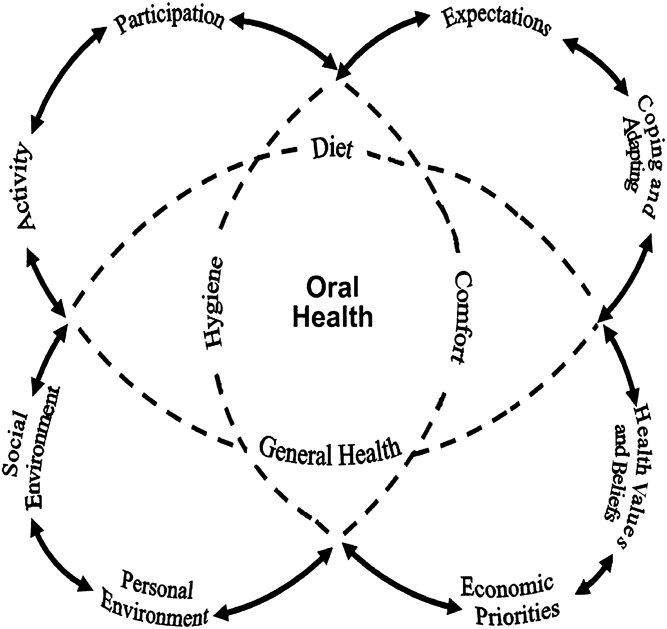
A conceptual model of oral health (Brondani, Bryant, & MacEntee, Reference Brondani, Bryant and MacEntee2007) evolved from MacEntee’s (Reference MacEntee2006) oral health model through focus group feedback from primarily older participants of northern European background (MacEntee, Hole, & Stolar, Reference MacEntee, Hole and Stolar1997). This refined model (see Figure 1) with roots in The International Classification of Function illustrates the general components of health, and accommodates both positive and negative consequences of impairment. It also has the potential to provide a conceptual context for exploring the oral health–related perceptions and experiences of other cultural groups.
A model of factors influencing the experience of oral health in old age (Brondani, Bryant, & MacEntee, Reference Brondani, Bryant and MacEntee2007)

Given the paucity of literature in this area, we were particularly interested in South-Asian immigrants’ perceptions of oral health and oral health management within their current sociocultural, personal, and economic environments, and to interpret these through personal and communal health values, beliefs, and oral health-related expectations. The purpose of the study addressed in this article was to explore, among older Punjabi-speaking immigrants from South Asia, perceptions of oral health, and management of oral health-related problems.
Methods
Recruitment
We recruited participants aged 60 years or older who had immigrated to Surrey, British Columbia, from the Punjab province of India within the previous 20 years. Surrey is the second-largest city by population in the province, with the largest Punjabi-speaking community in North America, and a population in 2006 that was 38 per cent immigrants, 46 per cent from non-European backgrounds, 28 per cent from South Asia (Statistics Canada, 2007b), 20 per cent self-identifying as Punjabi speakers, and 17.6 per cent aged 60 and older (Statistics Canada, 2012). It is largely a middle-income community although the incomes of many new immigrant families from South Asia are substantially below the average (Bonikowska et al., Reference Bonikowska, Green and Riddell2008; City of Surrey, 2009).
Two research assistants fluent in Punjabi – an experienced, male focus group facilitator; and a female dentist – introduced the study purpose and methods to potential participants visiting a Sikh temple and local community centres. They posted announcements in a local Punjabi newspaper, and with help from administrators of the temple and the centres, they arranged meetings with older members of the community. Essentially, they followed the successful recruitment protocol used previously by MacEntee et al. (Reference MacEntee, Wyatt, Kiyak, Hujoel, Persson and Persson2002), who had relied heavily on the ability of a cultural insider to attract interest in the study. Participants took part in one of four groups: three groups included only women; the other included only men. We segregated the groups on the basis of gender because men and women in the Sikh community prefer to avoid discussing health concerns in each other’s presence unless they are immediate family. The recruitment and other procedures were approved by the UBC Behavioural Research Ethics Board (Approval Certificate # H04-80922).
Focus Groups
The two research assistants prompted participants to discuss their opinions and experiences relating to oral health, aging, and the psychosocial impact of health, impairment, and disability. Open-ended questions for discussion were developed from two sources: the model of oral health identified in Figure 1, and the oral health–related opinions and experiences of other immigrants (MacEntee et al., Reference MacEntee, Marińo, Wong, Kiyak, Minichiello and Chi2012). Although the research assistants had an interview schedule of open-ended questions, the prompts were refined with each subsequent group to obtain more depth in our understanding of the participants’ experiences. One facilitator prompted each group initially with a general question, such as “What do you understand by ‘healthy mouth and teeth’?” or “How important are natural teeth?”. Subsequently and without disturbing the natural flow of the dialogue, new prompts were introduced to expand the discussion, such as “How are people disturbed if the mouth and teeth are unhealthy?” or to redirect the discussion with “In your experience, is there a difference in the quality of dental treatment between here in Canada, and back in India?” The research assistants obtained a signed consent from each participant, prompted the discussions, recorded the proceedings on audiotape, and made notes to assist in the interpretation of the discussions.
Each group with eight to nine participants met in the local Sikh temple or a nearby community centre, and they received a small financial token for travel expenses. After the first group discussion, we developed and used a questionnaire to collect information on the age, education, time in Canada, and dentition of each participant in the subsequent three group discussions.
Analysis
One of the assistants translated and transcribed the recordings in English with allowances for idiomatic adjustments and the meaning conveyed by the participants. Consistent with the methodological principles of interpretive enquiry (Thorne et al., Reference Thorne, Kirkham and O’Flynn-Magee2004), the principal investigator (PI), with others on the research team, systematically analysed the transcripts after each group discussion using open coding and constant comparison to identify key themes relating to the concerns, beliefs, and behaviours of the participants (Boeije, Reference Boeije2002; Thorne, Reference Thorne2000).
Analysis of each focus group was iterative with the PI, who is a dentist from a European background, and at least one other member of the research team, coding the transcripts as soon as possible after each focus group meeting. Firstly, they scrutinized the transcripts for important passages and keywords, and clustered them into higher-ordered categories based on recurrence and relevance to the dimensions of the oral health model (see Figure 1). Initial codes were derived from background information on the acculturation and oral health of older immigrants (Newton et al., Reference Newton, Khan, Bhavnani, Pitt, Gelbier and Gibbons2000), and expanded iteratively by the interactions within the focus groups (Maxwell, Reference Maxwell2013). This iterative process of interpretation, clarification, and refinement of information allowed the discussions of one group to influence the next until the themes seemed repetitive and saturated (Patton, Reference Patton2001). Secondly, our multidisciplinary team from dentistry, geriatrics, nursing, psychology, and sociology refined the analysis by identifying, juxtaposing, and refining all themes until there was consensus on the position and significance of each theme relative to the oral health-related beliefs and concerns of the participants (Lincoln & Guba, Reference Lincoln, Guba, Denzin and Lincoln2003).
Results
Participants
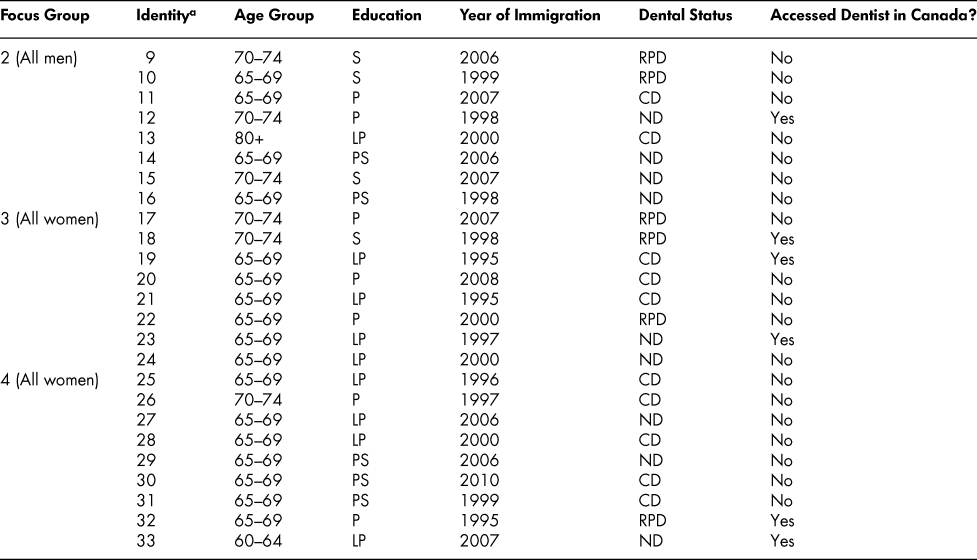
The four focus groups had a total of 33 participants – groups 1, 3, and 4 were women only and group 2, men only. We obtained limited information on the background or status of the eight participants in Group 1 other than confirmation that they met our inclusion criteria of age and residency in Canada. The 25 participants in the other three groups generally were aged between 65 and 75 years, had limited education (except for five with post-secondary education), had natural teeth (except for 10 with complete dentures), and most of them had not attended a dentist in Canada (see Table 1).
The 25 participants’ age, education, year of immigration, dental status, and access to dentistsa
a Excluding the 8 participants in first focus group
CD = Complete dentures
LP = Less than primary
ND = No denture
P = Primary
PS = Post-secondary
RPD = Removable partial denture
S = secondary/trade
Themes
The thematic analysis resulted in two umbrella themes: one involving the interpretations of oral disease and its connection to general health; and the other explaining the challenges to oral health. There were four sub-themes within the interpretive theme: (a) damage caused by wai; (b) disturbance of caries; (c) coping with dentures; and (d) quality of life. Challenges to oral health had three sub-themes: home remedies; using Western dentistry; and barriers to accessing dentists.
Interpretations of Oral Disease
Damage Caused By Wai
All of the groups discussed the damage to teeth, gingiva, and joints caused by wai. One woman explained that: “the wai begins, then it becomes resha (infection )(13)Footnote 1. When asked to explain further, we heard that wai is a property of “potatoes, pulses of ‘urad’Footnote 2 and rice …. [and its effect is balanced by] dried ginger, ginger, and black pepper”(19) in curries. Apparently, “Chinese people don’t get it, as they eat fish and other such kind of food … [whereas] Punjabi people, who do not eat fish [or] chicken”(21) get it. It is associated also with “drinking milk”(2) and with “rice and vegetables that produce gas, [or] stale vegetable curry”(13), and specifically with a “deficiency of blood”(25).
Weakness in the mouth accompanying tooth loss and dentures were also attributed to wai, as one woman explained: “if we don’t take out resha … teeth will be spoiled; there will be more accumulation of resha in gums; [and] teeth get decayed”(10); and as the “resha increases, there will be injury inside as cancer develops”(13). Women made other references to “the chances of cancer” from bad teeth(14), and from painful teeth from which “pus can create ... cancer … and diseases of digestive system, because when we eat food that poison our body, it can lead to diseases of the digestion”(21).
There was a belief that “there are some people who [are] more susceptible to wai … or wai jusa”(19). Jusa was described as the cold or hot nature of the human body, and wai forms more easily in people who are naturally cold. One of the women who had been to a dentist in Canada believed that dental caries were caused by a “germ produced in molars: it eats one molar and then it eats the adjacent ones”(4). Another told us that “in India they used to say ‘don’t drink cold water, you will lose teeth’”(15). The perception that women are more likely than men to have poor teeth was presented with the opinion that “men drink liquor and the germs die with this due to the bitter taste”(14), or that “when a new baby is born and the mother drinks cold water or eats something cold, then her teeth get bad”(15). The concern about cold water can be such that “after the birth of a child, the mother has to drink warm water for 40 days [because in India] they used to give them tea and dried dates, milk, and other concentrates”(15). The opinion surfaced also that women have poor teeth because they “have to care more for children”(18) than for themselves.
Disturbances of Caries
Participants provided explanations of dental caries that were in line with Western theories relating it to frequent consumption of refined sticky sugar. There was a commonly shared opinion illustrated by the comment that processed food damages teeth:
“Children may be eating candies, chocolates, and they drink coke more … by drinking coke your teeth start getting black, even juice has a lot of sugar.”(21)
There was also a complaint about the lack of information on caries both in India and now in Canada:
“They did not tell us that sugar should not remain stuck to teeth ... children used to eat sugary substances … a product of our own fields. Milk also contains sugar, and there is a common habit of eating sugary substances after taking meals in India. Here this habit is also prevalent. There we used to eat fresh food and here all we eat is frozen food. The food there is good for our health and teeth.”(14)
This quote alludes also to a belief that dietary habits in India compared to Canada are better for oral and general health. An exchange between three participants illustrates the opinions about the relative benefit of sugarcane (jaggery) over Western confectionaries:
“Chocolate, toffees are worse; jaggery still was good.”(4)
“Like, when we eat chocolate or toffees, these stick to our teeth … jaggery does not stick and it dissolves within 1–2 seconds.”(1)
~“Jaggery is made up of sugarcane and it is pure.”(8)
In contrast to the confectionaries, participants preferred the drinking-water in Canada than in India where “teeth are in bad condition due to bad-quality water”(8).
The painful consequences of caries were described in detail by a woman:
“When there is a pain in teeth, they have sometime pus in them that can create problems inside our bodies … It can create cancer, other diseases, and diseases of digestive system. Because, when we eat food, that poison goes inside our bodies. It can lead to diseases of the digestive system … When your tummy is not well then our body will be affected. Because when your tummy is not well then you cannot digest the food well … [and] there can be pain in the head and other parts of the body.”(21)
Participants in all of the focus groups referred to the smell from gums and diseased or broken teeth that one participant described as being “eaten by germs”(4).
Coping with Dentures
Experiences of losing teeth and wearing dentures varied considerably. One woman stated proudly that “now everyone says to me your dentures look like natural teeth … no one can say that [I] have dentures”(17); she continued later by explaining that her husband “ takes his dentures out. I don’t. I eat everything”(17). In contrast, another denture wearer in the same group preferred to “eat Indian bread without dentures. I feel it is tastier than [wearing dentures] when eating. My hunger is not satisfied when I wear dentures”(23). A similar lament was heard from a woman about how “natural teeth are very good and there is no comparison … with dentures [that] are [only] to pass the time”(13); and how “some of the old people who have dentures … say they cannot eat roasted grains and chew sugarcane”(15). A man who wore dentures complained that he ate “with very great difficulty”, and that he modified the “Indian bread by … putting it in the curry for some time, or eating the warm bread when it was just cooked”(5).
Quality of Life
The impact of tooth loss was identified pointedly by the comment from a woman with a removable partial denture: “if you don’t have teeth then you have nothing”(14). Indeed, all three groups discussed the consequences of infected or missing teeth on social interactions. For example, “if one is getting a smell from teeth, one does not like herself, and others also do not like it. Second thing is, when there is pain in teeth, one does not like to talk to others”(21); and “seniors do hesitate to eat in front of others, they hesitate”(8).
Similar concerns about social relations were extended also to younger generations and their prospects in marriage:
“If someone has not a complete set of teeth, or [the teeth] are not good, then a person eats the meal in a different way … some people don’t like this. Suppose we want to marry our daughter or son, and when we go to see the prospective girl or boy, and then we see the teeth, how they look, if the teeth are not in good shape or irregular or they are hanging towards the outside [of the mouth], then they don’t go for the relationship.”(4)
The presence of poor teeth in a young person was traced also to the appearance of the parents, such that “as the senior is, as will be her daughter”(8). A mouth without teeth, we were told, “will look like a dried fruit”(8). Discussions about how irregular teeth don’t look beautiful focused on how appearance matters in youth but not in old age. Participants recognized that orthodontic treatment is popular today in India, particularly “for girls, they go for it in large numbers”(8), but not for seniors because:
“As someone becomes old, then one does not give attention to these things like how his face is … No attention is paid to this. If teeth are in bad condition, then some people do not like this, but … everyone has to get old and to [face] this situation.”(4)
Challenges to Oral Health
Home Remedies
We were told that “after 65 years of age … wai production increases [which] we clean with brush and a tongue cleaner”(8). Relatively inexpensive toothpowder,Footnote 3 for example, is imported from India and can be mixed with locally available toothpaste to help dental hygiene. Several home remedies exist for decreasing wai in the mouth and managing inflamed gingiva by eliminating the resha:
“If we have the ill-fitting dentures, then we get the dentures ground. I was getting boils formed on the gums and I used to remove the dentures for sometime. In India we get one substance, they call it ‘Shula’. It is used for resha/infection and swollen gums. It takes out all the water from the gums.”(8)
Another remedy for resha consisted of paste and rangli datun applied to the gums with a finger. The rangli datum, we were told, is from the bark of an akhrot or walnut tree, and a woman in the first group said that it helps to make teeth “look good in marriages and other occasions … [by] shining teeth [and keeping] the mouth fresh and hygienic all day”(9). Other participants advocated a powdered mixture or curry from dried ginger, carom seeds, table salt, and possibly a little black pepper, liquorice, mustard oil, soda, or alum. The curry is eaten, or the powder massaged onto the teeth and gums, to kill germs. We received recommendations also for a manjan (toothpowder or paste) containing cardamomFootnote 4 and bamboo manna (tabasheer) to cool the gums, and reduce “gum swelling”; and for malathi (liquorice root). Someone else told us that clove oil, which is “hot by nature”(23), will reduce toothache and infection, and that dried ginger brushed on teeth will reduce the wai so that “when all the bad water/poison of teeth comes out, pain will stop; [and] everything will come out of the gums”(15). Salt water with mustard oil, when used repeatedly as a mouth rinse or “takor ... strengthens the teeth, and the gums get soothed … even the oily sticky things are cleaned … [and] after doing this, one feels good”(25). Other toothpowders included “soft sand where the water of the water pump falls”(12) and “soft wood coal and table salt”(16).
Traditionally, bitter twigs or the bark from a rangili tree were “crushed on one side to make a brush”(23) and rubbed around the teeth and gums. Participants identified different trees, such as the tahli tree, neem tree, acacia tree, flai tree, and eucalyptus as a source of twigs, although the neem was preferred even if bitter because “teeth get cleaned very well with neem” and it “prevents many other diseases … does not cause allergy, eye problems, or boils”(22). Even the pith of sugarcane was sucked until it could be used as a toothbrush or for chewing because with “the hard bark … teeth … become stronger”(19). A similar remedy was discussed involving “roasted grains of wheat, maize, corn, and gramsFootnote 5 … eaten after meals”(4). Similarly, cauliflower, radishes, chickpeas, and other raw vegetables are chewed several times a week to clean teeth, exercise the jaws, and prevent problems(6 & 17).
Cavities in teeth were filled with cotton soaked in tincture of iodine, and also with opium “solid and black in colour ... and the germs get intoxicated [and] remain intoxicated for 2–3 days, [and] sometimes they die”(23). The use of this tincture varied from region to region in India, although the participants were not sure whether or not it is used there now.
Using Western Dentistry
The general consensus in all focus groups was that “home remedies do not cure completely; one has to consult the doctor later on, … one uses these home remedies when the problem is during the night or in emergency when the doctor is not available”(25). This approval of Western health care, including dentistry, was explained as: “now when we have a problem or pain we don’t do home remedies, we go to the doctor and take the medicine and get the injection”(20). On the other hand, we heard that although it was unusual to chew “bitter bark” in Canada, some participants were dissatisfied with the difficulty of accessing this and other familiar home remedies in Canada because, we were told, Canadian doctors “do not understand anything about this, about resha, they do not consider this … they do their own experiments”(11).
The cost of attending a dentist in Canada was a recurrent concern mentioned in all of the discussions, and it served as another justification for home remedies, as expressed by this participant: “seeing our economic positions, and I have three people to feed, we… use home remedies”(25). When they were young, participants told us, “there was not much knowledge … about how to take care [of teeth]”(21), and despite the information in Canada about mouth care, most of them said they attended a dentist only when necessary to extract a tooth. However, this approach was condemned by others as careless. Some participants felt that “here in Canada they provide us with [information] but we do not avail of it because we are not educated”(14). As children, and particularly as young women, nobody remembered the promotion of oral health in India. Now, in Canada, they have become the subjects of commercial advertising, with apparent success if we can judge from their comments about toothpaste products, such as “since Colgate [toothpaste] is available, the use of tree twig has finished; earlier there was no Colgate”(16).
Accessing Dentists
Participants identified many barriers that limited access to dentists, but the out-of-pocket costs of dentistry was perceived as the most formidable, especially for “those who work for $8 per hour”(8). Most discussions concerning the cost of dentistry ended with a request for government to help with “assistance to seniors according to economic and social status”(8). In addition, it was usual, we were told, for older immigrants to return to India when possible for all but acute or emergency dental treatment. One man explained how “it is better to wait for some time and meanwhile plan on visiting India so that other family chores could also be completed along with dental treatment”(8). The same remedy was taken for “[eye]glasses and dentures”(17), with the belief that the quality of care was similar in India and Canada, although they hastened to acknowledge that dental equipment, materials, and cleanliness are better in Canada, and “if we have dentures from here, we can follow up with the doctor”(14).
The responsibility of children for their parents and grandparents was explained emphatically by a woman in the first focus group who stated:
“We are dependent upon the children for the ride … they go with us and explain to the doctor in English about our problems. We don’t know driving. They give us a ride … we don’t know where to go, like which building. They act as interpreter. If we get a pension from the government, we pay. Those who are not on a pension and who do not work, their grandchildren or children may be paying. When our children sponsored us to come here, they take care of us completely; the children help us”(18)
Transport to a dentist is a barrier overcome with support from “children, if they are off work and have time … or brothers in the Sikh temple”(11). A dentist from the Punjabi community was seen as a benefit because “if the doctor is Punjabi, then it is very easy to talk and explain the problem, if White then it becomes difficult”(25). The complexity of translations was expressed succinctly by a woman who told us that “if the doctor speaks, then my daughter tells us in English, or if my son-in-law is with me he tells me what they say”(15). Interactions are compounded further when there is referral to a specialist who is rarely from the Punjabi community. There were complimentary comments about dentists’ advertising in community newspapers and on TV channels, and about the local Faculty of Dentistry where they can be assigned for treatment by Punjabi-speaking dental students; however, there was little evidence from the participants that the barriers to accessing dentists in Canada were lowering for this older community of immigrants.
Discussion
The significance of the teeth and mouth in this older community of Punjabi immigrants revolved around hygiene, health, and comfort, much as it did among older European immigrants in Canada (MacEntee, Hole, & Stolar, Reference MacEntee, Hole and Stolar1997; Brondani et al., Reference Brondani, Bryant and MacEntee2007). It also echoed the emotional disturbances of tooth loss as reported from other cultures in the United Kingdom and Hong Kong (Scott, Leung, McMillan, Davis, & Fiske, Reference Scott, Leung, McMillan, Davis and Fiske2001). Some, but not all, of the study participants were dissatisfied with Western health care, including dentistry. They linked chronic oral diseases to systemic infections (resha), and, like older Chinese immigrants in Australia and Canada (MacEntee et al., Reference MacEntee, Marińo, Wong, Kiyak, Minichiello and Chi2012), they combined home remedies with Western health care in a pragmatic attempt to cope with oral discomfort and the risk it posed to general health, especially when they had problems accessing dentists. This use of home remedies corresponds to a growing trend in the West towards complementary and alternative health care (Mackenzie, Taylor, Bloom, Hufford, & Johnson, Reference Mackenzie, Taylor, Bloom, Hufford and Johnson2003) and a generalized dissatisfaction with health care systems that disregard the traditional beliefs and health practices important to immigrant groups (Hufford, Reference Hufford and Callahan2002; Roth & Kobayashi, Reference Roth and Kobayashi2008).
Improving health literacy is challenging, and all too frequently, efforts have been unsuccessful with immigrant communities (Ng & Omariba, Reference Ng and Omariba2010; Omariba & Ng, Reference Omariba and Ng2011). Use of traditional remedies for chronic mouth problems, such as bleeding gums, will remain with this immigrant group; therefore, dental personnel wishing to communicate effectively with Punjabi patients should know the meaning and significance of the traditional terms wai, resha, jusa, tabasheer, and malathi when managing chronic disorders of the mouth and gums. Greater sensitivity to the cultural beliefs of the Punjabi community would substantially improve Western dental services to this community in Canada. Furthermore, like other immigrant groups (MacEntee et al., Reference MacEntee, Marińo, Wong, Kiyak, Minichiello and Chi2012), our study participants explained how they had difficulties communicating in English with dentists, particularly with specialists who were not from the Punjabi community. Therefore, easy access to Punjabi translators familiar with dental and other medical terms and services would be a good start at bridging this cultural gap (Gurm et al., Reference Gurm, Stephen, MacKenzie, Doll, Barroetavena and Cadell2008).
It’s not clear from our study that individual dentists could do anything differently in their practice other than acquire cultural sensitivity to the experiences and expectations of their patients. Our results point to more systemic factors of access to dental care, and we propose that oral health should be made a public health priority for this and other culturally distinct communities.
Our findings allowed us also to assess the relevance of the oral health model proposed by Brondani et al. (Reference Brondani, Bryant and MacEntee2007), which was derived from interactions with older Canadians of European background, and based on the general principles of the International Classification of Functioning, Disability and Health (MacEntee, Reference MacEntee2006). As suggested in the oral health model (Figure 1), the experiences of oral health among Punjabi immigrants are also influenced by oral hygiene, general health, mouth comfort, and diet. A connection between the immigrants’ oral health experiences and their sociocultural environment, personal environment (e.g., susceptibility to health problems), and economic priorities (e.g., access to dental care) was apparent. Participants referred to the consequences of dental impairments on daily activities and social participation. Moreover, relationships between other factors in the model were evident. For example, the relationships among health values and beliefs and between diet and sociocultural environment were illustrated in the sub-theme of damage caused by wai, whereas the relationship between coping and adapting and expectations was evident in the sub-theme of coping with dentures. Relationships among the concepts of sociocultural environment, hygiene, comfort, and health values and beliefs emerged in the sub-theme of home remedies. Finally, as in other immigrant communities (MacEntee, Reference MacEntee2006), we heard strong concerns about the cost of dentistry in Canada, and preference for traditional remedies when available with a return to India for dental treatment when possible.
Concerns about the out-of-pocket cost of dentistry in Canada are echoed generally by older people in Canada (Health Canada, 2010; Yao & MacEntee, Reference Yao and MacEntee2014). A small premium is required for health care in most Canadian provinces, but this does not include much dental treatment. Consequently, most of the cost of dentistry in Canada has been an out-of-pocket expense with or without private dental insurance (Shariati, MacEntee & Yazdizadeh, Reference Shariati, MacEntee and Yazdizadeh2013). Although we did not collect information about dental insurance from our participants, we believe that very few older immigrants in the Punjabi community would have private dental insurance. Less than half (47%) of the group aged 60–79 in Canada have dental insurance, which is usually a continuation of their previous employment benefits (Health Canada, 2010). However, as all of our participants came to Canada within the past 20 years, it is unlikely that they have had access to this benefit. We heard also how older immigrants have the additional burden of being dependent on their children for financial support and for transportation, which are major concerns that can cause strong intergenerational tensions within immigrant families (Koehn, Spencer, & Hwang, Reference Koehn, Spencer, Hwang, Durst and MacLean2010, pp. 79–102). These issues of dependency certainly explain why we heard, as we have from other immigrant communities (MacEntee et al., Reference MacEntee, Marińo, Wong, Kiyak, Minichiello and Chi2012), that many prefer to obtain their elective dental care in India where dentistry is much less expensive.
Our participants valued and were comforted by traditional healing practices based on an Ayurvedic humoral paradigm through which:
“[a]ll symptoms … derive from humoral imbalances … associated either with [excess] heat and are referred to generally as garam ho gia or with a disturbance to wind, wai, and referred to as wai wadi” … sores in the mouth, a dry mouth or nose … yellow teeth … are all symptoms which are associated with excess heat in the body. Whereas … watery eyes and mouth, sores around the mouth … a white tongue … are associated with wind disturbance … Garmi and wai are body constituents or humours and most common symptoms are attributed to either of these.” (Krause, Reference Krause1994, pp. 280)
Krause (Reference Krause1994) explained further that there is a third constituent called pitta (bile) which affects the blood and possibly mental stability. One participant associated wai with a deficiency of blood, but, other than that, pitta was not mentioned in the discussions, probably because the participants did not associate it directly with mouth problems. References by our participants to hot and cold foods as initiators of mouth problems are consistent with the traditional Ayurvedic practice of avoiding foods or combinations of food that are wai or that cause gas (i.e., “disturb wind”). In general, foods with predominantly hot qualities can cause dry mouth and yellow teeth, while foods that are inherently cold have wai qualities that can cause excessive salivation (e.g., drooling) and sores around the mouth (e.g., angular cheilitis; stomatitis), much like the significance of hot and cold foods in Chinese culture (Kwan & Williams, Reference Kwan and Williams1999; MacEntee et al., Reference MacEntee, Marińo, Wong, Kiyak, Minichiello and Chi2012). Nonetheless, the unregulated distribution of traditional medicines carries risks when manufacturers combine herbs, minerals, and gems with metals such as lead, mercury, or zinc, which can be very harmful (Saper et al., Reference Saper, Phillips, Sehgal, Khouri, Davis and Paquin2008).
The focus groups were limited to older immigrants living in one large Sikh community and who had immigrated within the previous 20 years. Recruitment was a challenge despite the involvement of Punjabi-speaking research assistants from the community. Previously, in an earlier study, we had a more productive response to a similar recruitment strategy when forming focus groups with older Chinese and European immigrants to Canada (MacEntee et al., Reference MacEntee, Wyatt, Kiyak, Hujoel, Persson and Persson2002). Apparently, older members of the Sikh community are not as readily available for study participation as other immigrant communities, possibly because many of them work as farm labourers during the summer months and return to India during the winter which was when we began our recruitment (Koehn et al., Reference Koehn, Spencer, Hwang, Durst and MacLean2010). Alternatively, perhaps these older Sikhs simply felt unfamiliar and uncomfortable with the idea of participating in research.
We attempted, unsuccessfully, to recruit immigrants who had moved to Canada within the previous 10 (rather than 20) years in the hope of obtaining opinions more strongly influenced by their cultural origins. Moreover, we were unable to analyse the emergent themes by gender as we had planned because only a small number of men participated. However, the fact that many participants returned to India almost annually, and that theirs is a closely knit and culturally rich community, supports our finding that their original culture remains highly influential.
We did not gather demographic, educational, or dental information from the 8 participants in the first focus group. Consequently, we could not analyse the influence of these personal characteristics on the discussions. Nonetheless, despite this and the recruitment difficulties, we were able to achieve a good saturation response to our prompting questions within the four groups.
Conclusions
Older Punjabi-speaking South-Asian immigrants from the province of British Columbia revealed culturally rooted interpretations of oral disease, keen awareness of the significance of oral diseases, and challenges in accessing affordable oral health care in Canada. The participants explained how they met challenges of maintaining oral health by blending traditional Punjabi remedies with Western dentistry. They also explained how financial access to dental care is a major barrier that prompts the return to their native India by some members of the community for all but emergency dental care. Moreover, communication difficulties and the relatively high costs of dentistry in Canada – coupled with health care beliefs based on the Ayurvedic traditions – encourage the use of home remedies for chronic mouth problems. The model of oral health proposed by Brondani et al. (Reference Brondani, Bryant and MacEntee2007) offered a firm foundation for explaining the oral health–related beliefs and concerns of our participants. More work is now needed to examine the implications and benefits of these practices as well as barriers for detecting, preventing, and controlling caries and periodontal disease, and ultimately for making health care in Canada more accessible to older immigrants.