1. Introduction
There is a growing consensus in the scientific community that substantial changes in climatic conditions – including a growing frequency of extreme weather events – are under way.
The current knowledge on the potential socio-economic impacts of substantial changes in climatic conditions is still limited for two main reasons. First, notwithstanding the large research effort devoted to climate studies there is still a large degree of uncertainty on the exact nature of future climate scenarios. Secondly, individuals and communities affected directly and/or indirectly by climatic shocks behave in a rather complex and heterogeneous way.
Individuals put in place different adaptation strategies in order to cope with the consequences of climate shocks. One adaptation strategy that raises a lot of concerns in public opinion around the world is out-migration. Human mobility is one among several possible adaptation strategies to changes in climatic conditions and it is fundamental to understanding under which conditions migration is the preferred option. A limited but growing number of studies have tried to empirically investigate the links between climate shocks and international migration.Footnote 1 In particular, several case studies and analyses based on household-level surveys have contributed to boosting our knowledge on the micro-level behavior of individuals and communities affected by climatic shocks. Although insightful, these studies give us findings that are highly heterogeneous (and often contradictory) due to their unavoidable case-specific nature. One potentially important limit of micro-level studies is related to their inability to investigate the behaviors of individuals and communities that are affected only indirectly by climate shocks (for instance, through market dynamics such as changes in prices and factors' rewards). This drawback is likely to underestimate the link between climate shocks and geographical relocation.
In this paper, contrarily to the bulk of the existing literature, we employ a ‘macro-approach’Footnote 2 in order to investigate the nexus between climate shocks and international migration.Footnote 3 We estimate a theoretically rooted pseudo-gravity model in order to investigate the effect of climate shocks of different size and nature on bilateral international migration from a large sample of emerging and developing countries toward OECD countries in the period 1990–2001.
Our results show that past climatic shocks have contributed – both directly and indirectly – to the outflow of migrants from poor to rich OECD countries. We find that the magnitude, the sign and the nature of shocks matter in explaining the link between climate variability and international migration. Not all precipitation and temperature anomalies have the same impact on migration flows. We find evidence that a strong and persistent change in the intra-annual variability of precipitation has a significant effect on out-migration toward rich destinations. In the sample of developing countries considered in the study, precipitation shocks have a positive impact on international migration flows but the effect of excessive rainfall is generally stronger than that of severe rainfall shortages. Climate shocks have indirect effects via relative wages and direct effects which are probably related to changes in both the quality of amenities and in individuals' expectations. In fact, such events can substantially modify the expectation of (potential) migrants over future streams of utilities associated with the home location.
Our findings also point out the importance of the socio-economic characteristics of the origin country (such as the level of development and the vulnerability of the agricultural sector) in shaping the nexus between climate shocks and international migration flows. In general, countries with a lower level of development and a relatively larger agricultural sector are more sensitive to climate shocks.
Our analysis is closely related to a recent study by Beine and Parsons (Reference Beine and Parsons2013) who do not find evidence of direct impacts of climate anomalies on international migration but only an indirect effect through international wage differentials. As in the present analysis, the authors investigate the role of environmental changes as a push factor of bilateral international migration using a global panel data set on migrants' stocks for the period 1960–2000. Their analysis has the advantage of using a longer time span and a more comprehensive set of origin/destination countries,Footnote 4 but at the cost of measuring both migration flows and climatic shocks over a rather long time period (10-year intervals). In this respect, our study and that of Beine and Parsons (Reference Beine and Parsons2013) are highly complementary to each other. In fact, as stated by the authors, there is a tradeoff between the ‘geographic coverage and the frequency of observations’. The use of low frequency observation is likely to lead to the following undesirable consequences: (i) missing intra-period temporary migration and return migration; (ii) generating a less precise identification of climate anomalies due to the use of a 10-year average; and (iii) missing the precise timing between the occurrence of the environmental shock and the occurrence of migration flows.
Our paper contributes to the thin existing literature employing a macro approach to the study of the role of climate shocks as a determinant of international migration flows using yearly observations. As in Beine and Parsons (Reference Beine and Parsons2013), we ground our estimated model in microeconomic theory. To our knowledge, our study is the first one which tests in a detailed and systematic way the impact of heterogeneous precipitation and temperature shocks. In fact one of the main critiques of previous empirical analysis employing a multivariate methodological approach (see Piguet (Reference Piguet2010)) is the rough and unsophisticated identification of climate variables. Our study takes this criticism seriously and explicitly tests for the heterogeneous impact of climate shocks.
The paper is organized as follows. In section 2 we briefly discuss the link between climate shocks and human mobility and we outline a selective literature review. In section 3 we first derive our model starting from a random utility model of migration which takes into account the role of future expectations in the individual's migration decision. In the second part of the section we describe the data set and the methodology employed in our analysis. Section 4 reports the results of the empirical analysis. Some conclusive remarks are reported in section 5.
2. Climate and migration: what are the links?
Can we consider actual and/or expected changes in climatic conditions as push (or pull) factors of human migration? While the answer is certainly positive, the link between climate shocks and migration is complex. Whether a change in climatic conditions in a specific location is sufficient to induce individuals to geographically relocate depends on several factors, such as the nature of the climatic shock, the characteristics of the population affected and the degree of vulnerability of the socio-economic system (including the ability to undertake alternative coping strategies).
Different socio-economic systems – and the individuals within them – have different degrees of vulnerability to the same type of climatic shocks. Besides, climatic shocks are highly heterogeneous in their nature and type and might lead to significantly different effects. For instance, extreme climatic events such as droughts, floods or hurricanes are likely to have severe impacts – at least in the short run – on the economic resources of a given community and, as a consequence, can severely limit the adoption of strategies alternative to migration. On the other hand, changes such as the gradual reduction of precipitation are likely to have a small impact on the wellbeing of a community if individuals adjust their productive strategies over time (for instance, through investments in irrigation systems or the use of drought-resistant agricultural varieties).
The economic consequences of climatic events might also be highly non-linear: the increase in temperature or reduced precipitation generally have trivial or even no effects up to certain thresholds and, on the contrary, cause very severe effects if such thresholds are crossed (see le Blanc and Perez (Reference le Blanc and Perez2008), on the relationship between rainfall and population densities in sub-Saharan Africa for the year 2000). Another aspect that should be highlighted is the asymmetric impact that climate shocks have across the affected population. Some individuals or industries might experience negative effects; others might benefit from climate anomalies both as a direct consequence of such changes or as an indirect effect taking place through market mechanisms (CEEPA 2008).
The adoption of coping strategies (including out-migration) will also depend on the perceived duration of the direct and indirect effects of climate shocks and on expectations of the occurrence of additional shocks in the future. Given that migration is a costly adaptation strategy – in particular migration across international borders – if individuals perceive changes (and their effects) as transitory they might decide to adopt alternative strategies even if shocks are highly destructive. On the contrary, if climatic shocks are perceived as a permanent or long-lasting variation of the home country climate, then individuals are likely be more inclined to opt for costly but resolving adaptation strategies such as geographical relocation. Halliday (Reference Halliday2006) provides evidence which supports the idea that shocks of a different nature might have different effects on the formation of future expectations. Using data on a panel of rural households from El Salvador, the author finds that, while adverse agricultural shocks – which lead to harvest and livestock losses – increased migration toward the United States, the damage caused by the 2001 earthquake was associated with a reduced probability of out-migration. The transitory nature of the latter shock can be a possible explanation for such heterogeneous reactions.Footnote 5
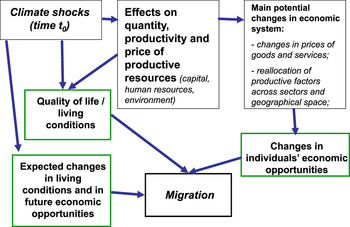
In order to analyze the effects of climate shocks on migration it is important to distinguish direct from indirect channels. The latter produce their effects on migration flows via other push and pull factors (see figure 1). Changes in climatic conditions could have direct effects as push factors of migration flows when the possibility of human survival in the ‘new’ environment is reduced (for instance because of unsustainable water supplies) or when the quality of amenities is substantially lowered. Another direct channel through which environmental adverse events trigger out-migration is through a change in individuals' future expectations. In fact, the decision on whether or not to migrate depends both on current and expected push and pull factors. Expectations might change both in terms of future expected effects of shocks that have already occurred and in terms of the perceived likelihood of future climatic shocks. Climate shocks also have substantial indirect effects on the migration decision through market forces, for instance by affecting the wage differential between home and (potential) host locations (Marchiori et al. Reference Marchiori, Maystadt and Schumacher2012; Beine and Parsons Reference Beine and Parsons2013).Footnote 6 Figure 1 suggests the complexity of the adjustment of the economic system to a shock; in fact, impacts on factor endowments (or on productivities) will translate into changes in factor prices and, in turn, in the price of the final goods and services that employ them. If factors of productions are sufficiently mobile, a sectoral and a geographical reallocation will likely occur.
Climate shocks and migration: a map of direct and indirect links

Migration is also induced by direct and indirect changes in the quality of life, in economic opportunities or a combination of both sets of factors. Note that such changes need not happen in the location (and for the individuals) that is initially affected by the climate shock. Although in the empirical exercise which follows we shed some light on directFootnote 7 vs. indirect channels, a precise assessment of the specific channel through which the climate-induced migration materializes is beyond the scope of the present paper.
Economic systems might have different degrees of resilience to climate-related shocks; hence the ability to undertake different adaptation strategies is highly heterogeneous across space and even across communities in a given area. Individuals and households with a larger endowment of resources (financial assets, land and other capital goods, human capital, social capital) are more likely to undertake adaptation strategies alternative to out-migration. For instance, individuals with large endowments of immobile capital (such as land or real estate) are probably less mobile than individuals with limited amounts of capital or who derive income exclusively from their labor. Individuals with a high level of human capital might have a relatively low-cost access to technologies or productive processes which overcome the negative consequences of climate change/shocks.
One kind of resource which is particularly relevant in shaping the links between climate shocks and out-migration is the possibility for individuals to rely on a network of family and friends who reside in other locations: migration networks or ‘relationship capital’.Footnote 8 The effect of migration networks on individuals' migration propensities might be ambiguous. On the one hand, the network might exercise a strong pull effect by reducing migration costs. On the other hand, external support (for instance in the form of remittances) might facilitate the adoption of alternative coping strategies. Yang and Choi (Reference Yang and Choi2007), using household-level data from the Philippines, find that remittance flows increase as a consequence of rainfall shocks and replace up to 60 per cent of the decline in household income. On the opposite side, studies by McLeman on the drought in Oklahoma during the 1930s suggest that networks played a fundamental role of a ‘bridge’ and favored the adoption of migration as a coping strategy (McLeman, Reference McLeman2006; McLeman and Smit Reference McLeman and Smit2006).
Another important element that might play a significant role in the nexus between climate shocks and migration is the public policy response both before – such as pre-emptive measures and insurance mechanisms that limit the vulnerability to or the consequences of shocks – and after the environmental damages occur (emergency help, financial subsidies and aid, recovery plans, etc.). Countries with a higher level of development and relatively good and effective public governance will generally limit the extent of climate-shocks induced damages and reduce the number of individuals who will adopt migration strategies.
The list of factors outlined above gives an idea about the complexity of the nexus between climate shocks and migration. Another issue that should be considered is the type of mobility patterns that is more likely to be triggered by climatic events of significant magnitude. Relocation strategies can be highly different according to which individual is affected and by which kind of climatic shock. For those individuals who lack the resources to finance a costly international move, or for those communities which have a weak or inexistent network of established migrants in foreign locations, migration is likely to be of short distance and within the country borders.
Barrios et al. (Reference Barrios, Bertinelli and Strobl2006) investigate the role of climate change on rural–urban migration in a panel of 78 countries over the period 1960–1990. Their results outline a positive and statistically significant relationship between urbanization and precipitation shocks for sub-Saharan Africa. No significant results are found for other developing countries, suggesting that the strength of the link between climate change and migration is larger for those communities where agriculture is more vulnerable to rainfall shortages. Marchiori et al. (Reference Marchiori, Maystadt and Schumacher2012) conclude that climate anomalies have contributed to rural–urban migration in sub-Saharan Africa; the authors also show that internal and international migration are linked phenomena.
Cross-border migration will take place if, compared to other adaptation strategies, this option is cost effective. International migration is likely to materialize when the country affected by adverse climatic shocks is, ceteris paribus, geographically, culturally or socially close to potential receiving countries.Footnote 9
The dominance in terms of magnitude of internal over international flows is a stylized fact in the migration literature. Whatever the determinant of migration, individuals are more sensitive to differentials in socio-economic conditions within countries than to differences between them. The fact that climate shocks are more likely to have a stronger effect on internal migration does not rule out the possibility of significant effects also on international migration flows, as documented by Beine and Parsons (Reference Beine and Parsons2013) and by the present study. Bearing in mind the complex ‘web of links’ outlined in this section, we present in the following part the data and the empirical strategy adopted in our analysis on the role of climatic shocks on international migration flows.
3. Empirical strategy and data
3.1. Climate shocks, expectations and migration: from a simple theoretical framework to the empirical model
Our starting point, as in Beine and Parsons (Reference Beine and Parsons2013), is a simple neoclassical model where native individuals optimally choose their location at time t over alternative destinations j ∈ K (including the home destination i).Footnote 10 The migration decision of a native will depend not only on current utilities derived in alternative destinations but also on expected ones. Suppose, for simplicity, that individuals consider only two periods, t (current) and t + 1 (future).Footnote 11 The expected present values of utilities of a native of country i in his current (home) and prospective location j are, respectively:
 $$\eqalign{& u_{ii\comma t} =w_{i\comma t} +A_{i\comma t} +E_{i\comma t}^{t+1} +\varepsilon _{i\comma t} \cr & u_{ij\comma t} =w_{j\comma t} +A_{j\comma t} +E_{j\comma t}^{t+1} -C_{ij\comma t} +\varepsilon _{j\comma t}}$$
where we assume that the individual's utility is linear in wages (w), depends on the current level of amenities (A k, t ) in each location with k = i, j, and ε k,t is a random term drawn from an iid extreme-value distribution. The term C ij, t captures the cost of moving from i to j at time t. Note that both A k, t and C ij, t encompass several dimensions of amenities and mobility costs, respectively, which we assume as distinct and separable in the utility function above. For instance, amenities can be environmental, and hence directly affected by climatic shocks, or related to the quality of the social and institutional environment of a specific location. Mobility costs depend on bilateral factors – such as the existence of a bilateral diaspora or cultural and/or geographical distance between i and j– but can also be origin or destination specific.
Differently from other studies based on the utility maximization approach – such as Beine and Parsons (Reference Beine and Parsons2013) and Ortega and Peri (Reference Ortega and Peri2009) – we introduce, E i,t t+1 ,E j,t t+1, which capture expectations on future realizations of wages and amenities in alternative locations as follows:Footnote 12
 $$E_{k\comma t}^{t+1} =EV\left({u_{k\comma t+1}}\right)=EV\left({w_{k\comma t+1} +A_{k\comma t+1} +\varepsilon_{k\comma t+1}}\right).$$
Following McFadden (Reference McFadden, Griliches and Intriligator1984) we can express the bilateral migration rate as:
 $$\displaystyle{{N_{ij\comma t}} \over {N_{ii\comma t}}} = \displaystyle{{\exp \left[{w_{j\comma t} +A_{j\comma t} +E_{j\comma t}^{t+1} -C_{ij\comma t} } \right]} \over {\exp \left[{w_{i\comma t} +A_{i\comma t} +E_{i\comma t}^{t+1} } \right]}}$$
where N ij, t is the number of migrants from country i to country j and N ii, t is the number of natives who decide to stay put in the home location, i.e., the home population at time t (N ii,t ≈ Pop i,t ). Taking the log of the above expression and substituting equation (2), we obtain the following expression for the (log of) bilateral migration rate between the home location i and destination j:
 $$\eqalign{\ln \left(\displaystyle{N_{ij\comma t} \over Pop_{i\comma t}} \right)& = \lpar w_{j\comma t} -w_{i\comma t}\rpar +\lpar A_{j\comma t} -A_{i\comma t}\rpar \cr & \quad + EV[\lpar w_{j\comma t+1} -w_{i\comma t+1}\rpar + \lpar A_{j\comma t+1} -A_{i\comma t+1}\rpar ] -C_{ij\comma t}}.$$
As argued above, climate shocks in the home location i might have effects on: (i) the current levels of wages, w i, t ; (ii) the current utility derived from amenities, A i, t ; and (iii) individuals' expectations concerning future economic opportunities in the home location. The latter effect is particularly important since expectations can be substantially shaped by climatic shocks in highly vulnerable communities; in our notation E i,t t+1 = f(X i , ClimeShocks i,t ) where X i is a set of country i characteristics which might affect future expected utility.
Our main goal is to identify the overall (direct) impact of climatic shocks on bilateral out-migration.Footnote 13 We use the following econometric specification based on equation (3):
 $$\eqalign{\ln \left({N_{ij\comma t}}\right)& = \beta _1 \left({\hbox{ClimeShocks}_{i\comma t}}\right)+\beta_2 \left({\displaystyle{{w_{i\comma t}} \over {w_{j\comma t}}}}\right)+\beta_3 A_{i\comma t} +\beta_4 \ln \left({Pop_{i\comma t}}\right)\cr & \quad + \beta_5 C_{ij\comma t} +\alpha _{j\comma t} +\alpha_i +\varepsilon _{ij\comma t}}$$
where N ijt , our dependent variable, represents migration flows from the origin country i to the destination country j at time t. We use annual data from the OECD International Migration Database, covering bilateral migration flows toward OECD countries. Due to a lack of data on climatic variables – see below – we limit our analysis to the period 1990–2001 using an unbalanced panel data, which includes 128 origin and 29 destination countries (see online Appendix 1, available at http://journals.cambridge.org/EDE).Footnote 14 A description of the dependent variable and of the covariates used in the estimation is reported in online Appendices 2 and 3. As a robustness check, we perform the same empirical exercise using an alternative data set on international bilateral migration flows – our dependent variable – developed by the UN Population Division (2011).Footnote 15 Given our focus on climate shocks affecting the origin country, a set of country-of-destination-by-time fixed effects (α jt ) is included in our estimates. This set of dummies will hence absorb any time-varying pull factors specific to the OECD destination countries, such as climate shocks and other economic, social and policy changes (including the ones related to A j,t ,F j,t t+1 in equation (3) and changes in migration costs for country j in all origin countries). The specification above also includes fixed effects for country of origin and destination in order to control for time-unvarying characteristics affecting migration flows. Note that these time-unvarying effects normally take account also of international differences in registering the immigrant population across OECD countries.
In our empirical exercise we also study the effect of climate anomalies on the wages in migrant destination countries, an important indirect channel through which these shocks might affect migration flows. In particular we estimate the following specification:
 $$w_{i\comma t} =\delta_1 \left({\hbox{ClimeShocks}_{i\comma t}}\right)+\delta_2 A_{i\comma t} +\delta_3 \ln \left({Pop_{i\comma t}}\right)+\alpha_i +\varepsilon_{ij\comma t}.$$
In the following subsections we describe in more detail the covariates that have been included in our empirical model and strategy.
3.2. Climate data and the identification of climate shocks
The covariatesFootnote 16 used in our econometric specification include a vector of past climatic anomalies in the origin country i, ClimateShocks i, t . Note that the coefficient β1 in equation (4) captures – as discussed in section 2 – both the direct effects on migration flows related to changes in current amenities/quality of life and the effects occurring via a change in future expectations F i,t t+1. By including in equation (4) the (ln) of wages in the home country and other home-country covariates, we control (at least partly) for other indirect channels through which climatic factors affect migration flows.
The existing evidence outlined above emphasizes the highly heterogeneous effect of climate shocks/anomalies. Simple measures of changes in rainfall – like the one used in – represent an unsatisfactory identification of climatic shocks. An important novelty in our approach is the explicit focus on the empirical analysis of the heterogeneous nature of climate anomalies.Footnote 17
Our climatic variables are based on data from Mitchell et al. (Reference Mitchell, Hulme and New2003), who provide detailed information on monthly precipitation and temperature at country level for the period 1901–2000.Footnote
18
The first step in the definition of our variables is the computation, for each of the 128 origin countries, of the long-term monthly mean values of precipitation (
 $\overline{p}_{m}$
; where m ∈ M[january,…,december]) and temperature (
 $\overline{t}_{m}$
), as well as their respective standard deviations (
 $\overline{p}_{SD\comma m}$
and
 $\overline{t}_{SD\comma m}$
) in the period 1901–1990.Footnote
19
On the basis of the first two month-specific moments, referring to climatic variable distributions, we compute a rich set of variables, which measure distinct climate anomalies – in temperature and precipitation – that occurred in three different time horizons before the beginning of bilateral migration between countries i and j Footnote 20 : (i) one-year lag; (ii) three-year lag; (iii) five-year lag.
More specifically, we test for the relevance of the following climatic variables as push factors of international migration flows:
-
(i) Absolute levels of precipitation and temperature (yearly average) computed respectively as:
where y is the year index that can assume values t − n for n equal to 1, 3 or 5 on the basis of the time lag considered; $$p_{abs} =\left({\sum_{y=t-1}^{t-n}{\sum_{m=1}^M {p_{y\comma m}}}}\right)/n \quad \hbox{and} \quad t_{abs} =\left({\sum_{y=t-1}^{t-n} {\sum_{m=1}^M {t_{y\comma m}}}}\right)/n\comma \;$$
-
(ii) Surplus (or deficit) of precipitation and temperature (yearly average) with respect to countries' long-term values (both in level – respectively millimeters and Celsius degree – and percentage value). The formulas applied (here restricted to precipitation, for illustrative purposes) are:
$$\eqalign{& p_{surplus} = \displaystyle{{\sum_{y=t-1}^{t-n} {\sum_{m=1}^M {\left({p_{y\comma m} -\overline{p}_m }\right)}}} \over {n}} \quad \hbox{and} \cr & p_{\% surplus} = \displaystyle{{\sum_{y=t-1}^{t-n}{\sum_{m=1}^M {\left({\displaystyle{{p_{y\comma m} -\overline{p}_m } \over{\overline{p}_m}}100}\right)}}} \over {n}}}\semicolon \;$$
-
(iii) Anomalies above or below one standard deviation with respect to long-term values. We consider separately anomalies above one standard deviation from the mean, henceforth defined as ‘positive’, and those below one standard deviation from the mean, defined as ‘negative’. For precipitation, the following formulas have been applied:
We have also considered an overall measurement of climatic anomalies – positive and negative – given by the sum of the above formulas: p anomalies = p (+)anomalies + p (−)anomalies . Besides, anomalies have been computed as percentage deviations from the mean.
$$\eqalign{& p_{\lpar +\rpar anomalies} = \displaystyle{{\sum_{y=t-1}^{t-n} {\sum_{m=1}^M {\max \left[{0\comma \; p_{y\comma m} -\left({\overline{p}_m +\overline{p}_{SDm}}\right)}\right]}}} \over {n}} \cr & p_{\lpar -\rpar anomalies} = \displaystyle{{\left\vert {\sum_{y=t-1}^{t-n} {\sum_{m=1}^M {\min\left[{0\comma \; \left({\overline{p}_m -\overline{p}_{SDm}}\right)-p_{y\comma m}}\right]}}}\right\vert } \over {n}}.}$$
-
(iv) Index of intra-annual rainfall variability, which is calculated as the mean absolute deviation (MAD) over the long-term MAD for each of the three lags considered in the analysis. The formula applied is the following:
The standardization of the index allows a convenient interpretation of the values as deviation from the country-specific natural level of variability. For example, an index equal to 1.2 at lag 3 for a specific year in country i implies that during the three years preceding the observed migration flow, precipitations were 20 per cent more volatile than usual.
$$p_{MAD\comma n} = \displaystyle{{90\sum_{y=t-1}^{t-n} {\sum_{m=1}^M {\left\vert {p_{y\comma m} -\overline{p}_m }\right\vert }}} \over {n\sum_{y=1901}^{1990} {\sum_{m=1}^M {\left\vert {p_{y\comma m} -\overline{p}_m}\right\vert }}}}.$$
-
(v) Seasonal effects of climatic shocks. We have computed distinct measurements of temperature and precipitation anomalies for rainy and dry seasons. These measurements allow us to test the heterogeneous impacts of shocks – for instance, through current and future damages to the agricultural systems – according to the timing of climatic events. The definition of the rainy season is conventional for most of the countries in our sampleFootnote 21 ; where this information was missing, we have defined as rainy months those with an average rainfall above the monthly mean for the full period available (1901–2000).


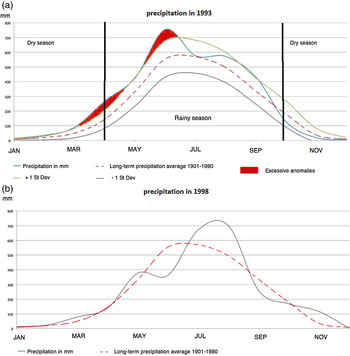
Figure 2 shows a compelling illustration of the importance of our refined identification of climatic shocks. It reports monthly precipitation that occurred in Bangladesh during two years – 1993 (panel A) and 1998 (panel B) – together with the long-term average monthly rainfall (1901–1990) and its standard deviations. During the flood that occurred in the summer of 1998, over 68 per cent of the country was inundated with major economic consequences and a death toll of approximately 2.4 thousand people. This major precipitation shock would not be sufficiently identified when using the year average, as it has usually been done in previous econometric analysis, due to a rather large rain shortfall in the two months preceding the shock. Namely, the year rainfall average was only 6.6 per cent higher compared to the long-term mean, thus not substantially different from other minor events that occurred in Bangladesh (and other countries). On the contrary, our computed index of intra-annual rainfall variability (P MAD1, y=1998) was 21.5 per cent over its long-term value.
Monthly precipitation in Bangladesh: 1901–1990 averages and rainfall in 1993 and 1998

Even more problematic is the aggregation of climatic variables over a longer time span. For instance, between 2000 and 1991 the yearly rainfall average in Bangladesh was 2,642 mm, i.e., below the long-term average of 2,736 mm. As a consequence, the aggregation would have completely excluded the two major floods occurring in 1998 and 1993 that are reported in figure 2. This ‘aggregation bias’ has characterized previous studies such as and Reuveny (Reference Reuveny2007), but also recent analyses such as Marchiori et al. (Reference Marchiori, Maystadt and Schumacher2012) and Beine and Parsons (Reference Beine and Parsons2013).
3.3. Description of other covariates
We introduce in our econometric specification a set of additional covariates (see online Appendix 2 for a detailed description of the sources). As a proxy for wage at the origin country in equation (4) we employ the (ln) GDP per capita lagged one year. Furthermore, we include the (ln) origin country employment rate. In both cases, we expect negative estimated coefficients.
The inclusion of a control for the origin country population, Pop i, t , originates from the theoretical model above. Even in the relatively short time span used in our analysis, some countries have experienced a significant increase in their population; hence, the time-invariant origin-country fixed effects might overlook the importance of demographic pressures on migration.Footnote 22
Our specification includes a set of variables which control for different dimensions of amenities in the origin country, A i,t . The first one is a proxy for social (in)stability, armed conflicts, a dummy variable equal to 1 when episodes of armed conflict occur in the origin country in year t. Note that this variable is likely to capture some of the indirect effects of climatic shocks on migration flows (see Reuveny Reference Reuveny2007). Short-term environmental shocks are captured through a natural disasters variable, which embraces events such as earthquakes, floods, extreme temperatures, epidemics, mass movements, storms, floods and wildfires. The variable is calculated as the sum of the number of episodes in the origin country in a year. In addition, we control for the quality of institutions in the home location by employing the Political Institutional Quality Index developed by Kuncic (Reference Kuncic2014), which ranges between 0 and 1.
In addition, we consider a set of bilateral variables C ij,t−1, affecting the costs of bilateral migration flows, such as geographical distance, contiguity, common language and colonial ties between country i and j. We also include the log of the (past) bilateral stock of migrants from the origin country i into the destination country j in year 1960 as a proxy for the important role played by the diaspora in shaping subsequent waves of migration flows. We also expect, as in the existing studies, that geographical distance is negatively related with bilateral flows between origin and destination countries. On the contrary, we expect that a common language, shared borders, colonial ties and a dense network of already established migrants, by reducing the cost of migration and increasing the number (and value) of opportunities in the destination country, are positively associated with bilateral flows.
Finally, we employ the share of agriculture over total GDP at time t − 1 as a conditioning factor of the effects of climatic shocks upon our dependent variable. The agricultural sector in developing countries is often highly sensitive (and hence vulnerable) to climate shocks; we expect that the larger the weight of agriculture in the origin country economy, the wider will be the effect of climate shocks on individuals' socio-economic opportunities and the smaller the capacity of other sectors to absorb adverse consequences.
3.4. Econometric issues
Two main issues need to be addressed in the estimation of equation (4). The first one is the presence of ‘zeros’ in bilateral migration flows, a problem leading to bias when using OLS estimations. Although in our sample the relative size of zeros is less pronounced, compared to other empirical works on migration determinants such as Beine et al. (Reference Beine, Docquier and Ozden2011) or Pedersen et al. (Reference Pedersen, Pytlikova and Smith2008), we address the issue by using a Poisson pseudo-maximum likelihood estimator (PPML), which has a superior performance compared to other estimators commonly employed in the literature, even when the dependent variable has a large proportion of zeros (Santos Silva and Tenreyro Reference Santos Silva and Tenreyro2006; Reference Santos Silva and Tenreyro2011).Footnote 23 ,Footnote 24 The second issue is related to the endogeneity of bilateral migration stocks (diaspora) – one of the regressors – and to our dependent variable, i.e., bilateral migration flows. Namely, unobservable bilateral characteristics might affect both the size of diasporas and the subsequent migration flows. Beine et al. (Reference Beine, Docquier and Ozden2011) follow Munshi (Reference Munshi2003) and employ an instrumental variable estimation approach instead of using the current size of diasporas (i.e., the bilateral stock between country i and j). In particular, they use as instruments – supposedly correlated with the size of bilateral diasporas, but not with current flows – a dummy variable, which captures the existence of the guest workers' scheme between the country of destination and origin in the 1960s and 1970s, and a variable which proxies the bilateral diaspora in the 1960s (see Beine et al. Reference Beine, Docquier and Ozden2011 for details). In this paper, we use as a proxy for the intensity of network effects in the bilateral diaspora of the year 1960 – which has been recently made available by Ozden et al. (Reference Ozden, Parsons, Schiff and Walmsley2011) – the World Bank Global Bilateral Migration Database. Using past diaspora is, in our opinion, a good measure of bilateral migration costs, given the more effective role exercised by established migrants compared to more recent waves of migrants. Besides, this ‘vintage’ diaspora measure is unlikely to be affected by the same estimation issue, given the large time lag between the stocks and the 1990–2001 flows.Footnote 25
4. Empirical results
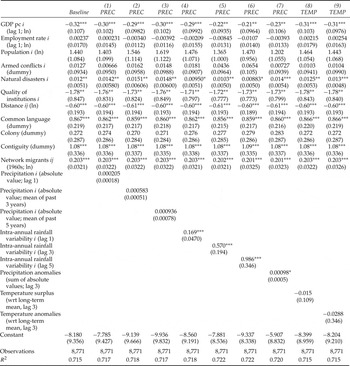
The starting point of our analysis is the baseline model of bilateral migration flows, reported in the first column of table 1. Estimation results for the non-climatic covariates are generally in line with our expectations. The size of bilateral migration flows is decreasing in the GDP per capita in the origin country; hence, a relative increase in wages (or level of development) translates into smaller bilateral migration flows. The employment rate in the origin country presents a negative but not statistically significant coefficient. Distance, as expected, is negatively associated with the size of the flows, while a common language and a common border have positive effects on out-migration flows. We do not find a statistically significant effect on the dummy variable for colonial ties. As highlighted in previous studies (see Beine et al. Reference Beine, Docquier and Ozden2011; Pedersen et al. Reference Pedersen, Pytlikova and Smith2008), migration networks play a crucial role in directing immigration flows; in our baseline model, the bilateral stock of already established migrants in 1960 is a strong determinant of subsequent bilateral flows. Note also that the estimated coefficient on the index of (political) quality of institutions is always negative and significant, suggesting a higher migration from origin countries with relatively weak institutional environments.
Climate shocks and international migration: baseline estimation (OECD data)

Notes: Dependent variable: bilateral migration flows ij (absolute values).
***, **, * denote statistical significance at 1%, 5% and 10%, respectively; estimates include origin and destination country fixed effects, destination country by time fixed effects. Robust standard errors (in parentheses) clustered by country of destination.
In columns (1)–(3) of table 1 we report model specifications which include simple measurements of average rainfall respectively in one-, three- and five-year lags. The estimated coefficients of these rather unsophisticated measurements of climate shocks – see our discussion in section 3.2 – are always not statistically significant. Things change when we consider the excessive variability of precipitation instead of the amount of rainfall. In columns (4)–(6) we include in the baseline regression the index of (excess) rainfall variability, P MAD, y , computed at different time spans (averages of one-, three- and five-year lags). The estimated coefficients of the index are positive and significant; an increase in intra-annual precipitation variability, with respect to the long-term mean variability, is strongly associated with an increase in out-migration. It is interesting to notice that the magnitude of the coefficients is increasing in the time span considered. This result implies that a persistent excess variability amplifies the out-migration push. This is in line with our hypothesis that climate shocks affect individuals' expectations on future consequences of climate shocks and on the occurrence of further shocks in the future; a persistent high intra-annual variability of rainfall might indeed induce individuals to believe that these shocks are a persistent feature of the origin country climate rather than transitory, one-off events. For instance, if we consider column (5), a back-of-the-envelope calculation reveals that, ceteris paribus, an increase in the index of rainfall variability at three years from mean value to one standard deviation above the mean is associated with a 13.7 per cent increase in average bilateral migration.
Precipitation anomalies, i.e., monthly rainfall deviations from a long-term mean exceeding one standard deviation, are associated with an increase in bilateral migration flows toward OECD countries (see column (7)). On the contrary, we do not find significant direct effects of temperature shocks, considering both surplus and anomalies (columns (8)–(9)).
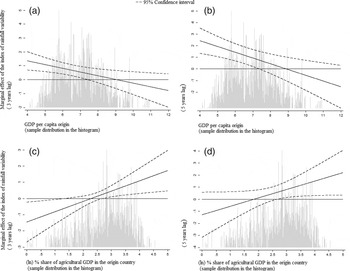
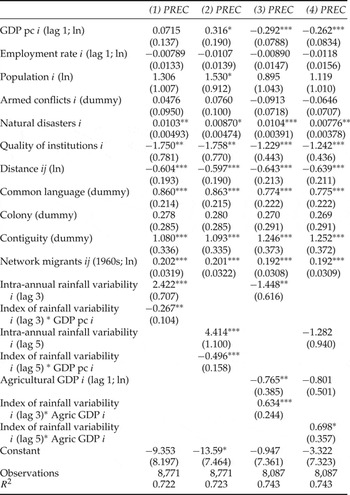
As argued in section 2, the nexus between climate shocks and migration is mediated by some conditioning factors; in particular, the adoption of migration as a coping strategy might depend on the vulnerability of the individuals directly and/or indirectly affected by the shocks. Beine and Parsons (Reference Beine and Parsons2013) find a heterogeneous impact of climate anomalies when estimating separate models for developed (North) and developing (South) countries. In particular, they find evidence of significative effects of climate anomalies upon the latter group when conditioning these shocks to ‘vulnerability’ factors, such as the importance of the agricultural sector and water stress. In table 2, we interact the index of (the excess of) rainfall variability with the GDP per capita (columns (1) and (2)) – our proxy for the relative level of development – and with the agriculture share of GDP in the origin country (columns (3) and (4)). The estimated coefficients on the interactions of the employed climatic variables with the GDP per capita are negative. In figure 3, we report the marginal effects of P MAD, 3y (panel A) and P MAD, 5y (panel B) upon bilateral migration conditional on the GDP per capita in the origin country. Confidence intervals around the marginal effect lines and the histogram of the distribution of the conditioning variable are also shown in figure 3. The findings suggest that an excess of rainfall variability is significantly associated with out-migration flows only in relatively poor countries. This result confirms the hypothesis that less developed areas are more likely to cope with climatic shocks by adopting cross-boundaries relocation strategies.
The marginal effect of rainfall variability on bilateral out-migration: the role of the relative level of development and the size of the agricultural sector

Rainfall variability: the role of the level of development and of the agricultural sector (OECD data)

Notes: Dependent variable: bilateral migration flows ij (absolute values).
***, **, * denote statistical significance at 1%, 5% and 10%, respectively; estimates include origin and destination country fixed effects, destination country by time fixed effects. Robust standard errors (in parentheses) clustered by country of destination.
Countries where the agriculture sector is largeFootnote 26 experience a sizable climate-induced out-migration (columns (3)–(4) of table 2). As for the previous conditioning variable, we report the marginal effects associated with a change in P MAD, 3y (panel C) and P MAD, 5y (panel D), conditional upon the size of the agricultural sector. The results confirm that rainfall variability generates a positive effect on migration flows in countries with a large agricultural sector; on the contrary, the marginal effect is negative for countries where this sector is rather small. A higher agriculture share of GDP implies that eventual shocks to this sector might produce very strong effects and that, at the same time, they are less likely to be absorbed by other sectors of the economy.
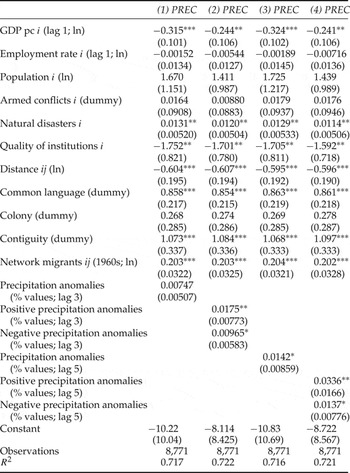
In table 3, we report our analysis on the heterogeneous effect of precipitation anomalies with different signs, respectively above or below one standard deviation with respect to the long-term mean. Our findings suggest that the magnitude of the effect is generally larger for excessive rainfall compared to severe droughts. Note that the aggregated measures using a three-year lag are not statistically significant (columns (1) and (3) in table 3), while these are marginally significant at a five-year lag.
Precipitation anomalies and international migration: draught vs. floods (OECD data)

Notes: Dependent variable: bilateral migration flows ij (absolute values).
***, **, * denote statistical significance at 1%, 5% and 10%, respectively; estimates include origin and destination country fixed effects, destination country by time fixed effects. Robust standard errors (in parentheses) clustered by country of destination.
Climate shocks generally have different impacts on economic systems (and on individuals' current and future livelihoods), depending also on the timing of events. Namely, excessive precipitation or temperature anomalies during the main crop season might have devastating effects on the affected economy; on the contrary, a similar event might not produce significant effects in another period of the year. Given the impossibility of conducting a highly disaggregated analysis, which considers differences in agricultural systems across all countries in the sample, we study the effects of climatic shocks occurring in rainy and dry seasons separately.
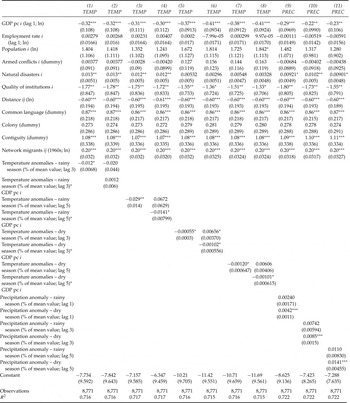
The estimation results reported in table 4 confirm the relevance of the timing of precipitation and temperature anomalies. In column (1) we include in the baseline model a variable which measures the magnitude of temperature anomalies which occurred during the rainy season in the past three years. The sign of the coefficient is negative, hinting that a severe decrease (increase) in temperature during the rainy season is associated with more (less) out-migration. In column (2), we interact the climatic variable with the per capita GDP in the origin country; the interaction effect has a negative but not statistically significant coefficient for those countries in our sample with a large GDP per capita. When considering the temperature anomalies in the previous five years – i.e., a relatively more persistent anomaly – the effects have a higher magnitude and the role of GDP per capita as a mediating factor is statistically significant (columns (3) and (4)).
Climate shocks and international migration: dry and rainy seasons (OECD data)

Notes: Dependent variable: bilateral migration flows ij (absolute values).
***, **, * denote statistical significance at 1%, 5% and 10%, respectively; estimates include origin and destination country fixed effects, destination country by time fixed effects. Robust standard errors (in parentheses) clustered by country of destination.
The effects of temperature anomalies during the dry season have the same pattern but are substantially different in magnitude and, generally, the effects are weakly statistically significant (columns (5)–(8)). In the last three columns of table 4 we report the different seasonal effects of precipitation anomalies. We find evidence of positive and statistically significant effects only for anomalies occurring during the dry season at all the time lags considered.
In additional estimates (available in online Appendix 4), we employ as a dependent variable the international bilateral migration flows of the UN Population Division (2011). The results related to the climatic variables are robust, although the magnitude of the average effects slightly diverges due to the different pool of origin/destination countries covered. Hence, the findings are robust to a different composition of origin/destination countries.Footnote 27
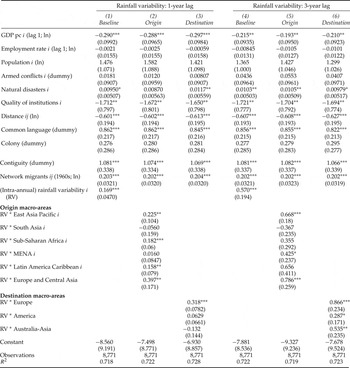
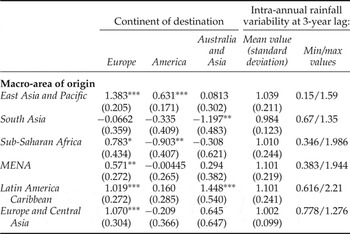
The climate-shocks induced effects highlighted so far represent average effects across the large sample of origin and destination countries included in the sample. There are good reasons to suspect that effects might be highly heterogeneous across country pairs – i.e., across migration corridors – due to specific dyadic factors that affect bilateral migration costs (for instance, visa policies). In table 5 we estimate the heterogeneous impact of rainfall variability, measured respectively at lags 1 and 3. In the first part, table 5a, the index of intra-annual rainfall variability is interacted with origin areas dummies (columns (2) and (5)) and with destination areas dummies (columns (3) and (6)). The estimates highlight significantly different effects. In particular, the magnitude of the effects is larger for origin countries belonging to Europe and Central Asia and to East Asia and Pacific. A positive and significant effect on out-migration is found also for countries belonging to sub-Saharan Africa and Latin America when we consider excess volatility of rainfall at lag 1. Interestingly, countries in South Asia where rainfall volatility is structurally quite high do not seem to be significantly affected by anomalies. Probably this result is related to a higher ability to adjust to climatic shocks of population that are structurally exposed to highly unstable climatic conditions. In terms of destination area, we find that out-migration associated with climatic shocks is more likely to happen toward European destinations and, to a lesser extent, to Australia and Asia, rather than toward the American continent. Table 5b shows the coefficients obtained by interacting the index of intra-annual rainfall variability (in the past three years) and origin-by-destination area dummies; it also reports summary statistics of rainfall variability for the origin areas.
Rainfall variability at lag 1 and lag 3: different impacts by origin and destination area (OECD data)

Notes: Dependent variable: bilateral migration flows ij (absolute values).
***, **, * denote statistical significance at 1%, 5% and 10%, respectively; estimates include origin and destination country fixed effects, destination country by time fixed effects. Robust standard errors (in parentheses) clustered by country of destination; RV is used as abbreviation of the intra-annual index of rainfall variability.
Rainfall variability and migration: evidence of heterogeneous effects upon different international migration corridors (OECD data)

Notes: In the table we report the coefficients obtained by interacting the measure of intra-annual rainfall variability at 3-year lag with origin-by-destination area dummies (only coefficients for climatic coefficients reported).
***, **, * denote statistical significance at 1%, 5% and 10%, respectively; estimates include origin and destination country fixed effects, destination country by time fixed effects. Robust standard errors (in parentheses) clustered by country of destination.
Interesting differences across (macro-area) migration corridors emerge.Footnote 28 Rainfall volatility seems to substantially increase out-migration in most of the migration corridors that involve a European county as a final destination, with the exception of South Asia/Europe and, to a lower extent, sub-Saharan Africa/Europe migration corridors. For some corridors such as South Asia/Australia and Asia and sub-Saharan Africa/America, there is evidence of a decrease in international migration flows when rainfall volatility is particularly high in the origin country. Climate shocks occurring in the Middle East and North Africa and in Europe and Central Asia have a significant effect on out-migration only toward European macro corridors; i.e., toward more accessible and less costly destinations. On the contrary, rainfall shocks in Latin America seem to have direct effects on out-migration toward Europe and Australasia but not toward the United States, Canada and Chile. One possible explanation might be related to quick adjustments in border enforcement – mainly in the United States – as a consequence of increasing migration pressure. These findings suggest that structural factors characterizing specific migration corridors are crucial in determining the direction and size of migration flows.Footnote 29
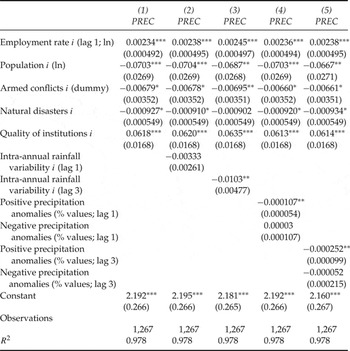
Finally, we propose an exercise on the indirect role of climatic shocks through the GDP per capita in the origin country (our proxy for wage). Table 6 reports our estimates, where we regress the GDP per capita in country i on a set of covariates including climatic shocks at one- and three-year lags.Footnote 30 We find evidence of a negative effect of excessive rainfall variability in the previous three years on GDP per capita. In addition, we find evidence on the negative effect on GDP associated with abundant rainfall (floods). This latter analysis confirms that climate shocks might be fundamental drivers – in a direct or indirect way – of out-migration from developing toward rich countries.
The effects of climate shocks on GDP per capita in origin countries (OECD data)

Notes: Dependent variable: GDP per capita i (ln).
***, **, * denote statistical significance at 1%, 5% and 10%, respectively; robust standard errors in parentheses; estimates include origin country fixed effects.
5. Concluding remarks
In the past few years, public opinion has often been exposed to apocalyptic figures of migration flows that in the near future will be induced by changes in climatic conditions. Some of these prognostics were taken, often uncritically, from important reports, such as the Stern review or other studies such as Christian Aid (2007). These estimates are often based on simplistic assumptions and what they actually measure is ‘population at risk’ (for instance, the number of people living in coastal floodplains below 1 m of elevation), rather than actual migrants. These estimates do not consider other forms of adaptation strategies that might take place.
The complexity of the nexus between climate shocks and international migration demands the use of different methodological tools and investigation approaches (i.e., from different methodological approaches). In this paper, we develop a theoretically grounded ‘macro’ approach that takes into account and empirically tests the importance of climate shocks as push factors using a panel data set of international bilateral migration flows. To our knowledge, this is the first paper which, rather than using highly aggregated and simple measurements of climate shocks, explicitly tests the importance of past climate shocks differing for type, magnitude and sign. Contrarily to the existing studies, we also consider the importance of the timing of shocks by computing measurements of climate anomalies occurring in rainy and dry seasons.
We find evidence of both direct and indirect effects of climatic shocks on international migration flows. As emphasized in our simple theoretical model, the direct effect of climatic shocks is likely to be related also to the impact that past events might have upon expectations on prospective streams of climate-induced changes in income and in non-monetary benefits and/or on expectations of the likelihood of additional adverse climate shocks.
Our findings show that climate shocks have heterogeneous effects depending not only on the specific kind of shock but also depending on cofactors, such as the level of development or the relative importance of agriculture within the local economy. In particular, we find that precipitation variability with respect to the long-term mean contributes to migration outflows toward rich OECD destinations. We find a different effect of floods compared to drought – respectively measured as rainfall average above or below one standard deviation from the long-term mean. Namely, the magnitude of the out-migration effect is on average larger for excessively abundant rainfall. With respect to temperature shocks, we find evidence that temperature anomalies have a significant effect on migration flows. We find evidence that a large fall in average temperature during the rainy season increases out-migration, in particular in less developed economies. The magnitude of these effects is substantially smaller if these shocks occur during the dry season. Finally, we highlight differences in the effects of rainfall variability across (macro-area) migration corridors. We detect a positive association between rainfall shocks in particular in migration corridors which include European destinations, probably as a consequence of more ‘porous’ borders and a higher heterogeneity of immigration policies.
A corollary of our analysis is the difficulty – and probably the impossibility, at least with the current methodological tools – of producing plausible predictions on future climate-induced migration flows. In order to provide reliable forecasts, researchers would need more accurate information on the exact nature and timing of future climatic shocks and on future evolutions of alternative coping strategies in societies and economies hit by these shocks.