Introduction
Bone metastases are the commonest cause of cancer-related painReference Chow, Harris, Fan, Tsoa and Sze1; palliative radiotherapy for bone metastases makes up a substantial workload in any radiotherapy department. This treatment modality, well proven in its effectiveness in this setting,Reference Agarwal, Swangsilpa, van der Linden, Rades, Jeremic and Hoskin2 has been examined extensively in clinical trials over 30 years.Reference Tong, Gillick and Hendrickson3–Reference Hartsell, Scott and Watkins Bruner12 Two systematic reviews of different dose-fraction schedules were published in the late 1990s, whereas Ratanatharathorn et al.Reference Ratanatharathorn, Powers, Moss and Perez13 found multi-fraction regimens to give greater pain relief, the Cochrane ReviewReference McQuay, Carroll and Moore14 found little discernible difference in efficacy between different fractionation schedules. Three subsequent meta-analysesReference Chow, Harris, Fan, Tsoa and Sze1, Reference Wu, Wong, Johnston, Bezjak and Whelan15, Reference Sze, Shelley, Held, wilt and Mason16 have demonstrated the equal efficacy of a single-fraction and multi-fraction treatment for pain relief in uncomplicated bone metastases. However, international surveys,Reference Chow, Danjoux and Wong17, Reference Hartsell, Shah, Graney and Kun18 in which radiation oncologists were asked their opinion on hypothetical case scenarios, have discovered a reluctance to adopt a single-fraction treatment in routine clinical practice, despite its obvious advantages in terms of patient convenience and resources. In one recent survey,Reference Fairchild, Barnes and Ghosh19 where patients’ views were also sought, sustained pain relief and minimising the risk of future complications were the most important factors given, whereas travelling distance and brevity of treatment were of least importance to patients.Reference van der Linden, Roos, Lutz and Fairchild20 The Royal College of Radiologists (RCR) audited UK practice in 200721 and reported a mean single-fraction delivery rate of 60%.
The International Consensus Conference Workshop convenes every 10 years to evaluate evidence and produce guidance statements on palliative radiation in the treatment of metastatic and locally advanced cancer.Reference Lutz, Berk and Chang22 The American Society of Therapeutic Radiology and Oncology (ASTRO) workshop 2010 sought a consensus on single-fraction therapy for painful bone metastases in practice. They found excellent pain control and minimal side effects were provided by both single-fraction and multi-fraction treatments. However, they concluded that the longer course had the advantage of a lower incidence of repeat treatments to the same site, whereas the single fraction proved more convenient for patients and caregivers.Reference Lutz, Berk and Chang22
Surveys of practice published between 1989 and 2004 used hypothetical case scenarios. This retrospective study examined actual practice and assessed the factors influencing choice of treatment regimen in real clinical settings for palliative radiotherapy for bone metastases at a major UK Cancer Centre, serving a population of 2·3 million23 over the last decade.
Materials and methods
Subjects
Subjects were patients with metastatic cancer who were treated with palliative radiotherapy for bone metastases at Clatterbridge Centre for Oncology (CCO) in the years 2000 and 2006. Clinical Audit Sub-committee approval was gained. There were no gender or age criteria. Patients were excluded if their primary tumour was melanoma, renal cell carcinoma, non-Hodgkins lymphoma or leukaemia; the former two because there is some evidence that they express a different biological behaviourReference Steenland, Leer and van Houwelingen9 and therefore benefit from hypofractionation because of low tumour α/β ratio,Reference Hall24 and the latter because they are not solid tumours.
Other exclusion criteria included patients treated for malignant spinal cord or cauda equina compression and hemi-body irradiation. Treatment of uncomplicated bone metastases, as well as pathological fractures and retreatments, were included.
Identification of audit population and sample size
All patients who were treated with radiotherapy for bone metastases in 2000 and 2006 within the inclusion criteria of the audit were identified. As there were 642 patients in the 2000 population and 663 patients in the 2006 population, the recommended sample size for both these populations, to give a 90% confidence ± 5% accuracy, was 137 patients per year group. Once data collection commenced, it became apparent that erroneously some cases of spinal cord compression had been recorded as palliative radiotherapy to bone metastases, before the updating of the coding system. Once these cases were removed, the recalculated sample size was 120 patients per year group. A single episode of palliative radiotherapy to a bone metastasis site was examined for each patient in the sample, having confirmed radiological evidence of bone metastasis, through radiological reports, before treatment delivery.
Methods
This was a retrospective study and audit, auditing dose-fractionation regimens used in palliative radiotherapy for bone metastases at CCO against the RCR standard of a single 8 Gy fraction for the treatment of uncomplicated bone metastases. Data were collected by individual case note review of each of the 240 subjects identified, collating information from hand-written documentation, formal typed letters and radiotherapy prescription charts.
Three categories were defined as ‘indications for treatment’: pain, instability or fracture and post-operative radiotherapy. Response to radiotherapy was assessed if pain was an indication for treatment. ‘Response’ was defined as any improvement in pain and ‘complete response’ was complete resolution of pain. ‘Overall response rate’ was the summation of partial and complete responders. ‘Progression’ was worsening of the pain and ‘no response’ was no change in pain levels.
Response rates were calculated by excluding any treatments where pain was not an indication for treatment. Retreatments were also excluded as were cases where there was no follow-up data recorded to assess response. However, early deaths before assessment of response were included as non-responders.
Data collection and analysis
Data were inputted into © Microsoft Access database before being exported into © Microsoft Excel where basic analyses could be undertaken. Multivariate analyses and survival calculations were carried out using © IBM Statistical Package for the Social Sciences (SPSS) software. Analyses of data used Pearson's χ 2 test and Fisher's exact test.
Results
Demographics
Radiotherapy for palliation of bone metastases made up 17% of all radiotherapy episodes (n = 988) delivered at CCO in 2000 and 16% of episodes in 2006 (n = 934). Of the study population, 62·5% was female, as breast was the commonest primary tumour site treated both in the audit sample and the whole population. The age range was 21–92 years with a median age of 68 years.
Indication for treatment
Pain was the indication in 90% of cases (n = 215), post-operative radiotherapy in 5% (n = 12), instability and pain together in 3% (n = 8) and instability alone in 2% (n = 5).
Primary tumour
Breast was the commonest primary site treated representing 39% (n = 93) of cases in this study. Metastatic prostate carcinoma was treated in 22% (n = 52) of cases and lung carcinoma in 17% (n = 40). ‘Other’ tumour sites included head and neck, bladder, gynaecological malignancy, thyroid and bone metastases from an unknown primary site. This group represented 23% (n = 55) of cases.
Bone metastasis site treated
The spine and the pelvis were the commonest index sites treated in both years with overall 38% (n = 92) of treatments to the pelvis and 39% (n = 93) to the spine. Treatments to the sacrum were included as ‘pelvis’. Long bones were treated in 9% (n = 22) of cases. ‘Other’ sites treated included ribs, shoulder and skull and contributed 14% (n = 33) of cases.
Dose fractionation regimens delivered
A single 8 Gy fraction was the predominant dose-fractionation regimen used overall in both years, making up 50 out of 120 radiotherapy episodes (42%) in 2000 and 48 out of 120 episodes (40%) in 2006; a single 10 Gy fraction was used on 17 occasions in 2000 and on only five occasions in 2006. The use of a single 8 Gy fraction did not change significantly between the 2 years. A single 6 Gy fraction was delivered on three occasions between the 2 years.
The commonest multi-fraction regimen used in both years was 20 Gy in five consecutive daily fractions. The use of this fractionation regimen increased from exactly one-fifth of all treatments in the sample in 2000 (24 out of 120 episodes; 20%) to one-third of all treatments in 2006 (40 out of 120 episodes; 33%).
The second commonest multi-fraction regimen used in 2000 was 25 Gy in five consecutive daily fractions (12%); this had almost halved by 2006. However, 30 Gy in ten fractions delivered over 2 weeks increased from three out of 120 episodes (3%) of cases in 2000 to 12 out of 120 episodes (10%) in 2006.
Sixteen of the treatments were retreatments, three delivering a single-fraction and 13 delivering a multi-fraction regimen. Excluding these retreatments, the single-fraction delivery rate for CCO was 53·6%.
Potential factors influencing choice of dose-fractionation regimen
Age
Cases were grouped into three age categories. Single-fraction and multi-fraction delivery rates were 2% and <1%, respectively, in the age group below 41, 18% and 19%, respectively, in the age group of 41–64 years and 32% and 29% in the age group over 64 years. Patients’ age was not a significant factor in whether they were treated with a single-fraction or multi-fraction regimen (p = 0·476), with a χ 2 value of 1·487.
Index site
The spine was treated in 93 cases, of which 46% (n = 43) received a single-fraction and 54% (n = 50) received a multi-fraction regimen. The pelvis was treated in 92 cases, of which 53% (n = 49) received a single-fraction and 47% (n = 43) received a multi-fraction regimen. Long bones were treated in 22 cases, of which 54% (n = 12) received a single-fraction and 46% (n = 10) received a multi-fraction regimen. Other bone sites were treated in 33 cases, of which, 58% (n = 19) received a single-fraction and 42% (n = 14) received a multi-fraction regimen.
Bone metastasis site treated was not a significant factor in choice of single-fraction or multi-fraction regimen (p = 0·635), with a χ 2 value of 1·709.
Primary tumour
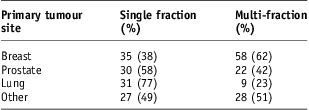
Table 1 displays the split of single- and multi-fraction treatment across tumour sites. Breast was the primary tumour site treated in 93 cases; a single-fraction treatment was delivered to the bone metastasis in 35 of these cases (38%) and multi-fraction treatment in 58 cases (62%). Prostate was the primary tumour site in 52 cases: a single-fraction treatment was delivered in 30 of these cases (58%) and a multi-fraction treatment in 22 cases (42%). Lung was the primary tumour site in 40 of these cases: a single-fraction treatment was delivered in 31 of these cases (77%) and a multi-fraction treatment in only nine cases (23%).
Dose-fractionation regimen in 240 episodes of palliative radiotherapy for bone metastases by primary tumour site
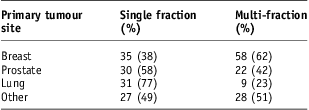
Tumour site was a significant factor in choice of dose-fractionation regimen used for delivering palliative radiotherapy to a bone metastasis (2000: p = 0·038, 2006: p = 0·001), with a χ 2 value of 8·428 obtained for the 120 cases in 2000 and a value of 17·279 for the 120 cases of 2006.
Patients with metastatic breast carcinoma were significantly more likely to be treated with a multi-fraction regimen than single-fraction regimen. Patients with metastatic lung carcinoma were significantly more likely to be treated with a single-fraction regimen than multi-fraction regimen.
Performance status
Performance status at the time of treatment with palliative radiotherapy for bone metastases was recorded in only 50 out of 240 cases examined. Patients with World Health Organisation (WHO) performance status 0–1 received single-fraction treatment in five out of 11 cases; patients with WHO performance status of two received single-fraction treatment in seven out of 11 cases; patients with WHO performance status of three received single-fraction treatment in 16 out of 28 cases. Numbers were deemed too small for meaningful statistical analysis.
Documented reasons for dose-fractionation regimen chosen
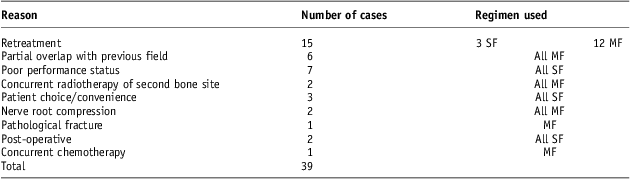
A reason for the dose-fractionation regimen chosen was documented in 39 out of 240 cases, as shown in Table 2.
Documented reasons for choice of dose-fractionation regimen for palliative radiotherapy for bone metastases
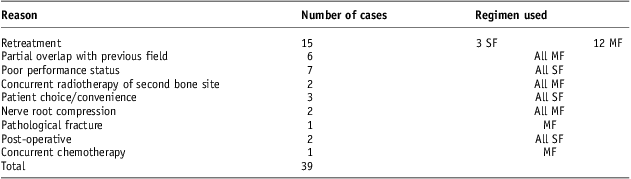
Abbreviations: SF, single fraction; MF, multi-fraction.
Response to treatment
Pain was not an indication for treatment in 16 cases, which were excluded from the response calculation. The radiotherapy was a retreatment in 16 more cases, and were therefore excluded, and in 42 cases there was no documentation of whether there had been any response to treatment or not, and thus these were also excluded.
Cases where there was no documentation of response because the patient died before returning to clinic were included as non-responders. Death within 4 weeks of treatment occurred in 36 cases (15%). Therefore, 165 out of 240 cases were included in the response calculation; results are summarised in Table 3.
Response rates for palliative radiotherapy for painful bone metastases

Abbreviations: SF, single fraction; MF, multi-fraction.
The overall response rate for the audit sample was 69%, with a complete response rate of 21%. Single-fraction response rate was 66%, whereas multi-fraction response rate was 71%. Single-fraction complete response rate was 23%, whereas multi-fraction complete response rate was 18%. There was no difference in single-fraction or multi-fraction regimen response rates in 2000 (p = 0·445, χ 2 = 1·620). Similarly, for 2006, there was no significant difference in response to the two regimens (p = 0·116, χ 2 = 4·315).
Acute toxicity
Toxicity was recorded in the case notes in only 17 out of 240 cases examined. All toxicities documented were either Grade 1 or 2 (CTCAE v3·0)25: diarrhoea in six cases, nausea in four cases, fatigue in six cases and pain flare in one case.
Of the 17 documented cases of acute toxicity, 15 occurred following multi-fraction treatment. There were no instances of radiotherapy being stopped because of toxicity.
Subsequent adverse skeletal events at the index site
Spinal cord/cauda equina compression
There were two subsequent episodes of cauda equina compression following the initial radiotherapy to the index site, both occurring 20 months after the initial treatment. In both cases, the initial treatment was with a single 8 Gy fraction.
Pathological fracture
There were four subsequent episodes of pathological fracture following the initial radiotherapy to the index site. Three of these occurred following multi-fraction regimens (two of 20 Gy in five fractions and one of 30 Gy in ten fractions). One occurred following a single 8 Gy fraction. The pathological fractures all occurred within 10 weeks following the initial radiotherapy treatment. Three of the four were fractured neck of femur and the fourth was a vertebral collapse fracture.
Retreatment results
Following radiotherapy to the index bone site in these 240 cases, there were 17 episodes of subsequent retreatment to that particular index site. Pain was the indication for the retreatment in 82% of cases (n = 14), and cauda equina compression in 12% (n = 2) with reason for retreatment not documented in one case.
Examining the retreatment cases, 76% (n = 13) had been previously treated with a single-fraction regimen, whereas the remaining 24% (n = 4) had been treated with multi-fraction regimens.
As 123 cases were treated with single fraction initially, from this audit population there is a retreatment rate of 11% following a single-fraction regimen; 117 cases were treated with multi-fraction treatment initially producing a multi-fraction retreatment rate of 3%.
Statistical analysis using Fisher's exact test gives a p-value of 0·027, indicating a significantly greater number of retreatments following single-fraction treatment compared with multi-fraction treatment.
Of the 17 retreatments that subsequently occurred, 65% (n = 11) were retreated with a multi-fraction regimen and 29% (n = 5) with a single-fraction regimen. The regimen used was unknown in one case as the patient was treated in another region.
Discussion
In its guidance on radiotherapy dose-fractionation,26 the RCR recommends a single 8 Gy fraction for initial therapy of pain from bone metastases on the basis of the results of three systematic reviews and meta-analyses,Reference McQuay, Carroll and Moore14–Reference Sze, Shelley, Held, wilt and Mason16 which reported no significant difference in efficacy between single-fraction and multi-fraction treatment for the palliation of pain.
In this study, a single 8 Gy fraction was the commonest dose-fractionation regimen prescribed overall, with a single-fraction delivery rate of 53·6% at CCO over the years 2000 and 2006, with no evidence of any change in this practice in the last 6 years. This is not dissimilar to many other UK Cancer Centres, as demonstrated by the RCR Audit of Single-Fraction Radiotherapy for Bone Metastases,21 in which a mean single-fraction delivery rate of 60% was reported (95% confidence interval 55·2–65%) with a range of 28–100%.
Tumour site as factor influencing dose-fractionation regimen
Statistical analysis of the results of this study showed the only factor influencing the choice of dose-fractionation regimen was primary tumour site, with patients with metastatic breast carcinoma significantly more likely to receive multi-fraction treatment and patients with metastatic lung carcinoma significantly more likely to receive single-fraction treatment. RoosReference Roos27 also found tumour site to be a factor in deciding dose-fractionation schedules when radiation oncologists in Australia and New Zealand were surveyed with hypothetical cases, with shorter fractionation schedules prescribed for lung cancer and longer schedules for prostate and breast cancer. This retrospective study demonstrates this finding in actual clinical practice.
Patients with metastatic breast carcinoma are a better prognostic group (5-year survival 23·4%) compared with those with metastatic lung carcinoma (5-year survival 3·5%).28 Selection of dose-fractionation schedule may be influenced by the aim to deliver a higher biologically effective dose (BED), the multi-fraction dose, to better prognosis patients and to try to avoid the need for retreatment.
During some of the initial randomised controlled trials examining dose-fractionation regimens for palliative radiotherapy for bone metastases, concern was expressed by some authors at delivering a lower BED, the single-fraction dose, to better prognosis groups. This was specifically addressed by the RTOG 9714 trialReference Hartsell, Scott and Watkins Bruner12 and a sub-group of the Dutch Bone Metastasis TrialReference Steenland, Leer and van Houwelingen9 that contained good prognosis patients with metastatic breast and prostate cancer commencing first-line hormone therapy. As with the majority of trials, no difference in pain relief or survival was found between a single-fraction and the multi-fraction regimen delivering a higher BED. Therefore, there is no proven benefit in treating good prognosis patients with a higher BED in terms of pain relief.
A higher retreatment rate following single-fraction therapy compared with multi-fraction treatment has been well documented. Single-fraction retreatment rates as high as 20% were found in the most recent meta-analyses,Reference Chow, Harris, Fan, Tsoa and Sze1 compared with 8% retreatment rates following multi-fraction treatment; in the present study, the single-fraction retreatment rate was substantially lower at 11%, although still statistically greater than the multi-fraction retreatment rate of 3%.
It is possible that clinicians may treat good prognosis patients with multi-fraction regimens to reduce the risk of requiring retreatment in the future. It should be borne in mind, however, that four out of five patients receiving a single 8 Gy fraction would not require further treatment of that bone site for the remainder of their lives.
The exact reason for a higher single-fraction retreatment rate is unclear. The Bone Trial Working Party10 examined absolute pain scores at the follow-up point immediately before retreatment and found that this score did not differ significantly between the single-fraction and multi-fraction arms of their randomised controlled trial. Therefore, it has been postulated that the higher single-fraction retreatment rate could represent clinicians having a lower threshold for retreatment, following delivery of single fraction.10
Miscellaneous factors
Performance status was also investigated as a possible factor in choice of regimen, although it was only recorded in 21% of cases precluding any meaningful analysis. ‘Poor performance status’ was cited as a reason for single-fraction regimen choice within the 39 cases where a reason for regimen choice was documented. Performance status has been identified as a factor influencing dose-fractionation regimen delivered in surveys asking clinicians about their management of hypothetical palliative radiotherapy cases.Reference Roos27
‘Retreatment’ and ‘overlap with a previous field’ were given as reasonable indications for multi-fraction treatment in 18 cases. With any radiotherapy retreatment, the increased risk of late toxicity must always be considered. In the palliative setting, late toxicity is often of less concern as the life expectancy of the patient may mean they are unlikely to survive long enough to develop late effects, and the overall doses used are less than for radical treatments. However, more protracted fractionation schedules are generally used for retreatments as late-responding tissues are more sensitive to dose per fraction with increased late toxicity with larger doses per fraction.Reference Hall24 This is especially relevant in palliative radiation retreatments of the spine as the spinal cord will receive full dose with each treatment, and radiation myelopathy is a devastating event, even for patients with limited survival. In its guidance on retreatments of palliative radiotherapy for bone metastases, the RCR suggests either 20 Gy in five daily fractions or a single 8 Gy fraction, or 20 Gy in eight fractions for retreatments covering the spinal cord.26
‘Nerve root compression’ and ‘pathological fracture’ were further reasons for multi-fraction treatments. The one randomised controlled trial examining neuropathic bone pain showed that the single 8 Gy fraction arm was not inferior to the multi-fraction arm.Reference Roos, Turner and O'Brien29 A pathological fracture would not be classified as an ‘uncomplicated’ bone metastasis, and therefore a higher total dose may be delivered, not only to relieve pain, but also to promote remineralisation of bone and improve mechanical stability. A German prospective studyReference Koswig and Budach8 investigated remineralisation of lytic bone lesions after radiotherapy. Computed tomography (CT) density measurements were used to measure bone density after either an 8 Gy single fraction or 30 Gy delivered in ten consecutive fractions. Six months after radiotherapy bone density had increased by a significantly greater amount in the cases of multi-fraction treatment (173% increase on average) compared with the lower dose single-fraction treatment (120% increase on average).
‘Concurrent chemotherapy’ and ‘concurrent treatment to another bone metastasis site’ were reasons for multi-fraction regimens in three cases. However, there is no evidence of any difference in toxicity between single-fraction and multi-fraction schedules in the most recent meta-analysis.Reference Chow, Harris, Fan, Tsoa and Sze1 In RTOG 9714,Reference Hartsell, Scott and Watkins Bruner12 the multi-fraction randomisation arm was 30 Gy in ten fractions, and there were 34 Grade three or four acute adverse events in this arm compared with 24 Grade three and no Grade four acute adverse events in the single-fraction arm. This is also comparable with the results of this audit where 15 out of 17 acute adverse events occurred following multi-fraction treatment. In the present study, as in RTOG 9714,Reference Hartsell, Scott and Watkins Bruner12 gastrointestinal toxicity was the commonest acute adverse effect.
Additional factors examined in previous studies have been the age of the radiation oncologist and type of financial reimbursement.Reference Coia, Owen, Maher and Hanks30 These factors were not investigated in this study.
Response
The International Consensus statementReference Chow, Wu and Hoskin31 of 2002 defined complete and partial response to pain, following radiotherapy to enable greater standardisation of results. These definitions involve not only scoring the magnitude of pain but also taking into account changes in analgesic requirement. It was correctly identified before commencing data collection for the audit that detailed accounts of changes in analgesia were unlikely to be recorded in all case notes, especially as such changes may be made by general practice and palliative care clinicians also involved in the patient's care. Accepting such limitations of a retrospective study, simpler definitions of response were used, which did not take into account analgesic usage and were similar to the definitions used in the Dutch Bone Metastases Study,Reference Steenland, Leer and van Houwelingen9 the largest individual randomised controlled trial on this subject.
There has been criticism of the earlier trials on this subject for not analysing data on an intention-to-treat basis. The response calculation performed here aimed to be as accurate as possible by including patients who died within 4 weeks of treatment as non-responders, rather than excluding them from the calculation, as was the case in some trials.
Another limitation of collecting retrospective data is that, in 42 cases, there was simply no documentation of whether there had been any change in pain since the radiotherapy at subsequent patient reviews.
Within the acknowledged limitations, the response results remain a reasonable reflection of the effect of palliative radiotherapy on painful bone metastases in one centre. The rates compare extremely favourably with those in the literature with overall response rates of 69% and 58·5%,Reference Chow, Harris, Fan, Tsoa and Sze1 respectively, and complete response rates of 21% and 23·5%,Reference Chow, Harris, Fan, Tsoa and Sze1 respectively.
Subsequent adverse skeletal events
The incidence of subsequent pathological fracture in this study (1·6%) is comparable with that described in the literature. Numbers are too small to demonstrate any meaningful differences in the previous regimen used; however, it is interesting that three out of four fractures occurred following a multi-fraction treatment, whereas Chow et al.Reference Chow, Harris, Fan, Tsoa and Sze1 showed a non-significant trend towards increased pathological fractures, following single-fraction treatment compared with multi-fraction treatment (3·2% versus 2·8%).
There were two cases of spinal neural axis compression following radiotherapy of the spine in the audit population. Both were cauda equina compressions occurring following a single 8 Gy fraction of radiotherapy. Both Sze et al.Reference Sze, Shelley, Held, wilt and Mason16 and Chow et al.Reference Chow, Harris, Fan, Tsoa and Sze1 found a trend towards an increase in subsequent spinal cord compression, following single-fraction treatment, although this was not statistically significant in either analysis. Subsequent spinal cord compression rate following single-fraction radiotherapy of the spine was 4·7% in this study compared with 5·6% in Chow et al.'s meta-analysis.Reference Chow, Harris, Fan, Tsoa and Sze1
Conclusion
There is no significant difference in efficacy between single-fraction and multi-fraction regimens in palliating pain from uncomplicated bone metastases in routine clinical practice. A single 8 Gy fraction is the commonest regimen prescribed, but multi-fraction regimens are still frequently delivered. This retrospective study suggests the major factor affecting dose-fractionation schedule prescribed is the primary tumour site, with breast cancer patients less likely to be treated with single fraction compared with lung cancer patients.
Acknowledgements
The authors thank Consultants in Clinical Oncology at Clatterbridge Centre for Oncology NHS Foundation Trust for permission to study their patients via the Audit Sub-committee and the Clinical Effectiveness Team for their invaluable help.
Conflict of interests
There are no conflicts of interest declared.
Funding
No grants or other financial support received.