Introduction
Red rice is taxonomically classified in the same genus and species as cultivated rice (Rajguru et al. Reference Rajguru, Burgos, Shivrain and Stewart2005), and Gealy et al. (Reference Gealy, Saldain and Talbert2000) reported that 65% of the rice in Louisiana was infested with red rice in 2000. Red rice can grow taller and produce more tillers than cultivated rice resulting in a competitive advantage, which can lead to a yield reduction (Estorninos et al. Reference Estorninos, Gealy, Gbur, Talbert and McClelland2005; Gressel and Valverde Reference Gressel and Valverde2009). Prior to 2002 in Louisiana, approximately 80% of rice grown was water-seeded in order to reduce losses from red rice competition (Gealy et al. Reference Gealy, Saldain and Talbert2000). However, in 2002 the commercialization of imidazolinone-resistant (IR) rice (Clearfield® BASF, Research Triangle Park, NC 27709) provided growers with an effective red rice control option (Croughan Reference Croughan2003; Webster and Masson Reference Webster and Masson2001). The release of IR-rice caused a shift from a predominantly water-seeded production system to a predominantly drill-seeded production system in Louisiana (Ronald J. Levy Jr., Rice Specialist, Louisiana State University Agricultural Center, personal communication).
In 2003, Hybrid IR-rice (RiceTec, Inc. Houston, TX) was introduced to the U.S. market. Hybrid rice has an inherent seed dormancy characteristic with a high degree of seed shattering, and often has weedy characteristics when the F2 progeny is allowed to establish in succeeding growing seasons (Burgos et al. Reference Burgos, Singh, Tseng, Black, Young, Huang, Hyma, Gealy and Caicedo2014; Sudianto et al. Reference Sudianto, Beng-Kah, Ting-Xiang, Saldain, Scott and Burgos2013). Also, growing IR-rice in close proximity with sexually compatible relatives such as red rice promotes gene flow from IR-rice to the naturally occurring red rice, resulting in IR-red rice (Gealy et al. Reference Gealy, Mitten and Rutger2003). Non-IR-red rice, IR-red rice, and subsequent generations of hybrid IR-rice are often referred to as weedy rice.
Barnyardgrass is one of the most troublesome weeds infesting rice fields (Dowler Reference Dowler1997) and is capable of reducing rough rice yields up to 79% with season-long competition (Smith Reference Smith1968). Propanil was first commercialized in the 1960s for control of barnyardgrass, and by 1995, 98% of Arkansas rice received at least one application of propanil (Carey et al. Reference Carey, Hoagland and Talbert1995). The discovery of propanil- and quinclorac-resistant barnyardgrass in 1989 and 1999, respectively, and the development of IR-weedy rice, led to the development of new herbicide-resistant rice technologies (Malik et al. Reference Malik, Burgos and Talbert2010).
In the mid-2010s, the BASF company began development of a new herbicide-resistant rice that confers resistance to acetyl-coenzyme A carboxylase (ACCase) inhibiting herbicides due to IR-weedy rice and herbicide-resistant barnyardgrass. This new nontransgenic rice is resistant to quizalofop, a Group 1 herbicide, in the aryloxyphenoxypropionate herbicide family. Quizalofop inhibits the ACCase enzyme, and this enzyme catalyzes the first committed step in de novo fatty acid synthesis (Burton et al. Reference Burton, Gronwald, Somers, Gengenbach and Wyse1989; Focke and Lichtenthaler Reference Focke and Lichtenthaler1987). The targeted single application rate of quizalofop in ACCase-resistant (ACCase-R) rice production is 92 to 155 g ai ha−1, not to exceed 240 g ha−1 per year (Anonymous 2017). ACCase-R rice allows quizalofop to be applied POST for control of annual and perennial grasses, including IR-weedy rice. Previously, quizalofop was used for POST control of red rice in soybean [Glycine max (L.) Merr.] production at 70 g ha−1 and often required a sequential application when red rice was treated at later growth stages (Askew et al. Reference Askew, Shaw and Street2000).
Quizalofop activity is limited to grass species only; therefore, herbicide mixtures will be needed to help manage sedge (Cyperus ssp.) and broadleaf weeds in ACCase-R rice production (Anonymous 2017; Rustom et al. Reference Rustom, Webster, Blouin and McKnight2018). Herbicide mixtures have proven to be beneficial in improving control and broadening the weed control spectrum in IR-rice (Carlson et al. Reference Carlson, Webster, Salassi, Hensley and Blouin2011; Fish et al. Reference Fish, Webster, Blouin and Bond2015, Reference Fish, Webster, Blouin and Bond2016; Pellerin and Webster Reference Pellerin and Webster2004; Pellerin et al. Reference Pellerin, Webster, Zhang and Blouin2003; Webster et al. Reference Webster, Carlson, Salassi, Hensley and Blouin2012). Herbicide mixture interactions may result in one of three responses: antagonistic, synergistic, or additive/neutral (Berenbaum Reference Berenbaum1981; Blackshaw et al. Reference Blackshaw, Harker, Clayton and O’Donovan2006; Blouin et al. Reference Blouin, Webster and Zhang2004, Reference Blouin, Webster and Bond2010; Drury Reference Drury1980; Fish et al. Reference Fish, Webster, Blouin and Bond2015, Reference Fish, Webster, Blouin and Bond2016; Hatzios and Penner Reference Hatzios and Penner1985; Morse Reference Morse1978; Nash Reference Nash1981; Streibig et al. Reference Streibig, Kudsk and Jensen1998). When a herbicide mixture has an observed response greater than the expected response based on each herbicide applied separately, the interaction is synergistic; when the observed response is a reduction in control the interaction is deemed antagonistic (Colby Reference Colby1967). If a herbicide mixture is said to be statistically similar as the expected value, the mixture is defined as neutral.
ACCase-inhibiting herbicide antagonism has historically been observed when applied in a mixture with broadleaf or sedge herbicides, such as herbicides that inhibit acetolactate synthase (ALS) and photosystem II (Ferreira and Coble Reference Ferreira and Coble1994; Hatzios and Penner Reference Hatzios and Penner1985; Myers and Coble Reference Myers and Coble1992; Rhodes and Coble Reference Rhodes and Coble1984; Rustom et al. Reference Rustom, Webster, Blouin and McKnight2018; Zhang et al. Reference Zhang, Webster, Blouin and Leon2005). Antagonism of ACCase herbicide activity on barnyardgrass has previously been observed in Louisiana rice production when fenoxaprop activity was reduced when applied in a mixture with halosulfuron (Zhang et al. Reference Zhang, Webster, Blouin and Leon2005). Rustom et al. (Reference Rustom, Webster, Blouin and McKnight2018) observed antagonism of quizalofop when mixed with numerous ALS inhibiting herbicides for control of either weedy rice or barnyardgrass.
Herbicide antagonism can be influenced by the ratios of the herbicides used in a mixture (Blackshaw et al. Reference Blackshaw, Harker, Clayton and O’Donovan2006; Culpepper et al. Reference Culpepper, York, Jordan, Corbin and Sheldon1999; Hatzios and Penner Reference Hatzios and Penner1985; Jordan et al. Reference Jordan, Frans and McClelland1993). Antagonism of an ACCase inhibiting herbicide can be reduced by increasing the rate of the ACCase inhibitor to broadleaf herbicide in a mixture. Green (Reference Green1989) observed that antagonism between bentazon and quizalofop for control of barnyardgrass can be overcome by doubling the rate of quizalofop. Rhodes and Coble (Reference Rhodes and Coble1984) observed that antagonism of sethoxydim by bentazon for the control of broadleaf signalgrass [Urochloa platyphylla (Munro ex. C. Wright) R.D. Webster] can be overcome by increasing the rate of sethoxydim. The antagonism of sethoxydim occurred at the lower rate of 0.28 kg ha−1 and no antagonism was observed at the higher rate of 0.56 kg ha−1 when it was applied in a mixture with the same rate of bentazon. Grichar and Boswell (Reference Grichar and Boswell1987) observed that increasing the rate of fluazifop from 0.28 to 0.42 kg ha−1 overcame reductions in fluazifop activity from bentazon but not from 2,4-DB for control of Texas panicum (Panicum texanum Buckl.) and large crabgrass (Digitaria sanguinalis L.); however, reductions in sethoxydim activity were overcome by increasing the rate from 0.28 to 0.42 kg ha−1 when mixed with 2,4-DB. Different responses among plant families in response to herbicide interactions may be due to genetic, physiological, or morphological differences (Zhang et al. Reference Zhang, Hamill and Weaver1995).
Research conducted by Rustom et al. (Reference Rustom, Webster, Blouin and McKnight2018) concluded that quizalofop mixed with the full labeled rate of halosulfuron at 53 g ha−1 can result in an antagonistic interaction for weedy rice and barnyardgrass control. Often, growers in Louisiana apply halosulfuron at a reduced rate for control of broadleaf and sedge weeds. Therefore, by reducing the rate of halosulfuron and holding the quizalofop rate at 120 g ha−1, there would be a higher ratio of quizalofop to halosulfuron in the mixture. The objective of this research was to determine reduced rates of halosulfuron in a mixture with quizalofop would result in a neutral interaction for weedy rice and barnyardgrass control.
Materials and Methods
A field study was conducted in 2017 and 2018 at the Louisiana State University Agricultural Center H. Rouse Caffey Rice Research Station (RRS) near Crowley, Louisiana, to evaluate the impact of reduced rates of halosulfuron on quizalofop activity in Louisiana rice production. The soil type at the RRS is a Midland silty clay loam (Fine, smectitic, thermic Chromic Vertic Epiaqualfs), pH 5.7, and with 3.3% organic matter. Field preparation consisted of a fall and spring disking followed by two passes in the opposite direction with a two-way bed conditioner consisting of rolling baskets and S-tine harrows set at a depth of 6 cm. A preplant fertilizer of 8-24-24 (N-P2O5-K2O) was applied to the study area at 280 kg ha−1 followed by a preflood application of 280 kg ha−1 of 46-0-0 fertilizer when rice was in the four-leaf to one-tiller stage immediately prior to permanent flood establishment. A permanent 10-cm flood was established when the ACCase-R rice reached the four-leaf to one-tiller growth stage, and was maintained until 2 wk prior to harvest.
Plot size was 1.5 by 5.1 m−2 and consisted of eight drill-seeded rows of ACCase-R ‘PVL01’ (Provisia®; Horizon Ag, Memphis, TN 38125) long grain rice with a row spacing 19.5 cm. In order to simulate a weedy rice population, eight 19.5-cm drill-seeded rows of ‘CLXL-745’ hybrid long grain IR-rice were planted perpendicular in the front third of the plot and eight 19.5-cm drill-seeded rows of ‘CL-111’ long grain IR-rice were planted perpendicular in the back third of each plot. All rice lines were planted April 26, 2017, and April 12, 2018, at a rate of 84 kg ha−1. Awnless red rice was also broadcast across the research area at 50 kg ha−1 immediately prior to planting. The research area was naturally infested with barnyardgrass with 100 to 150 plants m2 at the time of herbicide application.
The study was a randomized complete block with a two-factor factorial arrangement of treatments with four replications. Factor A consisted of quizalofop at 0 or 120 g ha−1. Factor B consisted of halosulfuron at 0, 17, 35, or 53 g ha−1 or a pre-packaged mixture of halosulfuron plus thifensulfuron at 34 or 53 g ha−1. Sources of materials are listed in Table 1.
Source of herbicide material.

a All treatments contained a crop oil concentrate (Agri-Dex® label; Helena Chemical Company, Collierville, TN) at 1% vol/vol.
b Abbreviations: EC, emulsifiable concentrate; WDG, water dispersible granule.
The herbicide treatments were applied when ACCase-R rice was at the three- to four-leaf growth stage using a CO2-pressurized backpack sprayer calibrated to deliver 140 L ha−1. Red rice, CLXL-745, and CL-111 were at the three- to four-leaf growth stage and barnyardgrass was at the three- to five-leaf growth stage at the time of the initial herbicide application. The spray boom consisted of five flat-fan 110015 nozzles (Flat Fan AirMix Venturi Nozzle; Greenleaf Technologies, Covington, LA 70434) with 38-cm spacing.
Visual evaluations for crop injury, barnyardgrass, CL-111, CLXL-745, and red rice were recorded at 14, 28, and 56 d after treatment (DAT), on a scale of 0% to 100% where 0 = no control and 100 = plant death. A second application of quizalofop was applied alone at 120 g ha−1 1 wk after the 28 DAT rating date to remove non-ACCase-R rice from plots that were not initially treated or not controlled with quizalofop, and to determine if reduced grass control due to antagonism could be controlled with a second application. At 38 DAT, halosulfuron was applied at 53 g ha−1 in order to eliminate any remaining broadleaf or sedge (Cyperus spp.) weeds. Immediately prior to harvest, ACCase-R rice plant height was recorded, as measured from the soil surface to the tip of the extended panicle. The four center rows of ACCase-R rice were harvested with a Mitsubishi VM3 combine (Mitsubishi Corporation, Chiyoda-ky, Tokyo, Japan), to determine the rough rice yield. Grain yield was adjusted to 12% moisture content.
Rough rice yield data were analyzed using the MIXED procedure in SAS (SAS 2013). Control data were analyzed using the Blouin et al. (Reference Blouin, Webster and Bond2010) augmented mixed method to determine synergistic, antagonistic, or neutral responses for herbicide mixtures by comparing the expected control calculated based on the activity of each herbicide applied alone to an observed control (Fish et al Reference Fish, Webster, Blouin and Bond2015, Reference Fish, Webster, Blouin and Bond2016; Rustom et al. Reference Rustom, Webster, Blouin and McKnight2018). Expected values are based on each herbicide in a mixture working independently. Say herbicide A and B are applied in a mixture and herbicide A provides Y percent control and herbicide B provides X percent control on the remainder of 100 – Y, then an expected control can be obtained by using Y + X(100 – Y); see Blouin et al. (Reference Blouin, Webster and Bond2010). Herbicide treatments and evaluation intervals represent the fixed effects for all models. The random effects were year, replication within years, and plot randomization. The effect of different environmental conditions on herbicide activity within a year or combination of years represents the random effects of the test (Carmer et al. Reference Carmer, Nyquist and Walker1989; Hager et al. Reference Hager, Wax, Bollero and Stroller2003; Rustom et al. Reference Rustom, Webster, Blouin and McKnight2018). Normality of effects over all evaluation dates were checked with the use of the UNIVARIATE procedure of SAS and significant normality problems were not observed (SAS 2013).
Results and Discussion
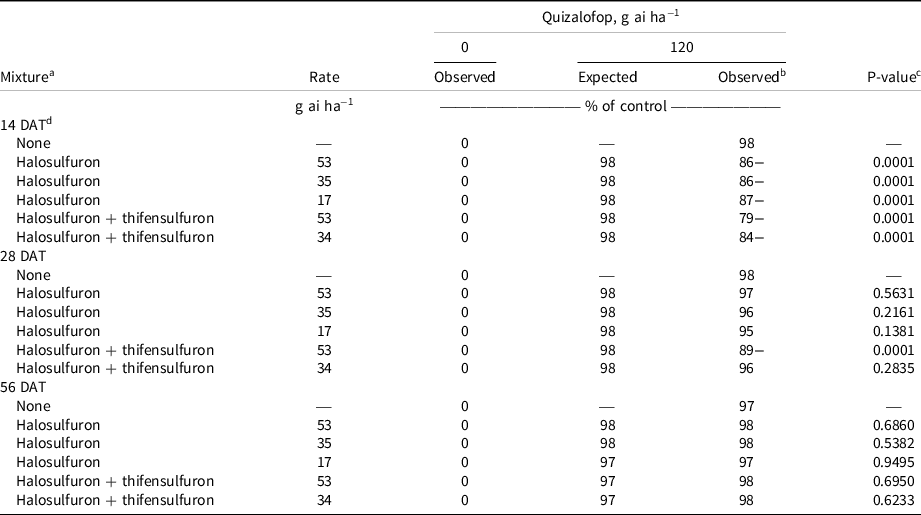
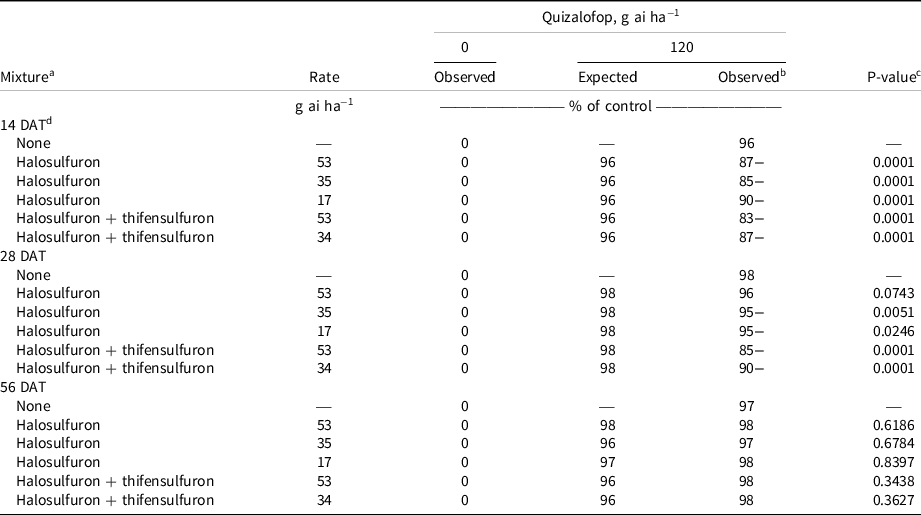
Across all species evaluated at 14 and 28 DAT, the expected control for all herbicide mixtures was equivalent to quizalofop applied alone, which is due to halosulfuron and halosulfuron plus thifensulfuron lacking activity on grass species. Quizalofop applied alone controlled all species evaluated by 96% to 99%; however, both halosulfuron and halosulfuron plus thifensulfuron applied alone resulted in 0% control across all species evaluated, regardless of the rate applied. Therefore, the expected value calculated using the Blouin et al. (Reference Blouin, Webster and Bond2010) augmented mixed method was solely dependent on quizalofop applied alone.
At 14 DAT, all herbicide mixtures resulted in antagonistic interactions for barnyardgrass control with an observed control of 79% to 87%, compared with an expected control of 98% (Table 2). These results are similar to those reported by Rustom et al. (Reference Rustom, Webster, Blouin and McKnight2018), who observed 85% control of barnyardgrass when quizalofop was mixed with halosulfuron that resulted in antagonism of quizalofop at 14 DAT. Antagonism for barnyardgrass control at 14 DAT was observed when quizalofop was mixed with the labeled full rate of halosulfuron plus thifensulfuron at 53 g ha−1 with an observed control of 79%, compared with an expected control of 98%. The reduced rate of halosulfuron plus thifensulfuron, 34 g ha−1, antagonized quizalofop control of barnyardgrass at 14 DAT with an observed control of 84%. At 14 DAT, quizalofop mixed with the low rate or the high rate of halosulfuron plus thifensulfuron controlled barnyardgrass 79% and 84%, respectively, compared with quizalofop mixed with any rate of halosulfuron, which controlled barnyardgrass 86% to 87%. These data could be a result of there being two ALS-inhibiting herbicides in the mixture when quizalofop is mixed with halosulfuron plus thifensulfuron.
Barnyardgrass control with quizalofop applied alone or mixed with various rates halosulfuron or halosulfuron plus thifensulfuron using Blouin’s modified Colby’s analysis, 2017 and 2018.

a Evaluation dates for each respective mixture component.
b Observed means followed by a minus (−) symbol are significantly different from Blouin’s modified Colby’s expected responses at the 5% level indicating an antagonistic response. No sign indicates a neutral response.
c P < 0.05 indicates an antagonistic or synergistic response, P > 0.05 indicates a neutral response.
d Abbreviation: DAT, days after initial treatment.
At 28 DAT, all rates of halosulfuron mixed with quizalofop resulted in a neutral interaction with 95% to 97% control (Table 2). Antagonism of quizalofop for barnyardgrass control was observed when mixed with halosulfuron plus thifensulfuron at 53 g ha−1 with an observed control of 89%, compared with an expected control of 98% at 28 DAT; however, this antagonism was overcome at the same evaluation date with a neutral interaction for barnyardgrass control when quizalofop was mixed with halosulfuron plus thifensufluron at 34 g ha−1 with an observed control of 96%. These results are comparable to those reported by Grichar and Boswell (Reference Grichar and Boswell1987), who observed that increasing the fluazifop to bentazon ratio will increase control for annual grass species. At 56 DAT, all mixtures were neutral for barnyardgrass control due to the second application of quizalofop applied at 120 g ha−1 at 35 DAT.
These results are supported by previous research conducted by Grichar and Boswell (Reference Grichar and Boswell1987) who observed that increasing the ratio of fluazifop to bentazon in a mixture overcame the reduced fluazifop control of Texas panicum (Panicum texanum Buckl.) and large crabgrass (Digitaria sanguinalis L.) due to bentazon. It was also reported that increasing the ratio of sethoxydim to 2,4-DB in a mixture overcame the reduced control of Texas panicum and large crabgrass with the lower rate of sethoxydim in a mixture with 2,-DB. Green (Reference Green1989) also reported that increasing the ratio of quizalofop to bentazon in a mixture overcame antagonism of quizalofop for control of barnyardgrass. These data indicate that quizalofop can be mixed with reduced rates of halosulfuron or halosulfuron plus thifensulfuron by increasing the ratio of quizalofop to the halosulfuron containing herbicides for barnyardgrass control.
As with barnyardgrass (Table 2), all mixtures evaluated resulted in antagonistic interactions for CL-111 control with an observed control of 83% to 90%, compared with an expected control of 96% (Table 3). Although quizalofop mixed with the low rates of halosulfuron at 17 g ha−1 or halosulfuron plus thifensulfuron at 34 g ha−1 did not overcome antagonism at 14 DAT for CL-111 control, the lower rates resulted in observed control of 90% and 87%, respectively. At 28 DAT, quizalofop mixed with halosulfuron at 53 g ha−1 resulted in a neutral interaction; however, quizalofop mixed with halosulfuron reduced rates of 17 or 35 g ha−1 resulted in antagonistic interactions (Table 3). Although the lower rates of halosulfuron proved to antagonize quizalofop for control of CL-111, observed control was 95%, compared with an expected control of 98%. Antagonistic interactions were observed at 28 DAT when quizalofop was mixed with halosulfuron plus thifensulfuron at 34 and 53 g ha−1 for control of CL-111 with an observed control of 90% and 85%, respectively, compared with an expected control of 98%. Neutral interactions were observed for all mixtures at 56 DAT with quizalofop applied at 120 g ha−1 at 35 DAT. This indicates that weeds with antagonistic interactions can be controlled with a second application of quizalofop.
CL-111 control with quizalofop applied alone or mixed with various rates of halosulfuron or halosulfuron plus thifensulfuron using Blouin’s modified Colby’s analysis, 2017 and 2018.

a Evaluation dates for each respective mixture component.
b Observed means followed by a minus (−) symbol are significantly different from Blouin’s modified Colby’s expected responses at the 5% level indicating an antagonistic response. No sign indicates a neutral response.
c P < 0.05 indicates an antagonistic or synergistic response, P > 0.05 indicates a neutral response.
d Abbreviation: DAT, days after initial treatment.
Antagonistic interactions were observed for all mixtures at 14 DAT for CLXL-745 control with an observed control of 82% to 89%, compared with an expected control of 97% (Table 4). These results were comparable to the control of barnyardgrass (Table 2) and CL-111 (Table 3), as well as the results concluded by Rustom et al. (Reference Rustom, Webster, Blouin and McKnight2018) who observed an antagonistic interaction at 14 DAT for control of CLXL-745 when quizalofop was mixed with halosulfuron. Quizalofop mixed with the high rate of halosulfuron and halosulfuron plus thifensulfuron controlled CLXL-745 by 82% at 14 DAT, compared with 88% to 89% control with the lower rates.
CLXL-745 control with quizalofop applied alone or mixed with various rates of halosulfuron or halosulfuron plus thifensulfuron using Blouin’s modified Colby’s analysis, 2017 and 2018.

a Evaluation dates for each respective mixture component.
b Observed means followed by a minus (−) symbol are significantly different from Blouin’s modified Colby’s expected responses at the 5% level indicating an antagonistic response. No sign indicates a neutral response.
c P < 0.05 indicates an antagonistic or synergistic response, P > 0.05 indicates a neutral response.
d Abbreviation: DAT, days after initial treatment.
As with CL-111 (Table 3), at 28 DAT a neutral interaction was observed when quizalofop was mixed with halosulfuron at 53 g ha−1; however, quizalofop mixed with halosulfuron at 17 or 35 g ha−1 resulted in antagonistic interactions with an observed control of 95%, compared with an expected control of 98% (Table 4). Although the lower rates of halosulfuron proved to antagonize quizalofop the difference between the lower rates and the high rate was 3%. Similar to CL-111 (Table 3), halosulfuron plus thifensulfuron at 34 or 53 g ha−1 antagonized quizalofop for control of CLXL-745 at 28 DAT. Conventional wisdom may suggest that CLXL-745 is more difficult to control because CLXL-745 is more robust in growth, produces more tillers, and is pubescent (Oard et al. Reference Oard, Cohn, Linscome, Gealy and Gravios2000, Zhang et al. Reference Zhang, Linscombe, Webster, Tan and Oard2006), but previous research conducted by Rustom et al. (Reference Rustom, Webster, Blouin and McKnight2018) suggests that CL-111 is more difficult to control than CLXL-745. At 56 DAT, all mixtures were neutral for CLXL-745 control due to an application of quizalofop applied at 35 DAT.
As with barnyardgrass (Table 2), CL-111 (Table 3), and CLXL-745 (Table 4), all mixtures evaluated at 14 DAT resulted in antagonistic interactions for red rice control with an observed control of 82% to 88%, compared with an expected control of 99% (Table 5). These results are supported by previous research conducted by Rustom et al. (Reference Rustom, Webster, Blouin and McKnight2018) who observed 86% control of red rice at 14 DAT when quizalofop was mixed with halosulfuron at 53 g ha−1.
Red rice control with quizalofop applied alone or mixed with various rates of halosulfuron or halosulfuron plus thifensulfuron using Blouin’s modified Colby’s analysis, 2017 and 2018.

a Evaluation dates for each respective mixture component.
b Observed means followed by a minus (−) symbol are significantly different from Blouin’s modified Colby’s expected responses at the 5% level indicating an antagonistic response. No sign indicates a neutral response.
c P < 0.05 indicates an antagonistic or synergistic response, P > 0.05 indicates a neutral response.
d Abbreviation: DAT, days after initial treatment.
Similar to CL-111 (Table 3) and CLXL-745 (Table 4), a neutral interaction was observed at 28 DAT for red rice control when quizalofop was mixed with the full labeled rate of halosulfuron at 53 g ha−1 (Table 5). Antagonistic interactions were observed for red rice control at 28 DAT when quizalofop was mixed with reduced rates of halosulfuron at 17 or 35 g ha−1 with an observed control of 95% and 94%, respectively, compared with an expected control of 98%. Although the reduced rates of halosulfuron proved to antagonize quizalofop, the observed control was 3% to 4% lower than the expected control. As with CL-111 (Table 3) and CLXL-745 (Table 4), antagonistic interactions were observed for red rice control at 28 DAT when quizalofop was mixed with halosulfuron plus thifensulfuron at 34 or 53 g ha−1. Following an application of quizalofop applied alone at 35 DAT, all mixtures containing halosulfuron and halosulfuron plus thifensulfuron were neutral at 56 DAT.
Crop injury did not exceed 5% across all herbicide treatments and evaluation dates (data not shown). A uniform standard treatment of quizalofop was applied 1 wk after the 28 DAT rating date to eliminate any remaining rice lines so rough rice yield would not be impacted by the other rice lines infesting the plot area. No yield differences were observed when quizalofop was mixed with any rate of halosulfuron or halosulfuron plus thifensulfuron and rough rice yields were 4,680 to 5,090 kg ha−1 (Table 6). A decrease in ACCase-R rice yield to 3,960 kg ha−1 was observed when neither halosulfuron nor halosulfuron plus thifensulfuron were mixed with quizalofop in the initial herbicide application. This yield reduction is a result of broadleaf weeds competing with the ACCase-R rice for essential growth requirements including light, space, and nutrients prior to the application of halosulfuron at 38 DAT. ACCase-R rice yielded 3,300 to 3,780 kg ha−1 when an initial herbicide application of halosulfuron or halosulfuron plus thifensulfuron was applied alone. It is essential to have early season broad-spectrum weed control program to reduce intraspecific and interspecific competition, which often leads to yield reduction.
Rough rice yields of ACCase-resistant rice treated with quizalofop and respective mixtures in 2017 and 2018. a

a Means followed by a common letter are not significantly different at P = 0.05 with the use of Fisher’s protected LSD.
b Respective mixture component.
In conclusion, these findings suggest that applying quizalofop in a mixture with reduced rates of halosulfuron or halosulfuron plus thifensulfuron can be used for barnyardgrass control in ACCase-R rice production. Increasing the ratio of graminicide to broadleaf herbicide in a mixture can alleviate antagonism of the graminicide (Rhodes and Coble Reference Rhodes and Coble1984); however, this is not always the case. Quizalofop mixed with the higher rate of halosulfuron resulted in a neutral interaction at 28 DAT for CL-111, CLXL-745, and red rice control, although the lower rates of halosulfuron antagonized quizalofop, and control was 92% to 95%. For barnyardgrass, quizalofop mixed with halosulfuron plus thifensulfuron at the lower rate of 34 g ha−1 was able to overcome the antagonism compared with the higher rate of 53 g ha−1. These results are supported by the findings reported by Green (Reference Green1989) that increasing the ratio of quizalofop to bentazon in a mixture overcomes the antagonism of quizalofop for barnyardgrass control. Different responses among plant families in response to herbicide interactions may be due to genetic, physiological, or morphological differences (Zhang et al. Reference Zhang, Hamill and Weaver1995).
Across all species evaluated, we observed that quizalofop mixed with halosulfuron plus thifensulfuron at 53 g ha−1 resulted in 79% to 83% control, compared with quizalofop mixed with halosulfuron at 53 g ha−1 with 82% to 87% control. This is probably a result of having two broadleaf/sedge herbicides in the mixture to antagonize quizalofop versus having one broadleaf/sedge herbicide in the mixture. This research suggests that mixing quizalofop with halosulfuron plus thifensulfuron especially at the higher rate of 53 g ha−1 should be avoided.
Acknowledgments
Published with the approval of the Director of the Louisiana Agricultural Experiment Station and the Louisiana State University Agricultural Center, Baton Rouge, LA 70803, as manuscript number 2021-306-35493. We thank staff members of the Louisiana State University Agricultural Center’s H. Rouse Caffey Rice Research Station. Louisiana Rice Research Board provided partial funding for this project. No conflicts of interest have been declared.