Externalizing problems represent a broad class of behaviors that range from minor disruptive or nuisance behaviors (e.g., calling out in class) to more severe and even criminal behaviors (e.g., physical assault). Although some of these behaviors can be considered normative at earlier developmental periods, acquiescence to socially normative behavior is expected over time, leading to a normative decline in such behaviors over the course of childhood and adolescence (Dishion & Patterson, Reference Dishion, Patterson, Cicchetti and Cohen2006). Persistence of these behaviors during developmentally inappropriate periods warrants concern and can lead to diagnosis of psychiatric disorders, such as disruptive behavior disorders (American Psychiatric Association, 2013). Such disorders are very costly for families and society because they often require extensive mental health services, detention or incarceration, and are associated with myriad negative emotional and behavioral consequences during adulthood (Foster, Jones, & Conduct Problems Prevention Research Group, Reference Foster and Jones2005). Moreover, researchers have found that these behaviors often result from or are exacerbated by child abuse and neglect (Cicchetti & Valentino, Reference Cicchetti, Valentino, Cicchetti and Cohen2006). Understanding the course of externalizing problems and the etiological factors associated with their persistence is crucial to intervening and preventing their development into more severe problems, such as criminality and violence, particularly among youth at risk for maltreatment.
Externalizing Problems and Child Maltreatment
Although externalizing problems have been consistently identified as a common consequence of child abuse and neglect, the role of these adversities in the development of behavior problems requires additional investigation (Cicchetti & Valentino, Reference Cicchetti, Valentino, Cicchetti and Cohen2006). Child maltreatment has been found to disrupt multiple physiological, cognitive, emotional, and social developmental processes, which in turn contribute to the development of externalizing problems and disrupt other developmental processes (Appleyard, Yang, & Runyan, Reference Appleyard, Yang and Runyan2010; Cicchetti & Valentino, Reference Cicchetti, Valentino, Cicchetti and Cohen2006; Kim & Cicchetti, Reference Kim and Cicchetti2010; Shonk & Cicchetti, Reference Shonk and Cicchetti2001). Attempts to disentangle the prospective relationship between maltreatment and externalizing problems have found that early, continued, and recent maltreatment are related to the development, maintenance, and exacerbation of externalizing problems (Kaplow & Widom, Reference Kaplow and Widom2007; Keiley, Howe, Dodge, Bates, & Pettit, Reference Keiley, Howe, Dodge, Bates and Pettit2001; Kotch et al., Reference Kotch, Lewis, Hussey, English, Thompson and Litrownik2008; Lansford et al., Reference Lansford, Miller-Johnson, Berlin, Dodge, Bates and Pettit2007; Manly, Kim, Rogosch, & Cicchetti, Reference Manly, Kim, Rogosch and Cicchetti2001; Thornberry, Henry, Ireland, & Smith, Reference Thornberry, Henry, Ireland and Smith2010). Attempts to delineate the specific effects of subtypes of maltreatment and the developmental periods during which they occur have been inconsistent across studies, but the general association between child maltreatment and externalizing problems has remained consistent. Researchers have found evidence for the lasting and immediate effects of early neglect and physical abuse, as well as later physical abuse, on externalizing problems in childhood and adolescence (Keiley et al., Reference Keiley, Howe, Dodge, Bates and Pettit2001; Kotch et al., Reference Kotch, Lewis, Hussey, English, Thompson and Litrownik2008; Lansford et al., Reference Lansford, Miller-Johnson, Berlin, Dodge, Bates and Pettit2007; Thornberry, Ireland, & Smith, Reference Thornberry, Ireland and Smith2001). Although maltreated children are often found to have higher rates of externalizing problems, there is little evidence to suggest that these behaviors follow substantially different developmental trajectories than in youth from the general population.
The Development of Externalizing Problems
Researchers have previously identified a generally decreasing trend in externalizing problems as youth mature (Broidy et al., Reference Broidy, Nagin, Tremblay, Bates, Brame and Dodge2003; Dishion & Patterson, Reference Dishion, Patterson, Cicchetti and Cohen2006; Loeber, Burke, & Pardini, Reference Loeber, Burke and Pardini2009). These results are not surprising given that children are socialized to adhere to specific behavioral guidelines in order to attend mainstream schools and develop more sophisticated emotional and behavioral regulation, as they get older. However, a subgroup of youth characterized by persistent externalizing problems have also been consistently identified and have been found to be at the highest risk for engaging in more serious criminal behavior during adolescence and continuing into young adulthood (Broidy et al., Reference Broidy, Nagin, Tremblay, Bates, Brame and Dodge2003; Dishion & Patterson, Reference Dishion, Patterson, Cicchetti and Cohen2006; Moffitt, Reference Moffitt, Cicchetti and Cohen2006). These youth have typically been distinguished by a greater frequency and severity of externalizing problems relative to their peers beginning as early as toddlerhood and persisting into adolescence. Moreover, this group generally consists of a higher proportion of boys than girls. These findings are consistent with theoretical models of the development of antisocial behavior, which distinguish between youth whose externalizing problems follow a normative decreasing trend after childhood, youth whose externalizing problems persist beyond childhood, and youth who first begin to present with externalizing problems during adolescence (Dishion & Patterson, Reference Dishion, Patterson, Cicchetti and Cohen2006; Moffitt, Reference Moffitt, Cicchetti and Cohen2006). According to these models, youth whose externalizing problems persist beyond childhood into adolescence learn new behaviors from family members and peers, which result in the development of more severe antisocial behaviors and sophisticated techniques for evading detection. Although researchers have found that youth following other developmental pathways are at an increased risk for some negative consequences later in life, their psychopathology is not as consistently severe and treatment resistant.
Clinically, externalizing problems correspond to symptoms of disruptive behavior diorders such as oppositional defiant disorder (ODD) and conduct disorder (CD; Achenbach, Dumenci, & Rescorla, Reference Achenbach, Dumenci and Rescorla2003; American Psychiatric Association, 2013; Loeber et al., Reference Loeber, Burke and Pardini2009). Although not typically considered an externalizing problem or a disruptive behavior disorder, attention-deficit/hyperactivity disorder (ADHD) is often grouped together with these problems, given the high rates of comorbidity and the high degree of overlap in their symptomatic presentations (American Psychiatric Association, 2013; Angold, Costello, & Erkanli, Reference Angold, Costello and Erkanli1999; Maughan, Rowe, Messer, Goodman, & Meltzer, Reference Maughan, Rowe, Messer, Goodman and Meltzer2004). An increase in research on the correspondence of externalizing problems and their developmental courses to diagnostic classifications in the general population, which contributed to the development of the DSM-5, provided evidence that both ADHD and ODD typically precede CD (Burke, Loeber, Lahey, & Rathouz, Reference Burke, Loeber, Lahey and Rathouz2005), can be identified in preschoolers as early as 17 months of age, remain stable into middle childhood (Baillargeon, Sward, Keenan, & Cao, Reference Baillargeon, Sward, Keenan and Cao2011; Keenan et al., Reference Keenan, Boeldt, Chen, Coyne, Donald and Duax2011; Wakschlag et al., Reference Wakschlag, Briggs-Gowan, Carter, Hill, Danis and Keenan2007), and have unique predictive abilities beyond those of CD (Burke, Waldman, & Lahey, Reference Burke, Waldman and Lahey2010). In addition, boys and girls have similar risk factors, consequences, and onsets for ODD and CD, but boys have higher rates of ADHD and ODD and are more likely to go on to develop CD (Boden, Fergusson, & Horwood, Reference Boden, Fergusson and Horwood2010; Fergusson, Boden, & Horwood, Reference Fergusson, Boden and Horwood2010; Keenan, Wroblewski, Hipwell, Loeber, & Stouthamer-Loeber, Reference Keenan, Wroblewski, Hipwell, Loeber and Stouthamer-Loeber2010; Pardini & Fite, Reference Pardini and Fite2010; Rowe, Costello, Angold, Copeland, & Maughan, Reference Rowe, Costello, Angold, Copeland and Maughan2010). Considerably less research has focused on the development of these psychiatric disorders among maltreated children, although increased rates of antisocial personality disorders have been identified in adults with histories of maltreatment (Kaplow & Widom, Reference Kaplow and Widom2007).
Investigations of the overlap in ADHD, ODD, and CD have typically been variable centered and focused on identifying unique prediction of outcomes. Person-centered statistical procedures have been increasingly applied to the identification of unobserved or latent groups of individuals from a population with similar traits, such as youth whose externalizing problems are persistent across development relative to youth whose externalizing problems desist or begin and remain low across development (Broidy et al., Reference Broidy, Nagin, Tremblay, Bates, Brame and Dodge2003; Nagin & Tremblay, Reference Nagin and Tremblay2005). Researchers have also implemented cross-sectional variations of these models, known as latent class/profile analysis (LC/PA; Collins & Lanza, Reference Collins and Lanza2010), in order to identify unobserved groups of individuals with similar presentations of externalizing problems (Sondeijker et al., Reference Sondeijker, Ferdinand, Oldehinkel, Veenstra, De Winter and Ormel2005; Storr, Accornero, & Crum, Reference Storr, Accornero and Crum2007; van Lier, Verhulst, van der Ende, & Crijnen, Reference van Lier, Verhulst, van der Ende and Crijnen2003; Villodas, Litrownik, & Roesch, Reference Villodas, Litrownik and Roesch2012). Using these techniques, three presentations were consistently identified using caregiver and youth self-reports of behavior during early (van Lier et al., Reference van Lier, Verhulst, van der Ende and Crijnen2003) and middle childhood (Sondeijker et al., Reference Sondeijker, Ferdinand, Oldehinkel, Veenstra, De Winter and Ormel2005), preadolescence (Villodas, Litrownik, & Roesch, Reference Villodas, Litrownik and Roesch2012), and adolescence (Storr et al., Reference Storr, Accornero and Crum2007): low or no externalizing problems; moderate to high probabilities of ADHD and ODD related problems, but low or no CD related problems; and high probabilities of ADHD and ODD related problems and moderate to high probabilities of CD related problems. All but one of these studies examined youth from the general population, while the other found similar results among a sample of maltreated children (Villodas, Litrownik, & Roesch, Reference Villodas, Litrownik and Roesch2012). Two of these studies further validated these findings by demonstrating that presentations which included behaviors related to CD in particular were at an increased risk for substance use and diagnoses of ADHD, ODD, and CD during adolescence (Storr et al., Reference Storr, Accornero and Crum2007; Villodas, Litrownik, & Roesch, Reference Villodas, Litrownik and Roesch2012).
Each of these previous studies identified externalizing problem presentations cross-sectionally, which limited their abilities to examine patterns in these presentations across developmental periods. Such an examination can be facilitated using a longitudinal extension of LC/PA models, latent transition analysis (LTA; Collins & Lanza, Reference Collins and Lanza2010). This data analytic procedure builds on LC/PA models and facilitates the estimation of probabilities that individuals change presentation groups across successive time periods. The elevated risk for externalizing problems among youth at risk for maltreatment underscores the importance of better understanding the developmental transitions in presentations of these problems in this population, as well as the effects of maltreatment subtypes and timing on the development and maintenance of these presentations.
Present Study
The present study had three objectives: to identify presentations of externalizing problems across developmental periods and patterns of change in these presentations; to establish the predictive validity of these presentations; and to identify differences in presentation group memberships between boys and girls and children who were reported to Child Protective Services (CPS) for different types of maltreatment. In order to accomplish the first of these objectives, the present study utilized LTA to identify changes in externalizing problem presentations among youth at risk for maltreatment across three developmental periods (i.e., early childhood, middle childhood, and preadolescence). Given the consistent finding of three externalizing problem presentations across previous studies, it was expected that these same three presentations would emerge in the present sample. Moreover, based on previous research findings, it was expected that a majority of youth would transition to less aggressive externalizing problem presentations over time and that only a small contingent of children would persist in their aggressive externalizing problem presentations (Dishion & Patterson, Reference Dishion, Patterson, Cicchetti and Cohen2006; Moffitt, Reference Moffitt, Cicchetti and Cohen2006).
With regard to the second objective, the present study established the predictive validity of the identified externalizing problem presentations by examining the patterns of relationships between these presentations and diagnoses of ADHD, ODD, and CD during early adolescence. In light of recent research that has sought to delineate the developmental course and stability of these disorders, we expected that children who developed severe and aggressive externalizing problem presentations early would be more likely to meet criteria for CD during early adolescence relative to children with other presentations, while children whose problem presentations were less severe or developed later would be more likely to meet criteria for ADHD and ODD, but not CD, relative to children who presented with lower levels of problem behaviors. In order to more clearly identify dimensional differences in diagnoses between children with each presentation that may not have been reflected in their diagnostic outcomes, differences in the number of symptoms that they presented with for each disorder were also examined.
Finally, in order to accomplish the third objective, membership in each externalizing problem presentation group was predicted by gender and whether children had allegations for four types of maltreatment during each developmental period. Based on the previous literature, boys were predicted to be more likely than girls to develop and persist in the most severe externalizing problem presentations over time and to present with more physically aggressive behaviors. Although the specific effects of type and timing of maltreatment on externalizing problems remains unresolved in the previous literature, it was expected that recent reports of physical abuse and neglect would predict more severe and persistent externalizing problem presentations characterized by physically aggressive behaviors.
Methods
Sample
The present study utilized data from a large-scale consortium of ongoing prospective studies, the Longitudinal Studies of Child Abuse and Neglect (LONGSCAN). LONGSCAN consists of five sites in the Southwestern, Northwestern, Eastern, Southern, and Midwestern United States dedicated to conducting longitudinal research examining the development of children and youth at risk for maltreatment. All sites used uniform measurement, data collection, data entry, and data handling protocols and were coordinated through a central coordinating center. Children and their caregivers were recruited to participate when the children were 4 years old and were interviewed biannually between ages 4 and 18 using developmentally appropriate measures of the children, their caregivers, families, neighborhoods, and schools. All interviews were conducted in person using laptop computers and audio–computer assisted self-interviews for sensitive materials.
The total sample recruited for LONGSCAN included 1,354 children across the five sites that were identified as being at varying levels of risk for child maltreatment. Specifically, the Northwestern and Southwestern sites recruited children who had been reported for maltreatment, while the Eastern site recruited children attending pediatric clinics who were at a high risk for maltreatment based on demographic risk factors and the Southern and Midwestern sites recruited both children who had been reported for maltreatment as well as children who were identified as being at a high risk for maltreatment (see Runyan et al., Reference Runyan, Curtis, Hunter, Black, Kotch and Bangdiwala1998, for a more detailed description of the overall study design and site-specific recruitment procedures). Little's test (Reference Little1988) of missing data patterns (results not presented here) revealed that youth's behavior problems were not associated with any identifiable missing data pattern. Moreover, youth with complete data did not significantly differ from youth who missed at least one interview on any of the demographic characteristics described below or on baseline problem behaviors. Thus, the present study included data from 788 youth who had completed caregiver interviews at ages 4, 8, and 12 (see Table 1 for sample demographics).
Sample demographics

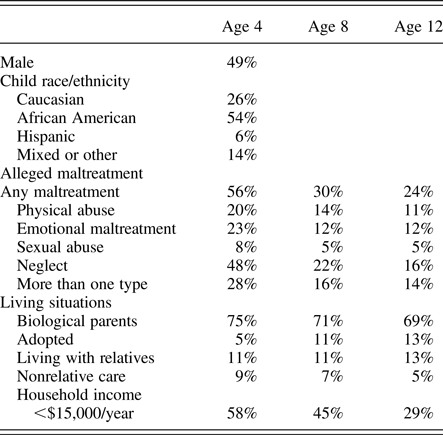
Sample descriptive statistics are presented in Table 1. The sample was very diverse and representative of children at risk for child abuse and neglect. Rates of all types of maltreatment were highest before age 4, which is reflective of the sampling method. Nevertheless, the rates of each type of maltreatment among children with maltreatment allegations were consistent with nationally reported trends in maltreatment for each age range (US Department of Health and Human Services, 2013). While the majority of the children in the sample were living with biological parents, an increasing number were adopted or living with relatives, as they got older. The number in nonrelative care (i.e., foster care or group homes) decreased as children got older. However, previous researchers have identified that some of the children's living situations were unstable over time (e.g., Proctor et al., Reference Proctor, Van Dusen Randazzo, Litrownik, Newton, Davis and Villodas2011, report that approximately 14% of the children who were placed in foster care from the Southwest sample changed caregivers between ages 6 and 8). For this reason, a minimum 2-month period of care was required before reports were obtained from a caregiver. A substantial proportion of the sample reported very low incomes (<$15,000 annually). Finally, at age 14, approximately 9% of children in the sample were diagnosed with ADHD, 13% were diagnosed with ODD, and 10% were diagnosed with CD.
Measures
Sociodemographics
A caregiver-report measure was developed by LONGSCAN including items that assessed sociodemographic variables at one time (i.e., youth gender and race/ethnicity or at each interview and current household income level).
Child Behavior Checklist (CBCL)
The CBCL asks caregivers to report on the frequency of 113 child and adolescent problem behaviors that their child has engaged in over the past 6 months on a 3-point scale (0 = never true, 1 = sometimes true, and 2 = often true; Achenbach, Reference Achenbach1991; Achenbach & Rescorla, Reference Achenbach and Rescorla2001). The present study focused on 26 items from the ADHD, ODD, and CD DSM-oriented scales identified by Achenbach et al. (Reference Achenbach, Dumenci and Rescorla2003). Each of these scales consists of an independent subset of items from the attention problems scale and the externalizing behavior problems broadband scale that is specific to each disorder. More specifically, the same 5 indicators of ADHD behaviors (e.g., “Can't concentrate, pay attention for long”), 5 indicators of ODD behaviors (e.g., “Argues a lot”), and 16 indicators of CD behaviors (e.g., “Physically attacks other people”) were included in the present study from the CBCL. These items were identified by experts and assigned to these categories before being factor analyzed in large normative samples of children (Achenbach et al., Reference Achenbach, Dumenci and Rescorla2003). Because of low frequencies of endorsement for several items, all CBCL items were dichotomized in the present analyses (i.e., 0 = never true, 1 = sometimes/often true), which is consistent with previous studies that have utilized the CBCL items in LCAs (Sondeijker et al., Reference Sondeijker, Ferdinand, Oldehinkel, Veenstra, De Winter and Ormel2005; Storr et al., Reference Storr, Accornero and Crum2007; van Lier et al., Reference van Lier, Verhulst, van der Ende and Crijnen2003; Villodas, Litrownik, & Roesch, Reference Villodas, Litrownik and Roesch2012). These items were administered to caregivers when the youth were ages 4, 8, and 12.
NIMH Computerized Diagnostic Interview Schedule for Children IV
The NIMH Computerized Diagnostic Interview Schedule for Children IV was administered at age 14 to assess more than 30 psychiatric diagnoses as well as symptoms for each disorder that have occurred in the youth over the preceding year using both child and caregiver reports based on the DSM-IV-TR (Shaffer, Fisher, Lucas, Hilsenroth, & Segal, Reference Shaffer, Fisher, Lucas, Hilsenroth, Segal, Hilsenroth, Segal and Hersen2004). These symptoms are later derived into symptom counts for each disorder as well as diagnoses when all relevant criteria are met (e.g., Shaffer et al., Reference Shaffer, Fisher, Lucas, Hilsenroth, Segal, Hilsenroth, Segal and Hersen2004). The present study included the combined youth and caregiver report (as described by Shaffer et al., Reference Shaffer, Fisher, Lucas, Hilsenroth, Segal, Hilsenroth, Segal and Hersen2004) of the following diagnoses and symptom counts: ADHD, ODD, and CD. There was some variability in the concordance between youth and caregivers' reports about whether each symptom was present for each disorder (ADHD: 56%–84%; ODD: 49%–86%; CD: 56%–99%) as has been reported by previous researchers (see review by Grills & Ollendick, Reference Grills and Ollendick2002). These variables were included to provide evidence of the predictive validity of the LCA solutions at ages 4, 8, and 12 in the identification of externalizing problem presentations that are of particular clinical concern.
CPS records
Each of the LONGSCAN sites systematically reviewed CPS records to identify reports of alleged maltreatment and coded the narratives using a modification of the Maltreatment Classification System (MMCS; Barnett, Manly, & Cicchetti, Reference Barnett, Manly, Cicchetti, Cicchetti and Toth1993; English & LONGSCAN Investigators, Reference English1997). Coders at each site were trained to use the MMCS by experienced coders until they reached 90% agreement with the gold standard. To further ensure reliable coding, coders at all five sites coded a subsample (n = 109) of the CPS narratives that represented cases from each site. Kappas for MMCS codes by LONGSCAN coders were high (ranging from κ = 0.73 for emotional maltreatment to κ = 0.87 for physical abuse; English & LONGSCAN Investigators, Reference English1997). The present study used dichotomous indicators (i.e., 0 = not alleged, 1= alleged) of maltreatment subtypes, including four types of maltreatment distinguished by the MMCS (i.e., physical abuse, sexual abuse, neglect, and emotional maltreatment), for each of three 4-year intervals including preschool (birth to age 4 interview), early childhood (following age 4 interview to age 8 interview), and late childhood (following age 8 interview to age 12 interview). The decision to use allegations of maltreatment was based on previous findings that children with alleged and substantiated maltreatment are at a similarly increased risk for maltreatment recidivism and mental health and behavioral consequences (Drake, Jonson-Reid, Way, & Chung, Reference Drake, Jonson-Reid, Way and Chung2003; Hussey et al., Reference Hussey, Marshall, English, Knight, Lau and Dubowitz2005; Kohl, Jonson-Reid, & Drake, Reference Kohl, Jonson-Reid and Drake2009). As can be seen in Table 1, a substantial proportion of children had allegations for more than one type of maltreatment during each developmental period. A previous investigation of the co-occurrence of these types of maltreatment in this sample found that abuse (either physical or sexual) frequently co-occurred with neglect and emotional maltreatment and, in the absence of physical or sexual abuse, neglect frequently co-occurred with emotional maltreatment (Villodas, Litrownik, Thompson, et al., Reference Villodas, Litrownik, Thompson, Roesch, English and Dubowitz2012).
Data analysis
Data were analyzed using LTA in Mplus version 7.12 (Muthén & Muthén, Reference Muthén and Muthén2012), in order to examine changes in the developmental presentations of externalizing problems prospectively. LTA is a person-centered data analytic procedure, much like LC/PA, which facilitates the identification of unobserved or latent groups of individuals with a common set of traits. LTA extends this model to longitudinal data by including additional parameters that allow researchers to examine stability and changes in group memberships over time. LTA requires the development of baseline measurement models using LC/PAs at each time point. In this way, categorical latent variables are created and the probability that individuals change latent classes across time points is estimated. As with LC/PA, the goal is to maximize homogeneity within classes and heterogeneity between classes.
Model selection and fit indices
According to the most current recommended model selection procedures (Collins & Lanza, Reference Collins and Lanza2010; Nylund, Asparouhov, & Muthén, Reference Nylund, Asparouhov and Muthén2007), models with increasing numbers of classes were fit sequentially and multiple indicators of model fit were compared in order to select the model with the best fit according to the majority of fit indices. The Lo–Mendell–Rubin adjusted likelihood ratio test (LMRT; Lo, Mendell, & Rubin, Reference Lo, Mendell and Rubin2001) provided a test of whether a more complex model (e.g., three-class) provided superior fit compared to a less complex model (e.g., two-class) based on differences between the corresponding log likelihood values for each model. The Bayesian information criterion (BIC; Schwartz, Reference Schwartz1978) and a sample size-adjusted version of the BIC (SSA-BIC; Sclove, Reference Sclove1987) were also used for model selection, with lower values indicating superior fit. Although standardized guidelines for evaluating the magnitude of change in each of these information criteria have not yet been developed, Nylund et al. (Reference Nylund, Asparouhov and Muthén2007) recommend comparing criteria across models with increasing numbers of classes until a minimum value is reached. Finally, in addition to statistical indices of model fit, Collins and Lanza (Reference Collins and Lanza2010) highlight the importance of considering the theoretical interpretability of each model, in conjunction with model fit statistics, when selecting the best fitting model. Related to the interpretability of the model parameters described below, entropy provides an index of class separation, with values closer to 1 indicating better separation and values above .80 indicating good separation. In the present study, the BIC, SSA-BIC, and LMRT were considered in the selection of the statistically best fitting model, while entropy and interpretability of other model parameters were also considered in the model selection process.
Model parameters
The basic LCA model includes two important parameters, conditional response probabilities (CRPs) and latent class probabilities (LCPs). CRPs are estimated for individuals in each class and represent the probability that they had each behavior problem. CRPs can be examined within and between classes in order to label each class and substantively differentiate it from the other classes in the model. CRPs can also be considered relative to the average probabilities that each behavior problem occurred across all children in the sample. In addition to CRPs, LCPs represent the relative prevalence of each class and are conditional on time because they are estimated for models at each time point (Collins & Lanza, Reference Collins and Lanza2010). The basic LTA model includes an additional parameter, latent transition probabilities (LTPs; Collins & Lanza, Reference Collins and Lanza2010), which represent the probability that individuals change classes or remain in the same class across consecutive periods. Additional parameters can be added to the LTA model to specify the effects of covariates on latent class memberships, and outcome variables can be predicted by the resulting LTA model (Muthén, Reference Muthén and Kaplan2004).
The proposed model
In order to address the first objective of the present study, individual baseline LCA models were sequentially tested based on the 26 indicators of externalizing problems from the CBCL at three time points (i.e., ages 4, 8, and 12), and transitions among classes across consecutive time points were estimated using LTA. The second objective of the present study was to validate the identified externalizing problem classes using diagnoses of ADHD, ODD, and CD at age 14. This was accomplished using logistic regression analyses to predict whether youth in each class had each of these diagnoses at age 14. In order to consider dimensional models of disruptive behavior disorders and to more clearly characterize the identified classes, differences in the mean numbers of symptoms that youth had for each disorder were also examined using analyses of variance with Tukey honestly significant difference post hoc tests. Finally, the third objective of the present study was accomplished by examining gender and maltreatment allegations as predictors of latent class membership at each time point using multinomial logistic regression analyses.
Results
Objective 1: Identify latent classes and transitions across developmental periods
Baseline model selection
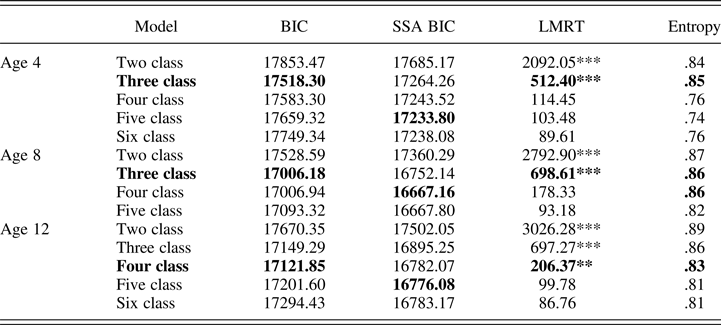
Two- through six-class models were tested at each age (individual model fit statistics are presented in Table 2). For the age 4 model, the BIC and LMRT indicated that the three-class model provided the best fit, while the SSA-BIC indicated that the five-class model provided the best fit. Decreases in entropy and interpretability of CRPs and LCPs further supported the selection of the more parsimonious and better statistically fitting three-class model. Similarly, for the age 8 model, the BIC and LMRT indicated that the three-class model provided the best fit, while the SSA-BIC indicated that the four-class model provided the best fit. Interpretability of CRPs and LCPs also supported the selection of the three-class model. Finally, at age 12, the BIC and LMRT indicated that the four-class model was the best fitting, while the SSA-BIC indicated that the five-class model provided the best fit. Once again, the interpretability of the model parameters supported the more parsimonious, and better statistically fitting, four-class model.
Fit statistics for externalizing problem baseline latent class analysis models
Note: BIC, Bayesian information criterion; SSA BIC, sample-size adjusted BIC; LMRT, Lo–Mendell–Rubin likelihood ratio test.
**p < .01. ***p < .001.
Age 4 model
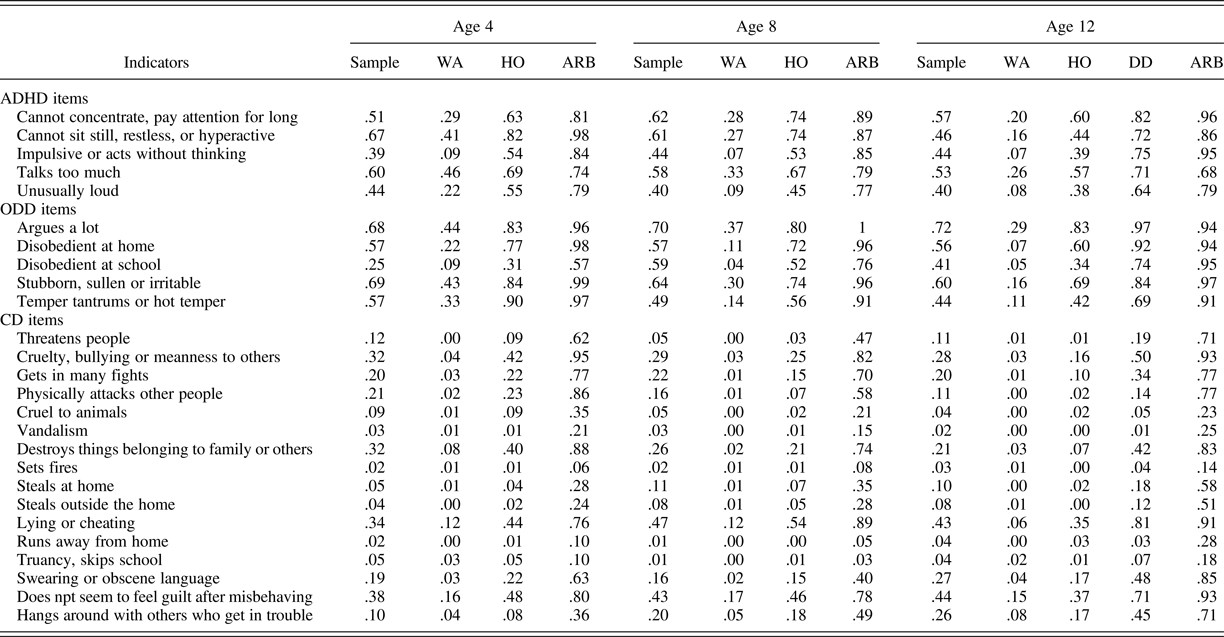
Three distinct classes of youth were identified in the sample based on their externalizing problem presentations (see Table 3 for the CRPs for each class). The first class, labeled “well-adjusted,” consisted of 41% of the sample and was characterized by lower CRPs relative to the other classes and to the sample average probabilities for all externalizing problems, with the exception of behaviors that were considered generally normative among 4-year-old children (e.g., difficulty sitting still). The second class, labeled “hyperactive/oppositional,” included 48% of the sample and consisted of youth with predominantly high probabilities of ADHD- and ODD-related behaviors (all CRPs above 0.50 except being disobedient at school) relative to the well-adjusted class and to the sample average probabilities, and relatively low probabilities of CD-related behaviors (most CRPs below 0.25 and at or below the sample average). The third class, labeled “aggressive/rule-breaking” represented a small proportion of the sample (11%) and was characterized by high probabilities of ADHD- and ODD-related behaviors (all CRPs above 0.70 except being disobedient at school) and relatively moderate to high probabilities of most CD-related behaviors (all CRPs above the sample average). The most pronounced elevations in CRPs relative to the other classes were for extreme aggressive behaviors such as bullying and being mean to others, physically attacking others, getting in many fights, and threatening others.
Conditional response probabilities for each class at each age
Note: Sample, Probability in overall sample; WA, well adjusted; HO, hyperactive/oppositional; ARB, aggressive/rule breaking; DD, defiant/deceitful; ADHD, attention-deficit/hyperactivity disorder; ODD, oppositional defiant disorder; CD, conduct disorder.
Age 8 model
The three distinct classes of youth that were identified at age 8 very closely resembled the three classes of youth identified at age 4 (see Table 3 for the CRPs for each class). The CRPs for the first class followed a similar pattern to those of the well-adjusted class at age 4, and this class consisted of 34% of the sample. The pattern of CRPs for the second class closely resembled that of the hyperactive/oppositional class at age 4. This class included 46% of the sample. The CRPs for the third class were analogous to those of the aggressive/rule-breaking class at age 4, but this class consisted of 20% of the sample at age 8. This class was again characterized by pronounced extreme aggressive behaviors such as bullying and being mean to others, physically attacking others, getting in many fights, and destroying others things.
Age 12 model
Although three classes emerged that were similar to those identified at ages 4 and 8, a fourth class emerged at age 12 (see Table 3 for the CRPs and LCPs for each class). The first class consisted of 30% of the sample and closely resembled the previously identified well-adjusted class. The second class was most consistent with the hyperactive/oppositional class and consisted of 36% of the sample. The third class that emerged was most similar to the aggressive/rule-breaking class identified at ages 4 and 8, represented 8% of the sample, and was again most clearly distinguished from the other classes by their extremely aggressive presentations such as bullying and being mean to others, physically attacking others, getting in many fights, and threatening others. Finally, the new fourth class that emerged included 26% of the sample and was characterized by high probabilities of ADHD- and ODD-related behaviors (all CRPs above 0.63 and all above the sample average) and predominantly low to moderate probabilities of most CD-related behaviors (including physically aggressive behaviors), except for bullying or being mean to others, destroying other's property, lying or cheating, lacking guilt, having bad friends, and swearing (CRPs range = 0.42–0.81). This class was labeled “defiant/deceitful.”
LTA of externalizing problems from age 4 to 12
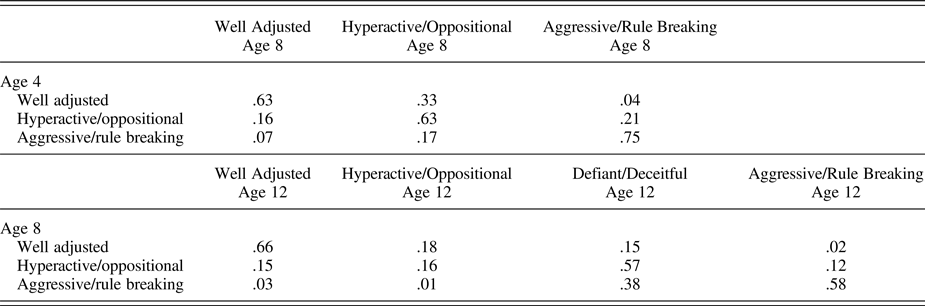
In order to examine the probabilities that youth transitioned to different classes, an unconditional LTA was conducted based on the LCA baseline models at ages 4, 8, and 12 described above (see Table 4 for LTPs). The CRPs for each class were fixed using the values from the baseline LCA models at each age so that classes were not reestimated (i.e., the substantive interpretations of the classes did not change) in the full LTA model. However, because class membership in the LTA model is dependent on memberships at the previous time point, class sizes are reestimated using this additional information and can differ from those identified in the initial LCA models (i.e., those described above). Although for the age 4 and 8 models, the class sizes estimated by the LTA did not differ from those reported above, the class sizes estimated for the age 12 model did differ substantially from those reported above. Only approximately 13% of youth were identified as hyperactive/oppositional at age 12 by the LTA (relative to 36% by the LCA reported above). Similarly, 38% of youth were identified as defiant/deceitful at age 12 by the LTA (relative to 26% by the LCA reported above). While the size of the well-adjusted class did not differ across the LCA and LTA, the aggressive/rule-breaking class consisted of 18% of the sample according to the LTA (relative to 8% according to the LCA reported above).
Latent transition probabilities for transitions from ages 4 to 8 and 8 to 12
Between ages 4 and 8, the majority of youth did not change classes (LTPs between 0.63 and 0.75). Of those youth who did change classes, the probabilities of transitioning to classes with more severe externalizing problems at age 8 (i.e., well-adjusted to hyperactive/oppositional; hyperactive/oppositional to aggressive/rule-breaking) was higher than the probabilities of youth transitioning to classes with less severe externalizing problems. Youth in the aggressive/rule-breaking class at age 4 had the highest probability of remaining in that class at age 8. Very few youth transitioned directly between the well-adjusted and aggressive/rule-breaking classes. More transitions occurred between ages 8 and 12, and the patterns were more variable, although this was in part because of the emergence of the defiant/deceitful class at age 12. More than half of the hyperactive/oppositional youth and a third of the aggressive/rule-breaking youth at age 8 transitioned to the new defiant/deceitful class at age 12. This indicates that the majority of youth in this group were escalating to a more severe externalizing class (i.e., a class with nonviolent conduct problems), while others were transitioning from a more aggressive externalizing class. However, age 8 aggressive/rule-breaking and well-adjusted youth were most likely to remain in those respective classes at age 12.
Objective 2: Validate externalizing problem presentation classes
In order to validate the externalizing problem presentation classes, logistic regressions were performed with age 12 class membership predicting the likelihood of being diagnosed with ADHD, ODD, or CD at age 14, χ2 (3) = 32.25, 82.87, and 71.71, Nagelkerke R 2 = .12, .23, and .23, respectively, ps < .001. As expected, aggressive/rule-breaking youth were more likely to be diagnosed with all three disorders relative to well-adjusted (ADHD: odds ratio [OR] = 11.26, p < .001, 95% confidence interval [CI] = 3.75–33.84; ODD: OR = 15.23, p < .001, 95% CI = 6.81–34.07; CD: OR = 12.21, p < .001, 95% CI = 5.43–27.48), hyperactive/oppositional (ADHD: OR = 9.61, p < .01, 95% CI = 2.18–42.38; ODD: OR = 54.15, p < .001, 95% CI = 7.26–403.74; CD: OR = 43.43, p < .001, 95% CI = 5.81–324.55), or defiant/deceitful youth (ADHD: OR = 2.19, p < .05, 95% CI = 1.16–4.15; ODD: OR = 4.85, p < .001, 95% CI = 2.83–8.33; CD: OR = 7.28, p < .001, 95% CI = 3.87–13.69).
Defiant/deceitful youth were more likely to be diagnosed with ADHD and ODD, but not CD, relative to the well-adjusted (ADHD: OR = 5.14, p < .01, 95% CI = 1.75–15.08; ODD: OR = 3.14, p < .01, 95% CI = 1.4–7.02) and hyperactive/oppositional (ADHD: OR = 4.39, p < .05, 95% CI = 1.01–19; ODD: OR = 11.16, p < .05, 95% CI = 1.5–83.21) youth. Meanwhile, well-adjusted and hyperactive/oppositional youth did not differ in their likelihood of diagnosis for any of the disorders.
In order to more clearly characterize the classes and explore dimensional differences in symptoms of ADHD, ODD, and CD between classes, mean differences were tested using one-way analyses of variance. These analyses indicated that mean symptoms of ADHD, ODD, and CD significantly differed between groups, F (3, 620) = 71.42, 75.52, and 122.37, respectively, ps < .001. Post hoc tests revealed that, consistent with the findings for the logistic regression above, the well-adjusted (ADHD: M = 3.26, SD = 2.62; ODD: M = 2.3, SD = 2; CD: M = 1.74, SD = 1.79) and hyperactive/oppositional (ADHD: M = 3.43, SD = 2.52; ODD: M = 2.54, SD = 1.72; CD: M = 1.74, SD = 1.64) youth did not significantly differ from one another with regard to their mean symptom counts for any disorders. Defiant/deceitful youth (ADHD: M = 5.87, SD = 3.58; ODD: M = 2.1) had significantly higher (p < .001) mean symptoms for ADHD and ODD relative to both well-adjusted and hyperactive/oppositional youth and also had significantly higher (p < .001) mean CD symptom counts (CD: M = 3.18, SD = 2.4) than both classes of youth. Finally, consistent with the results of the logistic regression above, aggressive/rule-breaking youth (ADHD: M = 8.92, SD = 4.22; ODD: M = 5.98, SD = 2.29; CD: M = 7.02, SD = 3.2) had significantly higher (ps < .001) mean symptoms for all disorders relative to all other classes of youth.
Objective 3: Predict latent class membership using gender and maltreatment allegations
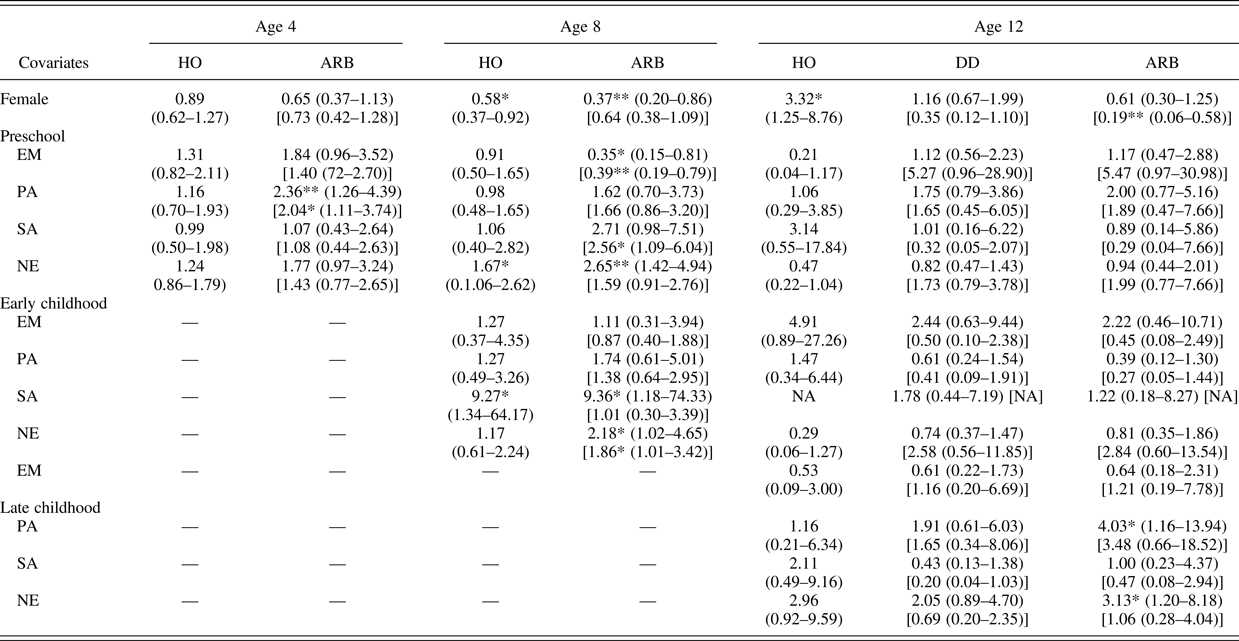
Multinomial logistic regressions were used to predict class membership at each age based on gender and maltreatment allegations. For each age, the well-adjusted class was initially coded as the referent and then the hyperactive/oppositional class was coded as the referent in a second analysis in order to obtain an alternate parameterization (see Table 5 for odds ratios and confidence intervals). Girls were generally more likely than boys to present as well-adjusted at age 8, but were more likely than boys to present as hyperactive/oppositional at age 12 relative to all other classes. With regard to maltreatment, children with recent physical abuse allegations were more likely to present as aggressive/rule-breaking than as well-adjusted at ages 4 and 12, but not at age 8. However, earlier physical abuse allegations did not predict class membership at later time points.
Odds ratios of gender and maltreatment predicting class at each age
Note: HO, Hyperactive/oppositional; ARB, aggressive/rule breaking; DD, defiant/deceitful; EM, emotional maltreatment; PA, physical abuse; SA, sexual abuse; NE, neglect. The well-adjusted class was the initial reference group. The confidence intervals for each odds ratio are in parentheses. The HO class was the reference group for the odds ratios in brackets. Odds ratios marked NA were not estimated because no children with SA allegations were assigned to the HO class at age 12.
*p < .05. **p < .01.
Children with allegations for neglect or sexual abuse during the preschool or early childhood years were generally less likely to present as well-adjusted at age 8 and were particularly more likely to present as aggressive/rule-breaking. However, neither neglect nor sexual abuse allegations that occurred during preschool predicted class membership at ages 4 or 12. However, children with neglect allegations that occurred during late childhood were more likely to present as aggressive/rule-breaking than as well-adjusted at age 12. Finally, children with emotional maltreatment allegations during preschool were more likely to present as either well-adjusted or hyperactive/oppositional, but not aggressive/rule-breaking, at age 8.
Discussion
The present study utilized a longitudinal person-centered analysis, LTA, to examine presentations of externalizing problems among youth at risk for maltreatment across developmental periods, evaluate the predictive validity of these presentations, and identify the impact of child gender and the timing and type of alleged child maltreatment on the development of these problems. With regard to questions about the uniqueness of ADHD, ODD, and CD, given the high rates of comorbidity among these disorders, models were developed at ages 4, 8, and 12, which identified presentations of externalizing problems that were largely consistent with presentations identified by previous researchers that used LC/PA (Sondeijker et al., Reference Sondeijker, Ferdinand, Oldehinkel, Veenstra, De Winter and Ormel2005; Storr et al., Reference Storr, Accornero and Crum2007; van Lier et al., Reference van Lier, Verhulst, van der Ende and Crijnen2003; Villodas, Litrownik, & Roesch, Reference Villodas, Litrownik and Roesch2012). The first presentation consisted of well-adjusted youth who were characterized by age-normative levels of relatively less problematic externalizing problems and had consistent prevalence rates (30%–41%) with those reported in previous studies across similar developmental periods. These high prevalence rates of well-adjusted youth were somewhat surprising in the context of the multiple risk factors (e.g., poverty, maltreatment, and violence exposure) for externalizing problems experienced by many youth in the sample. However, note that these children were considered well adjusted with respect to their presentations of externalizing problems, but they may have presented with internalizing problems that were not measured in the present study. In addition, a notable proportion of well-adjusted youth developed the hyperactive/oppositional presentation as they transitioned from early to middle childhood; a difficult transitional period that includes adjustment to the school environment and increased expectations for attentional, emotional, and behavioral self-regulation (Carter et al., Reference Carter, Wagmiller, Gray, McCarthy, Horwitz and Briggs-Gowan2010; Moilanen, Shaw, & Maxwell, Reference Moilanen, Shaw and Maxwell2010). Nevertheless, the majority of youth with this presentation remained relatively stable across developmental periods, which points to the need for future researchers to identify the processes that facilitate this resilience to externalizing problems for youth from high-risk populations. Although these youth did, on average, manifest some symptoms of ADHD, ODD, and CD during adolescence, it is possible that these symptoms represent a frequently noted and transitory increase in externalizing problems that occurs during this period (Moffitt, Reference Moffitt, Cicchetti and Cohen2006). It is also possible that they resulted from exposure to risk factors inherent to youth at risk for maltreatment.
The hyperactive/oppositional presentation included youth who were characterized by problems consistent with ADHD and ODD, but not CD, including difficulty concentrating, hyperactivity, argumentativeness, and conflict with adults and authority figures. The high probabilities of transitions from this presentation to the aggressive/rule-breaking presentation from early to middle childhood that one might expect based on current conceptualizations and empirical findings that ADHD and ODD precede CD did not emerge. Hyperactive/oppositional youth had a relatively low probability of developing the aggressive/rule-breaking presentation, but all transition probabilities during these time periods were similarly low. Thus, a substantial proportion of these youth were identified prior to starting school, and their presentations remained relatively stable as they transitioned to middle childhood, which is consistent with the findings of Keenan et al. (Reference Keenan, Boeldt, Chen, Coyne, Donald and Duax2011). However, this presentation became less pronounced during preadolescence and was not distinguished from the well-adjusted presentation during adolescence with regard to symptoms or diagnoses of ADHD, ODD, or CD. These findings initially appear to be consistent with previous research that has identified subsets of youth with decreasing trajectories of externalizing problems as they mature (Broidy et al., Reference Broidy, Nagin, Tremblay, Bates, Brame and Dodge2003; Nagin & Tremblay, Reference Nagin and Tremblay2005) and youth who develop ODD, but do not develop CD (Burke et al., Reference Burke, Waldman and Lahey2010; Rowe et al., Reference Rowe, Costello, Angold, Copeland and Maughan2010). In the context of the transition probabilities, however, many previously hyperactive/oppositional youth developed the defiant/deceitful presentation during preadolescence, indicating that a substantial proportion of youth with this presentation actually developed more severe externalizing problems. This is not uncommon as youth graduate from elementary school and begin middle school, where they have increased autonomy and opportunities for misbehavior (Moilanen et al., Reference Moilanen, Shaw and Maxwell2010). Although the prevalence of the hyperactive/oppositional presentation was comparable to that of previous studies across childhood (46%–49%), it drastically decreased during preadolescence (to 12%), indicating that this presentation may be less developmentally relevant during this period.
In contrast to the hyperactive/oppositional presentation, the defiant/deceitful presentation was characterized by slightly higher levels of ADHD- and ODD-related problems and considerably higher levels of specific CD-related problems such as lying and cheating, lacking guilt, swearing, bullying or being mean to others, and associating with deviant peers. Although this presentation was not identified in previous studies using LC/PA, the high-risk nature of the present sample may have facilitated the identification of a more specific subgroup with more covert conduct problems that were not easily detected by caregivers (e.g., Dishion & Patterson, Reference Dishion, Patterson, Cicchetti and Cohen2006; Loeber et al., Reference Loeber, Burke and Pardini2009) or a subgroup with a subthreshold ODD–CD presentation as described by Burke et al. (Reference Burke, Waldman and Lahey2010). However, the finding that youth with this presentation were distinguished from youth with the well-adjusted or hyperactive/oppositional presentations with regard to likelihood of being diagnosed with ADHD and ODD, but not CD, despite having a significantly greater number of CD symptoms, is less consistent with these explanations. This presentation could also be conceptualized as a “developing” or “late-onset” CD presentation, similar to the adolescent-limited antisocial youth described by Moffitt (Reference Moffitt, Cicchetti and Cohen2006; Moffit et al., Reference Moffitt, Arseneault, Jaffee, Kim-Cohen, Koenen and Odgers2008).
The characteristics of defiant/deceitful youth were clearly distinguished from the aggressive/rule-breaking youth, who generally comprised the smallest proportion of the sample and presented with problems related to ADHD and ODD as well as more physically aggressive and serious conduct problems related to CD. During adolescence, aggressive/rule-breaking youth had more symptoms and were more likely to be diagnosed with each disorder than were any of the other presentations. It is clear that these youth represent the most concerning risk for serious future antisocial behavior; however, a substantial proportion developed the defiant/deceitful presentation as they transitioned from middle childhood to preadolescence. This decrease in aggressive conduct problems has been observed by previous researchers (Broidy et al., Reference Broidy, Nagin, Tremblay, Bates, Brame and Dodge2003; Nagin & Tremblay, Reference Nagin and Tremblay2005) and could represent a childhood-limited antisocial trajectory more recently proposed by researchers (Moffitt, Reference Moffitt, Cicchetti and Cohen2006; Moffitt et al., Reference Moffitt, Arseneault, Jaffee, Kim-Cohen, Koenen and Odgers2008). In contrast, few new youth developed the aggressive/rule-breaking presentation across development. This is consistent with previous findings (Nagin & Tremblay, Reference Nagin and Tremblay2005) that new cases of aggression rarely emerge later in development and suggests that the most concerning presentation can be identified at a very young age.
Previously identified increased rates of externalizing problems among boys did not emerge until middle childhood, and they persisted for the most severe externalizing problem presentations during preadolescence. Although previous studies have found that gender differences in early externalizing problems did not emerge immediately, these differences were usually detected by preschool (Baillargeon et al., Reference Baillargeon, Normand, Seguin, Zoccolillo, Japel and Perusse2007, Reference Baillargeon, Sward, Keenan and Cao2011). However, it is possible that early gender differences in externalizing problems were obfuscated in the present sample by a general increase in externalizing problems as a result of the high prevalence of severe risk factors (e.g., early child maltreatment). Specifically, early physical abuse has been identified as a particularly salient risk factor for early, continued, and later externalizing problems across boys and girls in a number of previous studies (e.g., Lansford et al., Reference Lansford, Miller-Johnson, Berlin, Dodge, Bates and Pettit2007; Manly et al., Reference Manly, Kim, Rogosch and Cicchetti2001), while others have suggested that recent physical abuse contributes equally or more strongly to these problems (e.g., Keiley et al., Reference Keiley, Howe, Dodge, Bates and Pettit2001; Thornberry et al., Reference Thornberry, Ireland and Smith2001). In the present study, more recent physical abuse contributed to the development of aggressive/rule-breaking presentations during preschool and preadolescence, but the effects of physical abuse during middle childhood and the lasting effects of early physical abuse during later developmental periods were not observed. It is possible that the effects of physical abuse during middle childhood were not detected as a result of the generally high and peaking rates of externalizing problems often observed during this period (Broidy et al., Reference Broidy, Nagin, Tremblay, Bates, Brame and Dodge2003; Dishion & Patterson, Reference Dishion, Patterson, Cicchetti and Cohen2006; Loeber et al., Reference Loeber, Burke and Pardini2009). However, no distal effects of physical abuse were detected during preadolescence either. Early physical abuse has been associated with disruptions in a number of developmental processes related to the expression of externalizing problems (Appleyard et al., Reference Appleyard, Yang and Runyan2010; Cicchetti & Valentino, Reference Cicchetti, Valentino, Cicchetti and Cohen2006; Kim & Cicchetti, Reference Kim and Cicchetti2010). However, other studies have reported that maltreatment occurring earlier in childhood, and particularly during middle childhood, has a more profound immediate effect on externalizing problems than on later problems (Kaplow & Widom, Reference Kaplow and Widom2007; Thornberry et al., Reference Thornberry, Ireland and Smith2001, Reference Thornberry, Henry, Ireland and Smith2010). One explanation for the lack of a lasting effect could be the presence of effective intervention services. In contrast, specific unique effects of maltreatment types may not have been easily detected given the number of predictors in the regression models. Future research that accounts for the overlap in children's maltreatment experiences (e.g., Villodas, Litrownik, Thompson, et al., Reference Villodas, Litrownik, Thompson, Roesch, English and Dubowitz2012) is needed to further clarify these effects.
Previous researchers have identified that children who have been neglected are at an increased risk for externalizing problems during childhood (Kotch et al., Reference Kotch, Lewis, Hussey, English, Thompson and Litrownik2008; Manly et al., Reference Manly, Kim, Rogosch and Cicchetti2001) and adolescence (Thornberry et al., Reference Thornberry, Ireland and Smith2001). Although it was surprising that early neglect did not emerge as a predictor of externalizing problems during preschool, it did contribute indiscriminately to the development of the hyperactive/oppositional and aggressive/rule-breaking presentations during middle childhood. More recent neglect, however, contributed more specifically to the development of the aggressive/rule-breaking presentation during middle childhood and preadolescence. While the disruptive effects of neglect during the early years on children's development seem inherent, it is possible that these effects may not emerge immediately or are conditional on the co-occurrence of other risk factors or forms of maltreatment (e.g., physical abuse). Conversely, later externalizing problems may emerge as a more immediate response to caregivers' lack of supervision and/or failure to provide for children's physical and emotional needs. However, it may be particularly important for future researchers to consider the overlap in children's experiences of neglect and other types of maltreatment, as mentioned above, especially considering the high rates of co-occurrence between neglect and other types of maltreatment (Villodas, Litrownik, Thompson, et al., Reference Villodas, Litrownik, Thompson, Roesch, English and Dubowitz2012).
Although sexual abuse has more frequently been associated with internalizing symptomatology and sexualized behavior during childhood (for a review, see Putnam, Reference Putnam2003), it emerged as a salient risk factor for the development of externalizing problems in the present study. While early sexual abuse seemed to contribute to the development of aggressive/rule-breaking presentations in particular, the effects of more recent sexual abuse were stronger and less specific. Nevertheless, it is not difficult to conceive that victims of sexual abuse could begin to express difficult behaviors as they transition into more structured school environments and encounter new social experiences with peers. It is also possible that these behaviors are acute manifestations of their trauma symptoms, rather than emerging disruptive behavior problems. Findings for emotional maltreatment have been somewhat less clear, because emotional maltreatment has been less consistently defined. However, Shaffer, Yates, and Egeland (Reference Shaffer, Yates and Egeland2009) recently found that two, more clearly conceptualized forms of emotional maltreatment, emotional abuse and emotional neglect, prior to age 4 were both related to increased aggression during middle childhood. The findings of the present study are difficult to interpret, because they seem to contradict these findings during middle childhood but concur with these findings during preadolescence, albeit marginally significantly. It is clear, however, that more research on emotional maltreatment is needed in order to operationally define the construct more clearly, as well as delineate its effects.
Limitations
Although the inclusion of a large, high-risk sample may have facilitated the identification of more specific externalizing problem presentations, the generalizability of these findings may be limited for youth from the general population. Specifically, the presentations and their patterns of development that were identified in the present study may reflect different transactional processes than those of youth from the general population (Cicchetti & Valentino, Reference Cicchetti, Valentino, Cicchetti and Cohen2006). Although similar presentations have also been identified in general population samples, it will be important to replicate the transitions between these presentations in additional samples. The indicators of externalizing problems that were included in the present study have been extensively researched and validated (Achenbach et al., Reference Achenbach, Dumenci and Rescorla2003; Achenbach & Rescorla, Reference Achenbach and Rescorla2001), but are not representative of the full range of externalizing problems or symptoms of ADHD, ODD, and CD. Specifically, the indicators included in the present study did not include indicators of relational aggression, callous–unemotional traits, and more extreme antisocial behaviors, and the problems related to ADHD and ODD did not include several important symptoms. In contrast, the indicators of CD-related problems included three items (i.e., lacking guilt, having bad friends, and using bad language) that are not symptoms of CD, but represent commonly associated features or characteristics. Moreover, the present study relied exclusively on caregiver reports of youth's externalizing problems. It is possible that some caregivers (e.g., nonrelative caregivers, foster parents, or group care workers) were not aware of the extent of youth's externalizing problems. Nevertheless, the validity of the CBCL for use by group care workers has been previously established (Albrecht, Veerman, Damen, & Kroes, Reference Albrecht, Veerman, Damen and Kroes2001). It is also possible that maltreating caregivers would minimize their reports of children's problems in order to avoid further CPS involvement. However, previous research has shown that maltreating parents' reports of their children's behaviors are generally consistent with behavioral observations, and that when they are discrepant, they tended to overreport their children's behavior problems (Lau, Valeri, McCarty, & Weisz, Reference Lau, Valeri, McCarty and Weisz2006). Moreover, the presentations reported in the present study were validated using combined youth and caregiver diagnostic interviews during adolescence. Future researchers should attempt to replicate these results using multiple informants, particularly teacher reports, which could include more detailed information about symptoms of ADHD.
Although the data analytic models utilized in the present study were generally strengths, they were limited in some of the direct comparisons that could be made. Although indices of comparative model fit are readily available and interpretable, absolute indices of overall model fit are less reliable (Collins & Lanza, Reference Collins and Lanza2010). Moreover, inferential tests of model fit are not considered reliable, which means that model fit is often limited to comparisons among indices of relative fit. In addition, as a result of the relatively low base rates of some forms of maltreatment (i.e., sexual abuse between ages 4 and 8), as well as the small sizes of some classes (i.e., hyperactive/oppositional class at age 12), some odds ratios could not be estimated and others were not significant, despite indicating large effect sizes. Related to this issue, in consideration of the number of maltreatment variables included in the regression models, results of these analyses should be interpreted with some caution. Specifically, as a result of high overlap in the maltreatment types that children experienced, some estimates may be somewhat unstable or negated by the inclusion of other covariates.
Implications
A novel contribution of the present study is the finding that developmental trajectories of externalizing problem presentations among youth at a high risk for maltreatment are generally consistent with those identified in the general population. The identification of a qualitatively unique group of youth who met criteria for ADHD and ODD, but had late-onset, subthreshold, and non–physically aggressive CD symptoms during preadolescence could indicate an important distinction between youth with early and late-onset conduct problems. When considered relative to the stability of aggressive behaviors among a subset of youth, at the highest risk for the development of more serious conduct problems, it appears that many of the highest risk, most severe, and most persistently antisocial youth can be identified early with some degree of accuracy, are characteristically distinct from other youth with regard to their aggressive behavior problems, and may benefit from early, intensive intervention. This is consistent with long-term outcomes of the Fast Track intervention (e.g., Conduct Problems Prevention Research Group, 2011). Moreover, this more aggressive presentation appears to be a common consequence of different child maltreatment experiences, but most prominently recent physical abuse and neglect. This indicates that the etiological influences on the development of externalizing problems should be considered in addition to the developmental course of these problems in order to distinguish the highest risk youth who are most in need of interventions that target externalizing problems from youth with less persistent and severe externalizing problems. It will be imperative for future researchers to further explore the developmental processes that may account for the differential impact of these maltreatment types during specific developmental periods in order to inform more personalized intervention efforts.
The substantial overlap in behavior problems that was identified among youth with more severe presentations underscores the importance of implementing multifaceted intervention approaches in order to address a broader variety of externalizing problems and of identifying and intervening with youth very early (Conduct Problems Prevention Research Group, 2011; Henggeler & Schaeffer, Reference Henggeler, Schaeffer, Weisz and Kazdin2010; Smith & Chamberlain, Reference Smith, Chamberlain, Weisz and Kazdin2010). Moreover, these results suggest that more immediate trauma-focused treatments that directly target children's maltreatment experiences could perhaps prevent the development of more severe externalizing problem presentations. In contrast, examining the mechanisms of resilience to externalizing problems used by a substantial proportion of youth, and particularly girls, despite the high risk for maltreatment in the present sample, could inform the refinement of future interventions for reducing externalizing problems among boys and other high-risk youth.
In sum, the present study confirmed many of the findings of previous researchers and assertions of theoretical models with regard to the development of externalizing problems in a sample of youth at risk for maltreatment. These findings support the uniqueness of disruptive behavior problem presentations and the early identification of persistently severe aggressive conduct problems, particularly among physically abused and neglected children. The overlapping problem presentations identified in the present study provide support for multicomponent intervention strategies and treatments that directly target disruptions caused by youth's maltreatment experiences.