INTRODUCTION
Delirium is a neuropsychiatric syndrome characterized by an abrupt onset of disturbances of consciousness, attention, cognition, and perception that tend to fluctuate over the course of the day, precipitated by an underlying medical condition.
The prevalence of delirium at hospital admission ranges from 14% to 24%, and the incidence of delirium during hospitalization ranges from 6% to 56% among general hospital populations (Inouye, Reference Inouye2006). Elderly patients who develop delirium during a hospital stay have an estimated mortality rate of 22%–76% during that hospitalization (Trzepacz et al., Reference Trzepacz, Breitbart and Franklin1999). The reported prevalence of delirium at the end of life may approach as high as 85% (Casarett & Inouye, Reference Casarett and Inouye2001).
Many neurotransmitter systems, including the serotonergic, noradrenergic, opiatergic, glutamatergic, and histaminergic systems, may contribute to delirium as a syndrome. The most predominant evidence implies an underactivity of the cholinergic system as the final common pathway (Trzepacz, Reference Trzepacz1999, Reference Trzepacz2000). The acetylcholine–dopamine hypothesis explains the efficacy of dopamine antagonists in the treatment of delirium by regulating the imbalance between cholinergic and dopaminergic activity (Trzepacz, Reference Trzepacz1999, Reference Trzepacz2000). Cytokines (i.e., interleurkin-1, interleukin-2, interleukin-6) and chronic hypercortisolism may also contribute to delirium (Inouye, Reference Inouye2006).
The diagnosis of delirium is primarily clinical. Clinical features of delirium include rapidly fluctuating course, attention disturbance, altered level of alertness and arousal, increased or decreased psychomotor activity, disturbance of sleep–wake cycle, affective symptoms, altered perceptions, disorganized thinking and incoherent speech, disorientation, and memory impairment (American Psychiatric Association, 2000). Neurological abnormalities can also be present (Trzepacz et al., Reference Trzepacz, Breitbart and Franklin1999). It is this protean nature of the symptoms and the fluctuation of clinical findings that have made delirium so difficult to diagnose and treat.
Delirium is classified into three clinical subtypes, based on arousal disturbance and psychomotor behavior, including the hyperactive, the hypoactive, and the mixed subtype. Approximately two thirds are either of the hypoactive or mixed subtype. The hyperactive form is most often characterized by hallucinations, delusions, agitation, and disorientation, WHEREAS the hypoactive form is characterized by confusion and sedation, but is rarely accompanied by hallucinations or delusions (Trzepacz et al., Reference Trzepacz, Breitbart and Franklin1999).
USE OF ANTIPSYCHOTICS IN THE TREATMENT OF DELIRIUM
The standard approach to the management of delirium includes identification and elimination of factors contributing to delirium in addition to nonpharmacological and pharmacological treatment interventions. Nonpharmacologic approaches include creating a calm, comfortable environment, using orienting objects such as calendars and clocks, having family members around, limiting room and staff changes, and allowing patients to have uninterrupted periods of rest at night to improve the sleep–wake cycle (Inouye, Reference Inouye2006). One-to-one nursing observation may also be necessary and useful.
Antipsychotics constitute the primary pharmacological intervention. Haloperidol has been effectively used in the treatment of delirium for many years. Atypical antipsychotics, namely, olanzapine, risperidone, quetiapine, ziprasidone, and aripiprazole, are being increasingly used in the treatment of delirium due to their favorable side effect profile.
None of the antipsychotic medications have been approved by the Food and Drug administration (FDA) for the treatment of delirium. Most studies are limited to open-label trials, case reports, and retrospective reviews. Seitz et al. (Reference Seitz, Gill and van Zyl2007), in their review of the literature, found a total of 14 prospective studies of antipsychotics in the treatment delirium, including the use of haloperidol, chlorpromazine, olanzapine, risperidone, and quetiapine; improvements in delirium severity were reported with all of these antipsychotic agents. Comparison trials did not identify any antipsychotic medication as superior to another in terms of efficacy. Serious adverse events attributable to the antipsychotic medication were uncommon; however, side effects were not systematically evaluated in most studies. None of the studies included a placebo comparison to explain spontaneous improvements in delirium. The authors concluded that there was limited evidence supporting the use of low-dose antipsychotics for the short term in the treatment of delirium (Seitz et al., Reference Seitz, Gill and van Zyl2007). Michaud et al. (Reference Michaud, Bula and Berney2007) recently reviewed guidelines, systematic reviews, randomized controlled trials, and cohort studies for the management of delirium. They concluded that there was consensus among the experts to emphasize the prevention of delirium; pharmacological treatment was recommended in situations where the patient's condition prevented adequate care or put the patient or the staff at risk (Michaud et al., Reference Michaud, Bula and Berney2007). We believe that these results signify the lack of sufficient data on pharmacological treatment of delirium. Further research is needed to assess the efficacy and importance of antipsychotics in the treatment of delirium.
Haloperidol remains to be the most-studied antipsychotic in the treatment of delirium. Haloperidol is often the drug of choice in the treatment of delirium due to its high potency, low sedative effect, few anticholinergic side effects, minimal cardiovascular side effects, no active metabolites, and availability in different routes of administration (Trzepacz et al., Reference Trzepacz, Breitbart and Franklin1999). An intravenous route can facilitate rapid onset of medication effects. Intravenous haloperidol is associated with decreased rates of extrapyramidal symptoms (EPS), permitting increased doses of medication. However cardiac arrhythmias have been associated with intravenous haloperidol.
In a double blind, randomized comparison trial of haloperidol versus chlorpromazine versus lorazepam in hospitalized AIDS patients, Breitbart et al. (Reference Breitbart, Marotta and Platt1996) demonstrated that haloperidol (n = 11) and chlorpromazine (n = 13) in low doses (approximately 2 mg of haloperidol equivalent/per day), were highly effective in controlling the symptoms of delirium. In addition, both haloperidol and chlorpromazine were demonstrated to significantly improve the symptoms of delirium in both the hypoactive and hyperactive subtypes. Lorazepam alone was ineffective in the treatment of delirium and contributed to worsening delirium and cognitive impairment. None of the patients in the study developed any dystonic or dyskinetic symptoms during treatment (Breitbart et al., Reference Breitbart, Marotta and Platt1996).
Three open-label studies supported the use of risperidone for the treatment of delirium with minimal risk of sedation and extrapyramidal side effects (Horikawa et al., Reference Horikawa, Yamazaki and Miyamoto2003; Mittal et al., Reference Mittal, Jimerson and Neely2004; Parellada et al., Reference Parellada, Baeza and de Pablo2004). In a double-blind delirium intervention study assessing the efficacy of haloperidol versus risperidone (n = 24), no significant difference was found in clinical efficacy or response rate. The mean risperidone dose was 1.02 mg and the mean haloperidol dose was 1.71 mg. However, despite the double-blind design in this study, authors acknowledged that they were not able to obtain identical looking tablets of haloperidol and risperidone (Han & Kim, Reference Han and Kim2004). Kim et al. (Reference Kim, Jung and Han2005) studied dopamine transporter gene polymorphism and use of haloperidol versus risperidone for the treatment of delirium (n = 42). The authors concluded that relatively low doses of both antipsychotics showed similar efficacies, and dopamine transporter gene polymorphism did not influence treatment outcome of delirium (Kim et al., Reference Kim, Jung and Han2005).
In an open trial of olanzapine (n = 79) for the treatment of delirium in hospitalized patients with advanced cancer, olanzapine was found to be highly effective in the treatment of delirium, resolving delirium in 76% of patients with no incidence of extrapyramidal side effect (Breitbart et al., Reference Breitbart, Gibson and Tremblay2002a, Reference Breitbart, Tremblay and Gibson2002b). The mean olanzapine dose was 6.3 mg with a dose range of 2.5 to 20 mg per day. Age over 70, history of dementia, hypoxia, cerebral metastasis, and hypoactive delirium were associated with poor response to olanzapine. This study is unique in assessing the medication efficacy in different delirium subtypes. Skrobik et al. (Reference Skrobik, Bergeron and Dumont2004), comparing olanzapine to haloperidol in a critical care setting over a 5-day observation period, demonstrated significant improvement in both groups with a favorable side effect profile with olanzapine. The mean daily dose of haloperidol was 6.5 mg (range 1–28 mg), and the mean daily dose of olanzapine was 4.5 mg (range 2.5–13.5 mg).
A few authors have published their experience with quetiapine for the treatment of delirium. An open-label trial in 22 patients with delirium demonstrated significant improvement in delirium severity. None of the patients experienced EPS; sedation was the most common side effect (Pae et al., Reference Pae, Lee and Lee2004).
Leso and Schwartz (Reference Leso and Schwartz2002) published the first case report of ziprasidone in the treatment of delirium, with improvement of delirium on a daily dose of ziprasidone of 100 mg. An HIV/AIDS patient with delirium responded with a reduction in the Delirium Rating Scale score from 26 to 14. Ziprasidone treatment was discontinued due to hypokalemia, hypomagnesemia, premature ventricular contractions, and a calculated 8.4% prolongation in QT interval.
Use of aripiprazole in the treatment of delirium has been considered. Straker et al. (Reference Straker, Shapiro and Muskin2006) reported 14 cases of delirium successfully treated with aripiprazole, with a low rate of side effects. Twelve patients had a ≥50% decrease in Delirium Rating Scale scores, and 13 patients showed improvement in Clinical Global Impression scale scores.
Antipsychotics have recently been considered for delirium prophylaxis. In a randomized, placebo-controlled, double-blind clinical trial in elderly hip surgery patients, low dose haloperidol (1.5 mg a day) prophylaxis was not found effective for the prevention of postoperative delirium; however, it has markedly reduced the severity and duration of delirium, and no drug-related side effects were noted (Kalisvaart et al., Reference Kalisvaart, de Jonghe and Bogaards2005).
REVIEW OF ANTIPSYCHOTIC SIDE EFFECTS
QT Interval Prolongation
A prolonged QT interval predisposes the heart to the development of ventricular arrhythmias such as torsades de pointes and ventricular fibrillation, which can lead to syncope, cardiac arrest, or sudden cardiac death. Because many antipsychotic medications have known QT prolongation effects, it is important for the clinician to identify patients at risk and monitor all the patients. Risk factors include older age, female sex, preexisting heart disease, bradycardia, electrolyte abnormalities, and concomitant use of drugs that block potassium current or share a metabolic pathway. Of the typical antipsychotics, the most significant risk is with thioridazine (Glassman & Bigger, Reference Glassman and Bigger2001; Al-Khatib et al., Reference Al-Khatib, LaPointe and Kramer2003). Of the atypical antipsychotics, ziprasidone has been associated with the highest rates of changes in QT duration, followed by quetiapine, risperidone, and olanzapine (Zareba & Lin, Reference Zareba and Lin2003). APA practice guidelines recommend discontinuation of antipsychotic therapy if QTc exceeds 450 ms or increases more than 25% from baseline (Trzepacz et al., Reference Trzepacz, Breitbart and Franklin1999). We suggest that the clinicians consult with a cardiologist in individual cases where antipsychotic treatment is necessary despite QT prolongation.
Metabolic Syndrome
Metabolic dysregulation has become a major health concern with the use of atypical antipsychotics, foremost with olanzapine. This may affect the choice of atypical antipsychotic, especially for populations with preexisting metabolic disturbances (Nasrallah & Newcomer, Reference Nasrallah and Newcomer2004). Antipscyhotics are used for relatively short periods of time and at low doses in the treatment of delirium; therefore, data regarding the risk of metabolic syndrome in the short term and at low-dose use are needed.
Extrapyramidal Symptoms
Extrapyramidal symptoms are more common with typical antipsychotics; however, they can also be associated with use of atypical antipsychotics, particularly with risperidone at higher doses (i.e., doses exceeding 6 mg/day). Daily monitoring and identifying populations at risk will help to minimize this side effect.
Neuroleptic Malignant Syndrome
Neuroleptic Malignant Syndrome is an idiosyncratic, infrequent side effect of antipsychotic medications characterized by severe rigidity, hyperthermia, altered mental status, and autonomic dysfunction. Clinicians should be aware of this antipsychotic side effect while treating medically ill patients with delirium.
Risk of Mortality
FDA has released a public health advisory on increased risk of death related to use of atypical antipsychotics in treatment of behavioral disturbances of patients with dementia. This advisory was followed by studies showing increased mortality rates in patients using atypical antipsychotics (Schneider et al., Reference Schneider, Dagerman and Insel2005). Wang et al. (Reference Wang, Schneeweiss and Avorn2005), in their examination of a retrospective cohort of elderly people on antipsychotics, found that the typical antipsychotics were associated with similar rates of mortality as compared to atypical antipsychotics. As delirium is most common in elderly patients, it has become increasingly important to systematically study the safety and efficacy of antipsychotics in the treatment of delirium. It is unknown whether those warnings apply to short-term use of antipsychotics in a medically ill elderly population. Clinicians should attempt to use low doses, especially when treating elderly patients with delirium. It is important to remember that leaving delirium untreated may impose a greater risk of morbidity and mortality.
CLINICAL IMPLICATIONS
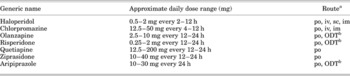
The choice of medication in the treatment of delirium depends on multiple factors, including the degree of agitation, subtype of delirium, the available route of administration, and concurrent medical conditions. Table 1 presents an overview of commonly used antipsychotic medications in the treatment of delirium.
Antipsychotics in the treatment of delirium

aRisperidone and aripiprazole are available in liquid formulations.
bOrally disintegrating tablet (ODT) forms are available for olanzapine, risperidone, and aripiprazole.
APA guidelines for the treatment of delirium recommend low-dose haloperidol (i.e., 1–2 mg po every 4 h as needed or 0.25–0.5 mg po every 4 h for the elderly) as the treatment of choice in cases where medications are necessary. Lorazepam (0.5–1.0 mg q 1–2 h PO or IV) along with haloperidol may be effective in rapidly sedating the agitated delirious patient and may minimize EPS associated with haloperidol (Trzepacz et al., Reference Trzepacz, Breitbart and Franklin1999). However, benzodiazepine monotherapy should be avoided unless the delirium is due to alcohol or benzodiazepine withdrawal.
An alternative strategy in agitated patients is to switch from haloperidol to a more sedating antipsychotic such as chlorpromazine. We have successfully used chlorpromazine in cases where increased sedation was required, as an alternative to haloperidol and lorazepam combination, especially in the ICU setting, where close blood pressure monitoring was feasible and in terminally ill patients for severe agitation to decrease patient, family, and staff distress. It is important to note the anticholinergic and hypotensive side effects of chlorpromazine, particularly in the elderly patients.
In light of the existing literature, risperidone may be used in the treatment of delirium, starting at doses ranging from 0.25 to 1 mg and titrating up as necessary with particular attention to the risk of EPS, orthostatic hypotension, and sedation at higher doses. Olanzapine can be started between 2.5 and 5 mg nightly and titrated up, with sedation being the major limiting factor, which may be favorable in the treatment of hyperactive delirium. The current literature on the use of quetiapine suggests a starting dose of 25–50 mg and a titration up to 100–200 mg a day (usually at twice daily divided doses). Sedation and orthostatic hypotension are the main dose-limiting factors (Boettger & Breitbart, Reference Boettger and Breitbart2005). The data on the use of ziprasidone in the treatment of delirium have been most understudied due to concerns about QT interval prolongation, particularly in the medically ill. Case reports and our clinical experience suggest a starting dose of 10–15 mg daily for aripiprazole, with a maximum dose of 30 mg daily. The hypothetical advantage of the “dopamine stabilizing” effect of aripiprazole in patients with hypoactive delirium remains to be studied. Intramuscular (IM) formulations are available for olanzapine, aripiprazole, and ziprasidone; to our best knowledge, there are no published case reports or studies on the use of parenteral forms of atypical antipsychotics in the treatment of delirium.
Initial doses of approximately one half the suggested doses may be necessary in frail elderly patients. Important considerations in starting treatment with any antipsychotic for delirium may include EPS risk, sedation, anticholinergic side effects, cardiac arrhythmias, and possible drug–drug interactions. Frequent reassessments should be made during the delirium episode to adjust the medication dose and assess for any medication side effects while underlying factors are being searched for.
It is important to note that antipsychotics may not be appropriate in certain patient populations with delirium, particularly those with dementia of Lewy Body type and Parkinson's disease dementia, patients with stroke, and patients with prior adverse reactions to antipsychotics.
Clinicians should note that delirium is often the manifestation of an underlying disease or effect of a medication. Every effort should be made to search for and correct all evident causes of delirium. A comprehensive, multimodal approach based on environmental strategies combined with pharmacologic interventions is likely to be the best management approach for delirium (Inouye, Reference Inouye2006; Seitz et al., Reference Seitz, Gill and van Zyl2007).
CONCLUSION
Antipsychotic medications are an essential component in the multimodal approach to managing delirium. Clinicians should be familiar with the available literature on the use of antipsychotics in the treatment of delirium and the potential side effects of these medications in the medically ill.
DRUG BRAND NAMES
Haloperidol * Haldol (brand discontinued in U.S.)
Chlorpromazine * Thorazine (brand discontinued in U.S.)
Olanzapine * Zyprexa
Risperidone * Risperdal
Quetiapine * Seroquel
Ziprasidone * Geodon
Aripiprazole * Abilify