Clostridium difficile is the most commonly identified cause of infectious diarrhea in hospitalized adults and has been associated with significant morbidity and mortality.Reference Cohen, Gerding and Johnson 1 , Reference Dubberke, Gerding and Classen 2 Recent studies have shown that the incidence of pediatric C. difficile infection (CDI) has increased over the past decade.Reference Kim, Smathers, Prasad, Leckerman, Coffin and Zaoutis 3 – Reference Nylund, Goudie, Garza, Fairbrother and Cohen 5 The clinical spectrum of CDI in adults and children varies widely, ranging from self-limiting diarrhea to more severe CDI such as toxic megacolon, sepsis, or death.Reference Elliott, Chang, Golledge and Riley 6 – Reference Sammons and Toltzis 8
To date, available data regarding CDI-associated outcomes in hospitalized children are limited. However, some evidence suggests that CDI among hospitalized children has been associated with poor outcomes resulting in significant morbidity and increased risk of death.Reference Nylund, Goudie, Garza, Fairbrother and Cohen 5 , Reference Sammons, Localio, Xiao, Coffin and Zaoutis 9 A recent study found that CDI was associated with an over two-fold increase in mortality, longer LOS, and higher total hospital costs among hospitalized children who were otherwise similar in important demographic and clinical characteristics.Reference Sammons, Localio, Xiao, Coffin and Zaoutis 9 However, factors associated with poor outcomes among hospitalized children with CDI are poorly understood.
Given the lack of understanding of outcomes associated with CDI in children, we sought to identify risk factors for in-hospital 30-day mortality and a CDI-related readmission within 8 weeks among a cohort of hospitalized children with CDI.
MATERIALS AND METHODS
Study Design and Data Source
We performed a retrospective, multicenter cohort study to assess risk factors for in-hospital mortality among hospitalized children with CDI. Data were obtained from the Pediatric Health Information System (PHIS) database, a comprehensive clinical and administrative database that contains information from 43 freestanding children’s hospitals across the United States. The PHIS hospitals are 43 of the largest children’s hospitals in America. These hospitals represent 17 of 20 major metropolitan areas in the United States. Data elements present in the PHIS database include demographics, insurance information, International Classification of Diseases, Ninth Revision, Clinical Modification (ICD-9-CM) procedure and diagnosis codes, and resource utilization data including billing data for pharmacy, imaging, and clinical services. Our analysis was limited to the 41 hospitals that provided all data elements during the study period.
Study Population
Children aged 1–18 years discharged from PHIS hospitals between January 1, 2006 and August 31, 2011 were eligible for inclusion in the study. Patients hospitalized for <3 days were excluded from the analysis. Children with CDI were identified using a previously validated case-finding toolReference Shaklee, Zerr and Elward 10 that included the presence of an ICD-9-CM code due to Clostridium difficile (008.45) plus a billing charge for a C. difficile test. Hospital onset (HO) CDI was defined as a C. difficile test ≥3 days after hospital admission. Community onset (CO) CDI was defined as a C. difficile test prior to hospital day 3. The day of admission was defined as day 0. Only the first CDI-related hospitalization for each patient was used in the analysis.
Outcomes
The primary outcome for the study was all-cause in-hospital mortality occurring during an index admission within 30 days of a C. difficile test. CDI-related readmission within 8 weeks, the secondary outcome, was defined as a subsequent admission within 8 weeks of the initial C. difficile test date that included both a C. difficile test charge within 48 hours of admission and receipt of CDI-directed therapy (ie, metronidazole or oral vancomycin).
Data Collection
All data utilized for this study were obtained from the PHIS database. Demographic and clinical information collected for each patient included age, sex, race, presence and type of comorbid condition, and in-hospital medication exposures including antimicrobial agents, proton pump inhibitors, H2 blockers, and total parenteral nutrition. Receipt of antibiotics 90 days prior to CDI was classified in 2 ways: (1) the presence of any antibiotics represented as yes/no and (2) the total number of antibiotic classes. Treatment for CDI was defined as the receipt of metronidazole or oral vancomycin. The presence and type of comorbid condition was classified using a previously validated classification system that groups ICD-9-CM diagnostic codes into pediatric chronic conditions.Reference Feudtner, Christakis, Zimmerman, Muldoon, Neff and Koepsell 11 Data collected on underlying severity of illness included admission to the intensive care unit (ICU) and receipt of respiratory support (supplemental oxygen or mechanical ventilation) or pressor support (dopamine, epinephrine, dobutamine, or norepinephrine).
Statistical Analysis
Summary statistics were constructed using frequencies for categorical variables and medians for continuous variables. Categorical variables were compared using the Pearson χ2 test or Fisher’s exact test when appropriate, and continuous variables were compared using the Wilcoxon rank-sum test. Univariate analyses, using simple logistic regression, were conducted to identify potential risk factors for in-hospital death or CDI-related readmission among children with CDI. All variables with P<.05 in the univariate analysis were included in the final multivariable logistic regression model. The number of inpatient deaths among the cohort limited the number of potential risk factors included in the final multivariable model. Therefore, to characterize the underlying severity of illness, a composite severity of illness variable was created from the following data elements: admission to the ICU, receipt of pressor support, or receipt of respiratory support in the 48 hours prior to the C. difficile test. The severity of illness variable ranged from a score of 0 to 3, 0 representing a patient with an absence of all severity of illness markers and 3 representing a patient with all 3 markers. Using the final multivariable model, we derived predictions of the probability of death for each factor and combinations of factors that were independently associated with in-hospital mortality. All analyses were performed using SAS 9.3 (SAS Institute, Inc., Cary, NC) or Stata 12.1 (Stata Corp., College Station, TX).
RESULTS
Patient Characteristics
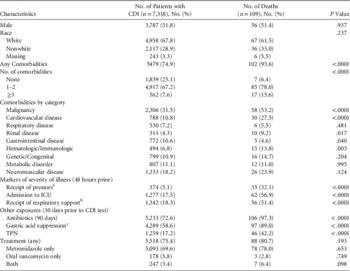
We identified 7,318 children with CDI that met our inclusion criteria during the study period. Table 1 displays the characteristics of these children. Median age of patients with CDI was 6 years [interquartile range (IQR), 2–13]. The majority of children (51.8%) were male, had at least 1 comorbid condition (74.9%), were classified as CO-CDI (52.9%), had gastric acid suppression (GAS) within 30 days prior to C. difficile test (58.6%), and received an antibiotic within 90 days prior to their C. difficile test (74.9%).
Baseline Patient Demographics and Clinical Characteristics of the Cohort

NOTE. CDI, Clostridium difficile infection; ICU, intensive care unit; TPN, total parenteral nutrition.
a Dopamine, epinephrine, norepinephrine, dobutamine.
b Mechanical ventilation or supplemental oxygen.
c Proton pump inhibitors or H2 blockers.
Primary Outcome: Risk Factors for In-Hospital Mortality
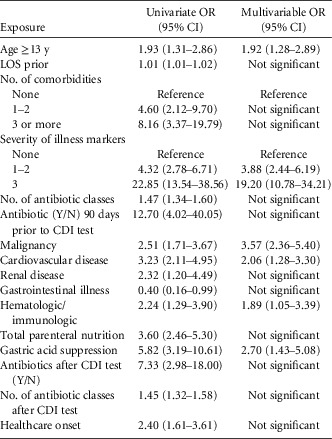
Among the study cohort, 109 (1.5%) children with CDI died in the hospital within 30 days of their C. difficile test. Univariate analysis identified several potential risk factors associated with in-hospital mortality (Table 2). These potential factors include age, severity of illness markers, number of classes of antibiotics received within 30 days prior to C. difficile test, GAS (receipt of proton pump inhibitors or H2 blockers) within 30 days, receipt of total parenteral nutrition (TPN) within 30 days, LOS prior to C. difficile test, and CO-CDI. History of and type of comorbid condition was also associated with death. We did not find an association with C. difficile treatment and in-hospital mortality.
Univariate and Multivariable Odds Ratios for In-Hospital Mortality in Children with C. difficile Infection (CDI)

NOTE. OR, adjusted odds ratio; LOS, length of stay.
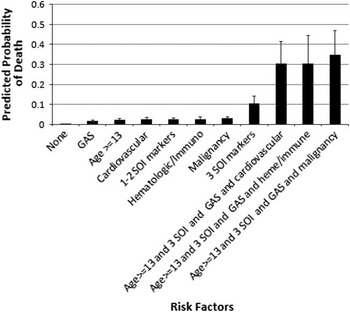
Multivariable analysis identified several independent risk factors for in-hospital 30-day mortality (Table 2). These risk factors include older age [adjusted odds ratio (95% confidence interval): 2.29 (1.40–3.77)], underlying malignancy [3.57 (2.36–5.40)], cardiovascular disease [2.06 (1.28–3.30)], hematologic/immunologic condition [1.89 (1.05–3.39)], receipt of gastric acid suppression 30 days prior to C. difficile test [2.70 (1.43–5.08)], and presence of >1 marker of severity of illness [3.88 (2.44–6.19)]. Figure 1 represents the predicted probability of in-hospital mortality for children hospitalized with CDI who have ≥1 independent risk factor from the multivariable model. Older children, children receiving gastric acid suppression, children with a history of certain comorbid conditions (cardiovascular disease, hematologic or immunologic condition, or malignancy), and children with 1 or 2 severity of illness markers had a ~2%–3% probability of death. Having all 3 severity of illness markers increased the probability of death to ~10%. Older children with 1 of the comorbid conditions and all 3 severity of illness markers in conjunction with receipt of gastric acid suppression had a ~30%–35% probability of death, depending on the type of condition.
Predicted probability and 95% confidence intervals of in-hospital mortality within 30 days in children hospitalized with Clostridium difficile infection (CDI) by risk-factor combinations. GAS, gastric acid suppression; SOI, severity of illness markers.

Secondary Outcome: Risk Factors for CDI-Related Readmission
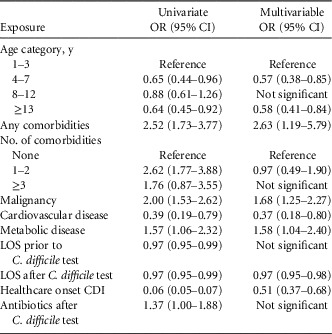
Among 5,186 children treated for CDI, 225 (4.3%) were readmitted within 8 weeks of their index CDI episode. The median number of days between C. difficile testing and CDI-related readmission was 22 (IQR, 13–34). Patients with a CDI-related readmission were more likely to have ≥1 comorbidity [adjusted odds ratio (95% confidence interval), 2.63 (1.19–5.79)], underlying malignancy [1.68 (1.25–2.27)], or metabolic disease [1.58 (1.04–2.40)]. These patients were less likely to have cardiovascular disease [0.37 (0.18–0.80)] and hospital-onset CDI [0.51 (0.37–0.68)], and had a shorter LOS [0.97 (0.95–0.98)] (Table 3).
Univariate and Multivariable Odds Ratios for CDI-related Readmission Within 8 Weeks in Hospitalized Children with Clostridium difficile Infection (CDI)

NOTE. OR, adjusted odds ratio; LOS, length of stay.
DISCUSSION
Over the past decade, the incidence of CDI increased. Recent pediatric studies suggest that CDI is associated with worse outcomes in children.Reference Nylund, Goudie, Garza, Fairbrother and Cohen 5 , Reference Sammons, Localio, Xiao, Coffin and Zaoutis 9 Identifying subpopulations of children with CDI that are at an increased risk of in-hospital mortality could inform the development of targeted CDI prevention programs and identify subgroups for future research in the optimal management of pediatric CDI. In this large, multicenter cohort study of children hospitalized with CDI, older age, receipt of gastric acid suppression, presence of ≥1 severity of illness markers, and various underlying comorbidities (eg, cardiovascular disease, hematologic or immunologic condition, or malignancy) were independently associated with increased risk of mortality.
Available data regarding CDI-associated outcomes and predictors of these poor outcomes among children are limited. Our finding that mortality among patients with CDI is associated with the presence of certain underlying comorbidities is consistent with previous published studies that were conducted primarily among adults.Reference Abou Chakra, Pepin, Sirard and Valiquette 12 – Reference Kim, Kim and Park 14 Several studies have shown that children with malignancy had an increased incidence of CDI and worse outcomes.Reference de Blank, Zaoutis, Fisher, Troxel, Kim and Aplenc 15 , Reference Tai, Richardson, Townsend, Howard and McDonald 16 Even after controlling for patient characteristics and additional clinical factors such as severity of illness, children with malignancies, hematologic or immunologic conditions and cardiovascular disease were still identified to be at an increased risk of mortality. To our knowledge, this is a novel finding, and suggests the need for additional studies to better understand this association and highlights the need for targeted prevention or treatment practices in subpopulations of children.
Inconsistent findings have been reported regarding the role of gastric acid suppression and the development of CDI; however, available data regarding the role of gastric acid suppression and CDI-related outcomes, especially in pediatrics, are limited.Reference Khanna, Aronson, Kammer, Baddour and Pardi 17 – Reference Turco, Martinelli and Miele 22 A recent population-based study of patients diagnosed with CDI between 1991 and 2005 evaluated the association between gastric acid suppression and outcomes related to CDI. In this study, no association between gastric acid suppression and severe complicated CDI including death was identified.Reference Khanna, Aronson, Kammer, Baddour and Pardi 17 In contrast to those results, our study found a statistically significant association between gastric acid suppression and death. These discordant findings are not surprising given that the majority of the CDI cases in the previous study were diagnosed prior to the changing epidemiology of CDI, the study was limited by a small sample size, and the outcome was a composite endpoint. It is important to note that gastric acid suppression could be an indicator for severity of illness that may not have been adequately captured in our model. Nonetheless, this significant association was identified after multivariable modeling. In addition, we found that underlying severity of illness was an independent risk factor for mortality by creating a composite severity of illness variable. While this is not a validated measure, our finding that mortality increased with an increasing severity of illness score suggests that this measure captured variability in the underlying degree of illness.
Antimicrobial use has been studied extensively with regard to development of CDI; however, few studies have assessed the role of antimicrobial use on outcomes associated with CDI.Reference Loo, Poirier and Miller 23 – Reference Vesta, Wells, Gentry and Stipek 28 In our study, we found no association between in-hospital mortality and antimicrobial use, total number of antimicrobial drug classes used, and timing of antimicrobial exposure. While antimicrobial exposure may have played a significant role in the development of CDI, according to our study findings, antimicrobial exposure was not a risk factor for in-hospital mortality in patients with CDI.
Recent studies conducted among adults with CDI suggests that metronidazole therapy may be associated with increased rates of treatment failure compared with oral vancomycin and that oral vancomycin is superior to metronidazole for treating adult patients with severe CDI.Reference Fernandez, Anand and Friedenberg 29 – Reference Johnson, Louie and Gerding 35 However, available data on the comparative effectiveness of C. difficile treatments among pediatric patients are limited. Our study did not identify an association between CDI treatment and mortality. To our knowledge, this is the first pediatric study to assess whether treatment was independently associated with mortality. However, these results should be interpreted with caution due to the small proportion of children who received oral vancomycin during our study period and the likelihood that oral vancomycin is given to sicker patients. Additional studies are urgently needed to answer this important question in pediatric patients.
Our study found that having ≥1 of the aforementioned independent risk factors increased the probability of death from 0% up to 35% depending on the combination of factors. Overall, the probability of death was the highest (~35%) among children ≥13 years of age, who received gastric acid suppression, had all 3 of the severity of illness markers, and had a malignancy.
We also evaluated potential risk factors for CDI-related readmission within 8 weeks of an initial CDI test. Given the limitations of the dataset, we were unable to assess recurrent CDI as defined by current clinical practice guidelines.Reference Cohen, Gerding and Johnson 1 To capture patients that were readmitted to the hospital due to their CDI, we defined a CDI-related readmission as a repeat test for C. difficile and treatment within 48 hours of the readmission. We found there to be a statistically significant association between patients readmitted and the presence of any comorbidities, malignancy, and metabolic disease. In addition, patients with a CDI-related readmission were significantly less likely to have cardiovascular disease and hospital-onset CDI. This could be due to the fact that patients with cardiovascular disease and hospital-onset CDI were more likely to have prolonged length of stays, decreasing the likelihood of recurrence of CDI following discharge. Many studies have evaluated risk factors for recurrent CDI in adults; however, limited data are available regarding risk factors for CDI-related readmissions in children.Reference Abou Chakra, Pepin, Sirard and Valiquette 12 , Reference Zilberberg, Reske, Olsen, Yan and Dubberke 36 – Reference Freedberg, Salmasian, Friedman and Abrams 38
Our study has several limitations. PHIS datasets do not include autopsy results or death certificates; therefore, we were unable to assess mortality attributable to CDI. All of the hospitals that contribute data to the PHIS dataset are freestanding children’s hospitals, and these results might not be generalizable to all institutions. However, PHIS hospitals represent a wide variety of geographic and metropolitan areas. PHIS datasets also do not include laboratory data. Therefore, we were unable to evaluate whether potential laboratory parameters or specific strains of CDI are associated with increased risk for mortality. In addition, due to the lack of laboratory data, we were unable to confirm a CDI diagnosis. However, to avoid potential misclassification, we used a previously validated case-finding tool with 79.82% sensitivity, 99.93% specificity, a positive predictive value of 81.31%, and a negative predictive value of 99.92%. These findings indicate that this method of identifying pediatric patients with CDI in administrative data is reliable and accurate.Reference Shaklee, Zerr and Elward 10 In addition, although we limited our analysis to the first admission for which a patient had a CDI diagnosis, it is possible that we could have included patients that had a prior CDI episode. Finally, PHIS data does not include clinical data. Therefore, we were not able to confirm the presence of recurrent CDI based on the presence of symptoms, as provided in current CDI guidelines;Reference Cohen, Gerding and Johnson 1 instead, we used readmission for CDI as a proxy for recurrence.
Our study identifies several important patient characteristics that were found to be independent risk factors for in-hospital mortality and CDI-related readmission within 8 weeks. Given the increased incidence of pediatric CDI and recent findings that CDI is associated with increased risk of death among hospitalized children, identifying subgroups of children with CDI who are at higher risk of poor outcomes is crucial and may inform the design of future studies to determine the optimal treatment of CDI in children. In addition, these children may benefit from targeted CDI prevention strategies, such as antibiotic stewardship programs.
ACKNOWLEDGMENTS
Financial support: This work was supported by Merck Research funding through their investigator initiated studies program.
Potential conflicts of interest: NV received research support from Merck. TEZ has received research support from Merck and has served as a consultant to Merck, Cubist, Astellas, and Pfizer. JSS received funding support through Merck from their investigator initiated studies program. SEC reports no conflicts.