






No CrossRef data available.
Article contents
Fifth arch artery – a case of mistaken identity?‡
Published online by Cambridge University Press: 30 October 2017
Abstract
An abstract is not available for this content. As you have access to this content, full HTML content is provided on this page. A PDF of this content is also available in through the ‘Save PDF’ action button.
Keywords
Information
- Type
- Article Commentary
- Information
- Copyright
- © Cambridge University Press 2017
Footnotes
‡
The original version of this article was published with the incorrect title. A notice detailing this has been published and the error rectified in the online and print PDF and HTML copies.
References
1.
Lloyd, DFA, Ho, SY, Pushparajah, K, et al. Persistent fifth aortic arch: the “great pretender” in clinical practice. Cardiol Young https://doi.org/10.1017/S1047951117001342
CrossRefGoogle Scholar
2.
Gerlis, LM, Ho, SY, Anderson, RH, Da Costa, P. Persistent 5th aortic arch – a great pretender: three new covert cases. Int J Cardiol
1989; 23: 239–247.CrossRefGoogle ScholarPubMed
3.
Gupta, SK, Bamforth, SD, Anderson, RH. How frequent is the fifth arch artery?
Cardiol Young
2015; 25: 628–646.CrossRefGoogle ScholarPubMed
4.
Gupta, SK, Gulati, GS, Anderson, RH. Clarifying the anatomy of the fifth arch artery. Ann Ped Cardiol
2016; 9: 62–67.CrossRefGoogle ScholarPubMed
5.
Naimo, PS, Vazquez-Alvarez Mdel, C, d’Udekem, Y, Jones, B, Konstantinov, IE. Double-lumen aortic arch: persistence of the fifth aortic arch. Ann Thorac Surg
2016; 101: 155–156.CrossRefGoogle ScholarPubMed
6.
Gupta, SK, Anderson, RH. Fifth aortic arch: Emperor’s new clothes?
Ann Thorac Surg
2017; 103: 1679.CrossRefGoogle ScholarPubMed
7.
Bamforth, SD, Chaudhry, B, Bennett, M, et al. Clarification of the identity of the mammalian fifth pharyngeal arch artery. Clin Anat
2013; 26: 173–182.CrossRefGoogle ScholarPubMed
8.
Lorandeau, CG, Hakkinen, LA, Moore, CS. Cardiovascular development and survival during gestation in the Ts65Dn mouse model for Down syndrome. Anat Rec (Hoboken)
2011; 294: 93–101.CrossRefGoogle ScholarPubMed
9. Occam’s razor. Retrieved September 4, 2017, from https://en.wikipedia.org/wiki/Occam%27s_razor
Google Scholar
10. Retrieved September 4, 2017 from https://en.wikipedia.org/wiki/Zebra_(medicine)#cite_note-2
Google Scholar
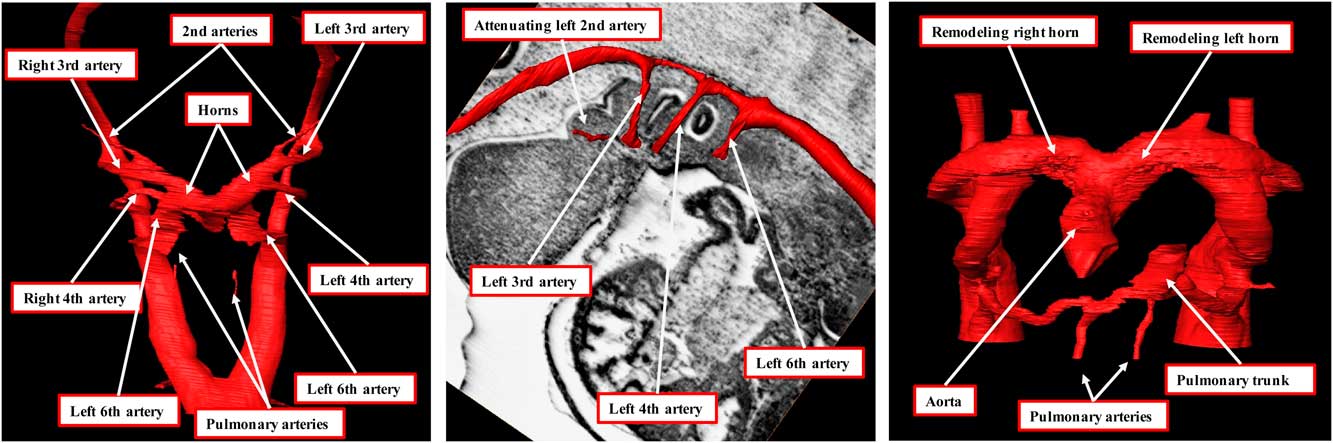
Figure 1 The images, taken from episcopic data sets prepared from mice sacrificed at embryonic day 10.5 (left-hand and central panels) and 11.5 (right-hand panel), show how the horns of the aortic sac become remodelled to supply the vessels initially derived from the third and fourth arch arteries. The right-hand and left-hand panel are shown in the frontal projection, whereas the central panel shows a view of a sagittal section as seen from the left side. Note that there is no pharyngeal mesenchyme producing an additional arch between the segments containing the fourth and sixth arch arteries.
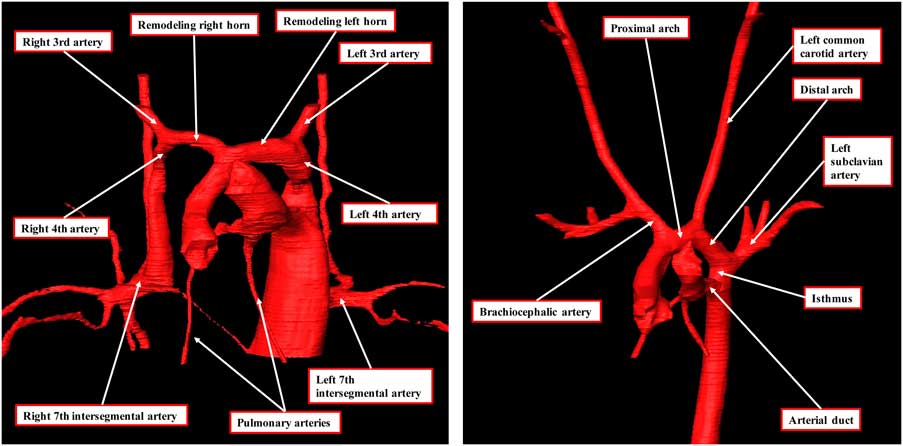
Figure 2 The images show the remodelling of the extrapericardial systemic arteries taking place during embryonic days 12.5 (left-hand panel) and 13.5 (right-hand panel). Both are shown in frontal projection. It is the horns of the aortic sac that become the brachiocephalic artery and the proximal component of the transverse aortic arch.
A recently published article,Reference Lloyd, Ho and Pushparajah 1 Lloyd et al interpret several rare cardiac malformations on the basis of persistence of the artery of the fifth pharyngeal arch. Following the precedent of Gerlis et al,Reference Gerlis, Ho, Anderson and Da Costa 2 they continue to accord the artery the role of the “great pretender”. One of us was a co-author of the initial work published by Gerlis and his associates that introduced this notion. At that time, however, we did not know as much as we do now about the fate, during development, of the arteries running through the pharyngeal arches. And, as Lloyd et al describe at length,Reference Lloyd, Ho and Pushparajah 1 we have collectively now cast significant doubt on the role of the putative fifth arch arteries as the basis of the lesions they now review.Reference Gupta, Bamforth and Anderson 3 , Reference Gupta, Gulati and Anderson 4 In this regard, we also questioned the interpretation of a vessel as a fifth arch artery in a case recently described by Naimo and Konstantinov.Reference Naimo, Vazquez-Alvarez Mdel, d’Udekem, Jones and Konstantinov 5 In our letter, however, we mistakenly asserted that the Melbourne authors had “claimed” that the fifth arch artery was involved in their case. As they pointed out in their response, to “claim” is to assert the veracity of any statement. It is the case that, when assessing the role of the fifth arch artery, the best we can do is to speculate.Reference Gupta and Anderson 6 In their response, however, Naimo and Konstantinov did comment that “this exceptionally rare anomaly does not appear to be of practical medical importance”. This is in contrast to the message from Lloyd et al, namely that “for the clinician, this group of conditions may explain various unusual anatomical features which may be important to recognise when caring for children with congenital heart disease”. The anatomical features emphasised by the group working in London are certainly unusual and of interest. It remains to be established, however, whether they are best interpreted on the basis of persistence of the enigmatic artery of the fifth pharyngeal arch, or whether there are more likely explanations for their morphogenesis.
Much depends, therefore, on our understanding of the events occurring during the development and maturation of the intrapericardial and extrapericardial arterial trunks. Of particular importance are the changes that take place during the formation of the brachiocephalic and pulmonary arteries. According to the current review, “It is a conventionally accepted model that mammals develop six paired pharyngeal arches, which do not co-exist, but variously involute to form the aortic arch and head and neck vessels. The left fourth arch is said to form definitive (left sided) aortic arch, with the developing pulmonary arteries taking their origin from the mid-ventral portions of the sixth arches.” They cite no references to support this allegedly conventional wisdom. In fact, their statement falls short in several regards. In the first instance, our own studies of large numbers of developing mouse embryos have shown that remodelling of the horns of the aortic sac is responsible for producing the brachiocephalic artery and the initial part of the extrapericardial aortic arch (Fig 1). Our studies then demonstrate that rapid and extensive morphological changes that take place during formation of the subclavian arteries from the seventh cervical intersegmental arteries (Fig 2).
The images, taken from episcopic data sets prepared from mice sacrificed at embryonic day 10.5 (left-hand and central panels) and 11.5 (right-hand panel), show how the horns of the aortic sac become remodelled to supply the vessels initially derived from the third and fourth arch arteries. The right-hand and left-hand panel are shown in the frontal projection, whereas the central panel shows a view of a sagittal section as seen from the left side. Note that there is no pharyngeal mesenchyme producing an additional arch between the segments containing the fourth and sixth arch arteries.
The images show the remodelling of the extrapericardial systemic arteries taking place during embryonic days 12.5 (left-hand panel) and 13.5 (right-hand panel). Both are shown in frontal projection. It is the horns of the aortic sac that become the brachiocephalic artery and the proximal component of the transverse aortic arch.
Significant remodelling, therefore, is ubiquitous and extensive during formation of the definitive extrapericardial systemic and pulmonary pathways. In contrast, and as also acknowledged by the London group, a partially formed artery of the fifth pharyngeal arch has been identified in but a solitary human embryo. In the developing mouse, furthermore, there has been no instance in which, as far as we are aware, it has been possible to identify either a segment of pharyngeal mesenchyme identifiable as a fifth arch, or a fifth pair of arch arteries. In about half of the embryos studied, nonetheless, both in our seriesReference Bamforth, Chaudhry and Bennett 7 and in an additional series,Reference Lorandeau, Hakkinen and Moore 8 collateral channels were identified at the insertion of the fourth and sixth arch arteries to the distal aorta. These findings, and those regarding remodelling of the aortic sac, offer alternative explanations for the lesions interpreted thus far as representing persistence of the arteries of the fifth pharyngeal arch. In this light, we suggest that note should be taken of the philosophical principle known as Occam’s razor, or the law of parsimony. An excellent review of this principle is now provided by Wikipedia. 9 With regard to medicine, we are informed that “A variation used in medicine is called the “Zebra”. A doctor should reject an exotic medical diagnosis when a more commonplace explanation is more likely. This approach is derived from Theodore Woodward’s dictum “When you hear hoofbeats, think of horses not zebras”. 10 It is directly pertinent to the interpretations offered by the London group for their series of cases. In our opinion, better explanations can be offered on the basis of remodelling, and by invoking the law of parsimony, for the cases illustrated in their Figures 1 through 3 and 5. Thus, double-barrelled aorta is more likely to represent collateral channels. Most of the abnormalities of brachiocephalic arteries can well be due to extensive remodelling of the aortic sac. Aorto-pulmonary connections are just as likely to represent remodelling of the arterial duct as is persistence of the fifth arch artery. When taking probabilities into account, we speculate the described changes are much more likely to be remodelling of the duct. As stated by Woodward, in these instances we should be thinking of horses, in other words remodelling of the aorta, its branches, and the arterial duct rather than zebras, represented by the fifth arch artery in the accompanying review.
Acknowledgements
None.
Financial Support
This research received no specific grant from any funding agency, commercial or not-for-profit sectors.
Conflicts of Interest
None.