





Introduction
Herbicides are integral to weed control in U.S. rice production (Hill Reference Hill1982; McWhorter and Shaw Reference McWhorter and Shaw1982). Glyphosate use increased significantly with the broad acceptance of glyphosate-resistant (GR) canola (Brassica napus L.), corn (Zea mays L.), cotton (Gossypium hirsutum L.), and soybean (Shaner Reference Shaner2000). However, the adoption of GR crops led to overreliance on glyphosate for weed control (Powles Reference Powles2008). Failure to incorporate multiple herbicide sites of action, as well as other poor stewardship practices, resulted in the selection for GR weeds (Powles Reference Powles2008). To combat GR weeds, paraquat plus residual herbicides are recommended preemergence in GR cropping systems (Bond et al. Reference Bond, Avila, Bararpour, Calhoun, Dodds, Eubank, Irby, Larson, Pieralisi, Reynolds and Zurweller2025; Syngenta 2019).
Paraquat is a nonselective, broad-spectrum, postemergence herbicide that inhibits the flow of electrons in photosystem I (PS I) in susceptible plants (Shaner Reference Shaner2014). Paraquat accepts electrons from PS I during photosynthesis and, in the process, reduces molecular oxygen, thereby generating superoxide radicals (Calderbank Reference Calderbank1968). Hydroxyl radicals are generated that readily oxidize lipid membranes. Paraquat is absorbed into exposed plant foliage and remains at the point of contact, and total vegetative necrosis typically occurs 1 to 3 d following application (Shaner Reference Shaner2014).
Paraquat is used as a herbicide, desiccant, defoliant, and plant growth regulator (US EPA 1997). As a herbicide, it controls broadleaf weeds and grasses in more than 100 different crops (Syngenta 2019). Paraquat can be applied preplant, preemergence, or postemergence to corn, cotton, peanut (Arachis hypogaea L.), soybean, grain sorghum [Sorghum bicolor (L.)], and other vegetable and fruit crops for nonselective weed control. However, when used on rice, paraquat is limited to preplant or preemergence applications (Bond et al. Reference Bond, Avila, Bararpour, Calhoun, Dodds, Eubank, Irby, Larson, Pieralisi, Reynolds and Zurweller2025; Syngenta 2019). Paraquat applied at 140 to 280 g ai ha−1 is often used as a harvest aid or desiccant in Mississippi when soybean plants are fully developed with at least 50% leaf drop and remaining leaves turning yellow (Bond et al. Reference Bond, Avila, Bararpour, Calhoun, Dodds, Eubank, Irby, Larson, Pieralisi, Reynolds and Zurweller2025). A preharvest interval of 15 d must be observed after herbicide application. Paraquat applied as a soybean harvest aid has been observed to improve soybean harvest efficiency along with crop quality (Boudreaux and Griffin Reference Boudreaux and Griffin2008).
Rice in the mid-southern United States is routinely drill-seeded in the same window when preplant and/or preemergence herbicides are applied to corn, cotton, and soybean (Buehring Reference Buehring2008). Paraquat-based herbicide treatments are commonly used in these preplant and/or preemergence applications (Bond et al. Reference Bond, Avila, Bararpour, Calhoun, Dodds, Eubank, Irby, Larson, Pieralisi, Reynolds and Zurweller2025; Syngenta 2019); therefore, off-target movement onto adjacent rice fields may occur. In addition, rice reproductive growth, grain filling, and ripening often coincide with soybean maturation and harvest in Mississippi, creating the potential for off-target herbicide movement from harvest-aid treatments of soybean. McCoy et al. (Reference McCoy, Golden, Bond, Dodds, Bararpour and Gore2020) reported paraquat applications inhibited the ability of the rice plant to complete proper reproduction as evidenced by reductions in rough rice yield, total seed weight, total number of seed, and number of seeds per panicle. Proper grain-fill during ripening was also inhibited due to paraquat exposure, as indicated by the reductions of 1,000-grain weight and whole milled rice yield (McCoy et al. Reference McCoy, Golden, Bond, Dodds, Bararpour and Gore2020).
Because paraquat-based treatments can be applied season-long, multiple exposures from off-target movement to rice are possible. Although previous research has documented rice response to early season and late-season off-target movement of paraquat (Lawrence et al. Reference Lawrence, Bond, Golden, Allen, Reynolds and Bararpour2020a, Reference Lawrence, Bond, Golden, Allen, Reynolds and Bararpour2020b, Reference Lawrence, Bond, Golden, Allen, Reynolds and Bararpour2021; McCoy et al. Reference McCoy, Golden, Bond, Dodds, Bararpour and Gore2020; Sanders et al. Reference Sanders, Bond, Allen, Gholson, Krutz and Webster2024), research quantifying rice response after multiple exposures to paraquat is not available. Therefore, research was conducted to evaluate rice growth and yield after exposure to sublethal concentrations of paraquat multiple times during the life cycle.
Materials and Methods
Field research was conducted from 2019 to 2021 at the Mississippi State University Delta Research and Extension Center in Stoneville, to evaluate rice growth and yield after exposure to sublethal concentrations of paraquat multiple times during the life cycle. Global positioning system coordinates, soil series, soil description, soil pH, and soil organic matter content are presented in Table 1. The experimental site included a rice-fallow rotation in which rice was seeded every other year. Glyphosate (1,120 g ae ha−1, Roundup PowerMax 4.5 L; Bayer CropScience, St. Louis, MO), paraquat (560 g ai ha−1, Gramoxone 2.0 SL; Syngenta Crop Protection, Greensboro, NC), and/or 2,4-D (1,120 g ae ha−1, 2,4-D Amine 3.8 SL; Albaugh LLC, St. Joseph, MO) were applied in late March to early April each year to control emerged vegetation prior to seeding.
Geographic location, soil classification, and agronomic information for the multiple exposure study.

Table 1. Long description
The table presents data on the geographic location, soil classification, and agronomic information for a study conducted from 2019 to 2021. It includes three rows and six columns. The columns are labeled Site-year, Latitude and longitude, Soil series, Description, pH, and Organic matter. The rows provide specific details for each year of the study. Row 1: 2019, 33.38 degrees North, 90.90 degrees West, Sharkey clay, Very-fine, smectitic, thermic Chromic Eqiaquerts, 8.2, 2.1 percent. Row 2: 2020, 33.44 degrees North, 90.90 degrees West, Sharkey clay, Very-fine, smectitic, thermic Chromic Eqiaquerts, 8.2, 2.1 percent. Row 3: 2021, 33.37 degrees North, 90.91 degrees West, Commerce silty clay loam, Fine-silty, mixed, superactive, nonacid, thermic Fluvaquentic Endoaquerts, 7.6, 1.8 percent. The table highlights the consistency in soil series and description for the years 2019 and 2020, with a change in 2021. The pH levels remain the same for 2019 and 2020 but decrease in 2021. The organic matter content shows a slight decrease from 2019 to 2021.
Rice cultivar CL153 (Horizon Ag, Memphis, TN) was sown at 356 seeds m−2 on May 28, 2019, May 20, 2020, and June 17, 2021, to a depth of 2 cm using a small-plot grain drill (Great Plains 1520; Great Plains Manufacturing, Salina, KS). Plots were 0.6 m by 4.6 m and consisted of nine rows of rice bordered on either end by a 1.5-m alley that contained no rice. Nitrogen fertilizer was applied at 168 kg ha−1 as urea (46-0-0) immediately prior to flooding (Norman et al. Reference Norman, Slaton, Roberts and Hardke2013). Plots were flooded to an approximate depth of 6 to 10 cm when rice reached the 1- to 2-tiller stage. Rice was managed throughout the growing season using local guidelines to optimize yield (Buehring Reference Buehring2008).
Treatments were arranged as a two-factor factorial within a randomized complete block design with four replications. Factor A was early season exposure and consisted of no early season exposure and paraquat at 84 g ha−1 applied to rice at the spiking to 1-leaf (VEPOST) and 3- to 4-leaf (MPOST) growth stages. Factor B was late season exposure and consisted of no late-season exposure and paraquat applied at 28 g ai ha−1 to rice when 50% of plants in a plot had visible panicles (HEAD), applications to rice the day of draining (DRAIN), and a sequential treatment at HEAD followed by (fb) DRAIN. Draining applications occurred 12, 14, and 8 d after HEAD in 2019, 2020, and 2021, respectively. Early season paraquat applications were applied at a sublethal rate of 10% of the suggested use rate in Mississippi (Al-Khatib and Peterson Reference Al-Khatib and Peterson1999; Lawrence et al. Reference Lawrence, Bond, Golden, Allen, Reynolds and Bararpour2020a, b, Reference Lawrence, Bond, Golden, Allen, Reynolds and Bararpour2021; Sanders et al. Reference Sanders, Bond, Allen, Gholson, Krutz and Webster2024; Syngenta 2019). Additionally, late-season paraquat was applied at 10% of the recommended soybean desiccant use rate in Mississippi (McCoy et al. Reference McCoy, Golden, Bond, Dodds, Bararpour and Gore2020 ; Syngenta 2019). These methods parallel simulated off-target movement previously tested with constant carrier volume using reduced herbicide rates to simulate low concentration exposure (Davis et al. Reference Davis, Scott, Norsworthy and Gbur2011, Ellis et al. Reference Ellis, Griffin and Jones2002, McCoy et al. Reference McCoy, Golden, Bond, Dodds, Bararpour and Gore2020).
Visible estimates of aboveground rice injury were recorded 3, 7, and 14 d after VEPOST, MPOST, HEAD, and DRAIN treatments on a scale of 0% to 100% where 0% indicated no visible effect of herbicide and 100% indicated complete plant death. Rice plant heights were recorded at maturity by measuring from the soil surface to the upper-most extended leaf and calculating the mean height of five randomly selected plants in each plot. Plots were drained approximately 2 wk before harvest maturity. Rice was harvested with a small-plot combine (Zürn Harvesting GmbH & Co., Schönstal-Westernhausen, Germany) at a moisture content of approximately 20% on October 24, 2019, September 30, 2020, and October 20, 2021. Final rough rice grain yield was adjusted to 12% moisture content.
Subsamples of rough rice were collected at harvest and allowed to dry in the greenhouse for 2 wk at 32 to 49 (±5) C to determine whole and total milled rice yield (McCoy et al. Reference McCoy, Golden, Bond, Dodds, Bararpour and Gore2020). Rice was mechanically hulled and milled in a Grainman No. 2 miller (Grain Machinery Manufacturing Corp., Miami, FL) for 30 s and size-separated with a No. 12 4.76-mm screen. Total milled rice (consisting of whole and broken kernels) and whole milled rice (whole kernels) yields were determined from cleaned 100-g subsamples of rice using the procedure outlined by Adair et al. (Reference Adair, Bollich, Bowman, Jodon, Johnston, Webb and Atkins1972). Whole and total milled rice yields are expressed as a mass fraction of the original 100-g sample of rough rice. Grain characterization was performed using WinSEEDLE (Regent Instruments, Régent Guay, QC, Canada) and grain length, width, and chalking were recorded.
Arcsine transformations of the square roots of rice injury were performed to improve homogeneity of variances. The transformation did not improve homogeneity of variance based on visual inspection of plotted residuals; therefore, nontransformed data were used in analyses. Nontransformed data were subjected to ANOVA using the GLIMMIX procedure in SAS software (v. 9.4; SAS Institute Inc., Cary, NC). Site-year and replication (nested within site-year) were considered random effect parameters (Blouin et al. Reference Blouin, Webster and Bond2011). Type III statistics were used to test the fixed effects of labeled herbicide treatment and paraquat exposure for rice injury, plant height, yield (rough, whole, and total milled rice), grain length, grain width, and chalking. Estimates of least squares means were used for mean separation (α = 0.05).
Results and Discussion
Rice injury evaluations at 3, 7, and 14 d after VEPOST, MPOST, HEAD, and DRAIN were all influenced by a main effect of early season exposure (P ≤ 0.0001) to paraquat. Pooled across late-season exposure treatments, rice injury at 3, 7, and 14 d after VEPOST was as much as 47% following paraquat exposure (data not presented). Similarly, rice injury 3, 7, and 14 d after MPOST was as great as 34% where rice was exposed to paraquat MPOST (data not presented). Lawrence et al. (Reference Lawrence, Bond, Golden, Allen, Reynolds and Bararpour2021) reported that sublethal concentrations of paraquat resulted in approximately 47% injury when rice was exposed during its early vegetative growth stages. Rice injury at 3, 7, and 14 d after HEAD was at least 5 percentage points greater for treatments that included an application at MPOST compared with applications at VEPOST (Table 2). Pooled over late-season exposure treatments, paraquat applied at VEPOST resulted in more injury to rice than when the crop was exposed to paraquat early in the season. Rice injury assessed at 3, 7, and 14 d after DRAIN ranged from 10% to 24% across all evaluations (Table 2). Rice injury was at least 5 percentage points greater when early season paraquat treatments included an MPOST treatment over one at VEPOST. The greatest injury following VEPOST exposure was 19% at 7 d after DRAIN compared with 24% following exposure at MPOST. The least injury (10%) occurred when there was no early season exposure to paraquat.
Influence of early season paraquat exposure on rice injury 3, 7, and 14 d after HEAD and DRAIN.a–c

Table 2. Long description
A table comparing rice injury percentages under different paraquat exposure conditions. The table has 3 rows and 6 columns. The columns are labeled as follows: Early-season exposure, 3 DA-HEAD, 7 DA-HEAD, 14 DA-HEAD, 3 DA-DRAIN, 7 DA-DRAIN, and 14 DA-DRAIN. The row labels are No early season exposure, VEPOST, and MPOST. The values in the table are as follows: Row 1: No early season exposure, 3 DA-HEAD: 5 c, 7 DA-HEAD: 7 c, 14 DA-HEAD: 8 c, 3 DA-DRAIN: 10 c, 7 DA-DRAIN: 10 c, 14 DA-DRAIN: 10 c. Row 2: VEPOST, 3 DA-HEAD: 9 b, 7 DA-HEAD: 13 b, 14 DA-HEAD: 16 b, 3 DA-DRAIN: 18 b, 7 DA-DRAIN: 19 b, 14 DA-DRAIN: 17 b. Row 3: MPOST, 3 DA-HEAD: 16 a, 7 DA-HEAD: 19 a, 14 DA-HEAD: 21 a, 3 DA-DRAIN: 23 a, 7 DA-DRAIN: 24 a, 14 DA-DRAIN: 24 a.
a Abbreviations: DA, days after; DRAIN, applications to rice the day of draining; HEAD, applications to rice when 50% of plants in a plot had visible panicles; MPOST, applications to rice in the 3- to 4-leaf growth stage; VEPOST, applications to rice in the spiking to 1-leaf growth stage.
b Data were pooled from four late-season exposure treatments and three experiments. Means followed by the same letter for each parameter are not different at P < 0.05.
c Paraquat was applied at 84 and 28 g ai ha−1 in early and late-season exposure treatments, respectively.
Rice injury at 3, 7, and 14 d after HEAD and after DRAIN, and rough rice yield were influenced by a main effect of late-season paraquat exposure (P ≤ 0.0001) (Table 3). Pooled across early season exposure treatments, rice injury was ≥13% following exposure at HEAD. Although treatments at the DRAIN stage had not been applied at the time of 3, 7, and 14 d after HEAD evaluations, rice injury from HEAD fb DRAIN treatments was similar to that following exposure at the HEAD stage. Rice injury following multiple paraquat exposures was at least 7 percentage points greater than that from the no late-season exposure across all evaluations. Rice injury at 3 and 7 d after DRAIN was similar and >19% following exposure at the DRAIN stage and HEAD fb DRAIN (Table 3). Injury following exposure at the HEAD and DRAIN stages was similar at the 3 d after DRAIN evaluation. By 14 d after DRAIN, the greatest injury (24%) occurred after HEAD fb DRAIN exposure treatments. Rice injury following exposure at the DRAIN stage was greater than that following exposure at HEAD. Across all evaluations, the least injury was observed when no late-season exposure occurred. Corban (Reference Corban2019) reported ≥43% injury after repeated soybean exposure to dicamba 7 d after the beginning of the reproductive growth stage (R1) when the crop had been previously exposed to dicamba at the V3 vegetative growth stage. That study also reported greater soybean injury after reproductive-stage treatments when the crop had prior exposure at the V3 growth stage.
Influence of late-season paraquat exposure on rice injury 3, 7, and 14 d after HEAD and DRAIN, and rough rice yield.a–d

Table 3. Long description
The table presents data on rice injury and rough rice yield under various late-season paraquat exposure conditions. It has 5 columns and 5 rows, including headers. The columns are labeled as Late-season exposure, 3 DA-HEAD, 7 DA-HEAD, 14 DA-HEAD, 3 DA-DRAIN, 7 DA-DRAIN, 14 DA-DRAIN, and Rough rice yield. The row labels are No late-season exposure, HEAD, DRAIN, and HEAD fb DRAIN. The values in the table are as follows: Row 1: No late-season exposure, 6 b, 6 b, 6 b, 9 c, 10 c, 9 d, 11,060 a. Row 2: HEAD, 13 a, 18 a, 21 a, 18 b, 16 b, 16 c, 9,430 b. Row 3: DRAIN, -, -, -, 19 ab, 21 a, 20 b, 10,400 a. Row 4: HEAD fb DRAIN, 14 a, 19 a, 22 a, 22 a, 24 a, 24 a, 9,070 b. The table shows the percentage of rice injury at different days after HEAD and DRAIN exposures, as well as the rough rice yield in kg per hectare. Notable trends include higher rice injury percentages with multiple paraquat exposures and the least injury observed with no late-season exposure.
a Abbreviations: DA, days after; DRAIN, applications to rice the day of draining; fb, followed by; HEAD, applications to rice when 50% of plants in a plot had visible panicles.
b Data were pooled over three early season exposure treatments and three experiments. Means followed by the same letter for each parameter are not different at P ≤ 0.05.
c Paraquat was applied at 84 and 28 g ai ha−1 in early and late-season exposure treatments, respectively.
d Treatments were not applied at evaluations 3, 7, and 14 DA-HEAD.
Pooled over early season exposure treatments, rough rice yields were reduced by 15% and 18% when the crop had been exposed to paraquat at the HEAD and HEAD fb DRAIN stages, respectively, compared with no late-season exposure (Table 3). Oakley (Reference Oakley2021) reported that multiple exposures to sublethal concentrations of dicamba at the V3, R1, R3, and R5 growth stages resulted in grain yield reductions of 7% to 37% compared with the nontreated control. That study also reported that two or more applications of 2,4-D at 5.6 g ae ha−1 occurring at the V3 fb R1, V3 fb R3, or R1 fb R3 growth stages resulted in a 5% to 7% reduction in soybean yield.
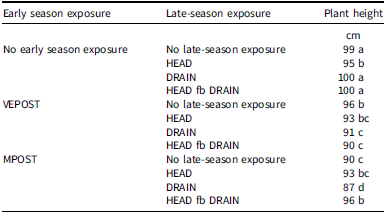
The height of mature rice plants was influenced by early versus late-season paraquat exposure (P = 0.028). Compared with plants that did not receive a paraquat treatment and those that were treated at DRAIN and HEAD fb DRAIN but no early season treatment, all other treatments resulted in shorter rice plants (Table 4). Plant heights were similar and ≥93 cm following paraquat exposure at VEPOST only, VEPOST fb HEAD, MPOST fb HEAD, MPOST fb HEAD fb DRAIN, and HEAD only. Total and whole milled rice yields were not affected by early or late-season exposure to sublethal concentrations of paraquat (P ≥ 0.0880) (data not presented). Our current results are congruent with those reported by McCoy et al. (Reference McCoy, Golden, Bond, Dodds, Bararpour and Gore2020), who observed that all cultivars they evaluated produced total milled rice >95% of nontreated crops following late-season exposure to sublethal concentrations of paraquat. Conversely, McCoy et al. (Reference McCoy, Golden, Bond, Dodds, Bararpour and Gore2020) observed an 8% reduction in milled rice yield after late-season paraquat exposure. However, McCoy et al. (Reference McCoy, Golden, Bond, Dodds, Bararpour and Gore2020) noted varying cultivar sensitivity following exposure to sublethal concentrations of paraquat; the lack of a response in whole milled rice from the CL153 cultivar evaluated in the current study may not be indicative of all modern rice cultivars.
Influence of early season and late-season treatments of sublethal concentrations of paraquat on rice height at maturity.a–c

Table 4. Long description
A table comparing the height of mature rice plants influenced by early versus late-season paraquat exposure. The table has three columns and nine rows. The columns are labeled Early season exposure, Late-season exposure, and Plant height. The Plant height column is measured in centimeters. The rows compare different combinations of early and late-season exposures and their corresponding plant heights. Row 1: No early season exposure, No late-season exposure, 99. Row 2: No early season exposure, HEAD, 95. Row 3: No early season exposure, DRAIN, 100. Row 4: No early season exposure, HEAD fb DRAIN, 100. Row 5: VEPOST, No late-season exposure, 96. Row 6: VEPOST, HEAD, 93. Row 7: VEPOST, DRAIN, 91. Row 8: VEPOST, HEAD fb DRAIN, 90. Row 9: MPOST, No late-season exposure, 90. Row 10: MPOST, HEAD, 93. Row 11: MPOST, DRAIN, 87. Row 12: MPOST, HEAD fb DRAIN, 96. The table shows that different combinations of early and late-season paraquat exposure result in varying plant heights, with some combinations leading to shorter plants compared to those that did not receive any treatment.
a Abbreviations: DA, days after; DRAIN, applications to rice the day of draining; fb, followed by; HEAD, applications to rice when 50% of plants in a plot had visible panicles; MPOST, applications to rice in the 3- to 4-leaf growth stage; VEPOST, applications to rice in the spiking to 1-leaf growth stage.
b Data were pooled over three experiments. Means followed by the same letter are not different at P ≤ 0.05.
c Paraquat was applied at 84 and 28 g ai ha−1 in early season and late-season treatments, respectively.
Practical Implications
This study indicates that multiple exposures to sublethal concentrations of paraquat negatively affects rice performance. Multiple exposures to paraquat had the greatest effect on rice performance when exposure occurred both early and late in the season. Rice was most sensitive following early season exposure fb exposure at HEAD fb exposure at DRAIN. The widespread use of paraquat as a herbicide, coupled with the broad window during which desiccation can occur in the mid-southern United States highlights the probability of rice being exposed to paraquat multiple times throughout the rice growing season. To mitigate detrimental effects from rice exposure to paraquat-based herbicide treatments, caution should be exercised when treatments are applied to fields in proximity to rice if conditions are conducive for off-target movement.
Acknowledgments
We thank personnel at the Mississippi State University Delta Research and Extension Center for their assistance.
Funding
This publication is a contribution of the Mississippi Agricultural and Forestry Experiment Station. This study is based on a larger study that is supported by Hatch project MIS-100019, which is funded by the U.S. Department of Agriculture–National Institute of Food and Agriculture. In addition, we extend gratitude to the Mississippi Rice Promotion Board for partially funding this research.
Competing Interests
The authors declare they have no competing interests.




 Open access

