Since the beginning of the coronavirus disease of 2019 (COVID-19)pandemic, the doctors of different specialisations have been challenged by the increasing number of patients infected with Severe Acute Respiratory Syndrome Coronavirus-2. Cases of severe heart damage in children presenting with multisystem inflammatory syndrome in children are intriguing. Cardiac abnormalities that may appear in the course of multisystem inflammatory syndrome in children include features of acute myocardial injury in the form of moderately elevated levels of cardiac troponins, significantly elevated levels of brain natriuretic hormone or its N-terminal prohormone (NT-proBNP); cardiac contractility abnormalities on echocardiography, including decreased left ventricular ejection fraction; acute heart valve regurgitation; the presence of fluid in the pericardium; coronary arteries abnormalities, including dilatation and coronary artery aneurysms; and cardiac electrophysiological dysfunction, including arrhythmias, atrioventricular conduction disturbances, and changes in the ST segment and T wave. Reference Simpson and Newburger1,Reference Belhadjer, Méot and Bajolle2
The pathophysiology of myocardial changes in the course of multisystem inflammatory syndrome in children has not been fully understood yet. Takotsubo syndrome is being presented among the possible explanations for the observed abnormalities. Reference Sperotto, Friedman and Beth3 While the cases of Takotsubo syndrome in adults with COVID-19 have been well described before, Reference Giustino, Croft and Oates4,Reference Roca, Lombardi and Campana5 data on this subject in the paediatric population are very limited. So far, there has only been one mention of a patient with apical contractility disorder corresponding to Takotsubo syndrome in a patient with multisystem inflammatory syndrome in children. Reference Belhadjer, Méot and Bajolle2
We present a case of a child with multisystem inflammatory syndrome in children diagnosed on the basis of World Health Organisation criteria 6 and with cardiac changes corresponding to Takotsubo syndrome. 7
Case report
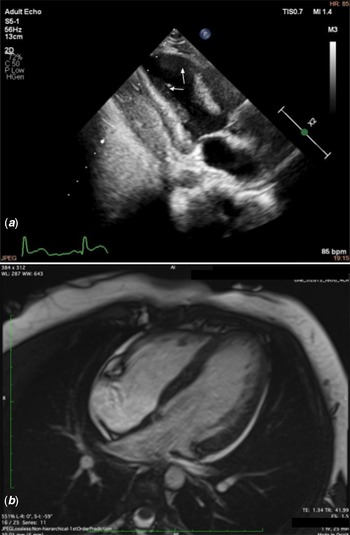
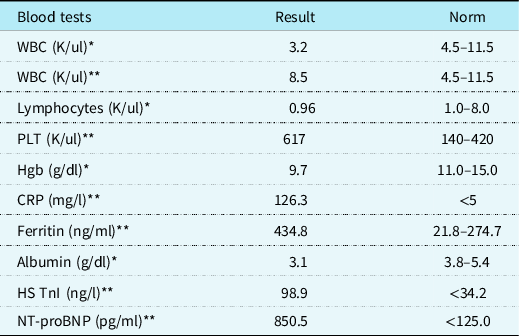
A 12-year-old boy with no significant medical history was admitted to the hospital in June, 2020 (during the so-called first wave of COVID-19 in Poland). About 5 weeks before this, his household developed symptoms of respiratory infection after contact with COVID-19. In the presented case, the disease started with acute abdominal pain (imitating acute appendicitis). It was followed by fever, other gastroenterological symptoms (vomiting, diarrhoea), and non-purulent conjunctivitis. Laboratory results revealed high inflammatory markers, lymphopoenia, elevated troponin levels (106 ng/l), and NT-proBNP (850.5 pg/ml) (Table 1). Tests for Severe Acute Respiratory Syndrome Coronavirus-2 indicated a past infection with negative real-time polymerase chain reaction test result and positive IgG antibodies. After excluding other possible causes of the disease, multisystem inflammatory syndrome in children was diagnosed. The patient remained in a fairly good general condition; the disease was self-limiting – the fever subsided after 8 days (on the 10th day after the onset of disease symptoms). On day 11, echocardiography revealed slight regurgitation of the atrioventricular valves, with no abnormalities in myocardial contractility; however, the left ventricular geometry remained altered with a distinct apical rounding (Fig 1). There were no abnormalities in the image of the coronary arteries. The resting ECG showed the presence of first-degree atrioventricular block and abnormal ventricular repolarisation in the form of flattened T waves in the precordial leads. Myocarditis was excluded on the basis of cardiac MRI, performed 19 days after the first symptoms – no swelling of the heart muscle was visualised in TIRM sequences, no foci of delayed enhancement were found in the late phase after contrast, attention was drawn to the rounding of the left ventricular apex, although already less apparent (Fig 1). MRI did not show any abnormalities in the coronary arteries.
( a ) Echocardiogram of a 12-years old boy with multisystem inflammatory syndrome showing Takotsubo cardiomyopathy in acute phase. Arrows point the ballooning of the apical portion of the left ventricle. ( b ) Cardiac magnetic resonance imaging (MRI), performed 19 days after the first multisystem inflammatory syndrome symptoms: the discrete rounding of the left ventricular apex – feature of subsiding Takotsubo cardiomyopathy. No other abnormalities were revealed.

Laboratory findings of case report. A patient with multisystem inflammatory syndrome in children (MIS-C) and Takotsubo syndrome (TTS)

CRP = C-reactive protein; Hgb = hemoglobin; HS TnI = high sensitivity troponin I; NT-proBNP = N-terminal prohormone brain natriuretic peptide; PLT = platelet count; WBC = white blood cell count.
* Lowest values were obtained.
** Highest values were obtained.
Laboratory test results, including troponin I and NT-proBNP levels, normalised over the next 10 days. Echocardiography returned to normal by the time of follow-up echocardiography performed after 4 weeks. Control MRI performed after 7 months revealed no abnormalities.
Discussion
Multisystem inflammatory syndrome in children is a complication occurring about 4 weeks after (usually asymptomatic or mildly symptomatic) infection with Severe Acute Respiratory Syndrome Coronavirus-2 in children. Reference Belay, Abrams and Oster8,Reference Payne, Gilani and Godfred-Cato9 Multisystem inflammatory syndrome in children is based on immune dysregulation following coronavirus infection. Reference Brodin10 Due to the partial convergence of clinical symptoms, the disease was compared primarily with Kawasaki disease, as well as with toxic shock syndrome and macrophage activation syndrome, but the further analyses suggest that it is a separate, new entity which emerged in the course of the COVID-19 pandemic. Reference Belay, Abrams and Oster8–Reference Brodin10
The disease most often occurs in children of school age (the median is 9 years of age, which is one of the distinguishing features of Kawasaki disease). The most common symptoms include fever, gastrointestinal symptoms, including – as in the presented case – severe abdominal pain, skin and mucosal symptoms, and features of involvement of the cardiovascular system. The most common complications include acute heart failure, hypotension, and shock, while the permanent complications include coronary artery aneurysms. Reference Belhadjer, Méot and Bajolle2,Reference Belay, Abrams and Oster8,Reference Payne, Gilani and Godfred-Cato9
The pathomechanism of cardiac changes in the heart muscle observed in patients with multisystem inflammatory syndrome in children remains unknown. One of the possible mechanisms is the Takotsubo syndrome, as described in the presented case. Takotsubo syndrome is a rarely recognised entity in the paediatric population. Virtually all documented Takotsubo syndrome cases in the paediatric population are from pre-COVID-19 pandemic time. Most of them were associated with emotional experiences, psychiatric disorders or the use of psychoactive substances. Reference Sendi, Martinez, Chegondi and Totapally11 A disease state that causes a strong activation of the adrenergic system can also be a stress factor for the body. There have been reports of Takotsubo syndrome in children with sepsis. Reference Sendi, Martinez, Chegondi and Totapally11 It is quite likely that the unusually strong autoinflammatory response seen in multisystem inflammatory syndrome in children could also be such a trigger. Therefore, during the cardiological evaluation of patients with myocardial dysfunction in the course of multisystem inflammatory syndrome in children, the possibility of Takotsubo syndrome, which may be neglected in the paediatric population due to its rarity, should be taken into account.
Differentiating between acute coronary syndromes, myocarditis, and other causes of cardiac complications is of significant clinical importance due to different prognosis and management. The pandemic has created a unique situation where it is possible to multicentric observation of numerous clinical cases of similar complications caused by the same trigger factor in a short period of time. So perhaps keeping a close eye on Takotsubo cases among children with multisystem inflammatory syndrome in children will also help to better understand the changes underlying Takotsubo syndrome.
Acknowledgements
We would like to acknowledge professor Leszek Szenborn who provided advice and supported the diagnostic process.
Financial support
This research received no specific grant from any funding agency, commercial, or not-for-profit sectors.
Conflicts of interest
None.
Ethical standards
Ethical approval was obtained from the Bioethics Committee at Wroclaw Medical University, Poland (CWN UMW BW: 437/2021).