While mother played an afternoon of Mah Jong with friends, we children listened to records or the radio. We heard a lot of Hawaiian music and I can remember the sliding and waving guitar tones over a gap of almost eighty years. The wonderful sculpture and architecture of Nek Chand, near Chandigarh set me to composing three small pieces in admiration.
—Lou HarrisonFootnote 1
On a fall morning in 2001, guitarist David Tanenbaum and luthier Kenny Hill drove to Lou Harrison's house in Aptos, California in a station wagon full of guitars. Tanenbaum had received word from Charles Amirkhanian, director of the Other Minds festival of contemporary and avant-garde music in San Francisco, that Harrison had agreed to a commission for a new guitar piece—on some conditions. The composer was not interested in writing for the classical guitar, an instrument that he found lacking in power and sustain, and favored the use of just tunings over equal temperament.Footnote 2
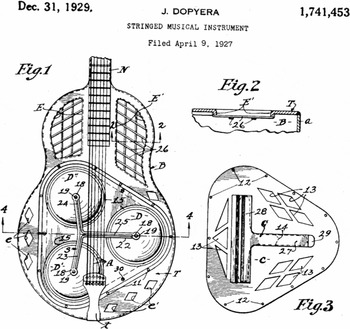
Tanenbaum's “guitar audition” began with his own most prized, French-made classical: “First I tried a Friederich for him, and then Kenny and I loaded a station wagon with lots of types of guitars—steel, twelve-string, Dobro—and Lou always said no.” Hill then thought of Dave Scully, a Santa Cruz street musician who performed on an old metal-body tricone resonator guitar. Hill and Tanenbaum located the busker, borrowed his guitar for an afternoon in exchange for lunch money, and brought it back to Harrison, who instantly and enthusiastically approved of the sound.Footnote 3 Tricone resonators, which were especially popular in the 1920s and 30s, use three wafer-thin spun aluminum cones, which are connected to the strings through a T-shaped bridge and resonate sympathetically to increase volume and projection; the individual cones can sometimes vibrate slightly out of phase with one another, producing a characteristic wavering vibrato effect (Figure 1).
Illustrations from one of John Dopyera's patents for the tricone resophonic guitar.

Having found an acceptable instrument, Harrison composed a piece in just intonation, inspired not only by the unique tone of the tricone resonator, which reminded him of Hawaiian music he heard on the radio as a child, but also by the imaginative work of Nek Chand (b. 1924), a self-taught sculptor and architect from India and the creator of the Rock Garden of Chandigarh. Around the time of the Other Minds commission, Harrison encountered a retrospective feature on Nek Chand in a book dedicated to outsider art, and found the visuals, as well as the artist's story, particularly moving.Footnote 4 In 1965, while working as a roads inspector for Chandigarh's Public Works Department, Nek Chand began developing a series of interlinked courtyards in a greenbelt area, incorporating sculptures made of found objects and recycled materials. Local authorities discovered this unsanctioned development in 1972; yielding to public pressure, they spared the garden from demolition and granted the artist a permanent workforce for expansion and upkeep in 1976.Footnote 5 As I will explain, these two seemingly disparate inspirational sources—the resophonic guitar used in Hawaiian music and the art of the Indian Nek Chand—in fact share a common historical link, the kind of cross-cultural connection that fascinated Harrison throughout his life.
Scenes from Nek Chand was commissioned with funds from Los Angeles new music patron Betty Freeman. It bears a dedication to Charles Amirkhanian, his wife Carol Law, and guitarist David Tanenbaum, who presented the premiere on 7 March 2002 at the eighth annual Other Minds festival in San Francisco. The work was recorded soon after, not only by Tanenbaum, but also by John Schneider, a guitarist who has specialized in microtonal and just intonation music, and who contributed to the difficult process of creating a just intonation fingerboard for the tricone resonator. Both his recording and Tanenbaum's were released within days of each other in June 2003.Footnote 6 As Harrison's last completed piece, Scenes from Nek Chand combines his lifelong interests in alternative tunings, instrument-building, and cross-cultural pollination. Perhaps most surprisingly, Harrison's visionary (if impractical) instrument choice would be validated by the many composers who have been writing for the just intonation resophonic guitar since the piece's premiere, thus contributing to an alternative guitar repertoire for the new millennium.
Fretting Matters: Guitars and Tuning Systems through the Ages
The use of just intonation on the guitar might at first appear unusual. Guitars, like lutes, viols, and other fretted instruments have been associated with equal temperament since the mid-sixteenth century.Footnote 7 Nevertheless, there have been attempts, dating to the Renaissance and Baroque, to realize a range of other temperaments and tunings on fretted instruments. Theorist Juan Bermudo (1510–65) and composer Luis Milán (c. 1500–61) advocated the use of a range of positions for some of the Spanish vihuela's tied frets to create irregular meantone tunings that would feature purer thirds on some strings at the expense of others.Footnote 8 An article presented to the Royal Society of London by Thomas Salmon in 1705 suggests placing independent fretlets under the individual strings of a viol in order to replicate the pure ratios of justly tuned intervals; the author even recommends the use of a different fingerboard for each key, describing how “they are taken out and put in upon the Neck of the Viol, with as much ease, as you pull out and thrust in the Drawer of a Table.”Footnote 9 More recent examples include Harry Partch's “Adapted Guitars,” which employed an assortment of open string and fretboard tunings (including a fretless model to be played with a sliding rod) and figure in the earliest versions of Partch's “hobo” works, such as Barstow (1941) and U.S. Highball (1943).Footnote 10 A more recent work of note is Ben Johnston's The Tavern (1999), which uses a refretted classical guitar to accompany the voice in a setting of the thirteenth-century Persian poet Rumi.Footnote 11
Harrison's experiments with different tuning systems on the guitar date to 1952, when he sent a one-page manuscript piece, Serenado por Gitaro, to composer Frank Wigglesworth. In an accompanying letter, Harrison suggested that the guitar could be tuned diatonically if an instrument with moveable frets were available. He might have been thinking of lutes, however; in 1952 guitars with moveable frets would not have been easy to find (and gut-fretted lutes would have been in similarly short supply). Harrison had been obsessed with just intonation ever since he read Harry Partch's Genesis of a Music in 1949, and this letter shows that the possibility of pure intervals on the guitar was already on his mind.Footnote 12
In 1977 Harrison met Tom Stone, the inventor of a system of interchangeable fingerboards for guitars and other fretted instruments called Switchboards. The design allowed the player to secure a number of different fingerboards to a specially made neck, thus enabling the use of a variety of tuning systems on the same instrument—not unlike what Salmon had advocated nearly three centuries earlier.Footnote 13 Fascinated with the idea, Harrison arranged to have such a guitar made to assist in the composition of five suites for the instrument, each in a different tuning. The first of these planned works, the Serenade for Guitar and Optional Percussion, was completed in 1978; however, Stone never delivered the promised guitar, leading Harrison to incorporate the early sketches of a second suite into what is now the String Quartet Set (1979).Footnote 14 Guitarists such as Tanenbaum and Schneider have since labored tirelessly (with the composer's blessing) to adapt Harrison's pieces for other plucked strings for performance, and many of his harp and harpsichord pieces have now become popular as guitar transcriptions. More recently, Schneider completed a series of “suites” in different modes by grouping pieces according to their tunings; by using removable fingerboards, the suites can be performed as a set, as Harrison originally intended.Footnote 15
Rather than employing removable fingerboards, the guitar for Nek Chand requires a fixed and highly idiosyncratic fretboard that could accommodate Harrison's tuning scheme, which is based on pure ratios of the sixth through eleventh harmonics. In addition to performers Tanenbaum and Schneider, the conversion of the instrument involved collaboration with a number of other figures. The details of the tuning calculations were worked out by Bill Slye (1970–2010), a young guitarist/composer from the University of California, Santa Cruz who had been studying informally with Harrison in Aptos. Slye worked with Bill Alves, a Southern California composer and codirector (with Schneider) of the microtuning festival MicroFest. Slye also recruited Don Young, CEO of National Reso-Phonic Guitars of San Luis Obispo, California, to help with the production of the custom instruments. By May 2002 National Reso-Phonic had built five just intonation tricones, two of which were intended as “loaners” to be circulated among guitarists and composers to stimulate further pieces for the instrument. Currently four are owned by Schneider, Tanenbaum, guitarist Elliot Simpson (The Hague), and composer Garry Eister (Santa Maria, California). The fifth instrument remains in the possession of the company.
Harrison's choice of a specialty guitar should not come as a surprise. He had written works for found, foraged, or newly constructed instruments since the 1930s, and had learned that performers (often his friends) were willing to indulge him.Footnote 16 For Harrison, the quality of the sound itself was paramount, and he would sooner build a new instrument than make do with one that could not deliver his ideal sound; he also vociferously eschewed amplification, always opting to resolve matters of volume and balance by means of instrumentation and orchestration. For example, in his Concerto for Pipa with String Orchestra (1997), Harrison chose the Chinese lute for its ability to be heard over the orchestral ensemble, thinning out the accompaniment in the quieter passages.Footnote 17
In the case of the classical guitar, Harrison had pointed to its short sustain and overall lack of power as the main drawbacks of an instrument for which he otherwise felt an affinity.Footnote 18 The tricone resonator addressed all of these issues, offering a louder, richer, and more sustaining timbre produced in an entirely acoustic way. From an extra-musical point of view, the instrument also mirrors the piece's inspiration; through the filter of Harrison's imagination, the resophonic guitar has been thought anew, repurposed from its previous context like the recycled sculptures of Chand's fantastical gardens.
Part One: Reminiscence—Tracing the History of Harrison's Inspirations
In his inscription to the score of Nek Chand, Harrison refers to the music of the Hawaiian Craze of the 1920s and 1930s as an inspiration; the sound of those “sliding and waving guitar tones” was the sound of the tricone resonator-equipped steel guitar. “Steel guitars” are referred to as such not because of the material from which they are built, but because of the manner in which they are played. Instead of fretting individual strings with the left hand, the strings are stopped by a rod typically called a “steel,” which is made of polished steel, brass, ceramic, or glass. Because the strings are tuned to various triadic configurations, the rod can be used to slide single-note lines as well as chords. This method of playing, which originates in late nineteenth-century Hawaiian practices, features the guitar held flat in the lap for better access. Because the sliding hand approaches the fingerboard from above, rather than reaching around the neck as with the traditional playing position, Hawaiian makers began to modify the typical Spanish design around the turn of the century. Necks were hollowed out and built using a square, rather than D-shaped, section, increasing structural strength and resonance, and steel strings supplanted gut and silk.Footnote 19
Some of these design elements, popularized in the early decades of the twentieth century by notable guitarmakers such as Chris Knutsen and Oscar Weissenborn, are apparent in the work of John Dopyera, a Slovak immigrant with a penchant for innovation, as attested by the patents he filed for improved neck-setting methods for violins, and mechanical optimization of banjo heads.Footnote 20 In 1924 Dopyera was approached by George Beauchamp, a vaudeville guitar player who was looking for a louder, better projecting guitar. Dopyera had already been considering various resonating devices, and through Beauchamp's prodding he finally designed the tricone resonator in 1926, receiving patents in 1928, 1929, and 1930. (See Figure 1 for one of Dopyera's patent illustrations.) Dopyera's original design was a metal-bodied instrument with a square neck meant exclusively for slide playing.Footnote 21 Round-neck, Spanish-style tricone guitars followed by the end of 1928.Footnote 22
The collaboration between Dopyera and Beauchamp led to the birth of the National Resonator Instruments company in 1927; however, the entrance of the United States into the Second World War effectively halted production and led to the dissolution of the company.Footnote 23 Nationals from the 1930s became extremely rare, sought after by collectors and performers alike beginning with the folk revival of the late 1950s and early 1960s. In more recent years, new instruments have been re-created according to the original specifications by National Reso-Phonic Instruments of San Luis Obispo, California—the company that would eventually bring to life the uniquely tuned Lou Harrison tricones.
Among the many musicians using National guitars, Sol Hoopii (1902–53) is generally credited as the first Hawaiian player to adopt a tricone resonator; he was given a guitar by National as early as 1926, and was featured extensively in the company's catalogs. Through his activity in Hollywood and in the recording studio, Hoopii established a permanent link between Island music and the sound of a resonator. He provided the soundtrack for popular Hawaiian-themed movies such as Bird of Paradise (1932), Waikiki Wedding (1937), and the cartoon feature Betty's Bamboo Isle (1937), and recorded dozens of traditional Hawaiian numbers for Columbia and Brunswick.Footnote 24 Other influential players such as the Tau Moe Family, Sam Ku West, Jim and Bob of “The Genial Hawaiians,” and David Kane also performed on National tricones.Footnote 25 The soundscape they created pervaded the country.Footnote 26 Radio programs of Hawaiian music date to 1923, and many stations held weekly shows dedicated to the style, such as the popular Hawaii Calls (1935–75); the music had its television debut in October 1939 when the Honolulu Serenaders appeared on a broadcast by the Farnsworth Television and Radio Corporation.Footnote 27 Musicians in other genres, such as Western swing bands in the Texas-Louisiana-Oklahoma region and bluesmen in the Mississippi Delta, also adopted resonator instruments.Footnote 28 Tricone resonator guitars are still employed in popular genres today, from Hawaiian and country to fingerstyle guitar and blues. Thanks to Harrison's determination, they have also found an unexpected niche in the classical guitar repertoire.
The Tuning of Nek Chand's Guitar
The exploration of just tuning systems constitutes one of the main features of Lou Harrison's mature style. The composer, who preferred pure intervals to the otherwise predictable and limited palette of intervals available in equal temperament, developed what had been a youthful interest into enthusiastic endorsement and, ultimately, complete philosophical advocacy. This process can be seen as a quest for freedom; to Harrison, the identical intervals of equal temperament were ultimately colorless next to the microtonal gradations provided by a system of pure harmonic ratios. He incorporated intonational considerations into his music in a remarkably organic way, as shown by the number of instruments he designed and crafted to produce his required tones; stylistically, he often employed homophonic textures to allow tuning and temperamental nuances to be heard clearly.
The turning point of Harrison's harmonic journey came in 1949, two years after suffering a severe nervous breakdown while living in New York City—a crisis stemming from the combination of a demanding yet unrewarding professional schedule, difficult romantic relationships, and a general aversion to the chaotic and noisy metropolitan life. Succored by John Cage and supported by Charles Ives, Frank Wigglesworth, and Virgil Thomson, among other friends, Harrison embarked on a lifelong path to recovery after nine months of clinical stay. Part of his therapy included a biographical reconstruction; the composer interpreted this prescription in a larger musical sense, retracing the harmonic and tuning theories found in Early Modern and Medieval European treatises to the works of ancient Greek and Hindu theorists.Footnote 29 While occupied in this research, Harrison received a copy of Harry Partch's Genesis of a Music from Virgil Thomson, who accompanied the gift with a sibylline invitation to make “what he could” out of it.Footnote 30 Partch's theorization of a new monodic language, based on a forty-three division octave in pure mathematical ratios, served as a catalyst for the recovering composer to break free from the constraints of both equal temperament and the twelve-tone explorations of his student days.Footnote 31
After his return to California in 1953, just intonation grew into an outright obsession for Harrison, who incorporated it in most of his works and progressively charged it with political and philosophical implications.Footnote 32 In an early example, the Strict Songs for eight baritones and chamber orchestra (1955), the composer specified the ratios for tuning the pentatonic modes employed in each of the four movements; piano and harp are required to retune, whereas strings, trombones, and voices can of course match these pitches. The limited pitch collection of pentatonic and hexatonic modes allow for uncompromised just tunings, and Harrison explored them extensively; in 1961 he spent his time aboard a freighter to Japan devising forty-three pentatonic computations in a variety of tunings.Footnote 33 Harrison completed the move from accompanied voices to solo keyboard in just intonation with Cinna (1957), a tack-piano or harpsichord piece that required a complete overhaul of the instrument's tuning. The piece features eleven sizes of seconds and thirds, and five kinds of fourths, all of which are used to great expressive effect.Footnote 34
In 1967 Harrison met William Colvig, an electrician with a passion for acoustics; the two men would become lifelong partners. Through their combined efforts, the composer's commitment to alternative intonation systems found a new outlet in instrument building.Footnote 35 Starting with simple harps and psalteries, the couple graduated to building and tuning complex ensembles such as the “American Gamelan,” an eclectic collection of resonating metallophones tuned to a just D major scale spanning more than five octaves that they later affectionately nicknamed Old Granddad. In the following years, Harrison and Colvig would build gamelans for San Jose State University and Mills College, which they tuned in accordance to acceptable Javanese standards, but featuring pure, non-beating interval ratios.Footnote 36
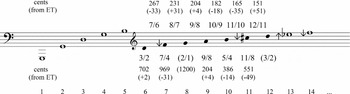
In light of Harrison's penchant for instrument building and alternative tunings, it should come as no surprise that he decided to cast his Scenes from Nek Chand in just intonation, or that he modified the standard arrangement of a guitar's tuning to meet his sonic requirements. As we have seen, Harrison was particularly interested in modes containing only five or six pitches. In an interview with John Schneider, he mused that he had spent most of his life coming up with “new” modes, when he found that a six-note scale occurred naturally in the harmonic series encompassing overtones six through eleven. Because intervals become progressively smaller as one ascends further in the series, this collection is the only contiguous six-note mode within an octave.Footnote 37 For Scenes from Nek Chand, Harrison based his scale on a low G, resulting in the mode D–F–G–A–B–C-sharp–D. As noted by composer and theorist David Doty, this tuning can also be characterized as otonal, Harry Partch's term for a collection of pitches derived from the overtone series (in this case, harmonics 1, 3, 5, 7, 9, and 11).Footnote 38Example 1 shows the overtone series on G with the notes used in Nek Chand indicated, along with their variance in cents from equal temperament.
Overtone series on G, with the pitches of Nek Chand represented by filled notes. The two rows of ratios indicate intervals between adjacent pitches of the mode (above the staff), and the intonation of each individual pitch in relation to the fundamental G (below the staff), with deviation from equal temperament in cents.

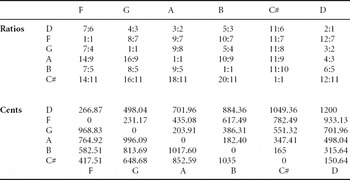
The tuning falls within the so-called eleven-limit, meaning that the eleventh harmonic is the highest prime number factor necessary to derive the tuning's intervals. Comparing sizes in cents (see Table 1), the subminor third D–F (~267 cents) and the neutral seventh D–C-sharp (~1049 cents) stand out as the intervals furthest removed from their equal-tempered counterparts of 300 and 1100 cents. The C-sharp in question is indeed a close approximation of the quarter tone between C and C-sharp in equal temperament, and Harrison exploits its poignancy at salient points in the piece, as will be highlighted later.
Intervals for Scenes from Nek Chand

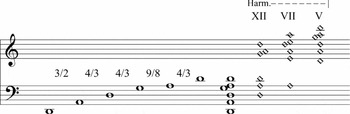
Such a collection of notes clearly requires an extensive modification of the guitar's tuning and positioning of frets. For Nek Chand, Harrison specified that the strings be tuned to D–A–D–G–A–D, low to high, a configuration that appears frequently in fingerstyle acoustic and Celtic guitar playing, but is foreign to most classical settings; it is likely that Harrison was introduced to the so-called DADGAD tuning by his pupil Bill Slye, who was a guitarist as well as a student of intonation systems.Footnote 39 In the DADGAD tuning, the shared harmonics between the strings, detailed in Example 2, maximize sympathetic resonance, resulting in a glowing sound when paired with the tricone's rich timbre and long sustain. These overlapping harmonics can also serve as a reference for tuning, as in the sequence notated in Example 3. Such a tuning offers a great practical advantage for the performer, as G–D and D–A are the two pure fifths in the mode of Nek Chand. Moreover, reducing the number of open pitches simplifies the calculations for the new just-intoned fretboard. These benefits, however, come with the disadvantage that the guitarist must learn a new set of fingerings.
open strings of a guitar tuned to DADGAD, with their respective harmonics at the twelfth, seventh, and fifth fret. (notated at sounding pitch)

sample tuning sequence using harmonics and open strings only (notated at sounding pitch).

Retuning the open strings was by far the simpler part of the process, as the guitar also needed an entirely new fretboard that would produce the required just intervals. Because there was not enough time for the construction of an appropriate instrument, Tanenbaum gave the world premiere of Scenes from Nek Chand in equal temperament, with the exception of the first movement, which features a slide throughout and could thus be delivered in its intended form. After this first performance, Harrison and Slye enlisted the help of Schneider, a champion of music for guitar in alternative tunings, to help realize a tricone guitar in just intonation. Their work ultimately led to the formulation of a just tuning for the entire twelve pitches of the chromatic scale, and the resulting guitar inspired the composition of sixteen new works by other composers.
Part Two: Reflections—An Analysis of the Musical and Programmatic Elements of Scenes from Nek Chand
Harrison cast his Scenes from Nek Chand in three movements (slow–fast–fast), giving each section a title that would evoke elements from the sculptor's gardens in Chandigarh: “The Leaning Lady,” “The Rock Garden,” and “The Sinuous Arcade with Swings in the Arches.” Performances of the work average around ten minutes, with the opening slow movement taking about half the duration of the piece. Although the music remains confined to the same six-note mode from beginning to end, the movements differ in terms of texture, structure, and affect to provide variety and balance.Footnote 40
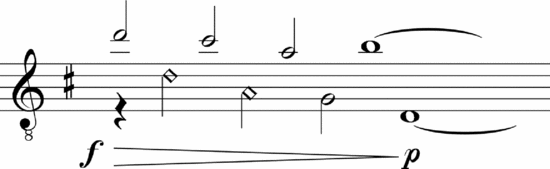
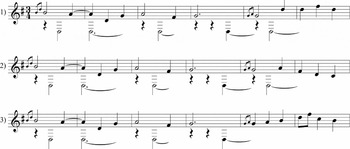
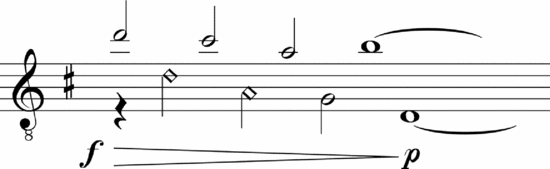
“The Leaning Lady” requires the guitarist to use a slide for the majority of the movement; the combination of the slide with the metal-bodied resonator recreates the signature sound of Hawaiian music that Harrison refers to in his program notes to the piece. The main motive's dual descending voices also serves as a representation of the eponymous slanting statue from Chandigarh;Footnote 41 the use of the slide, which Harrison encouraged to be “as sensuous” as one likes, gives the music a plaintive and meditative feel.Footnote 42 Structurally, the movement resembles an abbreviated rondo (A–B–A’–C–A”–B’–A’”) with a short coda; the downwards motive recurs in alternation with episodes that feature a melody played against interrupted drones—Harrison's personal interpretation of the jhala of classical Indian music.Footnote 43
Dual descending motive in “The Leaning Lady” (2001), Reproduced by permission of the Lou Harrison Archive, Special Collections, University of California, Santa Cruz.
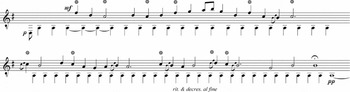
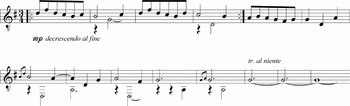
The piece's most idiosyncratic pitches, the “out-of-tune” F and C-sharp, appear in this movement in different guises; Harrison uses the F mostly as a passing tone, often sliding it down to D in a vocal gesture, whereas he gives the strident C-sharp more space, often letting it ring before resolving it. The resolution itself may occur in either direction, taking advantage of the almost equal distance from B or D (165 and 150 cents, respectively). As shown in Examples 5 and 6, both pitches sometimes appear in the same passage to build tension; the latter half of the phrase employs only sweeter-sounding intervals (such as the pure minor third B–D), thus offering a satisfying resolution. Harrison uses a similar device in the movement's coda, where the dissonant pitches become progressively scarcer until they disappear completely.
Interrupted drone (jhala) pattern in “The Leaning Lady” (2001), Notice the alternation of dissonant (C-sharp, F) and consonant intervals. Reproduced by permission of the Lou Harrison Archive, Special Collections, University of California, Santa Cruz.

“The Leaning Lady,” coda, with fading dissonances (marked with *) (2001). Reproduced by permission of the Lou Harrison Archive, Special Collections, University of California, Santa Cruz.

The gliding melody of Harrison's “The Leaning Lady” is not the first example of a musical thread connecting India to Hawaii. In an article on the relationship between Hawaiian steel guitar playing and its music, Mantle Hood reports the description of an 1884 performance by a man named Davion, an alleged stowaway traveler from India, who rested the guitar in his lap and played it with a rod held in the fretting hand. Hood notes the resemblance to the playing technique of the gottuvadyam, a type of Indian veena whose name literally means “sliding rod instrument,” which belongs to a tradition that could date back as far as 200 B.C.Footnote 44 He supports this hypothesis by alluding to a certain “untalkable” affinity between vocal and instrumental styles found in both Hawaiian and Indian musical idioms, with the voice and guitar imitating one another through range, color, and articulation. Drawing from recorded performances of Hawaiian music, Hood also highlights examples of parallel passages in falsetto (voice) and harmonics (guitar), the similar use of glides up to and down from the main note, and the careful employment of non-vibrato, straight tones as ornaments.Footnote 45
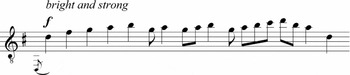
The second movement of Harrison's suite, The Rock Garden, features a much brisker tempo, and its boisterous single-note lines offer a radical departure from the placid atmosphere of the opening; the straightforward formal plan, a ternary structure with a brief coda, suits the exuberance of the music. Because of the scalar nature of the main theme (see Example 7) and the quick tempo, the pungent C-sharp goes almost unnoticed until the end of the first part, when it is highlighted by an insistent repeated-note passage. In the contrasting middle section, Harrison employs the fullest chords of the entire piece, a stack of fourths obtained from three open strings of the guitar, alternating with single-note passages in a call-and-response that culminates in a playful syncopated episode (see Example 8). Although there are no explicit programmatic references, The Rock Garden seems to convey Harrison's excitement for Nek Chand's creation in the jungle of Chandigarh.
“The Rock Garden,” main theme (2001–02). Reproduced by permission of the Lou Harrison Archive, Special Collections, University of California, Santa Cruz.

“The Rock Garden,” syncopated retransition (2001–02). Reproduced by permission of the Lou Harrison Archive, Special Collections, University of California, Santa Cruz.

Clearer extra-musical connotations return in the piece's last movement, inspired by the architectural detail of Chand's garden that struck Harrison's imagination most vividly. In conversation with John Schneider, Harrison conveyed his amazement at some of the pictures he had seen of the arcade:
A stream goes through the property and he's built an arcade, literally, following the shore. It's very big, and there are sizable arches made of bags of piled up concrete, but they are real arches. The arcade is two-sided, that is to say there are arches, and a roof with banisters so you can promenade on the top. In every arch there is an iron-chained swing for two people. It's just beautiful.Footnote 46
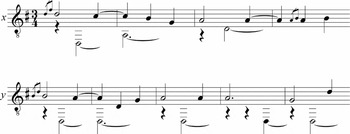
“The Sinuous Arcade. . .,” refrain x (above) and y (below) (2001–02). Reproduced by permission of the Lou Harrison Archive, Special Collections, University of California, Santa Cruz.

The music, in 3/4 for the first time in the piece, is marked “amiably swinging”; as instructed by Harrison, the guitarist is advised to incorporate a relaxed pushing-and-pulling into the phrasing to convey such an affect.Footnote 47 The texture recalls the implied polyphony and style brisé typical of seventeenth-century French lute music found in the works of Ennemond Gaultier and René Mesangeau, and then reprised by the school of clavecinistes. This peculiar textural approach represents perhaps another influence form Harrison's youth coming to the fore in the piece, as the composer was particularly interested in Baroque music in his formative years.Footnote 48
Harrison chose to write this final movement as an estampie, a medieval dance that he had employed in about a dozen other works, including the String Quartet Set, the Grand Duo (1987), the Concerto for Pipa and String Orchestra, and the Harpsichord Sonata (1999).Footnote 49 Traditionally, estampies feature repeating verselets followed by a short refrain with alternating “open” or “closed” endings; in this case, Harrison crafted a novel form, using two refrains of similar music, albeit with the melodic incipit of the second transposed down a third, which are then repeated without changes, yielding the scheme AxAy, BxBy, CxCy, DxDy, ExEy, CxCy, FxFy. The last notes of each refrain, however, are modified to lead seamlessly into the next verse.
The sections have varying lengths, with the repeat always longer due to an extra measure in the y refrains. Section F, the longest at 29 (14+15) measures, shows a remarkable use of the C-sharp, which is placed against first a G and then a D (yielding an 11:8 tritone and 11:6 seventh) in a poignant farewell gesture. Not unlike “The Leaning Lady,” this heightening of dissonance gives way to more consonant intervals, until the final dissolvenza of an unaccompanied trill on G.
Variations in the close of refrain y to accommodate for beginning of following verselet (2001–02). Reproduced by permission of the Lou Harrison Archive, Special Collections, University of California, Santa Cruz.

“The Sinuous Arcade. . .,” fading farewell gesture (2001–02). Reproduced by permission of the Lou Harrison Archive, Special Collections, University of California, Santa Cruz.

For the performer, Nek Chand poses a number of technical challenges that are not immediately apparent when looking at the score. The fretboard overhaul necessary to obtain the desired pure ratios requires the guitarist to learn to navigate a complex network of fretlets, as simply relying on muscle memory will not always provide the necessary accuracy. The performer must also learn a new set of fingerings for the DADGAD tuning, which shifts notes on the first, second, and sixth string two frets higher. Finally, the slide, required in the first movement, is unfamiliar to most classical guitarists; careful practice is needed in order to produce a full and convincing tone.
Performers must also decide how to approach the piece in terms of their picking hands. Bare fingernails (the classical guitarist's weapon of choice) are not only doomed by the tricone's steel strings, but also might prove too light to fully coax the instrument's tone and resonance—a matter of extreme importance for Harrison's aesthetics. The textures of the piece are sparse enough to allow for the use of a pick, if the performer has the required technical facility; alternatively, metal fingerpicks can be worn in the manner of folk and blues resonator players (as suggested by Schneider in his notes to the published score) thus allowing for the application of conventional right hand technique. The guitarist must become comfortable with all of these foreign elements (guitar, fingerboard, tuning, plucking technique) to give the kind of effortless performance that conveys the music's sense of serenity, tranquility, and awe.
Part Three: Resonance—The Legacy of Nek Chand
Dedicatee David Tanenbaum initially tried to dissuade Harrison from writing for such an unusual guitar, arguing that a more traditional instrument would interest guitarists all over the world. Harrison was steadfast, reportedly telling Tanenbaum that even a single performance in the Bay Area would be enough, but agreed to add a note to the score characterizing the just tuning as “only the preferred one,” thereby allowing for performances in equal temperament. What neither had foreseen was that the specially crafted guitar would elicit considerable attention from a diverse range of composers in the years following the premiere of Nek Chand. These new compositions utilize the full twelve-note tuning, devised in the spring of 2002 by Slye and Alves.Footnote 50
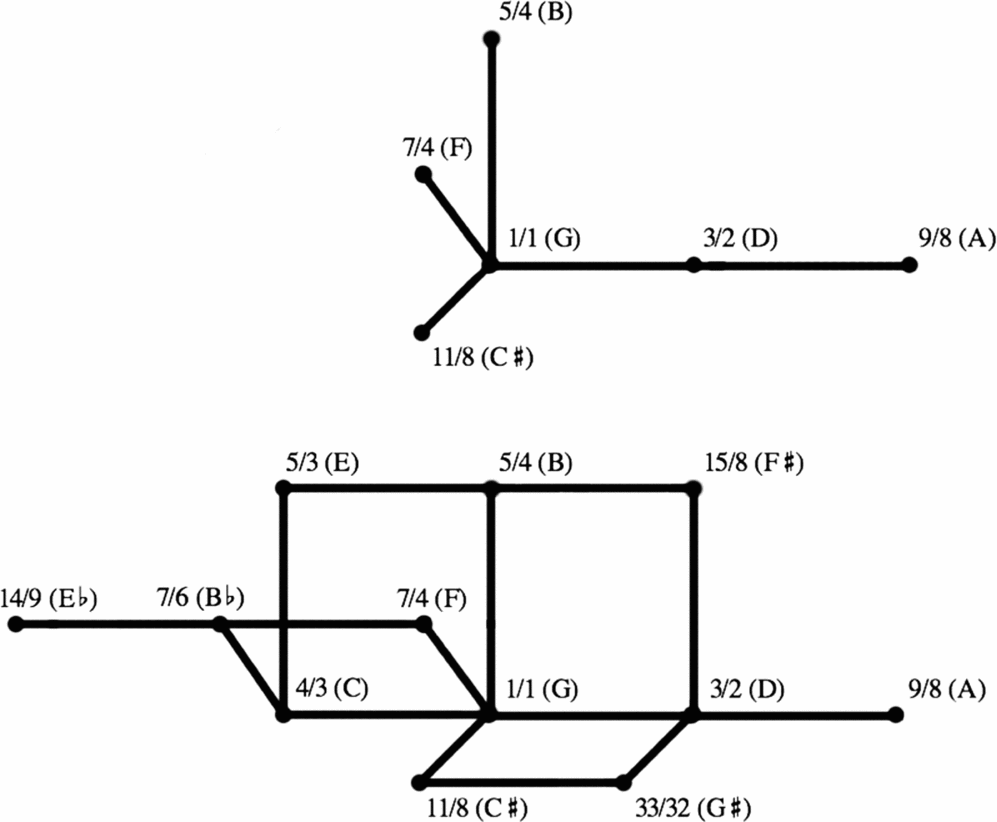
The evolution of the tuning is shown most clearly by the use of lattice diagrams, which in this case feature a ratio of 3:2 (pure fifths) on the horizontal axis, 5:4 (pure major thirds) on the vertical axis, and 7:4 (harmonic seventh) on the z-axis. To adapt the tuning's four prime factors to a three dimensional model, the 11:8 ratio was drawn “down and left.”Footnote 51 Comparing lattices for the original tuning and Alves's first proposal (Figure 2), one can see how the new G-sharp, B-flat, C, E-flat, E, and F-sharp were chosen to extend each of the four dimensions in a balanced and ultimately practical way. Along with a total of eight pure fifths (C–G, G–D, D–A, E–B, B–F-sharp, C-sharp–G-sharp, E-flat–B-flat, B-flat–F), the number of pure major triads grew from one (G–B–D) to three (adding D–F-sharp–A and C–E–G)—two features that increased the number of available tonal centers and, consequently, the possibilities for modulation, broadening the appeal to other composers. (Note that because the major thirds are given on the vertical axis and the perfect fifths on the horizontal ones, pure major triads are formed by lines at right angles.)Footnote 52
Lattice diagrams for the original tuning (above), and Bill Alves's proposal for a twelve-pitch completion (below). A left-to-right step on the horizontal axis represents a pure fifth (3:2); bottom-to-top describes pure major thirds (5:4); a harmonic seventh relationship (7:4) is drawn on the Z-axis (front to back); intervals with a ratio of 11:8 fall on an auxiliary fourth dimension, drawn in forward and left.
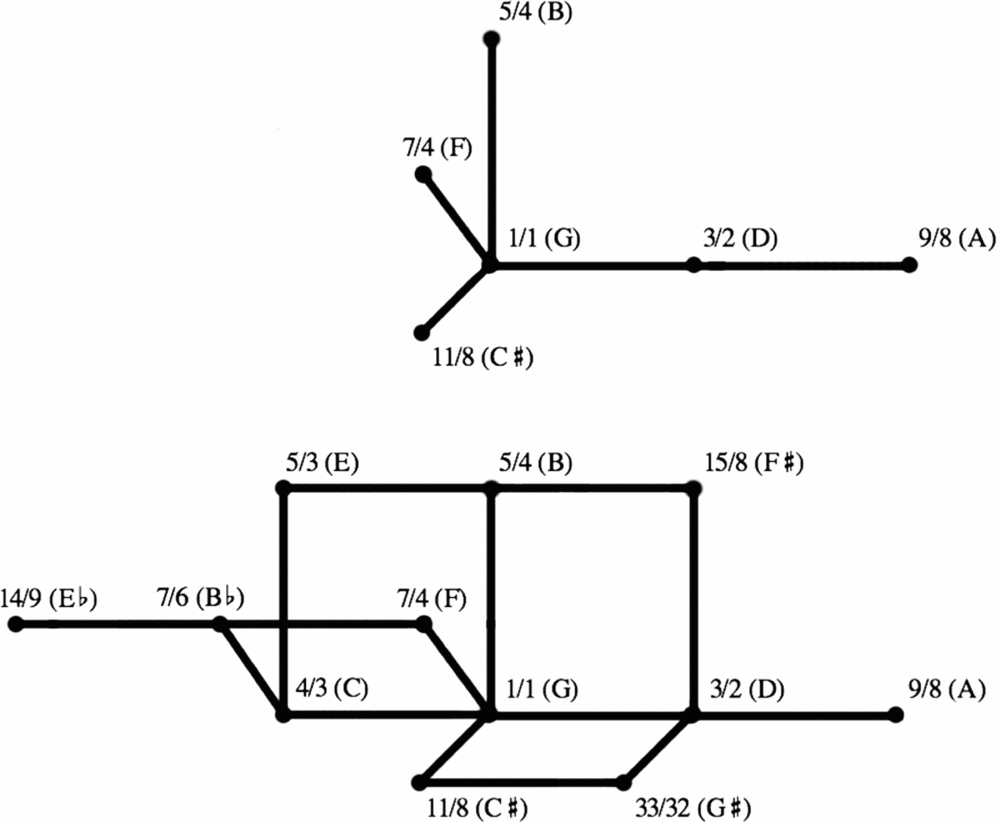
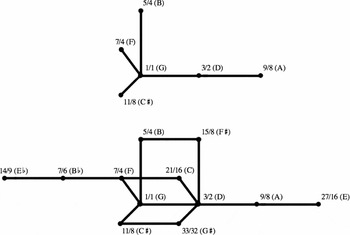
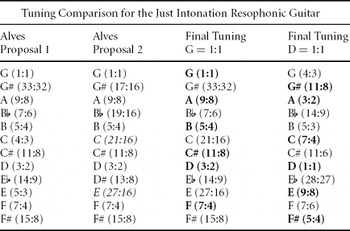
As an alternative, Alves conjured a scale made up exclusively of harmonics 16–32 of G, which would have resulted in an instrument of lush resonances but limited modulatory possibilities. The surviving correspondence between Alves and Slye shows that the latter was interested in modal variety and “blue” notes—those derived from the seventh harmonic and thus strikingly foreign to equal-tempered ears—more so than in expanding the tonal range of the instrument. Once given the two proposals, Slye tinkered with the possibilities, eventually incorporating the harmonic C (21:16) and E (27:16) into the framework of Alves's first tuning. The resulting hybrid allows for an assortment of modal flavors, while providing two viable tonal centers on G and D. As shown in Figure 3 below, the original six-note structure of Nek Chand was effectively duplicated in the process, being transposed by a ratio of 3:2 from G to D (one “step” to the right in the lattice). This structural shift results from the fact that the higher harmonics of G coincide with harmonics 6–11 of D—in more technical terms, the complete tuning now contains otonal hexads on G and D: G–D–B–F–A–C-sharp and D–A–F-sharp–C–E–G-sharp, respectively. The remaining two notes (B-flat and E-flat) reflect Alves's original instruction to keep the tuning within the eleven-limit rather than expanding it to higher orders of harmonics, as they were derived by extending the lattice down from F, the seventh harmonic of G. Table 2 juxtaposes the pitches and ratios for each tuning; a transposition of the final tuning to D highlights the recurrence of the Nek Chand mode, which now encompasses the scale A–C–D–E–F-sharp–G-sharp–A.
Bill Slye's final tuning scheme for the just intonation tricone resonator.

Side-by-side comparison of the two tuning proposals and final tuning; note the availability of otonal hexads (1:1–3:2–5:4–7:4–9:8–11:8) over G and D.

With the theoretical calculations in place, the last step required was to translate the tuning into practice, taking into consideration the physical attributes of strings as they are fretted (and thus stretched) and played—an endeavor in which Slye had some previous experience, having designed and inlaid two just-intoned guitar fingerboards, as well as a marimba keyboard, for his Senior Project at the University of California, Santa Cruz. According to National Reso-phonic CEO Don Young, who assisted Slye with the project, it took them the better part of a day to trace the prototype fingerboard with a movable fret and a strobe tuner; the resulting distances were then programmed into the company's computer-controlled fretboard routers, which in turn cut the slots into which the many fretlets were glued.Footnote 53 This newly tuned fretboard, characterized by a fractured, almost cubist, look, appeared on the five just-tuned tricones issued in spring of 2002; the just intonation premiere of Scenes from Nek Chand was immediately given by Schneider on 25 May in Los Angeles, for a concert dedicated to American just tunings as part of Microfest 2002.Footnote 54
A Rapidly Growing New Repertoire
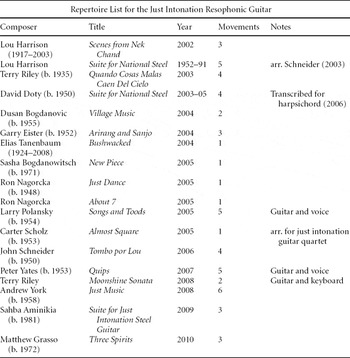
At the time of this writing, fourteen additional composers have written or arranged works for the just intonation tricone, including pieces with voice, keyboard, and even an ensemble of four Nationals (Table 3). Their ranks span three generations, from Terry Riley (b. 1935) to 31-year-old Iranian Sahba Aminikia; furthermore, the instrument has attracted composers who had not previously written for solo guitar, such as David Doty and Ron Nagorcka. The majority of these newly composed pieces were brought to life through the independent commissioning efforts of Schneider and Tanenbaum, who have, in fact, created an alternative twenty-first century guitar repertoire.
Current repertoire list for the just intonation resonator guitar.

One of the first composers to respond to the justly tuned resonator was Riley, who had been fascinated with the instrument since hearing Tanenbaum play Scenes from Nek Chand. In March 2003, the composer was arrested for assembling without a permit in Nevada City, California, where he had joined a demonstration against the U.S. invasion of Iraq. After spending one night in jail, the composer was found guilty and offered three choices by the judge: he could spend more time behind bars, pay a fine, or do some kind of community service. Riley chose the last option, suggesting he could write a piece of music as penance. That work, Quando Cosas Malas Caen del Cielo, depicts the events leading to Riley's arrest, the night in jail, and expresses, over the course of four movements, the composer's mounting feelings of horror caused by the first bombings of Baghdad.Footnote 55
Riley imaginatively employs the instrument's tuning to trace a descent from boisterous optimism to darkness and violence. The opening “National Broadstreet March” is written largely in D mixolydian, a mode that features a pure major third and sixth, perfect fourth and fifth, and a sweet minor seventh from the tonic; the tuning's more biting intervals, such as E-flat and B-flat, appear sparingly and mostly as coloristic appoggiaturas. “La Melodia Que Se Sienta Solo,” the second movement, features both a slide and a seven-note mode in overt homage to Harrison's “Leaning Lady;” together with the third movement, in which the tonal palette is further reduced to a mere five pitches, they offer textural contrast while increasing tension before the explosive finale. In the last movement, a brooding passacaglia, Riley employs the entire twelve-note gamut, with the dissonant intervals sounding especially strident and poignant by means of contrast. Because of its convincing and powerful musical rhetoric, the seventeen-minute Quando Cosas Malas Caen Del Cielo represents one of the most exciting new works for guitar of any kind in recent years.
Riley's creative use of tuning as an overarching aesthetic element is one of many that composers have taken in response to the musical restrictions of the instrument. In his Three Spirits (2010), guitarist-composer Matthew Grasso (b. 1972) introduces the available musical material gradually, setting the first movement in five-limit just intonation, the second in seven-limit, and the third in eleven-limit; the resulting sonic tapestry increases in color as well as complexity, reflecting the natural progression of the harmonic series. Larry Polansky's Songs and Toods, a collection of five independent pieces, including three self-accompanied songs and two guitar solos, adopts an even more radical departure from the layout of the instrument: only in the setting of the American folk ballad “Sweet Betsy from Pike” do the open strings remain tuned to DADGAD. In the instrumental etude “Schneidertood,” Polansky requires the strings of the guitar to be (de)tuned in such a way that no pitch be duplicated anywhere else on the instrument, leading to a variety of “shades” for any given pitch class. The other instrumental piece, “85 Chords (The Historical Tuning Problem),” uses the otonal tuning D–A–C–F-sharp–A-flat–D, bottom to top; given that the layout of the fretboard does not change, each retuned string now produces a new series of intervals when fretted, with notes across strings that may or may not be in tune with each other. The form of the piece traces an arch—from consonance to maximum dissonance and back—over the course of eighty-five arpeggiated chords. The second song, “Eskimo Lullaby,” lowers the bottom string by a fifth to an abysmal G, but in this case the fretted notes remain in tune with the rest of the fingerboard, given that the frets for the sixth and third strings coincide for the majority of positions. Finally, the Shaker setting, “Dismission of Great I,” calls for the open tuning D–A–D–G–G↓–C. Although the top C is tuned as a 7:4 from D (and is therefore in tune with the “original” Cs on the fingerboard), the G immediately below it is tuned as a pure fifth (3:2) from the same C, resulting in a pitch that is about twenty-seven cents flat of the open third string, as indicated by the downward arrow. Notes across these two strings are microtonal “doubles,” and Polansky employs them to create shimmering passagework reminiscent of a Balinese gamelan.
Polansky's collection offers a series of tuning and harmonic explorations that reach far beyond the usual scope of guitar pieces—his inventive reconfigurations of the instrument's tuning serve not only as a compositional point of departure, but also as a subtle commentary on the resources and idiosyncrasies of alternative intonation. The composer's preference for self-accompaniment in the three songs poses an additional challenge to the performer, given the highly independent nature of the guitar writing. In similar fashion to Harrison, however, Polansky mitigates these exacting requirements by allowing both performance on standard guitar (with the exception of “85 Chords”), and the employment of a dedicated singer.
Perhaps the strongest indication of the sustaining interest around the justly tuned tricone is represented by Sahba Aminikia's composition Suite for Steel Guitar, written nearly a decade after Scenes from Nek Chand by a composer two generations younger than Harrison. Aminikia heard one of the five National prototypes when he was a student at the San Francisco Conservatory, and reported that its smaller intervals resembled the maqmat of classical Persian music. In the fast middle section of the Suite, Aminikia uses odd-meter strumming patterns in combination with the tuning to evoke the Setar, a kind of plucked lute related to the Tar and Tanbur.Footnote 56 The Suite, which was commissioned by and dedicated to Elliot Simpson, was completed in October 2009 and recorded in April 2010.
The Quest for Pure Intervals: A Fool's Errand?
In addition to its theoretical and aesthetic allure, the instrument of Scenes from Nek Chand epitomizes the problematic nature of applying tuning systems to fretted instruments. While borrowing Tanenbaum's guitar in preparation for a commission in 2010, Matthew Grasso was troubled by some intervals that did not sound as pure as they were supposed to. He noticed discrepancies in the placement of several frets; for example, consider the position of the first fret for the first and sixth string—which are both tuned to D—in Figure 4. Measurements by luthier Scott Richter (Fairfax, California) confirmed that roughly a fifth of the notes in the first twelve frets varied from pure tuning by as much as six cents. Although these discrepancies are negligible when intervals are played melodically (as in most of Nek Chand), and can be remedied through sensitive finger placement and pressure, they become more apparent when a composition features consonant harmonies more overtly.Footnote 57 Richter suggests that the empirical way in which the frets were originally placed could have led to these idiosyncrasies, especially considering the variability of a given string's stretching under different fretting pressures. The design of a tricone bridge further complicates the picture, as the aluminum construction is not fixed on the instrument, and can easily be moved in and out of position during performance or transport. In the end, Richter laid out an alternative fretboard template by calculating fret positions from the mathematical ratios of the tuning, and subsequently applying compensation at both the nut and saddle (the breaking points that define the actual vibrating length of open and fretted strings). The resulting fingerboard has the added benefit of a cleaner look, as fretlets under those strings tuned to the same pitch class now fall on a straight line.
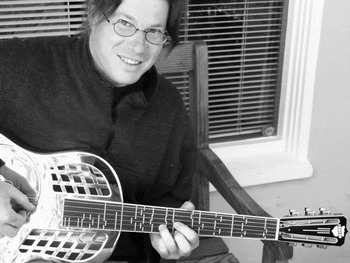
Bill Slye with the first National prototype. Photograph courtesy of John Schneider.

Even though the just intonation resophonic guitar seems especially unforgiving in its tuning needs, the predominantly homophonic and melodic bias in the instrument's repertoire also contributes to obscuring its faults, meaning that although imperfectly tuned intervals might be apparent under close scrutiny, they may well go unnoticed in a live performance.
Conclusion
The choice of any tuning system necessitates some degree of compromise—whether in terms of practicality, modulatory capabilities, or the purity of intonation. With the justly tuned resophonic guitar one must also contend with the inherent spectral inharmonicity of plucked metal strings as well as fretting complications such as those encountered by Slye and Richter. Whatever the difficulties of achieving the intervals envisioned by Harrison and Slye, Scenes from Nek Chand stands as a groundbreaking work that stimulated a new way of thinking about an old subject. Aside from the theoretical and aesthetic implications, the tuning in combination with the aluminum cones within the guitar's body creates an amazing resonance, almost giving the impression that the guitar is amplified. In a way, Harrison's original reluctance to write for the conventional classical guitar is vindicated by the sonic triumph that emanates from the justly tuned tricone; single-note lines excite a shimmering harmonic shadow thanks to the guitar's sensitivity to sympathetic resonance, whereas pure triads and extended harmonies, such as the eleven-limit otonalities built on G or D, glow with an intensity and richness completely foreign to our tempered musical world.
The just intonation resophonic guitar fits within the context of experimental instrument making in twentieth-century U.S. music, standing alongside the Rhythmicon (the electronic rhythm machine that Henry Cowell commissioned from Lev Termen), Harry Partch's original orchestra of percussion and string instruments, the Megalyra family of instruments of Ivor Darreg, and Paul Dresher's long-scale hurdy-gurdys. More so than any of these examples, Harrison's guitar has been remarkably successful in inspiring other composers, endowing the new instrument with a growing and diverse repertoire. In an age of staggering electroacoustic and digital resources, this entirely acoustic instrument proves that the topic of intonation still has much to offer. Like the Indian sculptor that inspired Scenes from Nek Chand, Harrison took something old and unwanted and made it into something vibrant, beautiful, and full of life.