‘As action plans, musical scores provide general instructions on how instrumentalists and singers may execute, control and coordinate their motor actions, the details of which are determined largely by the performer's musical sensibilities.’Footnote 1 This assertion articulates one of the principal starting-points for research projects in the field of musical performance studies. But is this a natural way of thinking about scores in musicology, where questions relating to composition and analysis, hermeneutics and aesthetics still dominate the discipline? What are the real consequences of understanding musical scores as ‘action plans’ – as composed sets of performance instructions – rather than as documents, transcripts, or concretizations of a composer's idea and, therefore, of a musical work? Such a question puts at issue not only the status and function of a musical score but also the relationship between reading and realizing a musical text. Further aspects to consider are those textual strategies that form an essential part of the ‘composition’ of performance instructions, and the performer's reactions to them – which may include misunderstandings and failures.
Such issues have dominated my work on the relationships between movement, rhythm, space, and performativity in contemporary music, music theatre, and sound and media art. Having for some time devoted most of my attention to the theory and aesthetics of performance and to analysing actual performance situations, I soon realized that arising from these issues were new and fundamental questions concerning the role of the score. The notion of the score as ‘action plan’ seemed to warrant investigation in its own right – and what kind of music involves and demonstrates more in the way of ‘action’ than contemporary music for solo percussionist?
The development of this genre has been closely connected with the fundamental change that took place in the percussionist's role in the second half of the twentieth century, its development into that of an independent, multi-tasking solo performer. This change meant that percussionists not only had to improve their competence in achieving the most efficient and economical organization of their bodily movements in time and space – almost like dancers or acrobats – but also had to become stage managers of their own percussion ‘orchestra’ and managers of themselves as modern solo performers – a task that involves among other things repertoire planning, the organization of concerts, and self-promotion. In this way today's percussionists can be seen as modern virtuosos par excellence.
Although many aspects of percussion playing have changed over the past few decades, the most important changes have centred on three main issues: the aesthetics of sound, an ideal that has always been of importance, albeit understated, in the history of percussion; the production of rhythm, now involving a far greater degree of complexity; and the coordination of rhythmic production and ‘motion patterns’, in that percussionists, while maintaining and shaping an overall tempo, have not only to play rhythms but also to realize ‘motion patterns’ in space – a coordination that requires considerable technical skill and goes some way towards explaining why percussionists are often seen as automatons, whether ‘timekeepers’ or ‘drum machines’. Through such ‘motion patterns’ it is possible to produce ‘inherent patterns’ – rhythms that do not follow directly from the actions of the player (for instance in realizing a line of note values in a score) but, rather, are inferred as resultant patterns by the listener from the overall sound picture. For that reason, ‘motional patterns or rhythms’ are to be distinguished from ‘sonic patterns or rhythms’.Footnote 2
Underlying these three main issues, which pertain regardless of compositional style or notational practice, four other factors are relevant to the performance process in all kinds of percussion music and, probably, all music in general. Firstly, there is the question of gaining a thorough understanding of a particular instrument. Percussionists have to get to know all possible ways of using (as well as ‘misusing’, altering, or otherwise experimenting with) an individual instrument and to familiarize themselves with its ‘behaviour’ and ‘characteristics’ in all situations (including with the use of different implements, such as sticks, mallets, and beaters). This is not an easy task, as modern solo percussionists have to master hundreds of different instruments. Evelyn Glennie, for example, has listed about six hundred.Footnote 3 Secondly, there is the aspect of ‘multi-tasking’. Whether in respect of one instrument or many, percussionists are forced to develop their spatiomotoric and sensomotoric abilities as best they can in order to coordinate the human body and its movements in relation to the instrument. One of the most important aims is fluid motion. The third aspect to be discussed, therefore, is the performer's task of creating continuity and coherence within sections of a piece or with regard to the overall structure of a piece. In addition, and this is the fourth aspect, we have to consider aspects of memory and cognitive processes, in particular those that concern the performance of complex rhythms. These four main factors, which are relevant not only to solo pieces but also to percussion music in general, stand not in isolation but in close relationship to one another.Footnote 4 All four have especially to do with problems of managing movements in time and space – not only bodily movements but also any reciprocal movements of (or other responses from) the instruments. During preparations for a performance the combination of these aspects requires a degree of choreography on the part of the performer, as we shall see in the following discussions of examples. I shall begin by discussing the production and realization of rhythm; this will be followed by a section about aspects of percussion playing as ‘automatism’, while the final part will be dedicated to ‘sound aesthetics’. It should be noted that a number of the aspects of percussion performance introduced up to this point remain nonetheless related to the competence of the performer. Even a discussion of the characteristics and capabilities of an instrument will not take into account the skill of the performer and his or her ability to actualize that sound potential in a particular performance situation.
As I mentioned above, my interest in the examples is directed not towards the ontological status of the pieces but rather towards the instructions that are given to the performers and the actions that result from them. This entails viewing the score as a script or an agent, which then becomes both a foundation and a catalyst for the actions of the performer and the unique performance, specific to that place and time, that results.Footnote 5 In this context performance is seen not only as the execution and interpretation of the work but also as the stage production and presentation of a certain version of a work, as well as a display of the performer's virtuoso abilities and efficiency of movement.
I The organization of time and the production of rhythm
Concepts of rhythm changed drastically in music of the twentieth century. The traditional concept of rhythm as regular movement based on regular metres was so vehemently rejected by composers that, for example, Wilhelm Seidel in his extensive study of the history of rhythm stated that rhythm met its demise in the music of the second half of the twentieth century.Footnote 6 If we think of rhythm in a more general way, as ‘organized fluency’ (an explanation given by Curt Sachs),Footnote 7 ‘time structure’, or ‘organized time’, we get a different picture. Accepting these latter definitions we can say that rhythm plays a central role in contemporary music, not in the sense of regular movements but as structures of durations, which may be regular but need not necessarily be so. Regularity, incidentally, seems to be something of a relative phenomenon, as even body movements that are often claimed to be absolutely regular and equal are not so if we look at their microrhythmic structures. The rhythms of walking or the heartbeat are in reality very flexible and elastic.Footnote 8 As recent studies on biomechanics and the biology of movement have shown, it is also doubtful whether there exists a cognitive model – or a so-called ‘Generalized Motor Program’ – related to regular body movements.Footnote 9 ‘Rhythm’, therefore, is not to be restricted to regular processes – a fact that is also clear from language and speech. Within this discussion of solo percussion music I shall be referring to this more general concept of rhythm.
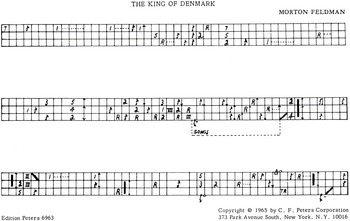
I shall explain some of my thoughts on the organization of time and rhythm in contemporary music by discussing two examples. The first is Karlheinz Stockhausen's Zyklus, a pioneering work for solo percussionist which was first performed by Christoph Caskel in Darmstadt in August 1959 (see Figure 1).Footnote 10 The second example is Morton Feldman's The King of Denmark, a composition from 1964 written for Max Neuhaus, who gave the première of the piece at the New York Avant Garde festival in the autumn of 1964 (see Figure 2).Footnote 11
Stockhausen, Zyklus, page of score. © 1960, Universal Edition (London) UE13186. Reproduced by permission.

Feldman, The King of Denmark (p. 1 of score). Reproduced by kind permission of C. F. Peters Musikverlag (Frankfurt, Leipzig, London, New York).

In both pieces the composers present very clear basic schemes concerning the temporal structures of the sound processes. They do not use bars, but rather a grid-like graphic arrangement with equal columns. For Stockhausen it was the first time he had worked with such a grid in instrumental music. Feldman developed these grids in the 1950s as notations on graph paper and continued to use them between 1958 and 1967.Footnote 12 The distances between the grid's columns represent individual units of time (time spans) or ‘beats’, although neither composer gives precise information that specifies an underlying tempo. Stockhausen explains in the score's introduction that equal distances mean equal durations. Feldman gives a tempo indication, but with a certain latitude (MM 66–92). In each case, then, the percussionist has to find an individual tempo each time the piece is performed. This approach – at the time quite novel for percussionists accustomed to traditionally notated scores – was related to concepts of the openness, mobility, and indeterminacy of musical works in the late 1950s and 1960s, as well as the search for an expanded compositional flexibility with regard to durational structure and the experience of time. Contrary to what one might assume, the notion of ‘giving freedom to the performer’ is of almost no relevance here. In both pieces the performer's discipline is much more important and, indeed, constitutes an essential pre-requisite. Firstly, the musician has to explore the limits of his or her own abilities and skills. For example, in Stockhausen's piece the player must react to the instruction to play a complex of notes ‘as fast as possible’, which means either adapting the time units and tempo of the piece to his or her own abilities or working to improve them. The performer therefore has to explore the so-called ‘Aktionszeit’: the time it takes to play, to traverse the instrument, to move between instruments, to carry out the score instructions, and to produce the sound. Stockhausen himself described ‘Aktionszeit’ as, for example, ‘the time it takes for the pianist to move his arm from a lower to a higher position’.Footnote 13 Secondly, the performer is asked to pay particular attention to the ‘Klangzeit’ – the amount of time that the sounds of the instruments need to unfold (in other words, the duration of the entire envelope from onset to decay). This factor is especially important in Feldman's piece, because the performer has to choose the tempo that allows a specified number or combination of sounds to be fitted within a given time unit. The musicians are required not only to create individual performance versions, but also – as we shall see – to invent new techniques and ‘tools’ to realize them.
Stockhausen claimed to have created in Zyklus a deterministic musical structure overlaid with various elements of indeterminacy. Hence he saw in the work the combination of both a dynamic and closed and a static and open cyclic form. Motion, even motion in space by the performer because of the set-up of the instruments, ‘is circular and may begin anywhere on the circle, progressing until the music returns to the starting point chosen for the particular performance. The score actually is spiral-bound so that a performer may begin anywhere and proceed until he or she returns to the point of origin.’Footnote 14 Stockhausen's ideas are thoroughly worked out compositionally, that is to say fully planned and notated. Over seventeen so-called ‘periods’ we see an increasing intensity curve related to nine ‘structures’ (Strukturtypen), each offering an increasing number of optional elements. The percussionist Neuhaus was interested in the piece exactly for this reason: he saw in it a combination of composition and improvisation.Footnote 15 The global curve of these ‘structures’ is combined with ‘a static and fixed skeleton of attacks’ in nine instrumental parts (snare drum, hi-hat, triangle, vibraphone, tam-tam, guero, marimbaphone, bells, tom-tom rimshots).Footnote 16 Each instrumental part demonstrates a different process of ‘accelerando’ and ‘ritardando’ (i.e. an increasing and a decreasing density of attacks), reaching a peak of intensity at the turning point from one to the other. As Jonathan D. Kramer commented, ‘The temporal continuum in this percussion work is a multiply-directed linearity, because of the large number of directional processes which move throughout the whole piece, yet start and end at different points.’Footnote 17 The main task for the performer, then, is to manage the complexity that results from the layering of directional processes, which occurs on the one hand in horizontal instrumental lines and on the other hand in the changes of vertical structures. In addition, the complexity is increased by the use of twenty-one instruments, which was a real challenge for young percussionists in the 1960s. Max Neuhaus recalls: ‘At that time percussionists generally played only one instrument at a time. Playing twenty one simultaneously was unheard of. I quickly realized that the only way to do it, in fact, was to think of all of them together as just one instrument, one multi-surfaced bank of timbre.’Footnote 18 The coordination of body movements in time and space, in other words the performer's kinaesthetic sense, became central.Footnote 19
I should like to present one example from Zyklus and concentrate on the line of attacks in the guero part.Footnote 20 Stockhausen used an ‘action or movement notation’ to instruct the player: the guero part is notated – almost drawn – in terms of ‘movement figures’ or ‘gestures’. The performer is asked to play certain guero ‘gestures’ which, in their length, their pitch organization, and their direction and complexity of movement relate to the ‘time units’ (columns of the grid). This causes the performer also to adapt and control his or her movement velocity to produce different scrape rhythms and different ‘pitches’ or sound brightnesses. The rhythm of this guero passage between periods 10 and 12 results from the presence and absence of these gestures, from their different shapes and lengths, and from the scraping movement and its different velocities.
The guero passage, notated horizontally, is combined with optionally performable sound-complexes set out in the vertical dimension on three instruments (marimbaphone, vibraphone, and log drums). We find different kinds of options within this passage: complexes of single notes to be played in a certain order (controlled by arrow signs in the notation); complexes or groups of notes to be played freely within the time-unit of the rectangle in which they appear; single notes or complexes of notes in two overlaid rectangles which have to be exchanged; one of two rectangles containing sounds that can be played ad libitum. The player has to read and choose the sounds from the vertical axis but present them either in succession or simultaneously as events in time, in relation to the graphically notated time grid. The performer is asked to prepare his or her own version like a puzzle.Footnote 21
In addition to the optional sound-complexes in the vertical dimension of the score there are non-optional notes or sound-complexes. These belong mainly to the ‘skeleton of attacks’ in the other instrumental parts and often serve as effective accents. For example, two of the guero ‘movement figures’ are ‘halted’ by an accent from a tom-tom rimshot and a tam-tam sound (period 11) respectively, which require not only different methods of sound production but also movements in different directions in space because of the instrumental set-up. Another guero gesture with an upward tendency is accompanied by a similar movement on the vibraphone. In period 12 a guero gesture starts at the end of an upward movement on the marimbaphone and is, so to speak, prepared by this marimbaphone gesture (if the score is turned upside down, which is possible, the accents appear in the opposite way). Many similar examples of multiple movement and sound processes could be cited. The player is constantly forced to coordinate many similar actions in time and space, and in the event has to invent new strategies to realize the instructions. Neuhaus remembers: ‘For example […] How do you trill on the vibraphone and riff on other things at the same time? You do the trill by taking two mallets in one hand; you put one under the vibraphone bar, one on the top, and quickly move them up and down. You play the riffs with two sticks in the other hand. It sounds simple, but nobody had ever thought of that before.’Footnote 22
What should be clear from the example of the guero passage is that Stockhausen did compose rhythmic, linear, and more or less fixed structures in certain sections of the work. Indeed, the piece is based on a mathematically proportioned ‘program’.Footnote 23 But the complexity of the work results in a polyrhythmic global texture, in which different densities register clearly but any linear continuity or coherence is extremely difficult to follow precisely.
Morton Feldman obviously wanted to situate his percussion piece The King of Denmark in opposition to Stockhausen's Zyklus.Footnote 24 As in many of his other works, Feldman was particularly interested in the vertical structure and dimension of the piece – its density and timbre – and, above all, in the appearance of single sustained sounds, or the complex nature of simultaneous sound events, separated from each other. As the preface to the score indicates, ‘[n]umbers represent the amount of sounds to be played in each box.’Footnote 25 Feldman was not interested in the articulation of coherent horizontal sound processes but in a slow presentation of sound events at a soft dynamic level, which he described as ‘whispers’. These whispers should ‘emerge temporarily and disappear again without continuing for long’.Footnote 26 The percussionist is asked to play without sticks or mallets, only with fingers, hands, and arms. The introduction to the score points out that the ‘dynamics are extremely low, and as equal as possible’.Footnote 27
As Max Neuhaus observes, ‘[t]he score specifies the relative pitch of each note (high, medium or low), its relative time, and in some cases the specific instruments.’Footnote 28 Performers are required, therefore, to create their own performance versions, not only with regard to the overall form but also with regard to the pitches, the instrumentation, the dynamics, and the articulation of the sounds. In doing so they have to explore carefully how much time is needed not only for a certain action to produce a certain sound or sound-complex but also for the sounds to develop. For example, bell-like sounds need more time than sounds produced by membranophones. To find or fix a tempo, the percussionist has to pay attention to the Aktionszeiten as well as to the Klangzeiten, which have to fit in with the ‘time grid’ or certain ‘boxes’ (time units) respectively. Creating an actual performance version is a reciprocal and experimental process, which is itself the performance. The player has to concentrate fully on the production of every single sound or sound-complex.
In this case we are confronted with the paradoxical situation, as often occurs with Feldman, that he seems to give the player freedom but instead forces him to be very disciplined. Playing on a single instrument or on many instruments simultaneously means above all preparing the individual actions (for example, imagining a certain tempo and deciding which instruments to use as well as how to play them), then carrying them out, and after that preparing the next action or actions and carrying them out, and so on. The ‘fluidity’ within the music comes from this incessant pattern of entering an event, experiencing the event, and leaving the event – a sequence of endless in-and-out movements. Not only the body in its movements but also the mind has to follow these waves. They create a continuous flux and a global ‘rhythm’ of different presences and absences of sound (which are no longer related to the underlying indirect ‘beat’; the ‘beat’ ultimately provides just one aspect or detail of the creation of the waves, which remain in the foreground of the perception process). The piece is like a melody, in which every sound is separated from other sounds: the listener either waits for every subsequent event or starts to relax, no longer ‘expecting’ the next event but simply allowing it to happen (in the moment).
II Motion patterns, automatism, and modern virtuosity
Musical multi-tasking is surely one of the most important elements of modern professional performance and virtuosity. Instrumentalists and singers specializing in twentieth-century music tend not only to concentrate on the improvement of their conventional playing or singing technique but to expand it experimentally across as wide a range as possible and combine it with further extended techniques, while also learning to do different things simultaneously. Modern virtuosity can often appear as a heightened manifestation of certain phenomena relating to the ‘modern world’, such as automation or human–machine interaction. In music this aspect became particularly relevant when modern media of sound reproduction were developed and machine aesthetics was integrated into art aesthetics, in the projects of the Futurists, for example.Footnote 29 Modern virtuosity developed both in competition with the performance of machines and in ways that involved a mastery of those machines: this was the case in composition as well as performance.
One important aspect of these developments in percussion music has been the ‘discovery’ and extension of pattern playing, influenced not only by music from other continents and cultures (for example in African or South American percussion music) but also by the functioning of machines. The main difference between articulated rhythmic processes and ‘automatic’ equal-pattern processes is to be seen in the difference between the articulation of time structures by the performer on the one hand, and on the other hand the creation of such structures by the listener through subjective rhythmic grouping effects or subjective rhythmicization (though such subjective effects are always part of the perception of rhythm).Footnote 30
I shall now discuss aspects of the production and perception of such rhythmic structures in a piece by David Lang, one of the founders of the New York festival Bang on a Can. The Anvil Chorus for solo percussion was composed in 1990Footnote 31 and was influenced by the ‘sound picture’ of blacksmithing. The composer explains his vision: ‘In the Middle Ages, blacksmithing was the loudest sound in the world. For large projects, all these people would pound on a single piece of metal, and they invented melodies to control hammering patterns, so they could stay out of each other's way.’Footnote 32
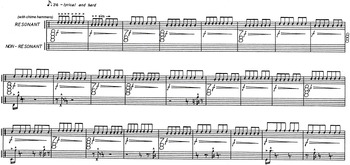
David A. Lang, The Anvil Chorus, bars 1–26. © 1991, Red Poppy. All rights administered by G. Schirmer, Inc. (ASCAP). All rights reserved. International copyright secured. Used by permission.

Lang's score is notated throughout on two systems (see Figure 3): on the upper system the composer calls for ‘resonant material’ (‘right hand: three resonant metals, two wood-blocks’), on the lower system for ‘non-resonant material’ (‘left hand: four tuned non-resonant metals; four non-resonant metals with foot pedals; bass drum with foot pedal’). The piece is divided into six sections, the later of which are essentially variations of the first two: A, B, A′, B′, A″, A′″. While different in almost every respect from Stockhausen's Zyklus, the most interesting and challenging element of the piece is again the combination and coordination of horizontal and vertical structures, which entails following the calculated artfulness of the rhythms of the linear patterns, mainly in the upper system, and embedding within them patterns and accents from the lower system. The A section is characterized by subtly changing quaver patterns (in time signatures of 8/8, 7/8, and 6/8), into which the sounds from the lower system appear to intrude by accident. The constant quavers (4+4, 4+3, or 3+3) in each bar are articulated always as ‘fade-out moments’ (beginning forte and followed by a decrescendo), thus constantly blurring the end of the bar; as a result of this the changes of metre are constantly blurred too. This sound effect is part of Lang's blacksmithing ‘soundscape’, which seems to present its ‘sound picture’ from a distance. In performance one gets the impression of listening to the actions of the blacksmiths from afar, as if there were a sound filter through space (not only through the different dynamic processes but also, for instance, through the combinations of resonant and non-resonant sounds). The percussionist is therefore asked to assume two subject-positions simultaneously: on the one hand to become an imitator of a crew of blacksmiths, and on the other to develop a listener's sensitivity to the sound effects and rhythmical conglomerations that would be evident when listening from a distant location.
In the first variation of A (A′) the underlying metrical scheme of 8/8, 7/8, 6/8 is intensified through changes of accents. In addition, a prominent rhythmic figure in the lower system is introduced, which is a combination of bass drum attack (a deep, unpitched sound) and two non-resonant but differently pitched quavers. This ‘hammering figure’ gradually assumes a more dominant role and is extended into B′ (where it reaches a climax, eventually appearing four times in isolation, followed by rests and unaccompanied by the resonant instruments in the upper stave). The second variation (A″) displays – in a much faster tempo – a further level of complexity, which builds on the principles established in A and A′: while in these earlier sections the fluid patterns are concentrated in the upper system, in A″ the patterns are divided and played in semiquaver sequences (16/16) alternating between the two systems. This causes stream segregation, in other words two streams of sound, each with its own melody in the listening process.Footnote 33 As the accents in both melodies shift throughout, certain groupings appear. These groupings, which remind the listener of section A, are also shifted against one another. Additional attacks in the bass seem to appear by accident (as at the beginning of the piece). In the last section (A′″) the piece comes to an end in a rapid conglomeration of A and B elements.
The B sections act as contrasts, mainly of articulation, pitch, rhythm, and timbre, and are characterized by patterns consisting of groups of semiquavers and quavers with interruptions – similar, but constantly varied. In the upper system the two wood-blocks predominate (in contrast to the A sections, where the resonant metals are dominant). Section B′ contains a mixture of wood-block and resonant metal sounds in the upper system; however, the performer is asked to ‘bring out woodblocks’.Footnote 34 Here we find two varied lines, which lead to the abovementioned climax broken by the four pauses.
In Lang's work the performers have to improve their regularity of movement and precision within sections consisting of a highly repetitive but at the same time rapidly shifting and varying rhythmic flow. The regularity of movement in Lang's piece is also challenged by the sound design, which derives, as we saw, from the conception of a blacksmithing ‘soundscape’. It seemed interesting to find out if and how Lang's picture had any meaning for a percussionist who was in the process of studying the piece. A discussion with one performer of the work suggested that there is no easy, one-dimensional answer to this question.Footnote 35 Although the image of blacksmithing had influenced his choice of instruments for the piece, the player was equally concerned with the work's rhythmic complexity and Lang's principle of on the one hand creating regularities and regular movements and on the other hand constantly subverting the regularities in a totally unexpected way (the shifts of accents always causing an element of surprise).
In searching for suitable instruments the percussionist experimented with many metal sounds (Lang's instructions are helpful only to a certain degree in this process). The score, for example, asks for ‘chime hammers’. The percussionist realized that it is almost impossible to play very fast and pianissimo with these hammers on his instruments. For this reason he used plexiglass mallets, which he wrapped at one end with a piece of rubber. He also partly ignored the separation of resonant and non-resonant metal sounds, as for him the mixture of sounds seemed to be more interesting (and enabled the texture to become more transparent). In fact the percussionist did not use the score as it is but rather made his own ‘performance score’ – the ten pages of the original score were fixed onto boards in order to avoid the need for page turns (this is a common practice which sometimes results in a completely new layout of the score, akin to that pioneered with Zyklus).
The interpretation of the piece – from the player's point of view – is also only tangentially related to Lang's image of blacksmithing. First and foremost the performer has to concentrate on the physical and mental challenge of his or her highly virtuoso body ‘performance’. The idea of an ensemble of blacksmiths can therefore be taken as a starting point for the sound picture, but it seems that players must ignore this idea to some degree if they are to devote their concentration to realizing the rhythms in all their complexity.
III Sound aesthetics: percussion music as ‘sound art’
The percussionist today is a sound designer, claims Rainer Römer, percussionist of the Ensemble Modern, in an interview in the Neue Zeitschrift für Musik.Footnote 36 This is surely one of the results of an increased interest in sound as acoustic phenomenon as well as in sound as ‘tone colour’, which is another characteristic tendency within twentieth-century music. Many composers, for example, have collaborated with performers or experimented with electronic equipment to discover new sound dimensions, to develop new instruments, and to integrate instruments from other cultures with very different aims and effects in mind. Of all areas of the instrumentarium the pool of percussion instruments without doubt underwent the greatest expansion. If, in principle, all sounds are useful musical ‘material’, then almost any object can be used as a percussion instrument.Footnote 37
Working with sound as such raised not only questions such as that of the Schoenbergian Klangfarbenmelodie – the possibility of composing structural continuities between ‘tone colours’ – but also the issue of how sound can be designed and channelled coherently in time (something that preoccupied Iannis Xenakis, for instance). We shall take up both questions in the discussion of another example, Helmut Lachenmann's solo percussion piece Intérieur I (1965–6), first performed in 1967 in Santa Fe by Michael W. Ranta. The piece is dedicated to the German percussionist Siegfried Fink.
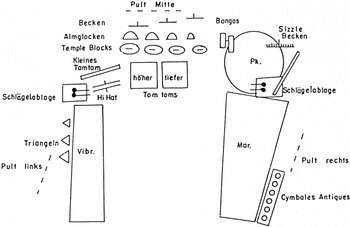
In this piece we find yet another aspect of the ‘organizing of time’. The work consists of sixteen sections, each to be played from one of three different positions on the stage – in the middle, on the left, and on the right of a U-form (see Figure 4). These sixteen sections are subdivided into different durations, given in seconds (with the exception of section 8, which is rhythmically notated). The performer is asked to play ‘groups of sound’ or ‘sound gestures’, almost always within a certain duration.Footnote 38 John Cage adopted this kind of notation in his piano piece Water Music (1952), where he asked the performer to execute certain actions within a fixed ‘real time’ span. The pianist Margaret Leng Tan has described the resulting, highly economical ‘choreography’:
For instance, pouring water [at 4.4875 and 5.4525 in the score] is not as easy as it seems. The first time you have to pour fast and the second time slower. I first practiced it with a stop-watch at the kitchen sink […]. By working this way I discovered that the reason Cage asks the performer to use a stop-watch, and the reason that he has occurrences at a quarter or three-quarters of a second, is because it forces you to move very rhythmically, and very precisely.Footnote 39
Since the performers have to concentrate on the reciprocity of changes of action and changes of sound, they are indeed forced to develop a hitherto unknown level of attentiveness and precision. This often forgotten aspect of Cage's work is equally a feature of Lachenmann's percussion piece.
Intérieur I is notated as a flexible score, consisting of single pages that can be placed at the middle, left, or right of the performing space. The sound gestures are fully notated, except in their rhythmic dimension. The notation is precise with regard to pitch and very precise and detailed in terms of dynamics and articulation. The shape of the noteheads (open or closed) indicates a particular use of the mallets. In other words, traditional rhythmic notation is used to indicate not note values but different varieties of tone colour. In his introduction to the score Lachenmann asks the performer to practise not only the production of the sound but also the use of different mallets and the changes between them (which should occur in as fluid and undemonstrative a manner as possible).Footnote 40
Set-up (space plan), Helmut Lachenmann, Intérieur I. Used by kind permission of Edition Modern Horgen.

From this constellation it is clear that the performance of the sound gestures within a certain duration in seconds includes many elements: the preparation and control of the movement in space (on stage), the preparation and control of the physical movements involved in the production of certain sounds, as well as the performer's conception of the ‘picture’ of the sound processes and the time (Klangzeit) required by the instruments and the different sonorities themselves. Lachenmann wrote in the score's introduction:
The rhythmic organization of the actions results on the one hand from the graphic order within the duration of the sections – indicated approximately in seconds – and on the other hand from the instrument's own time-dimension, which is to be made use of by the player and which plays an important and unpredictable role when shaping the notated sequence of tones.Footnote 41
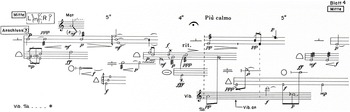
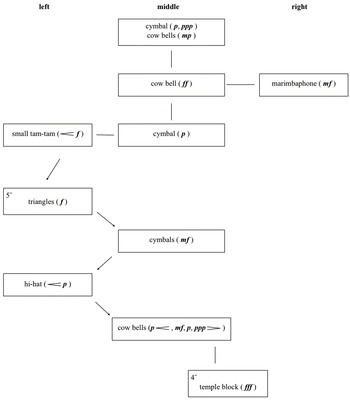
Figure 5 illustrates the complexity of the processes. In this section, section 4 (with the player in the middle position), the ‘structure of durations’ is 5″, 4″ (fermata, ‘Più calmo’), 5″, 9″, 10″.
Helmut Lachenmann, Intérieur I, score, section 4, beginning. Used by kind permission of Edition Modern Horgen.

In the first five-second passage the player begins with tremolandos on a cymbal along with arpeggiated sounds from four cowbells (mp 𝆒 ff). Both groups of instruments are placed towards the back in the middle position. At the same time as the ff attack on the cow bell, the performer has to play a downward glissando on the marimbaphone, which stands on the right of the stage. The performer has to control the time needed for lateral/medial body movements. The end of the marimba glissando is marked simultaneously by a cymbal roll and a crescendo on the small tam-tam. That requires a very quick movement to the opposite side of the performing space, as the small tam-tam stands to the left of the cymbals and cowbells. From the events in these first five seconds alone we get a sense of Lachenmann's approach to sound and his concept of ‘sound gestures’. Sounds and sonorities are ‘gestures’ or ‘formed time’.Footnote 42 The listening process is, in Lachenmann's view, a gradual screening process (‘sukzessiver Abtast-Prozeß’).Footnote 43
The beginning of section 4 is a slowly unfolding process, the gesture of a sound's ‘building up’ (‘Einschwingvorgang’). The next four seconds are conceived as a decrescendo, in other words a composed process of decay (‘Ausschwingvorgang’). Both processes form a ‘sound gesture’ or ‘sound type’, which Lachenmann has called a ‘Kadenzklang’ or ‘Klang-Kadenz’ (sound cadence).Footnote 44 Again the performer has to move in different directions: the tam-tam's forte attack is amplified by an arpeggio on three triangles, which are placed to the left of the tam-tam. Shortly afterwards the performer has to return to the middle position and the cymbals at the back: in addition to lateral/medial movements the performer has to manage forward/backward movements here. The cymbals are followed by the emergence of a roll on the hi-hat (a crescendo to p, dal niente), which is prolonged by cowbell rolls that slowly fade out. Before the end of this process an attack on a temple-block (fff) curtails and ‘colours’ the decay.
After a fermata the tempo slows down; the beginning of the next sound group is again a slowly unfolding process, in this case a cymbal roll (pp) combined with an attack on the vibraphone (pp) and a quick change to the cowbell (movements from middle to left and back to middle). A similar movement follows between triangle and hi-hat, followed by short cymbal attacks (movements to the left and middle). One hand's playing of the cymbals is combined again with vibraphone sounds in the other hand, which requires the percussionist to play with one arm in the middle position, the other arm on the left. This process is concluded by a sound from the small tam-tam (ff). Again middle position: cowbells and cymbals, followed by a left-to-right movement from vibraphone to tam-tam, triangles, and cymbals (these actions are to be played between the 5″ and 9″ points). The section ends with a sound from the large tam-tam positioned on the right, which is accompanied by prestissimo attacks on the cymbals, cowbells, and temple-blocks (all in the middle position), which follow a crescendo–decrescendo pattern that imitates the tam-tam's sound. The tam-tam sound turns into noise (Schnarren), which is halted by a drum attack and followed by a simultaneous attack on the marimba and the cowbell. This means that one arm has to play on the right of the performance space, the other in the middle. This action is followed by a cymbal decay (ppp) with a very short accent at the end.
Figure 6 illustrates the principles and strategies of the whole section. Rather than producing isolated sounds, the percussionist is always asked to articulate a sound group or to design a sound gesture. The player must constantly be creating coherences, continuities, and transitions within the sound processes and between the instruments. Linearity is related not to a certain rhythm or to patterns unfolding in time but to the forming of the sound gestures, horizontally as well as vertically – for example, by expanding a dynamic process, prolonging and amplifying a sound, or coordinating accents. This means that the performer's physical movements in time and space have to be precisely coordinated and must result not only in ‘sound gestures’ but also in different ‘sound sculptures’, which have their visible dimension too. The performer acts ‘in’ – in the interior of – the sound events (Intérieur being the title of the piece) and becomes a genuine ‘sound designer’.
Conclusion
Thinking about the musical text with respect to a work's execution and performance can give us not only a ‘sound picture’ but also, and perhaps most significantly, a kinaesthetic picture, as it were, of the performer and the production of sound on stage. With these percussion pieces I hope to have illustrated this aspect in some detail. By considering scores as ‘action plans’ we are able not only to imagine what the performer has to do but also (albeit approximately) how he or she does it and with what results. In addition musicologists can try to understand the musician's tasks within the performance situation and the performance process.Footnote 45 These considerations are likely to become increasingly relevant within performance studies and the development of methods of analysing live performances.Footnote 46
Watching a percussionist in a concert requires a specific form of multi-dimensional attention (rather like watching a dancer or an actor), although our perception is always highly selective. But the performer's body remains as an inescapable presence, at no point ‘disappearing’ during the performance but rather staying inseparable from the production of sound and from the music. Indeed the body and its motion communicate how the performer understands the music, how he or she reacts to the score's instructions, and with what intentions, efforts, and feelings he or she realizes the sounds. This is what audiences (can) relate and react to while the music is coming into being. The attention and reaction of the audience switches back and forth between the production of music and the music itself – part of a reciprocal process of perception or a constant feedback-loop.Footnote 47 The audience consists not only of listeners but also of viewers, not only of rational analysts but also of emotional, passionate individuals – in short, of multi-sensory perceivers, who are able to ‘understand’ the relationship between movement and sound.Footnote 48
Diagram of movements in section 4 of Lachenmann, Intérieur I.

Seeing the percussionist moving in a specific percussion set-up – as in the Stockhausen and Lachenmann pieces – one can detect a certain linearity resulting from contrived coherences. One is able to follow the performer from instrument (group) to instrument (group) and to ‘see’ the sound processes (as ‘succession does not exist without motion’).Footnote 49 In Feldman's piece the process of ‘stop and go’ is not only an acoustic phenomenon but also a visual one. The concentration of the performer and his or her attitudes towards the piece and its silences, for example, will be transmitted to the audience through postures of the body. By contrast, David Lang's ‘anvil’ piece, or rather the performance of the piece, will activate the audience's motor sensors, as rhythmic patterns cause particular sensomotoric co-representations, not to mention the aforementioned processes of ‘subjective rhythmicization’.Footnote 50 There are many things that can be experienced in live performances without any knowledge of the text at all. But even more interesting is to study and discover the rich relationship between an action plan and its results.