1. Introduction
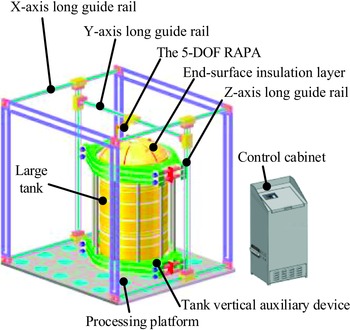
Aerospace represents the development of national science and technology. It is an important foundation for exploring space and an important guarantee for the construction of aerospace power. There are many large workpieces in the aerospace field. The box insulation layer of large workpieces is an important processing problem. The box insulation layer of large workpieces has characteristics of super size, small batch, and difficulty moving. It is difficult to process the box insulation layer of large workpieces. A piece of special equipment with a 1:1 ratio is no longer in line with the development trend of processing the end-surface insulation layer of the large box, it is necessary to redesign new thick processing equipment, which not only meets the variable size of the box insulation layer of large workpieces but also meets the processing of local complex curved surface. A new thick processing equipment is proposed to process the box insulation layer of large workpieces. The thick processing equipment consists of the XYZ shaft long guide rail and 5-DOF RAPA, as shown in Fig. 1.
The thick processing equipment.

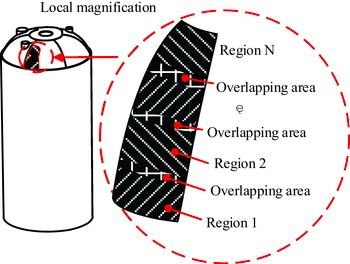
The processing scheme consists of the XYZ shaft long guide rail, the 5-DOF RAPA, a large box workpiece, an installation platform, a vertical auxiliary device, control cabinet. The XYZ shaft long guide can meet the processing workspace of the end-surface insulation layer of the large box. The XYZ shaft long guide is composed of two X-axis rails, one Y-axis guide rail, and two Z-axis guide rails. Among them, the size of the XYZ axis long guide depends on the size of the end-surface insulation layer of the large box. The XYZ shaft long guide has the effect of carrying, moving, and positioning processing units. The 5-DOF RAPA can independently process the box insulation layer of large workpieces. The control cabinet controls the movement and processing of the processing unit. The vertical auxiliary device can fix the large box to the workpiece installation platform. Compared with the serial robot, the 5-DOF RAPA has the advantages of fault tolerance and dynamic performance [Reference Lian, Sun, Song, Jin and Price1–Reference Shen, Xu and Li3]. To solve the processing of the end-surface insulation layer of the large box, it can be processed by splicing processing. The splicing processing method is to divide the end-surface insulation layer of the large box into several sub-areas. The processing equipment is planned to plan the processing path of the end-surface insulation layer of a large box according to the shape of the sub-areas, and then the processing unit is processing along the processing path of the adjacent sub-areas to complete the processing of the entire end-surface insulation layer of the large box. The end-surface insulation layer of the large box contains a fan-shaped surface, as shown in Fig. 2. The working principle of processing the fan surface insulation layer by splicing processing is as follows: First of all, the large box fixture fixes the vertical workpiece of the box to the processing platform. The processing equipment moves to the end-surface of the large box and divides the fan-shaped curved end-surface insulation layer of the overall box into N sub-areas. Among them, the two neighboring areas have overlapping remedial areas. The processing unit in the processing equipment moves to sub-area 1, and the processing unit processes sub-area 1. After sub-area 1 is completed, the processing unit moves to sub-area 2. The processing unit processes sub-area 2, and the sub-area 2 is completed, and the processing unit moves to the next sub-area. By push, the processing equipment completes the processing of the fan surface insulation layer of the entire box. Independent processing of processing units can help improve the processing efficiency of processing equipment.
Shapes of segmented region.

The mechanical structure of the 5-DOF RAPA is a RAPM, the 5-DOF RAPM has the advantages of fault tolerance and dynamic performance. Nowadays, some 5-DOF RAPMs have been designed by researchers, but most of them directly designed RAPMs by adding actuated limbs to parallel mechanisms. The result is that the 5-DOF RAPMs possess output small angle of the moving platform. Such as Yao [Reference Yao, Gu, Feng, Chen, Xu and Zhao4] analyzed the dynamic and optimization of the 5UPS-PRPU (S represents spherical joint, P represents prismatic joint, R represents rotational joint, and U represents universal joint) RAPM, which possesses high stiffness. The UPS limb is 6-DOF limb. PRPU decides the DOF of the RAPM. Liu [Reference Liu and Yao5] designed a 5-DOF 6PUS-UPU over-constrained RAPM and analyzed the dynamics deformation compatibility of the RAPM. To increase the load-carrying capacity, and avoid singularity points, Fang [Reference Fang, Tang, He, Liu and Zhang6] proposed 2PRU-(2PRU)R RAPMs based on type synthesis methodology. Yan [Reference Yan, Huang, Li and Zhou7] put forward 4PUS-PPPU redundantly actuated parallel mechanism five-face machining. The RAPM has large tilting angle.
The output angles of the traditional parallel mechanisms are small. The AMP is a good way of obtaining large angles of parallel mechanisms. Some experts adopt the AMP to design parallel mechanisms. Such as, Lian [Reference Lian, Sun and Song8] designed the T5 parallel mechanism. T5 consists of PaRot parallel mechanism and 5 UPS unconstrained limbs. The four UPS limbs are arranged symmetrically and control the rotational angle of the PaRot. Masouleh [Reference Masouleh and Gosselin9, Reference Masouleh, Gosselin and Saadatzi10] designed the parallel axis joint of the AMP and got large angles of the mechanism. Saadatzi [Reference Saadatzi, Masouleh and Taghirad11] designed and analyzed a large orientation workspace of the 5-PRUR parallel mechanism. Xie et al. [Reference Xie, Liu and Wang12] adopted the structure of icosahedrons to design a 5-DOF parallel mechanism, which is suitable for processing large tanks. Viboon [Reference Viboon and Chooprasird13] designed a non-collinear axis of two rotational joints and got a 4-DOF parallel mechanism. Based on computer-assisted and Lie group, some experts also proposed many 5-DOF parallel mechanisms. For exmple, Ding [Reference Ding, Cao and Cai14] synthesized some symmetrical and asymmetrical 5-DOF parallel mechanisms by establishing structure databases in a computer; the mechanisms possess large angles. Wang [Reference Wang, Fang and Fang15] proposed some no singular position of parallel mechanisms by topology design and synthesized a class of novel 5-DOF parallel mechanisms with high rotational capability by designing two AMP. Jin [Reference Jin, Fang, Qu and Guo16, Reference Jin, Fang, Qu and Guo17] synthesized 3T2R and 2T3R parallel mechanisms by designing the AMP. The parallel mechanisms can reach ±180°. Some scholars [Reference Huang, Zhang, Zou, Ye and Kong18–Reference Tian and Zhang23] also studied parallel mechanisms.
A conclusion is summarized according to the above research, the RAPM has less strangeness and high fault tolerance. Most researchers directly designed RAPMs by adding actuated joints to parallel mechanisms. At present, few scholars research proposed a configuration design method to synthesize 5-DOF RAPMs with large output angles. In this paper, a configuration design method for synthesizing 5-DOF RAPM with large output angle is proposed. The configuration design method can make a large number of 5-DOF RAPM. The 5-DOF RAPMs can be used as 5-DOF RAPAs in thick processing equipment.
Besides, the synthesized 5-DOF RAPMs processing the box insulation layer of large workpieces should avoid the mechanism vibration impact, some scholars adopt different trajectory methods to plan the movement of the mechanism. Many scholars adopted piecewise function polynomial method, cubic and quintic spline curves, and B-spline interpolation curve, and proposed their own trajectory planning methods [Reference Jahanpour, Motallebi and Porghoveh24–Reference Zhao, Zhu, Du, Liao and Chan32]. For example, Javad Jahanpour [Reference Jahanpour, Motallebi and Porghoveh24] adopted NURBS curves to plan path and obtained a smooth trajectory. Some scholars [Reference Gasparetto and Zanotto25, Reference Gang and Li26] used B-splines and obtained smooth velocity, acceleration, and jerk. Tian [Reference Tian and Curtis27] used polynomial method and can evaluate the trajectory to an optimal one quickly. The other scholars [Reference Wang, Wu and Yu28–Reference Zhao, Zhu, Du, Liao and Chan32] designed the modified sine and modified trapezoidal curve to plan goal trajectory. The robot has favorable characteristics in speed, compliance, and continuity.
In this paper, type synthesis and trajectory planning of the 5-DOF RAPMs with large output angles are studied. Firstly, a new thick processing equipment is proposed to meet the variable size and local complex curved surfaces of the box insulation layer of large workpieces. The thick processing equipment consists of the XYZ shaft long guide rail and 5-DOF RAPA in Section 1. In order to design 5-DOF RAPMs with larger angle, two AMPs are proposed. Four kinds of limbs based on Li group and configuration evolution are designed, and a series of 3T2R and 2T3R RAPMs are designed using two AMPs and four kinds of limbs in Section 2. By analyzing the kinematics of the example, the proposed RAPMs can reach ±90° and be proved to possess larger output rotational angles in Section 3. Finally, a new proposed trajectory planning method is designed to restrain mechanism vibration impact in movement in Section 4. The new proposed method is applied to the theoretical calculation and simulation of the example 5-DOF RAPM. The results show that the RAPMs have a large output angle, which verifies the effectiveness of the newly proposed trajectory planning method. The Section 5 gives the conclusion.
2. Design of RAPMs
2.1. The overall design of the RAPMs
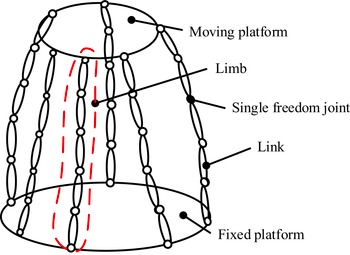
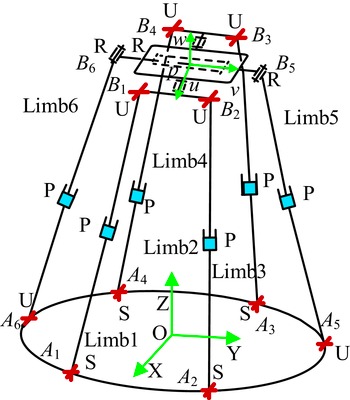
The traditional 5-DOF parallel mechanism is composed of a fixed platform, a moving platform, and five limbs. Each limb contains one actuated joint. Redundantly actuated limb is helpful to eliminate singularities, enlarge usable workspaces, and also can improve stiffness, dexterity, and acceleration capabilities. This paper proposes the 3T2R and 3R2T RAPM, which contain one more actuated joint than the traditional five DOFs of the parallel mechanism. Therefore, the RAPMs consist of a fixed platform, an AMP, and six limbs. The six limbs contain six actuated joints; there is an actuated joint on each limb. It is shown in Fig. 3.
The 5-DOF RAPM.

2.2. The moving platform
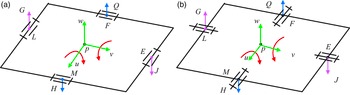
To design large angles of the moving platform, this paper simplifies the moving platform of the parallel mechanism into a square, as shown in Fig. 4. The p-uvw is established in the square center. The four connection points L, E, F, and M are arranged at the middle positions of four edges of the square, respectively. Fixing two points of F and M in the square, we can turn the square around the v-axis along the LG and EJ. In the same way, by fixing two points of L and E in the square, we can turn the square around the v-axis along the MH and FQ.
The square.

Because of the angle limitation of a spherical joint, cylindrical joint, and universal joint, the moving platform achieves a small angle. In order to make the square have a large rotational angle around the u and v-axes, four joints are installed at L, M, E, and F. Therefore, the square can be converted into a moving platform I and an AMP II, as shown in Fig. 5. The axis of the rotational joint of F and M is parallel, and the axis of the rotating joint of E and L is parallel in moving platform I. R represents the rotational joint. p point is the output point of the AMP I. L and G are the spatial connection points of two rotational joints, and J and E are the spatial connection points of two rotational joints. LG and JE control the rotational angle of platform I along pu-axes. FQ and MH control the rotational angle of platform I along pv-axes. In the same way, the axis of the rotational joint of F and M is collinear, and the axis of the rotating joint of E and L is collinear in moving platform II. R represents the rotational joint. p point is the output point of the AMP II. L and G are the spatial connection points of two rotational joints, and J and E are the spatial connection points of two rotational joints. LG and JE control the rotational angle of platform II along pu-axes. FQ and MH control the rotational angle of platform II along pv-axes.
(a) The AMP I. (b) The AMP II.

2.3. The fixed platform
To ensure that the 3T2R RAPM has a large angle round u or v-axes, the connection points of the fixed platform and six limbs are arranged symmetrically, as shown in Fig. 6. The six connection points of the fixed platform are A 1, A 2, A 3, A 4, A 5, and A 6. Six connection points are evenly arranged on the fixed platform.
The fixed platform.

2.4. The limb
Because the moving platform of the RAPM possesses 5-DOF, the end freedom of the limb should have at least 5-DOF. To obtain a 5-DOF joint, the rotational joint and prismatic joint are added to G(u) by Li group and configuration evolution. G(u) is one of the 12 types of Li group [Reference Peng, Meng and Xu30], which has 2D movement in plant and 1D rotation around the u-axis. Based on the exchange and closure property of Li group theory, G(u) and the corresponding limb are shown in Table I. {T(u)} and {R(N 1,v)} are added to G(u), 5-DOF equivalent limbs can be obtained and shown in Table II.
{G(u)} limb.

5-DOF limbs.

Configuration evolution [Reference Hérve33, Reference Fan, Liu and Zhang34] is the most intuitive and practical method to design parallel mechanisms. Based on existing and successful parallel mechanisms, a new parallel mechanism can be obtained by changing the joint and spatial layout of the limb. The principle of configuration evolution is that the needed limb can be obtained by changing the number and type of joint in the case of not changing the DOF of the limb. The new parallel mechanism is obtained by connecting the new limb and the design of the moving platform. Table II can be shown in Fig. 7.
Four kinds of corresponding 5-DOF limbs.

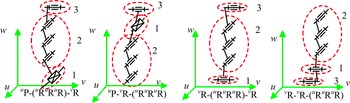
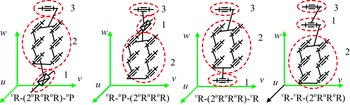
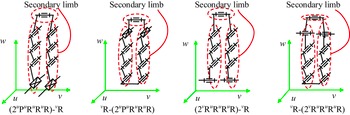
In order not to change the output freedom of the limbs, a G(u) limb is parallel to the G(u), as shown in Fig. 8. Four kinds of corresponding evolution limbs are evolved into four kinds of 5-DOF corresponding limbs without changing 5-DOF. One limb in Fig. 8 can be converted to two limbs, as shown in Table III. The first-level limb contains two second-level limbs. The four evolutionary limbs in Fig. 9 can be represented in Table III.
Four kinds of partial 5-DOF corresponding limbs.

Four kinds of corresponding evolution limbs.

Four kinds of 5-DOF corresponding limbs after final evolution.

2.5. Type synthesis of RAPMs
In order to realize the symmetry of the output angle of RAPM, based on the characteristics of a fixed platform and moving platform I and moving platform II, LG and EJ are connected with two same limbs respectively, and MH and FQ are connected with one the same limb respectively. Or MH and FQ are connected with the two same limbs respectively, and LG and EJ are connected with the same limb, respectively. Three orthogonal R joints represent the spherical, as shown in Fig. 10.
The new AMP.

Methods 1. Select any of the evolutionary limbs (a), (b), and (d) in Table III. The rotational joint v R is connected to the F or M point of the AMP I and II, and the U of the UPS limb is connected to the L or E point. Two symmetrical limbs of the evolutionary limb (c) are asymmetric motion, constraint couple of the evolutionary limb (c) is not parallel, and evolutionary limb (c) and the moving platform I cannot be equipped with a 3T2R RAPM. Based on type synthesis method 1 of parallel mechanism and platform I, three types of RAPM can be designed. Each type of RAPM contains seven classes of 3T2R RAPM. Twenty-one classes of 3T2R RAPM can be designed by type synthesis method 1 of parallel mechanism and platform I. Table IV only lists partial 3T2R RAPMs.
Three kinds of partial corresponding feasible limbs and 3T2R RAPMs.

Methods 2. AMP I is converted to the new AMP, corner of the AMP can become more smaller and low-rigidity, which can’t be used for the 5-DOF RAPA. In addition, the 5-DOF RAPA contains 7-DOF limbs, which are not easy to control. The AMP II is converted to the new AMP, as shown in Fig. 10. B 1, B 2, B 3, and B 4 are spherical joints. Two rotating joints are positioned at M and F, and the axis of two joints is collinear. Two rotating joints are positioned at L and E, and the axis of two joints is collinear. M and F share an v R of each limb in Table III. Four spherical joints of four UPS limbs are connected to B 1, B 2, B 3, and B 4. By using the fixed platform and the new AMP, four kinds of partial RAPMs are shown in Table V. When two symmetrical evolutionary limbs (c) are moving, the constraint couples of two evolutionary limbs (c) will not be parallel. Thus, two evolutionary limbs (c), two UPS, the fixed platform and the moving platform II can be assembled into 2T3R RAPMs.
Four kinds of partial corresponding feasible limbs and 5-DOF RAPMs.

3. Kinematics analysis
3.1. Structure description
All above RAPMs are selected as a 5-DOF RAPA according to criteria: (1) Six actuated joints are attached to the fixed platform. (2) The prismatic joint is the actuated joint. (3) In order to make the AMP move quickly along the direction of the Z-axis and the actuated joint, the selected actuated joint is consistent with the formation direction of the fixed platform. (4) The movement joint of the actuated joint and fixed platform or moving platform can be expressed by multiple freedom movement joints. The 4UPS-{2 v U uw P u R}- v R is more suitable as a 5-DOF RAPA, as shown in Fig. 11. The example 4UPS-{2UPR}-R consists of six actuated limbs, the AMP, and the fixed platform. The first-level limb {2UPR}-R consists of two secondary limbs and v R. M and F share one common joint v R. The 5-DOF RAPM doesn’t rotate around the normal of the AMP. v U uw P u R is a 4-DOF secondary limb in Fig. 9. The end DOF of 2 v U uw P u R is a 4-DOF, and {2 v U uw P u R}- v R is a 5-DOF first limb. {2 v U uw P u R}- v R can be written as v U uw P u R- v R- u R w P u U v . u R- v R- u R of { v U uw P u R- v R- u R w P u U v } is connected and perpendicular to the moving platform, so the moving platform has no DOF around the normal itself. Therefore, the 5-DOF RAPM doesn’t rotate around the normal of the AMP.
O-XYZ and p-uvw are the center of the fixed platform and the AMP, respectively. A 1, A 2, A 3, A 4, A 5, and A 6 are evenly designed on the fixed platform. A 5 and A 6 are on the OY-axis. The radius of the fixed platform is R 1. B 1, B 2, B 3, B 4, B 5, and B 6 are evenly distributed on the AMP, and B 5 and B 6 are on the pv-axis. The radius of the AMP is r 1, the length of the actuated limb is l i . All parameters of 5-DOF RAPM are shown in Table VI.
Structural parameters of the 4SPU-(2UPR)R mechanism.

4UPS-{2UwPuR}-vR RAPM.

3.2. Establishment of kinematic model
Four limbs 1, 2, 3, and 4 are not moving, and two limbs 5 and 6 make AMP rotate around the pu-axis. Two limbs 5 and 6 are not moving, and four limbs 1, 2, 3, and 4 make AMP rotate around the pv-axis. The center point O in O-XYZ is (0, 0, 0)T. The center point p of the AMP in O-XYZ is represented as
O
p
= (x, y, z)T.
 $\alpha$
represents the rotating angle of the AMP around OX-axis, and
 $\beta$
represents the rotating angle of the AMP around OY-axis. The rotating matrix of the 4UPS-(2UPR)R is expressed as
 \begin{equation} \boldsymbol{R}=\left[\begin{array}{c@{\quad}c@{\quad}c} \cos \beta & \sin \alpha \sin \beta & \cos \alpha \sin \beta \\[4pt] 0 & \cos \alpha & -\sin \alpha \\[4pt] -\sin \beta & \sin \alpha \cos \beta & \cos \alpha \cos \beta \end{array}\right] \end{equation}
B i (i = 1 ∼ 6) in O-XYZ is expressed as
 \begin{equation} {}^{O}{\boldsymbol{B}_i}= \boldsymbol{R}^{p}\boldsymbol{B}_i + {}^{O}{\boldsymbol{p}} \end{equation}
Vector length of the actuated joint of the RAPM in O-XYZ is represented as
 \begin{equation}\boldsymbol{l}_{i}= {{}^{O}{\boldsymbol{A}}_{i}}-{}^{O}{\boldsymbol{B}}_{i} \end{equation}
The closed loop vector A i B i pO can be represented in a fixed coordinate system O-XYZ as
 \begin{equation} \boldsymbol{Op} + \boldsymbol{pB}_{i} = \boldsymbol{OA}_{i}+\boldsymbol{A}_{i}\boldsymbol{B}_{i} \end{equation}
where Op represents O p , | OA i | represents R 1, A i B i represents q i w , and B i p represents −R p B i .
Length of the actuated limb i is q i , and unit vector of the actuated limb i is w i . Equation of the actuated limb is written as
 \begin{equation} \left\{\begin{array}{l} q_{i}=\left| {}^{O}{\boldsymbol{o}}{}+\boldsymbol{o}\boldsymbol{B}_{i}-\boldsymbol{O}\boldsymbol{A}_{i}\right| \\[8pt] \boldsymbol{w}_{i}=\frac{{}^{O}{\boldsymbol{o}}{}+\boldsymbol{o}\boldsymbol{B}_{i}-\boldsymbol{O}\boldsymbol{A}_{i}}{q_{i}} \end{array}\right.\begin{array}{l} \end{array}\begin{array}{l} i=1\sim 6 \end{array} \end{equation}
3.3 Velocity analysis
By taking the derivative of equation (4), we get the velocity relationship between the center point p of AMP and the actuated joint P.
 \begin{equation} \boldsymbol{v}_{Bi}=\boldsymbol{v}_{\boldsymbol{p}}+\boldsymbol{\omega }\times \left(\boldsymbol{R}\cdot {}^{p}{\boldsymbol{B}}{_{i}^{}}\right)=\dot{q}_{i}\boldsymbol{w}_{i}+q_{i}\boldsymbol{\omega }_{i}\times \boldsymbol{w}_{i} \end{equation}
where linear velocity of the center p is
v
p
, angular velocity vector for the actuated joint P of the actuated limb i is
 $\boldsymbol{\omega}_i$
, velocity vector for the actuated joint P of each limb is
 $\dot{\boldsymbol{q}}_{i}$
, and
 $\boldsymbol{\omega}$
is angular velocity of the center p.
S( w i ) and S( B i ) represent anti-symmetric matrices of the 4UPS-(2UPR)R and are written as
 \begin{equation*} S\left(\boldsymbol{w}_{i}\right)=\left[\begin{array}{c@{\quad}c@{\quad}c} 0 & -w_{iz} & w_{iy}\\[4pt] w_{iz} & 0 & -w_{ix}\\[4pt] -w_{iy} & w_{ix} & 0 \end{array}\right] S\left(\boldsymbol{B}_{i}\right)=\left[\begin{array}{c@{\quad}c@{\quad}c} 0 & -B_{iz} & B_{iy}\\[4pt] B_{iz} & 0 & -B_{ix}\\[4pt] -B_{iy} & B_{ix} & 0 \end{array}\right] \end{equation*}
Angular velocity of each actuated limb i by both sides of equation (6) crossing w i is expressed as
 \begin{equation} \boldsymbol{\omega }_{i}=\frac{\boldsymbol{w}_{i}\times \boldsymbol{v}_{Bi}}{q_{i}}=\frac{S\left(\boldsymbol{w}_{i}\right)}{q_{i}}\boldsymbol{v}_{Bi}=\boldsymbol{J}_{wi}\left[\begin{array}{l} \boldsymbol{v}_{p}\\[4pt] \boldsymbol{\omega } \end{array}\right] \end{equation}
where
 $\boldsymbol{J}_{wi}=\frac{S\left(\boldsymbol{w}_{i}\right)}{q_{i}}$
.
The velocity vector of each actuated joint P by both sides of equation (6) multiplying w i is obtained as
 \begin{equation} \dot{\boldsymbol{q}}_{i}=\left[\begin{array}{c@{\quad}c} \boldsymbol{w}_{i}^{T} \left(\left(\boldsymbol{R}\cdot {}^{o}{\boldsymbol{B}}{_{i}^{}}\right)\times \boldsymbol{w}_{i}\right)^{T} \end{array}\right]\left[\begin{array}{l} \boldsymbol{v}_{p}\\[4pt] \boldsymbol{\omega } \end{array}\right]=\boldsymbol{J}_{qi}\left[\begin{array}{l} \boldsymbol{v}_{p}\\[4pt] \boldsymbol{\omega } \end{array}\right]=\boldsymbol{J}_{qi}\boldsymbol{v}_{s} \end{equation}
where Jacobian matrix relationship between the p point of the AMP and the actuated joint P is J qi .
The relationship between the rotational angular velocity of the RAPM in the Cartesian coordinates and fixed coordinate is represented as
 \begin{equation} \boldsymbol{\omega }=\left[\begin{array}{c@{\quad}c@{\quad}c} 1 & 0 & \sin \beta \\[4pt] 0 & \cos \alpha & -\sin \alpha \\[4pt] 0 & \sin \alpha & \cos \alpha \cos \beta \end{array}\right]\left[\begin{array}{l} \dot{\alpha }\\[4pt] \begin{array}{l} \dot{\beta }\\[4pt] \dot{\gamma } \end{array} \end{array}\right]=\boldsymbol{J}_{\omega }\boldsymbol{v}_{s} \end{equation}
The velocity at the center of the AMP is represented as
 \begin{equation*} \left[\begin{array}{l} \boldsymbol{v}_{p}\\[4pt] \boldsymbol{\omega } \end{array}\right]=\left[\begin{array}{l} \boldsymbol{J}_{v}\\[4pt] \boldsymbol{J}_{\omega } \end{array}\right]\boldsymbol{v}_{s}=\boldsymbol{J}_{p}\boldsymbol{v}_{s} \end{equation*}
where
 $\boldsymbol{J}_{p}=\left[\begin{array}{c@{\quad}c@{\quad}c@{\quad}c@{\quad}c@{\quad}c} 1 & 0 & 0 & 0 & 0 & 0\\[4pt] 0 & 1 & 0 & 0 & 0 & 0\\[4pt] 0 & 0 & 1 & 0 & 0 & 0\\[4pt] 0 & 0 & 0 & 1 & 0 & \sin \beta \\[4pt] 0 & 0 & 0 & 0 & \cos \alpha & -\sin \alpha \\[4pt] 0 & 0 & 0 & 0 & \sin \alpha & \cos \alpha \cos \beta \end{array}\right]$
.
The velocity Jacobi matrix between the actuated joint P and the center point p of AMP in O-XYZ is written as
 \begin{equation} \boldsymbol{J}=\boldsymbol{J}_{qi}\boldsymbol{J}_{0}. \end{equation}
The velocity relationship between the actuated joint P and the center point p of AMP in the fixed coordinate is written as
 \begin{equation} \dot{\boldsymbol{q}}_{i}=\boldsymbol{J}\boldsymbol{v}_{s}. \end{equation}
3.4. Acceleration analysis
The acceleration at the point B i of the AMP by taking the derivative of equation (6) is obtained as
 \begin{equation} \dot{\boldsymbol{v}}_{Bi}=\dot{\boldsymbol{v}}_{p}+\dot{\boldsymbol{\omega }}\times \left(\boldsymbol{R}\cdot {}^{p}{\boldsymbol{B}}{_{i}^{}}\right)+\boldsymbol{\omega }\times \left(\boldsymbol{\omega }\times \left(\boldsymbol{R}\cdot {}^{p}{\boldsymbol{B}}{_{i}^{}}\right)\right). \end{equation}
 \begin{equation} \dot{\boldsymbol{v}}_{Bi}=\ddot{q}_{i}\boldsymbol{w}_{i}+2\left(\dot{q}_{i}\boldsymbol{\omega }_{i}\times \boldsymbol{w}_{i}\right)+q_{i}\dot{\boldsymbol{\omega }}_{i}\times \boldsymbol{w}_{i}+q_{i}\boldsymbol{\omega }_{i}\times \left(\boldsymbol{\omega }_{i}\times \boldsymbol{w}_{i}\right) \end{equation}
The velocity of each actuated joint P by both sides of equation (6) multiplying w i , is obtained as
 \begin{equation} \dot{q}_{i}=\boldsymbol{w}_{i}^{T}\boldsymbol{v}_{Bi} \end{equation}
By taking the derivative of equation (14), we obtain the relationship between the linear acceleration of the point B i of the AMP and the actuated joint P
 \begin{equation} \ddot{\boldsymbol{q}}_{i}=\boldsymbol{w}_{i}^{T}\dot{\boldsymbol{v}}_{Bi}+\boldsymbol{v}_{Bi}^{T}\left(\boldsymbol{\omega }_{i}\times \boldsymbol{w}_{i}\right)=\boldsymbol{J}_{qi}\left[\begin{array}{c@{\quad}c} \boldsymbol{a} & \boldsymbol{\varepsilon } \end{array}\right]^{T}+\boldsymbol{K}_{li}\left[\begin{array}{c@{\quad}c} \boldsymbol{v}_{p} & \boldsymbol{\omega } \end{array}\right]^{T} \end{equation}
where the linear acceleration at center point p is a, and angular acceleration at center point p is
 $\varepsilon$
.
 \begin{equation*} \boldsymbol{K}_{li}=\boldsymbol{w}_{i}^{T}\dot{\boldsymbol{J}}_{r}-[\boldsymbol{J}_{r}[\boldsymbol{v}_{p}\begin{array}{l} \end{array}\boldsymbol{w}]^{T}]^{T}\cdot S(\boldsymbol{w}_{i})\cdot \boldsymbol{J}_{wi}. \end{equation*}
3.5. Kinematics performance analysis
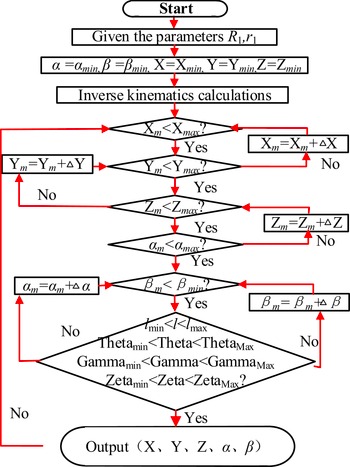
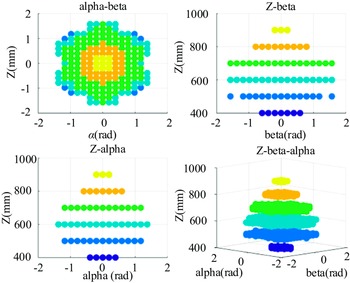
The position and posture of the RAPM represent the workspace and rotational angle of the RAPM. Large angles of the AMP of the proposed RAPM can improve processing efficiency of the RAPA. To make the AMP possess large angles, a composite hinge can represent the spherical joint and be shown in Fig. 12. All parameters in Fig. 11 are shown in Table VI. Figure 13 represents a flow chart for solving the reachable workspace of RAPM. Based on all parameters and flow chart for the reachable workspace, we get the reachable posture workspace of the RAPM and display it in Fig. 14.
The composite hinge.

Flow chart for the reachable posture workspace.

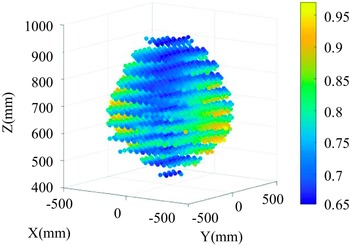
Alpha-beta-Z posture workspace.

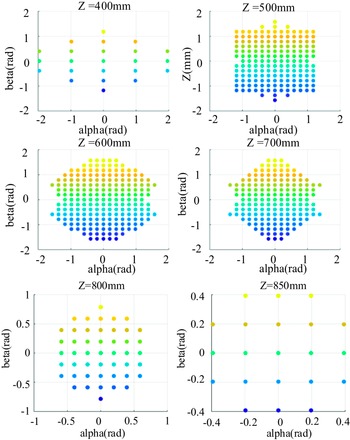
The alpha-beta-Z posture workspace can be shown in Fig. 14, and the values of alpha and beta in different cases of Z are shown in Fig. 15. According to Fig. 15, the maximum values of alpha and beta are 1.57 rad. When Z is at 620 mm, the AMP of the example RAPM is 90°. Based on Li group and configuration evolution, large output rotational angles of the RAPMs can be synthesized.
The values of alpha and beta in different cases of Z.

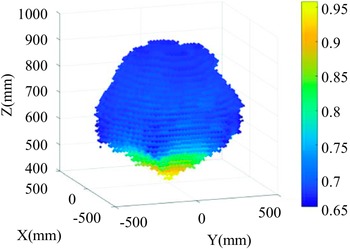
Dexterity is an important index to evaluate the kinematic performance of the mechanism. The moving platform of the mechanism contains translation and rotational movements. Translation and rotational dexterities of the mechanism need to be analyzed separately. The translation and rotational dexterities of the mechanism are expressed as LCI = 1/cond(Jv) and LCI = 1/cond(Jw), separately. Dexterity of the mechanism is shown as Figs. 16 and 17.
Translation dexterity of the mechanism.

Rotational dexterity of the mechanism.

The translation dexterity of the mechanism in the center of the workspace is better than the boundary position. When each limb is extended to a longer length, the translation dexterity of the mechanism is poor. The rotational dexterity of the mechanism has the best dexterity at X = ±480 mm, Y = 0 mm, and Z = 680 mm, while the dexterity at the central position is relatively poor. According to Figs. 16 and 17, the translation dexterity of the mechanism is inconsistent with the rotational dexterity of the mechanism.
4. Motion simulation
4.1. Trajectory planning of the 4SPU-(2UPR)R mechanism
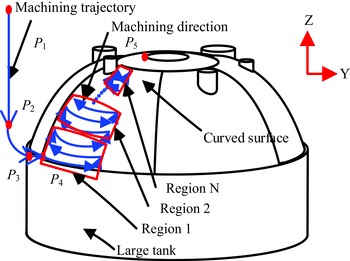
The vibration impact can damage the RAPM and then damage the workpiece. The continuity of acceleration can represent the vibration impact. In the movement process of the RAPM, the mechanism vibration impact should be avoided. Many scholars adopted piecewise function polynomial method, cubic and quintic spline curves, and B-spline interpolation curve, and proposed their own trajectory planning methods [Reference Tian and Curtis27–Reference Jiang, Kong, Zhu, Fang, Xie, Huang, Gu, Zhang, Zhang and Zhang35]. Such as higher-degree polynomial method can make velocity and acceleration of the robot too big. Seeking sine or cosine several times is a continuous function, but it is relatively long time when only using sine or cosine. In order to make the mechanism have a small velocity and acceleration along the target trajectory, and obtain a continuous function by repeatedly taking the derivative of displacement equation, it is better to combine functions of higher-degree polynomial functions and sine or cosine functions. Taking the derivative of acceleration equation represents jerk, which represents vibration shock. If jerk of the mechanism along the target trajectory is a continuous function at any time, it represents that the mechanism moves smoothly and steadily. However, this paper proposes a new trajectory planning method to eliminate the mechanism vibration impact in the movement process. The processing trajectory of the RAPM is shown in Fig. 18. P 1∼P 5 is the machining task. The RAPM has the minimum time and no vibration impact on the goal of trajectory planning. The trajectory of Fig. 18 in the processing task can be selected and shown in Fig. 19. P 1 P 2 is a straight line, P 2 P 3 is a circular arc line, P 3 P 4 is a straight line, and P 4 P 5 contains many arc lines. The RAPM can pass key points of machining the trajectory in a steady state and not have a mechanism vibration impact. All parameters P i (i = 1 ∼ 5) are shown in Table VII.
All parameters about Pi .

The machining trajectory and the large tank.

Simplified trajectories.

The trajectories from P 1 to P 4 in Fig. 18 are shown in Fig. 19. P 1 P 2 in Fig. 18 represents P 1 P 2 in Fig. 19. P 2 P 3 in Fig. 18 represents P 2 P 3 in Fig. 19. P 3 P 4 in Fig. 18 represents P 3 P 4 in Fig. 19. If the RAPM passes simplified trajectory in Fig. 18, the RAPM can also complete the trajectory task in Fig. 18. The time used by the RAPM from P 1 to P 2 is t 11, the time used by the RAPM from P 2 to P 3 is t 22, the time used by the RAPM from P 3 to P 4 is t 33, and the time used by the RAPM from P 1 to P 3 is t 44.
4.1.1. The new trajectory planning method
To make the 4SPU-(2UPR)R mechanism have small acceleration during the movement of the simplified trajectories and no vibration impact in the goal trajectory, this paper proposes a new trajectory planning method, which consists of cosine function and quadratic function, as shown in Fig. 20. The method consists of seven phases.
 $\tau_1$
and
 $\tau_5$
represent the accelerated acceleration,
 $\tau_2$
and
 $\tau_6$
represent steady acceleration,
 $\tau_3$
and
 $\tau_7$
represent the reduced acceleration, and
 $\tau_4$
represent constant velocity. The RAPM adopts the new method during movement. The jerk is obtained by taking the derivative of equation (16), as shown in Fig. 21. The jerk is continuous and represents no vibration impact.
The cosine function-constant planning method.

Jerk curve.

The starting and ending period velocity of the RAPM should be zero.
 $\tau_k$
is k duration,
 $\tau_1$
and
 $\tau_5$
are accelerated acceleration period,
 $\tau_2$
and
 $\tau_6$
are steady acceleration period, and
 $\tau_3$
and
 $\tau_7$
represent reduced acceleration period. Acceleration period of
 $\tau_4$
is 0. Based on Fig. 20, the acceleration equations are expressed as
 \begin{equation} a=\left\{\begin{array}{l} \mathrm{A}-\mathrm{A}\cos\left({\unicode[Arial]{x03C9}} _{1}t\right)\begin{array}{c@{\quad}c} & 0\lt t\lt t_{1} \end{array}\\[4pt] 2\mathrm{A}\begin{array}{l} \begin{array}{c@{\quad}c} & t_{1}\lt t\lt t_{2} \end{array} \end{array}\\[4pt] \mathrm{A}+\mathrm{A}\cos\left({\unicode[Arial]{x03C9}} _{2}\left(t-t_{2}\right)\right)\begin{array}{c@{\quad}c} & t_{2}\lt t\lt t_{3} \end{array}\\[4pt] 0\begin{array}{c@{\quad}c} & t_{3}\lt t\lt t_{4} \end{array}\\[4pt] -\mathrm{A}+\mathrm{A}\cos\left({\unicode[Arial]{x03C9}} _{3}\left(t-t_{4}\right)\right)\begin{array}{c@{\quad}c} & t_{4}\lt t\lt t_{5} \end{array}\\[4pt] -2\mathrm{A}\begin{array}{c@{\quad}c} & t_{5}\lt t\lt t_{6} \end{array}\\[4pt] -\mathrm{A}-\mathrm{A}\cos\left({\unicode[Arial]{x03C9}} _{4}\left(t-t_{6}\right)\right)\begin{array}{c@{\quad}c} & t_{6}\lt t\lt t_{7} \end{array} \end{array}\right. \end{equation}
where ω1, ω2, ω3, and ω4 are coefficients; A is amplitude; t 1, t 2, t 3, t 4, t 5, t 6, and t 7 express different time.
The velocity equation (17) by integrating the equation (16) is obtained and expressed as
 \begin{equation} v=\left\{\begin{array}{l} \mathrm{A}t+\mathrm{C}_{1}-\mathrm{A}\sin\left({\unicode[Arial]{x03C9}} _{1}t\right)/{\unicode[Arial]{x03C9}} _{1}\begin{array}{c@{\quad}c} & 0\lt t\lt t_{1} \end{array}\\[4pt] 2\mathrm{A}t+\mathrm{C}_{2}\begin{array}{l} \begin{array}{c@{\quad}c} & t_{1}\lt t\lt t_{2} \end{array} \end{array}\\[4pt] \mathrm{A}t+\mathrm{C}_{3}+\mathrm{A}\sin\left({\unicode[Arial]{x03C9}} _{2}\left(t-t_{2}\right)\right)/{\unicode[Arial]{x03C9}} _{2}\begin{array}{c@{\quad}c} & t_{2}\lt t\lt t_{3} \end{array}\\[4pt] \mathrm{C}_{4}\begin{array}{c@{\quad}c} & t_{3}\lt t\lt t_{4} \end{array}\\[4pt] -\mathrm{A}t+\mathrm{C}_{5}+\mathrm{A}\sin\left({\unicode[Arial]{x03C9}} _{3}\left(t-t_{4}\right)\right)/{\unicode[Arial]{x03C9}} _{3}\begin{array}{c@{\quad}c} & t_{4}\lt t\lt t_{5} \end{array}\\[4pt] -2\mathrm{A}t+\begin{array}{c@{\quad}c} \mathrm{C}_{6} & t_{5}\lt t\lt t_{6} \end{array}\\[4pt] -\mathrm{A}t+\mathrm{C}_{7}-\mathrm{A}\sin\left({\unicode[Arial]{x03C9}} _{4}\left(t-t_{6}\right)\right)/{\unicode[Arial]{x03C9}} _{4}\begin{array}{c@{\quad}c} & t_{6}\lt t\lt t_{7} \end{array} \end{array}\right. \end{equation}
where C i (i = 1–7) expresses constants.
The displacement equation (18) by integrating displacement equation (17) is obtained and expressed as
 \begin{equation} s=\left\{\begin{array}{l} \mathrm{A}t^{2}/2+\mathrm{C}_{1}t+\mathrm{d}_{1}+\mathrm{A}\cos\left({\unicode[Arial]{x03C9}} _{1}t\right)/{\unicode[Arial]{x03C9}} _{1}^{2}\begin{array}{c@{\quad}c} & 0\lt t\lt t_{1} \end{array}\\[4pt] \mathrm{A}t^{2}+\mathrm{C}_{2}t+\mathrm{d}_{2}\begin{array}{l} \begin{array}{c@{\quad}c} & t_{1}\lt t\lt t_{2} \end{array} \end{array}\\[4pt] \mathrm{A}t^{2}/2+\mathrm{C}_{3}t+\mathrm{d}_{3}-\mathrm{A}\cos\left({\unicode[Arial]{x03C9}} _{2}\left(t-t_{2}\right)\right)/{\unicode[Arial]{x03C9}} _{2}^{2}\begin{array}{c@{\quad}c} & t_{2}\lt t\lt t_{3} \end{array}\\[4pt] \mathrm{C}_{4}t+\mathrm{d}_{4}\begin{array}{c@{\quad}c} & t_{3}\lt t\lt t_{4} \end{array}\\[4pt] -\mathrm{A}t^{2}/2+\mathrm{C}_{5}t+\mathrm{d}_{5}-\mathrm{A}\cos\left({\unicode[Arial]{x03C9}} _{3}\left(t-t_{4}\right)\right)/{\unicode[Arial]{x03C9}} _{3}^{2}\begin{array}{c@{\quad}c} & t_{4}\lt t\lt t_{5} \end{array}\\[4pt] -\mathrm{A}t^{2}+\begin{array}{c@{\quad}c} \mathrm{C}_{6}t+\mathrm{d}_{6} & t_{5}\lt t\lt t_{6} \end{array}\\[4pt] -\mathrm{A}t^{2}/2+\mathrm{C}_{7}t+\mathrm{d}_{7}+\mathrm{A}\cos\left({\unicode[Arial]{x03C9}} _{4}\left(t-t_{6}\right)\right)/{\unicode[Arial]{x03C9}} _{4}^{2}\begin{array}{c@{\quad}c} & t_{6}\lt t\lt t_{7} \end{array} \end{array}\right. \end{equation}
where d i (i = 1 ∼ 7) represents constants.
The jerk equation (19) by taking the derivative of equation (16) is obtained and expressed as
 \begin{equation} Jerk=\left\{\begin{array}{l} \mathrm{A{\unicode[Arial]{x03C9}} }_{1}\sin \left({\unicode[Arial]{x03C9}} _{1}t\right)\begin{array}{c@{\quad}c} & 0\lt t\lt t_{1} \end{array}\\[4pt] -\mathrm{A{\unicode[Arial]{x03C9}} }_{2}\sin \left({\unicode[Arial]{x03C9}} _{2}\left(t-t_{2}\right)\right)\begin{array}{c@{\quad}c} & t_{2}\lt t\lt t_{3} \end{array}\\[4pt] -\mathrm{A{\unicode[Arial]{x03C9}} }_{3}\sin \left({\unicode[Arial]{x03C9}} _{3}\left(t-t_{4}\right)\right)\begin{array}{c@{\quad}c} & t_{4}\lt t\lt t_{5} \end{array}\\[4pt] \mathrm{A{\unicode[Arial]{x03C9}} }_{4}\sin \left({\unicode[Arial]{x03C9}} _{4}\left(t-t_{6}\right)\right)\begin{array}{c@{\quad}c} & t_{6}\lt t\lt t_{7} \end{array} \end{array}\right. \end{equation}
The new proposed trajectory planning method is applied to simplified trajectories in Fig. 17. The relationship parameters between each path in simplified trajectories can be expressed as
 \begin{equation} \left\{\begin{array}{l} \begin{array}{c@{\quad}c@{\quad}c} a_{1\mathrm{Z}}\left(0\right)=0 & v_{1\mathrm{Z}}\left(0\right)=0 & s_{1\mathrm{Z}}\left(0\right)=0 \end{array}\\[4pt] \begin{array}{c@{\quad}c@{\quad}c} a_{1\mathrm{Z}}\left(t_{11}+t_{22}\right)=0 & v_{1\mathrm{Z}}\left(t_{11}+t_{22}\right)=0 & s_{1\mathrm{Z}}\left(t_{11}+t_{22}\right)=s_{1} \end{array}\\[4pt] \begin{array}{c@{\quad}c@{\quad}c} a_{1\mathrm{Y}}\left(t_{11}\right)=0 & v_{1\mathrm{Y}}\left(t_{11}\right)=0 & s_{1\mathrm{Y}}\left(t_{11}\right)=0 \end{array}\\[4pt] \begin{array}{c@{\quad}c@{\quad}c} a_{3\mathrm{Y}}\left(t_{11}+t_{22}+t_{33}\right)=0 & v_{3\mathrm{Y}}\left(t_{11}+t_{22}+t_{33}\right)=0 & s_{3\mathrm{Y}}\left(t_{11}+t_{22}+t_{33}\right)=s_{3}+s_{2} \end{array}\\[4pt] a_{1\mathrm{Z}}\left(t_{11}+t_{22}\right)=a_{3\mathrm{X}}\left(t_{11}+t_{22}\right) \end{array}\right. \end{equation}
4.1.2. 3-4-5 polynomial trajectory planning method
The RAPM adopting 3-4-5 polynomial motion law can also completely simplify trajectories along the path.
 \begin{equation} \left\{\begin{array}{l} s\left(t\right)=\left(\mathrm{C}_{9}\tau ^{3}+\mathrm{C}_{10}\tau ^{4}+\mathrm{C}_{11}\tau ^{5}\right)a_{\max}\mathrm{C}_{8}T^{2}\\[4pt] v\left(t\right)=\left(3\mathrm{C}_{9}\tau ^{2}+4\mathrm{C}_{10}\tau ^{3}+5\mathrm{C}_{11}\tau ^{4}\right)a_{\max}\mathrm{C}_{8}T\\[4pt] a\left(t\right)=\mathrm{C}_{8}a_{\max}\left(6\mathrm{C}_{9}\tau +12\mathrm{C}_{10}\tau ^{2}+20\mathrm{C}_{11}\tau ^{3}\right)a_{\max}\mathrm{C}_{8} \end{array}\right. \end{equation}
where s(t), v(t), and a(t) represent the position, velocity, and acceleration of the RAPM in simplified trajectories, respectively. C8, C9, C10, and C11 are constants. a
max = S/T 2, S represents the total displacement in simplified trajectories, and T represents the total time used in simplified trajectories.
 $\tau$
= t/T,
 $\tau$
represent the equivalent operator time in simplified trajectories.
4.2. Simulation and analysis
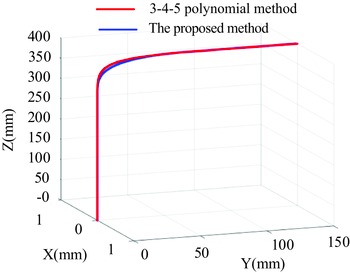
The kinematics equation of the RAPM in simplified trajectories is established. The new proposed trajectory planning method and the 3-4-5 polynomial trajectory planning method are used to the same simplified trajectories in Fig. 19. The parameters s 1 is 400 millimeter, s 2 is 100 millimeter, s 3 is 50 millimeter, t 00 is 0 second, t 11 is 6 second, t 22 is 4 second, t 33 is 2.1 second, t 44 is 44 second. The simplified trajectories in Fig. 19 can be expressed in Fig. 22.
Simplify trajectory of the RAPMs.

As shown in Fig. 22, it can be known that the RAPM along the simplified trajectories path is similar; two methods can make the RAPM pass the key points of the path. Compared with the 3-4-5 polynomial method, the new proposed trajectory planning method makes RAPM in the P 2 ∼ P 3 path smoother and more stable.
As shown in Figs. 23 and 24, it can be known that the maximum velocity of the RAPM in the newly proposed method along the Y-axis and Z-axis is 12 mm/s and 20 mm/s, respectively. The maximum velocity of the RAPM in 3-4-5 polynomial trajectory planning method along the Y-axis and Z-axis path is 320 mm/s, and 880 mm/s, respectively. The maximum velocity of the proposed method is less than the maximum velocity of 3-4-5 polynomial trajectory planning method in the same path and time. The amplitude A and ω i of the proposed method are tunable.
Velocity of simplified trajectory in Y-axis.

Velocity of simplified trajectory in Z-axis.

As shown in Figs. 25 and 26, it can be known that the maximum acceleration of the RAPM in the proposed method along the Y-axis and Z-axis is 20 mm/s2 and 20 mm/s2, respectively. The maximum acceleration of the RAPM in 3-4-5 polynomial trajectory planning method along the Y-axis and Z-axis path is 1100 mm/s2, and 3000 mm/s2, respectively. The curves of the two methods are also continuous and have no mutation. The maximum acceleration of the proposed method is less than the maximum acceleration of 3-4-5 polynomial trajectory planning method in the same path and time. The amplitude A and ω i of the proposed method are tunable. Compared with the 3-4-5 polynomial trajectory planning method, the new proposed trajectory planning method can make the RAPM have smaller acceleration and smaller inertial force. Because the amplitude A and ω i of the proposed method are adjustable, the proposed method has better adaptability. When the A and ω i in the newly proposed trajectory planning method are raised, the movement time of the RAPM in the above path will be shorter.
The acceleration of motion trajectory in Y-axis.

The acceleration of simplified trajectory in Z-axis.

The continuous curve of jerk represents the mechanism without impact. As shown in Figs. 27 and 28, it can be known that the maximum Jerk of the RAPM in the proposed method along the Y-axis and Z-axis are 8 mm/s3 and 8 mm/s3, respectively. The maximum jerk of the RAPM in 3-4-5 polynomial trajectory planning method along the Y-axis and Z-axis path is 6000 mm/s2, and 16,000 mm/s2, respectively. The curves of the two methods are also continuous and have no mutation. The maximum jerk of the proposed method is less than the maximum jerk of 3-4-5 polynomial trajectory planning method in the same path and time. The amplitude A and ωi of the proposed method are tunable. Compared with the 3-4-5 polynomial trajectory planning method, the new proposed trajectory planning method can make the RAPM have smaller jerk. The RAPM has no mechanism vibration impact on movement.
The Jerk of motion trajectory in Y-axis.

The Jerk of simplified trajectory in Z-axis.

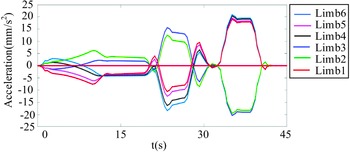
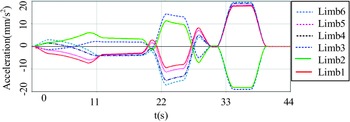
The proposed method is applied to L-shaped path, and the movement trajectory simulation of AMP of the 4SPU-(2UPR)R mechanism can be obtained and shown in Figs. 29 and 30. Besides, theoretical and simulation acceleration of actuated joint P of each limb of the 4SPU-(2UPR)R mechanism can be obtained and shown in Figs. 31 and 32. The theoretical acceleration and simulation acceleration of the center point p of the RAPM are consistent and continuous in the Y-axis and Z-axis. At the same time, the theoretical acceleration and simulation acceleration of the actuated joint P of the RAPM are consistent and continuous, as shown in Figs. 31 and 32. The theoretical and simulation accelerations of actuated joint P of each limb of the RAPM are consistent and continuous. The new proposed trajectory planning method ensures the RAPM is in a steady and no vibration impact state.
The acceleration of the 4SPU-(2UPR)R mechanism on Y-axis.

The acceleration of the 4SPU-(2UPR)R mechanism on Z-axis.

Theoretical acceleration of actuated joint P each limb of the 4SPU-(2UPR)R mechanism.

Simulation acceleration of actuated joint P of each limb of the 4SPU-(2UPR)R mechanism.

A conclusion is summarized according to the above theoretical acceleration and simulation research result. Velocity and acceleration of the proposed method are smaller than 3-4-5 polynomial trajectory planning method. The high-oriented order of the proposed method is lower and is easier to achieve the trajectory of the L-shaped path. L-shaped path contains arc lines and the straight line, therefore, the proposed method can be applied to the arc lines. The amplitude A and ωi of the proposed method are tunable. Therefore, the 4SPU-(2UPR)R mechanism moves along the L-shaped motion path in the proposed method, which can prevent the mechanism from excessive momentum, greater inertia, and institutional impact on external workpieces, and improve the movement accuracy of the institution.
5. Conclusion
This paper represents type synthesis and trajectory planning of 5-DOF RAPMs with large output rotational angles. A new thick processing equipment is proposed to meet the variable size and local complex curved surface of the box insulation layer of large workpieces. Some research work about 5-DOF RAPMs is summarized. In order to achieve 5-DOF RAPMs with larger output rotational angles, two AMPs are proposed. Four kinds of corresponding limbs based on Li group and configuration evolution are designed, and a series of 5-DOF RAPMs is obtained by using two AMPs and four kinds of limbs. By analyzing the kinematics of the example, the proposed 4SPU-(2UPR)R mechanism possesses ±90°. A new trajectory planning method is put forward and ensures that the 4SPU-(2UPR)R mechanism is in a steady state in motion simulation. The new trajectory planning method has the advantage of adjustable, and it is easier to achieve the simplified trajectory. This work lays the foundation for processing the box insulation layer of large workpieces. This paper needs to verify that the proposed method is suitable for other trajectories and the control method.
Author contributions
Bingshan Jiang, Guanyu Huang, and Lingyu Kong conceived and designed the study. Lan Zhang, Pengyu Zhao, and Xinyu Tian conducted data gathering. Anhuan Xie, Hairong Fang, and Jianjun Gu guided this article. Bingshan Jiang wrote the article.
Financial support
This research received no specific grant from any funding agency, commercial, or not-for-profit sectors.
Competing interests
No competing interests exist.
Ethical approval
Not applicable.
Acknowledgments
This work is supported by “Pioneer” and “Leading Goose” R&D Program of Zhejiang (No. 2023C01177), National Natural Science Foundation of China (Grants No. 52205034, No. 52305039 and No. 52205076), Key Research Project of Zhejiang Lab (No. G2021NB0AL03), Youth Foundation Project of Zhejiang Lab (No. K2023NB0AA01).