I. INTRODUCTION
The evolution of next generation technologies that focus on sustainability and efficiency in manufacturing will require the development of new materials and processing techniques. Following this path to sustainability, corrosion phenomena are ongoing concerns due to the high associated costs and potentially harmful environmental impacts. A comprehensive 2002 study by Koch estimated that the annual costs of corrosion exceed $237 billion in the US alone, Reference Koch, Brongers, Thompson, Virmani and Payer1 across a wide variety of industrial sectors, which would be close to $500 billion/annum in 2016, taking inflation into account. To a certain extent, advancements in materials manufacturing have helped to address these issues through the implementation of cermets and related coatings, which can exhibit excellent wear and corrosion properties, through combination of ceramic and metallic constituents. These materials are widely used in applications that require high erosion and corrosion protection, including use as cutting tools, pump seals, and protective coatings. Reference Gant and Gee2–Reference Beste, Hartzell, Engqvist and Axén4 Tungsten carbide (WC) based ‘hardmetals’, which are also known as cemented carbides, are the most common variant of cermets that are used commercially, and they are invariably formed via liquid sintering with Co as the metallic binder phase. Considerable interest has been invested in titanium carbide (TiC) based cermets in recent years, due to their reduced mass and improved elevated temperature properties in comparison to WC–Co hardmetals. The mechanical properties of TiC-based cermets offer an increase in overall hardness and, potentially, wear resistance due to the high hardness of the ceramic component (i.e., composite Vickers hardness values from 19.6 to 31.4 GPa). Reference Hussainova5,Reference Kumashiro, Itoh, Kinoshita and Sobajima6 In terms of microstructural ‘design’, the toughness of a cermet is invariably significantly improved through incorporation of a metallic matrix phase, at the expense of the overall hardness. Consequently, the properties can be tailored by varying the volume fraction of binder that is used and, potentially, through heat treatment of the sintered cermet to vary the ceramic grain size. Reference Reshetnyak and Kübarsepp7–Reference Onuoha, Jin, Farhat, Kipouros and Plucknett9
An understanding of the corrosion behavior of cermet materials is often obtained through application of electrochemical tests which are supported by analysis of the material surfaces prior to and after testing. Reference Tomlinson and Ayerst10,Reference Scholl, Hofman and Rauscher11 The corrosion mechanisms of cermet materials based on WC and TiC are mainly divided into two scenarios; oxidation of the metallic binder matrix and oxidation of the ceramic phase, in addition to dissolution of the binder. Micro-galvanic corrosion at the metal/ceramic interface, with preferential dissolution of the binder during galvanic attack, and finally removal of the carbide grains has been reported as the major corrosion mechanism for this type of material. Reference de Souza and Neville12,Reference de Souza and Neville13 The metallic phase, particularly when it is paired with ceramic materials with higher oxidation resistance (i.e., a more noble corrosion potential), is believed to be the dominating corroding component for cermet compositions. Reference Tomlinson and Ayerst10,Reference Tomlinson and Linzell14–Reference Sutthiruangwong and Mori17 However, it has also been repeatedly reported that several factors, such as grain size, contamination in the ceramic phase, and the electrolyte oxygen concentration can significantly affect the oxidation characteristics of the overall cermet. Reference Stewart and Cutler18–Reference Zackrisson and Andrén21
More recently, such fundamental studies have been extended to assess the corrosion response of new, high performance cermet systems. Reference Onuoha, Kipouros, Farhat and Plucknett22–Reference Memarrashidi and Plucknett24 For example, TiC and titanium carbonitride [Ti(C,N)] cermets based on the use of Ni3Al-based binders have been developed that exhibit comparable wear resistance to WC–Co, Reference Stewart and Plucknett8 while at the same time possessing aqueous corrosion rates that are two to three orders of magnitude lower. Reference Memarrashidi and Plucknett23,Reference Memarrashidi and Plucknett25 These studies have also demonstrated the subtle effects of changing the C:N ratio in the Ti(C,N)-based materials. Reference Memarrashidi and Plucknett23 Additionally, it has been shown that implementation of these types of cermet materials, and related coatings, can also be extended to alternate fields of application beyond simple wear scenarios, such as biomass boiler coatings, diesel engine coatings, and in petrochemical and mining environments. Reference Kawahara26–Reference Kumar and Singh Sidhu29
The present study examines the influence of raw material purity, binder alloy composition and electrochemical testing conditions on the aqueous oxidation characteristics of TiC–Ni3Al cermets. The effects of W contamination on the corrosion behavior of TiC–Ni3Al cermets were assessed through electrochemical testing of cermets manufactured with TiC powders from two suppliers, with and without the presence of W contamination in the feedstock material. The use of electrochemical techniques, such as anodic and cathodic polarization, offers information on the oxidation behavior of the specimen as a function of applied potential, varied under a controlled rate, to obtain data over a comparatively short duration. Reference Souza and Neville30 However, such accelerated test methods can affect the outcome of these measurements, particularly for multiphase materials with complex microstructures, such as cermets. For example, an increase in the rate of oxidation is possible by modifying the conductivity of the electrolyte media through increase of the concentration of salt or oxygen. The concentration of dissolved oxygen, or ions such as Cl−, can also affect the oxidation characteristics of both ceramic and metallic phase. For the present study, the effects of dissolved oxygen on the oxidation characteristics of the TiC-based cermets, with a fixed 30 vol% content of three different Ni3Al-based intermetallic binders was examined. The electrochemical behavior of each material was assessed through use of potentiodynamic polarization measurements. The role of O2, naturally present in the service environment, on the oxidation behavior was investigated in both aerated and deaerated electrolytes. Samples were subsequently analyzed by drawing comparisons between microstructural characteristics of the pre- and post-corrosion surfaces.
II. EXPERIMENTAL PROCEDURES
A. Cermet and single-phase ceramic production
Two sources of TiC powder were used in the present study. The first TiC powder, with W contamination arising from the production process (lot no. PL20125339; D 50 = 1.25 μm), was obtained from Pacific Particulate Materials (Vancouver, Canada), while a higher purity TiC powder (lot no. PL45693; D 50 = 1–2 μm) was purchased from Treibacher Industrie AG (Althofen, Austria). Single-phase TiC samples for both powders were consolidated using a spark plasma sintering (SPS) furnace (Model 10-3; Thermal Technologies LLC., Santa Rosa, California) under helium inert gas. The powder was held in a graphite die (Grade: Isocarb I-85; Milford, Connecticut), to yield a sintered disc with dimensions of 20 mm diameter and approximately 5 mm thickness. The temperature was monitored with an optical pyrometer. SPS sintering profiles involved a heating rate of 200 K/min, to an isothermal temperature hold of 1900 °C, which was for 10 min. The densified samples were then furnace cooled to ambient temperature under vacuum. The specimens were subjected to a uniaxial pressure of 50 MPa throughout the entire SPS cycle of heating/cooling.
The various Ni3Al-based binders were effectively generated in situ in the cermets through a simple reaction sintering technique. Reference Rodrigo and Boch31,Reference Liou, Wu and Chung32 Stoichiometric Ni3Al was prepared with an appropriate mixture of fine Ni powder (lot no. L10W013; 2.2–3.0 μm) and a pre-alloyed Ni/Al powder (lot no. D28X029; D 50 = 38 μm), both sourced from Alfa Aesar (Ward Hill, Massachusetts). The IC50 and IC221 alloys were obtained by mixing B4C powder (lot no. BC060F05; D 50 = 11.4 μm), provided by UK Abrasives Inc. (Northbrook, Illinois), ZrO2 powder (lot no. Z005551P; D 50 = 0.04 μm), provided by Tosoh (Kaisei, Japan), and Cr powder (lot no. I15U008; D 50 ≤ 10 μm), provided by Alfa Aesar, with the same Ni and Ni/Al powders used for the stoichiometric Ni3Al. The nominal compositions of the Ni3Al-based binder alloys are (in wt%): (i) Ni3Al (13.28 Al), (ii) IC50 (11.3 Al, 0.02 B, 0.6 Zr), and (iii) IC221 (8.5 Al, 0.02 B, 1.7 Zr, 7.8 Cr); Ni forms the balance in each case.
The cermet samples were prepared by mixing appropriate amounts of various ceramic and metallic powders through ball milling, with 10 mm diameter tetragonal zirconia polycrystal (TZP) media (Inframat Advanced Materials, Manchester, Connecticut). Powder blends were milled in acetone for 24 h, followed by a 24 h drying period. They were then sieved through a 75 μm stainless steel mesh, and uniaxially compacted in a hardened steel die at 45 MPa, to give discs of 31.75 mm diameter and ∼6 mm in thickness. The discs were then vacuum bagged and cold isostatically pressed at 207 MPa. The cermets were then placed in an alumina (Al2O3) crucible/lid, on a bed of bubble Al2O3, and sintered under dynamic vacuum at 1550 °C for 1 h. The sintered densities were calculated based on Archimedes’ principle, in distilled water. Sample surface preparation, for subsequent microscopy and electrochemical characterization, was achieved through sequential grinding and polishing; successively finer grades of diamond particles were used, starting with 160 μm diamond grit impregnated resin pads, with a final polishing stage using 0.25 μm diamond paste. Microstructural characterization of the polished samples was conducted using scanning electron microscopy (SEM; Model S-4700, Hitachi High Technologies, Tokyo, Japan). Compositional analysis of the samples was performed in the SEM using energy dispersive X-ray spectroscopy (EDS; Inca X-maxN, Oxford Instruments, Concord, Massachusetts).
B. Electrochemical test procedures and post-corrosion evaluation
Electrochemical measurements were performed at (21 ± 2 °C) in either an aerated or de-aerated aqueous electrolyte, containing 3.5 wt% NaCl, to simulate a controlled seawater-like environment. Tests were conducted using a potentiostat/galvanostat (Model: EG&G 273A; Princeton Applied Research, Oak Ridge, Tennessee) and frequency response analyzer (Solartron Model 1250; Solartron Analytical, Schlumberger, Texas). Corrosion testing was performed within a glass three-electrode flat cell. In this arrangement, the samples being evaluated were located as the working electrode, while a platinum mesh was used as the counter electrode, and a saturated calomel electrode (SCE; −0.241 V versus a standard hydrogen electrode) was used as the reference. Consequently, all potentials are subsequently reported versus SCE for both the aerated and de-aerated electrolytes. The de-aeration was performed by purging N gas into the electrolyte for 60 min prior measurement; the oxygen content was determined using a portable dissolved oxygen meter (Model DO 6+, Oakton Instruments Inc., Vernon Hills, Illinois). Samples were immersed in the electrolyte medium for a minimum of 50 min and the open circuit potential (OCP) was recorded at the end of this period. A potential scan rate of 0.1667 mV/s was used for all potentiodynamic testing. The applied potential was controlled using the CorrWare software package (CorrWare for Windows, Version 2.8; Scribner Associates, Inc., Southern Pines, South Carolina). For potentiodynamic polarization experiments, the voltage was swept from −0.3 V (versus the measured OCP) to +1 V (versus SCE). The corrosion current density (i corr) and potential (E corr) were then determined using an instantaneous Tafel-type fit corrosion analysis software (CorrView Version 2.8; Scribner Associates, Inc.); this software applies the Levenberg–Marquardt method, Reference Marquardt33 which utilizes an iterative, nonlinear least squares fit algorithm, that is applied to the potentiodynamic polarization data within ±250 mV of the OCP value. To achieve this, the measured Tafel curve is simulated by fitting four parameters of the Tafel equation [i corr and E corr, and the anodic and cathodic Tafel slopes (B a and B c, respectively)]. Using the current approach, it has typically been noted that the Tafel derived values for E corr corresponded closely to the preliminary measured OCP values, Reference Onuoha, Kipouros, Farhat and Plucknett22–Reference Memarrashidi and Plucknett24 invariably within one standard deviation error. From a previous study, Reference Onuoha, Kipouros, Farhat and Plucknett22 manual fits of both the anodic and cathodic Tafel slopes invariably correspond closely to those automatically derived using the CorrView software (i.e., deviation less than 4%). In the present work, the Tafel extrapolation measurements were typically repeated for 2 or 3 different samples for each cermet composition; standard deviation errors are only provided when 3 (or more) tests were conducted for identical conditions/samples. Based on the measured values that were obtained for i corr, the corrosion rates (in mm/year) can subsequently be estimated following the ASTM standard procedure. 34
III. RESULTS AND DISCUSSIONS
A. Cermet microstructure characterization
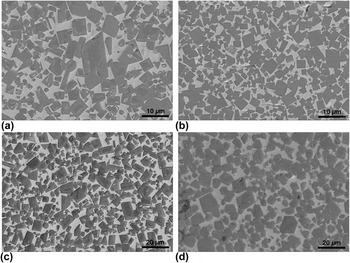
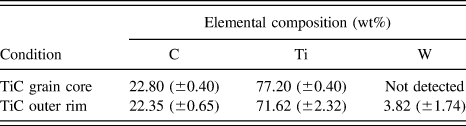
Representative microstructural examples of the polished surfaces of TiC–30 vol% Ni3Al cermets prepared using the two TiC powders, both with and without W contamination, are shown in Fig. 1. A general reduction in overall grain size was observed by eliminating W contamination from the chemical composition of the cermets [Figs. 1(a) and 1(b)]. Moreover, the core rim structure that was repeatedly observed in cermets produced when using TiC containing W contamination did not form when the cermets were manufactured from the higher purity TiC powder. Prior studies have shown that, in the instance of core-rim formation, the core is composed of undissolved TiC, while the rim is an alloyed TiC with measurable concentrations of heavier elements such as W, Ta, and Mo, if they are initial present in the powder blend Reference Cardinal, Malchère, Garnier and Fantozzi35 ; this is confirmed in Table I, with mean compositional data presented for the core and outer rim of the as-fabricated cermets with W-containing TiC powder. It has also been reported that a complex rim structure can be formed, with an inner rim i.e., generated through solid-state sintering and an outer rim which is related to dissolution/re-precipitation during liquid phase sintering. Reference Stewart36 EDS analyses of the compositions of the carbide grains showed that for the W-containing TiC, the cores were surrounded by a layer containing Ti and W. In some areas, the core/outer rim interface was separated by an inner rim, which was noted to contain higher concentrations of W than the outer rim, and appears as a lighter contrast band between dark core and gray rim phases. Figures 1(c) and 1(d) shows representative examples of SEM micrographs of the polished as-sintered surfaces of the TiC-based cermets prepared with 30 vol% of the IC50 or IC221 alloys, respectively, as the intermetallic binder phase. These cermets were prepared with the TiC source powder containing small amounts of W contamination. Details relating to the characterization of each cermet type is discussed in a separate work. Reference Memarrashidi37 Overall, these cermets exhibited a uniform microstructure, with a typical core-rim structure arising due to the presence of W. The average grain size for the Ni3Al based cermets (5.59 ± 2.16 µm) was slightly lower than IC50 and IC221 (7.42 ± 2.87 µm and 7.21 ± 2.97 µm, respectively), which is likely related to an increased solubility of the carbide in the more complex intermetallic phases.
Representative SEM images obtained from polished surfaces of the various TiC–30 vol% Ni3Al-cermets. (a) TiC–Ni3Al sample prepared with TiC source powder containing W contamination, showing the core-rim structure in the carbide grains (BSE image with −50 V bias). (b) TiC–Ni3Al sample prepared using high purity TiC source powder, without W contamination (combined SE/BSE image). (c) TiC–IC50 prepared with TiC source powder containing W (combined SE/BSE image). (d) TiC–IC221 prepared with TiC source powder containing W (combined SE/BSE image).

Average EDS chemical analyses of the core and outer rim compositions for the TiC–Ni3Al cermets prepared with W containing TiC powder. Standard deviation error is shown in parentheses.

B. Effects of W contamination on electrochemical behavior
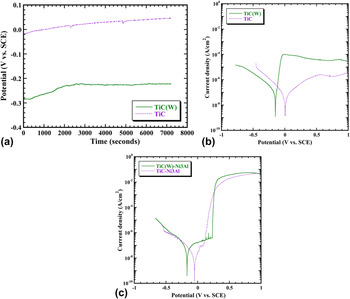
Representative OCP and potentiodynamic polarization curves obtained for the SPS processed, single-phase TiC specimens, both with and without W contamination, are shown in Figs. 2(a) and 2(b). The results of OCP measurement revealed a more noble free potential for the higher purity TiC when compared to the specimen containing W contamination. Furthermore, the measured OCP increased toward more positive potentials over a period of approximately 2 h, inferring the formation and growth of an oxide layer for both compositions. However, the OCP value stabilized for TiC samples with W after the first 2000 s of the monitoring period, while the OCP measured for the higher purity TiC continued to increase at a reducing rate throughout the complete stabilization period. The results of potentiodynamic polarization measurements were used to obtain the electrochemical parameters such as E corr, and i corr, as well as the passivation current, i pass, and subsequent calculation of the corrosion rate, which is presented in Table II, along with the measured electrochemical parameters. Galvanic coupling between phases was considered using mix potential theory by extrapolation of the anodic and cathodic slopes of the related phases. Reference Stern and Geary38 To identify galvanic couples E couple and i couple, polarization diagrams of ceramic phases were plotted with anodic polarization diagrams of Ni3Al and the value of current and the corresponding potential at the point of intersection between the cathodic and anodic curves. The results of electrochemical analysis showed that pure TiC exhibits a more noble corrosion potential compared to the TiC with W contamination. An initial pitting stage, at a potential just above the corrosion potential, was observed for the SPS processed TiC containing W (E pit = −0.19 V versus SCE). In contrast, the pure TiC did not display any significant increase in current up to ∼0.77 V (versus SCE). Furthermore, i corr for the higher purity, SPS processed single-phase TiC samples was lowered by two orders of magnitude, which results in an overall lower corrosion rate.
Electrochemical responses for SPS densified TiC ceramics, prepared with the two TiC powders, in a 3.5 wt% NaCl electrolyte: (a) OCP, and (b) potentiodynamic polarization. (c) Potentiodynamic polarization curves obtained for the TiC–30 vol% Ni3Al cermets, with and without W contamination within the ceramic phase.

The result of potentiodynamic polarization analysis on single-phase, SPS densified TiC specimens, with and without W contamination.

Figure 2(c) presents typical examples of the potentiodynamic polarization curves obtained for the TiC–30 vol% Ni3Al cermets that were prepared using the two TiC powders, both with and without W contamination. It is apparent that the cermet compositions with W contamination in the TiC source powder behaved similarly to the Ni3Al metallic phase in terms of their current activity during the polarization cycle. However, it can also be established that the nature of electrochemical analysis of the ceramic phase plays an important role in determining the E corr within the final cermet composition. By analyzing the galvanic relation between higher purity TiC and the Ni3Al intermetallic phase, a slight increase in E corr of the final cermet is expected. In a similar response to that outlined for the observations made with the single-phase TiC ceramic specimens, a more positive corrosion potential (E corr = −0.049 V versus SCE) and lower corrosion current (i corr = 1.37 × 10⁻⁸ A/cm2) were observed for cermets manufactured using the TiC source powder without W contamination, which results in an overall lowered corrosion rate. Table III summarizes the results of the electrochemical analyses on the TiC–30 vol% Ni3Al cermets manufactured from both types of TiC ceramic phase, namely with and without W contamination.
Results of electrochemical analysis extracted from potentiodynamic polarization curves on TiC–Ni3Al cermets in 3.5 wt% NaCl electrolyte.

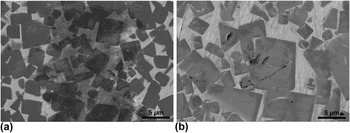
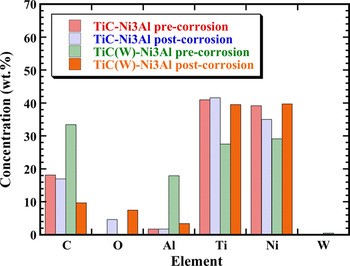
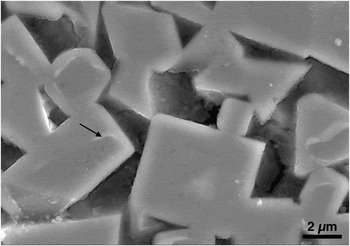
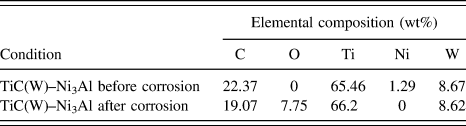
Figure 3 illustrates representative microstructures of the TiC–30 vol% Ni3Al cermets, both with and without W contamination, after the potentiodynamic polarization tests. Cermets containing W exhibited localized attack sites within the carbide grains, where composition changes related to the core-rim structure formation was observed. The results of compositional analysis across the TiC grains, before and after corrosion, obtained using EDS analysis demonstrated minimal changes for the cermets prepared with the higher purity TiC powder (i.e., no W contamination). Compositional mapping performed on each of the cermet composites confirmed the formation of a passive oxide layer (not shown for brevity). Average chemical compositions related to the pre- and post-polarization surfaces of TiC–Ni3Al cermets, both with and without W contamination, under de-aerated electrolyte conditions are shown in Fig. 4. EDS point analyses on the core-rim structure of the carbide grains, both prior to and after potentiodynamic polarization, showed that in addition to selective dissolution of the Ni3Al binder, the interface between the core and rim also undergoes an apparent oxidation attack. Compositional measurements on the core/rim interface (shown in Fig. 5), both before and after polarization below E pit, are presented in Table IV. An inconsistent concentration of W across the TiC grain arises from the development of a discrete core-rim interface (highlighted with an arrow in Fig. 5). Jeton and colleagues reported that XRD investigation indicates a higher lattice mismatch between the core and rim phases of nominally related cermets with an increase in the WC content, which is believed to be due to the formation of a W-rich inner rim layer in the cermet. Reference Jeon, Joardar and Kang20 A broadly similar study has shown that the thickness of the inner rim increases with addition of WC, while the grain size of core/rim phase becomes finer. Reference Yi, Fan, Xiong, Guo, Dong, Wan and Chen19 It was observed that in an HNO3 containing electrolyte, increasing the amount of W and the thickness of the rim results in substantial degradation of the inner rim phase due to lower oxidation resistance of W(C) in comparison to TiC. Reference Yi, Fan, Xiong, Guo, Dong, Wan and Chen19 Ultimately, further polarization of the surfaces highlighted dissolution of the metallic phase as the main corrosion mechanism.
SEM images obtained from surface of TiC–30 vol% Ni3Al, after polarization up to 1 V (versus SCE) in 3.5 wt% NaCl aqueous electrolyte: (a) using high purity TiC (combined SE/BSE image), and (b) with W contamination in the carbide phase (combined SE/BSE image).

Average chemical compositions of the pre- and post-polarization surfaces of TiC–Ni3Al cermets with and without W contamination.

SEM micrograph obtained from surface of TiC–Ni3Al (with W contamination) after polarization up to 0.5 V (versus SCE), highlighting the core/rim interface (arrowed) (combined SE/BSE image).

The results of EDS point analysis on post corrosion surfaces of the TiC(W)–Ni3Al cermet, highlighting the composition of the inner rim for the core-rim structure.

C. Effects of O2 concentration in the electrolyte: aerated versus de-aerated
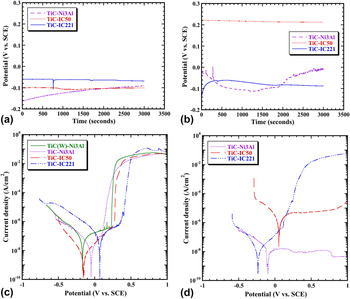
The results of OCP analysis, following a 50 min stabilization period under both aerated and de-aerated test conditions, for each of the cermet compositions are presented in Figs. 6(a) and 6(b). The OCP response of the TiC-based cermets, for both aerated and de-aerated environments, showed a general increase in the OCP values for each of the TiC cermets in the absence of dissolved oxygen. Under de-aerated conditions, the use of a stoichiometric Ni3Al binder for the TiC cermets demonstrated an increase toward more positive potentials after 1000 s, which stabilized at E corr. The cermets with the IC50-based binder exhibited a stable potential under static de-aerated conditions, at a value significantly higher than observed under aerated conditions [i.e., E OCP = 0.22 versus −0.6 V (versus SCE)]. Contrary to the other two alloys, in the absence of oxygen, the TiC cermets prepared with the Cr-containing IC221 alloy binder appeared to depress the E OCP, and recorded OCP values were similar to those measured for conventional aerated conditions.
OCP curves obtained from TiC based cermets with 30 vol% Ni3Al-based inter metallic binder under: (a) de-aerated, and (b) aerated test conditions (held for 50 min). Potentiodynamic polarization curves obtained from TiC based cermets with 30 vol% Ni3Al-based intermetallic binder under: (c) de-aerated, and (d) aerated test conditions.

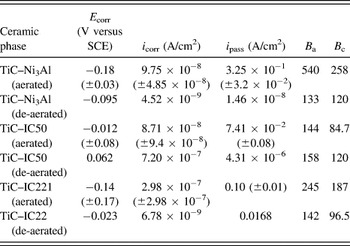
Examples of typical potentiodynamic polarization curves obtained for the TiC based cermets, with the Ni3Al, IC50 and IC221 alloy binders, are presented in Figs. 6(c) and 6(d). The related E corr and i corr values, which were obtained from the Tafel extrapolation process for each cermet, are presented in Table V. As can be observed from the potentiodynamic polarization curves, the TiC based cermets displayed broadly similar electrochemical responses to the applied potential, regardless of the chemical composition of the binder phase under conventional aerated conditions. In the absence of dissolved oxygen, an increase in E corr toward more noble potentials was observed for each of the TiC-based cermets, irrespective of chemical composition of the metallic phase. However, the magnitude of this change varied significantly from one binder composition to another. Stoichiometric Ni3Al containing cermets displayed passivation behavior essentially immediately above E corr and remained in this state through the experiment [i.e., up to an applied potential, E = 1 V (versus SCE)]. The i pass values recorded for the cermet compositions with IC50 as the intermetallic binder phase also displayed a significant drop (by approximately two orders of magnitude), in comparison to those recorded for stoichiometric Ni3Al, under de-aerated conditions. The electrochemical response, in terms of the oxidation behavior of the cermets prepared with IC221 in de-aerated media, demonstrated more noble E corr values. Nevertheless, a sharp increase of current up to i pass was recorded, similarly to the potentiodynamic polarization curves obtained under more typical aerated conditions.
Mean corrosion parameters determined for the TiC based cermets with 30 vol% Ni3Al-based intermetallic binder under aerated de-aerated conditions.

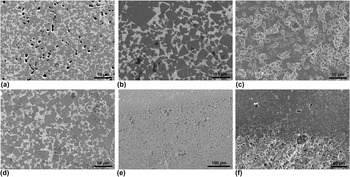
Figure 7 presents typical SEM images of the surfaces of TiC based cermets, using either Ni3Al, IC50, or IC221 as the intermetallic binder, that were subjected to oxidation attack under both aerated and de-aerated conditions in a 3.5 wt% NaCl containing aqueous electrolyte. Qualitatively, the observed microstructural changes during corrosion indicate that the highest volume of material has been lost when IC221 was chosen as the metallic binder. Uniform dissolution of the binder was observed within the test area, leaving a skeleton of hard ceramic phase behind. The use of the IC50 alloy as the binder has exhibited less aggressive damage in comparison to IC221. Under de-aerated conditions, cermets with IC50 or stoichiometric Ni3Al formed a passive layer, which remained intact through the duration of the experiment [i.e., polarization to +1 V (versus SCE)].
SEM micrographs obtained on the post-polarization surfaces of selected TiC based cermets under both aerated and de-aerated conditions, in 3.5 wt% NaCl: (a) TiC–Ni3Al aerated (combined SE/BSE image), (b) TiC–Ni3Al de-aerated (combined SE/BSE image), (c) TiC–IC50 aerated (combined SE/BSE image), (d) TiC–IC50 de-aerated (combined SE/BSE image), (e) TiC–IC221 aerated (combined BSE image with −50 V bias), and (f) TiC–IC221 de-aerated (combined SE/BSE image).

While the responses obtained from aqueous and thermal oxidation cannot be directly compared, some potential understanding of the former can be achieved through assessment of thermal oxidation. It is known that the rate of oxidation of TiC is a function of both the temperature and partial pressure of oxygen. Reference Stewart and Cutler18,Reference Jenkins39 It has been proposed that the diffusion of oxygen through the oxide layer (and concurrent vacancy diffusion) is the rate controlling step. The results of such analysis demonstrated that the partial pressure of oxygen had the most significant influence on the formation of a protective oxide layer in the temperature range of 600–900 °C. Reference Stewart and Cutler18,Reference Jenkins39 When considering the intermetallic binder phase, Ni3Al-based alloys have the capability to develop an Al2O3-based protective passive film, which has a high chemical stability. Reference Costina and Franchy40,Reference Venezia and Loxton41 Therefore, the performance of Ni3Al-based alloys depends, at least in part, on their ability to develop a continuous and stable film of Al2O3.
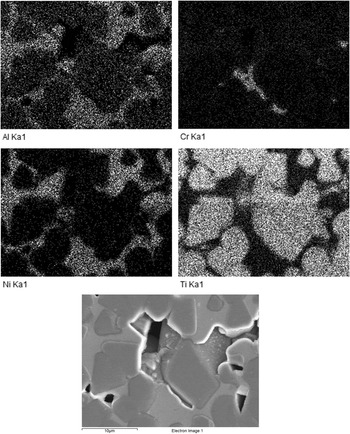
As was demonstrated through the OCP analysis, the TiC cermets utilizing a stoichiometric Ni3Al binder did not appear to reach steady state conditions in absence of oxygen (within a 50 min timescale), while steady state was clearly reached under aerated conditions, which is also related to the reactions depending upon the concentration of dissolved oxygen for cathodic reduction. Reference Porcayo-Calderon, Rodriguez-Diaz, Porcayo-Palafox, Colin, Molina-Ocampo and Martinez-Gomez42 Consequently, the removal of oxygen during polarization resulted in a reduction of the calculated corrosion rate to 2.92 × 10⁻⁵ mm/per year for the cermet compositions based on TiC–30 vol% Ni3Al. On the other hand, the presence of Cr in Ni3Al-based alloys has been reported to influence the rate of thermal oxidation. Reference Gleeson, Cheung, Da Costa and Young43,Reference Brumm and Grabke44 The presence of Cr in nickel aluminide-based super alloys, under conditions of high temperature oxidation, has been proposed as causing the accelerated transformation of θ-Al2O3 to α-Al2O3, by acting as nucleation sites for Al-based oxides. Reference Gleeson, Cheung, Da Costa and Young43,Reference Brumm and Grabke44 The resulting oxide has been reported to provide short diffusion paths, and thus increased corrosion rate independence on the O pressure in operating temperature. The results of microstructural analysis on post-corrosion surface of TiC-based cermets utilizing the IC221 alloy have confirmed the depletion of Cr (Fig. 8) and spallation of the oxide layer, after anodic polarization in a de-aerated electrolyte, in a manner somewhat related to thermal oxidation of similar materials. Reference Stewart and Cutler18,Reference Gleeson, Cheung, Da Costa and Young43,Reference Hou and Stringer45,Reference Prajitno, Gleeson and Young46 The effect of addition of Zr on the oxidation behavior of IC50 has been suggested to have a positive effect on oxidation resistance of the TiC-based, Ni3Al containing cermets.
Post corrosion EDS mapping on post-polarization surface of TiC–IC221 (de-aerated electrolyte).

IV. CONCLUSION
The influence of composition on the aqueous corrosion response has been examined for TiC-based cermets, with various Ni3Al-based intermetallic binders. Cermets with stoichiometric Ni3Al were prepared using TiC powders of differing purities. One powder exhibited W contamination, resulting in a core-rim structure for the TiC. Use of a higher purity TiC powder resulted in a more noble corrosion potential and lower corrosion current, thus exhibiting a positive effect on corrosion behavior. Selective dissolution of the Ni3Al binder was found to be the main corrosion mechanism, while the interface between the core and rim was also found to be subjected to attack for cermets with W contamination.
The presence of dissolved oxygen in the aqueous media was assessed for TiC based cermets with three types of Ni3Al-based metallic binder: stoichiometric Ni3Al, and the sub-stoichiometric alloys IC50 and IC221. In the presence of dissolved oxygen, the effects of the chemical composition of the intermetallic binder were found to be negligible. Conversely, for a de-aerated electrolyte, an increase in E corr, toward more noble potentials and a significant reduction in i pass, was observed for each of the TiC-based cermets, irrespective of chemical composition of the metallic phase. The magnitude of this change varied significantly from one binder composition to another. Cermets containing Cr (i.e., the IC221 alloy) where found to be less oxidation resistant in de-aerated media. Stoichiometric Ni3Al and IC50 showed a significant decrease in the oxidation rate, due to their high dependency on partial pressure of oxygen for the corrosion process.
ACKNOWLEDGMENTS
The authors would like to acknowledge the financial support provided by Boeing Research and Technology (research contract 11-6392). Technical discussions and support provided by researchers at Boeing (Marc Froning, Mark Pollack, and Stephen Gaydos) are also gratefully acknowledged. The Canada Foundation for Innovation, the Atlantic Innovation Fund, and other partners who helped fund the Facilities for Materials Characterization, managed by the Dalhousie University Institute for Materials Research, are also thanked.