Implications
Currently, many producers feed their ewe lambs without distinguishing between market ewe lambs and replacement ewe lambs. The ewe lambs usually have free access to diets promoting rapid weight gain until they reach the acceptable weight for selection as a breeding animal. In this study, we show that high plane of nutrition before puberty has a negative impact on mammary gland development. This suggests that allowing ad libitum intake and near maximum growth rate for ewe lambs may reduce the milk potential of future ewes.
Introduction
In commercial sheep production, market lambs are fed a high plane of nutrition in order to achieve the desired weight at a young age. Currently, many producers feed their ewe lambs without distinguishing between market ewe lambs and replacement ewe lambs. The ewe lambs usually have free access to diets promoting rapid weight gain until they reach the acceptable weight for selection as a breeding animal. However, the negative effects of rapid weight gain and fattening during early rearing on milk production are well documented in replacement dairy heifers (Little and Kay, Reference Little and Kay1979; Foldager and Sejrsen, Reference Foldager and Sejrsen1991). Similar studies in ewe dairy breeds are scarce, but most of them suggest a negative effect of a high plane of nutrition on milk production (Umberger et al., Reference Umberger, Goode, Caruolo, Harvey, Britt and Linnerud1985; McCann et al., Reference McCann, Goode, Harvey, Caruolo and Mann1989). The negative impacts of a high plane of nutrition have not been investigated in meat breeds, but if they exist, allowing ad libitum intake and near maximum growth rate for ewe lambs may reduce the milk potential of future ewes.
After birth, the mammary gland develops with the succession of isometric and allometric phases to reach near maximum development by the beginning of the first lactation. Earlier studies have shown that a high plane of nutrition during the first allometric period reduces mammary gland development in dairy heifers (Sejrsen et al., Reference Sejrsen, Huber, Tucker and Akers1982), goats (Bowden et al., Reference Bowden, Plaut and Maple1995) and ewes (Zidi et al., Reference Zidi, Caja, Ayadi, Castillo, Flores and Such2007) and also increases fat deposition in the mammary gland of heifers (Capuco et al., Reference Capuco, Smith, Waldo and Rexroad1995; Charles et al., Reference Charles, Vonnahme, Yelich, Dolezal and Wettemann1999) and ewes (Johnsson et al., Reference Johnsson, Hart and Turvey1986; Peclaris et al., Reference Peclaris, Nikolaou, Kann, Eleftheriou, Yupsanis and Mantzios1994 and Reference Peclaris, Nikolaou, Kann, Eleftheriou, Yupsanis, Mantzios and Koutsotolis1997). During this period, duct extremities lengthen and ramify into the fat pad. Well-elaborated and arborescent ducts will allow the development of more milk secretory cells during pregnancy. Therefore, although most mammary growth occurs during gestation, the duct network formation during the first allometric phase will determine the extent of lobulo-alveolar development and milk production potential.
Sheep producers are reluctant to impose a growth restriction, because it will increase the number of days to market for lambs not selected for breeding. Several studies report that a period of compensatory growth follows a period of restriction (Thornton et al., Reference Thornton, Hood, Jones and Re1979; Ryan, Reference Ryan1990). Indeed, Ryan et al. (Reference Ryan, Williams and Moir1993a and Reference Ryan, Williams and Moir1993b) reported that during the 12 weeks following a diet restriction sheep had the same dry matter intake (DMI) as control sheep fed ad libitum for the entire trial, but better average daily gain (ADG) and feed efficiency. Kamalzadeh et al. (Reference Kamalzadeh, Koops and Van Bruchem1998) found that lambs restricted between 3.5 and 6.5 months of age had almost fully compensated (compensatory index of 99.3%; Hornick et al., Reference Hornick, Van Eenaeme, Gérard, Dufrasne and Istasse2000) for growth at 14 months of age. Therefore, it may be possible to impose a growth restriction at an early age without affecting the growth performance of animals not selected for reproduction.
The aim of this study is to determine the effects of restricted diets before puberty on growth performance and mammary gland development in replacement ewe lambs.
Material and methods
This project was evaluated and approved by the Institutional Committee of Animal Protection of the Dairy and Swine Research and Development Centre, in accordance with the guidelines of the Canadian Council on Animal Care (1993).
Experimental procedures
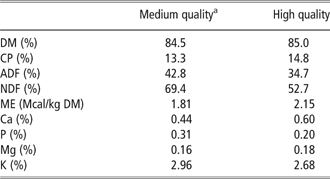
Seventy-two Dorset ewe lambs born in spring 2007 were weaned at 53.9 ± 1.6 days of age and a mean weight of 23.6 ± 0.8 kg. They were kept in individual pens and were randomly assigned to three different diets. In control diet with medium-quality forage (MQF; diet A-MQF), both MQF and concentrate were offered ad libitum. The feed concentrate served to A-MQF lambs contained 86% barley, 12% pelleted soybean meal and a mineral mix and an average of 16% crude protein (CP) and 2.69 Mcal of metabolizable energy/kg of dry matter. The restricted lambs (R-MQF and F-HQF) were fed with a concentrate containing 82% barley, 14% pelleted soybean meal and a mineral mix and an average of 16% CP and 2.62 Mcal of metabolizable energy/kg of DM. Sodium decoquinate (Deccox, Alpharma Inc., Bridgewater, NJ, USA) was included in the blend as a coccidiostat. Forage composition is presented in Table 1. Diet R-MQF consisted of a restricted amount of concentrate and ad libitum access to the same forage as in diet A-MQF. Lastly, diet F-HQF consisted of a diet with high-quality forage offered ad libitum with less concentrate than diet R-MQF. The quantity of feed served to the group R-MQF and F-HQF ewe lambs was adjusted weekly to obtain an ADG that was 70% of that of the group A-MQF ewe lambs. The diets were offered for 75 days after weaning to cover the allometric phase of mammary gland development (Anderson, Reference Anderson1975; Johnsson and Hart, Reference Johnsson and Hart1985).
Nutrient composition of experimental forage on a DM basis
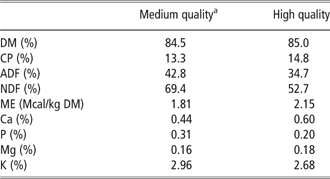
DM = dry matter; ME = metabolizable energy.
aMedium-quality forage was served to groups A-MQF and R-MQF, and high-quality forage was served to group F-HQF.
At the end of the feeding period, 28 ewes were slaughtered. Their mammary glands were taken off immediately after slaughter and frozen at −20°C until analysis. Before laboratory analysis, the mammary glands were thawed and trimmed. Skin, teats, supramammary lymph nodes, blood vessels and extra fat tissue around the gland were removed so that only parenchyma and fat pad tissues were kept. Deoxyribonucleic acid (DNA) content was obtained using the fluorescence method proposed by Labarca and Paigen (Reference Labarca and Paigen1980). Protein content was determined using the Kjeldahl method (Association of Official Analytical Chemists (AOAC), 1998), and lipid content was determined using the ether extraction method (AOAC, 1998). Dry fat-free tissue (DFFT) was estimated by removing lipid and water content from the weight of the parenchyma.
The remaining ewe lambs received a haylage and barley diet formulated according to the recommendations of the National Research Council (2007). The ewe lambs were housed individually until breeding. From weaning to breeding, daily DMI and weekly live body weight (BW) were measured. Further, backfat depth, loin eye depth, wither height, heart girth and body condition score (BCS) measurements were taken around the ages of 80, 130, 150, 200 and 250 days. The BCS ranged from 1 (very thin) to 5 (very fat). Backfat depth and loin ewe depth were determined by ultrasonography with an ULtraScan 50 device using a 3.5 MHz linear probe (Alliance Médical, Lachine, QC, Canada). Measurements were taken vertically from the spin, halfway between the last rib and the hip on the animal’s left side.
At breeding, the ewe lambs were moved into groups of 10 with one Dorset ram for a 35-day period. After this period, the ewe lambs were kept in groups until first lambing. Growth performance parameters were still collected after breeding at around the ages of 300, 350, 400, 450 and 475 days.
All data were analyzed using the MIXED procedure of the Statistical Analysis System (SAS Institute, 2002). Preplanned contrasts were used to compare treatments. Data repeated in time were analyzed using the REPEATED option. Means were considered to be significantly different at P < 0.05 and tended to be different when P < 0.10.
Results
Growth performance
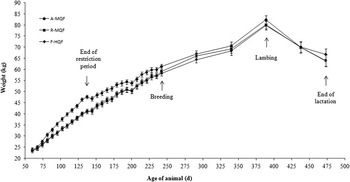
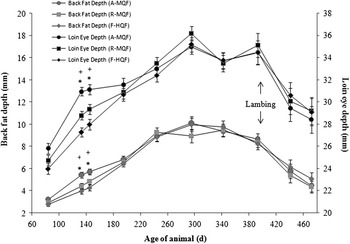
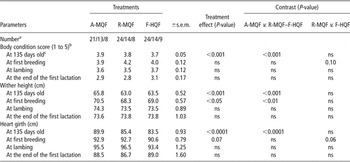
For groups A-MQF, R-MQF and F-HQF, the mean weight at weaning was 23.9, 23.0 and 23.4 kg, respectively, and at the end of treatment period, the ewe lambs were 135 days old and weighed 47.6, 40.9 and 41.2 kg (P < 0.001), respectively. The changes in the ewe lambs’ BW are shown from weaning to the end of the first lactation in Figure 1. At breeding, when the ewe lambs were 240 days old, mean weight was 61.3, 59.3 and 58.2 kg for the A-MQF, R-MQF and F-HQF treatments, respectively (P > 0.10). BW was similar between all treatments and followed the same pattern of change during this period. At the end of the restriction period, backfat and loin eye depth (Figure 2) were greater for the group A-MQF ewe lambs than for those in the other groups (P < 0.01) and were greater for group R-MQF than for group F-HQF (P < 0.05). However, there were no differences (P > 0.10) from 200 days old up to the end of the first lactation for these parameters. The BCS and heart girth changed with a similar pattern (Table 2), but wither height was still greater for the group A-MQF ewe lambs at breeding (P < 0.01). The higher BCS of the group A-MQF ewe lambs at 135 days old indicates that they were fatter than those in the other groups (P < 0.001) as well as more developed, since wither height and heart girth were also greater for this group (P < 0.001 for both). Nevertheless, at lambing and up to the end of the first lactation, no differences in development (P > 0.10) were observed.
Changes in the weight of ewe lambs from weaning (60 days of age) to the end of the first lactation (475 days of age). The ewe lambs were fed an ad libitum diet (A-MQF), a restricted diet (R-MQF) or a high-forage diet (F-HQF) from weaning to 135 days old. For the three groups, n = 21, 24 and 24 between weaning and 135 days old; n = 13, 14 and 14 between 135 days old and first breeding; and n = 8, 8 and 9 between the first breeding and at the end of the first lactation, respectively. The bars on the graph represent the s.e.m.

Changes in backfat depth and loin eye depth of ewe lambs from weaning (60 days of age) to the end of the first lactation (475 days of age). The ewe lambs were fed an ad libitum diet (A-MQF), a restricted diet (R-MQF) or a high-forage diet (F-HQF) from weaning to 135 days old. For the three groups, n = 21, 24 and 24 between weaning and 135 days old; n = 13, 14 and 14 between 135 days old and at the first breeding; and n = 8, 8 and 9 from breeding to the end of the first lactation, respectively. The symbol * indicates that the contrast A-MQF v. R-MQF–F-HQF is significant at the time point. The symbol+ indicates that the contrast R-MQF v. F-HQF is significant at the time point. The bars on the graph represent the s.e.m.

Body condition score, wither height and heart girth of ewe lambs fed an ad libitum diet (A-MQF), a restricted diet with medium-quality forage (R-MQF) or a high-forage diet (F-HQF) from weaning to 135 days old

ns = not significant.
aNumber of ewe lambs before 135 days of age/number of ewe lambs at first breeding/number of ewe lambs at the end of the first lactation.
bBody condition score was rated from 1 (very thin) to 5 (very fat).
cEnd of experimental diet corresponded to 135 days of age for ewe lambs.
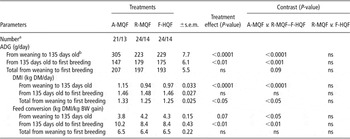
Table 3 presents the ADG, DMI and feed conversion of ewe lambs from weaning to first breeding. From weaning to 135 days old, ADG and DMI were greater for the group A-MQF ewe lambs (P < 0.001) than for the other groups. Feed conversion was also greater for group A-MQF than for the others (P < 0.01). From the end of the experimental period to the first breeding, the animals in groups R-MQF and F-HQF had better ADG (P < 0.001) with similar DMI (P > 0.10) and therefore had better feed conversion (P < 0.01) than group A-MQF. In all, between weaning and first breeding, even if the group A-MQF ewe lambs had greater DMI (P < 0.05) and tended to have greater ADG (P = 0.085) than the other groups, feed conversion did not differ between the treatments (P > 0.10). The group R-MQF and F-HQF ewe lambs were similar for all parameters (P > 0.10).
Average daily gain (ADG), dry matter intake (DMI) and feed conversion of ewe lambs fed an ad libitum diet (A-MQF), a restricted diet with medium-quality forage (R-MQF) or a high-forage diet (F-HQF) from weaning to 135 days old

ns = not significant; DM = dry matter.
aNumber of ewe lambs before 135 days old/number of ewe lambs remaining after slaughter.
bEnd of experimental diet corresponded to 135 days of age for ewe lambs.
Mammary gland development
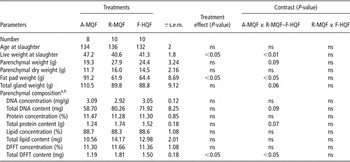
The mammary gland composition of the prepubertal ewe lambs is presented in Table 4. Groups R-MQF and F-HQF exhibited a trend toward higher parenchymal tissue content (P = 0.09). Although not significant, DNA and protein content tended to be higher in groups R-MQF and F-HQF (P = 0.09 and P = 0.07, respectively). The fat pad was bigger in the mammary glands from the group A-MQF ewe lambs (P < 0.05), and there was a corresponding tendency toward a bigger total gland (P = 0.060) in this group. The ewe lambs fed the restricted diets R-MQF and F-HQF had greater DFFT content (P < 0.05) than the ewe lambs fed diet A-MQF. No significant difference was observed between both restricted diets (contrast R-MQF v. F-HQF, P > 0.10).
Mammary gland composition in prepubertal ewe lambs fed an ad libitum diet (A-MQF), a restricted diet with medium-quality forage (R-MQF) or a high-forage diet (F-HQF) from weaning to 135 days old

ns = not significant; DFFT = dry fat-free tissue.
aDNA, protein, lipid and DFFT concentrations are reported as mg/g or % of dry parenchymal tissue.
bTotal weight of the parenchymal portion of the gland was corrected for lipid and water content to yield indirect estimates of DFFT.
Discussion
In this study, the prepubertal ewe lambs in groups R-MQF and F-HQF were fed diets designed to achieve about 70% of the weight gain of those in group A-MQF, as proposed by other studies in sheep (McCann et al., Reference McCann, Goode, Harvey, Caruolo and Mann1989; Peclaris et al., Reference Peclaris, Nikolaou, Kann, Eleftheriou, Yupsanis, Mantzios and Koutsotolis1997) and heifers (Little and Harrison, Reference Little and Harrison1981). The growth reductions achieved in this study was obtained either by reducing the amount of concentrate offered or by serving a high-nutritive-value forage with a further reduced amount of concentrate. The ewe lambs fed both restricted diets exhibited compensatory growth between the end of the restriction period and first breeding. The DMI of the group F-HQF and R-MQF ewe lambs increased after the restriction period to reach the same DMI as the group A-MQF ewe lambs during that period. The better ADG of groups R-MQF and F-HQF compared to group A-MQF for the same DMI resulted in a better feed conversion. Similar compensatory growth in ewe lambs was found by Johnsson and Hart (Reference Johnsson and Hart1985) and Ryan et al. (Reference Ryan, Williams and Moir1993a and Reference Ryan, Williams and Moir1993b) following a restricted diet. Hornick et al. (Reference Hornick, Van Eenaeme, Gérard, Dufrasne and Istasse2000) proposed a way to determine a compensatory index from the variations in weight between experimental groups, with an index of 100 indicating total compensatory growth. Using that system, the ewe lambs in groups R-MQF and F-HQF had indices of 99 and 94, respectively, at first lambing. Overall, even though the group A-MQF ewe lambs had greater DMI and ADG between weaning and first breeding, mean feed conversion was similar for all groups in this period. Johnsson et al. (Reference Johnsson, Hart and Turvey1986) and McFadden et al. (Reference McFadden, Daniel and Akers1990) found greater total feed intake and ADG in the unrestricted ewe lambs compared to the restricted ones. In both studies, however, feed conversion was similar for all rearing treatments, and no difference was perceptible. A moderate plane of nutrition during the allometric phase does not compromise growth performance of ewe lambs, since the restricted ewe lambs reached the same BW at breeding, with the same efficiency, as those fed a high plane of nutrition.
At the end of the restriction period, the group R-MQF and F-HQF ewe lambs had lower backfat thickness than the ewe lambs that were not restricted in their growth. Zidi et al. (Reference Zidi, Ayadi, Caja, Such, Ghirardi and Albanell2005) observed lower fat deposition in restricted Lacaune and Manchega ewe lambs at puberty (266 days of age) compared to those on a high plane of nutrition. However, this study did not find a significant difference for this parameter in the 240-day-old ewe lambs. Adipose tissue is the first to be mobilized during restriction, because animals need to compensate for the lack of energy (Wester et al., Reference Wester, Britton, Klopfenstein, Ham, Hickok and Krehbiel1995). That explains the difference observed between the treatments at the end of restriction period. The restricted ewe lambs in the study by Zidi et al. (Reference Zidi, Ayadi, Caja, Such, Ghirardi and Albanell2005) had a backfat depth of around 2 mm at 266 days old compared to the results of this study, which found a depth of around 8 to 9 mm at 240 days old. That difference is probably explained by the fact that ADG, the length of restriction period and the breeds used (dairy in their study compared to meat in the present one) differed. In the work of Zidi et al. (Reference Zidi, Ayadi, Caja, Such, Ghirardi and Albanell2005), the restriction period started at 49 days of age and ended at 154 days for an ADG of 180 g, v. 60 to 135 days of age in this study for an ADG of 225 g/day for the restricted ewe lambs. It therefore appears that the higher ADG during the shorter restriction period used in this study explains the similarity in the growth parameters at breeding. Therefore, if a sufficiently long realimentation period follows the restricted period, growth parameters such as loin eye depth, BCS and heart girth at breeding are unaffected by the early restriction, as observed earlier by McCann et al. (Reference McCann, Goode, Harvey, Caruolo and Mann1989).
In this study, different planes of nutrition were applied during the allometric phase of mammary gland development (Anderson, Reference Anderson1975; Johnsson and Hart, Reference Johnsson and Hart1985). The higher amount of DFFT is indicative of greater development of the mammary gland in the restricted ewe lambs. Although parameters such as parenchymal tissue weight, DNA content and protein content did not reach statistical significance, the trends observed are in accordance with the effect observed for DFFT. Johnsson and Hart (Reference Johnsson and Hart1985) reported that parenchymal growth occurred 3.7 times faster than live weight between 1 and 5 months of age in restricted ewe lambs compared to 2.4 times faster in ewe lambs that received a high plane of nutrition. The restriction was more severe in that study than in the present one, with ADG of 117 g/day for the restricted ewe lambs v. 221 g/day for the rapid-rearing group. Although not significant, parenchyma and DNA content had a tendency to be higher in restricted ewe lambs of that study, which is similar to the results reported in this study. Zidi et al. (Reference Zidi, Ayadi, Caja, Such, Ghirardi and Albanell2005) observed using X-ray densitometry that the parenchyma represented a higher proportion (46.1% v. 32.1%) of the mammary gland of Manchega ewe lambs restricted between 1 and 5.5 months of age. However, those authors did not observe a similar effect in the Lacaune breed (46.5% v. 42.2%). Other studies have failed to achieve significant improvements in mammary gland development, but the present observations are similar to the trends observed in those studies (Johnsson et al., Reference Johnsson, Hart and Turvey1986; Peclaris et al., Reference Peclaris, Nikolaou, Kann, Eleftheriou, Yupsanis and Mantzios1994 and Reference Peclaris, Nikolaou, Kann, Eleftheriou, Yupsanis, Mantzios and Koutsotolis1997). The effect of plane of nutrition on mammary growth has been extensively studied in bovines. Sejrsen et al. (Reference Sejrsen, Huber, Tucker and Akers1982) found in dairy heifers that a 50% growth restriction improved parenchymal content in the mammary gland. Similarly, Capuco et al. (Reference Capuco, Smith, Waldo and Rexroad1995) found lower DNA content in the mammary gland of dairy heifers fed a high plane of nutrition. Therefore, ewe lambs fed a high plane of nutrition, such as market lambs, during the allometric phase of mammary gland development will lay fewer duct cells in their mammary gland, which may compromise future milk production potential.
The weight of the mammary stroma, which is largely composed of adipose tissue at this stage, was greater in the group A-MQF ewe lambs. This result is in agreement with data previously reported in ovines (Johnsson and Hart, Reference Johnsson and Hart1985; Johnsson et al., Reference Johnsson, Hart and Turvey1986; McCann et al., Reference McCann, Goode, Harvey, Caruolo and Mann1989; McFadden et al., Reference McFadden, Daniel and Akers1990; Peclaris et al., Reference Peclaris, Nikolaou, Kann, Eleftheriou, Yupsanis and Mantzios1994 and Reference Peclaris, Nikolaou, Kann, Eleftheriou, Yupsanis, Mantzios and Koutsotolis1997) and bovines (Sejrsen et al., Reference Sejrsen, Huber, Tucker and Akers1982; Capuco et al., Reference Capuco, Smith, Waldo and Rexroad1995; Charles et al., Reference Charles, Vonnahme, Yelich, Dolezal and Wettemann1999; Meyer et al., Reference Meyer, Capuco, Ross, Lintault and Van Amburgh2006). In rodents, mammary parenchymal development occurs by gradual invasion of the mammary fat pad. Consequently, the size of the fat pad is, ultimately, the limiting factor for the size of the mammary gland (Sejrsen et al., Reference Sejrsen, Purup and Akers1990; Imagawa et al., Reference Imagawa, Yang, Guzman and Nandi1994). Nevertheless, mammary parenchymal development occurs differently in ruminants, and the size of the fat pad is unlikely to limit future mammary development (Sejrsen et al., Reference Sejrsen, Huber, Tucker and Akers1982).
Conclusion
This experiment showed that ewe lambs raised on a restricted diet designed to gain 70% of the ADG of unrestricted ewe lambs during the allometric phase of mammary development had more secretory tissue (as indicated by DFFT, DNA and protein content) and less stroma in their mammary gland than those raised on an ad libitum diet. The restricted ewe lambs achieved near full compensatory growth following the restriction period and consumed less feed than the unrestricted ones over the entire period. Therefore, the restricted ewes’ breeding BW was not affected by treatments. By restricting ewe lambs during the allometric growth phase, sheep producers can reduce the total amount of feed provided for the same breeding and lambing weights and, at the same time, achieve some positive effect on mammary gland development. More research is needed to study the effect of the restricted or unrestricted growth rates of ewe lambs during the allometric phase of mammary gland development on the ewe lambs’ future milk production and the growth of their offspring.
Acknowledgements
The authors thank Jasmin Brochu for her valuable technical assistance with the laboratory analyses, Steve Methot for his assistance with the statistical analyses and the staff of the Centre d’expertise en production ovine du Québec (CEPOQ) for taking good care of the animals and technical assistance. The authors are grateful to the Conseil pour le développement de l’agriculture du Québec (CDAQ) for its financial support. Dairy and Swine R&D Centre contribution no. 1034.