INTRODUCTION
Alcohol-based hand rubs (ABHR) are now the international reference in hand hygiene and are widely used. Their tolerance and acceptability have therefore been studied widely and are significantly associated with numerous factors such as the ABHR formula used,Reference Kramer, Bernig and Kampf1–Reference Rotter, Koller and Neumann3 the climatic region,Reference Rohr and Schrader4 the season,Reference Uter, Gefeller and Schwanitz5 and hygienic or surgical use.Reference Girard, Bousquet and Carre6 In order to choose the most appropriate ABHR, the World Health Organization (WHO) recommends holding field tests taking into account all these factors.Reference Larson, Girard, Pessoa-Silva, Boyce, Donaldson and Pittet7 However, the constraints of this method are not accepted by all hospitals. Some large hospitals conduct field tests as recommended by the WHO,Reference Girard, Bousquet and Carre6, Reference Girard, Carre and Pires-Cronenberger8 but others conduct limited testing at the risk of choosing ABHRs that are less well-tolerated and therefore less used.
In order to verify the relevance of including all these factors when designing field tests, the steering committee for a large bid, organized in 2011–2012 in order to procure ABHR for 30 public hospitals in France, decided to conduct the field tests using a rigorous method and to include the data provided in a post hoc analysis, to test the independent effect of each studied factor on the comparison of tolerance between ABHRs. The ultimate objective of the post hoc analysis was to decide whether these requirements should be maintained for future bids; this large bid, common to many public hospitals, will now be conducted every 4 years.
METHODS
Tender Method
Public hospitals using different ABHRs were invited to participate in a common bid. Each hospital could include its own specific requirements (1 or 2 different ABHRs, a different product for hygienic and surgical use or 1 for combined use, in liquid or gel form).
A steering committee was set up to define the organization and the selection criteria and to design the field tests. The bid was divided into consistent lots. In each climatic region, each hospital had to choose, before the bid, to participate in 1 lot if for hygienic AND surgical use or 2 lots if for hygienic use alone or surgical use alone. The only exception to this was the case of Saint Etienne, which determined a sublot in order to provide practitioners with both combined use and single use ABHRs. Each lot was an independent part of the bid.
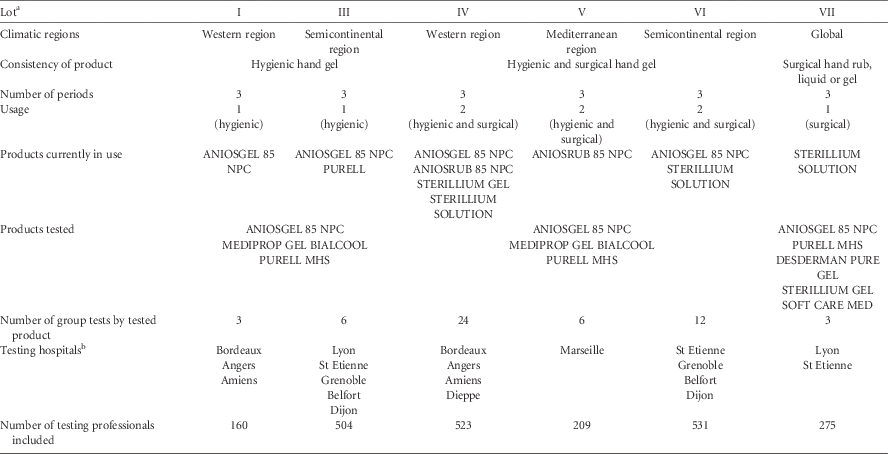
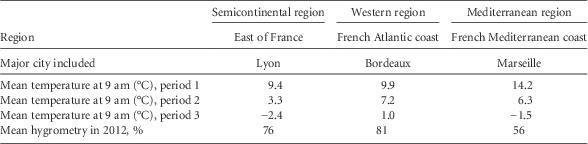
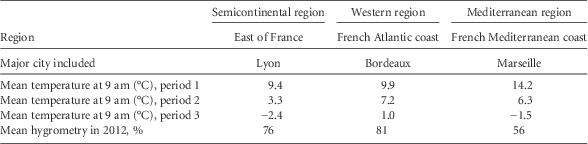
A lot was defined as a bid for an ABHR with a predefined consistency (liquid or gel), because the tolerance of a formulation could differ according to its consistency,Reference Stauffer, Griess, Pleininger, Zhumadilova and Assadian9 for a specific climatic region (western, Mediterranean, or semicontinental), as presented in Table 1. France was divided in 3 climatic regions, in order to take into account the temperatures and hygrometry at the locations of the hospitals included, as presented in Table 2.
Bid and Testing Procedure Organization

a Lot II Mediterranean region / hygienic hand gel was discontinued in the study because no hospitals were included.
b All data concerning a comparison between product in use and product in test for 1 use and a climatic region have been pooled, independently of the choice of the lot by hospital.
Characteristics of Climatic Regions
After being quantified, 7 lots were defined:
- An ABHR for hygienic hand rubbing (HHR), gel only (3 lots, 1 per climatic region);
- An ABHR for HHR and surgical hand preparation, gel only (3 lots, 1 per climatic region); and
- An ABHR for surgical hand preparation, liquid or gel (1 lot for all regions).
One ABHR lot for the Mediterranean region was discontinued because no hospitals wanted to choose it.
Prior to the test, the ABHRs had to comply with these specifications: European microbiological standards (EN 1040, EN1275, Pr EN 12054 or EN 13727) for all uses, as well as EN 14476 and EN1500 for HHR or EN 12791 for surgical hand preparation, evidenced by reports provided by the manufacturers; consistency: gel or liquid; packaging and dispenser; and the absence of teratogenic or oncogenic or allergenic molecules in the formula provided by manufacturers.Reference Kanerva, Estlander and Jolanki10–Reference Wong and Beck13
Test Method
The participating hospitals provided test data on both the products in use and the products tested with a view to procurement under the bid, as described above.
The main criterion used was the tested ABHR’s tolerance compared with the tolerance of the ABHR in use, based on the changes in the 4 WHO criteria between the beginning and the end of each test period, as recommended in the WHO guidelines for hand hygiene (http://whqlibdoc.who.int/publications/2009/9789241597906_eng.pdf).Reference Pittet, Allegranzi and Boyce14 These criteria are appearance (supple, red, blotchy, and rash), intactness (abrasions, fissures), moisture content (dryness), and sensation (itching, burning, and soreness). According to the literature, these 4 criteria cover all aspects of skin toleranceReference Rotter, Koller and Neumann3, Reference Larson, Girard, Pessoa-Silva, Boyce, Donaldson and Pittet7 and the reproducibility of this self-evaluation has been proven.Reference Girard, Carre and Pires-Cronenberger8, Reference Boyce, Kelliher and Vallande15, Reference Larson, Aiello and Bastyr16
The ABHRs tested and the ABHRs in use are presented in Table 1. For the purposes of clarity these ABHRs are coded as follows: Aniosgel 85 NPC (Anios) as ABHRA, Aniosrub 85 NPC (Anios) as ABHRB, Desderman pure gel (Schülke) as ABHRC, Mediprop bi-alcool (Prop) as ABHRD, Purell (Gojo) as ABHRE, Purell MHS (Gojo) as ABHRF, Softcare Med (Johnson Diversey) as ABHRG, Sterillium gel pure (Bode) as ABHRH, and Sterillium solution (Bode) as ABHRI.
Aniosgel 85 NPC (Anios, ABHRA) was tested in hospitals using other ABHRs, for HHR and surgical hand preparation. Sterillium solution (Bode, ABHRH) was not tested but was taken into account as an ABHR already in use because no hospitals included in lot VII used any other ABHR for surgical hand preparation.
Test periods
The tests began in November 2011 and ended in February 2012. Each test period lasted for 2 weeks. Three periods were defined, each separated by a wash-out period of at least 2 weeks.Reference Pittet, Allegranzi, Sax, Chraiti, Griffiths and Richet2 Each ABHR was tested during each of the 3 periods.
Organization
The tests were organized identically by infection control units in hospitals participating on a voluntary basis, in collaboration with pharmacists or purchasers. The test distribution was defined by the central bid coordination body. In each lot, separate tests were carried out all for potential interfering factors: HHR and surgical hand preparation, ABHRs already in use, test period, and ABHR in test (see Table 1). All tests were performed in winter to ensure maximum differentiation.Reference Chamorey, Marcy and Dandine17, Reference Larson, McGinley, Grove, Leyden and Talbot18 A minimum of 50 professionals had to be included in each test group (1 ABHR in test, 1 ABHR in use, 1 type of use, 1 climatic region, in different units and hospitals), possibly obtained from 2 lots. This number was calculated on the basis of preliminary experiments, in order to guarantee a limited beta risk in case no difference was found between ABHRsReference Girard, Carre and Pires-Cronenberger8 and to anticipate missing forms.
Other authors have performed double blind tests.Reference Kramer, Bernig and Kampf1, Reference Pittet, Allegranzi, Sax, Chraiti, Griffiths and Richet2 This method was not used in this study because it is both expensive and time-consuming, but all the data management was blinded.
Analysis
All criteria were self-evaluated, on 1 evaluation form, provided to the professionals at the beginning and at the end of the study period, including an analogue scale for each of the WHO criteria and the variables to identify the test period, the unit, and the professional (to match the forms) and the opinion of the ABHR tested.
The position on each analogue scale was converted to a 10-point score ranging from 0 for normal skin condition to 10.0 for poor skin condition. Data collection was blinded, after encoding.
The data were recorded in an SPSS, version 19, database (IBM). The statistical unit was a “pair” containing the before-and-after self-evaluation data regarding the 4 WHO criteria from a hospital practitioner who participated in a test period and data about climatic region, ABHR in use, tested ABHR, test period, and type of use.
The first step of the analysis, conduced separately for each test group, was to identify the tested ABHRs that were significantly less tolerated than 1 or more of the ABHRs in use for 1 type of use (HHR or surgical hand preparation). The initial score for each WHO criterion was subtracted from the end score, so a positive difference was associated with a deterioration in skin condition. The mean of the before-and-after differences was calculated and compared with 0 (t test or nonparametric test if variances were different). If the mean was positive and significantly different from 0, for 2 WHO criteria or more, the product was classified as “less tolerated” and excluded from this lot. After the exclusion of the less well-tolerated ABHR, possible choices were classified according to the calculated means for all criteria, to the professional opinions, and to other technical criteria and cost, to make the final choice for the lot.
The study was conducted in compliance with the Declaration of Helsinki. No consultation of an ethics committee and no signed informed consent form were required because all the ABHRs tested are widely available on the market.
Post Hoc Study Method
The objectives of the complementary analysis were to determine whether climatic region, test period, use for hygienic or surgical disinfection, products in use, and test product had a significant and independent effect on the measurement of an ABHR’s tolerance.
The data used for the bid was an SPSS, version 19, database.
The analysis method was composed of 2 steps. The first step was the comparison of the means of the differences between the self-evaluation of the skin at the beginning and end of the test period based on the 4 WHO criteria—for each climatic region, for each period, and for each type of use. The second step was a generalized linear model, of the differences between the evaluation of the skin at the beginning and end of the test period for each of the 4 WHO criteria separately, taking into account, as covariates, the climatic region, the ABHRs tested, the test periods, the ABHRs already in use, and the type of use. For this analysis, each factor has been reclassified, using the value for the before-and-after difference in appearance, ranked from the lowest to the highest values. Only appearance was retained for this classification because there are discrepancies between the WHO criteria. The order of periods remained unchanged, from 1 to 3, but the products tested, the products in use, and the climatic region were reclassified. Use was coded as 1 for hygienic hand disinfection and 2 for surgical disinfection. The climatic regions were coded as 1 for the western region, 2 for the Mediterranean region, and 3 for the semicontinental region.
The statistical test used to compare the means was analysis of variance because there was a large amount of data available and there was no difference in variance.
The significance of the generalized linear model was tested using the Wald χ2 test.
RESULTS
Results of the Bid
Following the introduction of the microbiological requirement in the European standard EN14476 (virucidal activity), only a limited number of hand rubs were found to be compliant and were finally included in the tests, as presented in Table 1. The tests generated 2,188 complete pairs of before-and-after data.
The final decision concerning lots I to VI was to select ABHRA. The tolerance of this product was no different from 3 other products in use (ABHRB, ABHRE, ABHRH). It was less well-tolerated than ABHRI but this product did not comply with the bid specifications for this lot (solution and not gel). The 2 other products tested (ABHRD and ABHRF) were significantly less well-tolerated than ABHRA and the other products in use. The other products in use were either not presented for the bid or did not comply with the bid specifications.
The final decision for lot VII was to select ABHRI, as all the other products (ABHRA, ABHRC, ABHRF, ABHRG and ABHRH) presented significantly lower tolerance than ABHRI already in use.
Results of Post Hoc Analysis
The data for lot VII were not included in the analysis because the tests were performed in only 1 climatic region. The analysis included 1,925 pairs of data.
Comparison between Climatic Regions
Comparison between climatic regions for HHR
In each climatic region, a global analysis was performed, for all periods and for all ABHRs already in use, ABHRE and ABHRA being comparable for tolerance, during the bid analysis for the 4 WHO criteria. The comparative analysis between climatic regions was conducted separately for each ABHR tested. A global analysis was not appropriate because significant differences were found between the tested ABHRs in the bid analysis.
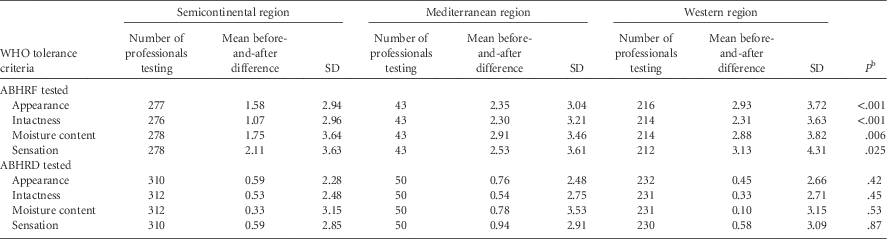
For ABHRF, the comparison between climatic regions showed statistically significant differences. ABHRF had high before-and-after differences for all 4 of the WHO criteria when tested, demonstrating poor tolerance. The lowest means of before-and-after differences were observed in the semicontinental region and the highest in the western region (see Table 3).
Comparison of the Before-and-After Differences Based on the WHO Tolerance Criteria for Each Product Tested for Hygienic Hand Rubbing, between Climatic RegionsFootnote a
NOTE. All products already in use and all periods are included. ABHRD, Mediprop bi-alcool (Prop); ABHRF, Purell MHS (Gojo); SD, 95% standard deviation; WHO, World Health Organization.
a A positive difference was associated with deterioration in skin condition and a negative value with an improvement.
b By analysis of variance.
For ABHRD, the comparison between climatic regions showed no statistically significant differences; however, the before-and-after differences for the 4 WHO criteria were smaller than for ABHRF.
Comparison between climatic regions for surgical hand preparation
The analysis between climatic regions was conducted only for the ABHRA in use and for the semicontinental versus the western region. The other products in use were present in only 1 climatic region (semicontinental) and no data were available on surgical use in the Mediterranean region.
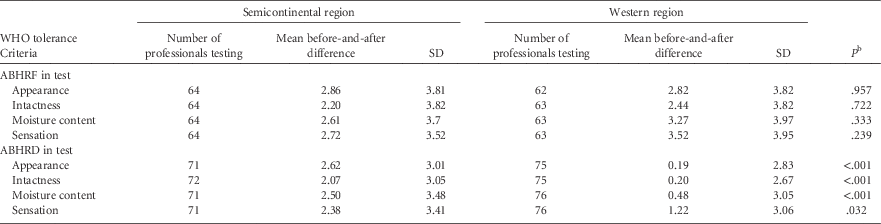
For ABHRF, the comparison between climatic regions showed no statistically significant differences. For ABHRD, the comparison between climatic regions showed statistically significant differences for all criteria (see Table 4).
Comparison of the Before-and-After Differences* Based on the WHO Tolerance Criteria for Each Product Tested for Surgical Hand Preparation, between Climatic RegionsFootnote a
NOTE. ABHRA (Aniosgel 85 NPC [Anios]) was already in use, and all periods are included. ABHRD, Mediprop bi-alcool (Prop); ABHRF, Purell MHS (Gojo); SD, 95% standard deviation; WHO, World Health Organization.
a A positive difference was associated with deterioration in skin condition and a negative value with an improvement.
b By analysis of variance.
For surgical hand preparation, the means of before-and-after differences were high in all regions for ABHRF but in only the semicontinental region for ABHRD.
For surgical hand preparation, the analysis by climatic region demonstrated a difference for surgical hand rubbing (SHR) for 1 product (ABHRD) but not the other (ABHRF).
Overall, for all types of use, the means of the differences observed before and after were significantly associated with climatic region.
Comparison between Periods
The analysis was performed for all ABHRs tested and for all climatic regions. For HHR the analysis was performed jointly on all the ABHRs already in use (no significant difference found between the 2 ABHRs). For SHR the analysis was performed separately for each ABHR already in use (ABHRA and ABHRI).
Comparison between periods for HHR
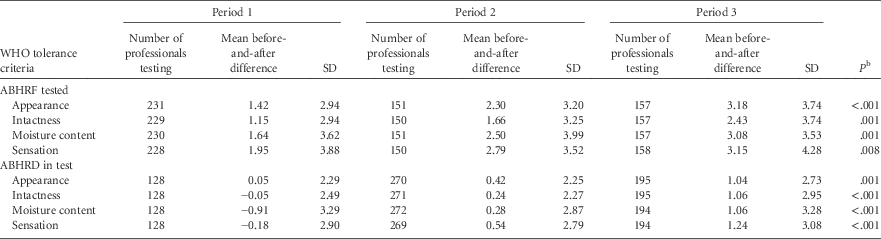
For HHR, the analysis showed a statistically significant difference between periods (see Table 5). The greatest differences were observed in colder periods (periods 2 and 3). For the 2 ABHRs tested, a highly statistically significant difference was observed between periods, but no statistically significant difference was observed between climatic regions for the second ABHR tested (ABHRD).
Comparison of the Before-and-After Differences Based on the WHO Tolerance Criteria for Each Product Tested for Hygienic Hand Rubbing, between Different PeriodsFootnote a
NOTE. All products were already in use, and all periods are included. ABHRD, Mediprop bi-alcool (Prop); ABHRF, Purell MHS (Gojo); SD, 95% standard deviation; WHO, World Health Organization.
a A positive difference was associated with deterioration in skin condition and a negative value with an improvement.
b By analysis of variance.
Comparison between periods for SHR
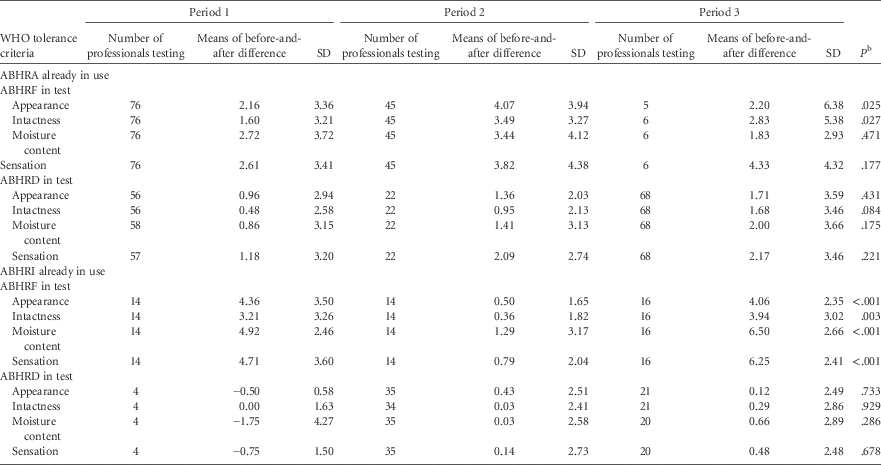
For SHR, the analysis showed a statistically significant difference between periods (see Table 6) but this difference varied according to the ABHR tested and the ABHR already in use. In some test groups there were an insufficient number of pairs to show any difference.
Comparison of the Before-and-After Differences Based on the WHO Tolerance Criteria for Each Product Tested for Surgical Hand Preparation between Different Periods and Different Products in UseFootnote a
NOTE. All periods are included. ABHRA, Aniosgel 85 NPC (Anios); ABHRD, Mediprop bi-alcool (Prop); ABHRF, Purell MHS (Gojo); ABHRI, Sterillium solution (Bode); SD, 95% standard deviation; WHO, World Health Organization.
a A positive difference was associated with deterioration in skin condition and a negative value with an improvement.
b By analysis of variance.
Generally speaking, for HHR and SHR, the means of the differences observed before and after were significantly associated with the test period.
Generalized Linear Model Analysis
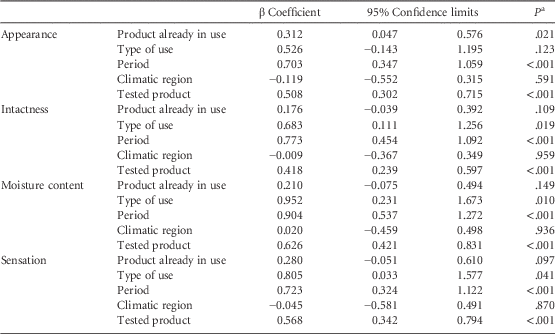
The generalized linear model was conducted for each WHO criterion. It demonstrated (see Table 7) that 3 factors (product already in use, type of use, and period) influenced the degree to which WHO tolerance criteria change.
Analysis of the Before-and-After Differences Based on the WHO Tolerance Criteria, Taking into Account the Product Already in Use, the Type of Use, the Product in Test, the Period, and the Climatic Region as Predictive Values (Generalized Linear Model).
a By Wald χ2.
The greatest effects (β coefficient) were observed for the period, significant for all the WHO criteria (P<.001) and the hygienic or surgical use (P=.010 to .041, not significant for appearance). The product tested remained discriminant (P<.001). The climatic region does not significantly modify the measurement of tolerance in this model.
DISCUSSION
The post hoc analysis of this large test dataset shows that taking into account the winter period, the type of use, and the product in use has a significant effect on the difference in tolerance measured between ABHRs, when tested comparatively with ABHRs already in use. The difference in tolerance measured between the test periods was clearly associated with the weather conditions (temperature, hygrometry). This demonstrates, once again, the importance of conducting tests during the winter.Reference Rohr and Schrader4, Reference Uter, Gefeller and Schwanitz5, Reference Larson, McGinley, Grove, Leyden and Talbot18 The results concerning the climatic regions have not established any clear conclusions because they were significant only for partial comparisons.
The relevance of using a tolerance measurement method based on the WHO criteria self-evaluated at the beginning and end of each test period has been confirmed, in line with the results of previous studies.Reference Rotter, Koller and Neumann3, Reference Girard, Carre and Pires-Cronenberger8, Reference Pittet, Allegranzi and Boyce14 Therefore, tests using this method impose a rigorous follow-up process for the teams testing the ABHRs including at least 1 briefing session at the beginning of each test period and a second at the end of the period, in order to ensure complete data pairs are obtained. This work, performed by the nosocomial infection prevention teams in the different hospitals, is an important constraint.
This study has a number of limitations, most of which relate to difficulties in the field.
The distribution of missing data between hospitals and units has not been analyzed, and it is impossible to estimate whether the effect would be a reduction or increase in observed differences: do the missing data relate to professionals with no problems in terms of hand skin condition or was the product dropped due to very poor tolerance? Unfortunately we have not been able to find a tool to ensure the completeness of returns.
The unequal number of professionals included in the different test groups, and the large amount of data concerning ABHRA compared with the other products in use, could perhaps explain the limited effect attributed to product in use in the final model. The variability between hospitals has not been taken into account in the final analysis, which is unfortunate because the frequency of missing data varies between hospitals. The number of ABHRs tested was very limited because certain products were not included since they had no virucidal effect, and all the new products were poorly tolerated. However, differences were still observed between the products tested. The 2 products chosen for the bid were 2 products already in use in different hospitals. Is this due to genuinely better tolerance or a bias in favor of the product in use?
The climatic region seems have an effect in the limited comparisons but not in the global model. Should we exclude this criterion from future bids? Yes, if you consider that France is only a small country and in the absence of proof. However, the lack of significant effect could be due to an unequal repartition of group tests between regions, the product in use being different at the beginning of bids. So, it would appear that the best course of action would be to repeat all the models, in order to definitively establish the effect of taking into account the climatic region.
In conclusion, these results suggest that these factors should be included when designing future tests. However, this type of organization comes at a price. The main costs (organization and administration of the bid, test design, and implementation) were incurred by the coordinating hospital and the steering committee. The testing hospitals incurred some much lower costs and none of the other hospitals incurred any additional costs relating to the bid.
In the future, this complex and multivariate method should be used to ensure that the ABHRs selected for procurement demonstrate good levels of tolerance, in order to encourage high levels of compliance with hand hygiene regimens.Reference Visscher and Randall Wickett19
Acknowledgments
We thank O. Allais, E. Bergue, M. Bourjault, H. Constant, S. Coudrais, L. Foroni, S. Goutelle, I. Gragueb Chatti, A. Henry, A. Kerhoas, S. Parat, V. Pergay, and A. Regard for their assistance with the data collection; I. Russel for editing the English; and L. Ayzac for assistance with the statistical methods.
Financial support. None reported.
Potential conflicts of interest. All authors report no conflicts of interest relevant to this article.