Introduction
Physicians providing medical direction and clinical services for ultramarathons must consider safety protocols and other preventative measures when participating in event planning. In addition to coordination of care and response to injuries, targeted preventative measures should be investigated as part of the usual practice of event medical directors.
There has been increased participation in ultramarathons over the past several years.Reference Joslin, Mularella, Bail, Wojcik and Cooney 1 Many of these are held in remote and exotic locales, such as deserts and jungles, where the risk of exertional heat injury is high.Reference Ong, Hoffman and Wang 2 Although exertional heat stroke (EHS) is a real danger in ultramarathons and has led to deaths, the clinical syndrome of heat exhaustion more often leads to decreased athlete performance and “Did Not Finish” (DNF) status. A multitude of factors contribute to EHS and heat stress such as ambient temperature, humidity, acclimatization to the heat, hydration status, and endogenous heat production.Reference Hoffman, Pasternak and Rogers 3 Physicians providing medical support for these events must take into account the unique attributes of the event and environment.
Acclimatization to a hot environment can take up to 10 to 14 days, resulting in increased plasma volume and sweating.Reference Lipman, Eifling, Ellis, Gaudio, Otten and Grissom 4 Indeed, most deaths amongst high school football players attributed to EHS occurred during the first four days of preseason practice.Reference Costa, Crockford, Moore and Walsh 5 Any intervention aimed at reducing the incidence of exertional heat illness should therefore focus on these first few days of activity.
The Jungle MarathonReference Armstrong, Casa and Millard-Stafford 6 is a 7-day, multi-stage ultramarathon that courses 254 km through the area of the Amazon rainforest in Para, Brazil. Daily temperatures often reach greater than 30 degrees Celsius (86 degrees Fahrenheit) and the humidity is near 100%.
The large number of athletes who received a DNF status due to heat-related illness had been a consistent problem for the race director; therefore, in 2011, the race implemented mandatory rest stops of 15 minutes at each of the four checkpoints on each of the first two days of the race. No mandatory rest periods were required at the remainder of the race checkpoints. As part of a quality assurance effort to evaluate the efficacy of this intervention, the race authors sought to review the available data and hypothesized that these mandatory stops allowed for both “thermogenesis intermissions” and accumulated heat dissipation, thereby decreasing the overall incidence of DNF secondary to heat stress.
Methods
This is a retrospective, observational report with historic control cohorts. After obtaining permission from the SUNY Upstate Medical University institutional review board (Syracuse, New York USA; #572332–1), the authors performed a review of the race director’s notes from the previous six years (2008-2013). Records of all runners during this period were reviewed and the number of runners who received DNF status recorded for each year. When a runner received a DNF status, the circumstances of their disqualification were reviewed and determined to be due to heat-related factors or unrelated to heat. Determination was made utilizing a panel review of field notes which categorized the athlete’s DNF reason as heat stress, musculoskeletal injury, other causes of injury, or illness. Heat stress manifestations included malaise, fatigue, weakness, inability to tolerate eating and drinking, or an obvious declaration of heat intolerance.
Checkpoints at the Jungle Marathon were spartan and austere. They consisted of locations such as a patch of grass flattened at the intersection of two trails, the intersection of the race route and body of water (such as a stream), or a roadside shelter re-purposed for providing shade to athletes. They typically were placed at these strategic locations and were varied widely in distance from each other (from a few to several kilometers). Services available to athletes were minimal, as the race was strictly self-supported. Checkpoint crews consisted of predominantly non-medical volunteers who assisted athletes in re-supplying water, gear adjustments, and general support. Medical team members assisted in these routine chores as well, but additionally interacted with athletes to assess their mental status, health, and general safety for continuing. These assessments were mostly informal, but rose to a more formal nature if a medical concern was identified. Foot care and other non-emergent medical services were limited, as the bulk of these types of supplies were centrally located at the finish line for the day. Medical personnel carried emergency medical supplies to deal with emergent concerns.
Ambient temperature data were obtained from a web site that reports temperatures obtained from a sensor at Santarem airport in Para, Brazil. 7 The reported temperatures used in the study represented all-day averages. Athletes ran day and night during the races.
Averages were calculated for the percent of racers who received a DNF status related to heat stress before the intervention and after the intervention was initiated. Chi Squared analysis was used to compare these sets (MedCalc v. 14.10.2; October 16, 2014; MedCalc Software bvba, Acacialaan 22, 8400; Ostend, Belgium). Historic temperature data were reviewed as a confounding factor between the two groups.
Results
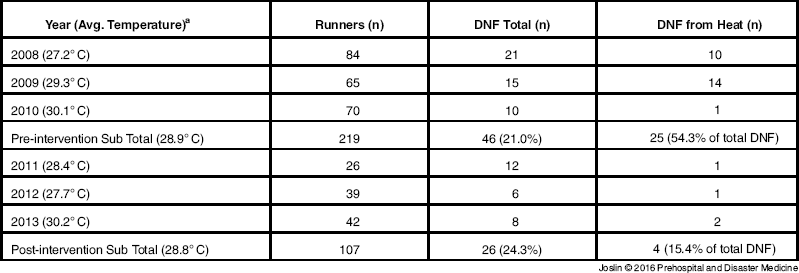
A total of 326 athletes were included in the review. Table 1 details average ambient temperatures, the number of athletes who received a DNF status, and whether the reason was determined to be from heat-related factors.
Numbers of Athletes Participating Each Year, Average Temperatures, and DNF Status

Abbreviation: DNF, did not finish.
a Temperature data from tutiempo.net. Sensor at Santarem airport in Para, Brazil. No statistical difference was noted between pre- and post-intervention temperatures.
From 2008 through 2010, a total of 219 athletes participated in the race. A total of 46 athletes (21%) received a DNF status during this 3-year period. Of the 46 athletes who received a DNF status, a total of 25 athletes’ DNF cases (54.3%) were attributed to heat-related factors.
From 2011 through 2013, during the period in which the race implemented the mandatory rest periods, a total of 107 athletes participated in the race. A total of 26 athletes (24.3%) received a DNF status during this period. Of the 26 athletes who received a DNF status, four athletes’ DNF cases (15.4%) were attributed to heat-related factors.
Though the percent of athletes who DNF were similar between the two groups (21% vs 24.3%; x2=0.28; 95% CI, −6.5 to 13.9; P=.59), the percent of athletes who attributed their DNF status to heat-related factors was considerably less in the period of mandatory rest stops (54.3% vs 15.4%; x2=8.9; 95% CI, 14.1 to 57.3; P=.003). When the mean race temperatures of each cohort were compared, there was no statistical difference in pre- and post-intervention temperatures for the race weeks (t=−0.192; P=.747).
Discussion
When providing medical direction and field medical support for highly competitive sporting events, physicians must consider safety protocols in addition to appropriate medical therapy for injured participants. If endogenous heat production from increased exertion outpaces the individual’s capacity to dissipate heat, then overall heat accumulated increases. This leads to elevated body temperature and, when combined with other individual factors affecting homeostasis, EHS may occur. Because many defense and regulatory mechanisms exist, elevation of body temperature is not directly causative of heat stroke itself. 8
It is known that the psychological stimulus of competition can override protective adaptations leading to continued exertion.Reference Joslin and Mularella 9 This leads to potential additional risk to highly competitive athletes. The authors’ group’s prior research has shown that a runner’s level of exertion is indeed correlated with their risk of receiving a DNF status.Reference Noakes 10 Mandatory periods of rest, which are recommended by several professional societies, should intuitively increase relative athlete safety by decreasing the risk of heat-related illness, and decrease the incidence of receiving a DNF status.Reference Costa, Crockford, Moore and Walsh 5 , Reference Joslin, Worthing, Black, Grant, Kotlyar and Wojcik 11 , 12
The current study’s results suggest that the intervention of inserting a mandatory rest period at each checkpoint of the race for the first two days did reduce the incidence of significant heat stress experienced by the runners. This reduction in heat stress is evidenced by a reduced percentage of athletes receiving a heat-related DNF status per year, and suggests that the overall safety of the runners was increased. Currently, mandatory rest periods are not standard practice for ultramarathons, and in fact, this appears to be the first race of its kind to adopt this practice.
Medical directors for these events may wish to consider the factors that may maximize the benefit of mandatory rest stops. However, there is currently no data for total rest time for these events. The effect of the institution of mandatory rest stops on total time of rest (mandatory+voluntary) cannot be quantitated as accurate data are not available for the study period. The resulting improvement in athlete safety may have been due to rest time that is greater than the mandatory periods. Therefore, no conclusions can be made about the time chosen for the mandatory rest stops.
There is currently no known standard benchmark for the DNF rate for ultramarathons. Multiple factors influence an athlete’s ability to complete a 254 km ultramarathon through a tropical rainforest; however, the authors believe that the mandatory rest periods are an important factor in athlete safety. Other factors suggested as possibly affecting DNF were suggested based on anecdotal observation, including time spent at destination acclimating before the event, pace and exertion of athlete during the race, and local weather conditions. Further study of these factors and establishment of an expected rate of DNF for ultramarathons is warranted.
Limitations
The events of 2010 do seem to be anomalous to other data in the group. A review of race director notes from that year provides no details that explain why there were so few athletes who received a DNF status, from heat-related factors, or otherwise. Indeed, weather data offer no explanation either. The authors contend that there may be no satisfactory explanation, but report the data accurately.
This study is limited to six years of data with a relatively smaller number of subjects than other studies evaluating similar environmental factors. Though limited, this report represents the only available data examining this intervention. It is unlikely that other events would be held in similarly extreme environments with a larger number of subjects over a longer period, suggesting that this may be a novel data set. Future study of this area will include prospective data collection with a more detailed data field set to enhance further characterization of the outcomes and to identify best practices with more specificity.
Conclusion
Mandatory rest stops during extreme running events in tropical environments, like the Jungle Marathon, are likely to improve athlete safety and improve the heat acclimatization process. Further study of this area is indicated.
Author Information/Contributions
Drs. Joslin and Cooney are board certified emergency physicians with Emergency Medical Services (EMS) fellowship training who actively provide EMS medical direction and have expertise in event and mass-gathering medical care. Dr. Mularella is fellowship trained in Wilderness and Expedition Medicine. Dr. Bail is an Emergency Medicine resident. Dr. Joslin is the Director of the Wilderness and Expedition Medicine Fellowship and Dr. Cooney is the Director of the EMS Medicine Fellowship. Dr. Wojcik is a key member of the research faculty.
Drs. Joslin, Mularella, and Bail participated in study design, data interpretation, and writing of the manuscript. Dr. Cooney participated in data interpretation and writing of the manuscript. Dr. Wojcik aided with performance of statistical analysis and participated in interpretation of the results.