Introduction
There can be no doubt that academic activities have long been internationalized. For research, this was the case long before the advent of modern information technology. Scientific results thus have a long tradition of relatively fast diffusion between universities in different countries. For instance, FriesReference Fries1 reports that the Laplandian study trip of Carolus Linnaeus in the 1730s was reported in the Hamburg journal Nieder-Sachsische Nachrichten von Gelehrten neuen Sachen only weeks after his departure and return.
Likewise, academic education has long been internationalized. In the early times of the Continental universities, such as those in Bologna, Leipzig, Padua, Paris and Vienna, foreign students were thus common (see, for example, Ref. Reference de Ridder-Symoens2; for Swedish students in Vienna and Leipzig, see Refs Reference Andersson, Ferm and Risberg3 and Reference Ferm and Kihlman4, respectively). This state of affairs was an effect of a lack of universities in many countries as well as the practice of using Latin as the common language. In addition, studies were mainly directed towards theology, which at the time offered a transnational labour market. Foreign students in, for instance, Bologna or Paris could thus return to their home countries and find employment.
As far as research is concerned, internationalization has definitely become stronger and stronger. Transnational associations have been created in most disciplines (for an example, see Ref. Reference Engwall and Hedmo5). These arrange regular meetings where people in the field meet for presentations of papers and for networking. They start journals where papers are published, following review by international peers. In this way, research has become highly internationalized. At the same time it has to be admitted that there are certain fields, particularly in the Humanities, where the national dimension is highly desirable. For such studies of language, literature, history, etc, of a particular country the scholars of that country are likely to be the most competent researchers, with only a limited number of colleagues in other countries. Although these circumstances always have to be considered, it has to be admitted that research is mainly an international activity.
The international character of research has had the consequence of continuous international evaluations of journals, individuals, and institutions on the basis of citations (cf., for example, Ref. Reference Blockmans, Engwall and Weaire6). These, in turn, constitute a significant part of various kinds of ranking lists that have developed during the past few decades. Some of them, such as those created by Shanghai Jiao Tong University, the Times Higher Education, and the Guardian, rank whole universities, while others, such as those made by the Financial Times, Business Week and the Economist, rank specific parts of universities (in the cases mentioned, business schools) (see further, for example, Ref. Reference Wedlin7).
The rankings of whole universities and specific parts of them have provided a general impression that there is global competition between academic institutions, not only in terms of research, but also in terms of higher education. As a result, it is often heard in speeches and strategic documents how all academic institutions in the world are competing with each other on a global market for talented students. The latter in turn are assumed to have full information about all alternatives, to be completely rational, and mobile. As a result academic institutions all over the world are stressing internationalization as a core strategy and channelling sizable resources into this project.
Against the above backdrop the present paper aims to provide an analysis of different aspects of the internationalization of higher education. In so doing, the following two sections will identify three characteristics of higher education and four modes of internationalization, respectively. These four modes of internationalization will then be discussed in the four following sections, which will be followed by a concluding section.
Three Characteristics of Higher Education
Studies of organizations have taught us that the task or technology is highly significant to consider in the analysis of their work.Reference Thompson8 Before turning to our analysis of the internationalization of higher education, it is therefore appropriate to look closer at some specific characteristics of higher education.
First, education in general differs from many other goods and services in that, by definition, the prospective student should not know its contents. The whole idea of education is that the student is going to learn something unknown. If the contents were known, it would be a waste of time to take the education in question. This, in turn, also implies that a student will not pursue a particular education more than once. Thus, in contrast to a cereal, a toothpaste, a car, etc, repeat consumption does not come into question even if the student liked the education very much.
Secondly, students will have difficulty evaluating their education in the short run. They may have views on certain parts of their education and remember some teachers as dull and uninspiring. However, the real test of their education is accomplished by the labour market, i.e. how their education brings success in their future career. And this test may take a number of years. It should also be noted that studies show that student evaluations of educational content change over time. The things in the education they appreciated in the short run are downgraded in the long run and vice versa.Reference Hägg and Johansson9
Thirdly, students will have difficulty hearing negative views from alumni. As mentioned, the latter find it difficult to evaluate their education in the short run. However, even more important is the fact that it is in the interest of alumni to curb their dissatisfaction, since negative information regarding an education would hurt the reputation of that particular education. And, the reputation of their institution is a key variable for alumni in their competition in the labour market.
Together, these three characteristics imply that prospective students are likely to be relatively uninformed about the specific content of the educational alternatives they face. Therefore, reputation plays a significant role in the choices of educational institutions by students. And this reputation is to a large extent based on the role of higher education as a selection mechanism of elites. So far these elites have tended to be strongly locally embedded. Therefore even in a globalized world, the local market tends to be the basic one for most institutions.
Four Modes of Internationalization
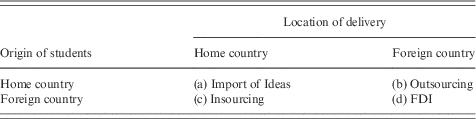
The above means that for most higher-education institutions the bulk of the education occurs in the home country for home-country students (Table 1). Nevertheless, even if this case appears very national, it involves internationalization. It is a question of (a) Import of Ideas.
Four modes of the internationalization of higher education.
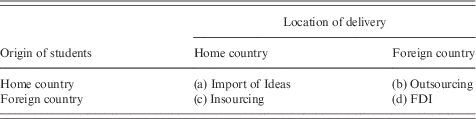
A second mode of internationalization is constituted by the sending of home country students to a foreign country. This means that a domestic educational institution in one country entrusts its students to a foreign institution. In the language of management this means (b) Outsourcing, i.e. that teaching and examination for a particular part of a program is performed by a foreign institution (cf. again Table 1).
The third mode of internationalization is that foreign-country students take part of the education of the home-country institution. This is the opposite of outsourcing, and could conveniently be labelled (c) Insourcing (cf. again Table 1).
The fourth mode of internationalization, finally, implies that the home country institution delivers its education in a foreign country to foreign students. This is what the literature on the internationalization of business activities mentions as (d) Foreign Direct Investments (FDI) (cf. again Table 1).
The four mentioned modes of internationalization will now be further discussed in the following four sections.
Import of Ideas
The import of ideas occurs in two ways: (i) human mobility, and (ii) course literature. As far as the first is concerned, there is often a view nowadays that academic labour markets are global. It has therefore been more and more common to advertise internationally when recruiting new faculty. However, just as there are restrictions on the global mobility of students (cf. above), there are also limitations to the global mobility of faculty. Personal relationships, particularly family bonds, still appear to play a role in hampering international recruitments. However, in line with the same argument, it seems that the finding of a partner from another country is a strong contributing factor to the international faculty movement we see today.
While there seem to be limitations to the possibilities of recruiting foreign faculty, the mobility of national faculty appears to be a significant part of internationalization. This is related to the high degree of internationalization that characterizes research activities. Significant features of this internationalization are constituted by international visits during doctoral studies, and afterwards as post docs or during sabbaticals, conference participation, and research cooperation. In this way, the research component of faculty work appears to be a very strong contributing factor in the internationalization of higher education.
The mobility of faculty in turn has a significant effect on the second way of importing ideas mentioned above, i.e. through course literature. The mobility of domestic faculty puts them in contact with international textbooks and also influences their writing of their own textbooks. In this way, although they are nationals, they will bring international perspectives to their students. An illustration of this mechanism is provided by a study of the curricula of eight Nordic business schools at the turn of the century.Reference Engwall10 It shows that 42% of the literature was published in the United States, and another 16% came from other foreign countries. The remaining 42% were Nordic titles, where the foreign inspiration was estimated to be substantial.
A critique expressed in relation to foreign literature is that it does not take context into consideration in fields where that would be appropriate. In management studies, for instance, despite globalization, cultural differences still play an important role. For this reason some of the international publishers have developed adaptions to specific geographical areas. The most apparent example is the marketing guru Philip Kotler, whose basic text-book Marketing Management Reference Kotler11 has been adapted to various European markets in collaboration with European scholars.Reference Kotler and Bliemel12–Reference Kotler, Armstrong, Saunders and Wong15 A more recent example is Management Control Systems,Reference Anthony, Dearden and Vancil16 which came out in a European editionReference Anthony, Govindarajan, Hartmann, Kraus and Nilsson17 in 2014 at the same time as the 18th edition of the original publication.Reference Anthony and Govindarajan18
Overall, it thus appears that the import of ideas constitutes a very significant part of the internationalization of higher education. However, this does not primarily occur through the recruitment of foreign faculty. Rather it mainly takes place through the international contacts of national faculty members and their selection of course literature.
Outsourcing
The second mode of internationalization mentioned above, outsourcing – i.e. the sending out of students to partner institutions abroad – has been practised for several decades. The major logic behind this internationalization arrangement is to provide an additional positive component to the reputation of a particular institution, thereby making it more attractive to prospective students.
Exchange programmes proliferated particularly in the 1980s and 1990s, and the number of such programmes a university could offer was considered an asset. However, with the passage of time the focus on quantity had to give away to the quality aspect. Many universities thus started reducing the number of partners on the basis of quality assessments, i.e. securing that the teaching and examination control they had outsourced maintained appropriate standards. For these selections of partners, accreditations and rankings came to play a significant role. Universities accredited by a certain accrediting body tended to limit their cooperation to those institutions that held the same accreditation. Similarly, the gap between the rankings of the receiving and the sending institutions were not allowed to be too large. In addition, as a part of a general wave of quality assessments, exchange programmes were evaluated.
As a result of this selectivity, several top institutions from one country may have exchange programmes with a particular counterpart in a foreign country. This in turn will hamper the international experience of the visiting students, who instead will make friends for life from their home country. In this way, the strong selectivity mechanism of higher education will be even more reinforced. National networks, rather than international networks, will be strengthened.
Needless to say, the mere sending out of students has limited effects on curricula. However, in the case of exchange programmes the reciprocity principle of course leads to a need to deal with incoming students. This is particularly the case in countries where the national language has to be given up in the teaching in favour of a lingua franca, i.e. today English (see further below).
In conclusion, the sending out of students appears primarily to have been a means to improve the institutional reputation among prospective national students. Since sending out students involves an outsourcing of the two main educational tasks of academic institutions (teaching and examination), there has been a strong tendency to select partners with reference to rankings and accreditations. Strangely enough, there are reasons to believe that exchange programmes may strengthen national elite networks rather than international ones.
Insourcing
Insourcing, i.e. the recruitment of foreign students, is frequently mentioned as the key to internationalization. Behind this we can identify at least three motives: (i) income, (ii) national reputation, and (iii) the dissemination of ideas and culture. The first of these is simply the ambition to recruit more students, thereby attracting more revenue, while the second one means that institutions count on raising their national reputation by holding a high international profile in times when internationalization has positive connotations. In this way, it is somewhat related to the first motive, i.e. a wish to increase income and to attract good students.
The third motive was particularly true during the Cold War period. The United States was active in attracting foreign students to North American universities through the Fulbright Program, which also financed foreign study trips for US scholars. Likewise the Ford Foundation has been active in promoting the inflow of foreign students to US institutions (see, for example, Ref. Reference Parmar19). Similar efforts to attract foreign students were also made by the Soviet Union, particularly on the African Continent.
While the inflow of students to English-speaking countries does not require any adaptation in the curricula, this is not the case, and so is a problem, in those countries where the modern lingua franca is not the national language. This is not without problems, although it is often claimed that English has today such wide diffusion and is spoken so well by most people. A study reported by the member of the Swedish Academy, Kjell Espmark,Reference Espmark20 thus claims that about 50% of the message is lost when Swedish university faculty teach in English. This is based on a study where first the teachers were asked how much less they can express themselves when lecturing in English instead of Swedish, and gave the answer 70%. When the students in the same study were asked how much they understand, when the teacher is speaking English instead of Swedish, they also answered 70%. As a result, just 49% is communicated. And, this figure may become even lower if the incoming students are even less fluent in English than the domestic students.
An additional problem in relation to the incoming students concerns the difficulty of assessing their qualifications. While domestic students are part of national evaluation systems through upper-secondary school certificates or other types of national entrance examinations, the foreign students are not. The scrutiny of their qualifications is therefore often a time-consuming task entailing considerable uncertainty.
A particular problem with the incoming students who take a whole educational programme is associated with their future in the labour market. In many countries they are not allowed to stay, and quite a few also want to go back to their home country. In so doing, they may encounter problems, as their foreign degree is not acknowledged in their home country. This is an effect of the above-mentioned characteristics of higher education and the fact that the reputation of higher-education programmes is constructed nationally rather than internationally. Using the terminology of the economists Assar Lindbeck and Denis Snower, they face an ‘insider-outsider problem’,Reference Lindbeck and Snower21 i.e. those inside the labour market favour candidates from national educational institutions, particularly their own Alma Maters, and do not value foreign degrees. A demonstration of this mechanism is that we can find many well-educated foreign taxi drivers in most of the big cities of the world.
It has been pointed out above that income, reputation, and ideology can be motives for the recruitment of foreign students. Particular problems occur in non-English speaking countries in a world where English has become the lingua franca. More general problems are the difficulties in assessing the qualifications of foreign students and the difficulties these students face in the labour market as they return to their home countries.
Foreign Direct Investments (FDIs)
Foreign Direct Investments (FDIs), finally, have generally been considered to be the ultimate sign of internationalization, and in the present-day economies there is much evidence of FDIs (cf., for example, Ref. Reference Blomström, Kokko and Zejan22). Transnational corporations are operating all over the globe with subsidiaries in many countries. Such efforts have also been made by educational institutions, although they have not demonstrated the same development as transnational production and service corporations.
At least three motives for FDIs of educational institutions can be identified. First, as the inflow of foreign students becomes too strong, there might be a wish to have a more balanced student population. Secondly, investments abroad may increase the national reputation of the institution. Thirdly, in areas with high internationalization, for example business education at the Master’s level, an opportunity for income might be seen. The latter has tended to entail that several institutions follow each other in a process of Follow the Leader, which in turn may lead to an excessive number of competing actors. A demonstration of this is constituted by the events during the 2002–2012 period in Dubai, where business school establishments developed into a bubble that eventually burst.Reference Alajoutsijärvi, Juusola and Lamberg23
An important reason for the difficulties of FDIs in higher education, in addition to the establishment of an excessive number of actors at the same place, is that students might prefer to go to the main campus in order to get the ‘proper product’, and to meet the stars of the foreign universities there. Of course, the stars may be sent out to the FDIs, but experience shows that their enthusiasm for travelling to distant places declines rather rapidly. The alternative of recruiting local faculty removes that problem but such a move will make the recruitment of the foreign students to the FDI even more difficult.
All in all, the evidence so far shows that FDIs in higher education have had limited success. The reason for this is again the significance of reputation for higher-education institutions, and that this reputation is basically associated with the original institution and its faculty. Nevertheless, a number of efforts have been made to establish FDIs. This in turn has in many cases resulted in an excessive number of competing actors.
Conclusions
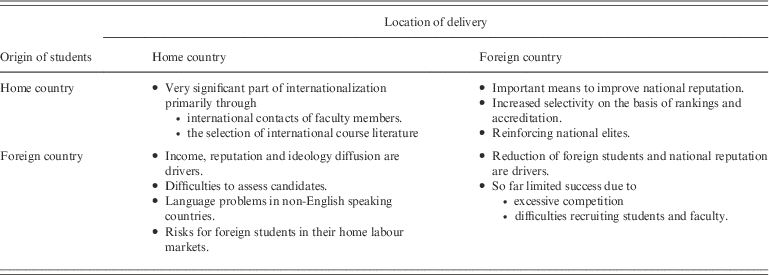
On the basis of the above reasoning we can now provide conclusions for the four modes (Table 2).
Conclusions regarding the four modes of internationalization.
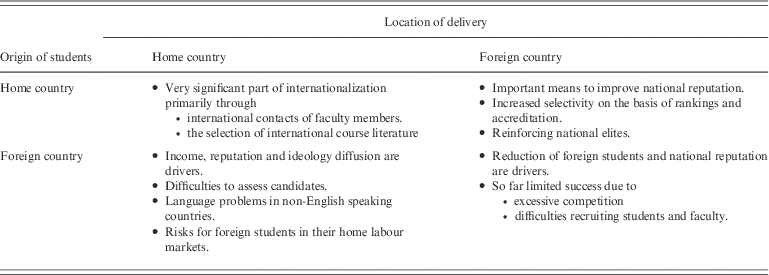
In terms of the delivery in the home country to home country students (Import of Ideas), it has been argued above that this is the most significant part of internationalization. It works through the repeated international contacts of faculty members, who in this way are linked to international developments in their field. Another significant component is constituted by their selection of course literature by their international colleagues (see Table 2).
As for the education of home country students in foreign countries (Outsourcing), it has been identified as an important means to improve national reputation. Recent decades have implied an increased selectivity on the basis of rankings and accreditations in order to strengthen reputation. At the same time outsourcing tends to reinforce the creation of national elites in the home country (see again Table 2).
As far as the education of foreign students in the home country (Insourcing) is concerned, it appears to be driven by aspirations for income, reputation and ideology diffusion. Problems associated with its application include difficulties in assessing candidates and language problems in non-English speaking countries. For students returning to their home country, problems being acknowledged in the home labour market may occur (see again Table 2).
Also in terms of FDIs, efforts to improve national reputation play an import role as well as perceived needs to reduce the share of foreign students in the home-country education. So far the success has been limited due to excessive competition and difficulties recruiting students and faculty (see again Table 2).
The conclusions presented indicate that we should expect higher education even in the present globalized world to be strongly embedded in its local environments. The strong rhetoric regarding internationalization can therefore be interpreted as an important means to strengthen home-market reputation.
The implications of the above reasoning appear to be that the home market is the most significant one for higher-education institutions. In this market, to take globalization seriously, it is important to prepare students for the globalized world through faculty members who are internationally connected and who are able to select the proper course literature on an international market. In addition, there are reasons to believe that students in all fields would be better prepared for a globalized world through the addition of more language and cultural studies. On top of that, the other three modes of internationalization can be considered, but tempered by realism in order to avoid negative effects for foreign as well as domestic students. A first step in that direction would be to take international rankings less seriously.
Lars Engwall is professor emeritus of management at Uppsala University, Sweden. His research has been directed towards institutional change as well as the production and diffusion of management knowledge. Among his recent publications can be mentioned The University in the Market (Ed., with Denis Weaire, 2008), Reconfiguring Knowledge Production (Ed., with Richard Whitley and Jochen Gläser, 2010), Scholars in Action: Past-Present-Future (Ed., 2012) and Bibliometrics: Use and Abuse in the Review of Research Performance (Ed., 2014 with Wim Blockmans and Denis Weaire). He is an elected member of a number of learned societies and has received honorary degrees from Åbo Akademi University and Stockholm School of Economics.