The live sharksucker, Echeneis naucrates Linnaeus, 1758, is the most abundant remora in warm waters, occurring both near and far from the coast (Cervignón et al., Reference Cervignón, Cipriani, Fischer, Garibaldi, Hendrick, Lemus, Marquez, Poutiers, Robania and Rodriguez1992). It is also often found free-swimming in shallow inshore areas and around coral reefs (Lachner, Reference Lachner and Whitehead1986). This species is mostly found in coastal areas, and attaches itself to a wide variety of hosts including marine turtles, cetaceans, elasmobranchs and teleost fish (at least 38 fish species), including conspecifics and divers (see references in Bertoncini-Andrade, Reference Bertoncini-Andrade2007). Brunnschweiler & Sazima (Reference Brunnschweiler and Sazima2007) reported about 50 fish species recorded as hosts for E. naucrates to date.
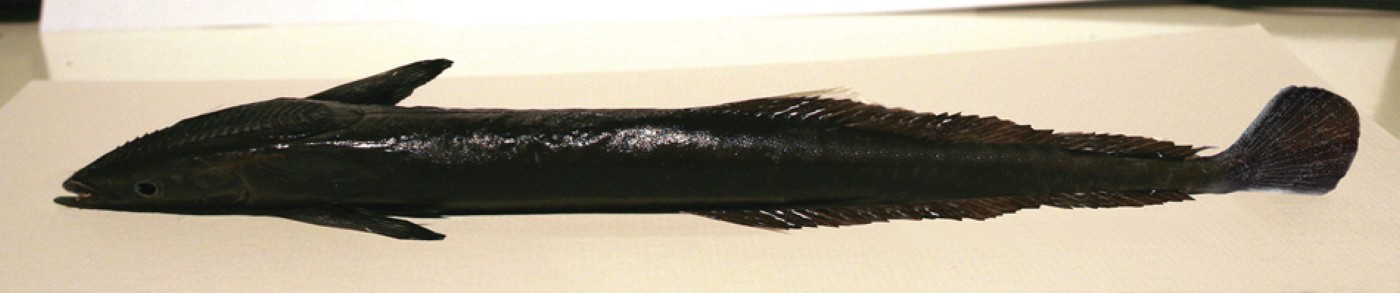
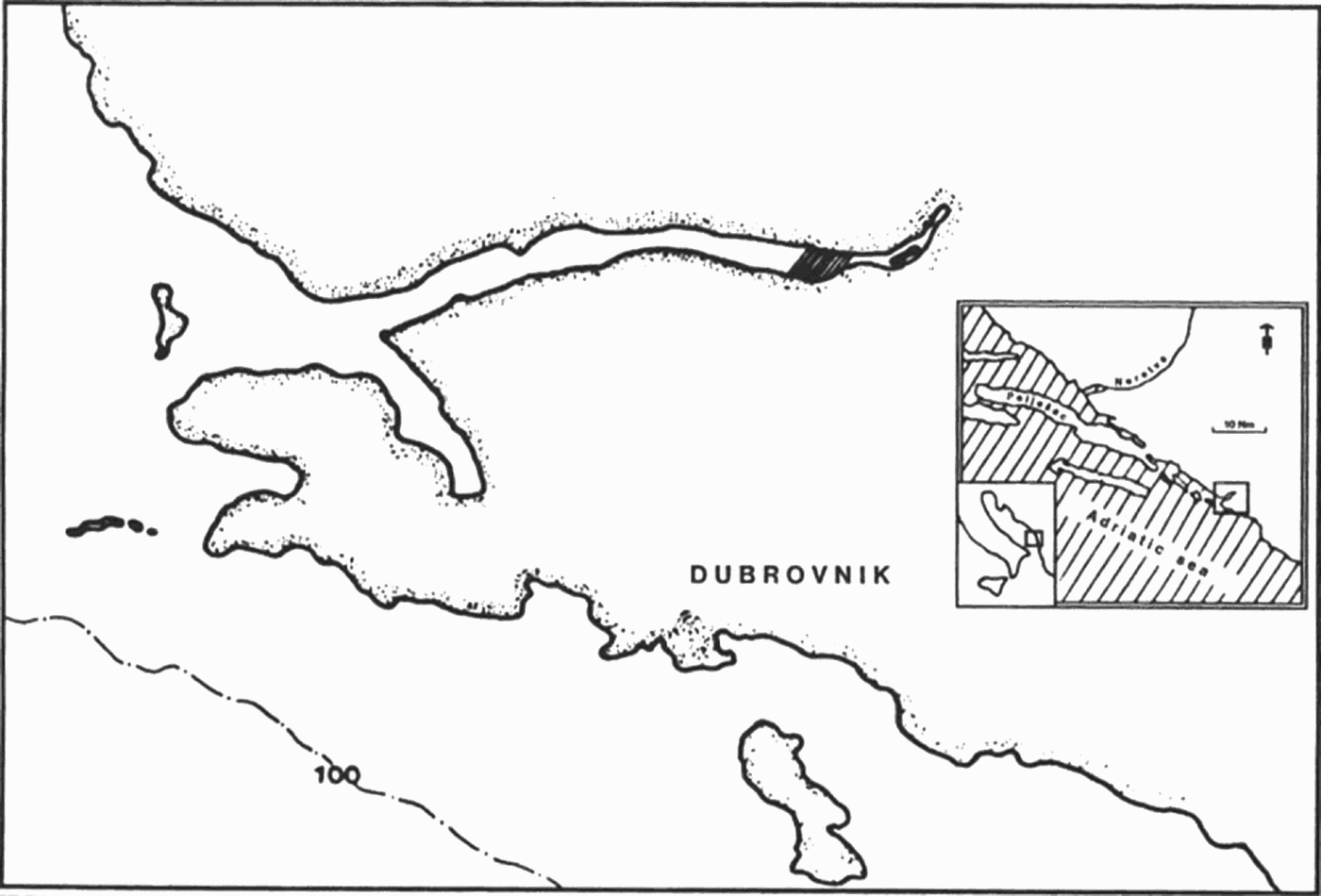
The aim of this paper is to present the first precise data on the location of capture, biometric characteristics and morphology of the live sharksucker from the eastern Adriatic Sea. On 23 July 2007 a specimen of the live sharksucker E. naucrates (Figure 1) was caught by nylon jig in the estuary of the Ombla River (Rijeka Dubrovačka) (42°40′26.68″N 18°08′11.32″E) (Figure 2) near Dubrovnik at 0.5 m depth. Salinity at the location of capture (Station Most) was 0.22 at the surface, and 3.28 at 1.5 m depth. The specimen was identified according to Jardas (Reference Jardas1996) and deposited in the Department of Aquaculture, University of Dubrovnik. The biometric lengths were measured to the nearest cm and total weight to the nearest g. The specimen was frozen and this was visible by its black colour.
Echeneis naucrates, caught from the Ombla River estuary (south-eastern Adriatic), 35.5 cm TL.
Location of capture (—) (Station Most).

The specimen had the following characteristics: elongate body, total length (TL) = 35.5 cm and weighing 165 g, standard length (SL) = 31.2 cm (88.1% TL), pre-anal length (Lpa) = 16.3 cm (45.9% TL), pre-dorsal length (Lpd) = 1.2 cm (3.4% TL), pre-pelvic length (Lpp) = 7.3 cm (20.6% TL), pre-pectoral length (Lppa) = 6.3 cm (17.7% TL), head length (HL) = 5.8 cm (16.3% TL), eye diameter = 0.95 cm (16.4% HL), pre-orbital length = 2.6 cm (44.8% HL). Diagnostic characters were noted as follows: dorsal soft fin rays 37, anal soft fin rays 35, pectoral fin rays 23 and ventral fin rays 5-5. Gill rakers on lower limb 14; ovalic cephalic succer disc with 23 laminae; caudal fin lanceolate with middle rays produced; white border on dorsal, anal, and caudal fins; pectoral fin pointed; dark longitudinal band on anterior trunk, and lower jaw with fleshy flap.
The data from the specimen of E. naucrates described herein are in agreement with the size, body proportions, biometric characteristics and descriptions by other authors who systematically described this species (Lachner, Reference Lachner and Whitehead1986; Froese & Pauly, Reference Froese and Pauly2006).
Echeneis naucrates is rare in the Mediterranean, and in the north-eastern Atlantic. In the western Atlantic, it is common from Nova Scotia, Canada to Bermuda and Uruguay. Elsewhere, it is found world-wide except along the Pacific American coast (Lachner, Reference Lachner and Whitehead1986; Froese & Pauly, Reference Froese and Pauly2006). It commonly swims in groups and can be found at depths ranging from 20 to 50 m.
According to Ninni (Reference Ninni1912) the first record of this species in the Adriatic Sea was noted by Trois (Reference Trois1893) in the Gulf of Venice, but without any morphological, biometric data presented. Pallaoro & Jardas (Reference Pallaoro and Jardas1996) noted the presence of one specimen in the Ichthyological Collection of the Institute of Oceanography and Fisheries in Split, which had been caught in the middle of the Adriatic, (no precise data). Beyond that, there was no data on this species from the eastern part of the Adriatic Sea in scientific literature. Jardas (Reference Jardas1996) reported that E. naucrates is very rare in the Adriatic Sea.
The occurrence of a live sharksucker in the estuary of the karst River Ombla is very interesting since it is the first one collected from freshwater in Croatia. This oceanic species has been recorded in freshwater (Williams et al., Reference Williams, Mignucci-Giannoni, Bunkley-Williams, Bonde, Self-Sullivan, Preen and Cockcroft2003), and similar areas, such as the shallow and brackish lagoon system in the Mediterranean (Beymelek Lagoon, Turkey) (Akyol & Balik, Reference Akyol and Balik2007). These authors noted that such a system is a quite interesting habitat for this species. The sharksucker is perhaps the most versatile species among the remoras. It free-swims in the water column and rides a wide array of hosts (sharks, rays, boney fish, sea turtles, manatees, dolphins, whales). Its versatility includes the role of a station-based cleaner (Sazima et al., Reference Sazima, Moura and Rodrigues1999). Given the sharksucker's versatility, our record may come as no surprise; even its presence in freshwater and estuarine waters may be more common than generally thought, as the sharksucker attaches to vertebrates that enter such habitats.
ACKNOWLEDGEMENTS
We are thankful to Pero Bradaš for providing us with a specimen. We are also thankful to Croatian Ministry of Science, Education and Sport for financial support (Projects 275-0010501-0856, 001-0013077-0844).