Background
Hospital disaster preparedness is essential to ensure adequate surge capacity and minimize morbidity and mortality during an event. Children, or pediatric patients, typically include individuals from birth to 18 years of age, but can extend up to 21 years of age. Reference Hardin and Hackell1 They represent 25% of the population and have distinct needs in mass casualty events (MCE) that need to be incorporated into hospital disaster plans. Reference Ketterhagen, Dahl-Grove and McKee2,Reference Burke, Iverson, Goodhue, Neches and Upperman3 A reason for this is that children have different anatomic, physiological, and psychological characteristics than adults, and these differences make them particularly vulnerable during a disaster. Reference Burke, Iverson, Goodhue, Neches and Upperman3,4 For example, pediatric patients’ weights must often be estimated when resuscitating and treating them during disasters and this can lead to inappropriate doses and potential treatment failure. Reference AlHarbi, AlGarni, AlGamdi, Jawish, Wani and Abu-Shaheen5 Children also have different airway structure and physiology compared to adults and require a different approach and pediatric-sized equipment for safe intubation and management. Reference Hanlon6 Children and adolescents also respond psychologically to disasters differently from adults, depending upon individual age groups. Reference Roberson7
During a disaster, some children will likely be brought to historically adult-focused hospitals due to surge capacity limits within pediatric hospitals or an inability to reach a pediatric hospital, necessitating the hospital to provide pediatric care. Reference Burke, Iverson, Goodhue, Neches and Upperman3 Researchers and the American Academy of Pediatrics recommend that all hospitals include pediatric surge capacity in their disaster plans, include pediatric patients in hospital disaster exercises, purchase and maintain pediatric-sized supplies and equipment, and cross-train healthcare personnel in pediatric triage, and medication dosing/administration. Reference Ketterhagen, Dahl-Grove and McKee2-4,Reference Wizemann, Reeve and Altevogt8 Research has indicated that advances have been made in some aspects of pediatric disaster planning. For example, the 2015 National Pediatric Readiness Assessment found that only 47% of hospitals addressed pediatric patients in their disaster plans, but a 2018 study reported that 78% of US hospitals address pediatric concerns in their plans. Reference Ketterhagen, Dahl-Grove and McKee2,9 Including pediatric patients in hospital disaster exercises has also increased; a 2009 study found that less than 20% of hospitals had included pediatric patients in their disaster drill, Reference Ferrer, Ramirez, Sauser, Iverson and Upperman10 but Ketterhagen et al.’s 2018 study reported that 86% of US hospitals had incorporated pediatric patients into their disaster drill. Reference Ketterhagen, Dahl-Grove and McKee2 Despite advances made in some areas, research indicates that gaps still exist within pediatric disaster preparedness.
In addition to including pediatric patients in hospital disaster plans and incorporating pediatric patients into exercises, it is important that healthcare personnel who work at historically adult-centered hospitals should be prepared to provide care to pediatric patients during disasters. Reference Burke, Iverson, Goodhue, Neches and Upperman3 Despite this, previous studies have found that many hospitals do not provide pediatric-specific training as part of disaster planning efforts. 9 Though healthcare providers are often asked to perform beyond their usual scope of practice during disasters, it is not known whether they will be willing to provide care to pediatric patients. It is important to determine the extent to which healthcare personnel who do not work in pediatric hospitals are willing to provide care to pediatric patients during disasters as this will affect community pediatric surge capacity.
The purpose of this study is to assess non-pediatric nurses’ willingness and ability to provide clinical care to pediatric patients during a disaster, in order to estimate nursing pediatric surge capacity in non-pediatric hospitals.
Methods
A survey was administered to nurses from 4 hospitals not exclusively dedicated to pediatric care in a major metropolitan Midwestern region in fall, 2018; Only nurses from units most likely to encounter pediatric patients during a disaster (emergency department (ED), medical/surgical, operating room, and intensive care) were approached. Only 2 of the hospitals have a well-baby nursery, but none have any pediatric inpatient wards or pediatric intensive care units that. Among the 4 hospitals, 2 were in an urban setting, 1 of which was affiliated with a university. The other 2 hospitals were located in suburban settings. Nurses were recruited face-to-face to their respective units and invited to complete the survey either electronically or on paper. Attempts were made to reach nurses on all shifts and all days of the week. The Saint Louis University Institutional Review Board approved this study.
Instrument
This study aimed at measuring non-pediatric nurses’ willingness to provide medical care to pediatric patients during a disaster. A new questionnaire was created for this study. The questionnaire was pilot tested by a group of 10 nurses. Pilot testing consisted of assessing the length of time needed to complete the questionnaire, ease of use, clarity and thoroughness of items and answer options. Feedback from the pilot testing was then used to refine the instrument. The final 23-item instrument measures: (1) attitudes and beliefs regarding pediatric surge capacity (5 items); (2) availability of pediatric-specific equipment and reference materials (2 items); (3) ability to use the Broselow tape and calculate doses for pediatric patients (2 items); (4) current status on certifications (6 items); (5) perceived usefulness of certification courses to increase pediatric surge capacity (6 items); (6) cross-training on pediatric care received (1 item); and (7) youngest age for which they would be willing to provide care during a disaster (1 item). Demographics were also collected.
Data Analysis
All data analyses were performed using the Statistical Package for the Social Sciences (SPSS version 25.0, IBM Corp, Armonk, NY). Descriptive statistics were computed for each question and used to describe nurses’ attitudes and beliefs regarding pediatric surge capacity, availability of pediatric-specific equipment and reference materials, ability to use the Broselow tape and calculate doses for pediatric patients, and willingness to provide care to pediatric patients during a disaster. A chi square goodness of fit was used to determine if there were an equal percentage of participants at the 4 hospitals. Chi square was used to examine demographic differences in attitudes and beliefs. Hierarchical logistical regression was used to describe factors associated with nurses’ willingness to provide care to pediatric patients during a mass casualty event (MCE). Variables that were significant on univariate analysis, but non-significant on multivariate analysis were dropped from the final model; only the final model is reported. A critical P-value of 0.05 was used for all analyses.
Results
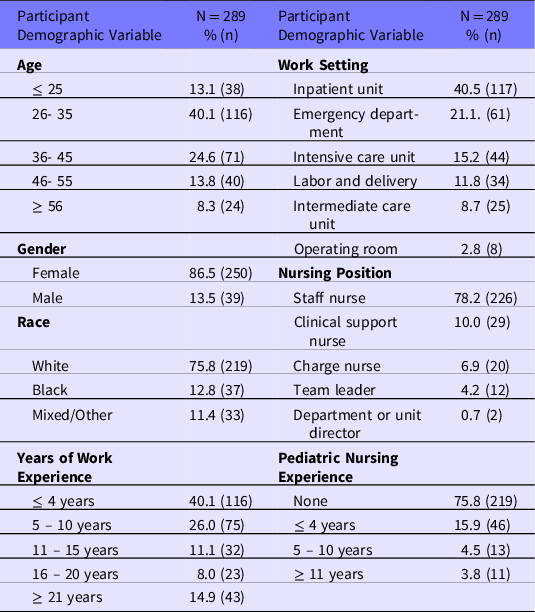
During recruitment, 313 nurses were approached from the 4 hospitals and invited to participate; 289 completed a survey (response rate = 92.3%). There were no differences in the percentage of participants from each of the four hospitals (range: 21.1% - 30.4%). Most nurses were female (86.5%, n = 250), white (75.8%, n = 219), and a staff nurse (78.2%, n = 226; Table 1). A total of 40% (n = 116) were ages 26 – 35 years and a quarter (n = 71) were 36 – 44; 13.1% were under 25 or 46 – 55 years and 8.3% were 56 or older (Table 1). About 40% (n = 116) had 4 or fewer years of experience and another quarter (26%, n = 75) had 5 – 10 years’ experience; 15% (n = 43) had 21 or more years’ 41% (n = 117) work in an inpatient unit, 21.1% (n = 61) work in an ED, 15.2% (n = 44) work in intensive care, and 11.8% (n = 34) in labor and delivery; very few work in an intermediate care unit (8.7%) or operating room (2.8%; Table 1).
Nurse respondent demographics

Nurses’ Attitudes and Beliefs Regarding Pediatric Surge Capacity
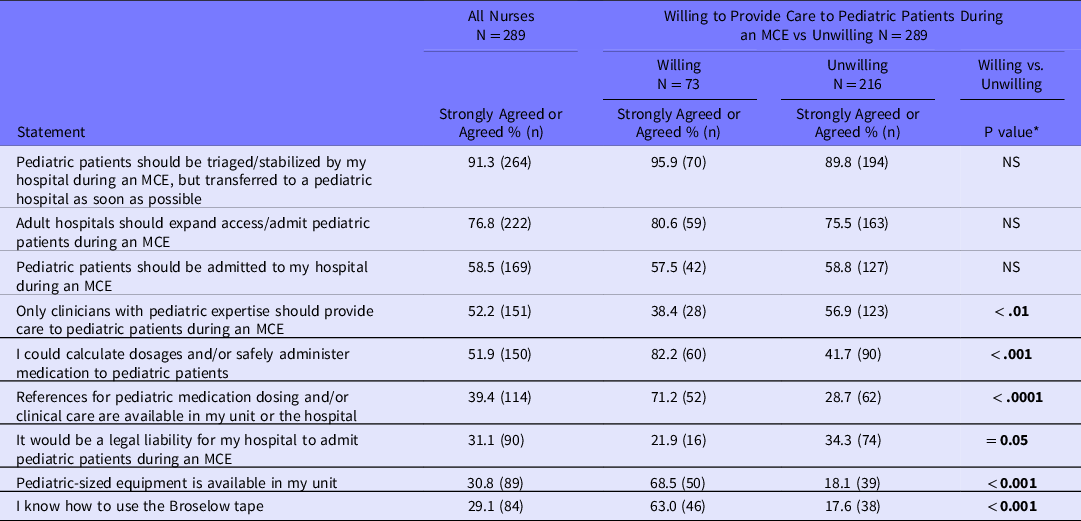
Almost all nurses (91.3%, n = 264) reported believing that pediatric patients should be triaged and stabilized by their hospital during a disaster, but then transferred to a pediatric hospital as soon as possible (Table 2). Majority of the respondents (76.8%, n = 222) believed that non-pediatric hospitals should expand their scope and admit pediatric patients during an MCE (Table 2). Significantly fewer believed that their own hospital should expand scope and admit pediatric patients during an MCE (58.5% vs. 76.8%, X 2 = 63.5, P < 0.001). About half of the nurses (52.2%, n = 151) reported believing that only clinicians with pediatric expertise should provide care to pediatric patients during an MCE (Table 2). Less than a third (31.1%, n = 90) believed that it would be a legal liability for their hospital to admit pediatric patients during an MCE (Table 2). Nurses who were unwilling to provide care to pediatric patients during an MCE were significantly more likely than nurses who were willing to provide clinical care for children during disasters to believe that only clinicians with pediatric expertise should provide care to children, and that it would be a legal liability to admit pediatric patients to their hospital during an MCE (Table 2).
Beliefs regarding pediatric surge capacity and access to pediatric resources among nurses willing to provide care to pediatric patients during a mass casualty event versus those who are unwilling to provide such care

* Determined by the X Reference Ketterhagen, Dahl-Grove and McKee2 test.
Abbreviations: MCE, Mass casualty event; NS, Non-significant.
Non-Pediatric Nurses’ Access to and Knowledge of Pediatric and Disaster Equipment and References and Participation in Hospital Disaster Drills
About half of the nurses (51.9%, n = 150) reported that they could calculate dosages and/or safely administer medication to pediatric patients (Table 2). About a third reported having access to pediatric-sized equipment available in their unit or references for pediatric medication dosing and/or clinical care (30.8% and 39.4%, respectively; Table 2). Less than a third (29.1%, n = 84) knew how to use a Broselow tape (Table 2). Nurses who were willing to provide care to pediatric patients during an MCE were significantly more likely than nurses who were not willing to provide clinical care for children during disasters to believe that they could calculate and administer safely pediatric doses of medication, have access to pediatric equipment and references, and know how to use the Broselow tape (P < 0.001 for all; Table 2). Nurses were asked to specify in how many hospital disaster drills (not counting fire drills) they had participated during the past 2 years. Most nurses (65.1%, n = 188) reported not having participated in any hospital disaster drills during the last 2 years; 21.1% (n = 61) had participated in 1 and 13.8% (n = 40) had participated in 2 or more.
Nurses’ Cross-Training, Certifications, and Perception of Certifications in Enhancing Ability to Provide Care to Pediatric Patients during a Mass Casualty Event
Nurses whose job duties involve clinical patient care at least some of the time (i.e., not nurses with 100% administrative duties) were asked to identify whether they had received cross-training on pediatric care and the amount of training receiving, which certifications they had achieved, and which certifications they believed would enhance their ability to provide care to pediatric patients during a future MCE. About a third (34.7%, n = 99) reported receiving any cross-training on pediatric clinical care. Of those who received cross-training (n = 99), almost half (46.5% (n = 46) had received more than 1 day of training; about a quarter (24.2%) had received 1 hour or less, 19.2% (n = 19) had received 1 day of training, and 10.1% (n = 10) had received 2 to 4 hours of training.
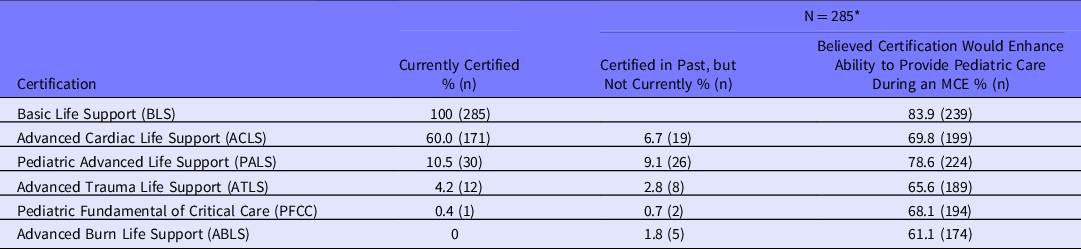
An average of 6 certifications were assessed: basic life support (BLS), advanced cardiac life support (ACLS), advanced trauma life support (ATLS), pediatric advanced life support (PALS), pediatric fundamental of critical care (PFCC), and advanced burn life support (ABLS). All clinical nurses were currently BLS certified and 60.0% (n = 171) were currently ACLS certified (Table 3). Significantly fewer were currently certified in PALS, ATLS, ABLS, or PFCC (P < 0.001 for all comparisons; Table 3). Most clinical nurses (83.9%, n = 239) reported believing that BLS certification enhances their ability to provide care to pediatric patients during an MCE (Table 3). About 75% (78.6%, n = 224) believed that PALS certification would enhance their ability to provide care to pediatric patients during a mass casualty event (Table 3). Significantly fewer nurses believed that ACLS, ATLS, PFCC, or ABLS certification would enhance their ability to provide care to pediatric patients during an MCE compared to BLS or PALS certification (P < 0.001 for all comparisons).
Percentage of clinical nurses with advanced certifications and their perception that certification would enhance their ability to provide pediatric care during a mass casualty event

* Nurses whose job duties involve clinical patient care at least some of the time (i.e., not nurses with 100% administrative duties).
Abbreviation: MCE, mass casualty event.
Willingness of Non-Pediatric Nurses to Provide Clinical Care to Pediatric Patients during a Mass Casualty Event
Nurses were asked to identify the youngest age for which they would be willing to provide clinical care during an MCE. A quarter (25.3%, n = 73) reported that they would be willing to provide care to a child of any age. 12% (n = 35) were willing to provide care only to newborns in the labor and delivery area, and 16.6% (n = 48) would only provide care to adults. About a quarter (23.9%, n = 69) would only provide care to adolescents or adults; the remaining nurses would be willing to provide care to children ages 3 to 5 or older (10%), 6 to 8 or older (3%), or 9 to 12 or older (9%). Predictors of willingness to provide clinical care to a patient of any age during an MCE included occasionally providing care to infants and other young children during routine duties, reporting confidence in calculating doses and administering pediatric medications, being currently or previously certified in PALS, currently working in the ED, and having access to pediatric-sized equipment in the unit or hospital (Table 4). No other demographic variable, attitude and belief question, cross-training undergone, current unit, nor previous work experience were significant predictors in multivariate analysis of nurses’ willingness to provide clinical care to pediatric patients during an MCE.
Predictors of non-pediatric nurses’ willingness to provide care to pediatric patients during a mass casualty event

Abbreviations: OR, odds ratio; CI, Confidence interval; MCE, mass casualty event; PALS, Pediatric Advanced Life Support.
Discussion
This study found that many nurses who work for adult-focused hospitals lack the confidence, training, and supplies necessary to provide care to pediatric patients during disasters, which translated into a lack of willingness to do so. At least 1 of the strongest predictors of being willing to provide care to children during an MCE was occasionally providing care to infants and other young children during routine duties. This implies that these nurses have developed self-efficacy related to providing pediatric care, even though they work for adult-focused hospitals. This is not unsurprising given that almost all of the nurses in this study who were willing to provide care to children during an MCE work in the ED. These nurses were significantly more likely than nurses in other parts of the hospital to report occasionally providing care to the youngest-age patients. ED nurses working at adult-focused hospitals routinely triage and then either provide definitive care in the ED or transfer the children to a local pediatric hospital, providing more opportunities for ED nurses to provide care to children compared to their counterparts who work in other areas of the hospital. It is therefore not surprising that ED nurses reported more willingness to provide pediatric care during an MCE compared to nurses working in other parts of the hospital.
Approximately half of the nurses in this study reported only being willing to provide care to an adolescent or adult during an MCE. This illuminates a noticeable lack of pediatric surge capacity in these non-pediatric hospitals, as pediatric patients cannot be admitted to a hospital without available nursing care. At the community level, this translates into a lack of pediatric surge capacity regionally. While studies have examined whether hospitals addressed pediatric patients in their disaster plans or incorporated pediatric patients into their disaster exercises, Reference Ketterhagen, Dahl-Grove and McKee2,9 there has been little research into healthcare worker surge capacity except around the concept of personnel’s willingness to report to work during disasters. Reference Brice, Gregg, Sawyer and Cyr11,Reference Charney, Rebmann and Flood12 A critical component of healthcare surge capacity is having sufficient trained staff with the self-efficacy to manage the unique needs of an influx of patients during an MCE, such as knowing how to provide burn care, critical care, and pediatric care. Currently, most pediatric emergency care is provided outside of pediatric facilities; During an MCE, pediatric patients will inevitably be brought to non-pediatric hospitals. Nurses in adult-focused hospitals will be asked not only to triage pediatric patients, but also to provide longer or definitive care, as both transportation and beds in pediatric hospitals are expected to be limited. Reference Ray, Olson and Edgerton13,Reference Burkle, Williams and Kissoon14
Findings from this study indicate that while nurses agree that non-pediatric hospitals will and should be called upon to provide more definitive care to children during an MCE, they do not believe that their hospital is equipped to provide that care. This belief does not seem to be based on a fear of litigation, as only a third of the nurses in the study reported that they believe that it would be a legal liability for their hospital to admit pediatric patients during an MCE. The exact reasons for nurses’ belief that their hospital should not admit pediatric patients during an MCE needs to be further explored. It is likely that the nurses’ reported lack of self-efficacy to provide pediatric care during an MCE is at least partially influencing this belief. A comprehensive effort among adult hospitals to increase nurses’ self-efficacy in providing pediatric care could increase pediatric surge capacity and minimize pediatric morbidity and mortality during MCEs.
A challenge in providing pediatric versus adult care is the variation in medication dosages based on weight. This knowledge was lacking among many nurses in this study; only about half reported the ability to calculate the doses for pediatric medication, only a third had access to references on pediatric dosages in their unit, and less than a third knew how to use the Broselow tape to estimate a child’s weight. A critical finding from this study is that confidence in calculating dosages and administering medications to pediatric patients, having access to pediatric references on their unit, and knowing how to use the Broselow tape were associated with willingness to provide care to children during an MCE. In addition, this study found that having access to pediatric equipment in their unit was associated with willingness to provide care to children during an MCE. Based on these findings, it is recommended that adult hospitals train nurses on pediatric weight estimation techniques and provide references or guides to more easily calculate frequent pediatric medication doses. This training would align with recommendations from the Task Force for Pediatric Emergency Mass Critical Care. Reference Tegtmeyer, Conway, Upperman and Kissoon15 The American Academy of Pediatrics currently recommends that all hospitals, even those that primarily see adult patients, have pediatric-specific supplies available in the emergency department. Reference Remick, Gausche-Hill and Joseph16 Based on the findings from this study and recommendations from researchers, Reference Ketterhagen, Dahl-Grove and McKee2 it may be prudent for hospital administrators to also consider making pediatric-specific supplies available in areas of the hospital that might provide definitive care to children during an MCE, such as inpatient and intensive care units, though this equipment may need to be purchased using disaster preparedness or other funding.
Important findings from this study included that the amount of cross-training received did not predict willingness to provide care to pediatric patients, but the nurse participants believed that certification coursework in advanced and pediatric care, particularly PALS and BLS, would improve their ability to provide care for children during an MCE. Furthermore, PALS certified nurses in this study were significantly more likely to be willing to provide pediatric care during an MCE compared to those who were not certified. Although it is not feasible to recommend that all nurses receive PALS training, these findings indicate that encouraging non-pediatric nurses to become PALS certified is 1 way to help increase pediatric surge capacity. Although cross-training was not found to predict nurses’ willingness to provide care to pediatric patients in this study, the exact nature of the training they received was not assessed. It is possible that the training they received was related to general hospital pediatric disaster preparedness versus clinical skills needed to provide pediatric care and this did not increase their self-efficacy related to providing pediatric care during an MCE. More focused training specific to providing pediatric care has been recommended by multiple researchers and professional organizations. 9,Reference Pham, Behar, Berg, Upperman and Nager17 The Task Force for Pediatric Emergency Mass Critical Care recommends that pediatric hospitals encourage disaster-related training at local hospitals. Reference Tegtmeyer, Conway, Upperman and Kissoon15 They also encourage the US Department of Health and Human Services (HHS) and the Assistant Secretary for Preparedness and Response (ASPR) to develop pediatric disaster preparedness training guidelines that could be used as the basis for continuing education of healthcare and first responder personnel. 9
Increasing nurses’ knowledge of pediatric mass casualty care is important not only because it increases pediatric surge capacity, but also because it has been linked to healthcare worker surge capacity in general; healthcare personnel with higher knowledge scores report more willingness to work during an MCE. Reference Goodhue, Burke, Ferrer, Chokshi, Dorey and Upperman18 However, specific recommendations regarding the exact training content and delivery methods that should be implemented are lacking. Pham, et al. Reference Pham, Behar, Berg, Upperman and Nager17 implemented an online pediatric disaster training module at their hospital and found that both medical and non-medical participants had significant change in pre- to post- module knowledge scores. A study examining community emergency department personnel’s preferences for receiving pediatric-related training found that most reported wanting to receive such training from staff working at pediatric hospitals rather than infrequent courses. Reference Goldman, Wong, Bhatnagar, Emerson, Brown and Auerbach19 Any training developed, particularly for nurses outside the emergency department who may rarely if ever provide pediatric care will need to be planned carefully so as to be both cost- and time-efficient, as well as readily utilized in a disaster. The Task Force for Pediatric Emergency Mass Critical Care and The Institute of Medicine have recommended using both pre-event and just-in-time training. Reference Wizemann, Reeve and Altevogt8,Reference Tegtmeyer, Conway, Upperman and Kissoon15 More research is needed in this area to determine the exact competencies that should be covered in pediatric cross-training for nurses and the best delivery methods for that education.
The strength of this study is that it is the first to measure pediatric surge capacity from the perspective of having sufficient numbers of trained nurses willing to provide care to children during an MCE. Some limitations must also be noted. This study assessed nurses working in urban and suburban hospitals in a single healthcare system in the Midwest (including those with and without a nursery) but the findings may not be generalizable to nurses working in rural community hospitals or in any type of hospital in other geographical areas. Another limitation is that this was a survey consisting of self-reported data, and therefore may not be reflective of nurses’ actual willingness to provide pediatric care during an MCE nor an accurate assessment of pediatric equipment available in their hospital.
Conclusions
Findings from this study indicate that there is a lack of pediatric surge capacity in terms of nurses willing to provide this care, and this is a major gap in disaster planning. A comprehensive effort among adult hospitals to increase pediatric surge capacity among nurses could minimize pediatric morbidity and mortality during mass casualty events. Community and adult hospitals should encourage PALS certification among nurses and consider partnering with pediatric hospitals to develop cross-training programs that include both pre-event and just-in-time education. This could help improve non-pediatric nurses’ self-efficacy in providing pediatric care during an MCE and increase pediatric surge capacity in communities.