Healthcare-associated Clostridioides difficile infection (CDI) rates have been decreasing in Department of Veterans’ Affairs (VA) acute-care medical facilities since the CDI Prevention Initiative began in 2012.Reference Evans and Kralovic1 The assessment of rates, however, is complicated by changing surveillance definitions and diagnostics.
In 2010, the Society for Healthcare Epidemiology of America (SHEA) and the Infectious Diseases Society of America (IDSA) recommended using nucleic acid amplification tests (NAATs) for the diagnosis of CDI instead of C. difficile toxin enzyme immunoassays (EIAs) because of better sensitivity.Reference Cohen, Gerding and Johnson2 Concerns arose, however, about the specificity of the NAAT and whether patients were being overdiagnosed and overtreated. Combinations of NAAT and other tests were suggested.Reference Polage, Gyorke and Kennedy3 In 2018, the National Health and Safety Network (NHSN) recommended the following: “When using a multistep method for CDI identification, the final result of the last test finding which is placed onto the patient medical record determines if the CDI positive laboratory assay definition is met.”Reference McDonald, Gerding and Johnson4
Since 2012, VA facilities have used different methods for CDI diagnosis including glutamate dehydrogenase (GDH), NAAT, toxin EIA, or a combination of these tests. Most facilities have used NAAT alone, but recently some facilities have shifted toward the use of NAAT followed by EIA, with reporting of the latter as the final result for clinical and surveillance purposes.5 We compared CDI rates at facilities performing NAAT alone or NAAT+EIA to determine whether there was a difference in reported CDI rates.
Methods
During the study, multidrug-resistant organism prevention coordinators at each of the 129 VA medical facilities entered the number of CDI cases, number of patient days, and CDI diagnostic method(s) used each month into a central database at the VA Inpatient Evaluation Center in Cincinnati, Ohio. Hospital-onset healthcare facility-associated (HO-HCFA) CDI cases were defined as a patient with a positive diagnostic laboratory test (LabID event) that was nonduplicate and/or nonrecurring and occurred >3 days after admission to the facility as recommended by the NHSN.Reference Evans and Kralovic1 Facility CDI rates were analyzed as infections per 10,000 patient days.
Facilities were categorized based on the type of CDI diagnostic method used over a 24-month period (period 1: October 2017 to September 2018, and period 2: October 2018 to September 2019). HO-HCFA CDI rates in facilities that used NAAT alone during period 1 and then switched to NAAT+EIA for period 2 were compared to rates in facilities that used NAAT alone for both periods. For facilities that switched from NAAT to NAAT+EIA, only those that used 12 months of NAAT alone only followed by 12 months of NAAT+EIA were included in this review. Differences in CDI rates between the 2 groups were examined using linear regression (SAS version 9.4 software, SAS Institute, Cary, NC). An analysis of covariance was used to evaluate whether the infection rate was similar between the 2 groups.
Results
Of the 129 reporting facilities, 70 (54.3%) used NAAT alone for the entire 24-month analysis period, and 7 facilities (5.4%) performed NAAT alone for period 1 and then switched to NAAT+EIA for period 2. During this time, no facility switched from NAAT+EIA to NAAT alone. The remaining 52 VA facilities were not included in the analysis because they either did not use the types of laboratory testing analyzed in this study or did not have enough months of data for the 24-month review period.
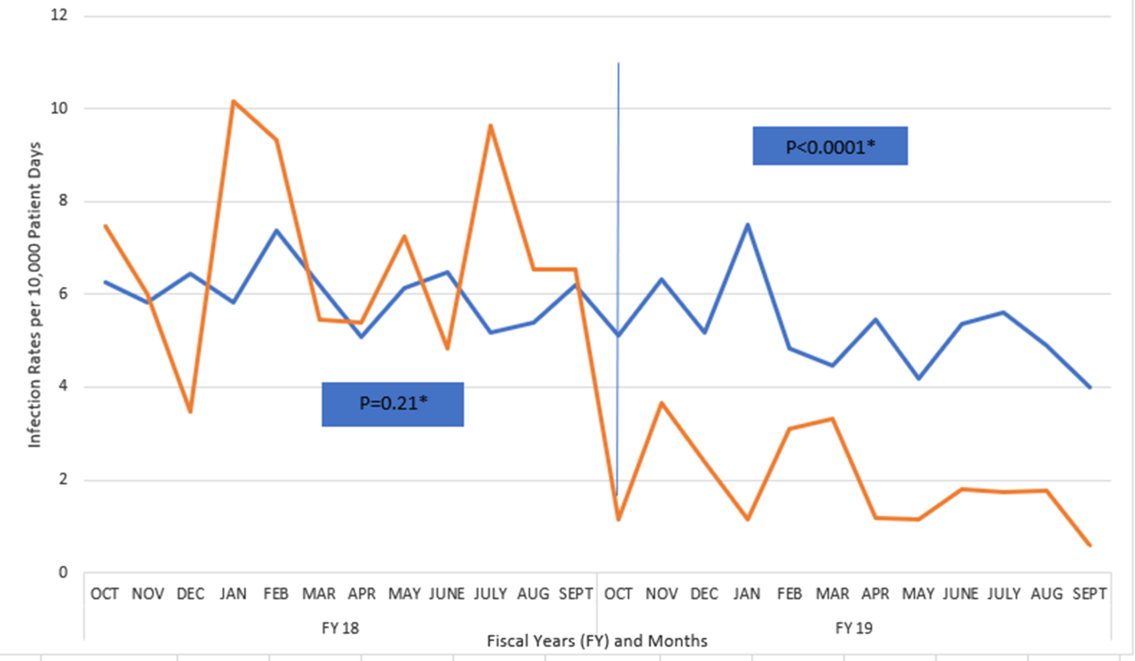
In 2019, 38 of 129 VA facilities used NAAT+EIA testing for CDI, an increase from the previous year, in which only 1 facility used the combination. During the 24 months, there were 79,363 admissions, and 409,143 patient days for the 7 facilities that switched testing methodologies after 12 months. We detected no difference (P = .21) in HO-HCFA CDI rates during period 1 when both groups were using NAAT alone (Fig. 1). However, we detected a difference (P < .0001) in HO-HCFA CDI rates between the groups during period 2 (Fig. 1). In period 2, the average infection rate for facilities using NAAT+EIA (1.91 per 10,000 patient days) was 64% lower than the average rate for facilities using NAAT alone (5.24 per 10,000 patient days).
Clostridioides difficile infection rates in VA acute-care facilities. Blue line: facilities that used nucleic acid amplification test (NAAT) only in both FY 18 and FY 19. Orange line: facilities that used NAAT only in FY 18 and NAAT + toxin EIA in FY 19. Comparisons of CDI rates in each fiscal year (FY) were performed using linear regression.

Discussion
We detected a significant decrease in reported CDI rates in facilities that switched from using NAAT only to NAAT+EIA compared to rates in facilities that did not switch. The 2018 NHSN Multidrug-Resistant Organism and Clostridium difficile Infection MDRO/CDI Module stated that when using a multistep methodology for CDI identification, the final result of the last test finding, which is placed onto the patient medical record, will determine whether the CDI-positive laboratory assay definition is met.Reference McDonald, Gerding and Johnson4 This statement was issued in the face of NHSN data being shared with the Center for Medicare/Medicaid (CMS) value-based purchasing program, which affects hospital reimbursement and has become a market force driver for test selection because of increased emphasis on reducing CDI rates within healthcare institutions.6 Although the VA does not receive reimbursement from CMS for service, the VA has a legislative mandate to participate in CMS Hospital Compare, the program within which the Value-Based Purchasing module resides, which includes reporting of healthcare-acquired CDI.Reference Shultz, Sickbert-Bennett and Marx7 This factor may have had an impact on testing across VA facilities. In 2017, 83.5% of VA facilities used NAAT only.Reference Singh and Evans8 Compared to data presented here, there is an increasing trend in VA facilities to perform 2-step testing for the presence of CDI and to document the finding of the toxin assay as the final result.
Another driver for 2-step testing is the low specificity of NAAT alone for diagnosing C. difficile disease. Polage et alReference Polage, Gyorke and Kennedy3 tested 1,416 patients suspected of CDI with NAAT and EIA. Overall, 55.3% of patients with a positive NAAT had a negative EIA and outcomes in these patients were comparable to those with no CDI detected. They concluded that exclusive reliance on NAAT for CDI diagnosis without tests for toxins may result in overdiagnosis and overtreatment.Reference Polage, Gyorke and Kennedy3
In contrast, the sensitivity of the toxin EIA is lower than that of the NAAT, raising the concern that CDI may be missed.5 Humphries et alReference Humphries, Uslan and Rubin9 looked at CDI testing of 269 inpatients using both NAAT and EIA. Among the patients with mild CDI, 49% tested positive by toxin EIA and 98% tested positive by NAAT. Among patients with severe CDI, 58% tested positive by toxin EIA and 98% tested positive by NAAT. Therefore, this study supported the use of NAAT for the diagnosis of CDI.Reference Humphries, Uslan and Rubin9
The contrasting outcomes of these studies demonstrate the real-world challenge of not having a gold standard for the diagnosis of CDI. There are advantages and disadvantages to both testing assays. No laboratory test can diagnose CDI with certainty; rather, it is a clinical diagnosis that can be supported by laboratory data.
Our analysis suggests that the increasing trend in VA facilities to perform NAAT+EIA testing for CDI and reporting the toxin EIA result as the final result for clinical and surveillance purposes may lead to the underreporting of cases. This could potentially lead to a false sense of security by an appearance of decreasing CDI rates, which could, in turn, influence patient treatment and isolation precaution measures.
Acknowledgments
We wish to thank the VA Under Secretary for Health and the Executive in Charge, the Deputy Under Secretary for Health for Policy and Services, the VA MRSA/MDRO Taskforce, the MRSA/MDRO Prevention Coordinators, Infection Prevention and Control Professionals, Infectious Diseases specialists, and clinical laboratory personnel at each facility for support of the MDRO Prevention Initiatives and their hard work and dedication toward improving the healthcare of America’s veterans. We also thank the CDI Data Workgroup and MDRO Prevention Office staff for their educational activities and help with data validation and cleaning.
Financial support
No financial support was provided relevant to this article.
Conflicts of interest
All authors report no conflicts of interest relevant to this article.