INTRODUCTION
Digenean trematodes are the most widespread metazoan parasites of marine invertebrates (Lauckner, Reference Lauckner and Kinne1980; de Montaudouin et al., Reference Montaudouin, de Blanchet, Kisielewski, Desclaux and Bachelet2003), they are thought to play a crucial role in the regulation of the abundance of their host populations (Huxham et al., Reference Huxham, Raffaelli and Pike1993; Mouritsen et al., Reference Mouritsen, Tompkins and Poulin2005), and they may impact other macrofaunal populations interacting with their host organisms.
A majority of digenean trematodes use gastropods as their first intermediate hosts, in which they asexually reproduce and release and disperse lecithotrophic larvae. These larvae have to infect a second intermediate host within a short time (hours to days), usually a bivalve or a crustacean. The second intermediate host acts as a transport vector to the definitive host—a bird or fish that feeds on them. In the definitive host the parasite reproduces sexually and eggs are released to the exterior, where they may eventually infect a snail. Depending on the digenean species, the eggs can be accidentally ingested by the snail, or the eggs can hatch in the external environment as swimming miracidia that will infect the subsequent host (Field & Irwin, Reference Field and Irwin1999; Jensen et al., Reference Jensen, Ferreira and Pardal2004). In nearly all snail–trematode systems, the parasites establish in the gonad and/or in the digestive gland of the host snails, where they grow and reproduce. Infected snails have a higher mortality rate and reduced fecundity (Mouritsen & Jensen, Reference Mouritsen and Jensen1994; Gorbushin, Reference Gorbushin1997; Probst & Kube, Reference Probst and Kube1999; de Montaudouin et al., Reference Montaudouin, de Blanchet, Kisielewski, Desclaux and Bachelet2003) and they are more vulnerable to unfavourable conditions (e.g. osmotic stress, desiccation, oxygen demand and temperature tolerance) than uninfected ones (Huxham et al., Reference Huxham, Raffaelli and Pike1995; Jensen et al., Reference Jensen, Latama and Mouritsen1996). All together this may have consequences for gastropods' population dynamics, as reported before for second intermediate host crustaceans (Jensen & Mouritsen, Reference Jensen and Mouritsen1992; Mouritsen & Jensen, Reference Mouritsen and Jensen1997; Meißner & Bick, Reference Meißner and Bick1999; Fredensborg et al., Reference Fredensborg, Mouritsen and Poulin2004; Ferreira et al., Reference Ferreira, Jensen, Martins, Sousa, Marques and Pardal2005). In shallow transitional water ecosystems, mud snails may play a key role in parasite networks, as first intermediate host to about 50 trematodes species in north-western Europe (Deblock, Reference Deblock1980). The patterns of parasites in mud snail populations may thus be indicative for the potential importance of parasites in an ecosystem.
The present paper will focus on the digenean fauna of the mud snail Hydrobia ulvae (Deblock, Reference Deblock1980). Apart from its role as host to many digenean species, H. ulvae constitutes an important link in estuarine food webs (Cardoso et al., Reference Cardoso, Lillebø, Pardal, Ferreira and Marques2002, Reference Cardoso, Brandão, Pardal, Raffaelli and Marques2005), being considered of great importance in the dynamics of the ecosystems in which they occur (Lillebø et al., Reference Lillebø, Pardal and Marques1999; Cardoso et al., Reference Cardoso, Lillebø, Pardal, Ferreira and Marques2002, Reference Cardoso, Brandão, Pardal, Raffaelli and Marques2005). It is one of the key species of the Mondego Estuary macrobenthic intertidal communities, reaching up to 300,000 ind m−2 in mud flats covered by Zostera noltii seagrass, where it has a stable and well-structured population (Cardoso et al., Reference Cardoso, Lillebø, Pardal, Ferreira and Marques2002, Reference Cardoso, Brandão, Pardal, Raffaelli and Marques2005). This mud snail's life span is estimated to be 16 to 20 months (Cardoso et al., Reference Cardoso, Lillebø, Pardal, Ferreira and Marques2002, Reference Cardoso, Brandão, Pardal, Raffaelli and Marques2005). The population dynamics of this gastropod have been addressed before, especially in relation to the eutrophication processes that this system has been undergoing since the 1980s (Lillebø et al., Reference Lillebø, Pardal and Marques1999; Cardoso et al., Reference Cardoso, Lillebø, Pardal, Ferreira and Marques2002, Reference Cardoso, Brandão, Pardal, Raffaelli and Marques2005). Progressive decline of the Z. noltii beds were observed, both in terms of biomass and coverage, along with seasonal proliferations of green macroalgae and macrofaunal impoverishment in the inner areas of the Mondego Estuary (Cardoso et al., Reference Cardoso, Lillebø, Pardal, Ferreira and Marques2002, Reference Cardoso, Brandão, Pardal, Raffaelli and Marques2005; Pardal et al., Reference Pardal, Cardoso, Sousa, Marques and Raffaelli2004; Ferreira et al., Reference Ferreira, Brandão, Baeta, Neto, Lillebø, Jensen and Pardal2007).
The Mondego Estuary is one of the few estuarine systems with an extensive long-term data base on its macrobenthic community, providing a suitable model system for the study in focus. Considering the presence of H. ulvae in both the undisturbed (Z. noltii bed) and disturbed (eutrophic sand flat that has lost its seagrass coverage) areas, combined with the well-known occurrence of all the other hosts (second intermediate and definitive) potentially involved in the life cycles of the snail's trematodes, a rich trematode fauna can be expected to be found in the snails of this system. In fact, the Mondego Estuary is an important international bird area under the Ramsar Convention (2007) (http://www.ramsar.org/wn/w.n.portugal_five.htm). Birds are potential definitive hosts of many trematodes parasitizing H. ulvae and they are considered the foremost factor influencing the trematode fauna in mud snail populations (Rothschild, Reference Rothschild1936; Hechinger & Lafferty, Reference Hechinger and Lafferty2005; Fredensborg et al., Reference Fredensborg, Mouritsen and Poulin2006). Data encompassing three years give a good basis to take into account seasonal variation. Overall, this study aimed: (1) to compare prevalence and species composition of trematodes infecting H. ulvae at two distinct sites of the Mondego Estuary (a Z. noltii covered mud flat and an inner eutrophic sand flat), from 1993 to 1995; (2) to relate the infection patterns to changing environmental conditions, such as the proliferation of green macroalgae or the floods; and (3) to identify seasonal and interannual patterns of parasitism.
MATERIALS AND METHODS
Study site
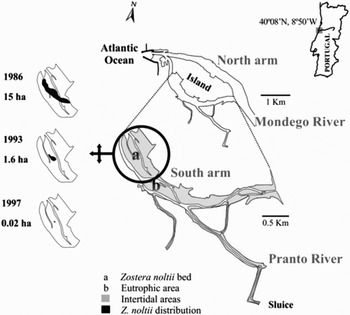
The Mondego Estuary is a small warm-temperate coastal system (1600 ha) located at the central western coast of Portugal (40°08′N 8°50′W) (Figure 1). It comprises two arms: a north and a south, separated by an alluvium-formed island (Murraceira Island). The north arm is deeper and constitutes the main navigation channel. The south arm is shallower and mainly composed of intertidal areas. The water circulation in the south arm was mainly dependent on the tides and on the irregular freshwater inputs from a tributary, the Pranto River, whose flow was controlled by a sluice. The south arm was particularly susceptible to eutrophication due to its shallow waters, high water residence time together with elevated nutrient loading. Two key study sites in the south arm, representative of the dominant habitats of the estuary, were established along a spatial gradient of eutrophication symptoms, based on the shift of primary producers: (1) a mud flat covered with Zostera noltii; and (2) a eutrophic sand flat. The Z. noltii beds were located downstream and represented a non-eutrophic situation, corresponding to the original state of the system. The eutrophic sand flat was located upstream, in the inner areas of the estuary, from where Z. noltii disappeared more than 25 years ago and where seasonal green macroalgal blooms (Ulva sp.) frequently occur. It was otherwise characterized by bare sediment. The nearby Coimbra forecast station of the Portuguese Institute of Meteorology provided the monthly precipitation and atmospheric temperature data.
Location of the sampling stations and alteration in the area covered by Zostera noltii in the south arm of the Mondego Estuary (Portugal). Mapping of benthic vegetation is based on field observations, aerial photographs and GIS methodology (ArcView GIS v. 8.2).

Sampling programme and laboratory work
Intertidal macrobenthic communities have been monitored in the Mondego Estuary since the beginning of the 1990s. The present study focused on the period from January 1993 to September 1995. This period has been addressed before in previous studies, due to the distinct environmental conditions between the years (Cardoso et al., Reference Cardoso, Lillebø, Pardal, Ferreira and Marques2002; Jensen et al., Reference Jensen, Ferreira and Pardal2004; Pardal et al., Reference Pardal, Cardoso, Sousa, Marques and Raffaelli2004; Dolbeth et al., Reference Dolbeth, Cardoso, Ferreira, Verdelhos, Raffaelli and Pardal2007). At each station, six core samples were taken in a haphazard manner using a PVC corer of 141 cm2 taken to a depth of 15 cm. Firstly the Z. noltii bed was sampled and the eutrophic area afterwards. The material was washed in a 500-µm mesh sieve and preserved in 4% buffered formalin. For every sampling date, at each station, low water pools temperature and salinity were measured in situ.
In the laboratory, sorted plant material from all the cores (Chlorophyceae plus Z. noltii leaves and rhizomes) was dried during 48 hours at 60°C and weighted. Afterwards, the ash free dry weight (AFDW) was determined by loss on ignition (8 hours at 450°C). The fauna was also sorted, separated by taxa and kept in 70% ethanol.
In the present study, Hydrobia ulvae specimens collected in the sampling cores were sieved through a 1-mm mesh, in order to remove immature and thus uninfected juveniles (Probst & Kube, Reference Probst and Kube1999). Adult specimens were sub-sampled using a Folsom splitter, to at least 300 individuals of each monthly sample. Replicates with smaller number of individuals were totally screened. Hydrobia ulvae individuals were measured for shell width, dissected, and inspected for parasites, which were identified according to Deblock (Reference Deblock1980). Shell height (mm) was estimated according to the equation: shell maximum width = 0.4369 × shell height + 0.2091 (N = 339, r 2 = 0.97) (Lillebø et al., Reference Lillebø, Pardal and Marques1999).
The macrobenthic sampling of the intertidal fauna, conducted from 1993 to 1995, also provided data on the abundance of potential second intermediate hosts, such as crustaceans, hosts for Microphallidae trematodes.
Data on the abundance of waders was provided by Múrias et al. (Reference Múrias, Cabral, Marques and Goss-Custard1996) and Lopes et al. (Reference Lopes, Cabral, Múrias, Pacheco, Marques, Pardal, Marques and Graça2002), obtained from visual census made within two hours of low water tide, from three fixed observation points adjacent to the flats, carried out monthly in the south arm of the Mondego Estuary from October 1993 to May 1995.
Data analysis
Pearson correlations were carried out using SigmaPlot 11.0. The PRIMER Statistical Package (v. 6.0) was used to perform analysis of similarities (ANOSIM) procedures, based on Bray–Curtis similarity indices of square-root  transformed density data of snails infected by different trematode species, in order to ascertain differences between sites, years and seasons. The multi-dimensional scaling (MDS) was carried out also with PRIMER Statistical Package (v. 6.0), in order to visualize infection differences between sites. A one-way ANOSIM test was performed to test for differences between groups (Clarke & Warwick, Reference Clarke and Warwick2001). Density data were calculated for each species and each month and season. They were square-root transformed due to the presence of zero values that did not allow the statistical procedure mentioned above (Zar, Reference Zar1996). The effect of season and year was tested through two-way crossed ANOSIM with no replication (Clarke & Warwick, Reference Clarke and Warwick2001). The diversity of the trematode taxa infecting H. ulvae in the two areas was calculated as species richness (Margalef's index) measures (Krebs, Reference Krebs1999). The diversity index was calculated employing PRIMER Statistical Package (v. 6.0), using the mean density of infected individuals of each monthly sample.
RESULTS
Environmental characteristics
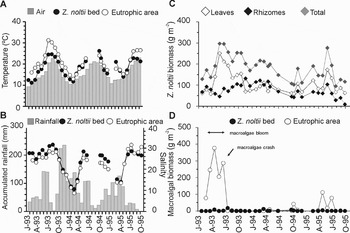
The annual patterns of air temperature and precipitation varied according to the temperate climate of the Mondego region (Figure 2A, B), showing higher temperature and lower rainfall during summer periods. The temperature of the water from low tide pools within the sediment was highly variable, depending on the season and time of the day when measurements were taken (higher in summer and late in the morning). The winter of 1993/1994, was considered atypical, due to the occurrence of floods. These resulted from intense rainfall (Figure 2B) that caused strong salinity declines (Figure 2B) to values lower than 8.0.
Variation of (A) monthly mean temperature of the air at the Mondego Lower Valley and temperature of the water pools (instantaneous measurements) from the two sampling stations at the Mondego Estuary; (B) monthly precipitation and salinity of the water pools; (C) seagrass leaves, rhizomes and total biomass at the Zostera noltii bed; (D) green macroalgal biomass at the two sampling stations of the Mondego Estuary, from January 1993 to September 1995. The results were presented as mean ± SE.

Between 1993 and 1995, the Zostera noltii bed suffered appreciable area reduction from 1.6 to nearly 0.02 ha (Cardoso et al., Reference Cardoso, Brandão, Pardal, Raffaelli and Marques2005; Ferreira et al., Reference Ferreira, Brandão, Baeta, Neto, Lillebø, Jensen and Pardal2007), concomitant with the decline of the seagrass biomass (Figure 2C). Along the south arm of the estuary, green macroalgae were especially abundant at the eutrophic area, decreasing towards Z. noltii beds where they were very scarce (Figure 2D). At the eutrophic area (Figure 2D), there were differences between the spring periods. During the first six months of 1993, there was an extraordinary algal biomass increase, characteristic of a spring bloom, followed by its sudden disappearance in late June (algal crash). In 1994 the presence of algae was scarce except for a period in autumn. An intermediate situation was observed in 1995.
Characterization of the trematode fauna within Hydrobia ulvae
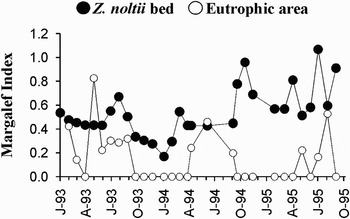
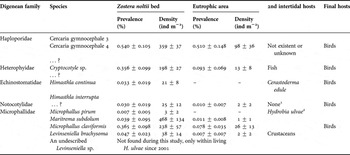
Trematode species from five families were found in Hydrobia ulvae from the Mondego Estuary (Table 1): Microphallidae, Haploporidae, Heterophyidae, Notocotylidae and Echinostomatidae. All were present in mud snails from both sites except echinostomatids that were not observed at the eutrophic area. Few unidentifiable immature larval stages were observed. Microphallidae was represented by four species: Maritrema subdolum, Microphallus claviformis, Levinseniella brachyosoma and Microphallus pirum. The last species was only found at the Z. noltii bed and has an abbreviated life cycle, as the gastropod is both its first and second intermediate host. The diversity of trematodes was highest at the Z. noltii bed as indicated by the Margalef index (Figure 3).
Variation of the Margalef index in the two sampling stations from January 1993 to September 1995.

Digenean trematodes found in Hydrobia ulvae from the Mondego Estuary, in the Zostera noltii beds and the eutrophic area, with indication of their mean annual prevalence (±SE), mean annual density (±SE) and groups of final and second intermediate hosts. 1, Cercariae encyst outside the host, in the open; 2, cercariae develop into metacercariae in the same host individual (Hydrobia ulvae). The symbol ‘… ?’ stands for the fact that there are still too many uncertainties regarding the identification of species from families Haploporidae, Heterophyidae and Notocotylidae, and consequently they will be treated as a whole group. A hithertho unknown Levinseniella species has also been observed in living snails from the same site in 2001–2004, but not in this particular study.

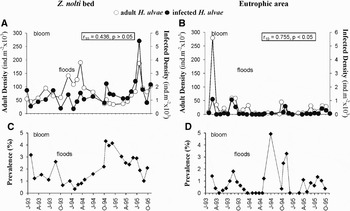
There were no obvious seasonal or interannual patterns in the densities of infected H. ulvae, neither at the Z. noltii bed (season: F = 2.184, P > 0.05; year: F = 1.182, P > 0.05; season versus year: F = 0.630, P > 0.05) nor at the eutrophic area, tested by a two-way crossed ANOSIM comparing the data of the three year study period and of their respective seasons. The density of adult mud snails (with shell height ≥1.5 mm) at the Z. noltii bed varied between 34,000 (autumn 1994) and 190,000 ind m−2 (spring 1994) (Figure 4A). At the eutrophic area, the density varied between a few hundred (spring 1994) and 280,000 ind m−2 (spring 1993) (Figure 4B). The density of infected snails at the Z. noltii bed was generally less than a few thousand individuals per m−2 but in June 1995 the density reached 5500 ind m−2 (Figure 4A). At the eutrophic area the density of infected snails was generally less than a few hundred individuals m−2 except in January and September 1993 where the density was around 1000 ind m−2 (August 1993). In this area, no infected snails were observed during winter floods, from December 1993 until April 1994, and also from December 1994 to February 1995 (Figure 4B). The prevalence of all trematode species combined at the Z. noltii bed fluctuated between 0.33% (January 1994) and 4.32% (October 1994) (Figure 4C). At the eutrophic area, the prevalence of snails infected with larval digeneans varied between 0.22% (May 1993) and 4.92% (June 1994) (Figure 4D).
(A) Density of adult (×103 ind m−2) and density of infected (×103 ind m−2) Hydrobia ulvae from January 1993 to September 1995 at the Zostera noltii bed; (B) density of adult (×103 ind m−2) and density of infected (×103 ind m−2) Hydrobia ulvae from February 1993 to September 1995 at the eutrophic area; (C) trematode prevalence (%) from January 1993 to September 1995 at the Zostera noltii bed; (D) trematode prevalence (%) from February 1993 to September 1995 at the eutrophic area.

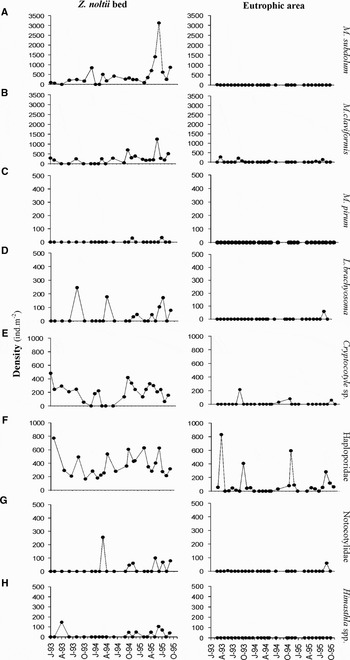
Most of the digenean species observed within H. ulvae from the Mondego Estuary occurred in low and fluctuating numbers throughout the study period (Figure 5). Mud snails infected with microphallid species, such as Maritrema subdolum and Microphallus claviformis, were the most abundant, reaching higher densities in June 1995 at the Z. noltii bed (3100 and 1250 ind m−2, respectively; Figure 5A, B). Haploporidae digeneans were somewhat constant during the study period, at the Z. noltii bed, reaching up to nearly 800 ind m−2. This family of digeneans was the most common taxon found in H. ulvae at the eutrophic area.
Density of adult Hydrobia ulvae (shell height ≥1.5 mm or shell width ≥1 mm) infected with: (A) Maritrema subdolum; (B) Microphallus claviformis; (C) Microphallus pirum; (D) Levinseniella brachyosoma; (E) Heterophyidae; (F) Haploporidae; (G) Notocotylidae; (H) Himasthla sp. trematodes, at the Mondego Estuary, from January 1993 to September 1995 in the Zostera noltii bed and from February 1993 to September 1995 in the eutrophic area.

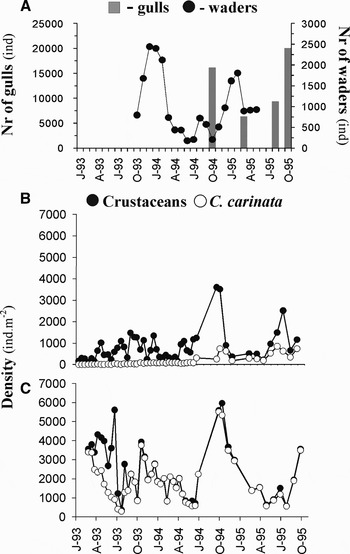
Concerning the whole life cycle of digeneans, the density of birds (potential final hosts) increases from autumn to winter, and decreases until early summer (Figure 6A). A coincident variation in the density of infected mud snail would be expected, but this was found in none of the sites, even taking time lag into consideration. Moreover, the density of crustaceans (possible second intermediate host) in the Z. noltii bed presents peaks of individuals in the autumn of 1994 and in the summer of 1995, which were concomitant with peaks observed in the infected mud snail densities (Figure 6B). In the eutrophic area, crustaceans were mainly represented by the isopod Cyathura carinata, and their density variation was not comparable to one of the infected mud snails in this area (Figure 6C).
(A) Abundance of Larus fuscus (Peter Rock, personal communication) and wading birds (mean ± SE), in the Mondego Estuary, from censuses carried out from October 1993 to May 1995 (Lopes et al., 2006); density of crustaceans and C. carinata population in the Z. noltii bed (R) and the eutrophic area, (C), from January 1993 to September 1995.

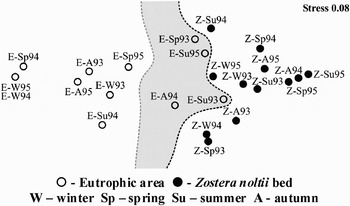
To identify possible differences between the two sites concerning seasonal density patterns of infected H. ulvae, a MDS analysis was performed (Figure 7). Significant differences were distinguished between the two sites by ANOSIM (R = 0.582, P = 0.001). Nevertheless, the data of spring and summer 1993, autumn 1994 and summer 1995 from the eutrophic site were closer to the data groups from the Z. noltii bed. Those seasons corresponded to periods when algae biomass increased. However, no seasonal or interannual patterns could be demonstrated with the two-way ANOSIM with no replication at the Z. noltii bed (season: R = −0.2, P > 0.05; year: R = 0, P > 0.05) or at the eutrophic site (season: R = −0.105, P > 0.05; year: R = 0.189, P > 0.05).
Non-parametric multi-dimensional scaling ordination plots based on square-root transformed abundances of species from each site at each season.

DISCUSSION
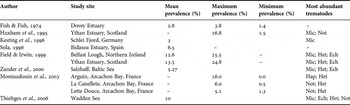
The prevalence pattern of trematodes in Hydrobia ulvae from the Mondego Estuary was relatively low compared to those seen in other estuaries (Fish & Fish, Reference Fish and Fish1974; Huxham et al., Reference Huxham, Raffaelli and Pike1995; Kesting et al., Reference Kesting, Gollasch and Zander1996; Sola, Reference Sola1996; Field & Irwin, Reference Field and Irwin1999; Zander et al., Reference Zander, Reimer, Barz, Dietel and Strohbach2000; de Montaudouin et al., Reference Montaudouin, de Blanchet, Kisielewski, Desclaux and Bachelet2003; Thieltges et al., Reference Thieltges, Krakau, Andresen, Fottner and Reise2006) (Table 2). Nevertheless, hundreds to thousands of infected mud snails occurred per square metre. The close contact between the first and second intermediate hosts of the trematodes is vital for their transmission, as is the presence, abundance and variety of their final hosts (Field & Irwin, Reference Field and Irwin1999; Esch et al., Reference Esch, Curtis and Barger2001; Fredensborg et al., Reference Fredensborg, Mouritsen and Poulin2006).
Prevalence data of previous studies of digenean trematodes in Hydrobia ulvae populations from other European localities; their most abundant trematode families (Mic, Microphallidae; Not, Notocotylidae; Het, Heterophyidae; Ech, Echinostomatidae; Hap, Haploporidae).

Adult H. ulvae were more abundant at the Zostera noltii bed, which supports a stable and well-structured mud snail population, with all age/size-classes represented (Lillebø et al., Reference Lillebø, Pardal and Marques1999; Cardoso et al., Reference Cardoso, Lillebø, Pardal, Ferreira and Marques2002, Reference Cardoso, Brandão, Pardal, Raffaelli and Marques2005). Under these circumstances, higher densities of infected gastropods were observed in this area, as well as a higher diversity of trematode species. Densities of infected mud snails in this area may also be explained by trematode eggs as well as miracidia (depending on the trematode species) being more protected among seagrasses, which diminishes the possibility of being washed away or killed than in the eutrophic area and therefore, increases the possibility of being found by the snail. The density of infected individuals did not show a seasonal or interannual pattern. It remained more or less constant, except for the summer of 1995. In this period, the density of infected H. ulvae at the seagrass bed reached maximum values, with a main contribution from microphallids. This observation occurred after the passage of migratory water birds at the end of spring. This also coincided with higher densities of the adult mud snails and the crustaceans that act as second intermediate hosts for these trematodes. Notwithstanding, this pattern was not related to the presence of birds in the system, even considering a time lag between the presence of birds in the Mondego Estuary and the increase of digeneans prevalence within the mud snail population. Shorebirds use this small estuary mainly as a wintering ground, however, there are also species using this system as a breeding site in summer (Charadrius alexandrinus, Himantopus himantopus, Calidris alpina, Tringa totanus and Numenius phaeopus) (Lopes et al., Reference Lopes, Cabral, Múrias, Pacheco, Marques, Pardal, Marques and Graça2002). The number of shorebirds that lingered in the estuary during summer was low. Only 200–300 birds, represented by adult specimens and young individuals of breeding species remained in the system. It may be expected that at least one of those species (that includes crustaceans as a main item of its diet) is responsible for the high abundance of microphallids.
Density of infected individuals was lower at the eutrophic area, since this location is mostly inhabited by juvenile mud snails (Lillebø et al., Reference Lillebø, Pardal and Marques1999; Cardoso et al., Reference Cardoso, Lillebø, Pardal, Ferreira and Marques2002, Reference Cardoso, Brandão, Pardal, Raffaelli and Marques2005). Trematodes are found within adult individuals, due to their mature gonads and their larger size. Adult H. ulvae not only provide more space for the parasites, but also offer more energetic resources (Graham, Reference Graham2003). Moreover, adults have lived longer, thus increasing the probabilities of encountering a parasite, as they have been interacting in an environment rich in other faunal organisms for a longer time. Exceptions to the low densities of infected individuals were verified in the period when green macroalgae developed in this site, due to the opportunistic character of this mud snail, which moves towards fresh sources of food and alternative habitats (Norkko et al., Reference Norkko, Bonsdorf and Norkko2000). During such periods, dispersion of H. ulvae occurred from the Z. noltii bed to the eutrophic area, as macroalgae constituted a new food, refuge and habitat resource (Lillebø et al., Reference Lillebø, Pardal and Marques1999; Cardoso et al., Reference Cardoso, Brandão, Pardal, Raffaelli and Marques2005). In the spring of 1993, it resulted in snail densities higher than those found at the seagrass bed (Lillebø et al., Reference Lillebø, Pardal and Marques1999; Cardoso et al., Reference Cardoso, Brandão, Pardal, Raffaelli and Marques2005), accordingly the abundance of infected H. ulvae increased as well during those same periods. However, the presence of an increasingly massive amount of macroalgae and its associated deleterious consequences (e.g. anoxic conditions) led to the decline in mud snail density prior to the algal crash, which was also reflected in the density of infected individuals.
In the Mondego Estuary, eutrophication seemed to have, in the short-term, a positive effect for the parasites. The presence of green macroalgae and its associated production led to an increased availability of potential hosts, which is in accordance with previous studies (Lafferty & Kuris, Reference Lafferty and Kuris1999; Zander et al., Reference Zander, Reimer, Barz, Dietel and Strohbach2000). Drifting algal mats may increase habitat heterogeneity on normally bare soft sediments (Norkko et al., Reference Norkko, Bonsdorf and Norkko2000), providing alternative habitats for a wide range of organisms, with resources and protection from predators. Yet, it is an ephemeral situation, not only because the algae eventually decompose, but also because they usually drift and are highly seasonal (Norkko et al., Reference Norkko, Bonsdorf and Norkko2000). On the other hand, as a result of eutrophication, the seagrass beds decreased gradually in the area covered during the study period. This process led to changes in the trophic structure and in the composition and productivity of the macrobenthic communities (Pardal et al., Reference Pardal, Cardoso, Sousa, Marques and Raffaelli2004; Dolbeth et al., Reference Dolbeth, Cardoso, Ferreira, Verdelhos, Raffaelli and Pardal2007). The Z. noltii beds are known to enhance species diversity, since their habitat complexity allows the occupation of diverse ecological niches (Blanchet et al., Reference Blanchet, de Montaudouin, Lucas and Chardy2004) and provides a stable environment for the faunal assemblages, not a temporary environment. In such a stable environment, with higher species richness (Dolbeth et al., Reference Dolbeth, Cardoso, Ferreira, Verdelhos, Raffaelli and Pardal2007), the parasite diversity and abundance are higher. In contrast, the eutrophic area being a disturbed site, with impoverished benthic community (Dolbeth et al., Reference Dolbeth, Cardoso, Ferreira, Verdelhos, Raffaelli and Pardal2007), has lower parasite diversity and lower abundance of infected individuals.
Climate instability may represent a threat by disrupting parasite networks. The winter of 1993/1994 was exceptionally rainy in the Mondego Estuary region. The increased input of the Pranto River led to flooding events and, consequently to an extensive opening of the sluices. Floods may have negative effects on the trematode infections, directly or indirectly, since no infected individuals were recorded at the eutrophic area until the end of the summer of 1994. Indirectly: due to the water currents that inhibited the establishment and growth of macroalgae (Martins et al., Reference Martins, Pardal, Lillebø, Flindt and Marques2001), which have consequences in the population dynamics of the mud snail that will not settle in this area. Directly: due to a possible dispersal of trematode eggs and the mud snails themselves by the strong water currents. In the Z. noltii bed, during the same period, water current consequences were not so drastic, since the presence of the seagrass usually protects benthic fauna and stabilizes the sediment (Short et al., Reference Short, Carruthers, Dennison and Waycott2007). Seagrass might have protected both the mud snails, cercariae and trematode eggs, from being washed away or killed. The salinity values were also very low, which could be detrimental to some digenean species (Huxham et al., Reference Huxham, Raffaelli and Pike1993; Mouritsen, Reference Mouritsen2002), which would also explain the low densities of infected individuals in the autumn/winter 1994/1995 at the eutrophic area.
Overall, the present study provides knowledge concerning digenean trematode fauna in mud snail populations, residing in distinct habitats within an estuary that has not only undergone anthropogenic change but also experienced climate instability. These continuous threats that coastal systems are subjected to may interfere in parasite–host interactions, and have shown to greatly influence infection patterns in the mud snail population. Facing the scenery of climate change, loss of biodiversity and environmental stress both of natural and anthropogenic origin, it is vital to understand disease dynamics and the ecological role of these parasites in all these processes.
ACKNOWLEDGEMENTS
The present work was supported by the FCT (Portuguese Science and Technology Foundation) through a PhD grant awarded to M.D. Bordalo (SFRH/BD/42320/2007). The authors are indebted to all colleagues that helped in the field and laboratory work.