1. Introduction
Fossils of Mesozoic terrestrial vertebrates have been previously unknown from Lithuania and the wider East Baltic region of Europe (Latvia, Estonia and Kaliningrad district of Russia). Therefore, although this region has produced rich records of Mesozoic sharks and invertebrates (e.g. Dalinkevičius, Reference Dalinkevičius1935; Karatajute-Talimaa & Katinas, Reference Karatajute-Talimaa, Katinas, Arratia and Tintori2004; Adnet, Cappetta & Mertiniene, Reference Adnet, Cappetta and Mertiniene2008; Salamon, Reference Salamon2008), nothing is known about those animals that inhabited terrestrial ecosystems in the East Baltic region during the Age of Dinosaurs. This is unfortunate, because the East Baltic region was located at a far northerly position during much of the Mesozoic, at palaeolatitudes (often greater than 40° N) where vertebrate fossils are rare. Any new specimens from these latitudes have great potential to provide novel insights into Mesozoic vertebrate biogeography and faunal evolution.
The lack of Mesozoic terrestrial fossils from the East Baltic region arises from the rarity of Mesozoic terrestrial sedimentary outcrops. A thick succession of Triassic terrestrial redbeds is present, albeit with limited surface exposure, in Lithuania and Latvia (Suveizdis, Reference Suveizdis1994; Šliaupa & Čyžienė, Reference Šliaupa and Čyžienė2000; Katinas & Nawrocki, Reference Katinas and Nawrocki2006). Although an economically important source of clay, these deposits are only briefly described in the literature and have yet to be extensively prospected for vertebrate fossils, even though lithologically similar redbeds in the Buntsandstein and Keuper of nearby Germany and Poland are often rich in fossils (e.g. Dzik, Reference Dzik2001; Dzik & Sulej, Reference Dzik and Sulej2007; Sues & Fraser, Reference Sues and Fraser2010). The discovery of vertebrate fossils in these units has the potential to reveal hitherto-unsampled faunas from the Triassic, a critical period in Earth history that witnessed the rise of dinosaurs and the recovery of ecosystems after the devastating Permo-Triassic extinction (e.g. Brusatte et al. Reference Brusatte, Nesbitt, Irmis, Butler, Benton and Norell2010b; Langer et al. Reference Langer, Ezcurra, Bittencourt and Novas2010; Sues & Fraser, Reference Sues and Fraser2010). Furthermore, fossils may help constrain the ages of the Lithuanian and Latvian units, which are currently dated as Early Triassic based on coarse lithological correlations to well-dated units in the Germanic Basin (Šliaupa & Čyžienė, Reference Šliaupa and Čyžienė2000; Katinas & Nawrocki, Reference Katinas and Nawrocki2006). As noted by Katinas & Nawrocki (Reference Katinas and Nawrocki2006, p. 53) in a recent overview of the East Baltic Triassic succession, palaeontological data has great potential to improve the dating and correlation of the Lithuanian and Latvian units, but is unfortunately ‘rather scarce and insufficiently studied’.
Here we describe the first records of Mesozoic terrestrial vertebrate fossils from Lithuania and the wider East Baltic region: two jaw fragments and three teeth of phytosaurs, a group of archosauriform reptiles, from the Triassic redbeds of the Šaltiškiai clay-pit of northwestern Lithuania (Figs 1–3). Aside from their novelty as the first terrestrial fossils from the Age of Dinosaurs in the East Baltic region, these specimens may represent the most northerly known members of the phytosaur clade, one of the most abundant and diverse terrestrial vertebrate clades of the Triassic, and prompt us to review phytosaur biogeography. Furthermore, the presence of phytosaurs, which are currently known only from the Upper Triassic, in redbeds previously assumed to be Early Triassic in age, demands a reassessment of the dating and correlations of the Lithuanian and Latvian units. We suggest that the phytosaur fossils help constrain the age of some of these deposits, and indicate that at least part of the Šaltiškiai clay-pit is Late Triassic (Carnian–Rhaetian) in age.
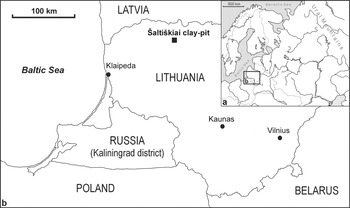
Location of the Šaltiškiai clay-pit, where the phytosaur fossils described herein were discovered, on a map of the East Baltic region of Europe.

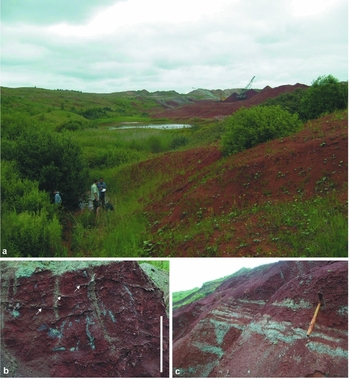
The Šaltiškiai clay-pit of northwestern Lithuania, where the phytosaur fossils described herein were discovered. (a) An overview photo of the northwestern part of the quarry, with geologists standing near where the fossils were discovered. (b, c) Close-up images of red clay with carbonate veins (white arrows) and green interlayers. Scale bar equals 50 cm; hammer is 42 cm long.

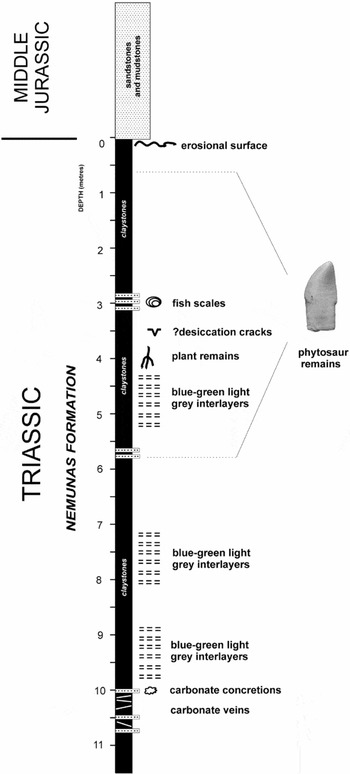
A stratigraphic profile of the Triassic Nemunas Formation and overlying Middle Jurassic clastic deposits at the Šaltiškiai clay-pit of northwestern Lithuania. As indicated, the phytosaur fossils described in this paper were found within the upper part of the Triassic succession in the quarry, although their exact provenance is uncertain because they were found as surface float.

2. Geological background
Terrestrial Triassic deposits crop out sporadically across northwestern Lithuania and are also present in subsurface boreholes and offshore under the Baltic Sea (Ūsaitytė, Reference Ūsaitytė2000). These deposits, most of which are redbeds, are part of a larger succession of latest Permian–Middle Jurassic terrestrial units that occur throughout the East Baltic area (Fig. 1; Lithuania, Latvia and Kaliningrad district of Russia). The Triassic deposits of the East Baltic are generally subdivided based on lithology, which has provided the justification for correlation to classic and well-dated Triassic sections in the Germanic Basin and the Permian–Triassic succession of the North Sea Basins (Paškevičius, Reference Paškevičius1997; Katinas & Nawrocki, Reference Katinas and Nawrocki2006). Most of the Triassic deposits in the East Baltic are considered to be Early–Middle Triassic in age based on such lithological correlations. They are subdivided into the Purmaliai (Induan) and Nadruva (Olenekian–Anisian) groups (Suveizdis, Reference Suveizdis1994; Šliaupa & Čyžienė, Reference Šliaupa and Čyžienė2000; Katinas & Nawrocki, Reference Katinas and Nawrocki2006). The Purmaliai Group consists of the Nemunas, Palanga and Tauragė formations, whereas the Nadruva Group comprises the Šarkuva and Deimė formations (Suveizdis, Reference Suveizdis1994). Together, these Lower–Middle Triassic units may reach a thickness of over 100 m (Šliaupa & Čyžienė, Reference Šliaupa and Čyžienė2000). Because they do not contain brackish or marine fossils, lack classic marine lithologies and preserve conchostracan fossils, it is likely that these units were deposited in freshwater lake or swamp-like environments. Younger Triassic rocks are rare in Lithuania, but a thin (~ 15 m) siltstone and claystone unit, the Nida Formation, is thought to be Late Triassic in age (Norian or Rhaetian; Paškevičius, Reference Paškevičius1997; Šliaupa & Čyžienė, Reference Šliaupa and Čyžienė2000).
Fossils are rare in the Triassic terrestrial deposits of Lithuania and are primarily known from borehole cores. These include bivalves, gastropods, fishes, ostracods, conchostracans and plants (Paškevičius, Reference Paškevičius1997; Karatajute-Talimaa & Katinas, Reference Karatajute-Talimaa, Katinas, Arratia and Tintori2004). Previous work has attempted to determine the age of the Lithuanian deposits by reference to palynomorphs, charophytes and conchostracans. In particular, the conchostracans Estherites gutta (Lutk.), E. aequale (Lutk.) and Estheria albertii (Voltz.) suggest that the majority of the Lithuanian succession is Early–Middle Triassic in age (see Kozur & Weems, Reference Kozur, Weems and Lucas2010). Unfortunately, other fossils such as ostracods, molluscs and fishes are poorly suited for biostratigraphy (Paškevičius, Reference Paškevičius1997). Therefore, there remains great doubt about the age of the Lithuanian units and their correlation to the Germanic Basin and the global Triassic time scale.
One of the most extensive and accessible exposures of the Lithuanian Triassic redbeds is a large and active quarry, the Šaltiškiai clay-pit, located in the Akmenė district of northwestern Lithuania, near the Latvian border (Fig. 1). Here, a thick profile of the Nemunas Formation is exposed, overlain by Middle Jurassic and Quaternary deposits (Figs 2, 3) (Mikaila, Reference Mikaila1971; Rajeckas & Saulėnas, Reference Rajeckas and Saulėnas1977; Satkūnas & Nicius, Reference Satkūnas, Nicius and Satkūnas2008). The Nemunas Formation, both here and elsewhere in Lithuania, is composed of reddish brown dolomitized clay with blue-green light grey interlayers (Šliaupa & Čyžienė, Reference Šliaupa and Čyžienė2000) (Fig. 2). Carbonate concretions and veins occur in the local section, especially its lowermost part (Fig. 2b). The Nemunas Formation in this part of Lithuania overlies Upper Permian limestones and dolomites, and the boundary between Permian and Triassic deposits is sharp and erosional. The upper boundary of the Nemunas Formation is also erosional, where it contacts Middle Jurassic clastic deposits (sandstones and mudstones). The Šaltiškiai clay-pit does not preserve lithologies characteristic of the lowest part of the Triassic section in Lithuania (interlayers of sandstone and conglomerate), so the base of the Nemunas Formation is likely not exposed in the quarry. It is also unclear if the Nemunas Formation continues upwards to contact the Jurassic clastic deposits in the quarry, or if there is another band of Triassic rock separating the two. If there is an intervening unit at the top of the Triassic succession, it has the characteristic lithology of Triassic redbeds and not the distinctive white to light grey silts and kaolinitic clays of the Upper Triassic Nida Formation (Šliaupa & Čyžienė, Reference Šliaupa and Čyžienė2000).
3. Systematic palaeontology
Institutional abbreviations. AkKM G – Akmenė Country Museum, Akmenė, Lithuania; BSPG – Bayerische Staatssammlung für Paläontologie und Geologie, Munich, Germany; NHMUK – Natural History Museum, London, United Kingdom; ZPAL – Institute of Paleobiology, Warsaw, Poland.
Subclass DIAPSIDA Osborn, Reference Osborn1903
ARCHOSAURIFORMES Gauthier, Kluge & Rowe, Reference Gauthier, Kluge and Rowe1988sensu Nesbitt, Reference Nesbitt2011
?ARCHOSAURIA Cope, Reference Cope1869sensu Gauthier, Reference Gauthier1986 (see Nesbitt, Reference Nesbitt2011)
PHYTOSAURIA Meyer, Reference Meyer1861sensu Sereno et al. Reference Sereno, McAllister and Brusatte2005
Phytosauria indet.
(Figures 4–6)
Specimens. AkKM G – 038, a premaxillary fragment; AkKM G – 039, a premaxillary fragment; AkKM G – 040, a right premaxillary tooth; AkKM G – 041, a left maxillary tooth; AkKM G – 042, a right maxillary tooth.
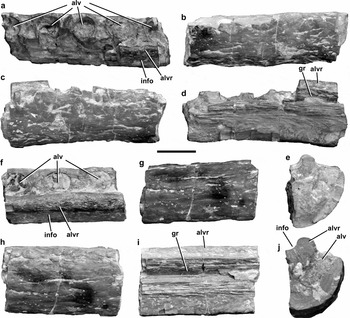
Photos of the two phytosaur premaxillary specimens found at the Šaltiškiai clay-pit of northwestern Lithuania. (a–e) AkKM G – 038 and (f–j) AkKM G – 039. Fragments are in ventral (a, f), dorsal (b, g), lateral (c, h), medial (d, i) and cross-sectional (either anterior or posterior) (e, j) views. Abbreviations: alv – alveoli; alvr – alveolar ridge; gr – groove on medial surface; info – interpremaxillary fossa. Scale bar equals 1 cm.

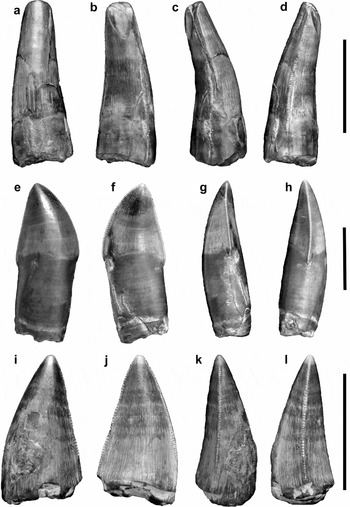
Photos of the three phytosaur teeth found at the Šaltiškiai clay-pit of northwestern Lithuania. (a–d) Premaxillary tooth AkKM G – 040, (e–h) more posterior maxillary tooth AkKM G – 041, (i–l) more anterior maxillary tooth AkKM G – 042 in labial (a, e, i), lingual (b, f, j), mesial (c, g, k) and distal (d, h, l) views. Scale bars equal 1 cm.

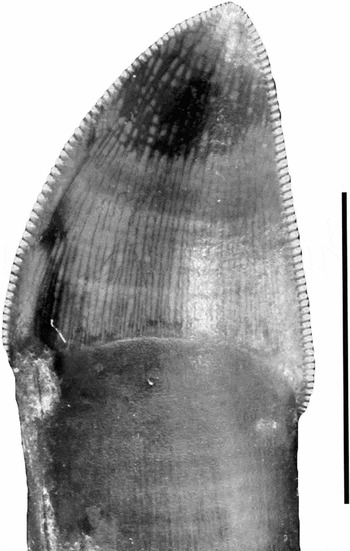
Close-up photo of the lingual surface of AkKM G – 041, the more posterior maxillary tooth of a phytosaur found at the Šaltiškiai clay-pit of northwestern Lithuania. Scale bar equals 1 cm.

Locality and horizon. All phytosaur specimens were found during three fieldtrips to the Šaltiškiai clay-pit in 2009–2010. They were discovered as surface float in a restricted area of the northwestern corner of the upper part of the clay-pit, near the main road vehicles use to enter the quarry (56° 10′ 10.00″ N, 22° 51′ 05.00″ E) (Figs 2a, 3). All specimens were encrusted with red clay similar to that of the upper part of the quarry. The Šaltiškiai clay-pit is located approximately 4 km ENE of the village of Papilė within the Akmenė district municipality of Šiauliai County (Šiauliųapskritis) in northwestern Lithuania (Fig. 1). The locality has been entered into The Paleobiology Database (http://paleodb.org), and is collection number 114996.
The Triassic redbeds exposed in the quarry are typically considered part of the Lower Triassic (Induan) Nemunas Formation (Mikaila, Reference Mikaila1971; Rajeckas & Saulėnas, Reference Rajeckas and Saulėnas1977), although it is possible that the upper part of the quarry may belong to another unit (see Section 5.b below). Because all of the phytosaur specimens come from the same small area of the quarry and are from the same region of the skeleton (cranium), and because there is no overlapping material among the specimens, we suspect that they belong to the same individual skull. The two premaxillary fragments are very similar in overall morphology and both belong to an uncrested phytosaur with irregular surface texture on the premaxilla (see Section 4.a below). Therefore, regardless of whether the teeth belong to the same individual or taxon as the premaxillary fragments, it seems likely that the two premaxillary specimens belong to the same taxon. It is also worth noting that no phytosaur or other vertebrate fossils have yet been recovered from the lower part of the quarry.
4. Description and comparisons
4.a. Premaxillae
Two jaw fragments (specimen numbers AkKM G – 038 and AkKM G – 039) are preserved, although no in situ teeth are present (Fig. 4). These fragments are both unambiguously referable to Phytosauria based on the possession of apomorphies of the clade, including the presence of distinct alveolar ridges and a broad fossa between these ridges (medial to the tooth row), and the inferred ‘tube-like’ morphology of the rostrum (Hungerbühler, Reference Hungerbühler2002; Stocker, Reference Stocker2010). Furthermore, the presence of the alveolar ridges and associated fossa identify these fragments as belonging to the premaxilla (the fossa is the interpremaxillary fossa of Hungerbühler, Reference Hungerbühler2000, equivalent to the ‘palatal ridges’ of Case & White, Reference Case and White1934). Distinct palatal ridges and an associated interpremaxillary fossa are absent from the dentary of phytosaurs (pers. obs. of basal phytosaur material from Krasiejów, Poland, ZPAL collections). It is not possible to determine if AkKM G – 038 and AkKM G – 039 are from the left or right sides of the skull, and thus it is also not possible to establish anterior and posterior orientations with certainty. The deep symphyseal surfaces and the dorsoventrally shallow groove present medially on both fragments suggest that they are from the anterior part of the premaxilla (pers. obs. of basal phytosaur material from Krasiejów, Poland, ZPAL collections).
AkKM G – 038 is 42 mm in length, is straight in dorsal and ventral views, and contains three complete and two partial alveoli. At its deeper end AkKM G – 038 is 17 mm in dorsoventral depth (medially) and 13 mm in mediolateral width (ventrally). At its shallower end AkKM G – 038 is 15 mm deep and 13 mm wide, although it is broken at its dorsal and ventral margins. The lateral surface is strongly convex and has an irregularly undulated texture superimposed upon which are a random array of grooves, pits and subtle rugosities. The central three alveoli are complete (although the medial rims of two of these are broken away) and are approximately equal in size: 6 mm in mesiodistal length and 5 mm in labiolingual width. The alveoli are defined by low raised rims that give the lateral surface of the premaxilla a slightly scalloped outline in ventral view. The spacing between alveoli is between 2 and 4 mm. Cross-sections show that the alveoli are deep and extend to the dorsal midline of the element, curving medially along their length. Medial to the alveoli is a 3 mm wide alveolar ridge, the ventral margin of which is just visible in lateral view. Medial to the alveolar ridge is the dorsally arched interpremaxillary fossa, which is 3 mm wide on AkKM G – 038 (such that the complete interpremaxillary fossa formed by both premaxillae would have been ~ 6 mm wide).
On the medial surface of AkKM G – 038 there is a 14–15 mm deep symphyseal surface for articulation with the opposing premaxilla. This surface is mostly flat, but is raised into a low ridge at its ventral margin. Anteroposteriorly extending lineations are concentrated on the ventral half of this symphyseal surface; dorsally, the symphyseal surface is less distinctly ornamented. A shallow anteroposteriorly extending groove (1 mm in dorsoventral height) is present on the ventral half of this symphyseal surface. This represents the anterior extension of the pneumatic paranasal sinus commonly present in the rostrum of phytosaurs (e.g. Witmer, Reference Witmer1997).
The second specimen, AkKM G – 039, is 31 mm in length, is straight in dorsal and ventral views, and contains three complete alveoli. There is little change in depth along its length: it is 16–17 mm in dorsoventral height (medially) and 13 mm in mediolateral width (ventrally). The groove on the medial symphyseal surface is slightly deeper dorsoventrally (2–3 mm) than in AkKM G – 038, suggesting that AkKM G – 039 is from a slightly more posterior part of the premaxilla (pers. obs. of Krasiejów phytosaur material, ZPAL collections). Moreover, the texture of the lateral surface of AkKM G – 039 is slightly different from that of AkKM G – 038: it is smoother with fewer rugosities and several anteroposteriorly extending lineations, probably also reflecting a more posterior position in the premaxilla.
The three alveoli of AkKM G – 039 are approximately equal in size: 6 mm in mesiodistal length and 5 mm in labiolingual width. Unlike the more anterior placed fragment (AkKM G – 038), the alveoli are not defined by raised rims, although the lateral surface of AkKM G – 039 still has a slightly scalloped outline in ventral view. Spacing between adjacent alveoli is about 4 mm. The alveolar ridge is 4 mm wide and borders the 3 mm wide, dorsally arched, interpremaxillary fossa. Medially, there is a 14 mm deep and flat symphyseal surface. Anteroposteriorly extending lineations are concentrated on the ventral half of this symphyseal surface.
4.b. Premaxillary tooth
The single tooth AkKM G – 040 is identified as a right tooth from the middle part of the premaxillary tooth row, using the detailed description of phytosaur dentition presented by Hungerbühler (Reference Hungerbühler2000) as a guide (Fig. 5a–d). Only the crown is preserved (the root is absent). The distal tip of the crown is broken and represented by a triangular wear surface, which is 3 mm tall apicobasally and tapers in width as it continues basally. Similar spalled surfaces have been described in carnivorous dinosaurs by Schubert & Ungar (Reference Schubert and Ungar2005) and in large crocodylomorphs by Young et al. (Reference Young, Brusatte, Beatty, Andrade and Desojo2012), and are interpreted as being formed by enamel flaking during life, probably as the result of tooth-on-food contact. The preserved portion of the crown is 17 mm in apicobasal length. In cross-section, the basal end is circular with a diameter of 6 mm, whereas at the apical broken surface the tooth is 3 mm in mesiodistal length by 2 mm in labiolingual width. The crown is recurved both distally and lingually. The distal curvature is slight; the distal surface is gently concave in labial and lingual views, whereas the mesial surface is correspondingly convex. The lingual curvature is more pronounced than the distal curvature; in mesial and distal views the lingual margin is strongly concave and the labial margin markedly convex. As a result, the apical tip of the crown is deflected lingually past the lingual margin of the crown base.
Serrated mesial and distal carinae are present. The distal carina is present across nearly the entire length of the crown: it begins approximately 1.5 mm from the basal edge of the crown and continues apically to the spalled margin. The mesial carina, on the other hand, extends for approximately half of the crown height. In cross-section the two carinae are placed in approximately symmetrical positions. In mesial and distal views both carinae are deflected somewhat lingually, so that they lie closer to the lingual edge of the crown than the labial edge. Both carinae curve in concert with the strongly lingual recurvature of the tooth itself. The distal carina is serrated along its entire length and possesses approximately 11 denticles per millimetre at its midpoint. The mesial carina, in contrast, is damaged towards its basal end, so it is difficult to be certain whether it is serrated here. It is clearly serrated along its apical half, but these serrations are tiny and indistinct, and resemble subtle scallops instead of the discrete chisel-shaped denticles of the distal carina (see Andrade et al. Reference Andrade, Young, Desojo and Brusatte2010 for similar denticle types in marine crocodylomorphs). Therefore, measurements of individual denticles or denticle densities are difficult on the mesial carina.
The external surface of the crown enamel is marked by faint apicobasal striations and colour banding on both labial and lingual surfaces. The striations are strongest (i.e. most offset laterally from the remainder of the enamel) basally and decrease in relief apically. The colour banding is faint. Superimposed on the banding are subtle transverse enamel wrinkles (sensu Brusatte et al. Reference Brusatte, Benson, Carr, Williamson and Sereno2007), which are common features in the recurved teeth of predatory groups such as theropod dinosaurs and marine crocodylomorphs (Brusatte et al. Reference Brusatte, Benson, Carr, Williamson and Sereno2007; Andrade et al. Reference Andrade, Young, Desojo and Brusatte2010), but have yet to be described in a phytosaur. The wrinkles are present across the mesiodistal width of the crown, extending from the mesial carina to the distal carina and sweeping apically, on both labial and lingual surfaces.
This tooth is identified as a middle premaxillary tooth based on comparison to the well-described dentition of Nicrosaurus (Hungerbühler, Reference Hungerbühler2000). In mesial and distal views the tooth is strongly recurved lingually, as is the case in the middle premaxillary teeth of Nicrosaurus (in contrast, anterior and posterior premaxillary teeth, all maxillary teeth and dentary teeth are straight or only subtly recurved lingually). Furthermore, the basal cross-section of the Lithuanian tooth is circular and the apical cross-section is only slightly flattened lingually, with bilaterally symmetrical carinae. A similar morphology characterizes the middle premaxillary teeth (teeth 8–14) of Nicrosaurus, whereas the dentary teeth are flattened lingually, the anterior premaxillary teeth have an ovoid apical cross-section (without pronounced carinae), the posterior premaxillary teeth have a flatter lingual surface (and thus an asymmetrical basal cross-section) and the maxillary teeth have ovoid basal cross-sections, a flatter lingual surface and strong asymmetry of the carinae.
The carinal morphology of the Lithuanian tooth also supports its identification as a middle premaxillary crown. In the anterior premaxillary teeth of Nicrosaurus the mesial carina is absent, but in the middle of the tooth row the carina appears and rapidly increases in length such that by teeth 14–16 it covers the entire length of the crown. As the Lithuanian tooth possesses a mesial carina that is approximately one half of the crown height, this is consistent with a position in the middle of the premaxillary tooth row. Yet further, the Lithuanian tooth possesses a distal carina that extends nearly, but not entirely, across the entire crown length. In Nicrosaurus, anterior premaxillary teeth have a very small carina but posterior teeth possess a carina that extends along the entire crown. Finally, the Lithuanian tooth possesses no discrete flanges (sensu Hungerbühler, Reference Hungerbühler2000) on the mesial and distal edges of the crown. This is true of premaxillary teeth 5–12 in Nicrosaurus, whereas more posterior teeth and most maxillary teeth have such flanges.
In summary, the morphology of the Lithuanian tooth is most similar to the middle premaxillary teeth of Nicrosaurus, especially teeth 8–13. Hungerbühler (Reference Hungerbühler2000) did not figure premaxillary teeth 8–13 in Nicrosaurus, but his figure of tooth 14 (fig. 8) exhibits a generally similar morphology to that of the Lithuanian tooth. The resemblance is not exact, however, as in tooth 14 of Nicrosaurus subtle flanges are present and both carinae extend along the entire apicobasal length of the crown.
4.c. Maxillary teeth
The teeth AkKM G – 041 and AkKM G – 042 are identified as maxillary teeth, using Hungerbühler's (Reference Hungerbühler2000) description as a guide (Figs 5, 6). AkKM G – 042, a right tooth, is from a more anterior position in the tooth row than AkKM G – 041, a left tooth (see below). Both teeth are diagnostically phytosaurian because they possess flanges on the mesial and distal edges of the crown, a unique feature of the group, and because they lack labiolingual compression (i.e. the labial surface is convex and the lingual surface flattened), which is unusual among ziphodont archosauromorphs (Hungerbühler, Reference Hungerbühler2000). This latter feature also demonstrates that the AkKM G – 040 premaxillary tooth, if found in isolation, could be referred to Phytosauria based on a diagnostic character.
The more anterior crown, AkKM G – 042, is broken at or near the junction between the crown and the root (Fig. 5i–l). The preserved portion of the crown is 13.1 mm in apicobasal length and the broken basal cross-section is 7.1 mm long mesiodistally by 5.5 mm wide labiolingually. The tooth is recurved both distally and lingually. In labial and lingual views, the mesial surface is highly convex and the distal surface essentially straight, resulting in the distally recurved profile. In mesial and distal views, the labial surface is more highly convex than the concave lingual surface, resulting in the lingually recurved profile.
Serrated mesial and distal carinae are present. The distal carina is positioned along the centre of the distal surface across its entire length, whereas the medial carina is offset lingually near the crown base but sweeps labially as it continues towards the apex, eventually becoming centred a few millimetres before the apex. Denticles are present along the entire length of the distal carina and extend to the crown apex. On the mesial carina, however, there are short regions both basally (2 mm) and apically (0.25 mm) that lack denticles. The non-denticulated region near the apex is slightly worn, so it is possible that small denticles were present but have since been eroded. If not, then there was a true gap and denticles from both carinae are not continuous across the crown tip. There are approximately four denticles per millimetre at the centre of both carinae, and individual denticles are chisel-shaped with straight or subtly convex mesial and distal edges.
There are short interdenticular sulci (‘blood grooves’ of Currie, Rigby & Sloan, Reference Currie, Rigby, Sloan, Carpenter and Currie1990) between individual denticles that continue a short distance onto the labial and lingual surfaces of the crown. These are common features of theropod dinosaurs (Currie, Rigby & Sloan, Reference Currie, Rigby, Sloan, Carpenter and Currie1990; Benson, Reference Benson2010) and their presence in the Lithuanian teeth suggests that they may be present in carnivorous archosaurs generally. However, the sulci in AkKM G – 042 (and AkKM G – 041, see below) are not as deep, elongate and distinct as those in large tyrannosaurids and other theropods (Currie, Rigby & Sloan, Reference Currie, Rigby, Sloan, Carpenter and Currie1990). Furthermore, the colour banding and subtle surficial enamel wrinkles described on the premaxillary tooth (see Section 4.b) are also present on AkKM G – 042.
The more posterior tooth, AkKM G – 041, is similar in overall morphology to AkKM G – 042, but is larger, more complete (both the crown and root are present) and better preserved (Figs 5e–h, 6). The crown is 13 mm tall apicobasally and the preserved portion of the root is 12 mm tall. There is a constriction between the crown and root in labial and lingual views; the crown is 10 mm wide mesiodistally and the root 8.5 mm wide where they meet. Both crown and root are 6 mm in labiolingual thickness at their junction, and there is not a constriction between them in mesial and distal views. The root remains approximately 6 mm in thickness across its entire apicobasal length, whereas the crown tapers in thickness apically. In labial and lingual views, the mesial surface of the crown is highly convex and the distal surface essentially straight, giving the tooth a recurved profile. In mesial and distal views, the labial surface is more highly convex than the subtly concave lingual surface.
Serrated carinae are present on the mesial and distal surfaces. As in AkKM G – 042, the distal carina is positioned near the centre of the distal surface whereas the mesial carina is deflected lingually near the base of the crown and then curves labially as it continues towards the apex. Both carinae begin at approximately the crown–root junction basally and extend apically until their denticles become continuous over the crown apex. There are approximately seven denticles per millimetre at the centre of both carinae, but the denticles get smaller near the apex, such that there are approximately ten per millimetre in this region. The apex itself is essentially an enlarged denticle, of more than twice the size of the small mesial and distal denticles that converge here. The denticles are chisel-shaped, there are short interdenticular sulci and there are distinct colour bands and subtle enamel wrinkles on the crown surface, as in AkKM G – 042.
Both AkKM G – 041 and AkKM G – 042 are identified as maxillary teeth, and because they are similar in size and morphology, and were discovered near each other in the quarry, they likely belonging to a single individual. Both teeth exhibit one of Hungerbühler's (Reference Hungerbühler2000) characteristic features of the maxillary teeth of Nicrosaurus: a basally flat lingual surface.
Furthermore, both teeth are identified as middle-posterior maxillary teeth by comparison to Nicrosaurus, based on the following features (Hungerbühler, Reference Hungerbühler2000). First, the anterior maxillary teeth of Nicrosaurus are proportionally similar to the tall and thin premaxillary teeth, whereas the two Lithuanian teeth have shorter and thicker crowns. Second, both mesial and distal carinae are present along nearly the entire length of the crown in the Lithuanian teeth. In Nicrosaurus all maxillary teeth posterior to (and including) tooth 9 possess complete carinae, whereas more anterior maxillary teeth have shorter or absent carinae. Third, in the Lithuanian teeth the crown outlines are essentially triangular in shape owing to the presence of strong flanges on both mesial and distal edges, the distal edges of the crowns are straight and the convex labial surfaces are more convex mesially and distally, all of which are characteristic of the middle-posterior maxillary teeth of Nicrosaurus. Finally, in the more complete AkKM G – 041 tooth, the moderately recurved tip extends slightly distally relative to the distal margin of the root and there is a marked constriction between the crown and root, both of which are characteristic of the posterior maxillary teeth of Nicrosaurus. Many of these features are summarized in Hungerbühler's (Reference Hungerbühler2000) figure 16.
The AkKM G – 041 tooth is identified as a more posterior maxillary tooth than the AkKM G – 042 tooth based on several features reviewed by Hungerbühler (Reference Hungerbühler2000). First, the AkKM G – 041 tooth is more triangular, owing to a greater ratio of mesiodistal length to labiolingual width and also of mesiodistal length to crown height, and the flanges on the mesial and distal margins are better developed. Second, AkKM G – 041 is longer mesiodistally than AkKM G – 042. Assuming that they come from the same individual with a dental morphology similar to Nicrosaurus, AkKM G – 041 would be more posterior than AkKM G – 042 because there is a general increase in mesiodistal length posteriorly along the maxillary tooth row in Nicrosaurus. Finally, in Nicrosaurus the lingual side becomes progressively flatter posteriorly, and AkKM G – 041 has a flatter lingual surface than AkKM G – 042.
Although the two Lithuanian maxillary teeth are strongly similar to the teeth of Nicrosaurus in overall morphology, there is one conspicuous difference. In the Lithuanian teeth, the mesial and distal flanges are essentially continuous with the crown, such that the entire labial and lingual surfaces of both teeth are smooth. In Nicrosaurus, by contrast, there is an apicobasally oriented concave furrow that separates the flanges from the centre of the tooth on both the labial and lingual surfaces (Hungerbühler, Reference Hungerbühler2000).
5. Discussion
5.a. Systematic position of the Lithuanian specimens
Both of the premaxillary fragments and all three teeth possess apomorphies of Phytosauria, as discussed in Section 4 (see also Hungerbühler, Reference Hungerbühler2000, Reference Hungerbühler2002; Stocker, Reference Stocker2010). Determining the phylogenetic position of the Lithuanian material within Phytosauria, however, is extremely difficult. Little is known about the systematic utility of phytosaur teeth, as detailed studies of the dentition have only been published for a single taxon (Nicrosaurus: Hungerbühler, Reference Hungerbühler2000). The morphology of the premaxillary fragments may be more helpful (Fig. 4).
The Lithuanian premaxillae are low, slender and tube-like, and show no signs of the development of a ‘rostral crest’ (see discussion in Stocker, Reference Stocker2010, supplementary material). This distinguishes them from taxa such as Smilosuchus gregorii, Nicrosaurus kapffi, Pseudopalatus mccauleyi and Leptosuchus spp., in which a rostral crest is present and the premaxillae are proportionally deep dorsoventrally (Stocker, Reference Stocker2010: character 18). Furthermore, the relatively broad interpremaxillary fossae of the Lithuanian specimens distinguish them from Mystriosuchus, and perhaps other taxa. Hungerbühler (Reference Hungerbühler2002, p. 405) proposed the slit-like interpremaxillary fossa as an autapomorphy of Mystriosuchus, but confusingly scored it as present in all pseudopalatine phytosaurs in his accompanying phylogenetic data matrix (Hungerbühler, Reference Hungerbühler2002, p. 418: character 43), a scoring that was followed by Stocker (Reference Stocker2010: character 8). A relatively broad interpremaxillary fossa is certainly retained in one pseudopalatine, Nicrosaurus kapfii (e.g. NHMUK 42743), but whether it is truly present in other members of the group requires clarification from future study. Therefore, the broad interpremaxillary fossa of the Lithuanian specimens can only be used to distinguish them from Mystriosuchus at present, pending a review of this character.
In summary, the morphology of the Lithuanian premaxillae is most closely similar to uncrested non-pseudopalatine phytosaurs such as Paleorhinus (e.g. Lees, Reference Lees1907; Stocker, Reference Stocker2010), Parasuchus (Chatterjee, Reference Chatterjee1978) and Rutiodon (Doyle & Sues, Reference Doyle and Sues1995), as well as some pseudopalatines such as Pseudopalatus pristinus (Mehl, Reference Mehl1928) and Nicrosaurus meyeri (Hungerbühler & Hunt, Reference Hungerbühler and Hunt2000).
5.b. Implications for the age of the Lithuanian Triassic units
The discovery of phytosaur fossils in the Triassic redbeds of Lithuania is not unexpected, as these archosauriforms were common elements of global terrestrial faunas during the Late Triassic period (Carnian–Rhaetian) and are frequently discovered in lithologically similar redbeds in the nearby Germanic and Central European basins of Poland and Germany (e.g. Gregory & Westphal, Reference Gregory and Westphal1969; Buffetaut, Reference Buffetaut, Mazin and Pinna1993; Dzik, Reference Dzik2001; Hungerbühler, Reference Hungerbühler2002). What is unusual, however, is the discovery of phytosaur fossils in redbeds that are thought to belong to the Lower Triassic (Induan) Nemunas Formation. Although phytosaurs are some of the most abundant terrestrial vertebrate fossils in Upper Triassic units, there are no confirmed phytosaur fossils from pre-Carnian deposits (Sereno, Reference Sereno1991; Brusatte et al. Reference Brusatte, Nesbitt, Irmis, Butler, Benton and Norell2010a; Stocker, Reference Stocker2010; Nesbitt, Reference Nesbitt2011). Therefore, the discovery of phytosaurs in the Šaltiškiai clay-pit requires at least one of four explanations.
First, it may be that the age identification of the Šaltiškiai deposits is correct, meaning that phytosaurs are older than their currently known fossil record. If this is the case, then the Lithuanian specimens would be the oldest phytosaurs in the global fossil record. Indeed, because phytosaurs are basal members of clades that include Early Triassic taxa (Archosauriformes or Archosauria), phylogenetic ghost ranges predict that they must have arisen prior to the Carnian but are absent from a biased Early–Middle Triassic fossil record (Brusatte et al. Reference Brusatte, Nesbitt, Irmis, Butler, Benton and Norell2010a; Butler et al. Reference Butler, Brusatte, Reich, Nesbitt, Schoch and Hornung2011; Nesbitt, Reference Nesbitt2011). The Lithuanian material may represent the long-awaited first discovery of Early–Middle Triassic phytosaurs. We find this unlikely, however, because hundreds of years of palaeontological exploration in Lower–Middle Triassic rocks in Europe and elsewhere has failed to document unequivocal phytosaur fossils with apomorphies of the clade. With the necessity of an Early–Middle Triassic phytosaur ghost lineage in mind, we suspect that phytosaurs were either remarkably rare in Early–Middle Triassic time, perhaps restricted to particular areas or environments, or that they had yet to develop their most salient anatomical features, making identification of fossils difficult. The Lithuanian fossils possess several characters seen in all known phytosaurs, such as the elongate rostrum with alveolar ridges on the premaxilla, and clearly did not belong to primitive species on the evolutionary lineage towards phytosaurs that had yet to develop the major features of the clade.
Second, it is possible that the thick redbed profile of the Šaltiškiai clay-pit does not belong to the Nemunas Formation as has long been regarded (Mikaila, Reference Mikaila1971; Rajeckas & Saulėnas, Reference Rajeckas and Saulėnas1977), but perhaps to a younger Triassic unit. We also find this unlikely, as the Šaltiškiai clay-pit is one of the most economically important mining sites in Lithuania (Satkūnas, Reference Satkūnas2009) and has been the subject of extensive geological mapping dating back several decades to Soviet times (Mikaila, Reference Mikaila1971; Rajeckas & Saulėnas, Reference Rajeckas and Saulėnas1977; Šliaupa & Čyžienė, Reference Šliaupa and Čyžienė2000).
Third, it is possible that all or some of the Nemunas Formation is not truly Early Triassic in age, but is rather younger, most likely Late Triassic. Because the Nemunas Formation is the stratigraphically lowest of the Lithuanian Triassic units, this would necessitate a younger age for the remainder of the Purmaliai and Nadruva groups as well. The age assessment of the Nemunas Formation and overlying Triassic units is based mostly on lithological correlation to units in the Germanic Basin, particularly the Calvorde and Bernburg formations (Suveizdis, Reference Suveizdis1994; Šliaupa & Čyžienė, Reference Šliaupa and Čyžienė2000; Katinas & Nawrocki, Reference Katinas and Nawrocki2006), as well as some limited data from conchostracan biostratigraphy (Kozur & Weems, Reference Kozur, Weems and Lucas2010). More dependable and persuasive age indicators, such as radioisotopic dating, palynomorph biostratigraphy and palaeomagnetic correlation, have yet to be applied to the Lithuanian units and may never be possible owing to the rarity of fossils and the absence of interbedded igneous deposits. Therefore, we consider it a reasonable possibility that the stated Early Triassic age of the Nemunas Formation in northwestern Lithuania (and other Lithuanian redbeds) is incorrect.
Fourth, and finally, it is possible that most of the Šaltiškiai clay-pit is comprised of the Nemunas Formation, which is correctly dated as Early Triassic, but the phytosaur fossils come from a small sliver of Upper Triassic rock at the top of the quarry, between the Nemunas Formation and the overlying Middle Jurassic clastic deposits. If this is the case, then this thin band of Upper Triassic rock may belong to the Nida Formation or a lateral equivalent. We note, however, that the uppermost redbeds in the Šaltiškiai clay-pit do not match the characteristic lithology of the Nida Formation, which is comprised of white to light grey silts and kaolinitic clays (Ūsaitytė, Reference Ūsaitytė2000). Therefore, if this explanation is correct, it may suggest that a previously unrecognized Upper Triassic unit is present in northwestern Lithuania. We consider this a likely explanation.
In summary, the presence of unequivocal phytosaur fossils in supposed Lower Triassic rocks is unexpected and demands an explanation. We consider the third possibility (that the Nemunas Formation in northwestern Lithuania is incorrectly dated) and fourth possibility (that the phytosaur fossils derive from a narrow band of Upper Triassic rocks capping the Nemunas Formation in the Šaltiškiai clay-pit) to be the two most likely scenarios. The discovery of phytosaur fossils in the Šaltiškiai quarry will hopefully spur additional geological research (mapping, biostratigraphy, correlations) on the Lithuanian Triassic succession.
5.c. Phytosaur biogeography: a review
Assuming a Late Triassic age for the bone-bearing unit at the Šaltiškiai clay-pit, the phytosaurs described here lived at palaeolatitudes of approximately 40–45° N (estimated using The Paleobiology Database (PBDB)). This represents one of the most northerly occurrences of phytosaurs, approximately 10° further north than well-known phytosaur localities in southwestern Germany and Poland, and as much as 40° further north than classic phytosaur localities in the southwestern USA. The only other possible report of phytosaurs from greater than 40° N is a report of undescribed and highly incomplete remains tentatively identified as referable to Phytosauria (albeit, not on the basis of synapomorphies) from the Østed Dal Member of the Fleming Fjord Formation (Late Triassic: middle Norian) of Greenland (Jenkins et al. Reference Jenkins, Shubin, Amaral, Gatesy, Schaff, Clemmensen, Downs, Davidson, Bonde and Osbaeck1994), which would have been at a palaeolatitude of approximately 45–50° N. The northerly occurrence of the Lithuanian phytosaur prompts us to briefly review the palaeogeographical and palaeolatitudinal distribution of this clade during the Late Triassic period. Most of the following discussion is based upon data within the PBDB, largely entered by one of us (RJB).
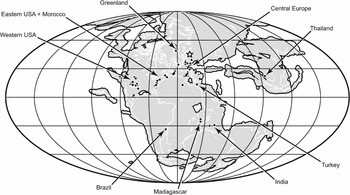
Phytosaurs were abundant components of Late Triassic terrestrial ecosystems (the PBDB contained 371 occurrences of the group as of 26 August 2011), but this abundance was unevenly distributed across the Pangaean supercontinent. The vast majority of the known specimens of phytosaurs have been collected from classic Upper Triassic strata in the southwestern and western USA (Arizona, New Mexico, Texas, Utah, Wyoming), ranging through palaeolatitudes of 0–20° N (e.g. Lees, Reference Lees1907; Long & Murray, Reference Long and Murry1995; Stocker, Reference Stocker2010). Strata of the Newark Supergroup of the eastern USA and Canada have also yielded phytosaur remains, although less abundantly, ranging from approximately 0–20° N, from North Carolina to Nova Scotia (e.g. Doyle & Sues, Reference Doyle and Sues1995). Well-preserved phytosaur material from Morocco (e.g. Dutuit, Reference Dutuit1977a,b) occurred at similar palaeolatitudes to that from the USA (~ 15–20° N), as did highly fragmentary phytosaur material from Turkey (~ 15° N; Buffetaut, Martin & Monod, Reference Buffetaut, Martin and Monod1988) and Thailand (~ 20° N; e.g. Buffetaut & Ingavat, Reference Buffetaut and Ingavat1982).
The other major geographic area for phytosaur discoveries has been the Upper Triassic of the Germanic Basin of central Europe, particularly southern Germany and Poland. Classic localities within Bavaria and Baden-Württemburg (southern Germany) and the Krasiejów locality of southern Poland range from around 30–35° N (e.g. Hungerbühler, Reference Hungerbühler2000, Reference Hungerbühler2002; Hungerbühler & Hunt, Reference Hungerbühler and Hunt2000; Dzik, Reference Dzik2001). Phytosaur remains from surrounding areas of western Europe (i.e. those from northern Italy, Austria, Switzerland, France, the UK and Luxembourg) fall within approximately the same palaeolatitudinal range as those of southern Germany and Poland.
Phytosaur remains are scarce within the Triassic Southern Hemisphere, and are only known from three countries. Rare and undiagnostic material has been collected from the Upper Triassic of Madagascar (~ 25° S; e.g. Dutuit, Reference Dutuit1978) and both basal and (undescribed) derived phytosaur material is known from the Upper Triassic of India (~ 30–35° S; e.g. Chatterjee, Reference Chatterjee1978). Just a single specimen is known from the well-sampled Upper Triassic of Brazil (~ 35° S; Kischlat & Lucas, Reference Kischlat and Lucas2003), and phytosaurs remain completely unknown from the well-sampled Upper Triassic deposits of South Africa and Argentina.
As shown in Figure 7, phytosaurs are therefore distributed across essentially all of the regions of the Triassic Northern Hemisphere that have been sampled to date, ranging through nearly 45° of palaeolatitude. This minimum palaeolatitudinal range is moderately broader than that of modern crocodilians, often used as a model for phytosaurs, which extend to approximately 30° N and S (Markwick, Reference Markwick1998). Phytosaurs may have extended in distribution to even higher palaeolatitudes, but this remains uncertain owing to incomplete sampling. Within the Triassic Southern Hemisphere, most phytosaur occurrences are along the eastern margins of Pangaea, along the margins of the Tethys Ocean, with only one specimen known from the southwestern part of Pangaea (Fig. 7). This distribution cannot be explained by simple palaeolatitudinal variation in diversity. Shubin & Sues (Reference Shubin and Sues1991) suggested that phytosaurs were restricted to tropical regions (i.e. between 30° N and 30° S), but the currently known distribution exceeds this range and, moreover, the only well-sampled Late Triassic fossil assemblages from higher latitudes (> 45° N or S) that lack phytosaurs are those from Argentina and southern Africa. The absence of phytosaurs in these areas may reflect climatic conditions of southwestern Pangaea, rather than a global palaeolatitudinal signal.
Global distribution of phytosaur localities reconstructed on a 210 Ma palaeomap using the built-in tools of The Paleobiology Database. Occurrence of a phytosaur in the Upper Triassic of Lithuania is marked with a star.

Notably, the palaeobiogeographical distribution of phytosaurs coincides closely with the distribution of the ‘summerwet’ biome (seasonal conditions with a humid summer and dry winter, i.e. monsoonal) as reconstructed by climatic modelling (e.g. Sellwood & Valdes, Reference Sellwood and Valdes2006, fig. 2), whereas southwestern Pangaea is reconstructed as arid (i.e. dry throughout the year). It remains uncertain whether phytosaurs were present in the high latitudes, which are reconstructed as wet and warm (Preto, Kustatscher & Wignall, Reference Preto, Kustatscher and Wignall2010). Thus, as suggested by Buffetaut (Reference Buffetaut, Mazin and Pinna1993), the distribution of phytosaurs (which approximately coincides with that of metoposaurid temnospondyls, which were also aquatic) may have been the result of climate-driven palaeoenvironmental variation, with the group being largely excluded from arid desert areas. The presence of a phytosaur in Brazil, reconstructed as an arid environment (Sellwood & Valdes, Reference Sellwood and Valdes2006) may reflect localized variation in climatic conditions.
Acknowledgements
We thank O. Rauhut (BSPG) and P. Barrett (NHMUK) for access to specimens in their care and B. Kear and an anonymous reviewer for their helpful comments that improved this paper. SLB is supported by an NSF Graduate Research Fellowship and his work in Poland and Lithuania was supported by the American Museum of Natural History, the Paleontological Society Kenneth E. and Annie Caster Student Research Award, and the Chevron Student Initiative Fund at Columbia University. SLB and RJB's work in Poland was supported by the Percy Sladen Memorial Fund (administered by the Linnean Society). RJB was funded during this research by an Alexander von Humboldt Foundation research fellowship and the DFG Emmy Noether Programme (BU 2587/3-1). Fieldwork by GN and TS was supported by a research grant from National Geographic Polska. We are thankful to Piotr Szrek, Marian Dziewiński and Artur Niedźwiedzki for their help during fieldwork in 2009 and 2010.