

“[T]here have been multiple attempts over the years to address the [drug shortage] problem, and clearly the approaches that have been implemented have not been successful in keeping the overall number down.”
— Michael Ganio, Pharm.D., American Society of Health-System Pharmacists (2024)Footnote 1
I. Introduction
Over the past three decades, the United States health care system has experienced numerous shortages of commonly used older medicines that are both off-patent and inexpensive, raising questions about the causes of inadequate supply and how to best address them. Recognizing the problem, Congress in 1997 required manufacturers of life-sustaining and other important drugs to notify the United States Food and Drug Administration (FDA) at least six months in advance of product discontinuation,Footnote 2 but shortages continued to worsen, reaching record levels in the late 2000s.Footnote 3 In 2012, Congress enacted several additional provisions to mitigate drug shortages as part of the FDA Safety and Innovation Act,Footnote 4 including expedited inspections of manufacturing facilities, annual reporting of shortages to Congress, increased funding to accelerate generic drug review, and the creation of a Drug Shortage Task Force, yet critical shortages continued to emerge at rates that exceeded those of the early 2000s.Footnote 5
Over the years, commentators seeking to explain drug shortages have identified a range of causes, including manufacturing quality, insufficient maintenance of factories and equipment, lack of backup facilities, low profit margins, supply interruptions of active pharmaceutical ingredients, and industry consolidation that leaves few manufacturers in the market.Footnote 6 However, these immediate causes do not explain why such problems emerged, why there was a sudden and dramatic increase in shortages between 2007 and 2012 (when the number of active shortages almost tripled from 154 to 456),Footnote 7 or why they have persisted at similar levels into the 2020s despite repeated efforts to address them (323 active shortages in the first quarter of 2024).Footnote 8
Drug shortages have occurred throughout history, particularly during times of external shock such as a warFootnote 9 or oil embargo.Footnote 10 The FDA has taken formal steps to address these events at least since 1976 when it implemented a Drug Shortage Monitoring Program in collaboration with the American Society of Hospital Pharmacists.Footnote 11 However, the issue of widespread drug shortages not attributable to external factors does not seem to have been an ongoing crisis within the United States until the mid-2000s.Footnote 12
To formulate an appropriate policy response, it is important to first understand the true underlying causes of drug shortages. Causes that have sometimes been identified as “underlying,” such as manufacturing quality or the discontinuation of a sole-source product, are better characterized as intermediate causes, since it is now widely recognized that these result largely from low drug prices, which reduce incentives to invest in quality and stable supply.Footnote 13 For example, a 2019 FDA study of 163 shortage drugs found that falling prices and “steeply declining revenue” were often associated with shortages.Footnote 14
Less recognized, is that low prices and narrow profit margins derive from fundamental shifts in the underlying economic environment, including competition and both direct and indirect price constraints. In the pharmaceutical sector, this economic environment has been substantially shaped by legislation that, over time, has constrained profitability by both increasing production costs and limiting prices. This Article considers the role of well-intentioned legislation over the past sixty years, including the 1984 Hatch-Waxman Act, the 2003 Medicare Modernization Act, the 2012 Generic Drug User Fee Act, and the 2015 Bipartisan Budget Act in inadvertently squeezing profitability out of the generic drug market and thereby serving as a true root cause of many drug shortages. Also considered are the potential effects of more recent legislation on drug shortages, including the 2021 American Rescue Act Plan and the 2022 Inflation Reduction Act.
II. A Timeline of Legislation Relating to Drug Shortages
Legislation often has unintended as well as intended effects. In 1962, the Kefauver-Harris Drug Amendments Act sought to protect the public from unsafe or ineffective drugs by requiring pharmaceutical companies to submit evidence from costly and lengthy pre-clinical and clinical development programs prior to the commercial introduction of a new drug.Footnote 15 Yet this law also increased barriers to entry, dampening the market’s ability to respond to increases in demand. To reduce such barriers for generic pharmaceutical companies, Congress passed the Hatch-Waxman Act in 1984, minimizing the evidence required for new generic drugs but also commoditizing the generic drug market.Footnote 16 The Hatch-Waxman Act and the laws that followed created a highly competitive and efficient generic drug market, but one that often had thin profit margins, thus reducing the ability of firms to invest in quality and supply stability.Footnote 17 For branded drug companies, the loss of market share following generic entry meant that profits increasingly had to derive from products for which patents had not yet expired, leading to rapidly rising branded drug costs.
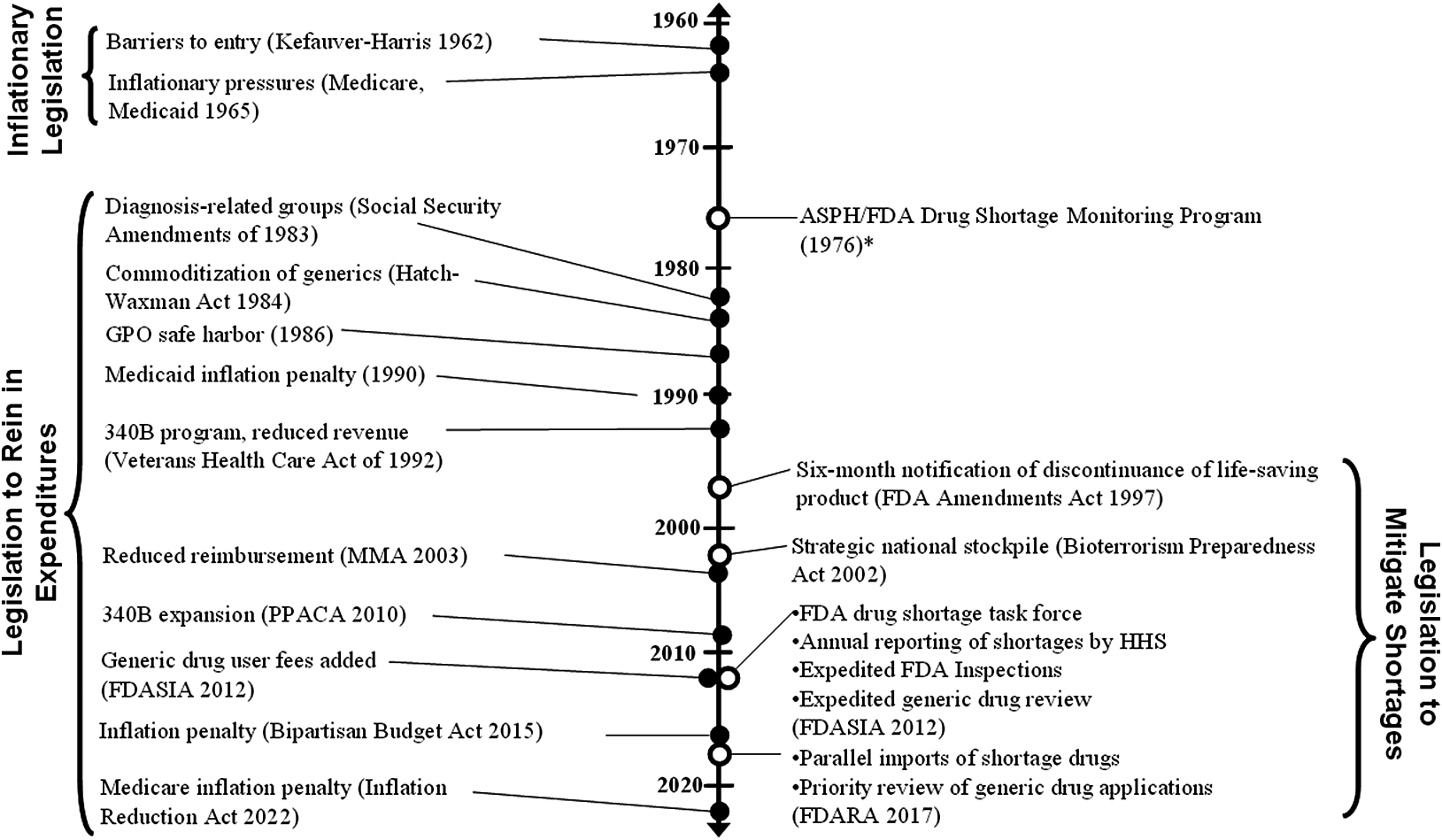
In the larger health care environment, the 1965 Medicare and Medicaid legislation sought to ensure that funds were available to pay for health care (including pharmaceuticals) for the elderly, poor, and disabled, but these guaranteed government payments meant that volume would fall very little even if prices were increased, removing an important market safeguard against rising prices. Laws in the 1970s followed, aiming to reduce overall health care expenditures, yet costs continued to increase at an alarming pace. Additional laws from the 1990s to the 2020s sought to limit pharmaceutical costs, but often swept inexpensive generic drugs within their reach, contributing to a system where such drugs are on average priced sixteen percent lower than in other developed countries.Footnote 18 Key statutory enactments and their relationship to generic drug shortages, beginning with the 1984 Hatch-Waxman Act, are considered in turn (Figure 1).
Legislation with Unintended Adverse Consequences for Shortages (left) and Shortage Mitigation Legislation (right).
Key to Figure 1: GPO = Group Purchasing Organization; MMA = Medicare Modernization Act; PPACA = Patient Protection and Affordable Care Act; FDASIA = FDA Safety and Innovation Act; ASPH = American Society of Hospital Pharmacists; HHS = U.S. Department of Health and Human Services; FDARA = FDA Reauthorization Act.
* Administrative (not legislative) action

A. 1984 Hatch-Waxman Act and Substitution Laws Promote “Perfect” Competition
The barriers to entry created by the 1962 Kefauver-Harris Amendments meant that it was costly for generic drug companies to enter the market, even following patent expiration.Footnote 19 The 1984 Drug Price Competition and Patent Term Restoration Act (“Hatch-Waxman Act”) created a pathway by which generic versions of post-1962 brand name drugs could be introduced by submitting less costly bioequivalence data rather than conducting full clinical trials.Footnote 20 In the years following its enactment, the number of generic drugs approved annually increased from 209 (1984), to 486 (2007), to 775 (2023),Footnote 21 creating a competitive environment that lowered consumer prices by exerting downward pressure on manufacturer profit margins.Footnote 22 Under the Hatch-Waxman Act, a generic drug was required by law to be therapeutically equivalent to other generic versions of the same drug as well as to the brand name reference drug, satisfying one of the criteria for perfect competition, namely, product homogeneity.Footnote 23 The publication of the first Orange Book in 1980,Footnote 24 which provides a list of FDA-approved prescription drug products and generic drugs determined to be therapeutically equivalent and therefore substitutable, along with state laws during the 1970s and 1980s that permitted automatic pharmacy substitution of a generic drug for a brand name drug, further commoditized the generic drug market.Footnote 25
Commodities are fungible (substantially interchangeable) and differentiated only by price,Footnote 26 creating an inability to raise prices if a company wishes to maintain market share. This intense price competition was one of the key animating purposes of the Hatch-Waxman Act, but the resulting need for operational efficiency left little buffer when production difficulties arose. To lower fixed costs per unit of output, some manufacturing facilities were in use twenty-four hours per day, seven days per week.Footnote 27 Narrow margins limited the ability of manufacturers to upgrade equipment, maintain excess capacity, establish backup facilities, or take other measures needed to prevent or address quality or capacity issues until they became critical.Footnote 28 With high profit margins, supply interruptions result in substantial lost profits for the manufacturer and thereby create a natural incentive for the manufacturer to ensure against them. With low profit margins, by contrast, the sudden loss of volume results in fewer lost profits, and the greatest adverse effects of an interruption may therefore be health-related externalities that are borne not by manufacturers or even by hospitals, but by patients in need of the product in shortage.Footnote 29
In extreme cases, efforts to reduce costs in the face of downward price pressure can even tempt unscrupulous businesses to intentionally adulterate their products with lower cost inputs. In 2008, eighty-one people died after using heparin, an anticoagulant medicine that appeared to have been deliberately contaminated with oversulfated chondroitin sulfate, an ingredient costing just $9 a pound compared to $900 a pound for heparin.Footnote 30 Oversulfated chondroitin sulfate is a weaker anticoagulant than heparin, but can exhibit disproportionately high anticoagulant activity when combined with heparin.Footnote 31
B. 1983 Diagnosis-Related Groups Focus Hospital Attention on Price
Following the establishment of Medicare and Medicaid in 1965, health care expenditures increased dramatically as insurance for medical services and products, including pharmaceuticals, expanded for older Americans and the poor.Footnote 32 To slow spending increases, Congress during the 1970s and 1980s took a number of steps that moved away from fee-for-service models and toward bundled payment models,Footnote 33 including the Health Maintenance Organization Act of 1973Footnote 34 and, more germane to the issue of drug shortages, the introduction in 1983 of “Diagnosis Related Groups” (“DRG”).Footnote 35 By defining a fixed reimbursement amount for the treatment of Medicare patients presenting with similar conditions, such as hip fracture or chest pain,Footnote 36 DRGs and other bundled payment mechanisms incentivized hospitals to reduce costs, such as by eliminating unnecessary laboratory testsFootnote 37 or bargaining harder for low drug prices,Footnote 38 such as through the use of group purchasing organizations.Footnote 39 About thirty-five state Medicaid programs as well as private payers and foreign countries have also embraced the concept of DRGs, thus expanding their economic effect.Footnote 40 When confronted with concerns that DRGs could be contributing to drug shortages, the FDA’s Drug Shortages Task Force explained that the Centers for Medicare and Medicaid Services (“CMS”) do not have the authority “to move shortage drugs out of a DRG.”Footnote 41 The Task Force further noted that creating separate payments for shortage drugs in addition to the DRG payment would partially undermine the purpose of the DRG system, namely, to incentivize cost containment by providing a single price and letting providers determine how to most efficiently deliver care.
To reduce costs in the face of increased competition and price control measures, including DRGs, those in the pharmaceutical distribution chain increasingly adopted “just-in-time” inventory management practices.Footnote 42 The just-in-time approach had originated in Japan and became popular with U.S. companies during the 1980s and 1990s.Footnote 43 By keeping the minimal required inventory on hand and purchasing goods such that they arrive just in time for when they are needed, companies could reduce obsolescence associated with product expiry, minimize the square footage required for storage rooms, and tie up as little capital as possible in the inventory itself.Footnote 44 For example, one hospital in upstate New York implemented a just-in-time model and reduced its average stock room inventory from $800,000 to $440,000, a forty-five percent reduction.Footnote 45
Although such cost-saving measures improved profit margins during ordinary operations, they also reduced or eliminated the buffer of inventory available to prevent shortages if supply chain issues arose.Footnote 46 According to the U.S. Pharmacopoeia’s analysis of drugs on the FDA’s shortage list, the median duration of drug shortages was 1,202 days as of 2023 (increasing each year, from 706 days in 2019),Footnote 47 but many drug manufacturers, wholesalers, and health care providers hold only a few weeks of product on hand.Footnote 48 The maturing of just-in-time inventory management practices contemporaneously with legislative and economic pressures that limited incentives for generic firms to invest in robust production capacity led to a system in which small perturbations in the supply chain could quickly propagate to the bedside.
C. 1986, Group Purchasing Organizations Exercise Oligopsony Power
Efforts to rein in health care spending also contributed to the growth of group purchasing organizations (“GPOs”),Footnote 49 which pool the negotiating power of individual health care institutions to secure lower prices for health care inputs, such as pharmaceuticals.Footnote 50 Because GPOs often earn revenue by charging an administrative fee to pharmaceutical sellers rather than the health care institutions on whose behalf they purchase, it was the view of both the U.S. Department of Justice and the Inspector General of the U.S. Department of Health and Human ServicesFootnote 51 viewed the arrangement as violating the federal Anti-Kickback Statute,Footnote 52 a 1972 amendment to the Social Security Act enacted to counter the “widespread provider fraud and abuse” that had contributed to ballooning Medicaid and Medicare expenditures.Footnote 53 To allow GPOs to avoid prosecution, Congress amended the law in 1986, exempting GPOs from the Anti-Kickback Statute, provided certain conditions were met.Footnote 54 The following year, Congress directed the Department of Health and Human Services to more fully articulate in regulation those payment and business practices that would qualify for the safe harbor.Footnote 55
Because GPOs exercise some degree of monopsony power vis-à-vis their upstream suppliers,Footnote 56 they can exert downward price pressure that discourages investments by drug manufacturers in quality and reliability investments.Footnote 57 Regarding their hospital customers downstream, GPOs have also received criticism for violating traditional principles of antitrust law, such as through the use of illegal tying arrangements and exclusive dealing contracts.Footnote 58 For example, commentators have expressed concern that bundling practices could disfavor smaller manufacturers who have a narrower range of products. Such manufacturers may have difficulty offering competitive “bundles” of drugs to GPOs, even if hospitals would find one of the manufacturer’s individual pharmaceutical products to be competitive on its own.Footnote 59 Consistent with the lack of clarity on whether GPOs improve or harm the financial positions of their member institutions, the U.S. Government Accountability Office issued a report in 2002 whose title conceded that “Group Purchasing Organizations … Do Not Always Offer Hospitals Lower Prices,”Footnote 60 and another in 2014 that was equally ambiguous as to the benefit or harm resulting from the GPO safe harbor.Footnote 61
Despite potential concerns, federal policy toward GPOs has generally been permissive, including the 1992 promulgation of the regulatory safe harborFootnote 62 from the Anti-Kickback Statute (as directed by the 1987 law), and a safe harbor from the antitrust laws jointly issued by the U.S. Department of Justice and Federal Trade Commission (FTC) in 1993.Footnote 63 The 1993 safe harbor, as amended, stated that a GPO generally would not be subject to antitrust scrutiny absent “extraordinary circumstances,” so long as the GPO accounted for less than thirty-five percent of purchases for a particular drug and a participating hospital’s revenue attributable to the GPO was less than twenty percent.Footnote 64 These policies have encouraged GPOs to proliferateFootnote 65 and by 2014 an estimated ninety-eight percent of hospitals used GPOs.Footnote 66 According to the U.S. Government Accountability Office, a majority of sterile injectable drugs—the types of drugs most often in shortage—are purchased via GPOs.Footnote 67
Although these figures raise questions, they do not conclusively demonstrate whether, on balance, GPOs exacerbate or mitigate drugs shortages. The GPO trade group, the Healthcare Supply Chain Association, argues that GPOs help mitigate shortages by adjusting contracts to account for supply stability, allowing small and rural health care providers to compete more effectively with larger institutions, helping to bring additional suppliers to market, and helping to identify clinically appropriate substitute products.Footnote 68 Nevertheless, GPOs have faced continued scrutiny over the years. In 2023, the Department of Justice withdrew its permissive 1996 guidelinesFootnote 69 and the FTC expanded its ongoing fair trade practices investigation of prescription drug intermediaries to include GPOs.Footnote 70 Depending on the outcome of this investigation, Congress may wish to leverage the FTC’s findings and reevaluate whether GPOs should continue to be treated differently than market participants in other sectors concerning general antitrust scrutiny and whether they should continue to enjoy special exemption status from the Medicare and Medicaid Anti-Kickback Statute.
D. 1992, Medicaid Reduces Reimbursement, 340B Expands Reductions
Just as generic drug manufacturers were experiencing unprecedented levels of competition flowing from the Hatch-Waxman Act and the growth and oligopsony power of GPOs, another federal law was enacted to control escalating reimbursements under Medicare and Medicaid. Unlike previous legislation, however, the new federal effort focused explicitly on the price of drugs. Historically, drug manufacturers had given discounts to the Veterans Administration (elevated to an Executive Department by a 1988 statute).Footnote 71 In 1990, seeking to give a similar benefit to low-income individuals covered by Medicaid,Footnote 72 Congress mandated that drug manufacturers pay a rebate to the states for Medicaid-covered outpatient single-source and innovator multiple-source drugs (typically, brand-name drugs),Footnote 73 in which the rebate was keyed to the “best price” the manufacturer offered to most other buyers.Footnote 74 Predictably, to offset the legislated loss in revenue, manufacturers raised prices for other buyers, including not only the U.S. Department of Veterans Affairs but also hospitals and federally funded “Public Health Service Act” clinics for migrants, black lung disease, drug addiction, mental health, and family planning.Footnote 75
In the ongoing parry and riposte, Congress responded to the increase in drug prices experienced by the Department of Veterans Affairs and the federally funded clinics by enacting the 340B program. Created in 1992, the 340B program provided that the Department of Veterans Affairs, Department of Defense, and a selection of federally-funded clinics would pay lower prices on outpatient drugs, whereby the prices would be determined by an “average manufacturer price” to which a rebate percentage would then be applied.Footnote 76 Federal discounts, however, again predictably led manufacturers to raise prices for those not benefiting from such discounts, which further encouraged the expansion of federal discounts, leaving a smaller and smaller share of the population to pay a larger and larger share of the drug costs, trapping manufacturers and payers alike in an upward price spiral.
As policymakers responded to pressure to make discounts ever more widely available, Congress loosened eligibility criteria for the 340B program. In 2003, the MMA doubled the “disproportionate share adjustment percentage”Footnote 77 (applicable to hospitals serving a disproportionate share of low-income patientsFootnote 78), making many more hospitals eligible for the 340B program.Footnote 79 In 2010, the Patient Protection and Affordable Care Act further expanded the 340B program to include certain children’s hospitals, cancer centers, critical access hospitals, and rural referral centers, and broadened it to include inpatient as well as outpatient drugsFootnote 80 (the inpatient expansion was then reversed by amendments just a few months laterFootnote 81). The 2010 law also expanded the overall Medicaid population,Footnote 82 allowing more health systems to qualify for the 340B program since the disproportionate share qualification is based in part on the number of inpatient Medicaid days.Footnote 83
Although 42% of new drug shortages in 2023 were for injectable drugs, which are often used in the inpatient setting where the 340B program does not apply, the remaining 58% of new shortages did not involve injectables.Footnote 84 The emergence of DRGs also incentivized shifting care to the outpatient setting where costs could be billed separately, bringing outpatient use of injectable drugs, including some chemotherapy drugs, within the 340B program’s reach. To benefit from the spread between the higher reimbursement amount from Medicare and the lower 340B price the health care provider had to pay to manufacturers, hospitals began acquiring community oncology clinics.Footnote 85 By 2013, qualifying sites under the 340B program included approximately one-third of all U.S. hospitals,Footnote 86 and by 2023, 62% of the country’s non-for-profit community hospitals.Footnote 87 The number of participating sites more than quadrupled from 8,605 in 2001 to 38,396 in 2017.Footnote 88 From 2013 to 2020, the share of Medicare Part D prescriptions benefiting from a 340B discount more than quintupled, from 1.7% to 9.6%,Footnote 89 accounting for 11.6% of all prescription drug expenditures in the United States by 2021.Footnote 90 As explained by a group of scholars at Memorial Sloan Kettering Cancer Center, continuous expansion led the 340B program to stray from its original purpose, “increasingly provid[ing] benefits to larger, well-financed hospitals.”Footnote 91
In 2013, one-third of U.S. hospitals reportedly purchased chemotherapy drugs through the 340B program.Footnote 92 An information sheet for a hospital in Georgia entitled “Value of the 340B Program” explained that its off-site infusion center administers, on an outpatient basis, non-cancer injectables such as “antibiotics, medications for rheumatoid arthritis, ulcerative colitis, Crohn’s disease, refractory chronic gout, moderate to severe psoriasis, osteoporosis, [and] rejection prophylaxis for kidney transplants, just to name a few.”Footnote 93 The FDA’s drug shortage list has in 2024 included a wide range of non-chemotherapy injectables subject to 340B pricing,Footnote 94 including dexamethasone (arthritis), dexmedetomidine (sedation), digoxin (heart failure), etomidate (anesthesia), heparin (anticoagulant), hydromorphone (pain), ketamine (anesthesia), lidocaine (local anesthetic), lorazepam (seizures), methotrexate (rheumatoid arthritis, psoriasis), methylprednisolone (inflammation), midazolam (sedation), morphine (pain), promethazine (antihistamine), propranolol (hypertension), rocuronium (muscle relaxant for intubation), sodium chloride 0.9% (saline solution; hydration), sterile water (solvent for other drugs), sufentanil (pain), and valproate (seizures).Footnote 95
The 340B program provides for rebates that, in some cases, can reduce the price of drugs to below the cost of manufacture, creating pressure for firms to reduce expenditures or exit the market.Footnote 96 Beginning in 2020, Eli Lilly provided “penny priced” insulin to 340B covered entities on the condition that the associated contract pharmacies agree to not charge a dispensing fee or mark-up the price, which Lilly explained was just ten cents per 10-mL vial under the 340B program.Footnote 97 In 2011, the Government Accountability Office observed that the 340B rebate formula, which is based on the rebated Medicaid price,Footnote 98 could even result in a negative price, in which case manufacturers were directed to charge $0.01 under the penny pricing policy.Footnote 99 Congress recognized, in 1992, that the 340B discounts might cause some companies to discontinue particular products lines, but was of the view that “[i]n most instances” such market exit would be followed by “the prompt replacement of that company by another company.”Footnote 100 With more recent data, Congress is now aware that even companies already holding approval to market shortage drugs have chosen not to enter the market.Footnote 101 The length of ongoing shortages also sometimes spans years—the antibiotic vancomycin has been in shortage since 2009, according to Congressional testimonyFootnote 102—contradicting free-market assumptions that drug shortages would lead to new entrants at least over the long-term. Constrained by an accumulating thicket of legislation, in other words, the market is not “free.”Footnote 103
E. 2003, MMA 106% Rule, Reduced Reimbursement Expands to Medicare
Prior to 2005, Medicare drug reimbursement to providers was based on a discount from the Average Wholesale Price (“AWP”) or “sticker price,” which was often much higher than the actual price paid by providers, allowing them to profit from the mark-up.Footnote 104 To address the associated waste and abuse, a provision of the 2003 Medicare Prescription Drug, Improvement, and Modernization Act (“Medicare Modernization Act” or “MMA”), replaced the AWP reimbursement model with a model based on the Average Sales Price (“ASP”) plus 6%, based on sales from the previous six months.Footnote 105 The ASP was intended to be much closer to the actual price paid,Footnote 106 and a statutorily mandated report by the U.S. Department of Health and Human Services (HHS) Office of the Inspector General comparing ASP to AWP revealed how much the AWP had become inflated. Across 1,152 generic drugs, for example, the median ASP was a remarkable 68% less than the median AWP.Footnote 107
The new approach reduced reimbursement for sterile injectable drugs by a median of approximately 50%.Footnote 108 Reimbursement for the cancer drugs paclitaxel and etoposide declined by 90% eachFootnote 109 and both were in shortage by 2011.Footnote 110 Although these reductions affected the reimbursement from Medicare to providers and not from provider to manufacturer or wholesaler,Footnote 111 the provision indirectly limited the rate at which prices could increase since, due to the six month look-back period, raising them too fast would lead the reimbursement amount offered to providers to be less than the cost providers faced in acquiring the drug.Footnote 112 An econometric analysis from the National Bureau of Economic Research (“NBER”) calculated that “the reimbursement change [of the MMA] led to about 2 additional weeks (13 days) of shortages for generic injectables . . . .”Footnote 113
Even though the 2003 MMA reimbursement policy (with an effective date of January 1, 2005Footnote 114) led to decreased reimbursement for many older drugs, it did not necessarily reduce overall health care expenditures. The 106% calculation (reduced to 104.3% under sequestration in 2013Footnote 115) was generally based on data from the previous two quarters, but for new drugs without a price history it was based on the wholesale acquisition cost, which allowed manufacturers leeway to set a higher starting price.Footnote 116 Indeed, the legislation gave manufacturers added leverage to negotiate higher starting prices, since they could argue—truthfully—that agreeing to a lower initial price would have a lock-in effect that would limit their ability to respond to future market conditions, for example, if demand turned out to be lower in volume but more inelastic than forecasted. According to a study of drugs launched in the United States between 1999 and 2010, the 2005 legislative policy change led to a seven-fold increase in average launch prices for newly approved non-generic outpatient drugs.Footnote 117
In response to increasing prices, the 2022 Inflation Reduction Act mandated price negotiation for ten Part D drugs beginning in 2026, fifteen additional Part D drugs beginning 2027, fifteen additional Part B or D drugs in 2028, and twenty additional Part B or D drugs in 2029 and thereafter.Footnote 118 Because these provisions focus on high-priced single-source drugs, they have implications for pharmaceutical investment,Footnote 119 further illustrate the ongoing duel between manufacturers and Congress over price, and raise questions about whether these additional legislative constraints will lead to higher drug prices for those segments of the market not directly protected by the legislation, but they have limited direct relevance to the issue of low-cost generic drug shortages.
F. 2009, Surge in FDA Enforcement Leads to Costs and Production Stoppage
In addition to the substantial reductions in the prices paid by Medicare for some generic injectables beginning in 2005 under the MMA, a staff report of the U.S. House of Representatives’ Committee on Oversight and Government Reform identified, as a second principal cause of shortages, the substantially increased FDA inspections, warning letters, and remediation efforts carried out under the direction of Margaret Hamburg, who became FDA Commissioner in 2009.Footnote 120 In an enforcement-focused speech just eight weeks into her tenure, the FDA Commissioner noted with approval Congress’s provision of “significant funding increases for the current and next fiscal year that will be devoted to additional inspection and compliance activities.”Footnote 121 True to her word, the number of FDA warning letters increased from 474 to 1720 during Hamburg’s first two years,Footnote 122 while drug recalls increased from 426 in 2008 to 1742 in 2009.Footnote 123 These efforts preceded a 30% reduction in the production of generic injectable drugs at four leading manufacturers.Footnote 124
Nonetheless, the FDA did find quality problems during its increased inspections. For example, two FDA inspections in 2011 at Ben Venue’s facility in Ohio found bacterial contamination, metal particles in vials, a ten-gallon can containing an unknown liquid that was possibly urine,Footnote 125 moldy walls, and a leaking roof,Footnote 126 but it was unclear whether, nationwide, quality problems from 2009 to 2011 were worse than in previous years or whether fewer problems than average would have been caught by existing company quality control procedures. For example, Ben Venue’s Quality Unit had investigated the unknown liquid and it had been tested by an independent laboratory, but Ben Venue was nevertheless cited by the FDA over the incident for “fail[ing] to follow established procedures during [Ben Venue’s] deviation investigation.”Footnote 127 Supporting these uncertainties, the 2012 Committee on Oversight and Government Reform “could not find any evidence that any products produced . . . at the facilities undergoing remediation had harmed anyone . . . .”Footnote 128
The closure of the Ben Venue site resulted in more than 80 drug shortages,Footnote 129 and an NBER econometric study corroborated the association between increased enforcement and drug shortages claimed in the House report, finding “a consistent and statistically significant predictive relationship between FDA regulatory activity in the drug market (i.e., drug-quality inspections and citations) and the incidence of new drug shortages.”Footnote 130 To assure the public that government was working to reduce drug shortages, the President issued an Executive Order in 2011 directing the FDA to take appropriate actions such as expediting review of manufacturing changes.Footnote 131
Contrary to the House staff report’s implication that responsibility should lie with Margaret Hamburg and her policy of overzealous FDA enforcement, the increased FDA enforcement was largely the result of Congressional action and would likely have occurred regardless of who took the helm of the FDA in 2009. The new Commissioner ascended to office in the wake of not only the 2008 heparin incident,Footnote 132 but the 2007 FDA Amendments Act (“FDAAA”) which, responding to public concerns over drug safety, decreed that the FDA “shall expand” its “enforcement . . . to secure the drug supply chain against . . . subpotent, substandard, [or] adulterated . . . drugs.”Footnote 133 Further revealing Congress’s insistence on greater safety-related actions, the 2007 FDAAA established the Risk Evaluation and Mitigation Strategies (REMS) system,Footnote 134 required bi-weekly screening of the Federal Adverse Event Reporting System (FAERS, a passive surveillance system),Footnote 135 and mandated a post-market active surveillance program that later became known as Sentinel.Footnote 136 FDAAA also required the FDA to respondFootnote 137 to a 2007 report by the Institute of Medicine condemning the FDA for lacking “stable leadership strongly and visibly committed to drug safety.”Footnote 138
Given this overwhelming legislative context and media-fueledFootnote 139 public concern, it is difficult to imagine how the FDA Commissioner could have led the agency in any other direction. The FDA’s subsequent focus on inspections and enforcement was unsurprising. Congress’s actions themselves were also understandable in light of recent high-profile safety events. In 2004, for example, Merck withdrew rofecoxib (Vioxx), a medicine similar to ibuprofen and other non-steroidal anti-inflammatories, which was estimated to have been responsible for at least 26,000 deaths in the United States.Footnote 140 The withdrawals of troglitazone (diabetes), cisapride (gastroesophageal reflux disease), cerivastatin (high cholesterol), and alosetron (irritable bowel syndrome) converged with other factors, including the ability to quickly disseminate information publicly via the still-developing Internet, “to create,” according to the Institute of Medicine, “at the least the appearance of a crisis in drug safety.”Footnote 141 Despite the reasonable response to genuine safety concerns, the increased Congressional and agency focus on enforcement appears to have taken place with insufficient consideration of the potential effect on drug shortages. According to the U.S. Government Accountability Office, 40% of shortages between 2011 and 2013 resulted from quality problems, often in response to FDA action.Footnote 142
G. 2012, Generic Drug User Fees Increase Costs and Speed Approvals
Regulatory costs are among the many indirect input costs faced by generic drug manufacturers. In 2012, a new regulatory cost was added as part of the FDA Safety and Innovation Act, which for the first time imposed “user fees” on generic drug manufacturers to help fund FDA review of their products.Footnote 143 Total fees collected from the generic drug industry increased from $298 million in 2013 to $552 million in 2023,Footnote 144 and are likely to further increase each year based on statutorily-prescribed factors such as inflation and FDA staff costs.Footnote 145 Some fees are one-time only, such as the abbreviated new drug application fee of $252,453 and drug master file fee of $94,682, while others must be paid annually, such as the domestic fixed-dosage form facility fee of $220,427 and the program fee, which varies from $172,963 for manufacturers with up to five approved generic drug applications to $1,729,629 for manufacturers with twenty or more such applications.Footnote 146
Compared to branded drug user fees, including the new drug application fee of more than $4 million,Footnote 147 generic drug fees are modest, and these fees may help prevent or address shortages by expediting approval and revenue generation for new generic drugs. However, the FDA’s Drug Shortages Task Force has noted that median quarterly revenues for drugs experiencing shortages were just $300,000,Footnote 148 potentially incentivizing generic drug manufacturers to drop older, low-profit products to reduce their fee obligations, some of which are based on the number of generic drugs in a company’s portfolio.Footnote 149 For example, a generic drug manufacturer with six Abbreviated New Drug Applications (“ANDAs”) can reduce its annual program feeFootnote 150 by 75%, or more than $500,000 ($756,666 to $189,166), by withdrawing one ANDA and thereby shifting from the “medium” to “small” business category.Footnote 151 Although, fee waivers for branded drugs were provided under the original 1992 Prescription Drug User Fee Act (“PDUFA”), Congress declined to provide a corresponding waiver provision for generic drugs because they were “expected to be orders of magnitude less than those in PDUFA.”Footnote 152
H. 2015, Inflation Penalty Directly Limits Prices
Amendments to the laws governing Medicare and Medicaid have mandated explicit drug price reductions. In one such enactment directed primarily at branded drugs, the Omnibus Budget Reconciliation Act of 1990 constrained reimbursement under Medicaid for single-source and innovator multiple-source drugs by providing that rebates paid by the drug manufacturer to Medicaid would be increased if the drug’s price rose faster than the rate of the inflation, as measured by changes in the consumer price index.Footnote 153 In 2022, the Inflation Reduction Act extended a similar inflation rebate to Medicare Part B and Part D single-source drugs costing over $100.Footnote 154 Although most shortages are of lower cost generics, the 2022 law provided exceptions to the inflation penalty, in the form of reductions or waivers, for those drugs on the FDA’s shortage list,Footnote 155 suggesting Congress’s recognition that price constraints could be contributing to shortages of moderately priced single-source drugs as well. Between 2017 and 2023, 16% of shortage drugs were branded, and another 7% were branded generics.Footnote 156 Biologics are potentially subject to the inflation rebates as well.Footnote 157 Despite what may be the best of intentions, these provisions fail to recognize that the inability to adequately raise prices can, long before a shortage actually arises, lead to the types of quality and resilience issues that contribute to a fragile supply chain.Footnote 158
Rebate reductions or waivers under the 2022 law are likely to lead to costly new administrative burdens and greater price uncertainty, potentially worsening rather than mitigating shortages and market exits. For example, to ensure CMS sets rebate reductions or waivers at a level sufficient to avoid current shortages and no higher, one commentator proposed an additional administrative layer in which companies would submit information justifying their rebate reduction requests and authorizing the FDA to release data to CMS to help calculate rebate reductions.Footnote 159 The proposal acknowledged that rebate waivers “could incentivize companies to increase production to just under the level that would close off a shortage”—i.e., incentivize a state of persistent shortage—and that to avoid such strategic gamification might “require a lot more coordination with the FDA” as well as an audit process to ensure the accuracy of company-submitted information.Footnote 160
Until 2015, the inflation rebate was directed at single-source and innovator multiple-source drugs, minimizing the impact on shortages of lower-cost generics. But in the Bipartisan Budget Act of 2015, Congress expanded the 1990 Medicaid inflation penalty to apply to generic multiple-source drugs.Footnote 161 While net Medicaid spending on prescription drugs was $51 billion in 2023,Footnote 162 or only about 10% of the $429 billion U.S. market for pharmaceuticals,Footnote 163 the change provided one more contributing factor to future drug shortages while making it more difficult to recover from existing shortages. The relevance of Medicaid inflation rebates to shortages also became more pronounced after the 2010 Affordable Care Act expanded the Medicaid population by 24 million people, to a peak of 98 million enrollees by 2023 (29% of the U.S. population).Footnote 164
Other expansions have also occurred, such as the increase under the 2010 Affordable Care Act in the minimum rebate percentage for single-source and innovator multiple source drugs (15.1% to 23%) as well as generic drugs (11% to 13%),Footnote 165 and the expansion of rebates for extended-release versions and other line-extensions of oral solid dosage forms under the 2018 Bipartisan Budget Act.Footnote 166 Forty-seven states and Washington, DC, have “supplemental” rebate agreements that are additive to federal rebates.Footnote 167
The 2010 Affordable Care Act had limited the sum of regular Medicaid rebates and Medicaid inflation rebates to 100% of the average manufacturer price,Footnote 168 but in 2021 the American Rescue Act Plan removed the 100% cap for single-source and innovator multiple-source drugs,Footnote 169 creating the possibility of a “negative price” analogous to the situation that gave rise to the penny pricing policy under the 340B program.Footnote 170 In 2020, 4.7% of drugs had rebates that would have been an average of 30.8% over the cap if the cap removal had been effective that year, and for generic drugs the inflation rebate averaged nearly three times the basic rebate (15.9% versus 5.4% of gross spending).Footnote 171 A Kaiser Family Foundation analysis emphasized the benefit of lower prices that resulted from the cap’s removal, but conceded that at least one drug company had already discontinued drugs in response and that manufacturers might also respond by raising launch prices.Footnote 172 Congress was made aware of the likelihood of higher launch prices due to inflation rebates by testimony from the former director of the Congressional Budget Office,Footnote 173 but nevertheless enacted the inflation rebate provisions.
The consumer price index on which inflation rebates are based is an average of costs across a basket of products, and does not necessarily reflect price changes of the inputs needed by any particular individual or business, such as a generic drug manufacturer, or for any particular product.Footnote 174 Such inputs cover the entire panoply of business costs, ranging from equipment and labor, to the costs of excipients, active pharmaceutical ingredients, and other raw materials, to fixed costs such as user fees or the interest rates charged for financing a factory or warehouse. If a drug’s price generously exceeds its marginal cost—the case for many innovator drugs, for example—the inability to raise prices more quickly than inflation may have only a modest impact on overall product profitability or expected future profitability, at least in the short term. Where margins are thin, however, an inflation rebate limitation could cause a marginally profitable drug to suddenly become unprofitable, for example, if ordinary changes in market conditions (or more dramatic external shocks such as war, pandemic, or extreme weather) cause supply inputs to increase in cost. For manufacturers considering entrance into a generic drug market, the mere possibility of legislatively constrained pricing could increase business risk to the point that the company chooses not to enter the market, as an economic analysis commissioned by the generic drug industry has explained.Footnote 175
The share of drugs subject to Medicare, Medicaid, and 340B rebates or discounts has grown, and inflation rebates limit the ability of drug companies to make up for those lower revenues by raising prices in the market as a whole.Footnote 176 Manufacturers, in other words, are increasingly boxed in when it comes to pricing, making market exit more likely and decreasingly the feasibility of investment upgrades or new entrants.Footnote 177 A report by a leading economic consulting firm criticized the Medicaid inflation rebate as potentially applying “even when manufacturers are reducing their prices” or “in a market experiencing manufacturer exits.”Footnote 178 Although it is only one legislative factor among many, the 2015 inflation provision became effective in November 2016,Footnote 179 and the number of active shortages rose from 176 in the fourth quarter of 2016 to consistently over 200 since 2018 and consistently around 300 since the first quarter of 2023.Footnote 180
I. Synthesis of Legislative Thicketing
Congressional efforts to expand access to health care (1965 Medicare and Medicaid Act) and protect the public from unsafe or ineffective drugs (1962 Kefauver-Harris Amendments) have benefited the public but also led to unintended market sequelae, including greater manufacturer costs and the erosion of an important market check on prices, namely, the fear that volume will decline if prices increase. To control rising costs, Congress has enacted an accumulating thicket of legislation that has slowly constrained the ability of drug manufacturers to raise prices. Various legislative enactments commoditized the generic drug industry (state substitution laws throughout the 1970s–80s; and the Hatch-Waxman Act of 1984); strengthened the negotiating power of drug purchasers (e.g., GPO safe harbors of 1986 and 1992); directly limited drug reimbursement across an expanding share of the market (e.g., Medicaid rebates in 1990, the 340B programs in 1992, 2003, and 2010); increased manufacturer fixed costs (e.g., GDUFA, 2012); and directly prevented drug manufacturers from increasing prices (e.g., inflation penalties in 2015 and 2022).Footnote 181 The effort required to strategize within an increasingly dense statutory thicket also contributed to overhead costs.
As pressure from the hand of Congress progressively squeezed the stress ball of industry, prices ballooned out wherever they could for as long as they could, finding gaps between Congress’s legislative fingers. Over time, however, Congress moved to close these gaps, increasingly boxing-in drug manufacturers and leading more and more firms to exit the market or decline to enter the market. Given sunk investments, market exit would not necessarily occur immediately. Instead, drug manufacturers might linger for as long as they could generate minimal profits while making the minimum investments necessary to carry on. Within this precarious environment, even a modest shock to the system—for example, increased FDA enforcement, a supply interruption, or a breakdown too costly to repair—could prompt a firm at the margin to stop manufacturing an old and inexpensive drug, regardless of its clinical importance.
III. Addressing Drug Shortages
Numerous academics, task forces, government agencies, and others have proposed potential solutions to address drug shortages, but few analyses have considered these solutions within the context of underlying legislative causes or evaluated how accumulating legislative enactments influence the business environment within which generic drug manufacturers make investment decisions.Footnote 182 Because most have turned to Congress for long-term solutions, and because industry responses to legislation often create unforeseen new issues, it is particularly important to understand how proposed solutions relate to underlying legislative causes and how they are likely to impact future business decisions. The most commonly-discussed solutions are critiqued below with this framing in mind.
A. Public Actions
1. FDA Flexibility Is a Hidden Industry Subsidy
Following the 2003 Medicare Modernization Act’s changes to reimbursement, the 2007 FDA Amendments Act’s direction that the FDA intensify its enforcement, and the subsequent surge in drug shortages from 2007 to 2011,Footnote 183 Congress in 2012 directed the FDA to provide it with annual reports listing the major actions taken by the agency to prevent or mitigate shortages, including the exercise of “regulatory flexibility.”Footnote 184 In a report issued just a few months later, the FDA indicated it had already, in approximately 5% of shortages, exercised enforcement discretion to allow the temporary importation of foreign drugs that had not been approved in the United States.Footnote 185 For example, the FDA allowed limited importation of unapproved versions of propofol (anesthetic), phosphonomethanoic acid (antiviral), ethiodized oil (contrast agent), thiotepa (chemotherapeutic), norepinephrine (hypotensive agent), capecitabine (chemotherapeutic), and leucovorin/levoleucovorin (chemotherapeutics).Footnote 186 In 2017, the FDA’s flexible approach was formalized under the FDA Reauthorization Act, which authorized parallel importation without the permission of the manufacturer in certain cases of shortage.Footnote 187 Other flexibilities provided by the FDA have included extension of expiration dates,Footnote 188 assistance in bringing manufacturers into compliance,Footnote 189 the identification of alternate sources of production,Footnote 190 recommendations as to clinically feasible alternative products,Footnote 191 and the expediting of facility inspection or approval of pending generic drug applications.Footnote 192
Although such FDA assistance may ameliorate shortages in the short term, in the long term many of these actions risk shifting the burden to the FDA to provide ad-hoc solutions rather than ensuring that manufactures have appropriate incentives to prevent quality issues before they arise.Footnote 193 Congressional enactments over the years have already placed a growing list of unfunded mandates on the FDA,Footnote 194 contributing to the need for an increasing share of FDA funding to originate from industry-provided user fees.Footnote 195 The Institute of Medicine (now National Academy of Medicine) has reiterated the sentiments of some observers that user fees “reinforce[] the perception that the industry has become a primary driver of the agency’s priorities and performance.”Footnote 196
The 2012 Generic Drug User Fee Act’s user fees provided additional funding to expedite FDA approval of new generic drugs vulnerable to (or already in) shortage, but also imposed increased costs on manufacturers.Footnote 197 The 2017 FDA Reauthorization Act formalized priority FDA review of certain generic drug applications, including those on the FDA’s shortage list and those with not more than three generic manufacturers,Footnote 198 but there has been an accumulation of categories of generic drug applications entitled to some amount of priority (e.g., relating to patent challenges, shortages, AIDS relief, public health emergencies, government purchasing programs, legally required label changes, and applicant hardship) and not all of them can be simultaneously first in line.Footnote 199
The FDA has always exercised regulatory flexibility to facilitate a well-functioning market, such as its creation of expanded access programs years before similar policies were codified in legislation,Footnote 200 but the burden should not fall on the agency to correct problems that originated elsewhere.Footnote 201 If a drug’s true shelf-life reliably extends beyond the labeled expiration date, the procedures for establishing expiration dates should be revised for all affected drugs in the normal course of regulation, rather than after a crisis has emerged and time is of the essence. If parallel importation consistently offers a supply of safe and effective medicines, it is unclear why FDA law (as distinct from patent or contract law) should prohibit it. And while the expertise of the FDA means it may be well-positioned to advise manufacturers on how to best come back into compliance with regulations, assistance by agency personnel should not morph into free consultancy services that would normally be the responsibility of the manufacturer to procure in the private market. Similarly, while the FDA can share information about alternate sources of production or appropriate alternate drugs, the responsibility for making these selections traditionally falls on those within the distribution chain, such as purchasing managers, intermediaries (such as GPOs), and Pharmacy and Therapeutics committees.
Congressional mandates commanding the FDA to first be more strict (2007 FDAAA) and then more lenient (2012 FDASIA) risk producing regulatory whiplash and a less predictable business environment that exacerbates rather than mitigates shortages.Footnote 202 Instead of reacting to high-profile media reports, Congress should more searchingly consider drug shortages in the overall regulatory context, including the role its own legislation may have played. Repealing or paring back legislation may not be appropriate in all circumstances, but professional pride or embarrassmentFootnote 203 should not prevent consideration of whole or partial rescission as one of the possible options.
2. Congress Should Explore Underlying (Statutory) Causes
Some observers have accepted the conclusion that, with respect to shortages, the generic drug market is “not self-correct[ing].”Footnote 204 The FDA promoted this viewpoint in its 2020 report, noting that only 18% of shortages drugs had a price increase of 50% or more lasting at least six months, and only 42% had either new generic entrants or production increases by existing suppliers that restored at least 50% of the unavailable quantity.Footnote 205 The agency concluded that “[t]he marketplace often fails to respond to drug shortages in a way that self-corrects shortages.”Footnote 206 But the FDA did not appear to examine the reasons why new entrants did not emerge or why prices did not rise more frequently.
Rather than serving as evidence that undermines market theory, these criticisms and observations about the causes of drug shortages merely beg the question: if the market did not self-correct, why did it not? The failure to ask and answer this question could lead to markedly different proposals for reform, depending on the assumed answer: those assuming that market theory is somehow flawed are likely to propose greater government intervention to correct a “market failure”; those assuming a failure to self-correct was caused by, for example, statutory limits on the ability to raise prices are likely to propose a paring back of government price controls. The failure to thoroughly investigate the root causes of the market’s inadequate response leaves the question unanswered and the appropriate policy response uncertain.
In part, this failure is understandable. It is much easier to identify a particular quality issue and its associated production stoppage or market exit as the proximate cause of a shortage than to conclusively trace the causative chain further upstream to a particular law, and even more difficult to trace it to the overall economic effect of an accumulation of laws over time. Even immediate causes can be difficult to trace. The University of Utah Drug Information Service, which has tracked shortages since 2001, has reported that it was unable to identify the immediate causes of shortages in 56% of cases.Footnote 207
Nevertheless, given that low profitability is now a widely accepted underlying cause of drug shortages, and that laws designed to affect the prices of drugs, or their competitive environment have likely had such an effect, Congress should include revising existing laws as well as creating new laws as possible tools when addressing shortages. It will be important for Congress to include in future hearings those with strategic business expertise from the generic drug industry, to help understand what drives decisions to invest in quality or enter and withdraw from the market,Footnote 208 and how statutory price constraints and the proliferating statutory thicket have affected such decisions.
i. Reevaluating Rebates and 340B Discounts
Because increased shortages appear to have coincided with changes to federal reimbursement policies, Congress should revisit the Medicare, Medicaid, and 340B programs. These programs and policies may have gone too far in restricting payments, particularly for inexpensive medicines, in a way that has led to higher overall drug and health care costs. For example, mandated price reductions on inexpensive drugs such as paclitaxel (Taxol) ($312) have been associated with shortages that led to the substitution of more expensive drugs such as palbociclib (Abraxane) ($5,284).Footnote 209 Shortages, fueled by low profit margins, cost hospitals at least eight million person-hours and $500 million annually in labor and substitute medicines,Footnote 210 before considering the costs to human health. Rebate and discount programs contribute to the annual costs of health care regulatory compliance, which the American Hospital Association has estimated totals $39 billion per year.Footnote 211
The rebate and payment systems alone are enormously complex, cumbersome, and costly, leading to additional compliance and labor costs and non-utilization of program benefits. One survey found that fewer than half (39.1%) of survey respondents participating in the 340B program, and only 9.8% of non-participants, understood the 340B program “well.”Footnote 212 Even after three decades of the program’s existence, “340B covered entities are still only recouping half of the 340B revenue for which they are eligible,”Footnote 213 since the 340B discount is only available if the prescription is both written by a 340B-eligible prescriber and filled at a 340B-eligible pharmacy.Footnote 214 The President of the American Society of Health-System Pharmacists explained that it took “hours” for a pharmacist to help a single patient navigate the U.S. drug payment system, including Medicare Parts B and D, and that a patient would “not be able to navigate this complex system independently.”Footnote 215 Under the 2022 Inflation Reduction Act, Congress expended $80 million to carry out the Medicare Part B rebate revisions, and another $80 million for the Part D revisions, “[i]n addition to amounts otherwise available.”Footnote 216 These appropriations were modest in comparison to the $3 billion allocated in 2022 for drug price negotiation—an amount that only reflects the government’s burden.Footnote 217 The burden imposed on the market to participate in negotiations must be added to these costs.
Layering additional legislative patches onto an already bewildering payment system will only serve to increase costs, create more opportunities for regulatory gaming, and make it more difficult to predict how statutory changes might have unintended, off-target effects. For example, according to the Medicaid and CHIP Payment and Access Commission (MACPAC), a nonpartisan legislative branch agency charged with providing policy recommendations to Congress, the 2010 Affordable Care Act’s line-extension rebate provisions contained what some considered a drafting error that inadvertently produced lower rebates than intended.Footnote 218 Similarly, the drug price negotiation provisions seem to have inadvertently included a number of loopholes, such as those related to reformulations, despite congressional attempts to foresee and prevent regulatory gaming.Footnote 219 Policymakers should thus proceed with caution when considering proposals, such as those contemplated in a 2024 U.S. Senate Finance Committee white paper, to create new and as-yet poorly defined “layer[s] of . . . accountability” that involve such things as “quarterly[] lump sum [incentive] payments,” the submission of shortage prevention plans to HHS “at a regular cadence,” and bonuses to pharmacies “for meeting basic process measures.”Footnote 220 Instead of making the federal payment system ever more impenetrable and costly to administer,Footnote 221 Congress should entertain proposals to simplify it. Doing so could not only reduce administrative transaction costs, but also help avoid inadvertent downstream effects, such as decisions by manufacturers of inexpensive generic medicines to exit the market.
ii. Reevaluating Percent-Based Compensation
Generic drug manufacturers are affected both directly and indirectly by reimbursement and pricing policies. Because prescriber income and hospital revenue sometimes depend on the drug selected, these decision-makers may experience conflicts of interest that affect drug selection. For example, oncologists are unusual among physicians in that an estimated 50% or more of their incomeFootnote 222 is derived from the spread between chemotherapy acquisition prices and the Medicare reimbursement received under the 106% reimbursement formula. This payment arrangement makes expensive products more lucrative, reducing the urgency of ending shortages of inexpensive alternatives as well as lowering demand for them.
The use of percent-based markups means that changes to the law intended to lower unrelated health care costs could inadvertently cause a sudden loss of expected generic drug volume, adding to business uncertainty. For example, the Inflation Reduction Act’s drug price negotiation provisions are directed at a small number of costly drugs and will be phased in gradually beginning in 2026, yet oncologists are already worried that the change will shrink the value of the 6% Medicare markup so dramatically that it will “undermine the solvency of community oncology practices.”Footnote 223 As community oncology practices struggle for survival, the pressure to prescribe more costly treatments will intensify.Footnote 224
Smaller and less predictable volume can affect the investment decisions of generic drug manufacturers. To avoid such unintended market distortions, Congress should ensure that reimbursement amounts reflect the value of the health care service provided rather than rewarding the selection of higher-cost drugs.Footnote 225 Unless prescribing a more expensive pill or administering a costlier infusion requires more physician time, physician compensation should remain the same as if a lower cost treatment is used.Footnote 226 For similar reasons, Congress should consider narrowing the protection from antitrust law and the Anti-Kickback Statute currently enjoyed by GPOs, which are “almost always [compensated] based on a percentage of the purchase price,”Footnote 227 creating “misaligned incentives” to either negotiate higher pricesFootnote 228 or favor the purchase of more expensive products.
3. Government Manufacturing Reduces Price Transparency
The vacuum of information about the relationship between laws and shortages has led proponents of the “market failure” theory to propose solutions that side-step private drug manufacturing altogether. In 2019, legislators introduced a bill that would have established a government-funded entity tasked with producing or contracting for the production of off-patent drugs, such as insulin.Footnote 229 The bill was not enacted, but it was re-introduced in 2020 and 2023.Footnote 230 Some proposals suggest that government manufacturing could be preferable to private manufacturing, for example, because government could offer a more stable supply and lower prices than the private sector.Footnote 231 There may be limited circumstances in which greater government involvement can help, such as manufacturing (or contracting for the manufacture of) drugs for hard-to-predict future infectious disease outbreaks, bioterrorism attacks,Footnote 232 or diseases with very low prevalence in the United States, in which the private market is unlikely to invest due to the absence or near-absence of a current market.Footnote 233 However, even in those cases, use of the standard government procurement bidding process may provide greater value.Footnote 234
The benefits of government involvement in manufacturing older, inexpensive, commonly used products rest on less certain rationales. Proposals for government manufacture are seemingly based on an idealized view of the workings of a pubic bureaucracy—for example, the assumption that lower prices for the end-user are equivalent to lower total social costs—and tend to give limited consideration to the costs a government entity would face in acquiring sufficient expertise to match that of a global industry, or the fact that government would face many of the same challenges currently faced by the private sector and bear many of the same costs.Footnote 235 In most cases, government manufacturing would simply shift the costs needed to ensure a robust generic drug supply to the public, substituting higher taxes for higher drug prices and resulting in even less price transparency than the current system provides.Footnote 236 As a 2022 National Academy of Sciences report explained, a backup manufacturing facility maintained by the government would be “enormously expensive.”Footnote 237
4. Government Stockpiling Is Costly
Because drug shortages have been an ongoing problem that appears to be related to profitability, and profitability in turn appears to be substantially related to statutory enactments, the principal focus of reform should first involve diagnosing more specifically what went wrong and restoring the generic drug market to its previous state. For example, legislators should ensure their pricing policies do not inadvertently discourage health care institutions from maintaining adequate buffer stock.Footnote 238 However, even well-functioning markets cannot guarantee production of all products under all circumstances. For those drugs in which a shortage would severely threaten national security or human health, government could guard against shortages through the expansion of its strategic national stockpile.Footnote 239 Created in 2002 in the wake of the September 11, 2001 attacksFootnote 240 and expanded thereafter, the Strategic National Stockpile contains antibiotics, vaccines,Footnote 241 toxin antidotes, personal protective equipment such as masks and gloves, ventilators, and other items relevant to bioterrorist attack or public health emergencies.Footnote 242
A national stockpile, however, is costly. Products, particularly those with a limited shelf-life, require inventory rotation to ensure against product expiry. If shortages fail to materialize or prescribing trends change to favor newer products, inventoried drugs would eventually need to either be discarded due to obsolescence or sold into the distribution chain, reducing demand for manufacturers, perhaps at unexpected times. By its nature, a stockpile is intended as a short-term solution to a sudden external shock, not a permanent fix for a product in shortage. Aside from predicting which drugs are likely to experience shortages, the government would need to predict the duration of shortages and the volume of product needed. Estimations that are too low would fail to prevent shortages despite the stockpile, while those that are too high would lead to increased waste. A 2022 National Academy of Sciences report concluded the Strategic National Stockpile was not adequately “effective” and should “model how health systems manage inventory,” a polite way of stating that the government system was not as efficient as its counterparts in the private sector.Footnote 243
5. Quality Rating Systems Could Worsen Shortages
Given that many drug shortages occur due to some type of quality deficit, the FDA’s Drug Shortage Task Force has recommended developing a rating system to incentivize manufacturers to invest in quality management systems. In 2022, following a 9-0 vote of its Pharmaceutical Science and Clinical Pharmacology advisory committee,Footnote 244 the FDA solicited comments for a new voluntary Quality Management Maturity Prototype Assessment Protocol Evaluation Program (QMM).Footnote 245 The QMM program was designed to enhance supply chain reliability by “go[ing] beyond current good manufacturing practice (CGMP) requirements” to address topics such as employee empowerment, management commitment to quality, corrective action processes, and demand forecasting.Footnote 246
Such a QMM program could help to encourage a culture of quality among participating manufacturers, but has a number of limitations and disadvantages. For example, if the quality problems that have led to past shortages resulted from a failure to follow good manufacturing practices, stronger enforcement of existing rules is a simpler solution that avoids the need for a new layer of regulation and added burdens on both manufacturers and the FDA. To the extent that quality problems occurred despite compliance with CGMP, the CGMP regulations should be amended, such as by incorporating the principles of the QMM program. As a comment from the International Society for Pharmaceutical Engineering (ISPE) pointed out, many companies already have internal quality maturity programs, and an ISPE-led program comparable to the FDA’s QMM is already available.Footnote 247 For those that do not have such programs, implementing them may be cost prohibitive, incentivizing market exit.Footnote 248 In other words, the manufacturers with quality problems that would benefit most from a QMM program may be the least able to make the needed investments, as an industry trade group noted.Footnote 249 A study interviewing generic drug manufacturers found that 70% were discouraged from upgrading facilities due to high costs,Footnote 250 suggesting that quality vulnerability is caused not by lack of knowledge or desire, but lack of funds.
More concerning, however, is that the QMM program could actually worsen shortages if nothing else is changed. For example, proponents of a quality rating system often assume that if FDA’s quality ratings are made publicly available, as they recommend, it “would create an incentive for some manufacturers to produce a higher-quality product.”Footnote 251 While some manufacturers might do so, others might simply choose to exit the market, an option that becomes increasingly likely as profit margins diminish and the ability to increase prices is restricted.Footnote 252 Proponents have also sought to justify quality ratings by comparison to letter grades given to restaurants by public health authorities, pointing out that “consumers are sensitive to letter grades.”Footnote 253 Consumers who frequent restaurants, however, have little means to negotiate quality, while GPOs and other drug purchasers tend to have long-term relationships and written contracts where quality and reliability provisions can be added or strengthened.Footnote 254 Any given restaurant is also not the nation’s sole source of food: if, in response to a poor letter grade, a restaurant determines it does not have the resources to improve quality and instead closes, there are many other restaurants and supermarkets to make up for the lost supply. In short, cost pressures are a key driver of quality problems, shortages, and manufacturer exits, but the QMM system imposes additional costsFootnote 255 and risks on manufacturers without relieving any of the downward price pressure imposed by statutory constraints.Footnote 256
B. Private Actions
1. Nonprofit Manufacturers Are a Hidden Industry Subsidy
The criticism that the market is not self-correcting is only partially true at best. The market has in fact responded, as the FDA’s figures show,Footnote 257 even if those responses were not sufficient to rectify shortages. The market has also responded through backward integration.Footnote 258 In 2018, a cadre of health systems established a non-profit pharmaceutical manufacturer called Civica Rx to ensure a stable, long-term supply of critical drugs.Footnote 259 By 2023, Civica Rx was associated with fifty-five health systems representing one third of licensed hospital beds in the United States and had supplied 140 million containers of more than eighty different drugs.Footnote 260
Despite this success, Civica Rx’s non-profit nature raises questions about whether even the most efficient for-profit manufacturer could sustain profitable operations in the same markets, and what Civica Rx’s “cost-plus” pricing policy really means.Footnote 261 In addition to an exemption from income taxes (approximately 26% U.S. marginal rate considering both federal and state income taxesFootnote 262), Civica Rx’s 2022 tax-exempt organization return (Form 990) indicates it received $13 million in “contributions and grants,” including $5 million in government grants, compared to net income from inventory sales—presumably drug sales—of $27 million.Footnote 263 Even so, Civica Rx experienced a net loss of $21 million.Footnote 264 The previous year it had a much larger net revenue of $52 million, but also much larger contributions and grants of $62 million.Footnote 265 Income from inventory sales was similar in both years ($26 versus $27 million).Footnote 266
Another measure of the private market’s eventual ability to respond is the Mark Cuban Cost Plus Drugs Company, a Delaware public benefit corporationFootnote 267 founded in 2018 that announced it would start supplying sterile injectable drugs in shortage beginning in mid-2024.Footnote 268 In general, public benefit corporations pay taxes like regular corporations but are not legally required to maximize shareholder value,Footnote 269 potentially reducing government tax revenues but only to the extent that a company’s profits are smaller. The Mark Cuban Cost Plus Drugs Company explains that it plans to reduce drug costs through vertical integration from manufacturing to wholesaling to its “unPBM.”Footnote 270 The latter is named in satirical reference to pharmacy benefit managers (“PBMs”), drug intermediaries that have garnered both academic criticismFootnote 271 and Federal Trade Commission scrutinyFootnote 272 for their potential conflicts of interest and questionable effects on drug pricing. However, the Mark Cuban Cost Plus Drugs Company plans to begin as a 503B compounding facility,Footnote 273 thus engaging in a type of large-scale compounding authorized in 2013 by the Drug Quality and Security Act,Footnote 274 limiting comparability to traditional generic drug manufacturing.Footnote 275
2. Stronger Contract Provisions Require Price Flexibility
Market responses can also be evidenced by private action further down the supply chain. For example, participants in the distribution chain can include provisions in their contracts to promote stable supply, including financial or other incentives or penalties to help ensure that contract provisions are honored.Footnote 276 Typically, an ordinary default provision would allow non-payment in the case of a producer’s failure to supply,Footnote 277 plus damages equal to the difference between the contract price and the price obtained from an alternate seller.Footnote 278 Goods in shortage, however, are unlikely to be available from other sellers, and on average GPOs recover only about 10% of losses in case of breach due to shortage.Footnote 279 In the case of low-cost pharmaceuticals, monetary damages based on contract prices will likely be insufficient, since the losses due to drug shortages are primarily indirect (e.g., extra hospital labor) or non-economic (physical harm or suboptimal treatment), fall most heavily on the patient, and are not easily measured (e.g., damage to hospital reputation).Footnote 280 A liquidated damages provision, used in cases where damages are not easily measured, may therefore be preferable.Footnote 281 Structuring the contract to include a bonus for fulfillment rather than a penalty for failure-to-supply is another option.
The persistence of drug shortages over a sustained period despite the awareness of GPOs and hospitals of the costs and consequences of such shortages raises questions about whether stronger contract provisions are feasible within the current reimbursement context. With some exceptions, investigations and commentaries have primarily focused on the manufacturers of shortage drugs and especially their quality lapses, rather than considering the responsibility of the intermediaries and health care institutions.Footnote 282 Policymakers should investigate why sufficiently strong supply-guarantee provisions have not been routinely included in intermediary and health care institution contracts, and what legislative changes, if any, could help.Footnote 283 One possibility is that such contractual incentives and penalties would require higher prices, and that those higher prices would in turn require higher reimbursement levels, which are currently constrained by law.
Another potentially helpful contract provision is for purchasers to offer manufacturers a guaranteed volume of purchases over a defined period of time, reducing uncertainty for the manufacturer and incentivizing investment in manufacturing lines. This approach may be particularly appropriate for low-cost, high-volume products that have been used for many years, such as bags of saline solution. Consistent with this approach, Civica Rx has entered into five-year supply agreements for essential sterile injectables.Footnote 284 As with failure-to-supply provisions, it will be important to investigate why long-term contracts have not already been the norm for shortage drugs. Part of the answer may be that long-term contracts shift some risk to hospitals, for example, in the case that new technology (e.g., advances in packaging or shelf-life) renders a product no longer adequate to satisfy the standard of care. Long-term contracts also limit the ability of hospitals to shift to lower cost manufacturers should they emerge during the course of the supply agreement,Footnote 285 meaning that price pressure may be a factor here as well.
Yet another option would be to bar suppliers from future contracts for some period of time if they default on government purchase contracts, such as with the Departments of Defense or Veterans Affairs, as some countries have done.Footnote 286 However, because draconian penalty provisions could lead to manufacturer exits that worsen shortages, higher payments are a more promising solution, particularly in the case of low-cost, high-volume products.
3. Redundant Suppliers Require Price Flexibility
Notwithstanding the seeming absence of adequate supply provisions in purchase agreements, market intermediaries have responded to shortages in other ways. For example, one GPO reported that it now tries to contract with at least two manufacturers for drugs with a recent shortage history.Footnote 287 Of ten interviewed manufacturers of sterile injectables, eight had dual source suppliers, although not necessarily for every product.Footnote 288 Some commentators have concluded that diversifying supply sources can give a false sense of security since, for example, a GPO may not know that two separate manufacturers both source their active pharmaceutical ingredients (API) from the same supplier, a manufacturer may not know that two API suppliers source their key starting materials from the same supplier, and so on throughout the distribution chain.Footnote 289 While transparency of the supply chain may help in assessing supply chain vulnerability and identifying remedies,Footnote 290 it does not by itself provide those remedies, nor does it address the situation where there is only one supplier of an API or key raw material.
By contrast, ensuring that laws do not unduly limit financial incentives can allow those throughout the distribution chain to take the most efficient measures to ensure against shortages, motivated by the concomitant loss of profits that would result if those measures proved inadequate.Footnote 291 Drug manufacturers have indicated that return on investment is a factor when deciding when to incorporate redundancy into the production system.Footnote 292
4. Inventory Buffering Requires Price Flexibility
Another way the market has responded is by moving away from just-in-time inventory management practices. Those throughout the distribution chain can hold buffer inventory when it is consistent with their financial interest or institutional mission to do so. A study of 802 hospitals found that 89% responded to shortages of critically important drugs by purchasing back-up inventory, 71% added substitute products to the pharmacy formulary, 60% opened accounts with new suppliers, and 47% educated staff about alternative treatments.Footnote 293 Of ten interviewed manufacturers of sterile injectables, all ten held safety stock of both raw materials and finished goods.Footnote 294 Civica Rx claims to “target” a six-month buffer supply of its drugs.Footnote 295 Just as reserve requirements help to reduce the chance that banks will run out of cash,Footnote 296 these voluntary drug reserves appropriately roll back just-in-time inventory management practices, reducing the chance that drug shortages will occur and providing contingency options in case they do.
As with a national stockpile, drug stability can limit the amount of buffer stock that can be held. Unlike stockpiles, however, which are generally intended to be held in reserve until needed, inventories are an inherent part of the distribution chain and can easily incorporate stock rotation as a natural part of their business model. Despite this solution’s simplicity, the ability of health care providers to mitigate the risk of shortages by increasing inventory may not always be made apparent during legislative hearings. For example, in testimony to Congress in 2024, one oncologist reported with alarm that his treatment center did not receive a shipment of carboplatin (a chemotherapy) for ten days.Footnote 297 It is true that the stability of carboplatin in a 0.9% sodium chloride solution has been measured to be “at least seven days” when refrigerated, and less if stored at room temperature and exposed to normal fluorescent light.Footnote 298 However, generic versions of FDA-approved carboplatin are available in sealed vials in a water solution (without sodium chloride) with an approved shelf-life of eighteen months, allowing for longer-term storage.Footnote 299 Sodium chloride solutions can then be prepared for administration to patients as they are needed and used within eight hours, per the FDA-approved labeling.Footnote 300 This longer shelf-life was not mentioned in the Congressional testimony. The shorter the shelf-life, the more important it can be for those in the distribution chain to maintain relationships with backup suppliers or pharmacy compounding facilities to help ensure continuous supply.
Given that manufacturers, distributors, retail pharmacies, and hospitals can and in some cases have already voluntarily created buffer inventories, it is unclear why special purpose tax credits or incentives are needed, as some have proposed.Footnote 301 Rather than introduce further complications into an already labyrinthine payment system, added costs needed to cover better inventory management practices could be incorporated into existing compensation mechanisms, as CMS generally described in 2023.Footnote 302 However, creating lists of drugs eligible for buffer stocking and separately tracking and reporting the costs of buffer stock should be avoided, contrary to some proposals discussed in the 2023 CMS notice, as these steps would increase costs of administration.Footnote 303 Instead, payments received by hospitals and others in the supply chain must be free to rise sufficiently so that these institutions can secure their supply of essential medicines in the most efficient way possible, whether through increasing their own inventory, entering into agreements with additional backup suppliers, or revising contract provisions with existing suppliers.
A less savory market response to shortages is the emergence of gray market suppliers, which divert drugs from the usual distribution channels only to sell them back at much higher prices.Footnote 304 If those prices are reasonable in light of costs such as shortage prediction, storage, transportation, and risk of obsolescence if a shortage does not occur, then these gray market suppliers are performing a useful inventory buffering function. A Congressional report concluded, however, that the “exorbitant prices” charged by gray market intermediaries “bear little or no relation to the companies’ cost of purchasing, shipping, or storing the drugs.”Footnote 305
One might wonder why, if gray market actors can anticipate and address demand during at least some shortages, those in the legitimate distribution chain cannot do the same. But the Congressional report’s findings suggested that gray market actors quickly bought up supply as soon as an incipient shortage was known rather than engaging in predictive analytics and responsibly holding drugs in reserve long before shortages emerge.Footnote 306
5. Capacity Buffering: “Warm Starts” Are Costly
The capacity to make additional product on short notice can be secured in various ways, such as by maintaining agreements with contract manufacturers that could engage in “warm starts” (rapid, on-demand production) when demand surges.Footnote 307 Such agreements are analogous to practices within the energy sector, in which “peaker plants” can be quickly engaged when energy usage exceeds the capacity of the main energy generation facility.Footnote 308 Of ten interviewed manufacturers of sterile injectables, five had the capacity for warm starts.Footnote 309 However, maintaining the capacity for warm starts is costly, and manufacturers report that use is generally limited to drugs with annual sales of at least $10 million,Footnote 310 while median revenue for shortage drugs has been reported as $1.2 million, or just over one tenth of this threshold amount.Footnote 311 Similarly, maintaining the ability to add an extra shift of workers to an existing production line, a practice of six of ten interviewed manufacturers,Footnote 312 is premised on the assumption that the line is not already in twenty-four hour use, which would require leaving equipment and facilities idle during some portion of the day.
Another measure of unused capacity is the number of approved generic drugs that are not manufactured. Of all approved generic applications, 61% (of 1,671) were not marketed,Footnote 313 suggesting that manufacturers may be interested in entering or re-entering the market and increasing the supply of generic drug products under the right conditions. According to the FDA, the average drug in shortage has three approved ANDAs at the time of the shortage that are not being marketed.Footnote 314 By this statistic, the FDA all but lays the blame at the foot of Congressional reimbursement limits, acknowledging that “the textbook model of how product shortages resolve,” is that “prices should increase sharply” causing manufacturers to “increase production to fill the gap between supply and demand,” but concluding that the expected price and supply increases did not consistently materialize.Footnote 315
IV. Conclusion
Despite hundreds of academic articles and multiple legislative hearings, the underlying causes of drug shortages are still little acknowledged and largely understudied. As a Congressional majority staff report has stated: “[t]he underlying causes of drug shortages have generally not changed since . . . 2019 . . . . These primarily include economic drivers, quality issues, overreliance on foreign sources, increased demand, and logistical and regulatory challenges.”Footnote 316 The 2019 minority staff report largely agreed, pointing to the FDA’s 2019 report that identified low profit, related disincentives for quality, and regulatory challenges.Footnote 317 While all of these may be causes, these lists politely direct attention away from what caused the “economic drivers, quality issues, [and] overreliance on [lower cost] foreign sources.”Footnote 318 Conspicuously absent from this list, in other words, is “Congressional legislation.”Footnote 319
Legislatures are charged with representing the public and acting in its best interest, but it is sometimes difficult to foresee all the consequences of well-intentioned legislation. Pressures to please constituents, such as by passing legislation aimed at lowering drug prices, can lead to compromises that may not best serve society in the long term. Working within this environment, Congress has diligently sought to address genuine challenges facing the American public, helping to address some problems along the way—such as the inability to pay for health care—but inadvertently creating others, in a never-ending game of whack-a-mole that has resulted in the need for repeated legislative “patches,” which in turn may have both salutary and unanticipated consequences.
The 1962 Kefauver-Harris amendments helped to ensure against unsafe and ineffective drugs by requiring pre-approval testing but thereby raised barriers to entry for both brand and generic drugs. In response, the FDA (1969) and later Congress (1984) created the far cheaper ANDA pathway so competitors could enter when patents expired, leading to robust generic competition, but that competition led to thin profit margins, leaving manufacturers without the financial reserves to withstand additional legislative shocks such as rebates and limits on price increases.
The 1965 Medicare and Medicaid legislation provided health care coverage for millions of vulnerable people, but was also “wildly inflationary,”Footnote 320 resulting in efforts to rein in costs, such as DRGs (1983) and the expansion of GPOs (encouraged by Congress in 1987), which further shifted the focus toward low price and away from long-term reliable supply. The ANDA pathway (1969, 1984), though far lower in cost than the full drug approval pathway under the 1962 amendments, was still time consuming, slowing the ability of manufacturers to nimbly respond to drug shortages, and leading Congress to create user fees (2012) to expedite FDA review of generic drugs. But those fees raised costs too, further squeezing profit margins.
When examining the vast complexity surrounding United States health care, it is challenging to avoid getting bogged down with the intricacies of a labyrinthine medical, commercial, and regulatory ecosystem. Nevertheless, as health care providers, businesspersons, elected representatives, and agency officials all work to create a better society, it is important to occasionally step back and reevaluate the overall picture: generic drugs tend to be lower cost in the United States than in most of the world,Footnote 321 yet, as a staff report by United States House of Representatives Committee on Oversight and Government Reform observed, shortages of generic injectable drugs “are not widespread features of other developed countries’ health systems.”Footnote 322 The potential connection between these two features—lower cost and higher shortages—should be considered by scholars and Congress alike when proposing and formulating policy changes.
Congress and the FDA have taken repeated steps to combat drug shortages since 1997, with increased intensity since 2012 and the creation of the Drug Shortage Task Force, yet the first quarter of 2024 had the highest number of active shortages (323) of any quarter since tracking began in 2001.Footnote 323 This is in stark contrast to “25 years ago,” when, according to Congressional testimony, “a bad year would be marked by a maximum of 10 to 15 drug shortages.”Footnote 324 These statistics alone are reason to consider whether the underlying causes of drug shortages are truly well-understood, and whether the remedial actions taken have been aimed at the proper targets.