Almost all medieval and modern commentators on the liturgy have traced the origin of the introit chant of the Mass to the pontificate of Pope Celestine I (422–32). In this they followed Amalar of Metz (c.775–c.850), who was the first to attribute the introduction of this processional chant to Celestine. In his Liber officialis (c.835), Amalar cited the passage from the Liber pontificalis (c.530) that credited Celestine with introducing the singing of ‘the 150 psalms of David … before the sacrifice’. He construed this phrase as meaning that the author of Celestine's biography meant to attribute (albeit obliquely) the creation of the introit chant to a pope who lived about a hundred years earlier.Footnote 1 This interpretation must have seemed all the more reasonable to Amalar, since the second edition of the Liber pontificalis, produced under Pope Vigilius (537–55) and the one with which he was presumably familiar, added that the psalms in question were sung ‘antephanatim ex omnibus’. Though this phrase might have seemed unusual or obscure to Amalar, as it did to scribes who altered it when they copied the Liber pontificalis,Footnote 2 there seemed to be little doubt that it referred somehow to antiphonal psalmody. That being the case, Amalar concluded that ‘from all of the psalms [Celestine] extracted antiphons that are sung at the introit of the Mass’ (ex omnibus psalmis excerperet antiphonas quae psallerentur in officio missae).Footnote 3 This was followed by a lengthy allegorical interpretation of the splendid entrance ritual of a Mass celebrated by a bishop.Footnote 4
The portion of Celestine's (brief) biography in the Liber pontificalis on which Amalar based his conclusions reads as follows:

Texts enclosed within square brackets are additions proper to the second edition of the Liber pontificalis; the penultimate line in parenthesis (et sic missas fiebant) is not found in every manuscript of this edition, but only in the so-called ‘mixed’ class of manuscripts.Footnote 6 The conventional first interpolation (multa constituta fecit) hardly merits attention, while the second (antephanatim ex omnibus), though undoubtedly intended as a clarification, offers little help, given the idiosyncratic nature of ‘antephanatim’ and the lack of an immediately evident referent for ‘ex omnibus’. This phrase has sometimes been construed as an indication that the chant involved the entire congregation, clerical and lay, but it cannot be translated ‘by all’. It is probably to be understood as ‘from all’ (sc. the psalms), just as understood by Amalar.
Amalar's interpretation of this passage (‘somewhat obscure in character’, as Louis Duchesne admitted) prevailed as a record of the introduction of the introit.Footnote 7 Hrabanus Maurus (780–856), one of the few medieval commentators with a sense of the historical development of the liturgy, observed that ‘it was not the custom from the beginning to sing, as done now, before the sacrifice is celebrated’.Footnote 8 He understood that the sacrificum began with the introit, as did later medieval authors, whose testimony cannot be disconnected from Amalar's interpretation of the passage. Peter Jeffery cited many of these medieval authors in his challenge to the accepted interpretation, but he maintained that there was an ‘overwhelming likelihood’ that Celestine did not introduce singing at the beginning of Mass but rather a chant between the epistle and gospel readings, that is, the responsorial psalm (later, gradual).Footnote 9 He further interpreted ‘antephanatim ex omnibus’ as referring not to the antiphonal psalmody of the introit, as might be assumed, but instead to the familiar responsorial psalmody between the readings.
Jeffery supported his argument by interpreting the word ‘sacrificium’ as referring exclusively to that part of the Mass known in modern liturgical terminology as the ‘Liturgy of the Eucharist’, as distinct from the preceding ‘Liturgy of the Word’.Footnote 10 While sacrificium can admittedly be found in this narrower sense, its broader meaning, that is, the entire Mass, was at least as familiar – and perhaps the more widely accepted understanding. Amalar knew the narrower meaning, which he employed in his commentary on the prayer ‘Memento, domine’ of the canon of the Mass, which refers to ‘all those standing about’ (omnium circumstantium). He observed that this phrase did not include the unbaptised, ‘because they fittingly depart at the time the sacrificium is celebrated’, that is, before the properly eucharistic portion of the Mass.Footnote 11 Nevertheless, he recognised the broader meaning of the word by interpreting ‘psalmi … ante sacrificium’ as an allusion to the introit. This phrase can be understood only by a closer look at the meaning of the word sacrificium as understood by the editor of Celestine's biography and in light of its use by Christian writers of Late Antiquity and by Romans themselves. The present study must necessarily concern itself as much with what Pope Celestine did as what the author of his biography thought he did. Each is of equal importance within its proper temporal orbit.
The early Christian understanding of sacrificium
A recent book review called the debate about the Eucharist as sacrifice ‘the hottest topic in Eucharistic theology today’, a reference to controversies that date back to the Reformation and which continue to be examined by theologians against the background of the ecumenical movement and the broad present convergence of liturgical forms across Christian denominations.Footnote 12 The following (necessarily limited) overview of the use of sacrificium will concentrate on appearances of the term in Christian literature of the second to the fifth century in contexts that presuppose a connection with the liturgy.Footnote 13 It will reveal a strong thread of continuity in the Christian understanding of sacrifice as a liturgical concept throughout Late Antiquity and the Middle Ages.
The Didachē (early second century) admonished Christians to come together ‘on every Lord's day, break the bread and give thanks, … so that your sacrifice (θυσία) may be pure’, an allusion to the prophecy of Malachi (1:10–12) that in the future, gentiles would offer to God ‘incense and pure sacrifice’.Footnote 14 This passage, which became a locus classicus in Christian dismissals of Jewish sacrifice, illustrates that the Eucharist was already considered a sacrificial action.Footnote 15 Justin Martyr (c.100–65) in his Dialogue with Trypho paraded the Malachi prophecy before his Jewish interlocutor as an argument that the sacrifices of the Old Law had lost even the limited efficacy they once had. Henceforth, true sacrifice would assume the form of ‘the bread of the Eucharist and likewise the cup, an institution ordained by Jesus Christ and offered by the hand of his priests’.Footnote 16 Later in the Dialogue Justin referred again to the prophecy of Malachi, which signalled God's proleptic acceptance of Christian sacrifice, ‘the Eucharist of bread and wine’, while rejecting the sacrifices of the Old Law.Footnote 17
Several passages in the Adversus hereses of Irenaeus of Lyons (c.140–c.200) expound the theology of Christian sacrifice, contrasting it with Jewish sacrifice, so often spurned by God through the mouth of his prophets. For Irenaeus, as for the author of the Didachē and Justin, the prophecy of Malachi formed the cornerstone of his argument that ‘the offering (προσφορά) of the Church is deemed a pure sacrifice (καθαρὰ θυσία) acceptable to God’.Footnote 18 Irenaeus appears to use προσφορά and θυσία synonymously, though the first term (oblatio in the Latin version of Irenaeus) usually relates to what the believer offers and to his moral disposition, the second to the public ritual offering.Footnote 19
A large dossier of texts on the Eucharist as sacrificium could be assembled from the works of Cyprian, bishop of Carthage, who was martyred in 258.Footnote 20 In a letter to Caecilius, bishop of Biltha, he reviewed the sacrifices of the Hebrew Scriptures and the teaching of the apostle Paul, principally to attack the ‘aquarians’, who celebrated the Eucharist with bread and water alone. Such people ‘do not follow the precepts and practices of Jesus Christ our Lord and God, the author and teacher of this sacrifice’.Footnote 21 Cyprian insisted that Jesus's actions at the Last Supper should be scrupulously imitated, especially the cup of wine mixed with water, since ‘at every sacrifice we offer we mention the passion of our Lord – indeed, the passion of the Lord is the sacrifice we offer’.Footnote 22 Cyprian's usual word for the Mass is sacrificium.Footnote 23
In Adversus Vigilantium Jerome used sacrificium in a way that might suggest a narrower interpretation. Refuting the complaint that the pope celebrated Mass (offert domino sacrificia) ‘over the bodies of dead men, the apostles Peter and Paul’,Footnote 24 he countered that, while his adversary Vigilantius demeaned their mortal remains as mere ‘specks of dust’ (pulvisculum), the Romans considered their tombs veritable altars of Christ. Given Jerome's intent in penning this polemic, it is unlikely that he intended to distinguish between ‘sacrificia’ and everything that happened before the pope approached the altar.
Augustine (354–430), responding to a question about whether or not Mass could be offered by the living for deceased members of the Christian community, advised that ‘the souls of the deceased could be refreshed by the devotion of the living, when the sacrifice of the Mediator is offered or alms distributed’.Footnote 25 He used oblatio as a synonym for sacrificium in his reply to a similar question about ‘whether an oblation (oblatio) for the deceased could benefit their souls’.Footnote 26 He advised that, while the ‘the sacrifice of the altar and alms were to be offered for all the faithful departed, … it makes no sense to offer the sacrifice of the body and blood of Christ for the non-baptized of whatever age’.Footnote 27 In book 10 of De civitate dei Augustine linked Christians' offering of their bodies as living sacrifices to the sacrifice of the Mass:
This is the sacrifice of Christians: many [are] one body in Christ. And this also is the sacrifice which the Church continually celebrates in the sacrament of the altar, known to the faithful, where it is made manifest that she herself is offered in the offering she makes.Footnote 28
Here, as elsewhere in his writings, sacrificium is Augustine's term for the entire Mass, not merely a portion of it, with oblatio as an alternative.Footnote 29
A phrase that parallels the ‘ante sacrificium’ of the Liber pontificalis appears in Augustine's Liber retractationum, an annotated bibliography of his works, in which he summarised the contents of a (now lost) tractate, Contra Hilarem, written to refute an objection that had arisen at Carthage about the singing of ‘hymns from the book of psalms before the oblation’ (hymni … de psalmorum libro … ante oblationem).Footnote 30 Though the context is unknown, this phrase has often been interpreted as a reference to the offertory chant, an interpretation that encounters the same problems that confront the narrow interpretation of sacrificium. Augustine, as we have seen, regarded sacrificium and oblatio (or even the two together as oblatio sacrificii) as virtual equivalents, a coincidence that renders the parallel between Augustine's phrase in Contra Hilarem and the ‘psalmi ante sacrificium’ in Celestine's biography very striking. The ‘hymni’ to which objection was made at Carthage might well have been an introit procession, a conclusion that cannot be confirmed, given the disappearance of the Contra Hilarem tract.
Caesarius of Arles (469/70–542) distinguished two parts of the ‘missa’, a distinction he was obliged to make between ‘lectiones divinas’ and the ‘sacra mysteria’ by the lukewarm Christians of his congregation, many of whom exited the church after the readings. (Reception of communion was infrequent at the time.) Caesarius admonished his congregation not to desert the church ‘before the divine mysteries are completed’.Footnote 31 While the distinction between the chants and Scripture readings that preceded the consecratory prayer was an obvious one to Caesarius's less than fervent congregation, he regarded the entire rite as the unified ‘divina mysteria’. Isidore of Seville (c.560–636) expounded the several meanings of sacrificium in various contexts. In the Etymologies he identified the entire Mass with sacrificium, whereas missa was that point in the sacrificum when the catechumens were dismissed, and thus only a moment in the entire Mass.Footnote 32
I have not made a thorough survey of conciliar decrees, but canon 5 of the Council of Toledo (400) is representative of the conventional terminology. It decreed that a priest, deacon, subdeacon or other cleric who did not come ‘to the church for the daily sacrifice’ (ad ecclesiam ad sacrificium cotidianum) was to be punished.Footnote 33 This disciplinary canon reflects the ubiquitous understanding of sacrificium in the early centuries of the Christian era as the entire Mass, not just a part thereof distinct from the preceding scriptural readings.Footnote 34 Patristic exegesis often expounded sacrificium in the context of the relationship between Jesus's sacrifice and the central act of the Eucharist, but the appearance of the word in liturgical contexts does not limit its applicability to a specific part of the liturgy.
Sacrificium in Roman sources
In addition to its appearance in Celestine's biography, sacrificium occurs in two other places in the Liber pontificalis. Both were construed by Peter Jeffery in the narrow sense, a conclusion that requires closer examination. According to the first edition of the Liber pontificalis, Pope Telesphorus (c.125–c.136) decreed that ‘Masses should be celebrated at night on the birthday of our Lord Jesus Christ, and that at the beginning of the sacrifice (‘in ingressu sacrificii’) the angelic hymn Gloria in excelsis deo was to be sung, but only on the night of the Lord's birth’.Footnote 35 Telesphorus was a genuinely historical figure, identified by the church historian Eusebius as a bishop of Rome martyred during the persecution of Antoninus Pius (138–61), but the information about him provided by the Liber pontificalis must be dismissed as pure fabrication.Footnote 36 Christmas was not introduced as a liturgical commemoration until at least two centuries after his pontificate,Footnote 37 and the Gloria in excelsis is recorded no earlier than the Apostolic Constitutions (c.380), though its Arian-tinged text is probably the reworking of an orthodox text found in the late fifth-century Codex Alexandrinus.Footnote 38 From other sources it is known that the Gloria was at first restricted to bishops; Roman priests were allowed to intone it on rare occasions – for example, their first Mass after ordination.
When the biography of Pope Telesphorus was revised, the phrase ‘in ingressu sacrificii’ was tellingly replaced by ‘ante sacrificium’, matching precisely the terminology of Celestine's biography. The place of the Gloria in the Roman Mass has not changed since the sixth century – it stands close to the beginning of Mass and before the readings. If the editor of the Liber pontificalis intended to establish a consistent chronology of Mass chants, he might have reckoned that, were he to make the Mass of Telesphorus's time begin with Gloria in excelsis deo, he could estimate that by the time of Celestine, three centuries later, another chant (the introit) had been inserted ‘ante sacrificium’ (and before the Gloria), thus extending further the ritual formalities at the beginning of Mass.
The second reference to sacrificium in the Liber pontificalis occurs in the biography of Pope Sylvester (314–35), who is said to have decreed that the ‘sacrifice of the altar (sacrificium altaris) must be celebrated not with silk or dyed cloth, but only with naturally produced linen, just as the body of our Lord Jesus Christ was buried in a fine linen shroud’.Footnote 39 The intent of this prescription is not to narrow the meaning of the term as a point of division in the Mass, but to assure a dignified preparation of the altar to receive the bread and wine of the Eucharist.Footnote 40 Antependia that hung before the altar frontal, several attested in Roman sources, were of the richest materials and frequently adorned with iconographical programmes.
Both of these references to sacrificium must be interpreted in light of the Liber pontificalis's intent to furnish a historical pedigree, genuine or invented, for liturgical practices current when the papal biographies were compiled.Footnote 41 Their authors, as Emanuel Bourque noted, tended to impute ‘an almost apostolic authority’ to liturgical practices whose origins were inevitably unknown.Footnote 42 The information provided by biographies of popes who lived before the sixth century cannot be summarily dismissed as ‘of no documentary value’, as Victor Saxer did.Footnote 43 But even he made an exception for information drawn from the Lateran archives. Since these have disappeared, distinguishing genuinely archival material from (not necessarily unreliable) clerical lore and legend is a difficult undertaking, one that requires each statement to be examined on its own merits.
Sacrificium appears rarely in other Roman documents, but none of its appearances imposes a narrow interpretation as ‘Liturgy of the Eucharist’. Pope Celestine himself is a witness to its broader meaning as the entire Mass. In a letter to Emperor Theodosius II (408–50) approving what had transpired at the Council of Ephesus (431), mainly the condemnation of Nestorius and confirmation of Mary's right to the title theotokos (Mother of God), Celestine assured the ruler in effusive terms that the prayers of all Christians were being offered for the well-being of the empire: ‘behold now they fill the house of the Lord with prayers, and throughout all the churches they commend your empire to our God with offerings of sacrifices’ (oblatis sacrificiis), a phrase that can hardly have meant just the last half of the Mass.Footnote 44 The authenticity of this letter is not open to question, for it was included among the original documents pertaining to the Council of Ephesus that were placed in the papal archives by Celestine's archdeacon, the future Leo I (440–61). This source was surely available to the editors of the Liber pontificalis.
Pope Leo's understanding of sacrificium did not differ from that of Celestine, his patron and predecessor.Footnote 45 In a letter to Bishop Dioscoros of Alexandria (444–51), who had asked Leo's advice about what to do on great feasts, when even the largest church in the city could not accommodate all of the faithful at one time for Mass. The pope responded with typical Roman practicality and pastoral sense, using three alternative names for Mass: sacrificii oblatio, sacrificium and missa (each underlined in column 1):
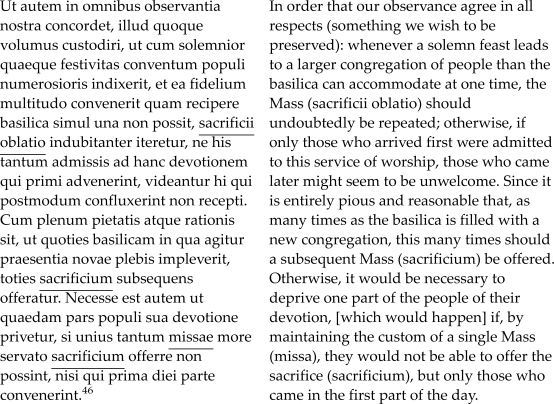
Under the circumstances described by his correspondent, the venerable custom (more servato) of celebrating only one principal Mass was to be suspended.Footnote 47 Leo advised Dioscoros to authorise repetitions of Mass as often as necessary, obviously recommending that the entire Mass be repeated, not just one portion of it. Otherwise, the faithful would have been deprived of hearing the Scriptures. Leo's use of the expression ‘sacrificii oblatio’ (here and elsewhere) echoes the language of Cyprian and other early Christian authors. There can be no doubt that in this context all three terms signify the same thing: the Mass as a whole.
The second edition of the Liber pontificalis recorded that Leo added to the canon of the Mass (intra actionem sacrificii) the words ‘sanctum sacrificium’, a phrase applied to the bread and wine offered by Melchisedech on Abraham's behalf.Footnote 48 Given that the canon of the Mass was known in Rome as the ‘actio’, it must be that sacrificium here refers to the totality of the liturgy in which the ‘actio’ was embedded.Footnote 49 The rubric ‘Incipit canon actionis’ is inserted in the Old Gelasian Sacramentary before the Preface dialogue (‘Sursum corda’, etc).Footnote 50
In 416 Pope Innocent I (401–17) sent a letter to Decentius, bishop of Gubbio, who had inquired about certain Roman liturgical practices.Footnote 51 Though the tone of the letter is friendly, Innocent expected that in liturgical matters the model of the Roman see would be respected by all bishops under his jurisdiction.Footnote 52 Although the term sacrificium is not involved, two of the questions reveal something about Roman liturgical terminology. Innocent was asked about (1) when the ‘kiss of peace’ should be exchanged and (2) when the names of offerers should be read out to the congregation. Decentius had informed Innocent that some priests and laity were exchanging the peace ‘ante confecta mysteria’. The pope stated his preference for doing this after ‘quae in mysteriis aguntur’. A propos of the second question, Innocent pointed out that it was illogical to name the offerers before their gifts (oblationes) were ‘commended’. It made more sense to name them ‘inter sacra mysteria’. If sacrificium had been the accepted term at Rome for that part of the Mass (the canon), might not Innocent have used this instead (e.g., ‘inter sacrificium’)? If he preferred mysterium in both cases, it could have been because at Rome sacrificium was understood as the Mass in its entirety.
The broad meaning of sacrificium is also attested in the correspondence supposed to have passed between Pope Damasus (366–84) and his erstwhile secretary, Jerome. Peter Jeffrey demonstrated that this fictitious correspondence depended on the (contemporary) Liber pontificalis, contrary to the prevailing opinion, which posited exactly the reverse relationship.Footnote 53 One of the questions posed by ‘Damasus’ to ‘Jerome’ concerned the proper time for the celebration of Mass (‘qua hora licet sacrificare’).Footnote 54 ‘Jerome’ claimed that, since the Holy Spirit descended on the apostles at the third hour, whoever sings Mass (‘canere missas’) after that hour is anathema. A few lines later, the prohibition is repeated in other terms: ‘it is not permitted to offer the sacrifice (sacrificare) after the third hour on Sundays, nor to fast, nor to engage in any other abstinence’. Pseudo-Jerome also forbids a priest to ‘sacrifice’ alone. Moreover, ‘under no circumstances do we allow sacrificing in the absence of light’ (sine lumine accenso sacrificare) or incense: ‘when the priest sacrifices at the altar with the fragrance of incense, the devil quickly flees and that fragrance ascends to the Lord through his angels’ (cum odore incensi sacrificat sacerdos ad altare, praesentialiter fugit diabolus et ille odor per angelos ad dominum ascendit). The fictitious exchange presumes that sacrificare/sacrificium applies to the entire Mass, not just a portion thereof. ‘Jerome's’ reply also uses sacrificium in the sense of what is offered: ‘on account of the sacrifice to be placed upon the altar’ (propter sacrificium ponendum super altare), the priest must be properly vested.
Gregory the Great – by no means the least of Roman authorities – also understood sacrificium in a broader sense. In the fourth book of the Dialogues, he recounted the story of Cassius, bishop of Narni, ‘who was accustomed daily to offer the sacrifice (sacrificium) and to offer himself in those hidden things (arcana) of the sacrifices’.Footnote 55 Apparently, sacrificium here means the entire Mass as distinguished from the ‘sacrificiorum arcana’, probably the solemn prayer of offering: the canon. The following anecdote in the Dialogues concerns a woman who was accustomed on certain days to ‘offer the sacrifice’ for her imprisoned husband, on which days his chains were loosened, an allusion to the ‘sacrifice’ of bread or wine offered to the priest before the beginning of Mass. Gregory also recounted that Bishop Agatho of Palermo had the ‘sacrificium victimae salutaris’ offered for a sailor-cleric whom he believed lost at sea.Footnote 56 There is thus no reason to believe that Gregory's understanding of sacrificium departed markedly from that of the Liber pontificalis, whose second edition was being prepared during his youth.
A comprehensive study of the prayers of the Roman Missal led Mary Pierre Ellebracht to conclude that sacrificium ‘besides being the very general word for sacrifice in pagan Latin, had also a very broad meaning in Christian Latin’.Footnote 57 In addition to the applied senses of fasting and almsgiving, she identified at least four meanings present in the prayers of the Missal: (1) the sacrifice of the cross, (2) the Eucharist as the renewal of that sacrifice, (3) the gifts offered by the faithful, (4) the consecrated bread and wine. Nevertheless, the many appearances of sacrificium (frequently in the plural) in the collects, secrets and post-communion prayers of the Roman Missal and earlier sacramentaries are by themselves of little effective value in determining the meaning of ‘ante sacrificium’ in the Liber pontificalis. It can, nevertheless, be reasonably concluded that in fifth-century Rome sacrificium was an accepted term for the Mass, one familiar to the clerics who edited the Liber pontificalis at the beginning of the next century.
Antephanatim ex omnibus
The sixth-century author of Celestine's biography portrayed the first part of the Mass a century earlier as devoid of musical embellishment: only a reading from the epistle and the gospel preceded the prex eucharistica.Footnote 58 In the absence of corroborative evidence from the time of Celestine, one cannot be absolutely sure whether or not the Roman Mass of the early fifth century began this way. Historians of the liturgy have pointed to Good Friday as a possible paradigm of primitive Roman practice: the service begins immediately with readings that are already divided by chants, in this case, tracts.Footnote 59
Responsorial singing was certainly well known in the Latin West by Celestine's lifetime; hence its introduction to Rome by the third decade of the fifth century cannot be accounted remarkable.Footnote 60 It was popular in the East by the late fourth century. According to the Apostolic Constitutions (Syria, c.380), this manner of responding to the ‘hymns of David’ was already customary in connection with Scripture readings.Footnote 61 The first clear reference to responsorial psalmody at Rome appears in a sermon preached in 443 by Leo I on the anniversary of his ordination as pope. He identified the refrain of the ‘Davidic psalm … that we sang with one voice’ as ‘Tu es sacerdos in aeternum secundum ordinem Melchisedech’ (Ps 109:4).Footnote 62 Sometime during the later fifth or sixth century the responsorial psalm (psalmus responsorius) was transformed at Rome into the gradual,Footnote 63 a chant that contrasts markedly, in both form and musical elaboration, with the antiphonal chants of the Mass (introit and communion), which have variable numbers of psalm verses, the number dictated by practical considerations.
The earliest Roman reference to ‘antiphona’ appears in a psalm commentary written at Rome by Arnobius the Younger during the pontificate of Leo's predecessor, Sixtus III (432–40). The commentator expressed his desire to see the good things of the Lord in the land of the living (Ps 26:13), to which the Holy Spirit responded ‘in antiphona’ with the next following verse of the psalm: ‘Expect the Lord, do manfully, and let thy heart take courage, and wait thou for the Lord’ (expecta dominum, age viriliter, confortetur cor tuum et sustine dominum).Footnote 64 Arnobius might not have had any formal significance in mind; the phrase ‘in antiphona’ might be merely the equivalent of ‘in response’. The mid-sixth-century reviser of Celestine's biography in the Liber pontificalis had in mind some kind of refrain-oriented performance. Given that he chose a variant of ‘antiphona’ to describe this, it would seem logical to conclude that he did so because he thought that Celestine had introduced the antiphona ad introitum. Had he wished to indicate the responsorial psalm (assuming that the gradual had not already supplanted it), he might well have chosen the phrase ‘inter lectiones’ or something similar. Exactly how this ‘antiphonal’ psalmody was carried out remains uncertain until the description of the introit in the first Ordo Romanus.
Non-psalmic introits
The Liber pontificalis claimed that Celestine chose introit texts from the psalms of David, yet a number of texts found in the earliest introit repertoire, first recorded in the late eighth and early ninth centuries, are taken from other books of the Bible, mainly the Hebrew Scriptures (especially Isaiah and Wisdom) and the epistles rather than the Gospels.Footnote 65 Of the thirty Temporale observances with non-psalmic texts, only one is based on a Gospel passage – that for Wednesday in Easter week (Venite benedicti, Mt 25:34). In the Sanctorale two vigils, St John Baptist and St Peter, manifestly late additions to the kalendar, are assigned Gospel texts.Footnote 66
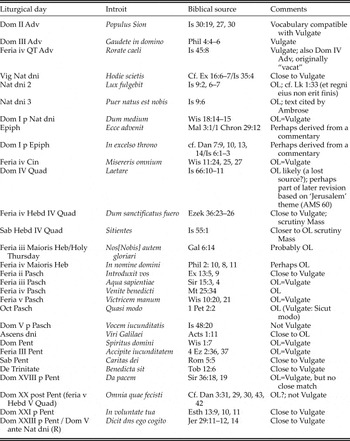
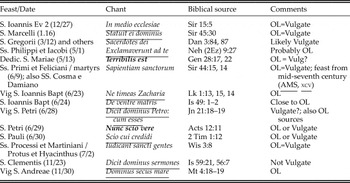
Christoph Tietze has investigated these non-psalmic introit texts, comparing them to Old Latin biblical versions and the Vulgate (Tables 1 and 2).Footnote 67 No single overarching plan emerges from the liturgical assignments, though certain tendencies can be observed. Nearly one-third of non-psalmic introits of the Temporale (9) fall within the Advent–Christmas–Epiphany cycle extending to the Sunday after Epiphany. Six occur during the Lent–Holy Week cycle. An additional five are concentrated in Easter Week and the following Dominica in albis. Four are assigned to Pentecost and the following week. Three occur towards the end of the post-Pentecost cycle.
Non-psalmic introits: Temporale

After Tietze – Table 4.1.
Non-psalmic introits: Sanctorale

After Tietze – Table 4.2.
Underlined chants are proper to the assigned feasts in the Antiphonale Missarum Sextuplex.
Some feasts with non-psalmic introit texts are among the oldest in the kalendar – Epiphany, Ascension, Pentecost – but others are demonstrably more recent. Included in the latter category is Advent, unknown at Rome in Celestine's time.Footnote 68 The second and third Sundays have non-psalmic introits (Populus Sion and Gaudete in domino).Footnote 69 The Advent emphasis of the ember week of December, the result of a shift from the original agrarian tenor, is exemplified by the introit Rorate caeli.
In Celestine's day there was but a single Mass on Christmas, and even a decade later Pope Leo I made no reference to the existence of three Christmas Masses in any of the many sermons he preached on that day.Footnote 70 The second and third Masses of Christmas (and a fortiori their introits) must have been introduced in the later fifth century. Most likely they existed by the early sixth century, a development implied by the Liber pontificalis report (of dubious historical accuracy, as we have seen) that credited Pope Telesphorus with decreeing that ‘Mass should be celebrated at night on the Lord's birthday’.Footnote 71 Celebration of three Masses on Christmas, the ‘trina celebratio’ to which the post-communion of the Mass ‘de vigilia in nocte’ of Christmas in the Gelasian sacramentary (mid-sixth century) alludes, was a privilege at first reserved to the pope. Gregory the Great confirms its existence in a sermon, which he begins by excusing its brevity, occasioned by the fact that ‘today we are to celebrate Mass three times’ (missarum solemnia ter hodie celebraturi sumus).Footnote 72 Perhaps the original unique Christmas Mass with its psalmic introit (Ps 2:1) was transferred to the midnight Mass, when the other two Masses with the introits Lux fulgebit (Is 9:2, 6–7) and Puer natus est (Is 9:6) were introduced.
Ash Wednesday and the following Thursday, Friday and Saturday entered the kalendar when it was deemed necessary to have exactly forty days of fasting before Easter. Five weeks of Lent (5 weeks × 6 days = 30 days) plus the six days of Holy Week amounted to only thirty-six days, Sundays being exempt from the rule of fasting.Footnote 73 In order to make up a full forty days, the Sunday that had hitherto marked the beginning of Lent was anticipated by four days. This happened by the beginning of the sixth century, when the Liber pontificalis attributed to Pope Telesphorus (however unlikely) the introduction of a seven-week fast, thus implicitly including Quinquagesima week in the calculation. Thus a relatively later date (late fifth century?) for Misereris omnium, the introit for Ash Wednesday, must be presumed.
The introit for the fourth Sunday of Lent, Laetare Jerusalem (Is 66:10–11), may have been introduced as part of a revision that gave a ‘Jerusalem’ theme to a Sunday when the pope celebrated Mass at the basilica of Santa Croce in Gerusalemme.Footnote 74 Such a revision became desirable when the three Sunday scrutinies preparatory to baptism were shifted to seven weekdays, a realignment established before the end of the sixth century.Footnote 75 The non-psalmic introits of the fourth week (Wednesday and Saturday) fall on the new baptismal scrutiny days. The texts selected could hardly be more appropriate: ‘Dum sanctificatus fuero in vobis … et effundam super vos aquam mundam’ and ‘Sitientes venite ad aquas’.
The concentration of non-psalmic texts in Easter week, an ancient observance that focused on the newly baptised, is striking. A reorganisation of this week's liturgy took place sometime between the pontificate of Gregory the Great and the earliest Roman list of Gospel readings (c.650).Footnote 76 It may very well have involved introits or other chants of the Mass – for example, the communions on texts from the gospels and epistles. The reorganisation also included the following Sunday, which came to be celebrated as the Octave of Easter.
The non-psalmic chants of the Sanctorale (Table 2) are fewer, but all are for the feasts of saints traditionally venerated at Rome. The ‘Dedicatio S. Mariae’ stands out as a manifestly later feast, whether or not it was established as an annual liturgical commemoration when the Pantheon was converted to a church dedicated to St Mary and the Martyrs in 608. Its introit (Terribilis est) does not permit a clear determination of the text form, Old Latin or Vulgate. The same is generally true of other sanctoral feasts, as can be seen from Table 2. The vigils are certainly among the latest additions.
Christoph Tietze's analysis of the textual sources of non-psalmic introit chants indicates a general preference for Old Latin biblical versions over the Vulgate, but a firm chronology cannot be established on that point alone. As can be seen from Table 1, in many cases at least one Old Latin version is similar to or identical with the Vulgate reading, thus obscuring any clear-cut historical procession from Old Latin to Vulgate in the choice of text. Both are translations of the same (Greek) original; thus the fact that they often agree can hardly be regarded as remarkable. Nor is there any reliable consensus about when the changeover from Old Latin to Vulgate as the favoured source for new chants took place. It surely happened in different places at different times. Even in the absence of a comprehensive chronology of the non-psalmic introits, however, the liturgical and textual evidence points to a later, rather than an earlier origin.
Stational liturgy and the introit
The introduction of the introit – ritual and chant – might have been connected with the organisation of the Roman stational system. The period during which a ‘stational’ liturgy was observed at Rome extended from the first Sunday in Advent until the end of Pentecost week. Only during Lent and (eventually) Easter and Pentecost weeks was there a daily station. On stational Sundays, clergy and laity gathered at the designated church, but on Lenten weekdays they assembled at a ‘collect’ church for a brief prayer service before walking in procession to the stational church of the day. After the people had entered, the clergy, who had vested in the secretarium at the rear of the church, made their processional entrance.
The system must have been well established at Rome (if not for every Lenten weekday) by the middle of the fifth century, because the Liber pontificalis attributed to Pope Hilarius (461–68) the provision of sacred vessels (ministeria) for the stational services. These vessels may have needed (it has been hypothesised) to replace those lost in 455 to Vandal plundering.Footnote 77 Hilarius's benefaction included twenty-five silver scyphi, a like number of silver amae, and fifty silver chalices for the distribution of communion (calices ministeriales), a number that reflects the practical needs of the twenty-five tituli in the city of Rome.Footnote 78 (He also made generous donations of communion vessels to the papal basilicas.)
The architectural framework of the introit
The hypothesis of a fifth-century origin of the introit may be related to the presence in a few Roman churches of an enclosed passageway leading from a point in the nave to the presbyterium and altar. Revealed by excavation, the precise dating of these installations remains uncertain, but they were certainly placed in churches for a liturgical, and not merely decorative, purpose. Most often, architectural historians have referred to installations of this type as a ‘schola cantorum’, but the nomenclature is quite misleading since the feature bears no relationship whatsoever to the renowned papal choir.Footnote 79 A preferable alternative is ‘solea’, a word applied to a comparable structure in churches of the Christian East, although it may have originated (or have been anticipated) in the West, perhaps in North Italy.Footnote 80 The earliest processional enclosures, attested from the last half of the fourth century, may have consisted of wooden or metal transennae, which might have been moveable. These have since disappeared, either from natural decay in the case of wood or from ‘recycling’ in the case of structures that incorporated precious metals.Footnote 81 The transennae were supported by pilasters inserted in blocks in the floor of the nave.
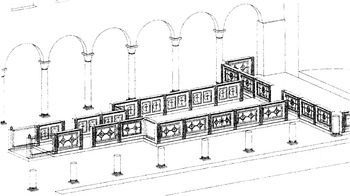
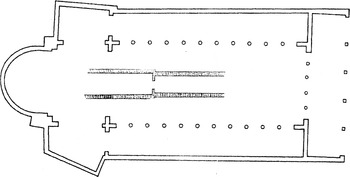
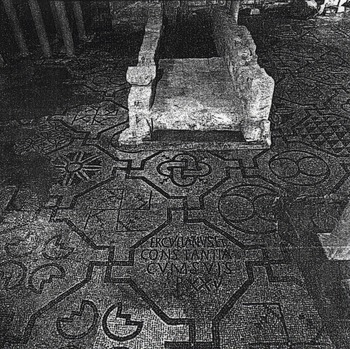
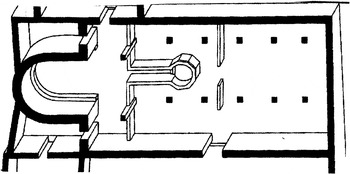
Evidence of the earliest Roman solea was discovered during the nineteenth-century excavations that brought to light the first church of San Clemente (fourth century), severely damaged during the sack of the Rome by the troops of Robert Guiscard in 1084. A few years later, it was filled with rubble and a new church erected above the old. Its solea, which consisted of sculptured marble plaques joined by pilasters, can be assigned to the pontificate of John II (533–35), former priest of the church, whose monogram is displayed prominently on five of the surviving transennae, reused for the choir enclosure of the present church.Footnote 82 The location of impost blocks for pilasters in the floor of the first church permits a reconstruction of the solea of the sixth-century basilica (Fig. 1).Footnote 83 The installation at San Clemente, presumably designed to enhance the introit procession, was contemporary with the Liber pontificalis biography of Pope Celestine. It would have certainly drawn the attention of Celestine's biographer and perhaps suggested to him the need to provide an explanation of how the singing of ‘psalmi ante sacrificium’ began. One cannot exclude the possibility that he had at his disposal other evidence that Celestine had introduced the innovation.
Rome, San Clemente, reconstruction of the solea (early sixth century) from Guidobaldi, ‘Struttura e cronologia’, fig. 2.

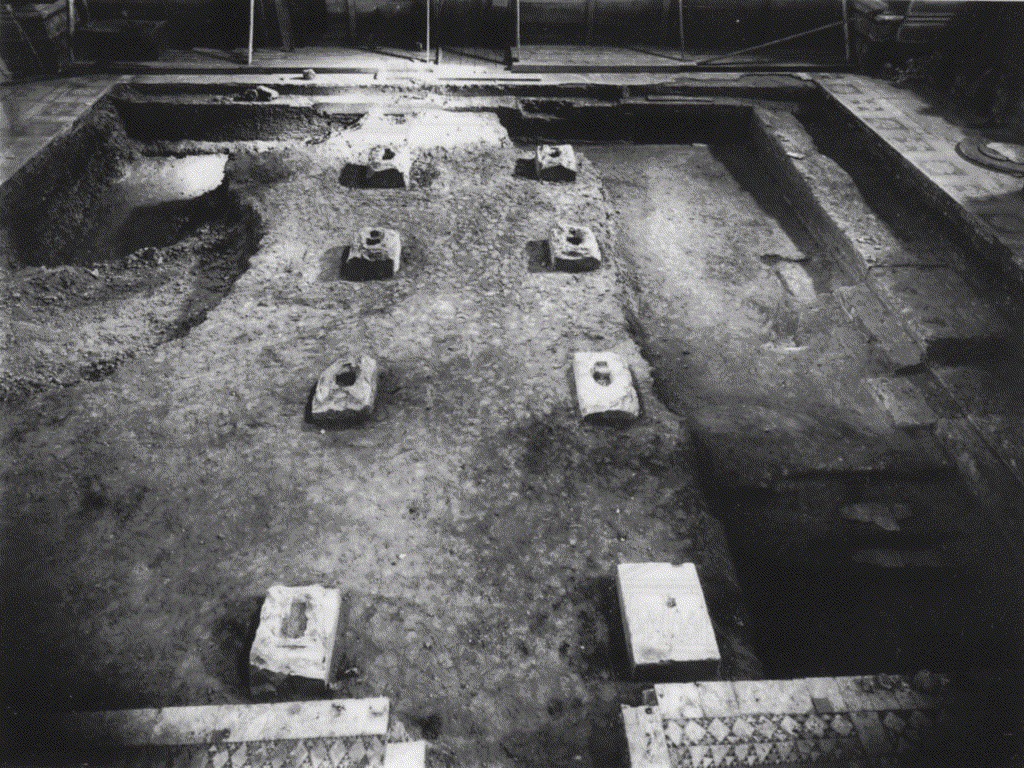
Rome, St John Lateran, impost blocks in the middle of the nave for pilasters that supported transennae of the solea (fifth century?), from a photograph taken during the excavations of 1936.
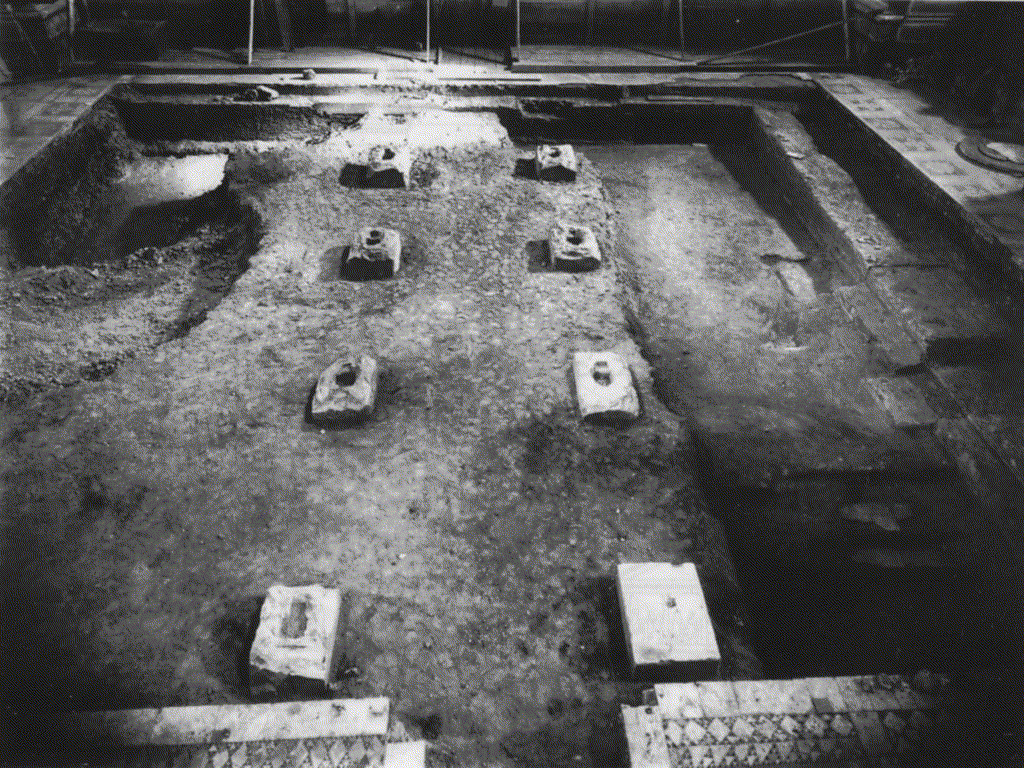
A photograph taken during a brief excavation campaign at San Giovanni in Laterano during the 1930s shows four parallel pairs of impost blocks in the middle of the nave, spaced two or three meters apart (Fig. 2). The holes for the pilasters that supported the transennae can be clearly seen. Hugo Brandenburg and Sible de Blaauw proposed that the solea began not at this point but at the entrance façade.Footnote 84 Such an elongated design would be unique in the context of similar archaeological finds at Rome and in North Italy, and it goes beyond what can be reasonably deduced from the evidence. Although not obvious from the photograph or any published excavation report, the beginning of this processional corridor is probably to be placed about halfway up the nave. Federico Guidobaldi doubted that the solea at St John Lateran could be attributed to the Constantinian phase of the building, and he proposed instead a date contemporary with the San Clemente solea.Footnote 85 Such a processional passageway installed in the bishop's own church would have provided an architectural framework for the introit chant and the solemn entry of the bishop of Rome and his clergy.
Marble panels that were once part of liturgical enclosures, some similar in their sculptural motifs to the San Clemente transennae, are to be seen embedded in walls of porches and sidewalls of present-day Roman churches. Many (e.g., those at S. Maria in Trastevere, S. Agata dei Goti, S. Maria in Cosmedin, S. Martino ai Monti, SS. Cosma e Damiano, SS. Apostoli) may be coeval with those of San Clemente, but the panels displayed were discovered in the course of excavations as flooring material and hence not in situ.Footnote 86 They could just as well have served to separate the presbyterium from the nave. Other panels – for example, at S. Sabina – date to the Carolingian era, though they may have been used to complement earlier installations.Footnote 87 The ‘schola cantorum’ at S. Sabina with transennae from the pontificate of Eugene II (824–27) was devised by Antonio Muñoz in the early 1930s and has no medieval authority.
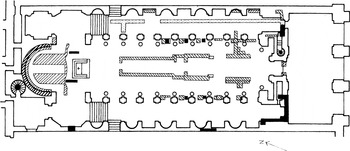
Processional pathways enclosed in brick or masonry walls – and hence necessarily in situ – are more plentiful from the sixth and seventh century at Rome, although many of them cannot be dated very precisely. Some were two-stage constructions such as San Clemente. Such an enclosure at San Pietro in Vincoli (Fig. 3; 4.20m and 3.40m, beginning 16.30m from the façade) may have been installed in the early fifth-century church, but it may date from the rebuilding under Sixtus III (432–40).Footnote 88 The church of S. Stefano in via Latina, built c.450, also had an enclosed structure in the nave consisting of parallel walls 4.20m apart that extended about 12m into the nave.Footnote 89
Rome, S. Pietro in Vincoli, plan showing placement of the masonry walls of the solea (late fourth century?), from Guidobaldi, ‘Struttura e cronologia’, fig. 11.

Rome, San Marco, plan showing placement of masonry walls of the solea (sixth century?), from Matilda Webb, The Churches and Catacombs of Early Christian Rome: A Comprehensive Guide (Portland, OR: Sussex Academic Press, 2010), 146. (The altar was at the south end of the pre-Carolingian church.)

The present church of San Marco, the third erected on the site, dates from the time of Gregory IV (827–44). Its present orientation (apse to the north) reversed the orientation of the previous two churches.Footnote 90 The two-stage solea (Fig. 4; 3.70m and 3.00m wide; approximately 17.0m long) was installed in the second church in two successive campaigns: the wider section contiguous with the presbyterium being the older part. Since there exists no agreement about the dating of the second church, neither can its solea be dated. Richard Krautheimer dated it to the later sixth century (579–90), but Margherita Cecchelli prefers a century later, when Hadrian I (772–95) restored the church. Similar uncertainty surrounds the two-stage solea in the fifth-century church of S. Crisogono located in Trastevere.Footnote 91 A frequently reproduced excavation drawing documents the presence of a masonry wall on the south side of the nave, an area that has yet to be excavated. It could date from any one of a number of decorative campaigns (mid-fifth century, c.600, or the pontificate of Gregory III (731–41), who installed the annular crypt). Less certain is the existence of a solea in the church of S. Balbina, near the Baths of Caracalla. Antonio Muñoz claimed to have found traces of a ‘schola cantorum’, which he attempted (not very convincingly) to replicate in the present church.Footnote 92 The marble slabs (transennae) he discovered in the floor were no longer in situ.
The archaeologist Federico Guidobaldi surveyed all the evidence uncovered in the excavations of Roman churches and concluded that soleae were more prevalent in the sixth and seventh centuries than the fifth.Footnote 93 Their popularity, continuing into the ninth century, suggests that such structures continued to be valued enhancements of the dignity of the clerical entrance procession. They precede by as much as a century the description of the grand papal entrance procession described in Ordo Romanus I.
Victor Saxer, taking up a suggestion of the lexicographer Charles du Cange (1610–88), argued that the term ruga/rugae, found in the Liber pontificalis fourteen times (always in the plural) referred to this processional passageway.Footnote 94 He thus disagreed with Louis Duchesne (and practically all later commentators), who interpreted rugae as the gates that closed off precincts reserved to the clergy.Footnote 95 According to the Liber pontificalis, popes made donations of rugae to the major basilicas. Only under Paschal I (817–24) and Sergius II (844–47) did a few titular churches receive ornaments of this type – here called rugula. The contexts imply that rugae led to something, that they were located before the presbyterium, confessio or altar. They are described as solid objects made of precious metals, the weight of which was duly supplied by each papal biographer, as was the custom. One ruga is described as of gold adorned with precious stones (Leo III at St Peter's and at St Paul's), not a description applicable to marble transennae, even those destined for the basilica of the prince of the apostles. More than one ruga could be installed in a single decorative campaign, as was the case at St Peter's, when Paul I placed rugae on opposite sides (utraque parte dextera levaque) of the presbyterium. A similar intervention is attributed to Hadrian I, who had two silver rugae installed in St Peter's in front of the presbyterium, one on the left the other on the right (a parte virorum et mulierum) and an additional one at the entrance to the presbyterium before the grave of Peter (in caput presbiterii ante confessionem). All of this evidence supports the conclusion that rugae were gates of some sort, either of wood or metal grillwork, upon which objects (statues, lamps?) could be placed. Functional marble ‘furniture’ or masonry construction did not merit such notice from the Liber pontificalis.
Non-Roman soleae
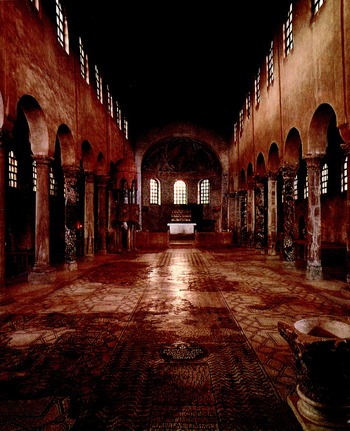
The earliest Roman solea may have been inspired by comparable installations in churches of the North Adriatic littoral (the Veneto, Friuli, Istria, Dalmatia), the earliest of which can be dated to approximately the second half of the fourth century.Footnote 96 (See the Appendix for a listing of representative examples.) Evidence for their existence is of two kinds: (1) distinctive narrow bands of mosaic extending from the mid-point of the nave to the presbyterium or (2) a similarly placed raised passageway enclosed by either transennae or masonry walls. The first type can only be suggestive: such mosaic fields could have been merely decorative, as seems to be true of the basilica meridionale at Aquileia (c.320).Footnote 97 A later specimen of this type, a broad strip of mosaic with an undulating pattern suggesting waves runs through the centre of the nave in the basilica of S. Eufemia on the nearby island of Grado (Fig. 5).Footnote 98 Processional use of these mosaic soleae is sometimes confirmed by the presence of strips of stone on either side of the walkway pierced at regular intervals for the posts that supported transennae. Such is the case at Pula (Croatia) and Aosta (Italy).Footnote 99
(colour online) Grado, S. Eufemia, from Cuscito, Grado e le sue basiliche paleocristiane, fig. 7.

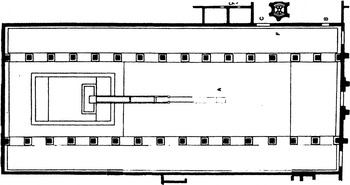
Aquileia, Basilica post-teodoriana nord (c.350), from Bertacchi, ‘Un decennio di scavi e scoperte’, fig. 1.

The twin basilicas (north and south) at Aquileia, built before 320 by Bishop Theodore, served as models for churches of the region.Footnote 100 In the middle of the nave of the north church was installed a mosaic band 28m in length. Within two decades the church was soon quadrupled in size, very likely by Bishop Fortunatianus (342–58), the so-called basilica post-teodoriana nord. In the course of this building campaign, a solea raised 15cm above the pavement and 1.80m wide was installed. It stretched from the altar (located forward in the presbytery) to the middle of the nave, a distance of 16m (Fig. 6).Footnote 101 Excavations east of the medieval campanile have revealed the eastern end of the solea and the presbyterium, but the area was subsequently covered over with earth and can no longer be viewed. Since the north church ceased to be used by the second half of the fifth century – a combination of Attila's devastation and a diminishing population – the solea must be dated before the mid-fifth century. How the solea was used in the Aquileian liturgy will never be known, because there survive no early liturgical books of any kind from Aquileia. The introduction of the Roman liturgy towards the end of the eighth century under the patriarch Paulinus (787–802) and his successors eliminated the ancient liturgy.Footnote 102
Soleae of the second type (raised passageways), inserted in pavements subsequent to the construction of the original floor, sometimes concealed mosaic installations of the first type. An excavation in Piazza della Vittoria (olim della Corte) on the island of Grado revealed a church with a raised solea installed in the early sixth century over the original mosaic.Footnote 103 At Fondo Tullio (Beligna; 1.70km from Aquileia) a similar solea installation may be attributed to a fifth-century restoration, perhaps necessary to repair damage caused during Attila's passage through the area. Excavation of a church at Invillino – Ibligo (Colle di Zuca; fifth or sixth century) revealed an oblong floor area in the centre of the nave paved in small tesserae.Footnote 104 Shallow, narrow cavities on either side of the mosaic were intended to receive transennae, probably of wood.
An excavated church whose remains display aspects of the Aquileian model is the basilica at Iulia Concordia (present-day Concordia Sagittaria, 15km from Aquileia). At the dedication of this church in 389 the sermon was preached by Chromatius of Aquileia (388–408), a fervent promoter of church building on a grand scale in the ecclesiastical province under his jurisdiction.Footnote 105 When the mosaic floor was covered with cocciopesto (a kind of terrazzo), the original short (1.85m) pathway to the altar was extended to form a raised solea with a length of at least 8.50m raised 40cm above the original floor (Fig. 7).Footnote 106 An ambo was located on a podium outside the solea immediately in front of the presbyterium.Footnote 107
Iulia Concordia (Concordia Sagittaria), nave looking towards the presbyterium with remains of the raised solea; the base of the ambo is towards the rear on the left, from Da Aquileia a Venezia, fig. 275.

Geneva, St-Pierre (cathedral), reconstruction of the south church of the double basilica (fourth century), after Franz Gläser, Fruhes Christentum im Alpenraum, fig. 86. Note that the enclosure cannot be entered from the nave.

Typically, the end of the solea farthest from the presbyterium is rarely preserved, a fact of some importance, since a passageway allows movement in either direction – a procession from nave to altar or a procession from the presbyterium to a bema or pulpit in the nave from which the Gospel would be read. There are a number of cases (none of them Roman) in which the solea gave access to a (typically hexagonal) structure reserved for the proclamation of the Scriptures. Remains of soleae that lead to such platform have been discovered at Cologne (second half of sixth century), Boppard (first half of sixth century), and Trier in the Rhineland, as well as at Geneva (fifth century; Fig. 8) and Vienne (second half of sixth century).Footnote 108 No evidence of this type has been unearthed at Rome. Conceivably, a solea could have been used for either ceremony; both called for an enhanced degree of solemnity. On the rare occasion that an ambo is present elsewhere in the church (e.g., at Iulia Concordia) the solea's function as a processional entryway is clear.
News of the intense building activity along the North Adriatic littoral would have arrived at Rome just as churches were being newly erected or restored. Visitors from the North and members of the embassies dispatched from Rome to Ravenna or Constantinople to plead (usually in vain) for the exarch's or the emperor's protection from the attacks of Germanic armies would have brought word to Rome of splendid new basilicas arising in the region around Aquileia. The most distinguished member of the Roman clergy to have spent time in this region was Pope Innocent I (d. 417). Having come to seek help from the exarch to defend Rome from the approach of Alaric (a forlorn hope, as it turned out), he remained in the region for three years (until 412), during which time he was surely invited to visit some of the awesome churches of Aquileia and the surrounding area. No Roman soleae can be attributed to his pontificate, but the slightly later church of S. Crisogono in Trastevere honoured an Aquileian martyr, the immediate predecessor of the same Bishop Theodore who founded the twin basilicas at Aquileia. Might it not have been deemed appropriate to include a distinctively Aquileian feature in the new church? None of the Roman soleae can be securely dated to the fifth century, though those of San Pietro in Vincoli and San Stefano in via Latina have been dated to this period. A few must have been present in Rome by the closing years of the fifth century. By the time the first edition of the Liber pontificalis was compiled, a solea had already been erected at San Clemente. (The design of the possibly contemporary solea at the Lateran cannot be ascertained.) Could the sophisticated bi-partite design at San Clemente be the first installation of its type at Rome? It does not replicate the single-passageway Aquileian model, which had a constant width throughout. Perhaps it was a distinctive Roman adaptation of a simpler format.
Conclusions
It cannot be determined with absolute certainty what kind of musical change Pope Celestine I introduced. Nor is it clear on what basis the author of Celestine's biography in the Liber pontificalis attributed to him the introduction of singing ‘psalmi ante sacrificium’. For this reason, I have endeavoured to clarify what the pope's biographer intended to convey, based first of all what he understood by sacrificium.Footnote 109 Though applied sometimes in the narrow sense to the Eucharistic portion of the Mass, sacrificium was likewise a familiar Roman term for the entire Mass. Celestine himself understood sacrificium in this way, as did his successor, Leo the Great, and also (as I have argued) the compiler of Celestine's biography in the Liber pontificalis. Accordingly, ‘psalmi ante sacrificium’ is most likely to be interpreted as a reference to the introit, introduced sometime in the fifth century, if not by Celestine himself. The addition of ‘antephanatim’ by the reviser of Celestine's biography points in the same direction, that is, an intention to credit the pope with the institution of the introit chant. The objection that a number of ancient feasts have non-psalmic introits does not invalidate my conclusion. Some, like the Sundays of Advent or the second and third Masses of Christmas, do not belong to the primitive liturgical stratum; other non-psalmic introits (Lent, Easter Week) may well be the product of liturgical revisions. The Vulgate readings in many non-psalmic introit texts cannot, however, be adduced as evidence of a later date, since any of these readings are close to, or the same as, the equivalent Old Latin ones.
I have pointed to the presence in some Roman churches of a walled passageway (solea) leading from a point midway down the nave to the presbyterium as addition evidence for the presence of the introit in the Roman Mass by the beginning of the sixth century. Modelled after similar processional ways in North Italian churches, soleae enhanced the ceremonial entrance for Mass of the bishop of Rome or a titular priest. The Roman soleae were thus visual analogues to the psalmi sung by the schola cantorum as the pope and his clergy approached the altar to celebrate the sacrificium.
Appendix: Soleae in churches of north Italy and the Adriatic coast