‘Writing and producing yourself’: a brief discussion of originality
In December 2005, the ArjanWrites music blog asked its readers to submit questions destined for Alison Goldfrapp, lead singer of British electro-pop duo Goldfrapp, for an interview that was to take place during her promotional tour of New York City (a trip coinciding with the North American launch of Supernature, the band's third album). The first question asked by the blogger on behalf of his readership was the following:
(Question from reader Peter J.): In several publications it was stated that you think Madonna's music is unoriginal. Were your comments taken out of context?
Alison: No. Do I have to go over this again? She has made a career out of using other people, like the latest DJ or whatever person, to kind of build her music for her. It is a clever way of making her music. It is very different than what we do. We're actually writing and producing all of our music ourselves. (ArjanWrites, Reference ArjanWrites2005. My emphasis.)
As part of her response, Alison Goldfrapp did not hold back in reproaching Madonna for what seems like her abusive and unabashed recourse to the best and most popular producers at hand (an accusation apparently based upon the idea that Madonna excels at the so-called ‘vampirisation’ of other artists’ talents). She was referring at the time of this interview to Madonna's relationship with British musician, producer and disc jockey Stuart Price, with whom the pop star had recorded tracks for her American Life (2003) and Confessions on a Dance Floor (2005) albums. (Incidentally, Price was also the musical director of both tours following the release of these long players.) However, in her response, Alison Goldfrapp neglected to mention that, in 2003, her band had also called upon the services of the same Stuart Price for producing a remix of the song ‘Twist’ (taken from Black Cherry, their second album). Yet the fact they had turned to Price for a remixing job is basically no different from Madonna doing the same for the co-writing and the producing of some of her album material: the difference is that Goldfrapp and her fellow band member Will Gregory write and produce their own music by themselves, something Madonna apparently cannot do without the help of hired industry professionals.
Furthermore, Alison Goldfrapp's comments seem subtly yet stereotypically gendered: they posit Madonna as an alleged passive subject while her (predominantly) male collaborators are actively ‘building her music for her’. Such criticism might even suggest that a mainstream female pop star such as Madonna is unable to work her way in the studio environment without these male counterparts. Goldfrapp's assertions regarding this specific type of performing female/producing male relationship are reminiscent of what Emma Mayhew, in a paper titled ‘Positioning the producer: gender divisions in creative labour and value’, calls ‘patriarchal discourses’ in rock and pop music. For Mayhew, these discourses ‘mobilise individual authority in a narrow and limited way, and often attempt to deny female performers authenticity as creative subjects’ (Mayhew Reference Mayhew, Whiteley, Bennet and Hawkins2004, p. 153). In this context, ‘the male producer becomes the rational father figure to an infantilised undisciplined femininity’ (Mayhew Reference Mayhew, Whiteley, Bennet and Hawkins2004) by providing the female subject with technical knowledge, experience and overall virtuosity and musicianship. As her answer continues, Alison Goldfrapp might recognise Madonna's own inventiveness, but in the realm of self-image creation, not sound production:
But what she's doing is not really that different than what singers did in the ’60s. Or it is like Massive Attack. Where Massive Attack is the label and then other singers come in to do the vocal parts. I'm not a particularly big fan of Madonna's music. I can't get passionate about the music she puts out there. I think her persona is far more fascinating for me and for a lot of people. She's been amazing inspiration to women and I think it is fantastic that she's 47 and still does what she's doing. I think that's quite inspirational.
In light of these claims, we should remind ourselves that popular music, in the post-MTV era, is polymorphous in nature. Analysis in pop music and culture should therefore encompass all arrays of creation, from music composition and production to photographic and video imagery as well as live performance settings. In that regard, Stan Hawkins points out Madonna's mastering and redeploying of popular music's various codes and tropes: ‘Perhaps the dominant feature of her [Madonna's] aesthetic, then, is sounded out through the coming together of a wealth of musical elements that define her role. I am referring to a role in which authority becomes a dramatic fiction in itself’ (Hawkins Reference Hawkins, Whiteley, Bennet and Hawkins2004, p. 188). In other words, the construction of a pop star's public self through a multifaceted artistic work (either musical, lyrical or visual) such as Madonna's serves as a way to assert original authorship for the artist, even when this authority and its related authenticity explicitly appear in the end to be a ‘fictional construct’. Mayhew means the same thing when she argues that ‘if an artist is seen as having some input into the more technical roles of the recording process, even the decision-making process of hiring a producer, it can help maintain some musical credibility’ (Mayhew Reference Mayhew, Whiteley, Bennet and Hawkins2004, p. 155). This is how, for instance, a decision about aspects of production can be turned into an authorial gesture in itself and, as a result, considered a challenge to the aforementioned gendered roles by affecting the creation and meaning of pop songs.
The assumption to be drawn regarding patriarchal discourses on popular music authorship, at least from the vantage point of Alison Goldfrapp as it was expressed in this specific interview, is the following: the greater the perceived distance between the original artist and the result at the receiving end, the less authenticity a song will have, in the sense that it is ‘divorced’ from its origins. In other words, because it delegates recording processes and studio mastering techniques to another, the operation and its products are somehow rendered unoriginal. This is precisely what Allan Moore refers to when he talks about ‘authenticity as primality’: ‘wherein an expression is perceived to be authentic if it can be traced to an initiatory instance’ (Moore Reference Moore2002, p. 213). It would be entirely acceptable for a recording artist, then, to recruit the talents of a fashionable producer to remix a particular song if the artist is the writer and producer of the original, that is to say in a relationship of ‘unmediated’ (Moore), direct proximity to it. Therefore, one can argue that Alison Goldfrapp's criticisms of Madonna are directly linked to her belief that Madonna is not at the essential, true origin of her own music, due to the fact, as stated earlier, that she shares writing and producing credits with others.Footnote 1
DJ culture and meta-authorship
Such challenges posed to traditional patriarchal discourses on authenticity and the Romantic notion of originality are not exclusive to mainstream pop artists such as Madonna. They were also put forward, from the early 80s up to today, by the electronic dance music (EDM) scene and community, namely house and techno producers and disc jockeys (DJs). More precisely, the very nature of the DJ's work, through the selection and combination of pre-existing material mostly created by others, questions these assumptions by redefining, through ‘destruction/preservation’ dialectics, the very idea of the ‘original’ artist. As Ulf Poschardt states in his pioneering essay entitled DJ Culture:
the DJ appears on the music scene to interrogate and partially destroy the archaic notion of art that has managed to survive into the aesthetics of the late 20th century. The artist as the creator of his work, as an autonomous genius, came into being in the Renaissance, and has repeatedly had his status confirmed by the idealist aesthetic: as an alter deus and a superman. Only the avant-gardes of the 20th century shook this idea to its foundations. […] The DJ occupies exactly the same ambivalent place between the destruction and preservation of the idea of the artist. (Poschardt Reference Poschardt1998, p. 16)
Other cultural studies researchers interested in EDM and DJ culture share these positions. For Jeremy J. Beadle, for instance, ‘the breakdown of authorial certainty and omniscience is traditionally a hallmark of modernism’ (Beadle Reference Beadle1993, p. 17), and he sees it at work in sampling practices from artists such as Stars on 45, M/A/R/R/S and The KLF. For Tony Langlois, an activity like deejaying imposes a redefinition of expressive originality, as ‘DJs create original music as “bricoleurs”, using a wide range of sound material, some not obviously “musical”, in an organised, expressive way’ (Langlois Reference Langlois1992, p. 235). French researcher Jean-Yves Leloup furthermore insists on the author's very ‘dilution’ (Leloup Reference Leloup2006, p. 177) emphasised by DJ culture as it leaves traditional authorship in a confused state overall; he even sees this phenomenon as characteristic of postmodern subjectivity. Finally, for someone like Kai Fikentscher, the very act of deejaying in a rave or dance club context relies, in itself, on the idea of ‘interactive/collective performance’ (Fikentscher Reference Fikentscher2000, pp. 76–7): in live settings, the dancer and the DJ are caught up in a dialectic exchange during which the performance of one is fuelling/fuelled by the performance of the other, thus rendering the proper ‘origin’ of the rave impossible to establish firmly.
Following these introductory remarks, this paper explores the relationship between authorship and originality in popular music, especially in EDM and DJ culture. More specifically, I investigate how a so-called ‘unoriginal’ musical work such as the cover version, in the context of dance music culture, can be used by an artist for self-creation, and serve the purpose of identity construction. Paradoxically, these unoriginal practices give rise to a renewed sense of authentic ‘meta-authorship’, with consequences for the artist's identity, image and overall representation. In short, the notion of the ‘theological Author’ may be put to ‘death’ by modern artistic undertakings (Barthes Reference Barthes1977) such as the ‘building of one's music by others’ (Goldfrapp) or by the use of one's music by others through record mixing, song covering or track remixing (as seen in DJ culture), but the representational modalities of this skewed meta-authorial subjectivity have yet to be thoroughly analysed.
A recent point of departure, in methodological terms, is Mark Gillespie's musicological research on the recording processes he calls ‘phonographic forgery’ and ‘sound signature’. Through such processes, a producer can inscribe his/her own musical identity traits ‘on a purely sonic level within musical texts’ (Gillespie Reference Gillespie2007, p. 30). These are typical of recording methods used in contemporary urban music (namely hip-hop and R'n’B) and EDM (techno, house, etc.) in which the traditional distance between performer as ‘original author’ and producer as ‘technological translator’ is abolished. As Gillespie puts it:
the meaning of a musical text now has as much to do with how sound is inscribed, as it does with what material is inscribed, or, perhaps, that these two levels of sound – the concrete and abstract – are simply no longer separable in the popular recording. Hence, the performative and technological parameters have converged within the recording process to the extent that the record producer's role is no longer to ‘translate’ information from performance to recording; rather, it is to form the very ideas and information being communicated through or in the process of recording and not before it. (Gillespie Reference Gillespie2007, p. 25; the author's emphasis)
It is precisely the operations performed by the techno producer while creating a new track out of a pre-existing one – i.e. the ‘how’ and ‘what’ of producing – that interest me, since these operations allow access to the process of identity construction. Another methodological cue comes from musicologist Mark J. Butler. In his book, Unlocking the Groove. Rhythm, Meter, and Musical Design in Electronic Dance Music, Butler insists on the necessity of understanding how individual EDM tracks are produced, since the signification of the entire rave/dance club experience relies on this primary material:
[i]ndividual unmixed tracks are important, in both musical and social ways. In addition to being the locus of activity of the producer, unmixed tracks are always the starting points for DJ performances, or ‘sets’. Consequently, to understand how and why DJs choose particular records, alter their sound, and combine them with other records to create a larger musical whole, we must become thoroughly acquainted with the characteristics of individual tracks; in short, we cannot understand the building unless we also understand the blocks. (Butler Reference Butler2006, p. 21)
The current analysis also stems from this need to ‘understand the blocks’, i.e. to comprehend and interpret the ‘how’, ‘what’ and ‘why’ of EDM production and the challenges they present to subjectivity and identity when it comes to practices such as the cover version. That said, my own academic background being in literary studies and semiotics, the results presented here rely mostly on a method inspired by the linguistics of enunciation (especially with regard to subjective markers related to the who, where and when of enunciation) and on French literary theory's definition of intertextuality and transformative practices known as the ‘hypertextual’. Accordingly, I draw attention to the various marks left, on the enunciation level, by this ‘unoriginal’ meta-author we find in DJ culture and to the relation between these marks and the matters of generic conventions and identity politics. I do so by using disc jockey and producer Tiga as a paradigmatic case. Such an approach offers an alternative way to elucidate how meaning circulates in popular music as well as how re-versioning can engender new forms of authenticity and identity in the postmodern cultural context.
Dance music, Tiga and the cover version
The work of internationally renowned Montreal-based disc jockey Tiga Sontag is closely linked to the subjects of song covering and intertextuality, and these matters inform his pioneering position on the Canadian EDM scene. Regarded as one of the founders of the rave movement, both in Montreal and the rest of Canada, Tiga is credited with organising what many consider to be the first Canadian rave, Solstice, held in Montreal in 1993. In 1994, he launched DNA Records, the first retail boutique in Montreal devoted entirely to the sale of EDM. Around the same time, he opened Sona, the city's first afterhours club. He then went on to establish Turbo Recordings in 1998 (then briefly called Marquis Recordings), a record label aimed at distributing his own recorded mixes on compact disc (Montreal Mix Sessions – Tiga: Live, 1998), as well as those of other DJs from across Europe (Jesper Dahlbäck, ADNY) and North America (DJ Laflèche, Fred Everything, Kenny Glasgow).
In addition to his career as a DJ and label owner, Tiga is also a music producer and singer. After the release of four DJ-mix compilations and some well received techno tracks with vocals (‘Burning Down’ in 2003; ‘Pleasure from the Bass’ in 2004), he recorded a first artist album, Sexor (released in early 2006 in Europe on Belgian imprint Play It Again Sam and in North America on Last Gang). This album included original compositions such as ‘Far From Home’ and ‘3 Weeks’ as well as cover versions of Public Enemy's ‘Louder Than a Bomb’, Nine Inch Nails’ ‘Down In It’, and Talking Heads’ ‘Burning Down the House’. Ciao!, his second artist album (Play It Again Sam, 2009), arguably displays a newfound sense of authorial confidence, considering it consists of 11 original songs; nonetheless Tiga's artistic work as a singer and producer draws attention to itself by blurring the traditional distinctions between original composition, sample-based track and cover version. This phenomenon was exemplified by Sexor's first single, ‘You Gonna Want Me’. The piece incorporates lyrical and melodic elements from the 1976 B-side ‘I Know’ by soul singer Candi Staton and from British hardcore rave duo Altern-8's ‘Infiltrate 202’ (a remake of Bowa's 1991 house classic ‘Different Story’, which is itself a cover version of the Staton track) in addition to original, non-borrowed parts co-written and co-produced by Tiga himself with Belgian brothers Stephen and Dave Deweale (of Soulwax/2 Many DJs). He also shares singing credit on the song with Jake Shears (the main vocalist for New York disco band Scissor Sisters), thus obscuring the boundaries even more between the roles of writer, producer and singer.
This ambiguous attitude toward authorship was not new for Tiga, considering that he launched his singing career with cover versions, most notably with a hip-house take on American rapper Nelly's ‘Hot in Herre’ in 2003. Tiga's elaborate video featuring dancing marionettes earned him precious airtime and exposure on Canadian television music stations such as Musique Plus and Much Music. But it was his remake of the hit single ‘Sunglasses at Night’, popularised by fellow Montreal artist Corey Hart in Reference Hart1983, that gave Tiga his first taste of commercial success in 2001. Produced with the help of self-proclaimed ‘God of synths’ Zyntherius, aka Finnish producer and Turbo-affiliated Jori Hulkkonen, it went on to sell over 200,000 copies across Europe, mainly in Germany and the United Kingdom, where it broke into the Top 40 in the charts and gave Tiga access to mainstream stardom with an appearance on the BBC's Top of the Pops programme. A few years later, in September 2008, the track was re-released with new remixes to celebrate Turbo's 10 years of existence, and it reached the #1 position on Beatport, a popular online store specialising in the sale of electronic music in digital formats.
Without taking into consideration Tiga's repeated commercial successes with ‘Sunglasses at Night’, his work as a singer (maybe even more than as a DJ) is of interest since it challenges notions of authorship and originality. First of all, as previously mentioned regarding Madonna, Tiga himself calls upon the talents of a multitude of international artists to compose and produce songs with him, including the aforementioned David and Stephen Dewaele and Jori Hulkkonen, but also Jesper Dahlbäck of Sweden, Montrealer Mateo Murphy (as TGV), Canadian pianist Gonzales or Gareth Gaytex (pseudonym of Richard Philips, aka Richard X), to name just a few. Following the axiological system adopted by Alison Goldfrapp earlier, one would be correct in saying Tiga is not the true ‘author’ of parts of his repertoire, in the sense that he neither writes the lyrics nor composes the music for some of his own songs. As a result, he seems to have built a career mostly by remaking or remixing songs made popular by others. That said, a cover version like ‘Sunglasses at Night’ can also lead us to revisit the traditional, patriarchal and heteronormative notions of author and originality in popular music, specifically because these notions were initially rendered problematic by the DJ and rave cultures of the 1980s and the early 1990s, but also because of the intertextuality of the song and its accompanying imagery. For this reason, I first focus on the poetics of intertextuality in Tiga's work and its consequences for identity representation.
Intertextuality and hypertextuality as transformative practices
Intertextuality is broadly defined as the presence of one text within another: ‘The basic premise of the theory of intertextuality is that any text is essentially a mosaic of references to or quotations from other texts; a text is not a closed system and does not exist in isolation. It is always involved in a dialogue with other texts’ (Macey Reference Macey2001, pp. 203–4).Footnote 2 That said, the notion is not limited to written words: sampling in popular music, for instance, is an explicit example of the process. A cover version such as ‘Sunglasses at Night’ is also highly intertextual, soliciting lyrical, musical and even visual elements from a previous text and redeploying them within a new (con)text. Intertextuality can also be more implicit and elusive, as Mark Gillespie suggests, with the use of various ‘signatures’. According to Gillespie, signatures are ‘a collection of sound material consistently worked into a body of recordings by a producer or group of producers as a means of identifying production authorship on a purely sonic level within musical texts’ (Gillespie Reference Gillespie2007, p. 30). In other words, intertextuality is not only the presence of one musical utterance within another, but it can also refer to the concomitance of various enunciators (or ‘voices’) in one single utterance.
For the study at hand, the intertextual process of covering a pre-existing song is defined, according to musicologist Serge Lacasse, as ‘hypertextualisation’. The term itself is borrowed from French narratologist Gérard Genette in Palimpsests. Literature in the Second Degree, an essay presenting the various modalities of intertextuality. For Lacasse, following Genette, a ‘hypertext’ is an artistic undertaking that results from the transformation or imitation of a previous work, known as the ‘hypotext’. Additionally, the transformative or imitative processes can take various forms, from the parody or the pastiche of a previous text to its strict copy or general reinterpretation (Lacasse Reference Lacasse2000, p. 52). Here, ‘Sunglasses at Night’, originally written by Corey Hart, produced by Jon Astley and Phil Chapman, and released in 1983 on the First Offense album (Aquarius Records/EMI), is the hypotext, while the version released by Tiga and Zyntherius in 2001 and 2008 (International Deejay Gigolo Records/Turbo Recordings) is the hypertext. Because the song is transformed from one specific musical genre to another, Lacasse would call this precise hypertextual practice ‘trans-stylisation’, since Tiga and Zyntherius are bringing Hart's pop hypotext into a new style, namely techno music, with no apparent intention of it being a parody. Because trans-stylisation is transformative, it implements certain modifications on a musical level; however, in the case of Tiga, it equally implies a reworking of the original lyrics and, more generally, a modification of the linguistic markers such as pronouns found in them, thus affecting the song's very enunciation. Consequently, the sense of the original hypotext is itself modified through trans-stylisation, and we are left with a completely novel symbol, an ‘honest and authentic’ original piece, as Don Cusic says in his paper ‘In Defense of Cover Songs’ (Cusic Reference Cusic2005, p. 177). In light of the representation of identities, namely gendered identities and their relation to generic conventions proposed herein, this new hypertext resonates back to the original hypotext and affects its overall meaning.
For me, it is precisely the masculine identity enacted by Corey Hart in Reference Hart1983 that has been perverted by the stylistic transformation carried out by Tiga and co-producer Zyntherius in 2001. I return later to the question of visual representations of gender identity in relation to the two videos of ‘Sunglasses at Night’ (Hart's and Tiga's) and the artwork of each release (of 1983, 2001 and 2008), as this is where the matter of sexed identities and gendered performances are the most apparent and telling. For now, I examine in greater depth the subtler consequences of trans-stylisation from hypo- to hypertext: firstly, as it relates to the music; secondly, as it relates to the lyrics. In all matters, the analysis aims to establish how unoriginal hypertextual practices such as the cover version affect the overall representation of subjectivity and gendered identities in EDM in the post-MTV era.
Conflicting genres, conflicting genders: cock rock versus new pop
The original ‘Sunglasses at Night’ by Corey Hart was initially released in 1983, shortly after the launch of the music television network MTV in 1981. Firstly, it should be noted that as well as allowing artists access to a brand new mode of expression (the music video) while taking full advantage of an already popular mode of diffusion (the television set), MTV was also instrumental in putting emphasis on the visual aspect of popular music performances. It is well established that artists such as Madonna, Michael Jackson, Annie Lennox and Prince, just to name a few exemplary cases, found new and inventive ways to portray themselves and play with various gender-related signifiers through the medium (see Hawkins Reference Hawkins2002). But the overall accentuated attention given to the performer's playful image following the subsequent rise of the network was not restricted to mainstream stars: it also became one of the dominant features of the popular music of the era, especially with the arrival of the New Romantic movement. The original release of ‘Sunglasses at Night’ has to be placed in this precise cultural context.
Also referred to as ‘new pop’, New Romantic performers embodied, according to Stan Hawkins, ‘the ongoing transgression of identity boundaries taking place in early 1980s pop’ (Hawkins Reference Hawkins2002, p. 104). This transgression was effectively exemplified by synth-based recording artists from the UK such as Eurythmics, Orchestral Manoeuvres in the Dark, Duran Duran, Spandau Ballet, A Flock of Seagulls, Depeche Mode, Culture Club and numerous others, who filtered disco's festive sensibility through the cold prism of European electronic experimentalists such as Kraftwerk and Giorgio Moroder. Moreover, the New Romantics continued the challenge to gender-related conventions in popular music initiated by British stars of the 1970s such as David Bowie or T-Rex's Marc Bolan by opting for an overall visual appearance connoted as ‘feminine’ or at least ambiguously androgynous, especially compared to vintage mainstream Anglo-American rock from the 1970s.
It should be stressed here that most New Romantic artists used the synthesiser as their main writing and performing instrument. It all but emphasised this gender-bending tendency, considering how ‘un-phallic’ it is compared to the electric guitar (or even live drumming). As Steve Waksman puts it, an instrument like the electric guitar ‘is used to invest the body of the performer with meaning, to confer upon it a unique identity whose authentic, natural appearance works to conceal its reliance upon artifice and technology’ (Waksman Reference Waksman1999, p. 5), whereas the synthesiser reveals its very technological nature through colder colours, visible wires and its computer-like interface. By barely demanding body movement from its player, it even denotes immobility, thus passiveness, and can therefore also be connoted, at least from a Western perspective, as ‘feminine’. Only the invention and commercialisation in 1980 of the ‘keytar’ by American company Moog Music challenged that perspective, though briefly and to a limited extent. The electric guitar, on the other hand, usually remains the privileged locus of a male virtuosity that is, right from its origins, bound to strong racial and sexual identity traits:
the electric guitar as ‘technophallus’ was built out of a highly charged relationship between white and black men, within which white men sought to appropriate what they perceived to be the potency of black men. The electric guitar mediated this relationship in at least two ways. Visually, it was used to accentuate the phallic dimensions of the performing male body. Aurally, the volume and distortion generated by the instrument had a similar effect, amplifying the physical presence of the performer. (Waksman Reference Waksman1999, p. 244)
Yet the New Romantic aesthetics was important in the overall challenging of these traditional phallocentric views on ‘vintage’ musicianship. More concretely, it privileged an
ongoing discourse on the role of technology in authentic musical expression, a trope that was especially prevalent in the 1980s, when the enduring presence of synth pop seemed to threaten the dominance of rock aesthetics. Because the individual performer was the source of authentic expression in rock, it was important that he or she be seen as the author of the sounds she [sic] created; displays of effort were a way of highlighting this relationship. In electronic dance music, however, technology often obscures the relationship between music and its creator […]. (Butler Reference Butler2003, p. 4)
Synth-based pop was seen, then, as trivialising the traditional definition of a musical author while revealing its gendered bias. Nevertheless, ‘new pop’ artists were hugely popular in the early 1980s: their aesthetics is remembered, even to this date, as the quintessential ‘1980s sound’. It is in this specific context that we must reposition Hart's musical hypotext, especially since ‘Sunglasses at Night’ is the site of two overarching conflicts related to generic matters: conflictive musical genre conventions on the one hand and oppositional gendered identities on the other.
Corey Hart might discursively position himself as a ‘rock’ artist, but ‘Sunglasses at Night’ remains, stylistically speaking, a ‘new pop’ track, due to its instantly recognisable opening melody played on a synthesiser and its rhythmic patterns played on a drum machine. Paradoxically enough, ‘the synthesiser’, according to Beadle, ‘was the staple of disco music’ (Beadle Reference Beadle1993, p. 73), while Hart presents himself alongside a rock-based tradition. Clearly, after Tiga's version was released to considerable critical and commercial success (at least in Europe) in 2001, Hart felt the need to release the following statement via his official website to reassert what he saw as the intended lineage of his song:
I wrote and recorded ‘Sunglasses at Night’ in the summer of 1983 … I just turned 21 … I was working in what was at the time my musical Mecca, England. Eric Clapton had just played Dobro guitar on one of my songs and I was hanging out at Pete Townsend's house chatting with him about the best London studio rooms and his favourite vocal mic pre-amps. (Hart Reference Hart2002)
Hart saw his own music as being part of the traditional English rock scene, a tradition Clapton and Townsend could have passed on to him through their own musical background and technical training. That probability becomes even more likely considering the fact that Hart was, at the time, a young and inexperienced artist on the verge of releasing his first album. In a way, this is all reflected in ‘Sunglasses at Night’ itself, as the electric guitar track (first appearing during the chorus) literally competes with the synthesiser for the listener's attention. The instrument acts here as a veritable sonic and iconographic signifier of a whole tradition of technical virtuosity and authenticity associated with rock, but equally signifies, again, a very masculine tradition, one might even say phallic (assuming we accept the strictly male references given by Hart). That said, the electric guitar never fully takes over the song; both synthesiser and guitar tracks are heard until the very end of ‘Sunglasses at Night’, thus leaving the listener with an unresolved tension between two oppositional gendered representations. Although Hart himself would probably disagree, the song can even be interpreted as questioning ‘cock rock’ – a challenge that was also ongoing at the time.Footnote 3 For instance, female rockers of the era, such as Suzi Quatro, Joan Jett, Lita Ford and The Bangles tried, so to speak, to beat the boys at their own game by contesting through appropriation the electric guitar's traditionally male connotations and the performance style associated with it. Female punks such as The Slits or ESG, on the other hand, questioned these very assumptions by deconstructing conventional portrayal of genders and musicianship. In that sense, New Romantic aesthetics was part of a broader redefinition of the long male-coded, electric guitar-based tradition. Since Hart's song does not seem to be able, at least musically, to transcend the ‘feminine’ connotation connected to ‘new pop’, it has to find possible conflict resolutions in its lyrical content and its visual representations through artwork and video.
Hart's visual appearance embodies the rock tradition he associated himself with via the ‘rebel’ image signified by his leather jacket and dark sunglasses. Moreover, the conflict between New Romantic and traditional rock aesthetics will transform, visually speaking through the ‘Sunglasses at Night’ video, into conflictive male–female relationships in which the female is seen as what the rebel must reject and keep at distance in order to assert the identity of a viable traditional rock figure. ‘In the rebel imagination’, according to Simon Reynolds and Joy Press:
women figure as both victims and agent of castrating conformity. Women represent everything the rebel is not (passivity, inhibition) and everything that threatens to shackle him (domesticity, social norms). This ambivalence towards the feminine domain is the defining mark of all the classic instances of rock rebellion, from the Stones through the Doors, Led Zeppelin, the Stooges, to the Sex Pistols, Guns ’N’ Roses and Nirvana. (Reynolds and Press Reference Reynolds and Press1996, p. 3)
Traditionally gendered rock, then, affirms its own machismo by fleeing the feminine realm:
The rebel is always running away from home. He defines himself against domesticity and dreads being house-trained; home is precisely where adventures don't happen. Heroic life is only possible when the rebel has made the break, distanced himself from what Robert Bly calls the ‘force-field’ of women. (Reynolds and Press Reference Reynolds and Press1996, p. 43)
Tellingly, Corey Hart's first album, from which ‘Sunglasses at Night’ is taken, is titled First Offense, suggesting the release of the music he recorded is itself insubordinate and outlaw in nature. These connotations are also visible in the imagery associated with the album. Directed by Canadian Rob Quartly, the music video accompanying the release of ‘Sunglasses at Night’ (the album's first single) showcases Hart embodying this rebellious ‘bad boy’ image. Often seen alone and running, he is an outsider confronted by a domineering female character sitting at a desk and representing the menacing bureaucratic apparatus of the Law. At first, the so-called rebellious character seems confined to a bedroom, lying on a single bed connoting domesticity, celibacy and passiveness, or singing from a public telephone booth from which he seems unable to escape. But this overall immobility is interrupted by sequences during which we see Hart running in the hall of a dungeon-like building or being restrained by police officers and escorted to a prison cell. His sentence seems to get a seal of approval from his female nemesis, which confirms the castrating power she has over him. That said, the very last image of the video shows him back in his bedroom sleeping. It ultimately suggests the prison episode was a dream and his outlaw rebellion imaginary, thus recreating on the visual level the same unresolved ambiguity found in the music itself between activity and passivity, masculinity and femininity, cock rockers and New Romantics. At the beginning of Hart's career, it seems we are confronted in the ‘Sunglasses at Night’ video with the imaginary construction of a rebellious subject, but a construction obviously still in process and informed by the gender conflict found in the music itself. Later in Hart's career, at the time of his second album (Boy in the Box, 1985), the ‘Never Surrender’ video (also directed by Quartly) re-enacts the same rebel narrative by showing the male character played by Hart himself fleeing the parental household and small-town life for the adventures of the big city, where his dream of becoming a performing rock star finally materialises. In that regard, the ambiguity found in the ‘Sunglasses at Night’ 1983 video would only have been a temporary phase related to Hart's own ‘immaturity’ as a performer. One could pertinently wonder, then, if this original ambiguity is also found in the cover version recorded by Tiga with the help of Zyntherius in 2001, especially when the musical genre (and the related gender politics) in which it is expressed is so radically different.
Musical trans-stylisation: from MTV rebel to Electroclash dancers
Tiga and Jori ‘Zyntherius’ Hulkkonen both associate themselves with techno music and the overall rave and post-rave scenes: this is the type of music they play as DJs, but also the type of music they produce. Therefore, their trans-stylisation transforms Corey Hart's rock-tinged new pop composition into a completely different style, more precisely the techno subgenre known as ‘Electroclash.’Footnote 4 The specific stylistic traits of this sub-generic scene are defined by Simon Reynolds as follows:
Bored by the entire gamut of post-rave club music on offer – from filter house to trance to Sasha and Digweed-style progressive – a new generation of trendy club kids have rejected the ease-of-release offered by house music's warm pump'n’flow. Essentially, they've taken the E out of house, and rolled back time to the cold, neuro-Euro sounds that originally inspired the guys in Chicago and Detroit.
This new (nu?) generation have abandoned the very ethos of Ecstasy culture: the principles of egalitarian unity and ‘only connect’, the notion of shedding your ego in the hypnotic flow of the music and merging with the crowd, and the ‘in the mix’ aesthetic that treats tracks [as] anonymous components for the DJ's seamless montage. Instead, nu-wave electro-pop songs [known as Electroclash] compete to stand out, through domineering vocals, larger-than-life singers (as opposed to the depersonalised diva-as-raw material approach in most modern dance), witty lyrics, and extravagant amounts of obscenity and trash talk. (Reynolds Reference Reynolds2002)
After the featureless approach to self-presentation most EDM artists opted for in the 1990s, from Daft Punk's refusal to have their faces shown in pictures (and their subsequent hiding behind robot masks) to The Chemical Brothers, Sasha or John Digweed's guys-next-door absence of any recognisable in-fashion style, Electroclash artists put great emphasis on the visual aspects of their performances, from the use of artifices such as fake blood and confetti, elaborate costumes, haircuts and make-up, and complex scenography reminiscent of the looks and stage presence of the New Romantics performers, hence the ‘nu-wave electro-pop’ reference made by Reynolds.Footnote 5
The subgenre of Electroclash acquired notoriety in the 2001–2002 period for bringing back not only the style of early 1980s synth-based ‘new pop’, but also the music from that era via a series of remakes. The cover versions recorded by Electroclash artists included Eurythmics’ ‘Sweet Dreams’ (covered by Miss Kittin and The Hacker), The Cars’ ‘Just What I Needed’ (covered by W.I.T.), Wire's ‘The 15th’ (covered by Fischerspooner), Duran Duran's ‘Girls On Films’ (remade as ‘Girls on Pills’ by The Droyds), and the theme song from 1980s TV series Miami Vice (inspiring FPU's ‘Crockett's Theme’ and ‘Ocean Drive’). What should really be understood from this resurgence of products and ideas from the 1980s is the importance of intertextual referencing, which Reynolds goes on to define as the ‘Eighties-ness’ of the Electroclash movement:
It's an aggregate of attributes (coldness and clean-ness of synth-sound, square-ness and stiffness of groove and rhythm) and absences (obvious examples: the absence of R&B influences, jazziness, ‘blackness’ of feel, is what makes the music sound European [and 80s-like]). (Reynolds Reference Reynolds2002)
Consequently, it is not only the content of 1980s synth-based New Romantic pop that makes a comeback with the emergence of Electroclash, but also its expressive character: cold, distant, cool. As Reynolds puts it, ‘Tiga and Zyntherius's “Sunglasses at Night” suggets [sic] a guy hiding behind an impenetrable mask of supercool, feelings frozen’. Yet, ‘from Divine to Depeche Mode to Human League and OMD, the hallmark of first wave synth-pop was the deeply human and fallible singing on the records’ (Reynolds Reference Reynolds2002), whereas Electroclash artists such as Miss Kittin, Adult., or Artist Unknown favoured vocals that are detached, even alienated and disengaged, a fact highlighted by their common use of the vocoder or Tiga's light digital treatment of his voice on ‘Sunglasses at Night’. The recurring use of such sound effects reveals what Gillespie would call an intertextual sonic signature (Gillespie Reference Gillespie2007, p. 38) that helps create the sense of belonging to a specific scene. Reynolds concludes that the 1980s decade referred to by Electroclash artists through the recourse to such sound effects is a pure construct: ‘Both the deadpan vocal and vocoder trends [in Electroclash songs] show the way that retro movements always reinvent and fictionalise the past. Even when they try hard to be meticulously faithful and purist, they inevitably amplify certain aspects and suppress others’ (Reynolds Reference Reynolds2002). In other words, it seems the construction and reinvention of the past via amplification and suppression stem, too, from intertextual poetics, hence the need to describe and analyse these processes.
The return of both the New Romantic content and style found in Electroclash is of methodological concern to us since Tiga and Zyntherius engage precisely in a type of hypertextual transformation which Gérard Genette refers to as ‘expansion’ (Genette Reference Genette1997, p. 260). Technically speaking, they exaggerate a syntagm of the hypotext (in this case, the melody made with the synthesiser which opens Hart's version) and do away with what surrounds it (most notably, the electric guitar track). Then they superimpose this melody onto a repetitive, 130-bpm rhythmic loop (which itself echoes the almost wearisome repetition of three lyrical utterances) that places the hypertext in the style favoured by Tiga and Hulkkonen in their career as DJs. There is thus an apparent intention within this practice of hypertextual transformation to take a song from 1983 and completely re-contextualise it by choosing to magnify its synthetic attributes. This is done to the detriment of its rock-related characteristics, so it henceforth becomes affiliated with dance music and DJ culture, something that was never originally intended by Hart.
This play on generic affiliations has consequences for generic representations. If intertextual practices such as hypertextual trans-stylisation and expansion seem to be anti-essentialist in nature, challenging the notions of originality, authenticity and authorship, they also put into question, most notably, the sexed divisions on which these essences rely. Since Tiga's trans-stylisation of the song is also concerned with the play on linguistic markers such as pronouns found in the hypotext, it consequently modifies its generic references and affects the gendered identities supported by both the lyrical utterances and their enunciation, as I go on to argue.
Lyrical gender-bending, or ‘switching the blade on the guy in shades’
Tiga himself freely admits that his singing capabilities are, for lack of a better word, ‘limited’. This shortcoming was even pointed out by various music critics upon the release of his first album. For instance, a reviewer for the PopMatters website commented that ‘you can't really take Tiga's rapping seriously’ and lamented the fact his vocals on Sexor ‘have that disembodied/disinterested tone’ (Raper Reference Raper2006, www.popmatters.com). That said, the limitations of his vocal performances on ‘Sunglasses at Night’ are a consequence of both physiological and technological flaws. Tiga emphasises this in a 2008 press release:
Our lack of sample memory in the MPC combined with my hesitancy to sing complex notes (or ANY notes for that matter) is what resulted in the ‘genius’ of eliminating the bridge and pre chorus. I remember Jori thought it was amazing. I didn't really like it. Score one for Zyntherius. (Sontag Reference Sontag2008)
The use of studio effects by Zyntherius to filter Tiga's voice only enhances the ‘disembodied’ and ‘disinterested’ tone of his voice, as if the performance itself was devoid of ‘complexity’, authenticity and naturalness.
As a result, when the time comes to remake a song by covering it, it seems Tiga chooses a section of the song that he feels would be the easiest for him to sing, furthermore insisting on the inherent deferral of the original material at the heart of hypertextuality. For instance, his version of the Talking Heads classic ‘Burning Down the House’ is reduced to only two couplets, while his use of Candi Stanton's song ‘I Know’ revolves around the single phrase ‘I know you gonna want me, but when you want me it might be a different story’ (which isn't to say that he never follows the full hypotext since the lyrics in his version of ‘Hot in Herre’ and ‘Louder Than a Bomb’, for instance, are both conserved in their entirety). Theoretically speaking, this type of reduction of the hypotextual lyrics, with either the explicit or implicit intention of modifying their content, is another hypertextual transformation Genette calls ‘excision’:
One cannot reduce a text without diminishing it or, more precisely, without subtracting from it some part or parts. The simplest, but also the most brutal and the most destructive to its structure and meaning, consists then of suppression pure and simple, or excision, with no other form of intervention. The assault does not inevitably include a diminution of value; it is possible to ‘improve’ a work by surgically removing from it some useless and therefore noxious part. (Genette Reference Genette1997, p. 229)
Therefore, it is not only a simple exercise in ‘concision’, a different type of transformation ‘whereby a text is abridged without the suppression of any of its significant thematic parts, but is rewritten in a more concise style’ (Genette Reference Genette1997, p. 235), that Tiga deploys in his hypertext. Rather, we are offered a radical excision of the hypotext, at least as it pertains to subjective matters such as the gendered identity of the enunciator and the relationship to the lyrics’ addressee. Reading Genette's definitions, it is clear both excision and concision practices can have axiological consequences, whether they are intentional or not. For that reason, it should not be a surprise to see either transformation affect the very subjectivity the hypotext sustains.
This transformation of the enunciator's identity is perfectly exemplified by Tiga's excision of the original, hypotextual piece, as he only retains the following three lines:
As we can see, Tiga's hypertext conserves the generic masculine identity of the hypotext: the ‘I’ who sings is the one who wears the famous sunglasses, and that ‘I’ is explicitly male (‘the guy in shades’). The addressee is neutral, without any specified gender: nothing in Tiga's version indicates who ‘you’ is or to whom the order ‘don't masquerade’ is addressed. However, within the hypotext, this ‘you’ was in fact explicitly feminine, as can clearly be heard in the bridge of Hart's version:
Consequently, in Tiga's version, the rebellious masculinity of the enunciator, who is being deceived, made to feel insecure, and controlled by this explicitly feminine ‘you’, effectively disappears. By cutting away the ‘Don't switch the blade on the guy in shades’ utterance from the original (a metaphor connoting menace, if not castrating aggression), Tiga also eliminates the generic binary opposition upon which the masculinity of the hypotext is based. As we have seen earlier, Hart associated himself with a phallocentric rock tradition: it is precisely through the excision of a few gender-marked utterances that Tiga is able, on the lyrical level, to pursue the trans-stylisation initiated, on the musical level, from traditional rock to dance music and rave culture.
In fact, according to Simon Reynolds in Generation Ecstasy. Into the World of Techno and Rave Culture, one of the main differences between rock'n’roll and rave culture (and the musical subgenres associated with it such as techno, house, trance, hardcore, Electroclash, nü-rave, etc.), is precisely the fact the latter ‘de-phallicises’ the body (Reynolds Reference Reynolds1999, p. 247). Through the trans-stylisation of ‘Sunglasses at Night’ from electric guitar-tinged ‘new pop’ to Electroclash, we witness a modification in the gendered enunciation of the hypotext. This enunciation is qualified as ‘Oedipal’ and ‘phallic’ in the sense that it is based, following Hart's desire to present himself as a traditionally masculine rock performer, on a strict division of the sexes. It is based as well on the enunciator's need to keep the feminine realm at bay following the fear of being castrated (i.e. immobilised and rendered passive) by his female nemesis (hinted at by both lyrical and visual content in the video). The hypertext, once excised of a few gendered utterances and re-contextualised within dance music culture, becomes from then on ‘pre-Oedipal’ since it moves away from oppositional gender politics to a more neutral, ‘sex-less’ portrayal of subjectivity. This was, of course, already suggested by the aforementioned use of studio effects to treat Tiga's voice with ‘disembodying’ and more gender-neutral consequences.
This idea of a return to a pre-gender state of being and subjectivity through EDM culture might be one of the strongest challenges posed to representations of identity in popular music. It is also its most explicit political content, considering how it takes issue with traditional patriarchal and heteronormative divisions of gendered identities:
dance music should be seen as tending to induce an ecstatic experience of jouissance which is – if only partially and temporarily – an escape from gender itself, a return to a moment when there was no ‘I’ and specifically no ‘I'm male’ or ‘I'm female’. We might say, in fact, that this is precisely how the central experience of ‘rave’ works; it offers us ecstasy by liberating us from the demands of the symbolic order, the demand to be male or female, the demand to speak and understand, the demand to be anything at all. (Gilbert and Pearson Reference Gilbert and Pearson1999, p. 67)
It is precisely this pre-generic ambiguity the Tiga and Zyntherius hypertext generates with musical trans-stylisation and lyrical excision. One can accordingly talk of a truly new meaning to the song and, by extension, of a new yet deferred ‘origin’ to the degree that ‘Sunglasses at Night’ perverts all the usual original generic (both in the sense of musical genres and of gendered identities) references associated with rock (or, at least, rock tradition as Corey Hart defines it). Practices such as collaborative writing and co-producing (somewhat deplored earlier by Alison Goldfrapp), remixing or remaking a pre-existing song might contest traditional definitions of authority and originality, but they remain significant practices and should therefore be considered as equivalent to the original material in terms of potentially renewed interpretations.
That said, the Electroclash movement, contrary to the faceless, sex-less and pre-Oedipal approaches to techno in the 1990s, was never afraid of domineering, strongly gendered performers who toyed with the very signifiers of gender representation and various popular music-bound generic conventions in overtly explicit ways. Examples include Peaches, who has been photographed wearing underwear and revealing a stuffed black penis and out-of-control pubic hair, and all-girl trio W.I.T. (abbreviation for Whatever It Takes), who performed on stage using fake electric guitars to pre-recorded, synth-based songs while executing badly practised dance routines and showing off a parodic sense of exaggerated female identity (via haircuts and make-up). Another example is female duo Avenue D, whose ‘booty house’ songs display an explicit and voracious female sexual appetite, and whose overall look during live settings was reminiscent of femme drag queens (or ‘bio-queens’) performances. Therefore, the portrayal of genders by Electroclash artists at the beginning of the 2000 decade should not be interpreted strictly as a pursuit of rave culture's pre-Oedipal trends, since it also incorporated some early 1980s New Romantic gender-bending tendencies and highly stylised portrayals of genders. The result is a telescoping of influences that anchors the Electroclash movement and a song like ‘Sunglasses at Night’ into postmodern aesthetics, especially when it comes to visual representations of identities. In the final stage of analysis, I consequently address this issue as I examine the releases’ peritextual artworks as well as the new music video produced to accompany Tiga and Zyntherius’ cover version.
The specular identity of the postmodern subject
As I have shown so far, both the musical trans-stylisation operated by Tiga and Zyntherius on Corey Hart's hypotext and the excision operated on the lyrics helped impose the representation of a pre-Oedipal and ‘de-phallicised’ subjectivity. The visual materials accompanying their 2001 and 2008 ‘Sunglasses at Night’ releases only enhance the ambiguously gendered identity purveyed by the hypertext. My analysis will now focus on the 2001 video for the song as well as the 2001 and 2008 artworks for the vinyl and compact disc releases as they complete the hypertextual transformation initiated on the musical and lyrical levels.
The music video released in 2001 was directed by John Langdon and Katya Casio, members of fellow Electroclash duo Hong Kong Counterfeit. On the video's enunciation level, the duo's artistic pseudonym inevitably suggests ideas of imitation, artificiality and unoriginality, but also of androgenic origins considering the promotional product has both a male and a female director. These connotations are accentuated visually by a lip-synched performance from Amanda Lepore, a famous New York City male-to-female transgender model made popular by photographs taken of him/her by David LaChapelle. Neither Tiga nor Zyntherius appears in the video, while Lepore, who becomes the star of the filmed performance, had nothing to do with the writing, producing or singing of the track. This visual deferring of performance to someone else entirely once again helps sever the tie between origins and hypertext. Further evidence for this interpretation comes from the fact that the clip opens with a blurred image that does not allow one to identify the on-screen figure, denoting the very authorial ambiguity I argue is a feature of the lyrics.
The sexless opening image is followed by a close-up shot of an opening and closing mouth with brightly coloured lips that could be best described as lascivious and ‘incorporating’. Oral fixation, presented in psychoanalytic theory as the first stage of the subject's pre-Oedipal psychosexual development, corresponds to a moment during which the identity of the self is not yet formed and is characterised by the drive to incorporate surrounding objects through the mouth (Laplanche and Pontalis Reference Laplanche and Pontalis2004, p. 457). That said, the movement of the lips and tongue also connote (sexual) desire and (attempts at) seduction, even though it is impossible to establish who is involved in this very process, considering how solipsist the Lepore performance remains. These sequences also have an exaggeratedly artificial aura that matches the counterfeit nature of the video's enunciation. The rest of the video then oscillates between fetishist shots of what now appears to be ‘female’ face parts such as these and a close-up of Lepore's almost grotesque face as he/she lip-syncs the lyrics. The contrived femininity of the performer rests solely on the idea of amplified, culturally gendered signifiers (luscious, bee-stung lips covered in bright red lipstick, outrageously blond hair, smooth and even skin, excessive eye shadow), yet the singer adopts poses that are more akin to a malfunctioning android than a human being. In short, his/her performance recalls a mechanical type of femininity that has lost all sense of ‘nature’, a performance that has nothing do to with the rebellious male figure from the video of Hart's 1983 release. Finally, it is clear that Lepore's very presence is limited to a silent visual portrayal of femininity: in other words, he/she is strictly in the video to be seen and not to be heard.
The only remaining link to Corey Hart's hypotext is the presence of the famous sunglasses from the title. The defining symbol of that rebellious rocker's masculinity is, by the end of the hypertextual video, revealed as being painted on the eyes of Lepore, thereby reduced to a simple artifice that is nothing more than make-up, in short, a masquerade of Hart's ‘original’ masculinity. This process is enhanced by the fact Lepore's own femininity is also, in itself, ‘made up’, artificial, nothing more than a construction (literally: Lepore had previously undergone numerous cosmetic procedures to look like this). But what is more striking in his/her filmed re-enactment is the fact that there does not seem to be any real cohesion between Lepore as enunciator and the lyrics of the song, since the movement of his/her lips is only partly synchronised with the sound of Tiga's voice, as if to imply that the ‘singer’ in the video is not really the one responsible for uttering them. In other words, there is an authorial clash between the singing performance from Tiga and the lip-synching of Lepore that is only accentuated by the video's own unsynchronised enunciation. At the receiving end of this process, the viewer is confronted with a multiplicity of enunciators (Hart, Tiga, Zyntherius, Hong Kong Counterfeit, Lepore) that make the very absence of any stable or fixed origin even more obvious.
Furthermore, this authorial dilution evokes the aforementioned patriarchal discourses on music production, discourses that posit an oppositional relationship between male studio producers and female vocal performers over which they gain technological control. This was, as stated earlier, something Alison Goldfrapp reproached Madonna for since it seemed to distance her from being the ‘true’ originator of her own songs. As Emma Mayhew states:
the objective/subjective and producer/performer opposition is often easily read through an essentialised gendered subject, in which discourses of femininity and masculinity reinforce aesthetic values. Thus the producer is positioned as rational, lending technological expertise, instrumentality and structure to a feminine performance which lacks an ability to edit or transform emotional expression into a general communicative format. (Mayhew Reference Mayhew, Whiteley, Bennet and Hawkins2004, p. 157)
The 2001 ‘Sunglasses at Night’ video mocks the traditional and phallocentric division of gender roles in the popular music industry as it insists on visually and aurally representing the multiplication of enunciators without the deferring process ever associated with a single, all-encompassing originator. It is as if the song emanates from concomitant yet contradictory provenances, an enunciator that is male and female all at once, but also neither at the same time.
The Andy Orel artwork that accompanies the 2002 compact disc release of the song on Tiga's own Turbo Recordings (previously, it was only available on vinyl) remains consistent with the overall ambiguous generic artifice and blurring of sexed identities. While Corey Hart was seen on the artwork for his 1983 release looking like the rebellious figure of the video, Tiga's artwork consists of a black and white copy of a picture that shows Jacqueline Bouvier Kennedy in the infamous convertible only seconds before the assassination of her husband in Dallas in 1963, complete with the Chanel suit and hat she was wearing at that tragic moment. But instead of her face, we see Tiga's. As if the juxtaposition of masculine and feminine identities seen in the character of Jackie Kennedy/Tiga was not in itself sufficiently significant in terms of non-essentialist gender flexibility, the photograph places us in that time and space where one is soon to be confronted by the violent death of the archetypical 1960s American male figure John F. Kennedy, a ‘phallic’ president if there ever was one. In this way, the ‘sexless’, pre-Oedipal subjectivity hinted at in the lyrics of the hypertext is reinforced by the pulverisation – and literal assassination – of all fixed generic representations of the artwork.
Before summing up, I reiterate the anti-essentialism associated with popular music in general, and not only with dance music and rave culture per se. As Sara Cohen reminds us:
[g]ender roles and ideologies do not exist prior to music to be expressed or suppressed by it. Rather, music contributes to the process through which patterns of male and female behavior, and the ways in which we think about men and women and how they should or shouldn't behave, are established. Rock music is not male in a fixed or essential way, but actively made as male through social practice and ideology, part of a continual process through which a variety of masculine roles and categories are defined, contested and transformed. (Cohen Reference Cohen, Frith, Straw and Street2001, p. 231)
These anti-essentialist processes have here been analysed in the context of the hypertextual practice of Tiga and Zyntherius, as showcased by their cover version of ‘Sunglasses at Night’. This was motivated by the need to understand how the so-called ‘blocks’ forming the DJ sets at the basis of EDM culture function and how they are already invested with meaning prior to their combination to other tracks. If the dissolution and de-phallicisation, even momentarily, of the gendered self was a tenet of EDM and rave culture from the late 1980s through the 1990s, I have also shown how some Electroclash artists have redeployed notions of authorship, origins and generic identity by opting, in their various representations, for the artificial parade of gendered signifiers. They refuse as well, most significantly, to attribute any fixed or stable origins from whence the ‘text’ emanates and where its original enunciation might be anchored. In other words, the Electroclash movement, as embodied by an ‘unoriginal’ song such as ‘Sunglasses at Night’, merged the pre-Oedipal subjective ambiguity inherent to EDM and culture with the masquerading of the patriarchal paradigm upon which the generic identities of traditional rock music are fundamentally based in an authentically ‘original’ way – and I am purposely using the word ‘original’ in its axiological sense here.
In summer of 2008, Tiga and Zyntherius made ‘Sunglasses at Night’ available again to coincide with Turbo's 10 year, 50th release celebrations. The release compiled a series of new remixes of the track from fashionable, contemporary techno producers Konrad Black, Popof, Black Devil, D.I.M. and Alter Ego. This kaleidoscope of different versions only renders the differing nature of the Tiga and Zyntherius ‘original’ even more apparent, considering it is now only a mere version among versions, a momentary stasis in an ongoing process that keeps opening the very matter of subjective identity and skewed authorial lineage (artistic pseudonyms such as ‘Konrad Black’, a barely hidden reference to the infamous Canadian press mogul, and ‘Alter Ego’, one's alternative personality, can only attract attention to this).
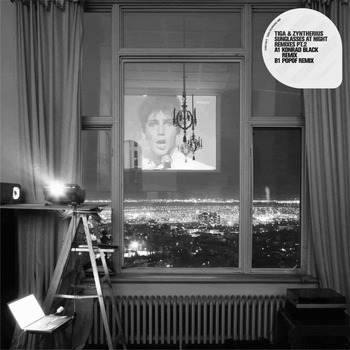
Even more pertinently, a new artwork was created (see Figure 1) for the 2008 release. Designed by Qarim Brown and Pawel Karwowski, it consists of a photograph of a loft's empty living room in which a movie projector shows the image of Tiga's face with open mouth while holding a microphone. This very image is taken from his own lip-synched apparition on the Top of the Pops programme. Yet the projection is only seen as reflection in the main window of the room, as if the glass itself mirrors what is being shown on the opposite wall, a wall where we as receiving spectator (are supposed to) stand. It seems we are excluded from the projection's enunciation, since it is not our image being mirrored by the windows, but Tiga's. What is blatantly absent from the room is the lip-synching performer himself, whose projection becomes its own receiver: all that is left is the ‘image’ of a fake performance, the representation of a masculine originator who has deserted the very utterances for which he was supposed to be held accountable. The authorial absence/presence shown here is the locus of postmodern subjectivity, the enunciation ‘origins’ of the text constantly deferred and made absent, yet constantly actualised in the representation itself, living through the potentially infinite play on and displacing of identity signifiers. The (un)original hypertextual practice that is the ‘Sunglasses at Night’ cover version thus allows Tiga, with the help of Zyntherius, to perfectly epitomise the specular, masquerading nature of the shades-wearing postmodern subject.
Artwork designed by Qarim Brown and Pawel Karwowski for the 2008 release of ‘Sunglasses at Night’.

Acknowledgements
Parts of this paper were presented at conferences at the University of Regina (IASPM-Canada, May 2006) and at the University of Hearst (June 2006). The author wishes to thank Christopher Haber, Ron Ménard, Brad Caldwell and Todd L. Burns for partial translation, revision and proofreading.