Introduction
Over a century ago, it was proposed that schizophrenia is a disorder arising from pathological alterations in the brain's association fibers (Wernicke, Reference Wernicke1906), and since then much evidence of white matter abnormalities has emerged from postmortem studies (Stephan et al. Reference Stephan, Friston and Frith2009; Farkas et al. Reference Farkas, Lendeckel, Dobrowolny, Funke, Steiner, Keilhoff, Schmitt, Bogerts and Bernstein2010). More recently, diffusion tensor imaging (DTI) techniques have provided evidence of white matter pathology in schizophrenia in vivo (Ellison-Wright & Bullmore, Reference Ellison-Wright and Bullmore2009; Skudlarski et al. Reference Skudlarski, Schretlen, Thaker, Stevens, Keshavan, Sweeney, Tamminga, Clementz, O'Neil and Pearlson2013). Brain regions are connected by a complex white matter network known as the human connectome (Sporns et al. Reference Sporns, Tononi and Kotter2005). The topological organization of this anatomical network is vital for efficient information segregation and integration among brain regions. The application of graph theory to DTI data permits quantification of both integration and segregation properties of the fiber network (Watts & Strogatz, Reference Watts and Strogatz1998). Individual differences in topological organizations of white matter networks are substantially hereditable (Bohlken et al. Reference Bohlken, Mandl, Brouwer, van den Heuvel, Hedman, Kahn and Hulshoff Pol2014). Graph analytical studies have found some consistent topological abnormalities, such as prefrontal topological deficits in unaffected first-degree relatives at high genetic risk for developing schizophrenia (Shi et al. Reference Shi, Yap, Gao, Lin, Gilmore and Shen2012; Collin et al. Reference Collin, Kahn, de Reus, Cahn and van den Heuvel2014), leading us to hypothesize that part of the pattern of structural network topology observed in this disease may mediate the genetic effect as an endophenotype or biological trait. More extensive anatomical network topological deficits were reported in chronic schizophrenia patients (CSP), such as topological impairments in the prefrontal, cingulate and occipital gyri, insula, pallidum and caudate (Van den Heuvel et al. Reference Van den Heuvel, Mandl, Stam, Kahn and Hulshoff Pol2010, Reference Van den Heuvel, Sporns, Collin, Scheewe, Mandl, Cahn, Goni, Hulshoff Pol and Kahn2013; Zalesky et al. Reference Zalesky, Fornito, Seal, Cocchi, Westin, Bullmore, Egan and Pantelis2011; Wang et al. Reference Wang, Su, Zhou, Chou, Chen, Jiang and Lin2012; Collin et al. Reference Collin, Kahn, de Reus, Cahn and van den Heuvel2014). However, these investigations in CSP are difficult to rule out the network topologic abnormalities being a consequence of disease progression or other factors, particularly antipsychotic treatment effects.
To separate chronic stage disease-related findings from those related to treatment and treatment response, longitudinal studies that examine first-episode psychosis before medication is started are needed. Although there is still a lack of follow-up studies directly examining antipsychotic effects on the topological characteristics of white matter networks, three longitudinal studies of first-episode schizophrenia patients (FESP) have reported region-specific antipsychotic medication effects on measures of white matter integrity, such as fractional anisotropy (FA). One study found increased FA in the cingulum and uncinate in FESP after 12 weeks of medication (Reis Marques et al. Reference Reis Marques, Taylor, Chaddock, Dell'Acqua, Handley, Reinders, Mondelli, Bonaccorso, Diforti, Simmons, David, Murray, Pariante, Kapur and Dazzan2014). The two other studies found decreased FA in frontal, occipital and parietal regions after short-term treatment (Wang et al. Reference Wang, Cheung, Deng, Li, Huang, Ma, Wang, Jiang, Sham, Collier, Gong, Chua, McAlonan and Li2013; Szeszko et al. Reference Szeszko, Robinson, Ikuta, Peters, Gallego, Kane and Malhotra2014). In addition, using functional magnetic resonance imaging (MRI), Achard & Bullmore (Reference Achard and Bullmore2007) found that a single dose of sulpiride (400 mg) appeared to have detrimental effects on topological parameters (network efficiency) of cingulate gyrus and temporal cortex in healthy people; Carbonell et al. (2014) demonstrated that dopamine depletion can reduce local efficiency in limbic regions, further supporting a relationship between brain network topology and dopamine signaling. Given this evidence, a reasonable prediction is that antipsychotic medications would have effects on fiber network topological parameters. A longitudinal DTI study to specifically examine how antipsychotic medications influence white matter topology would be a powerful complement to a study of drug-naive FESP.
The current study investigates topological alterations of the anatomical network using baseline MRI scans within 12 months of psychosis onset in FESP who had never been treated with an antipsychotic agent, and a second scan after the baseline scan following treatment with risperidone for 8 weeks. To our knowledge, this is the first longitudinal DTI study to explore the effect of risperidone monotherapy on anatomical graph-theoretic topological properties in a relatively large study sample (n = 42) of treatment-naive FESP. We hypothesized that: (a) abnormalities would be present in the topological characteristics of the white matter network in medication-naive FESP when compared with healthy volunteers, particularly in the prefrontal cortex, limbic/paralimbic system and subcortical structures based on previous studies (Zalesky et al. Reference Zalesky, Fornito, Seal, Cocchi, Westin, Bullmore, Egan and Pantelis2011; Wang et al. Reference Wang, Su, Zhou, Chou, Chen, Jiang and Lin2012; Van den Heuvel et al. Reference Van den Heuvel, Sporns, Collin, Scheewe, Mandl, Cahn, Goni, Hulshoff Pol and Kahn2013; Collin et al. Reference Collin, Kahn, de Reus, Cahn and van den Heuvel2014); and (b) antipsychotic treatment would influence the topological organizations of the above-mentioned systems in patients, but this effect would be differentially localized based on prior reports (Achard & Bullmore, Reference Achard and Bullmore2007; Carbonell et al. Reference Carbonell, Nagano-Saito, Leyton, Cisek, Benkelfat, He and Dagher2014; Reis Marques et al. Reference Reis Marques, Taylor, Chaddock, Dell'Acqua, Handley, Reinders, Mondelli, Bonaccorso, Diforti, Simmons, David, Murray, Pariante, Kapur and Dazzan2014; Szeszko et al. Reference Szeszko, Robinson, Ikuta, Peters, Gallego, Kane and Malhotra2014). We also conducted an exploratory investigation to examine whether alterations of white matter topological properties would relate to clinical symptom response to medication.
Method
Participants
A total of 80 right-handed Chinese Han people were recruited, including 42 treatment-naive FESP and 38 age-, gender- and education-matched healthy volunteers. These participants were all in our previous study (Zong et al. Reference Zong, Hu, Li, Cao, He, Liao, Zhou, Sang, Zhao, Tang, Lv and Chen2015). All the patients were recruited for this study at Henan Province Mental Health Center, the Second Affiliated Hospital of Xinxiang Medical University, Henan, China. Diagnoses of schizophrenia were determined with the Structured Clinical Interview for DSM-IV-TR, patient version (SCID-I/P). All the patients had less than 1 year since onset of psychotic symptoms, and mean age was 24.86 (s.d. = 4.80) years (range 18 to 37 years; online Supplementary Table S1). Healthy volunteers were recruited by advertisement and screened using the SCID-NP, non-patient edition for lifetime absence of any psychiatric illness, and did not have a family history of psychiatric illness in any first-degree relative. Any individual with a history of physical illness, neurological disorder, or alcohol or drug abuse was excluded from the study.
All procedures were approved by the ethics committee of the Second Xiangya Hospital and the Second Affiliated Hospital of Xinxiang Medical University. Written informed consent was obtained from all participants, who were permitted to discontinue participation from this research at any time. One patient discontinued during the DTI scan at baseline, and also withdrew from the follow-up MRI scan. Three other patients withdrew from the follow-up MRI scans. Consequently, MRI data were collected from 41 patients at baseline, 38 patients after treatment, and 38 healthy controls. All 42 patients completed clinical assessments.
Medication and clinical assessments
All schizophrenia patients were stabilized on risperidone monotherapy at a dosage of 4–6 mg/day for 8 weeks. Mood stabilizers and antidepressants were not used. The efficacy and safety of risperidone was assessed weekly by clinical interviews. During the 8-week treatment, no serious adverse effects occurred. Symptom severity of all patients was evaluated at baseline and followed up with the 30-item Positive and Negative Syndrome Scale (PANSS) (Kay et al. Reference Kay, Fiszbein and Opler1987).
Acquisition of MRI data
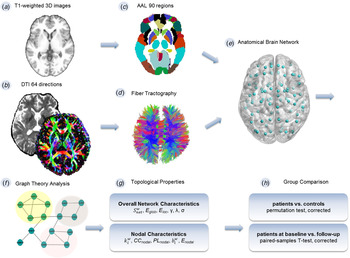
All patients had high-resolution T1-weighted three-dimensional images and DTI scans both at baseline when they were free from antipsychotics and after the 8-week treatment, while controls were scanned only once. Participants were scanned on a 3 T Siemens MRI scanner (Germany) with a 16-channel head coil. Whole-brain volume sagittal T1-weighted images were obtained with a three-dimensional spoiled gradient echo pulse sequence [repetition time/echo time (TR/TE) = 1900 ms/2.52 ms, flip angle = 9°, field of view (FOV) = 250 × 250, slice thickness = 1.0 mm, gap = 0 mm, number of excitations = 1, 176 slices] (Fig. 1 a). DTI images were collected using a single-shot spin-echo planar imaging (EPI) with a twice-refocused balanced echo sequence to reduce eddy current distortions (TR/TE = 7500/93 ms, FOV = 240 × 240, acquisition matrix = 128 × 128, flip angle = 90°, b = 0 and 1000 s/mm2 along 64 non-collinear directions, slice thickness = 3.0 mm, 45 contiguous axial slices) (Fig. 1 b). All data processing used the same methods and quality thresholds, and was checked for noise, motion and artifacts. Any individual with movement greater than 1.5 mm translation or more than 1.5° rotation was excluded.
Schematic overview of construction of anatomical network. (a) Acquisition of T1-weighted images. (b) Diffusion tensor images (DTI). (c) Parcellation of whole brain with Automated Anatomical Labeling (AAL) template consisting of 90 unique brain regions. (d) Whole-brain fiber tracking. (e) Depiction of white matter network. (f) Calculation of the topological characteristics with graph theory. (g) Computation of both overall and nodal network properties. (h) Between-group comparison. The topological characteristics of patients both at baseline and follow-up, respectively, were compared with controls using a permutation test (corrected). Within-individual comparisons were performed using paired-samples t tests (corrected). 3D, Three-dimensional;
 $S_{net}^W $
, net strength; E
glob
, global efficiency; E
loc
, local efficiency; γ, normalized clustering coefficients; λ, normalized path lengths; σ, small-worldness;
 $k_i^W $
, nodal degree; CC
nodal, clustering coefficiency; PL
nodal, path length;
 $b_i^W $
, betweenness centrality; E
nodal
, nodal efficiency.

Construction of anatomical brain network
We used the Automated Anatomical Labeling (AAL) atlas as a volumetric template with 90 whole-brain regions (Tzourio-Mazoyer et al. Reference Tzourio-Mazoyer, Landeau, Papathanassiou, Crivello, Etard, Delcroix, Mazoyer and Joliot2002). Statistical Parametric Mapping (SPM8; http://www.fil.ion.ucl.ac.uk/spm) was implemented to perform the preprocessing and map the AAL atlas to each individual's subject space. Each individual T1-weighted image was co-registered to the B0 image by a linear transformation in the native diffusion space. Co-registered structural images were mapped to the Montreal Neurological Institute (MNI) T1 template by utilizing an affine transformation and a series of non-linear warps. Using nearest-neighbor interpolation and inverted MNI transformation parameters, the volumetric (AAL) template was warped from MNI space to the native diffusion space, resulting in 90 network nodes (45 in each hemisphere) (Fig. 1 c).
FSL 4.1(FMRIB's Diffusion Toolbox; http://www.fmrib.ox.ac.uk/fsl) was used to correct head motion and eddy current distortions for DTI. The linear least-squares fitting method was used to estimate diffusion tensor models at each voxel with the Diffusion Toolkit software (TrackVis.org), and the Fiber Assignment by Continuous Tracking (FACT) algorithm was used to perform whole-brain fiber tracking in native diffusion space using TrackVis 0.5.1. The DTI tracking followed procedures as described in a previous study (Zhang et al. Reference Zhang, Liao, Chen, Mantini, Ding, Xu, Wang, Yuan, Chen and Jiao2011) (Fig. 1 d), and path tracing was terminated if the FA was <0.1 or the angle between the current and the previous path segment was greater than 45°. We constructed weighted graphs according to the number of reconstructed streamlines between each pair of regions (Fig. 1 e). One of the reconstructed brain networks was removed from the control group as its network density was over mean plus three standard deviations of the group. Failure to remove those outliers may lead to false-negative findings (De Reus & van den Heuvel, Reference De Reus and van den Heuvel2013).
Network organization and topological properties
Graph theoretical analysis was utilized to calculate the topological characteristics of the weighted brain structural network at nodal and overall levels in all participants (Fig. 1
f). Nodal characteristics consist of: (1) nodal degree
 $(k_i^W )$
; (2) clustering coefficiency (CC
nodal
); (3) path length (PL
nodal
); (4) betweenness centrality
 $(b_i^W )$
; (5) nodal efficiency (E
nodal
). Overall network characteristics include: (1) net strength
 $(S_{net}^W )$
; (2) global efficiency (E
glob
); (3) local efficiency (E
loc
); (4) normalized clustering coefficients (γ); (5) normalized path lengths (λ); (6) small-worldness (σ) (Fig. 1
g).
The Brain Connectivity Toolbox (http://www.brainconnectivtiy-toolbox.net) was used to calculate the network properties (Rubinov & Sporns, Reference Rubinov and Sporns2010). In brief,
 $k_i^W $
is equal to the sum of the reconstructed streamlines terminating in a node. CC
nodal
is defined as the fraction of how close the node's neighbors are to being a clique (complete graph). PL
nodal
refers to the average of the shortest path from the node to all the other nodes in the network. The
 $b_i^W $
is equivalent to the number of all shortest paths in the network that pass through a node. Efficiency was defined as the reciprocal or inverse of path length, E
glob
is the average inverse shortest path length in the network, and E
loc
is the E
glob
computed on node neighborhoods (Bullmore & Sporns, Reference Bullmore and Sporns2012). The
 $S_{net}^W $
is defined as the gross of all neighboring link weights. A set of random networks were created by randomizing the connections of the network, keeping the degree distribution and sequence of the matrix intact (Rubinov & Sporns, Reference Rubinov and Sporns2010). Finally, small-worldness (σ = γ/λ) was used to describe complex networks that have a high efficiency and high clustering, respectively, which can be figured by the two attributes, namely normalized clustering coefficients (γ = CC
real/CC
random), and normalized path lengths (λ = PL
real/PL
random) (Watts & Strogatz, Reference Watts and Strogatz1998).
The E
glob
, PLnodal
and λ properties reflect the integration of the network, while the E
loc
, CCnodal
and γ reflect the segregation. The architectural features
 $k_i^W\!\comma\ S_{net}^W $
and σ represent the network architecture, and the
 $b_i^W $
represent the measure of centrality.
Group differences in topological properties
The anatomical network topological characteristics of patients at baseline and after the 8-week treatment, respectively, were compared with healthy volunteers using the permutation test. Briefly, for a given characteristic, we firstly computed the group difference between FESP and controls. Then all participants were randomly assigned into two groups, and we recalculated the group difference between the two random groups. This process was repeated for 5000 permutations and a sampled group difference null distribution for every topological property was obtained. We computed the proportion of the actual group difference in the 5000 random group differences. Finally, any between-group difference greater than the 95th percentile of the empirical distribution in a two-tailed test can be declared significant at an α = 0.05. Comparisons in patients before and after treatment were performed using paired-samples t tests (α = 0.05). As the examined nodal topological measures are dependent, we performed false discovery rate (Storey, Reference Storey2002) correction in 90 × 3 multiple tests (cut-off value 0.05) for each nodal characteristic. Comparisons of global network characteristics were corrected by the Bonferroni method (p < 0.05) (Fig. 1 h).
Statistical analysis
Statistical analyses were performed with the SPSS 13.0 software package (SPSS Inc., USA). The independent-samples t test or χ2 test were used to compute the group differences of demographic data. The paired-samples t test was used to compare patients’ longitudinal alterations of PANSS scores. Correlations between either baseline network metrics (exhibiting between-group differences) and clinical variables (PANSS scores), or longitudinal alterations (with significance) in anatomical network topological properties and improvement of clinical symptoms (PANSS scores) were computed by multiple linear regression analysis, controlling for age and gender.
Results
Demographics
A total of 42 patients met the criteria of treatment-naive FESP. Healthy volunteers were well matched with patients on age, gender, years of education, and alcohol and tobacco use (p's > 0.05) (online Supplementary Table S1).
Longitudinal alterations of clinical symptoms
After the 8-week treatment, patients had pronounced reductions in PANSS-total scores, positive scores (PANSS-P) and general psychopathology (PANSS-G), but no significant alterations in negative scores (PANSS-N) (online Supplementary Table S1).
Schizophrenia- and treatment-related alterations in nodal characteristics
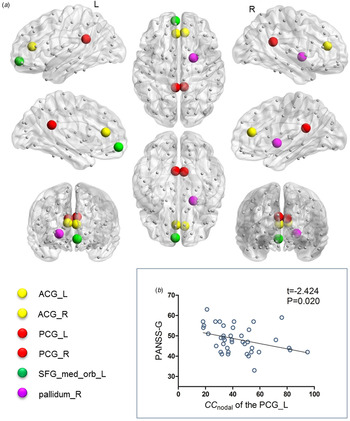
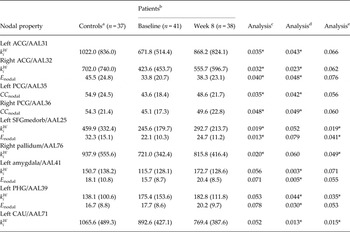
At baseline, patients had lower
 $k_i^W $
(p = 0.032, corrected) and E
nodal (p = 0.040, corrected) in the right anterior cingulate and paracingulate gyri (ACG) and decreased
 $k_i^W $
(p = 0.035, corrected) in the left ACG compared with controls (Table 1; Fig. 2
a). There were also reduced CC
nodal in the left (p = 0.035, corrected) and right (p = 0.048, corrected) posterior cingulate gyrus (PCG) (Table 1; Fig. 2
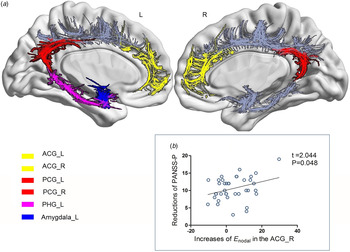
a). After 8 weeks of treatment, there was an increase in the
 $k_i^W $
(p = 0.023, corrected) and E
nodal (p = 0.048, corrected) of the right ACG, and the
 $k_i^W $
(p = 0.043, corrected) of the left ACG (Table 1; Fig. 3
a). CC
nodal in the left (p = 0.042, corrected) and right (p = 0.049, corrected) PCG also increased (Table 1; Fig. 3
a). Moreover, all the observed nodal parameters bilaterally in the ACG and PCG at the 8-week follow-up did not differ from controls (p's > 0.05, corrected) (Table 1).
Brain regions showing deficient topological characteristics in anatomical brain networks and the relationship with a clinical variable in drug-naive first-episode schizophrenia patients (FESP). (a) Areas of deficient topological attributes in drug-naive FESP relative to healthy controls at baseline. There were significant differences in the bilateral anterior cingulate and paracingulate gyri (ACG), bilateral posterior cingulate gyrus (PCG), left superior frontal gyrus medial orbital (SFG_med_orb_L) and right pallidum (pallidum_R). (b) Negative correlation between baseline clustering coefficiency (CC nodal) of the left PCG and Positive and Negative Syndrome Scale general psychopathological symptom scores (PANSS-G) in FESP. L, Left; R, right.

Brain regions showing longitudinal alterations of nodal topological metrics in anatomical brain networks and the relationship with improvement of clinical variable after 8 weeks of risperidone treatment in drug-naive first-episode schizophrenia patients (FESP). (a) Areas with alterations of topological attributes in white matter networks after 8 weeks of risperidone treatment of drug-naive FESP. There was improvement of topological properties in the bilateral anterior cingulate and paracingulate gyri (ACG), bilateral posterior cingulate gyrus (PCG), left PHG (PHG-L) and left amygdala (amygdala_L). (b) Positive correlation between improvement of nodal efficiency (E nodal) in the right ACG and the reduction in Positive and Negative Syndrome Scale positive symptoms (PANSS-P) score (p = 0.048, controlling for age and gender). L, Left; R, right.

Nodal topological characteristics of healthy comparison controls and first-episode schizophrenia patients for baseline and follow-up data

Values are given as mean (standard deviation).
ACG, Anterior cingulate and paracingulate gyri; AAL, Automated Anatomical Labeling;
 $k_i^W $
, nodal degree; E
nodal, nodal efficiency; PCG, posterior cingulate gyrus; CC
nodal, clustering coefficiency; SFGmedorb, superior frontal gyrus medial orbital; PHG, parahippocampal gyrus; CAU, caudate nucleus; DTI, diffusion tensor imaging; MRI, magnetic resonance imaging; FDR, false discovery rate.
a One of the reconstructed brain network was removed from the 38 healthy volunteers for its lowest outlier network density.
b One of the 42 patients discontinued during the DTI scan at baseline, and also withdrew from the follow-up MRI scan. Three other patients withdrew from the follow-up MRI scans.
c Patients at baseline v. controls, permutation test with FDR correction.
d Patients at baseline v. follow-up, paired-samples t test with FDR correction.
e Patients at follow-up v. controls, permutation test with FDR correction.
* Significant difference (p < 0.05).
Patients had lower baseline
 $k_i^W $
(p = 0.019, corrected) and E
nodal
(p = 0.013, corrected) in the left superior frontal gyrus medial orbital (SFGmedorb), and lower
 $k_i^W $
(p = 0.020, corrected) in the right pallidum compared with controls (Table 1; Fig. 2
a). After treatment, there were no longitudinal changes in nodal metrics of the left SFGmedorb or right pallidum (p's > 0.05, corrected) (Table 1). Moreover, compared with controls, patients after 8 weeks of treatment continued to exhibit lower
 $k_i^W $
(p = 0.019, corrected) and E
nodal
(p = 0.041, corrected) in the left SFGmedorb, and lower
 $k_i^W $
(p = 0.049, corrected) in the right pallidum (Table 1).
Patients revealed no differences in the left amygdala and left parahippocampal gyrus (PHG) compared with controls at baseline (p's > 0.05, corrected). After the 8-week treatment, however, patients showed increased
 $k_i^W $
(p = 0.003, corrected) and E
nodal
(p = 0.005, corrected) in the left amygdala, and
 $k_i^W $
(p = 0.044, corrected) and E
nodal
(p = 0.030, corrected) in the left PHG (Table 1, Fig. 3
a).
At baseline patients had no significant difference in
 $k_i^W $
of the left caudate nucleus (CAU) (p > 0.05, corrected) compared with controls. After treatment, the
 $k_i^W $
(p = 0.013, corrected) in the left CAU decreased (Table 1).
See online Supplementary Table S2 for more detail about nodal topographical characteristics. We also normalized these characteristics of each node by dividing the mean value of each metric of random network to control the potential bias, and got similar results as described above (online Supplementary Table S3).
Comparisons of overall network characteristics
Group comparisons showed no significant differences in γ, λ,
 $S_{net}^W $
, E
glob
, Eloc
or σ (p's > 0.05, corrected) (online Supplementary Table S4). We provide preliminary evidence that patients’ regional topological impairments occur in the context of preserved overall topological organization during the early phase of schizophrenia (see online Supplementary Discussion).
Relationships between topological characteristics and clinical variables
The baseline CC nodal of the left PCG showed a negative correlation with PANSS-G scores (p = 0.020, corrected by age and gender, Fig. 2 b). The post-treatment improvements of E nodal of the right ACG were positively correlated with decreases in PANSS-P scores (p = 0.048, corrected by age, gender and baseline E nodal of the right ACG, Fig. 3 b). However, none of the associations survived Bonferroni correction.
Discussion
As hypothesized, drug-naive FESP had baseline topological abnormalities of the white matter network, primarily located in limbic system regions such as the bilateral ACG, bilateral PCG, prefrontal area involving the left SFGmedorb, and in the striatum involving the right pallidum. These findings suggest that the white matter topological dysfunction of the limbic system, frontal gyrus and striatum may be involved in the pathology of schizophrenia, because they are present early in the course of overt illness and prior to any medication usage. To characterize antipsychotic treatment effects on fiber network topology, participants were rescanned after 8 weeks of risperidone monotherapy. The topological disruptions of the limbic system improved in at least one nodal property, while there were no significant changes in the frontal gyrus or right pallidum. Positive symptoms improved and the degree of improvement in the PANSS-P scores correlated with alterations in some indices of topological disruption in the limbic system. However, as these findings did not survive corrections for multiple comparisons, these findings should be considered provisional requiring replication in an independent sample. Antipsychotic therapy failed to normalize either prefrontal topology or improve negative symptoms. Additionally, the topological parameter of the left CAU decreased after antipsychotic medications, and yet did not show any baseline differences when compared with the control group. That may be a medication side effect unrelated to therapeutic benefit or the pathology of schizophrenia or a compensatory effect.
We found baseline deficits in the
 $k_i^W $
of the bilateral ACG, and E
nodal of the right ACG, suggesting the ACG may have less regional efficiency in transferring information and communication with the rest of its anatomical networks. These ‘deficient’ topological properties of ACG were improved by 8 weeks of treatment. In addition, patients’ reduced baseline CC
nodal of the bilateral PCG showed normalization after treatment, suggesting that risperidone monotherapy may increase the PCG's local efficiency of information transfer. Interestingly, treatment increased topological indices (
 $k_i^W $
and E
nodal
) in the left PHG and amygdala, while at baseline there were no significant group differences relative to controls, implying a gain-of-efficiency of these two regions in transferring information in the anatomical network. This may reflect a secondary response to the changes of the ACG and PCG, given they are the source of crucial afferent and efferent connections in the limbic system including the PHG and amygdala (Catani et al.
Reference Catani, Dell'Acqua and Thiebaut de Schotten2013); or it may be part of the therapeutic effect of the medication or a non-specific side effect. The ACG, PCG, amygdala and PHG are important components of the limbic system considered to be involved in the physiopathology of schizophrenia (Gur et al.
Reference Gur, Loughead, Kohler, Elliott, Lesko, Ruparel, Wolf, Bilker and Gur2007; Lahti et al.
Reference Lahti, Weiler, Holcomb, Tamminga and Cropsey2009). The limbic damage is regarded as a ‘state’ marker and actively responds to pharmacological interventions (Lahti et al.
Reference Lahti, Weiler, Holcomb, Tamminga and Cropsey2009; Lui et al.
Reference Lui, Li, Deng, Jiang, Wu, Tang, Yue, Huang, Chan, Collier, Meda, Pearlson, Mechelli, Sweeney and Gong2010). Moreover, the cingulate gyrus furnishes the limbic system with the crucial axonal wiring to constitute connectivity to and from other divisions including the amygdala and PHG of the system (Catani et al.
Reference Catani, Dell'Acqua and Thiebaut de Schotten2013). White matter abnormalities of these identified regions in schizophrenia have been widely reported in neuroimaging and histopathological studies (Kubicki et al.
Reference Kubicki, Westin, Nestor, Wible, Frumin, Maier, Kikinis, Jolesz, McCarley and Shenton2003; Farkas et al.
Reference Farkas, Lendeckel, Dobrowolny, Funke, Steiner, Keilhoff, Schmitt, Bogerts and Bernstein2010; Van den Heuvel et al.
Reference Van den Heuvel, Mandl, Stam, Kahn and Hulshoff Pol2010). These implicated nodes included the key cortical (i.e. ACG) and subcortical (i.e. amygdala) structures of the salience network, as well as the posterior component (i.e. PCG) and medial temporal region (including PHG) of the default mode network. Both the salience network and default mode network are proposed to be an important part of the triple network model, a unifying network that is implicated in the cognitive dysfunction and aberrant saliency mapping of schizophrenia and other neuropsychiatric disorders (Menon, Reference Menon2011). Our current findings of post-treatment increased topological attributes in the PCG, ACG, PHG and amygdala, together with the preliminary evidence suggesting the potential effect of antipsychotic medications on salient (Palaniyappan et al.
Reference Palaniyappan, White and Liddle2012) and default mode network (Sambataro et al.
Reference Sambataro, Blasi, Fazio, Caforio, Taurisano, Romano, Di Giorgio, Gelao, Lo Bianco, Papazacharias, Popolizio, Nardini and Bertolino2010), imply that dysfunctions of the triple network are viable therapeutic targets in schizophrenia.
Treatment-related changes of E nodal in the right ACG positively correlated with reductions in PANSS-P scores after treatment, suggesting that the degree of increase in the right ACG's communication efficiency is linked to improvement in positive symptoms. The ACG plays a role in decision-making, choosing between conflicting options and error detection (Carter et al. Reference Carter, MacDonald, Ross and Stenger2001), and this region's inability in self-monitoring may contribute to the failure to identify one's own inner thoughts from external circumstances, and is therefore a potential neuropathological substrate for positive symptoms (Kubicki et al. Reference Kubicki, Westin, Nestor, Wible, Frumin, Maier, Kikinis, Jolesz, McCarley and Shenton2003). The association of abnormalities of the ACG with positive symptoms is in accord with prior studies (Cheung et al. Reference Cheung, Chiu, Law, Cheung, Hui, Chan, Sham, Deng, Tai, Khong, McAlonan, Chua and Chen2011; Kates et al. Reference Kates, Olszewski, Gnirke, Kikinis, Nelson, Antshel, Fremont, Radoeva, Middleton, Shenton and Coman2015). Moreover, salience network dysfunction leads to damaged detection of salient external environment and internal events, with significant self-monitoring consequences (Menon, Reference Menon2011). Cross-sectional studies suggest a relationship between structural or functional deficits of the ACG within the salience network with psychosis (Palaniyappan et al. Reference Palaniyappan, Mallikarjun, Joseph, White and Liddle2011; Palaniyappan & Liddle, Reference Palaniyappan and Liddle2012). Our current findings based on a longitudinal design provide further evidence linking post-treatment topological organization alterations of the salience network component and improvement of positive symptoms in schizophrenia. Additionally, we also observed a relationship between baseline CC nodal of the left PCG and PANSS-G, although, to our knowledge, this is the first study linking PCG topological attributes with severity of general psychopathological symptoms in schizophrenia. Pathology of the PCG has been postulated to cause emotional and cognitive impairments (Maddock, Reference Maddock1999) and thus might underlie the genesis of the general psychopathological symptoms in schizophrenia.
We observed lower
 $k_i^W $
and E
nodal in the left SFGmedorb at baseline, indicating the possibility of the frontal gyrus's inefficient communication with other brain regions and low regional efficiency in transferring information in the white matter network. The frontal gyrus is strongly implicated in the physiopathology of schizophrenia (Wang et al.
Reference Wang, Cheung, Deng, Li, Huang, Ma, Wang, Jiang, Sham, Collier, Gong, Chua, McAlonan and Li2013; Piantadosi & Floresco, Reference Piantadosi and Floresco2014). This study provides new support for the frontal dysfunction hypothesis of schizophrenia because our findings are in drug-naive FESP. No improvement of frontal deficits is consistent with other studies (Snitz et al.
Reference Snitz, MacDonald, Cohen, Cho, Becker and Carter2005; Van Veelen et al.
Reference Van Veelen, Vink, Ramsey, van Buuren, Hoogendam and Kahn2011) and suggests that the frontal dysfunction may represent a ‘trait’ marker of schizophrenia because it responds poorly to antipsychotics. It remains to be seen whether these topological deficits improve when effective treatments for negative clinical symptoms of schizophrenia are identified.
Behavioral outcome and white matter topological changes after treatment initiation can be further understood in the context of the schizophrenia dopamine (DA) hypothesis and risperidone's D2 antagonism (Meyer & Feldon, Reference Meyer and Feldon2009). More specifically, DA in the mesocortical system (projecting to the prefrontal areas) may be hypoactive and its deficits are proposed to underlie negative symptoms, whereas the mesolimbic DA pathway may be hyperactive and its hyperactivity may be critically involved in the emergence of positive symptoms. Risperidone's antagonism of DA, especially D2 receptors in the limbic areas, is beneficial for positive symptoms. However, risperidone's block effect in the frontal gyrus has no beneficial and perhaps detrimental influence on negative symptoms because patients already have low frontal DA levels. Our observations of no benefit for negative symptoms and no improvement in frontal topological parameters suggest a relationship between frontal topologies and negative symptom severity at baseline.
Limitations
Although structural network graph theory properties appear to have moderate test–retest reliability (Cheng et al. Reference Cheng, Wang, Sheng, Kronenberger, Mathews, Hummer and Saykin2012), the lack of repeated scans for the control group is a limitation of this study as we cannot exclude the possibility that the observed topological changes after treatment might be related to test–retest variability. The identified relationship between nodal topologies and clinical symptoms should be considered as exploratory in nature as results did not survive corrections for multiple comparisons.
Conclusion
In summary, this is the first follow-up DTI study in drug-naive recent onset psychotic patients which demonstrates that topological deficits of anatomical networks may be due to medication effects. Limbic white matter topological dysfunction improves with positive symptom reduction, whereas prefrontal topological deficits appear to be unresponsive to psychopharmacological intervention and may be potential trait biomarkers and targets for negative symptom treatment development. Future studies with more effective treatments for negative symptoms are needed to evaluate their effects on prefrontal topological deficits and to determine whether such deficits may serve as treatment biomarkers.
Supplementary material
The supplementary material for this article can be found at http://dx.doi.org/10.1017/S0033291716001380
Acknowledgements
This work was supported by grants from the National Natural Science Foundation of China (81271484 and 81471361 to X.C.; 61533006 to H.C.; 30900486 and 81371480 to J.T.), the National Key Basic Research and Development Program (973) (2012CB517904 to X.C.), the National Institutes of Health (K01MH108721 to S.P.P.), the 863 project (2015AA020505 to H.C.) and the China Scholarship Council Program (to M.H.).
Declaration of Interest
J.J.M. received royalties for commercial use of the Columbia Suicide Severity Rating Scale (C-SSRS) from the Research Foundation for Mental Hygiene.