INTRODUCTION
Current knowledge about Brazilian opisthobranchs is mostly derived from the taxonomic studies of Ernst and Eveline Marcus on material from the intertidal zone of São Paulo State and a few samples from other regions of the Brazilian coast (e.g. Marcus, Reference Marcus1955, Reference Marcus1957, Reference Marcus1970). As is the case for other species described by Ernst Marcus (e.g. Plocamopherus gulo Marcus, 1979), Corambe carambola (Marcus, Reference Marcus1955) and C. evelinae Marcus, 1956 have never been collected again since their original description (Martynov & Schrödl, Reference Martynov and Schrödl2011). This is partly because corambids are very small animals, living camouflaged under rocks, and because of a lack of collections featuring them. However, recent efforts by researchers, especially in the last two decades, conducting new faunal surveys have brought to light poorly known species (Padula & Santos, Reference Padula and Santos2006; Lima & Delgado, Reference Lima and Delgado2011; Padula et al., Reference Padula, Bahia, Vargas and Lindner2011, Reference Padula, Bahia, Correia and Sovierzoski2012) and updated the Brazilian opisthobranch fauna with the description (Pola et al., Reference Pola, Cervera and Gosliner2005; DaCosta et al., Reference DaCosta, Cunha, Simone and Schrödl2007; Domínguez et al., Reference Domínguez, García and Troncoso2006a, Reference Domínguez, García and Troncosob, Reference Domínguez, Troncoso and García2008; Padula & Delgado, Reference Padula and Delgado2010; Alvim et al., Reference Alvim, Padula and Pimenta2011; Cunha, Reference Cunha2011; Silva et al., Reference Silva, Meirelles and Matthews-Cascon2013; Alvim & Pimenta, Reference Alvim and Pimenta2013).
During collection along the rocky shore of Santos Bay (São Paulo State, Brazil) three specimens of the onchidoridid genus Corambe were collected. Corambids comprise fewer than 20 species (Martynov, Reference Martynov1994) and are considered aberrant or primitive dorid nudibranchs owing to their singular morphology (Schrödl & Wägele, Reference Schrödl and Wägele2001). They have a flat oval shape, posteroventral gills formed by a thin lamellar layer, the anus located between the gills, a notal cuticle, a lobed digestive gland, a dorsoventral septa and a peculiar circulatory system (Martynov & Schrödl, Reference Martynov and Schrödl2011). The species are small (usually 5–10 mm), mainly found under or on rocks in littoral and sublittoral temperate waters, and most of them feed on encrusting bryozoans (Yoshioka, Reference Yoshioka1986; Valdés & Bouchet, Reference Valdés and Bouchet1998).
One of our collected specimens was identified as C. carambola (Marcus, Reference Marcus1955) and the other as C. evelinae Marcus, Reference Marcus1958. Thus, in this contribution C. carambola (Marcus, Reference Marcus1955) is recorded for the first time after Marcus (Reference Marcus1970) and C. evelinae Marcus, Reference Marcus1958 is recorded for the first time after their original descriptions; also photographs of both the living specimens of these species are presented.
MATERIALS AND METHODS
Study area
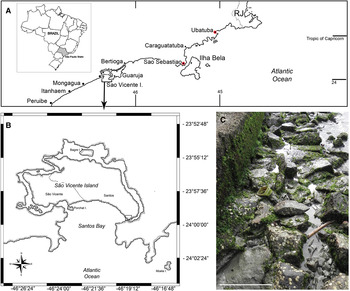
Santos Bay (Figure 1A, B), is located on the coast of the State of São Paulo, Brazil (23°30′5″S–24°S 46°05′W–46°30′W), part of the Santos and São Vicente Estuarine System (Figure 1B) and it shelters part of the Baixada Santista Metropolitan Region. The Santos and São Vicente Estuarine Systems are surrounded by mangroves which make up 43% of the total mangrove area of São Paulo (Lamparelli et al., Reference Lamparelli, Costa, Prósperi, Bevilácqua, Araújo, Eysink and Pompéia2001; Cesar et al., Reference Cesar, Abessa, Pereira, Santos, Fernández, Choueri and DelValls2009). Despite the area's ecological importance, it is a densely urbanized region, containing the Port of Santos (a major Latin American port) and it houses the biggest Brazilian industrial complex, consisting predominantly of petrochemical, siderurgy, and fertilizer industries (Boldrini & Navas-Pereira, Reference Boldrini and Navas-Pereira1987; Abessa et al., Reference Abessa, Sousa, Rachid and Mastroti2001; Lamparelli et al., Reference Lamparelli, Costa, Prósperi, Bevilácqua, Araújo, Eysink and Pompéia2001; Cesar et al., Reference Cesar, Pereira, Santos, Abessa, Fernández, Choueri and DelValls2006, Reference Cesar, Abessa, Pereira, Santos, Fernández, Choueri and DelValls2009).
Study area: (A) map of north coast of São Paulo, São Paulo State, Brazil; (B) map detail of the rock shore position located in São Vicente Island, Santos Bay; (C) rock shore area where the specimens were found. RJ, Rio de Janeiro State; red dots, type localities. Scale bar: C = 100 mm.

The study area is a rocky shore consisting of a continuous range of small and medium stones that can be easily lifted. This area ranges from 1–3 m spread and extends ~3 km along the entrance channel of the port of Santos, in São Vicente Island (Figure 1B). The specimens were found in a specific locality (Figure 1C) in this area.
Collection and material processing
Both C. carambola and C. evelinae were collected during the low tide and were living actively under rocks encrusted by the bryozoan Biflustra denticulata (Busk, 1856), on the rocky shore of Santos Bay, São Paulo State, Brazil.
The specimens were taken to the laboratory, analysed, photographed under a stereomicroscope, and deposited in the following institutions: Museu de Zoologia da Universidade de São Paulo (MZSP; São Paulo, Brazil); and Zoologische Staatssammlung München (ZSM Mol; Munich, Germany). The external morphology of both species agrees with the original descriptions.
RESULTS
SYSTEMATICS
NUDIBRANCHIA Cuvier, Reference Cuvier1817
Family ONCHIDORIDIDAE Gray, Reference Gray, Smedley, Rose and Rose1827
Corambe Bergh, Reference Bergh1869
Corambe carambola (Marcus, Reference Marcus1955)
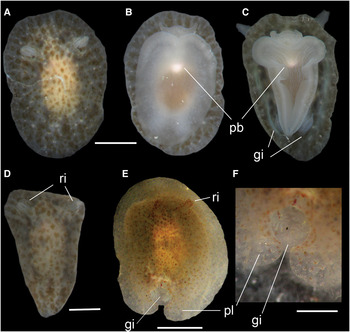
(Figures 2 A–D)
Brazilian corambids: Corambe carambola: (A) dorsal view of living specimen (MZSP 111021), with notum and foot expanded; (B) same, ventral view, with notum and foot expanded; (C) same, contracted; (D) same view of (A), but with notum and foot contracted; Corambe evelinae, (E) dorsal view of living specimen (MZSP 111020); (F) same specimen, detail of posterior notch. gi, gills; ri, rhinophores; pb, circular bright white patch; pl, posterior notal lobes. Scale bars: E = 3 mm; F = 1 mm; A–D = 2 mm.

Corambella carambola, Marcus, Reference Marcus1955: 163–167, figures 209–217.
Corambe carambola, Martynov & Schrödl, Reference Martynov and Schrödl2011: 587–600, tables 1 & 2, figures 3 & 4; Bouchet, Reference Bouchet2013.
Doridella carambola, Marcus, Reference Marcus1970: 210; Abbott, Reference Abbott1974: 365; Rios, Reference Rios1985: 187, pl. 66, figure 951, Reference Rios1994: 209, pl. 71, figure 1015.
Corambe obscura, Swennen & Dekker, Reference Swennen and Dekker1995: 105, table 2 (in part); Rios, Reference Rios2009: 412, unnumbered figure of same drawing of original description of C. carambola; Rosenberg, Reference Rosenberg2009 (in part) [non Verrill, 1870].
TYPE LOCALITY
Ubatuba and São Sebastião Island, São Paulo, Brazil (Figure 1A).
DISTRIBUTION
So far, São Paulo (Brazil).
MATERIAL EXAMINED
Under rocks encrusted by the bryozoans Biflustra denticulata (Busk, 1856) at low tide, Brazil; São Paulo, Santos, Ponta da Praia, 23°59′29.37″S 46°18′16.26″W, MZSP 111021 (Figure 2A–D), 1 specimen (living 4.2 mm long, Cunha col. 2 August 2011).
REMARKS
This species was reported after its original description (from Ubatuba and São Sebastião Island, São Paulo State, Brazil) only once more, from Cananéia (southern São Paulo, about 300 km to the south of the type locality), by Marcus (Reference Marcus1970: 210, as Doridella carambola). Afterwards, it was cited in Abbott's (Reference Abbott1974: 365) and Riośs catalogues (Reference Rios1985: 187, pl. 66, figure 951; Reference Rios1994: 209, pl. 71, figure 1015), also as D. carambola. Although many authors have afterwards treated C. carambola as a synonym of C. obscura (Swennen & Dekker, Reference Swennen and Dekker1995; Rios, Reference Rios2009; Rosenberg, Reference Rosenberg2009), Martynov & Schrödl (Reference Martynov and Schrödl2011) recently revealed considerable differences between both species and regarded C. carambola as a valid species.
When analysed alive under a stereomicroscope the specimens of C. carambola which were observed to have a small (~0.3 mm) circular bright white ventral patch (Figure 2B, C). This feature, also observed by Dr Michael Schrödl (personal communication) in specimens of C. cf carambola from Pernambuco (north-eastern Brazil) had not been reported previously.
As Corambe carambola were found upon a colony of the encrusting bryozoans Biflustra denticulate, this could suggest a predator–prey relationship with this species, although Marcus (Reference Marcus1970) reports specimens of C. carambola from Cananéia (southern São Paulo) living upon hydrozoans.
Corambe evelinae Marcus, Reference Marcus1958
(Figures 2 E–F)
Corambe evelinae, Marcus, Reference Marcus1958: 53–56, figures 50–55; Abbott, Reference Abbott1974: 365; Rios, Reference Rios1985: 187, pl. 65, figure 946, Reference Rios1994: 209, pl. 71, figure 1014, Reference Rios2009: 421, unnumbered figure of same drawing of original description; Martynov & Schrödl, Reference Martynov and Schrödl2011: 587–599, table 2, figures 3 & 4; Martynov et al., Reference Martynov, Brenzinger, Hooker and Schrödl2011: 130–140; Rosenberg, Reference Rosenberg2013.
Neocorambe evelinae, Swennen & Dekker, Reference Swennen and Dekker1995: 105, table 2.
MATERIAL EXAMINED
Under rocks encrusted by the bryozoans Biflustra denticulate (Busk, 1856) at low tide, Brazil; São Paulo, Santos, Ponta da Praia, 23°59′29.37″S 46°18′16.26″W, MZSP 111020 (Figure 2E, F), 1 specimen (living 8.0 mm long, Cunha & Saad col. 26 July 2010), ZSM Moll 20120182, 1 specimen (living 7.4 mm long, Cunha & Saad col. 10 September 2010).
TYPE LOCALITY
Ubatuba, São Paulo, Brazil (Figure 1A).
DISTRIBUTION
So far, São Paulo (Brazil).
REMARKS
Although this species has been included in the Abbot (1974: 365) and Rios' catalogues (1985: 187, pl. 65, figure 946; Reference Rios1994: 209, pl. 71, figure 1014; Reference Rios2009: 421), and more recently quoted in the Martinov & Schrödl (2011) and Martynov et al. (Reference Martynov, Brenzinger, Hooker and Schrödl2011) contributions, this is the first record of the species after its original description, from the city of Ubatuba in the State of São Paulo, Brazil.
As in the case of Corambe carambola, a predator–prey relationship with the bryozoan Biflustra denticulata could be suggested.
ACKNOWLEDGEMENTS
Our thanks to Barbara Louise (Brazil) and Lucas Cervera (Spain) for lending valuable reference material; to Rodrigo B. Salvaror for the English revision and helpful comments; and to Leandro M. Vieira for the identification of the bryozoan. We thank Michael Schrödl (Germany) for further comments on the manuscript. This work was partially supported by Fundação de Amparo a Pesquisa do Estado de São Paulo (FAPESP) procs. No. 2010/11253-9 (CMC) and No. 2011/01493-5 (LOS) and the Capes Foundation, Bolsista da CAPES proc. No. 8739/13-7 (CMC).