Introduction
Posttraumatic stress disorder (PTSD) is one of the most common psychological consequences of exposure to trauma (Norris et al., Reference Norris, Friedman, Watson, Byrne, Diaz and Kaniasty2002; Galea et al., Reference Galea, Nandi and Vlahov2005). While older persons may be more resilient to PTSD following trauma exposure compared to younger persons (Norris et al., Reference Norris, Friedman, Watson, Byrne, Diaz and Kaniasty2002), several factors should be taken into consideration when assessing this disorder in this population (Cook and O'Donnell, Reference Cook and O'Donnell2005; Cook et al., Reference Cook, Elhai and Areán2005; Schinka et al., Reference Schinka, Brown, Borenstein and Mortimer2007; Hudson et al., Reference Hudson, Beckford, Jackson and Philpot2008). Older persons may have sensory and/or cognitive impairments that may affect understanding or recall of assessment-related information; and they may be more likely to manifest traumatic stress symptoms in the form of somatic (e.g. sleep difficulties) as opposed to psychological concerns (Averill and Beck, Reference Averill and Beck2000). Further, PTSD symptoms may be expressed differently in older persons (e.g. more prominent hyperarousal symptoms (Goenjian et al., Reference Goenjian1994)); lower cut scores on PTSD assessment instruments may be optimal in detecting probable PTSD in older persons (Cook and O'Donnell, Reference Cook and O'Donnell2005; Cook et al., Reference Cook, Elhai and Areán2005; Hudson et al., Reference Hudson, Beckford, Jackson and Philpot2008); and little is known about the factor structure of PTSD symptoms in this population (Schinka et al., Reference Schinka, Brown, Borenstein and Mortimer2007).
To date, research on the assessment of PTSD in older persons has focused primarily on examining the psychometric properties of commonly used PTSD assessment measures (e.g. PTSD Checklist (PCL; Weathers et al., Reference Weathers, Litz, Herman, Huska and Keane1993)) in older adult samples. One study of 142 older adult primary care patients found that a PCL score of 37 achieved optimal sensitivity and specificity in assessing an algorithm-derived diagnosis of PTSD (Cook et al., Reference Cook, Elhai and Areán2005). Another study of 100 older persons being treated for medical or psychiatric conditions in a hospital setting found that a PCL score of 36 was optimal in assessing PTSD (Hudson et al., Reference Hudson, Beckford, Jackson and Philpot2008). Results of these studies suggest that application of more conservative cut scores of 44 or 50, which have been found to be optimal in identifying probable PTSD in general adult civilian and veteran samples (McDonald and Calhoun, Reference McDonald and Calhoun2010), may fail to identify a significant proportion of older persons with clinically significant PTSD symptoms.
A second, albeit nascent, area of research on the assessment of PTSD in older persons has focused on the factor structure of PTSD symptoms. According to the Diagnostic and Statistical Manual of Mental Disorders, 4th edition (DSM-IV; American Psychiatric Association, 2000), PTSD is comprised of a three-factor model of re-experiencing, avoidance/numbing, and hyperarousal symptoms. However, a large body of confirmatory factor analytic (CFA) studies (Yufik and Simms, Reference Yufik and Simms2010), which have been conducted primarily in general adult samples, has demonstrated the superiority of two four-factor models in characterizing the structure of PTSD symptomatology. These models include the dysphoria model, which is comprised of separate clusters of re-experiencing, avoidance, dysphoria, and hyperarousal symptoms, and the emotional numbing model, which is comprised of separate clusters of re-experiencing, avoidance, emotional numbing, and hyperarousal symptoms. A recent meta-analysis revealed that both of these four-factor models yielded good fit across studies, with the dysphoria model appearing to fit better than the numbing model, irrespective of the sample or assessment instrument employed (Yufik and Simms, Reference Yufik and Simms2010). To date, however, only one study has examined the structure of PTSD symptoms in trauma-exposed older persons. This study of 134 older adults (aged 66–90) who were exposed to the 2004 Florida hurricanes found that the four-factor emotional numbing model provided the best representation of PTSD symptoms in this sample (Schinka et al., Reference Schinka, Brown, Borenstein and Mortimer2007).
The latest development in the CFA literature on PTSD has been an attempt to reconcile differences between the two four-factor models by separating symptoms that comprise the DSM-IV hyperarousal symptom cluster into “dysphoric arousal” (i.e. sleep disturbance, irritability, and concentration difficulties) and “anxious arousal” (i.e. hypervigilance, exaggerated startle) clusters (Elhai et al., Reference Elhai, Biehn, Armour, Klopper, Frueh and Palmieri2011). The separation of hyperarousal symptoms into these two clusters is based on a theoretical model, which posits that hyperarousal symptoms characterized by restlessness and agitation (i.e. irritability) are distinct from more fear-based, panic-like symptoms (i.e. exaggerated startle response; Watson, Reference Watson2005). Recent studies of general adult samples of primary care medical patients (Armour et al., Reference Armour, Elhai, Richardson, Ractliffe, Wang and Elklit2012), survivors of an earthquake and violent riot (Wang et al., Reference Wang2011), domestic violence (Elhai et al., Reference Elhai, Biehn, Armour, Klopper, Frueh and Palmieri2011), and war veterans (Armour et al., Reference Armour, Elhai, Richardson, Ractliffe, Wang and Elklit2012; Pietrzak et al., Reference Pietrzak, Tsai, Harpaz-Rotem, Whealin and Southwick2012) have found that this five-factor model provides a significantly better representation of PTSD symptom structure than either the DSM-IV or four-factor models.
The objective of this study was threefold: (1) to examine the diagnostic utility of the PCL (i.e. identification of optimal cut point) in assessing worst event- and recent disaster-related PTSD in older adults; (2) to evaluate the best-fitting theoretical representation of PTSD symptom factor structure in this population; and (3) to assess the construct validity of the best-fitting model of Hurricane Ike-related PTSD symptoms using concurrently administered measures of depressive and generalized anxiety symptoms. Based on prior research (Cook et al., Reference Cook, Elhai and Areán2005; Watson, Reference Watson2005; Schinka et al., Reference Schinka, Brown, Borenstein and Mortimer2007; Hudson et al., Reference Hudson, Beckford, Jackson and Philpot2008; Elhai et al., Reference Elhai, Biehn, Armour, Klopper, Frueh and Palmieri2011; Wang et al., Reference Wang2011), we hypothesized: that a PCL score in the high 30 range would provide optimal sensitivity and specificity in assessing both worst event- and disaster-related PTSD, as assessed using PCL-based, DSM-IV algorithm-derived diagnoses of PTSD; that the recently proposed five-factor model of PTSD symptom structure (Elhai et al., Reference Elhai, Biehn, Armour, Klopper, Frueh and Palmieri2011) would provide a better-fitting representation of PTSD symptom structure; and that Hurricane Ike-related re-experiencing and anxious arousal symptoms would correlate more strongly with concurrent generalized anxiety symptoms than with depressive symptoms, while the dysphoric arousal cluster would correlate equally strongly with generalized anxiety and depressive symptoms.
Methods
Sample
A total of 206 adults aged 60 or older who had been living in Galveston County or Chambers County, Texas, for at least one month before September 13, 2008, when Hurricane Ike made landfall, participated in this study. These adults represented 31.3% of the total sample of 658 adults aged 18 or older who were recruited as part of this study (Norris et al., Reference Norris, Sherrieb and Galea2010). Details regarding sampling and recruitment procedures are available elsewhere (Norris et al., Reference Norris, Sherrieb and Galea2010). Briefly, disproportionate stratified cluster sampling was employed to acquire samples in areas that experienced more damage from Hurricane Ike and that were more likely to be exposed to hurricane-related traumas. The cooperation rate for the full sample was 83%. Interviews were conducted by experienced interviewers at the University of Michigan Institute for Social Research using a computer-assisted interview system. All interviews took place between November 7, 2008, and March 24, 2009, and lasted an average of 70 minutes. If a potential respondent had cognitive issues or other medical concerns such as a serious illness or hearing impairment that limited his or her ability to complete the interview, the interview was suspended and coded a non-interview; of respondents aged 60 or older, five cases were coded as non-interviews. Data from the first interview, which was conducted two–five months after Hurricane Ike, were analyzed in this study.
Assessments
Hurricane Ike exposures were assessed using questions that asked about respondents’ experiences during and after Hurricane Ike. This section of the interview began as follows: “My next questions focus on the impact of Hurricane Ike on you and your household.” The interviewer then proceeded to ask questions about respondents’ Hurricane Ike experiences (e.g. “Were you physically injured in any way as a result of Hurricane Ike?” “Did you personally see any dead bodies either during or after Hurricane Ike?”). These experiences were grouped into nine categories and summed to yield a hurricane exposure measure: (1) threat to safety of self or family/friends; (2) injury or health problem to self or household member; (3) family member or close friend injured or killed; (4) encounter with dead bodies during or after Hurricane Ike; (5) damage to three or more types of property (e.g. residence, furnishings, cars/vehicles); (6) financial loss (i.e. lost income as a result of Hurricane Ike); (7) displacement from home ≥ ten days; (8) lack of two or more necessities for ≥ one week (e.g. shelter, electricity, food/water, transportation); and (9) high level of area disruption or damage (sum of ratings of damage and disruption to area schools, churches, streets/highways in the top third for the full sample). Cronbach's α for this summary hurricane exposure measure was 0.80.
Traumatic life events were assessed by asking respondents about their exposure to ten DSM-IV Criterion A-qualifying traumas (e.g. serious accident, sudden unexpected death of someone close; Breslau et al., Reference Breslau, Kessler, Chilcoat, Schultz, Davis and Andreski1998). This section of the interview was introduced as follows: “I am going to read a series of statements that refer to events you may have experienced at any time in your lifetime.” Respondents were then asked whether they experienced ten potentially traumatic events (e.g. “In your lifetime, have you experienced the sudden, unexpected death of someone close to you?” “In your lifetime, have you experienced combat or exposure to a warzone – in the military or as a civilian?”). Respondents were also asked if they experienced any stressful situation(s) or event(s) other than the ten specific traumatic events: “In your lifetime, have you experienced any other extraordinarily stressful situation or event?”
PTSD symptoms were assessed using the PCL – Specific Stressor Version, a 17-item self-report instrument that assesses DSM-IV symptoms of PTSD (Weathers et al., Reference Weathers, Litz, Herman, Huska and Keane1993). Total scores on the PCL range from 17 to 85. In this study, the PCL was administered twice – first, to query respondents about PTSD symptoms related to Hurricane Ike, and a second time to query respondents about lifetime PTSD symptoms related to their worst traumatic life event other than Hurricane Ike. These assessments occurred at different sections of the interview – Hurricane Ike-related PTSD symptoms were assessed early in the course of the interview, while worst event-related PTSD symptoms were assessed later in the interview. All respondents were asked about PTSD symptoms in relation to Hurricane Ike; respondents who did not endorse any other traumatic events in their lifetimes were not asked about worst event-related PTSD symptoms. Questions regarding PTSD symptoms were assessed by phrasing each of the 17 PCL items in the following manner: “How much were you bothered by repeated, disturbing memories, thoughts, or images of this stressful experience? Would you say not at all, a little bit, moderately, quite a bit, or extremely?” Additional questions were also asked to assess Criteria A2, E, and F. Diagnoses of probable PTSD, which were used as the “gold standard” in the receiver operating characteristic (ROC) curve analysis (Cook et al., Reference Cook, Elhai and Areán2005), required endorsement of all DSM-IV criteria for PTSD as follows: experienced, witnessed, or was confronted with event(s) that involved actual or threatened death or serious injury, or a threat to physical integrity of self or others (Criterion A1) with response involving intense fear, helplessness, or horror (Criterion A2); endorsement of being bothered “moderately,” “quite a bit,” or “extremely” by at least one intrusion (Criterion B), three avoidance/numbing (Criterion C), and two arousal (Criterion D) symptoms (Blanchard et al., Reference Blanchard, Hickling, Taylor, Forneris, Loos and Jaccard1995); endorsement of symptom duration greater than one month (Criterion E); and endorsement of symptoms cause significant distress or impairment in social, occupational, or other important areas of functioning (Criterion F). Criterion A2 was assessed by asking respondents the following questions in relation to Hurricane Ike and respondents’ worst traumatic event: “When this event occurred, did you feel terrified?” “When this event occurred, did you feel helpless?” A “yes” response to either question was required to meet Criterion A2. Criterion E was assessed by asking respondents the following question: “How long did you continue to have any of these problems because of this event?” – experiencing symptoms for one month or longer was required to meet Criterion E. Criterion F was assessed using the following two questions: “You said you had problems with [PTSD symptoms reported by respondent]. How difficult did these problems make it for you to do your work, take care of things at home, or get along with other people? Would you say – not difficult at all, somewhat difficult, very difficult, or extremely difficult?” and “When you had several of these bad mood, feelings, and memories, how distressing was it for you? Was it not at all distressing, mildly distressing, moderately distressing, or severely distressing?” Endorsement of very or extreme difficulty in response to the first question or moderate to severe distress in response to the second question was required to meet Criterion F. This method of identifying probable diagnoses of PTSD has been validated against the Clinician Administered PTSD Scale (CAPS), and has been shown to be highly specific for PTSD and to have excellent psychometric properties (Uddin et al., Reference Uddin2010; Tracy et al., Reference Tracy, Norris and Galea2011).
To examine how the best-fitting model of Hurricane Ike-related PTSD symptom structure was related to external measures of psychopathology, participants also completed the Generalized Anxiety Disorder-7 (GAD-7; Spitzer et al., Reference Spitzer, Kroenke, Williams and Lowe2006), and Patient Health Questionnaire-9 (PHQ-9; Kroenke et al., Reference Kroenke, Spitzer and Williams2001), which provide measures of current symptoms of generalized anxiety disorder (GAD) and depression. Only Hurricane-Ike related PTSD symptoms were examined in relation to these measures because the timeframes of these assessments were congruent.
Data analysis
Seven respondents had missing symptom-level data for the PCL assessment of worst event-related PTSD symptoms, and three had missing symptom-level data for the PCL assessment of Ike-related PTSD symptoms. These data were multiply imputed using the Sequential Regression Imputation Method in IVEware (Raghunathan et al., Reference Raghunathan, Lepkowski, Van Hoewyk and Solenberger2001; Reference Raghunathan, Solenberger and Hoewyk2002) based on other demographic information, Hurricane Ike-related experiences, and lifetime histories of traumatic events and stressors (Tracy et al., Reference Tracy, Norris and Galea2011). Prevalence estimates of probable PTSD and individual PTSD symptoms were weighted to account for unequal probabilities of selection across sampling strata and within households, as well as for non-response. An additional post-stratification adjustment was applied to match the sample to the population in Galveston and Chambers counties, according to the 2005–2007 American Community Survey (http://www.census.gov/acs/www/data_documentation/data_main/).
ROC analyses and κ statistics were computed to assess the optimal cut scores on the PCL that identified older adults with and without PCL-based, DSM-IV algorithm-derived diagnoses of PTSD. Sensitivity, specificity, quality of sensitivity, quality of specificity, positive predictive value, negative predictive value, efficiency, quality of efficiency (Cohen's κ), and Youden's index (Youden, Reference Youden1950; Kraemer, Reference Kraemer1992) were computed for PCL cut scores ranging from 34 to 50. To ensure comparability to prior studies of the diagnostic utility of the PCL in older adults (Cook et al., Reference Cook, Elhai and Areán2005; Hudson et al., Reference Hudson, Beckford, Jackson and Philpot2008), we refer to Youden's index in ascertaining PCL cut scores that had optimal sensitivity and specificity in identifying probable PTSD. We also used quality of efficiency (Cohen's κ) to identify PCL cut scores that provided optimal correlation with PCL-based, DSM-IV algorithm-derived diagnoses of PTSD.
Because PCL scores exhibited multivariate non-normality, as evidenced by Mardia's coefficient > 1.96, CFAs were conducted using robust maximum likelihood estimation with the Satorra and Bentler (S-B) χ2 scaling correction (Satorra and Bentler, Reference Satorra and Bentler2001). This correction estimates standard errors under conditions of multivariate non-normality and computes other χ2-dependent fit statistics based on the S-B χ2 statistic. In all CFAs, PCL items were specified to load on only one of several factors, all factors were allowed to correlate, all error covariances were fixed to zero, and all tests were two-tailed. Model fit was evaluated using the following fit statistics: S-B χ2, comparative fit index (CFI), Tucker-Lewis Index (TLI), and root mean square error of approximation (RMSEA). By convention, higher CFI and TLI values, and lower χ2 and RMSEA values indicate better fit. In CFA studies, fit is also commonly determined by empirically defined benchmarks, with CFI and TLI ≥0.90 indicative of adequate fit and ≥0.95 indicative of excellent fit; and RMSEA ≤0.08 indicative of adequate fit and ≤0.06 indicative of excellent fit (Hu and Bentler, Reference Hu and Bentler1999). χ2 difference tests for nested models with a correction factor (given the use of the S-B χ2 statistic) were computed to compare the relative fit of the five-factor model to the three-factor DSM-IV model, and the four-factor dysphoria and numbing models; χ2 difference tests were also used to compare the DSM-IV to the numbing model (Fan and Sivo, Reference Fan and Sivo2009). To compare non-nested models (i.e. DSM-IV vs. dysphoria model; dysphoria model vs. numbing model), the Bayesian Information Criterion (BIC) was computed using the following formula: BIC = S-Bχ2 + ln(N) × t, where N = sample size and t = the number of parameters estimated in the model. In comparing BIC values, a difference of <2 indicates that the two compared models cannot be discriminated; and differences of 2–6, 6–10, and 10 or higher are indicative of positive, strong, and very strong support, respectively, in favor of the model with the lower BIC value (Raftery, Reference Raftery1995).
Four theoretical models of PTSD symptom structure were evaluated. Model 1 was the DSM-IV three-factor model of re-experiencing, avoidance, and hyperarousal symptoms. Model 2 was the four-factor emotional numbing model consisting of separate re-experiencing, avoidance, emotional numbing, and hyperarousal factors. Model 3 was the four-factor dysphoria model consisting of separate re-experiencing, avoidance, dysphoria, and hyperarousal factors. Model 4 was the recently proposed five-factor model, which is similar to the four-factor numbing model, except that symptoms D1–D3 and D4–D5 that comprise the DSM-IV PTSD hyperarousal cluster are separated into two separate factors (Elhai et al., Reference Elhai, Biehn, Armour, Klopper, Frueh and Palmieri2011). Internal consistency analyses were conducted to evaluate the reliability of PCL in assessing worst event- and Hurricane Ike-related PTSD symptoms, as well as CFA-derived PTSD symptom clusters.
To evaluate the external convergent and discriminant validity of the best-fitting model of Hurricane Ike-related PTSD symptoms (Elhai and Palmieri, Reference Elhai and Palmieri2011), we conducted an additional structural equation model to examine correlations between factors of the best-fitting model of Hurricane Ike-related PTSD symptoms and external measures of depressive (PHQ-9) and generalized anxiety (GAD-7) symptoms. Steiger's z tests (Steiger, Reference Steiger1980) were used to compare magnitudes of correlations between the best-fitting model of Ike-related PTSD symptoms and external measures of depressive and generalized anxiety symptoms. All p-values reported for the Steiger's z statistics are two-tailed.
Results
The majority of participants (59.9%) were aged 60–69 (mean age = 69.2; SD = 7.6; range = 60–92), male (53.3%), White/non-Hispanic (76.7%), high school-educated (73.2%), married (62.7%), retired (73.5%), and had an income <$40,000 (64.3%).
Of the 206 older adults who participated in this study, 157 (76.2%) endorsed at least one lifetime traumatic event. These individuals served as the sample for ROC and CFA analyses of worst event-related PTSD symptoms (Cook et al., Reference Cook, Elhai and Areán2005). In this sample, the most commonly endorsed worst events were unexpected death of someone close (47.8%), “other” traumatic event (21.7%), disaster other than Hurricane Ike (11.5%), and combat (7.0%). Other traumas were endorsed with lower frequency: involved in serious accident (5.1%), witnessed assault or killing (2.5%), serious illness or injury to self (1.9%), and robbery or mugging (1.3%). Conditional weighted prevalences of PTSD were 16.9% for respondents who endorsed “other” traumatic event as their worst event, 12.6% for combat, 9.5% for unexpected death of someone close, and 0% for disaster other than Hurricane Ike. Conditional prevalences of PTSD for less commonly endorsed traumas were not computed due to small sample sizes.
On average, respondents reported two major Hurricane Ike exposures (SD = 2.1; range = 0–7). Regarding specific exposures, 38.3% reported experiencing life threat to self or other, 34.1% reported being displaced from home ≥ ten days, 27.6% reported incurring a financial loss because of Ike, 27.4% reported experiencing damage to three or more types of property, 23.9% reported experiencing high level of community damage, 23.4% reported lacking two or more resources for ≥ one week, 20.4% reported sustaining an injury or health problem because of Ike, 6.6% reported seeing dead bodies during or after Ike, and 2.4% reported a family member or friend being killed or injured during or after Ike.
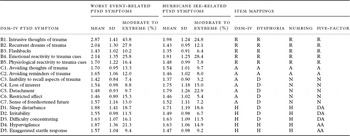
The mean total worst-event related PCL score was 29.5 (SD = 14.8; range = 17–85). The weighted lifetime and past-month prevalences of worst-event related PTSD were 14.2% and 7.4%, respectively. The mean total Ike-related PCL score was 24.7 (SD = 11.1; range = 17–85) and weighted prevalence of Ike-related PTSD was 7.6%. Table 1 shows mean scores, standard deviations, proportion of the sample that endorsed “moderate” or greater severity of each symptom, and item mappings for the CFA models. The most commonly endorsed worst-event related PTSD symptoms were intrusive thoughts and recurrent dreams of the trauma, and emotional reactivity to trauma cues. The most commonly endorsed Ike-related PTSD symptoms were emotional reactivity to trauma cues, intrusive thoughts of the trauma, and detachment.
Mean symptom ratings on the PTSD Checklist items and item mappings for tested CFA models
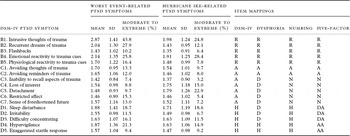
Note: CFA = confirmatory factor analysis; DSM-IV = Diagnostic and Statistical Manual of Mental Disorders, 4th edition; PTSD = posttraumatic stress disorder; SD = standard deviation; moderate to extreme (%) = percentage of sample endorsing “moderate,” “quite a bit,” or “extreme” severity of each symptom of the PTSD Checklist; R = re-experiencing; A = avoidance; N = emotional numbing; H = hyperarousal; D = dysphoria; DA = dysphoric arousal; AA = anxious arousal.
Receiver operating characteristic analysis
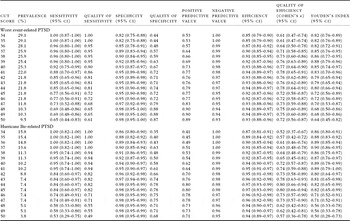
Table 2 shows the performance of PCL cut scores ranging from 34 to 50 in assessing PCL-based, DSM-IV algorithm-derived diagnoses of worst event- and Hurricane Ike-related PTSD. For worst-event related PTSD symptoms, a PCL cut score of 39 (according to Youden's index) and 41 (according to Cohen's κ) optimally identified older adults with and without a PCL-based, DSM-IV algorithm-derived diagnosis of worst event-related PTSD. The total score of the PCL had an area under the curve of 0.98 (standard error = 0.01; 95% confidence interval (CI) = 0.94–0.99; z statistic = 49.64; p < 0.0001) in discriminating a DSM-IV algorithm-based diagnosis of worst event-related PTSD.
Results of analyses examining the diagnostic utility of the PTSD Checklist in assessing worst event- and Hurricane Ike-related PTSD
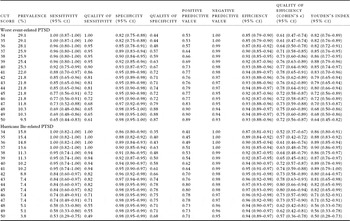
Note: PTSD = posttraumatic stress disorder; 95% CI = 95% confidence interval.
For Hurricane Ike-related PTSD symptoms, a PCL cut score of 37 (according to Youden's index) and 44 (according to Cohen's κ) optimally identified older adults with and without a PCL-based, DSM-IV algorithm-derived diagnosis of Ike-related PTSD. The total score of the PCL had an area under the curve of 0.98 (standard error = 0.01; 95% CI = 0.94–0.99; z statistic = 48.40; p < 0.0001) in discriminating a DSM-IV algorithm-based diagnosis of Ike-related PTSD.
Confirmatory factor analyses
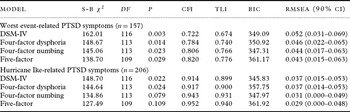
Fit statistics for each of the four models of worst event- and Ike-related PTSD symptom structures are shown in Table 3. For worst-event related PTSD symptoms, corrected scaled χ2 difference tests revealed that the five-factor model fit significantly better than the DSM-IV (Δχ2(7, n = 157) = 41.18, p < 0.001) and four-factor dysphoria (Δχ2(4, n = 157) = 13.25, p = 0.010) models, but the difference compared to the numbing model did not reach statistical significance (Δχ2(4, n = 157) = 6.15, p = 0.19); the numbing model fit significantly better than the DSM-IV model (Δχ2(3, n = 157) = 18.33, p = 0.0004). Comparison of non-nested models suggested that the numbing model fit better than the dysphoria model (ΔBIC = −3.61), but that the DSM-IV and dysphoria models did not differ (ΔBIC = −1.83).
Fit statistics of models of PTSD symptom structure
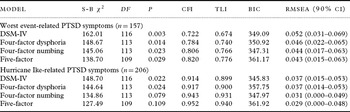
Note: PTSD = posttraumatic stress disorder; DSM-IV = Diagnostic and Statistical Manual of Mental Disorders, 4th edition; S-B χ2 = Satorra-Bentler chi-square statistic; df = degrees of freedom; CFI = comparative fit index; TLI = Tucker-Lewis Index; BIC = Bayesian Information Criterion; RMSEA = root mean square error of approximation; 90% CI = 90% confidence interval.
For Ike-related PTSD symptoms, CFA of the five-factor model showed greater evidence for excellent fit, as indicated by CFI = 0.952 and RMSEA = 0.029 (90% CI = 0.000–0.048). Corrected scaled χ2 difference tests revealed that the five-factor model fit significantly better than the DSM-IV (Δχ2(7, n = 206) = 18.46, p = 0.010) and four-factor dysphoria (Δχ2(4, n = 206) = 11.17, p = 0.025) models, but the difference compared to the numbing model did not reach statistical significance (Δχ2(4, n = 206) = 6.61, p = 0.16); the numbing model fit significantly better than the DSM-IV model (Δχ2(3, n = 206) = 12.81, p = 0.005). Comparison of non-nested models provided very strong support for the DSM-IV fitting better than the dysphoria model (ΔBIC = −11.92), and strong support for the numbing model fitting better than the dysphoria model (ΔBIC = −9.78).
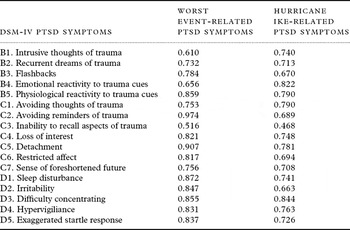
Table 4 shows factor loadings of worst event- and Ike-related PTSD symptoms that comprise the five-factor model of PTSD symptom structure. With the exception of inability to recall aspects of trauma, which had factor loadings of 0.516 and 0.468 on latent factors of worst event- and Ike-related numbing symptoms, respectively, factor loadings of other symptoms ranged from 0.610 to 0.974 for worst event-related PTSD factors, and from 0.663 to 0.844 for Ike-related PTSD symptoms. Internal consistency analyses of the five-factor model of worst event-related PTSD symptoms suggested good reliability for each of the five PTSD symptom clusters, with Cronbach's α values of 0.87 for the re-experiencing cluster, 0.84 for the avoidance cluster, 0.87 for the numbing cluster, 0.88 for the dysphoric arousal cluster, and 0.80 for the anxious arousal cluster. Internal consistency analyses of the five-factor model of Ike-related PTSD symptoms also suggested good reliability for each of the five PTSD symptom clusters, with Cronbach's α values of 0.88 for the re-experiencing cluster, 0.82 for the avoidance cluster, 0.86 for the numbing cluster, 0.80 for the dysphoric arousal cluster, and 0.85 for the anxious arousal cluster.
Factor loadings of five-factor models of PTSD symptom structure
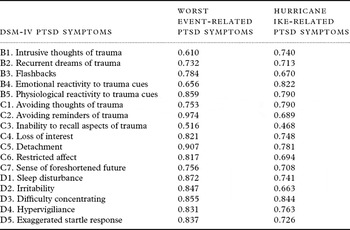
Note: DSM-IV = Diagnostic and Statistical Manual of Mental Disorders, 4th edition; PTSD = posttraumatic stress disorder.
Construct validity analyses of five-factor model of Hurricane Ike-related PTSD symptoms
Correlations between the five-factor model of Hurricane Ike-related PTSD symptoms and current depressive and generalized anxiety symptoms revealed significant associations between re-experiencing and generalized anxiety (r = 0.61, p < 0.001) and depressive (r = 0.46, p < 0.001) symptoms, avoidance and generalized anxiety (r = 0.41, p < 0.001) and depressive (r = 0.40, p < 0.001) symptoms, numbing and generalized anxiety (r = 0.46, p < 0.001) and depressive (r = 0.50, p < 0.001) symptoms, dysphoric arousal and generalized anxiety (r = 0.58, p < 0.001) and depressive (r = 0.51, p < 0.001) symptoms, and anxious arousal and generalized anxiety (r = 0.38, p < 0.001) and depressive (r = 0.28, p < 0.001) symptoms. Depressive and generalized anxiety symptoms were also significantly correlated (r = 0.80, p < 0.001). Steiger's z-tests indicated significantly stronger correlations between re-experiencing (Z = 3.61, p < 0.001) and anxious arousal (Z = 2.17, p = 0.03) and generalized anxiety symptoms than with depressive symptoms. Correlations between the avoidance, numbing, and dysphoric arousal symptom clusters and the generalized anxiety and depressive symptom factors did not differ (all Zs < 1.73, all ps > 0.08).
Discussion
We found that the PCL reliably assesses both worst event- and disaster-related PTSD in older adults, and that the optimal cut score in identifying probable worst event- and disaster-related PTSD in this population ranges between 37 and 44. Further, CFA results revealed that a newly described five-factor model of re-experiencing, avoidance, numbing, dysphoric arousal, and anxious arousal provided a better fitting representation of both worst event- and Ike-related PTSD symptom structure relative to alternative models.
According to Youden's index, a cut score of 39 for probable worst event-related PTSD and 37 for probable Ike-related PTSD on the PCL were optimal in identifying probable worst event- and Ike-related PTSD. This finding is consistent with previous studies of older adult samples recruited from clinical settings (Cook et al., Reference Cook, Elhai and Areán2005; Hudson et al., Reference Hudson, Beckford, Jackson and Philpot2008). Importantly, these cut scores identified worst event- and Ike-related probable PTSD that met full DSM-IV diagnostic criteria for PTSD, as assessed using the PCL, not simply Criteria B, C, and D. Thus, these scores were optimal in identifying a more rigorous and diagnostically accurate operationalization of PTSD than is commonly employed using the PCL. This finding replicates and extends prior research on the diagnostic utility of the PCL in older adults (Cook et al., Reference Cook, Elhai and Areán2005; Hudson et al., Reference Hudson, Beckford, Jackson and Philpot2008) to suggest that cut scores in the high 30 range on this measure provide greater sensitivity and specificity than more conservative cut scores such as 44 or 50 (McDonald and Calhoun, Reference McDonald and Calhoun2010) in assessing probable worst event- and recent disaster-related PTSD in older adults. While Cohen's κ suggested that higher PCL cut scores of 41 for worst event-related PTSD and 44 for Ike-related PTSD provided the highest correlation with probable PTSD diagnoses, CIs for these statistics overlapped with those of other cut scores; furthermore, some researchers have criticized Cohen's κ as being too conservative (Uebersax, Reference Uebersax1987; Guggenmoos-Holzmann, Reference Guggenmoos-Holzmann1993). Taken together, these findings suggest that the application of conservative PCL cut scores of 44 or 50, which have been found to be optimal in identifying probable PTSD in general adult civilian and veteran samples, respectively (McDonald and Calhoun, Reference McDonald and Calhoun2010), may result in an increase in false negatives and possible lack of referral for treatment when assessing PTSD in older persons. Given that older adults may minimize or attribute their psychological symptoms to physical symptoms or conditions (Averill and Beck, Reference Averill and Beck2000), and may be less likely to acknowledge or report their trauma-related symptoms because of shame or stigma (Falk et al., Reference Falk, Hersen and Van Hasselt1994), assessments of PTSD should consider the significance of any clinical elevation in PTSD symptoms, as the application of conservative cut scores may fail to identify clinically meaningful symptoms and possibly prevent or delay referral for appropriate treatment.
That the five-factor model of PTSD symptom structure provided a better representation of worst event- and Ike-related PTSD symptoms in this sample compared to alternative models is consistent with recently published studies of primary care medical patients (Armour et al., Reference Armour, Elhai, Richardson, Ractliffe, Wang and Elklit2012), survivors of an earthquake and violent riots (Wang et al., Reference Wang2011), domestic violence (Elhai et al., Reference Elhai, Biehn, Armour, Klopper, Frueh and Palmieri2011), and war veterans (Armour et al., Reference Armour, Elhai, Richardson, Ractliffe, Wang and Elklit2012; Pietrzak et al., Reference Pietrzak, Tsai, Harpaz-Rotem, Whealin and Southwick2012). Further, the numbing model provided a better fit to PTSD symptom data than the DSM-IV and dysphoria models, which corroborates results of a CFA study of the PCL in elderly survivors of the 2004 Florida Hurricanes (Schinka et al., Reference Schinka, Brown, Borenstein and Mortimer2007). Although χ2 difference tests suggested that the five-factor model did not fit significantly better than the numbing model, inspection of other fit statistics suggested that this model fit the data better, and there was greater evidence of “excellent fit” for the five-factor model of Ike-related PTSD symptoms, as indicated by empirically defined benchmarks on the CFI fit statistic (Hu and Bentler, Reference Hu and Bentler1999). Factor loadings of each of the PTSD symptoms on their respective latent factors were also strong, with the exception of inability to recall aspects of the trauma, which, as has been observed in prior research (Elhai et al., Reference Elhai, Biehn, Armour, Klopper, Frueh and Palmieri2011; Pietrzak et al., Reference Pietrzak, Tsai, Harpaz-Rotem, Whealin and Southwick2012), did not load as strongly on its respective factor. Further, internal consistency analyses suggested good reliability for each of the five PTSD symptom clusters, with Cronbach's α ranging from 0.80 to 0.88.
A large body of prior CFA research has suggested that the dysphoria and numbing models consistently provide a significantly better representation of PTSD symptom structure than the three-factor DSM-IV model (Yufik and Simms, Reference Yufik and Simms2010). Thus, it was surprising that the DSM-IV model provided a better fit than the dysphoria model in characterizing the structure of Ike-related PTSD symptoms. While it is not entirely clear why this was the case, one possible interpretation is that this may be related to the DSM-IV model being more similar in structure to the numbing model, which provided a better fit to these data. Additional research in larger samples of trauma-exposed older persons will be helpful in further evaluating the structure of PTSD symptoms in this population.
Construct validity analyses of the five-factor model of Hurricane Ike-related PTSD symptoms revealed that re-experiencing and anxious arousal symptoms correlated more strongly with generalized anxiety symptoms than with depressive symptoms. Further, consistent with Watson's theoretical model (Watson, Reference Watson2005) and Elhai and colleagues’ five-factor model of PTSD symptom dimensionality (Elhai et al., Reference Elhai, Biehn, Armour, Klopper, Frueh and Palmieri2011), the dysphoric arousal cluster correlated equally strongly with generalized anxiety and depressive symptoms. These findings, which provide support for the convergent and discriminant validity of the five-factor model of PTSD symptoms, suggest that, in older adults, the dysphoric arousal symptom cluster reflects both depressive and generalized anxiety symptoms, while re-experiencing and anxious arousal symptom clusters more strongly reflect generalized anxiety symptoms.
Taken together, results of CFA analyses suggest that worst event- and recent disaster-related PTSD symptoms in older persons are heterogeneous in nature and may be best represented by independent clusters of re-experiencing, avoidance, numbing, dysphoric arousal, and anxious arousal. These findings suggest that clinical assessments of PTSD in older adults should take into consideration this heterogeneity of symptom presentation, as it may help identify symptom cluster(s) that may be differentially related to an individual's current distress and functional difficulties. Further, given that the temporal development of PTSD symptoms may vary over time in clinically important ways (e.g. re-experiencing symptoms giving rise to avoidance symptoms and/or arousal symptoms giving rise to numbing symptoms; Asmundson et al., Reference Asmundson, Stapleton and Taylor2004), consideration of these symptom clusters with respect to their developmental characteristics in the course of PTSD may help inform the selection of appropriate psychotherapeutic and/or pharmacotherapeutic treatments.
Methodological limitations of this study must be noted. First, it is unclear whether results of this study generalize to the broader population of trauma-exposed older persons, who may differ with respect to medical/disability and cognitive status, which were not assessed in the current study. Second, although diagnoses of PTSD used in this study were based on DSM-IV criteria, a “gold-standard” clinician-interview such as the CAPS was not administered. Further, given that the PCL was used to assess both severity and probable diagnoses of PTSD, results do not reflect the “true” diagnostic utility of the PCL, which would require independent, clinical interview-based diagnoses of PTSD; instead, these results more appropriately reflect the calibration of total PCL scores against PCL-based, DSM-IV algorithm-derived diagnostic classifications of PTSD. Nevertheless, a prior study on the diagnostic utility of the PCL in older adults found that a score of 36 achieved optimal sensitivity and specificity in assessing independent, CAPS-derived diagnoses of PTSD (Hudson et al., Reference Hudson, Beckford, Jackson and Philpot2008). Third, while the five-factor model fit better than several alternative models in characterizing the structure worst event-related PTSD, inspection of some fit statistics such as the CFI and TLI did not indicate adequate fit. This finding may, at least in part, be explained by differences in the nature, duration, and timing of worst traumatic life events, as well as by variable patterns of PTSD symptom presentation across worst traumatic life events. Fourth, while the relatively small sample size may also be considered a limitation, power analysis tables suggest that a sample size between 132 and 178 would be sufficient to test the CFA models, assuming 80% power and RMSEA values between 0.05 and 0.08 (MacCallum et al., Reference MacCallum, Browne and Sugawara1996). Fifth, assessments of both worst event- and Hurricane Ike-related PTSD symptoms occurred two–five months after a major natural disaster; thus, it is not clear whether elevations in psychiatric symptoms associated with this event may have affected recall and/or reporting of worst event-related PTSD symptoms.
Despite these limitations, results of this study contribute to extant understanding of the assessment of PTSD in older adults by identifying optimal cut scores on the PCL that may be used to identify probable worst event- and disaster-related PTSD, and providing a theory-based evaluation of factor structures of PTSD symptoms in older persons. Further research is needed: to replicate these findings in other samples of trauma-exposed older adults; to investigate the natural history of re-experiencing, avoidance, numbing, and dysphoric and anxious arousal symptoms; and to evaluate the utility of the five-factor model of PTSD symptom structure in predicting long-term distress, functioning, and treatment outcomes in this population.
Conflict of interest
None.
Description of authors’ roles
S. Galea and F. Norris designed and supervised data collection for the larger study from which data in the current study were drawn; R. H. Pietrzak, P. H. Van Ness, and T. R. Fried designed the current study; R. H. Pietrzak and P. H. Van Ness were responsible for the statistical design of the study and for carrying out the statistical analysis; and all authors contributed to the writing, editing, and revising of the paper.
Acknowledgments
This research was supported by the National Center for Disaster Mental Health Research (NIMH Grant 5 P60 MH082598; Fran H. Norris, Center Director; Sandro Galea, Research Director). Preparation of this report was supported by a Research Career Development Award to Dr Pietrzak from the Claude D. Pepper Older Americans Independence Center at Yale University School of Medicine (NIA Grant P30AG21342), as well as the National Center for Posttraumatic Stress Disorder. These funding sources had no further role in study design; in the collection, analysis, and interpretation of data; in the writing of the report; or in the decision to submit the paper for publication.