Introduction
The Changing Roles of Schools
Historically, the Australian school system had one role: to prepare children to participate in and stimulate the economy (Meer, Reference Meer2007). In recent times this role has become more expansive (Bottrell & Goodwin, Reference Bottrell, Goodwin, Bottrell and Goodwin2011; Roberts, Reference Roberts2012; The Ministerial Council on Education, Employment, Training and Youth Affairs [MCEETYA], 2008; Watson, Reference Watson2009), with recognition that schools play an influential and multifaceted role in children's lives (Edwards & Sweeney, Reference Edwards and Sweeney2007). Schools are perceived to support children's wellbeing and socialisation, and through education, enhance life opportunities (Bottrell & Goodwin, Reference Bottrell, Goodwin, Bottrell and Goodwin2011; Department of Education and Early Childhood Development [DEECD], 2014a; MCEETYA, 2008; Roberts, Reference Roberts2012). Further, the Victorian DEECD argues that schools must promote educational learning as well as protect all students from perceived physical and/or psychological harm DEECD, (2014a) in partnership with their families.
One group of vulnerable children, whose special circumstances remain somewhat unnoticed in schools are children of prisoners. Despite an estimated 5% of Australian children having experienced parental imprisonment throughout their lifetime, which equates to at least one child in every Australian classroom (Quilty, Reference Quilty2005), there remains an absence of educational debate or policy-development attention on the issue. In Victoria, there are no specific guidelines or policy to assist schools or staff in responding to the needs of these children (DEECD, 2014a; Flat Out Inc. & VACRO, 2006). Similarly, there is no communication pathway between either Corrections Victoria or the Department of Human Services – Child Protection and the education system to inform schools when parental imprisonment occurs (Flat Out Inc. & VACRO, 2006), despite all departments being represented on the Children's Services Coordination Board. The role of this board is to coordinate state government departments to improve outcomes for children, “particularly those vulnerable to harm, disadvantage or social exclusion” (DEECD, 2014b: Para. 3). This lack of specific policy within the school environment is mirrored worldwide (Roberts, Reference Roberts2012). Currently, the City of Gloucester in England is one of the few known areas that has acknowledged and sought to guide and support schools in assisting children affected by parent imprisonment (Gloucestershire County Council, 2010). Most recently, in Somerset, England, Barnardos have conducted awareness raising training with 17 schools involved in the From Learning Partnership, about the needs of children affected by parental offending. The aim of this training is to improve school's understanding of and response to these children and their families, and for each school to have one staff ‘champion’, as the point of contact for families, whose role it is to advocate for these issues in the school environment and in the local community (Barnardos, 2014).
Children of Prisoners
There is currently only limited data gathered about these children, with researchers and policy makers relying largely on estimates. The most recent estimate in Victoria was made some 15 years ago, when it was suggested that around 3,000 children resided in households affected by parental imprisonment (Tudball, Reference Tudball2000). Given the growth in the prisoner population since that time (ABS, 2013), and with further prison expansion planned (Premier of Victoria, 2014), the numbers affected are now likely to be considerably higher, and continuing to grow.
It is suggested that in comparison to their peers, children of prisoners are more likely to live in poverty, instability, experience violence, stress, and a lack of access to supports (Edwards & Shillingford, Reference Edwards and Shillingford2008; Lopez & Bhat, Reference Lopez and Bhat2010; Shlafer, Poehlmann, Coffino & Hannenman, Reference Shlafer, Poehlmann, Coffino and Hanneman2009; Travis & Waul, Reference Travis and Wahl2004; Tudball, Reference Tudball2000). Quite simply, parental imprisonment typically increases the stress in households, which are already stressed and depleted (Gaudin & Sutphen, Reference Gaudin and Sutphen1993).
Although no simple causal relationships have been established, and these families have clear pre-existing problems (Dalley, Reference Dalley2002; Mumola, Reference Mumola2000), a range of negative outcomes for children associated with parental imprisonment have been documented in the literature. These include: homelessness, stigmatisation, criminal behaviour, poor physical and mental health, behavioural issues, substance misuse, and premature departure from home (Dallaire, Reference Dallaire2007; Hagan, Reference Hagan1996; Huebner & Gustafason, Reference Huebner and Gustafson2007). Moreover, a number of studies with imprisoned parents and children's carers (e.g. see Block & Potthast, Reference Block and Potthast1998; Trice & Brewster, Reference Trice and Brewster2004), as well as with young people (Flynn, Reference Flynn2008; McCulloch & Morrison, Reference McCulloch and Morrison2002) have identified problems with ‘school behaviour’ subsequent to parental imprisonment. Specific difficulties in engaging with peers and in learning are described by Murray, Farrington and Sekol (Reference Murray, Farrington and Sekol2012). Importantly, Phillips, Burns, Wagner, Kramer and Robbins’ (Reference Phillips, Burns, Wagner, Kramer and Robbins2002) findings indicate that parental imprisonment has a clear and independent negative effect on adolescent children, which is expressed in their problematic behaviour both in the community and in the school setting.
Yet, as noted above, within the education system children of prisoners seem somewhat forgotten. It has been suggested that this is a direct result of schools having limited understanding of parental imprisonment (Willms, Reference Willms2002), either as a social issue or in relation to its impact on specific children. Having a parent involved in the criminal justice system had been recognised by the Victorian Child and Adolescent Monitoring System (VCAMS) to be an indicator of concern, although it was also acknowledged that little had been done to assess or address outcomes for these children. Very recently, however, this indicator (24.4) has been removed from VCAMS (DEECD, Reference Flynn, Bartlett, Fernandez Arias, Burgess and Evans2015). Therefore, the scope and nature of the problem within schools remains unclear (Flat Out Inc. & VACRO, 2006; Tudball, Reference Tudball2000). What is known, however, is the importance of education in establishing opportunities later in life, including basic social inclusion and participation (Abbott-Chapman, Martin, Ollington, Venn, Dwyer & Gall, Reference Abbott-Chapman, Martin, Ollington, Venn, Dwyer and Gall2014; Watson, Reference Watson2009; Willms, Reference Willms2002). Despite these known issues, the relationship between parental imprisonment and a child's schooling experience is under-researched, in Australia, and Victoria specifically.
The Effects of Parental Imprisonment on Children in a School Setting
The literature clearly indicates that the arrest and imprisonment of a parent has profound, long-lasting and detrimental impacts on children (Jones et al., Reference Jones, Gallagher, Manby, Robertson, Schützwohl, Berman and Sharratt2013; Murray et al., Reference Murray, Farrington and Sekol2012). Within a school setting, the limited literature available points to concerns about stigmatisation, behavioural issues, and academic engagement and performance; these are now discussed.
Stigmatisation
A number of studies in the United States (US) (e.g. Braman, Reference Braman2004; Gaudin & Sutphen, Reference Gaudin and Sutphen1993; Myers, Smarsh, Amlund-Hagen & Kennon, Reference Myers, Smarsh, Amlund-Hagen and Kennon1999) highlight that the children of incarcerated parents experience stigmatisation from their peers and community, including their school community. This finding was recently substantiated by a US school-based study that found all 30 teacher participants described stigmatising behaviour towards these children from their peers, as well as from other staff (Dallaire et al., Reference Dallaire, Ciccone and Wilson2010). This is associated with an array of negative consequences for the affected child and their families, including: internalising of problems, isolation, disengagement and withdrawal from school, low life outcomes, trauma and mental health issues (Boswell, Reference Boswell2002; Dallaire et al., Reference Dallaire, Ciccone and Wilson2010).
Stigma is seen to have further effects; Braman (Reference Braman2004) and Nesmith and Ruhland (Reference Nesmith and Ruhland2011) both noted that affected families and carers struggled with the negative stereotypes accompanying imprisonment, which often results in this being kept a secret from others. The active concealment of parental imprisonment by families has also been borne out in local research (Flynn, Reference Flynn2008), with a noted impact on families’ willingness to seek assistance (Tudball, Reference Tudball2000). Roberts (Reference Roberts2012) found that a specific fear of stigmatisation in the school environment is one of the greatest concerns for families in Scotland. Jones et al.'s (Reference Jones, Gallagher, Manby, Robertson, Schützwohl, Berman and Sharratt2013) study in four other European countries noted that parent participants in Romania and Germany did not inform their child's school of their imprisonment due to shame, embarrassment, and fear that the child would be bullied and excluded from the school community. Of interest, and somewhat more hopefully, responses from the UK and Sweden indicated that when schools were informed, they were found to be supportive (Jones et al., Reference Jones, Gallagher, Manby, Robertson, Schützwohl, Berman and Sharratt2013). The findings indicated that informed staff members were able to address issues such as bullying and inappropriate comments, and provide emotional support to students in both informal and formal settings. For example, in the UK sample, students were able to access school counsellors or school nurses to discuss their feelings towards parental imprisonment. In addition, informed schools showcased leniency towards school absence and prison visits (Jones et al., Reference Jones, Gallagher, Manby, Robertson, Schützwohl, Berman and Sharratt2013). Therefore, stigmatisation and/or the fear of it may prevent affected families and children from seeking and obtaining help more generally. It may also specifically impede their communication with their child's/children's school about important changes in the home environment, which may affect the child's engagement, performance, and overall coping and behaviour.
Behavioural issues
Behavioural difficulties associated with parental imprisonment, including antisocial behaviour and emotional problems, have been described in children over the past five decades (for example see Dallaire, Reference Dallaire2007; Gabel & Johnston, Reference Gabel, Johnson, Gabel and Johnston1995; Huebner & Gustafson, Reference Huebner and Gustafson2007; Johnson, Reference Johnson2008; Johnston, Reference Johnston, Gabel and Johnston1995; Lowenstein, Reference Lowenstein1986; Zalba, Reference Zalba1964). Murray and Farrington's (Reference Murray and Farrington2008) influential longitudinal study indicated that boys whose parents were in prison were at greater risk of displaying problem behaviours at school, which then resulted in educational problems, than their counterparts. The views of Stanton's (Reference Stanton1980) teacher participants were similar, observing that children whose mothers were incarcerated were more likely to have externalising and troubling behaviours within the classroom. Murray and Farrington (Reference Murray and Farrington2008) concluded that these emotions and difficulties less able to manage their feelings and problems and, subsequently, externalizing by engaging in antisocial behaviours. More recently, Jones et al. (Reference Jones, Gallagher, Manby, Robertson, Schützwohl, Berman and Sharratt2013) drew similar conclusions when they found that these children were more likely to be aggressive within the school environment. They highlighted the likely links to experiences of stigmatisation, indicating that these altercations were often in retaliation to bullying due to their parent's imprisonment. Australian research has yet to focus on understanding the behaviour, in a school setting, of children whose parents are in prison.
Academic engagement and performance
Although limited, US research has consistently indicated that children of prisoners have poor academic performance, which in turn has implications for social inclusion and participation. Early research by Friedman and Esselstyn (Reference Friedman and Esselstyn1965) and Stanton (Reference Stanton1980) found that teachers rated children, whose fathers and mothers were in prison, much lower on both social and academic performance. These findings were reinforced in recent, larger scale research by Cho (Reference Cho2009), which indicated that children whose mothers were imprisoned have lower levels of educational success compared with their counterparts. The reasons for this poorer performance, however, have not been explored.
Further, it appears that not only do these children do less well, but they are also more likely to disengage from school, which possibly adds to their poorer outcomes. Murray and Farrington's (Reference Murray and Farrington2008) study compared boys in England who had experienced parental imprisonment with those who had not, finding that the former were more likely to leave school early. Findings from large US studies by Nichols and Loper (Reference Nichols and Loper2012) and Cho (Reference Cho2011) and smaller qualitative research (Trice & Brewster, Reference Trice and Brewster2004) reinforced these findings, similarly describing an increased likelihood of these young people not completing secondary school. As with academic performance, none of these studies sought to investigate or explain the reason for this trend, although Murray and Farrington suggested that it may be due to concurrent adversities.
School Responses to Children of Prisoners
Reviews of literature (Parke & Clarke-Stewart, Reference Parke and Clarke-Stewart2002) and practice (Roberts, Reference Roberts2012) suggest that when schools are aware of parental imprisonment, appropriate responses to children can be facilitated. Awareness by the schools can contribute to a safer environment for these children (Parke & Clarke-Stewart, Reference Parke and Clarke-Stewart2002; Roberts, Reference Roberts2012), which also contributes to a marked improvement in child wellbeing. Both Parke and Clarke-Stewart (Reference Parke and Clarke-Stewart2002) and Roberts (Reference Roberts2012) described the different ways that this awareness can impact on stigma and children's sense of shame. For example, awareness by the school allowed children to speak more freely (Roberts, Reference Roberts2012), and supported the development of responsive programs – notably groupwork, which encouraged and acknowledged children's shared experiences (Parke & Clarke-Stewart, Reference Parke and Clarke-Stewart2002). Interestingly, while both commented on the issue of stigma, little attention has been given to the ways that problems like bullying are addressed, or if these problems are reduced for children.
This awareness allows the child to view the school as a safe and secure environment in which to express their fears and worries. Roberts (Reference Roberts2012) advised that when this awareness is augmented by support, the chances of these children succeeding and reaching their full potential increase. Bottrell and Goodwin (Reference Bottrell, Goodwin, Bottrell and Goodwin2011) argued that, because of their existing relationships with families, staff members should provide information and support that enables families to access other agencies. Braman and Wood (Reference Braman, Wood, Travis and Waul2003), Boswell (Reference Boswell2002) and Lopez and Bhat (Reference Lopez and Bhat2007) all recommended that schools must understand the signs of imprisonment, and implement broader responses, in the form of programs and policies. Braman and Wood (Reference Braman, Wood, Travis and Waul2003) in particular, focused on the need to help children increase their social connections and decrease their isolation. Interestingly, this discussion concentrates on broad environmental issues; there is limited attention to how specific concerns, for example stigma and bullying, are addressed, or if these problems are reduced for children.
Overall, the existing literature indicates that there is inadequate empirical research on these children's educational experiences or outcomes beyond basic description, or what factors can help or hinder these. There is very limited knowledge of how schools understand and respond to this population, with knowledge in Australia particularly sparse. Therefore, this study sought to explore how Victorian schools respond to students with incarcerated parents.
Methodology
Data Sources
This paper reports on one discrete aspect of an ARCFootnote 1 project examining children's care at parental imprisonment in New South Wales (NSW) and Victoria. In the larger study, data were sought from multiple primary and secondary sources. Primary sources included 124 professional stakeholders from a range of sectors in direct contact with children and families of prisoners: magistracy, police, prisons, child protection, foster care, and education; it also included representation from the non-government sector and community and government interest groups. Primary data was also gathered from 151 primary carer parents and a smaller group of carers and children. This primary material was augmented by secondary data, on children and families, from government and non-government partners.
For the purposes of this paper, we focus on the qualitative data provided by Education stakeholders from Victoria (N = 8). As there is limited formalised knowledge of the experience of school staff in responding to children whose primary carer has been incarcerated, an exploratory approach, relying on a non-probability sampling strategy, was used. One of the key objectives of the study was to provide new insights on the experiences of this cohort. Data gathering with education staff occurred during the period May–August 2013 and included participants from metropolitan Melbourne as well as regional Victoria.
Ethical oversight of the project was complex with a total of nine Human Research Ethics Committees (HREC) or Research Coordinating Committees (RCC) reviewing and approving the project.Footnote 2
Sampling and Recruitment
The overall study utilised a maximum variation sampling strategy (Patton, Reference Patton2002), purposefully selecting a wide range of professions/areas of practice and locations, and seeking to generate a sample that represented the broadest group of participants possible. Within these identified groupings, the sole inclusion criterion was self-identified experience of working with at least one child/family who had experienced parental imprisonment. Whilst this strategy clearly sought ‘expert’ views, such expertise cannot be guaranteed, given the reliance on participants volunteering.
Invitations to partake in this discrete (education focused) aspect of the study were sent via emails (n = 55) to relevant professional groups, the broader project's partner organisations, the broader project Chief Investigators’ professional contacts, as well as the first author's contacts who were deemed to have experience in this area. The response to this strategy was minimal, possibly because this group of children may be seen as being outside the remit of education staff/schools. Snowballing (Patton, Reference Patton2002) was then used, with contacted staff members recommending the study to other colleagues who they were aware had practice experience with this client group. A total of eight individuals volunteered, which is consistent with the number of participants in other professional groups who participated in the broader study.
Data Collection
A semi-structured data collection tool was utilised. This focused on five core areas: the organisational perspective on children of prisoners, organisational expectations of responding to these children, current processes for responding, professional experiences of working with these children, and suggestions for improvements. This approach provided sufficient scope to allow for participants to shape the discussion, introduce new or unanticipated ideas, and capture the complexity of individual experiences and contexts. Given the current paucity of knowledge in this area, the study sought to use a focus group method, with the advantage of focus groups well documented with relatively unknown topics (Liamputtong, Reference Liamputtong2013). This method emphasises the expert knowledge of the participants, and encourages interactions with one another to build collective knowledge (Bryman, Reference Bryman2012; Hennink, Reference Hennink2007; Liamputtong, Reference Liamputtong2013). However, due to self-identified participant time constraints and some individuals stating that they did not feel comfortable disclosing delicate information within a group, only one focus group was conducted (all three participants in this group were from the same school, which minimised privacy and confidentiality related concerns). Individual interviews were implemented with the remaining five participants. With the same tool used for all data collection, there was no discernible difference in the data generated in the focus group compared to the interviews. All interviews/focus groups were conducted by the first author.
Data Analysis
All interviews/focus groups were audio recorded in the same way to ensure consistency and to allow for a more thorough examination of the data. Additionally, the audio recording facilitated direct transcribing and analysis, which minimised researcher bias and the limitations caused by memory and personal values (Bryman, Reference Bryman2012; Liamputtong, Reference Liamputtong2013). This study utilised a thematic approach to data analysis (King & Horrocks, Reference King and Horrocks2010). Although the analysis utilised codes which had been developed from the broader studyFootnote 3, to ensure that analysis was not constricted by the pre-existing codes, the study also drew on the emerging codes. The application of King and Horrock's (Reference King and Horrocks2010) approach facilitated clear direction and aided in the identification of emerging themes based on repetition, similarities and differences, important concepts, and missing data before employing the computer software program, NVivo. All coding and analysis was done by the first author. To ensure this was accurate and captured the truth of what the participants had expressed, the sorted de-identified data underwent an independent review by peers. This promoted the study's trustworthiness as the coding and understanding of the data was consistent (Bryman, Reference Bryman2012).
Limitations
This study has limitations: it is small scale and may reflect the views of a relatively homogenous group – the latter a result of snowball sampling. Such similarity is not necessarily problematic, however, as the study was seeking a specific group of participants who share similar characteristics (professional experiences of working with children and families of prisoners) to understand common concerns. Interestingly, the small sample size and limited response to recruitment also provide indirect data. As previously noted, in the state of Victoria, there is no policy that requires schools to be informed of a parent's imprisonment. As the eligibility criteria sought only participants who had experience with at least one student who had an incarcerated parent, the limited response may indicate a general lack of awareness of these children among education staff. As most participants indicated that they typically became aware of a parent's imprisonment by informal means, this may limit the scope of their knowledge of the child/family situation. The extent to which the limited response to recruitment reflects a view that responding to this target group is not a school's role or concern is unknown. Although the sample is small, it is similar in size to the other groups of professional stakeholders involved in the broader study (Flynn, Bartlett, Fernandez Arias, Evans & Burgess, Reference Flynn, Bartlett, Fernandez Arias, Burgess and Evans2015) and consistent with trends with the existing research.
Findings and Discussion
Participants
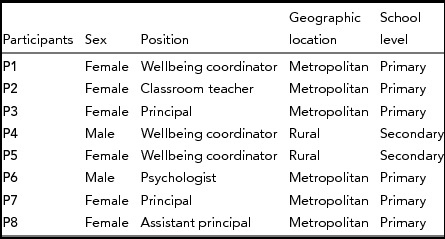
As previously noted, the study's primary sample comprised eight school staff members currently employed within the state of Victoria. All eight participants described their experiences of working with students whose parents were imprisoned. An overview of the sample's demographic details is presented in Table 1.
Participant characteristics.
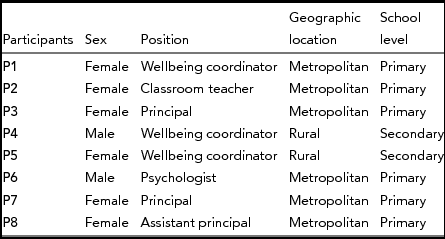
The majority of participants (n = 6) were employed at the primary school level within metropolitan Melbourne. The sample represents a diverse range of professionals with varying degrees of direct contact with students. All participants reported being employed at their current school for at least one year, with a maximum of 15 years’ service. The majority of the participants were female, reflecting the broad gender breakdown of staff in Australian schools (ABS, 2012). While only six Victorian schools are represented in this research, the sample provides variation across gender, roles, and location and allows for a range of opinions to be explored.
Understanding Children of Prisoners: Troubled and Troublesome
Parental imprisonment was identified by participants as sharing a strong link with negative schooling experiences. As anticipated by the literature (Cho, Reference Cho2009; Friedman & Esselstyn, Reference Friedman and Esselstyn1965; Jones et al., Reference Jones, Gallagher, Manby, Robertson, Schützwohl, Berman and Sharratt2013; Murray et al., Reference Murray, Farrington and Sekol2012; Stanton, Reference Stanton1980; Watson, Reference Watson2009; Willms, Reference Willms2002), all participants described an array of interrelated consequences that they observed to affect students with incarcerated parents. For the purposes of discussion and elicitation of trends, we group these into (1) behaviours which cause problems for others (‘troublesome’) and (2) behaviours of concern about the individual child (‘troubling’).
A small number (n = 3) of participants identified parental imprisonment as specifically leading to troublesome behaviours in students, particularly aggression and antisocial behaviours: having “melt-down moments” (P7). One participant described a child being “asked to do something, in turn his actions were often quite violent. So there was a time when he trashed the classroom, apprehended children” (P2). This participant also particularly noted these children being on behaviour support plans (BSPs) – plans developed by the school to monitor and support students at risk of harm or doing harm (DEECD, 2013). The extent to which these BSPs respond only to problem behaviours, rather than underlying causes was not commented upon or further explored. The majority of participants (n = 5) placed broader emphasis on how ‘bringing their personal difficulties into school’ impeded children's engagement with school, both with peers and with learning, which is similar to the observations of Murray et al. (Reference Murray, Farrington and Sekol2012). Parental imprisonment was described as negatively affecting a student's ability to concentrate in class, with a notable deterioration in grades and attendance rates observed by participants. Some children just “don't know how to react to the situation [parent imprisonment]” (P3). The data suggests that these negative behaviours are at least partly the result of affected children not having appropriate coping mechanisms (Jones et al., Reference Jones, Gallagher, Manby, Robertson, Schützwohl, Berman and Sharratt2013; Murray & Farrington, Reference Murray and Farrington2008) or resources, whilst experiencing additional stress.
In comparison to the broader student body, participants saw these students as exhibiting troubling behaviour, including more pronounced mental health issues such as anxiety and depression; some participants saw this as the result of unacknowledged grief and loss. Stigma as a result of parental imprisonment and the resultant embarrassment and labelling by peers was also identified, with students reportedly feeling that their life has already been “mapped out” for them (P4). As noted by Jones et al. (Reference Jones, Gallagher, Manby, Robertson, Schützwohl, Berman and Sharratt2013), this stigmatisation, both real and anticipated, can result in children feeling rejected from their community, and can impede help seeking (Tudball, Reference Tudball2000). Of concern was the suggestion of self-stigma – the acceptance and internalising of negative stereotypes. P4 identified that students themselves “worry that they will be going down the same path” as their incarcerated parent. These concerns were seen to contribute to overwhelming feelings for students, which they were unable to respond to appropriately, and sometimes led to troublesome behaviour. Participants described children's behaviours such as not eating or sleeping, fighting with friends, or being disruptive in class. They indicated, however, that it was common for them to be unaware of the source of the distress, which left them feeling unable to address the problem effectively. This was seen to further compound the children's poor educational performance, behaviour, and wellbeing.
Responding to Children of Prisoners: Necessary Knowledge
The study's findings illustrate that not only is there a lack of relevant knowledge held by schools about this issue, but they also give some indication of the impact of the lack of formal policies and pathways, which would allow schools to be informed and educated.
General knowledge
None of the participants reported that the schools in which they were employed had any policies, guidelines, or procedures in place to respond to this specific group of students. Instead, participants noted that their schools adapted generalised policies, programs, and protocol to the target group, e.g. grief and loss programs. Yet, participants were also clear that this group of children bring multiple problems (“They are high need families, high risk kids” P5) and “. . . have specific needs” (P3). A need for tailored responses, based on knowledge of both the child's situation and the broader criminal justice system was indicated (P1).
Despite some hands-on experience with these children and families, participants were unaware of any training options available to support their work with children who have an incarcerated parent. Rather, a desire for more education to be provided to schools about this target group was expressed: “I guess more education. It isn't really spoken about – this topic” (P2). This reinforces that the impact of parental imprisonment within the Victorian school system is hidden and not prioritised. This concept was highlighted during the study's recruitment process, when a related professional association advised the research team that students with incarcerated parents were not really an issue of concern to teachers or schools.
Specific knowledge
Lack of Information Sharing with and within Schools
This study's findings also confirm previous research and professional observations that schools lack specific knowledge (Flat Out Inc. & VACRO, 2006; Roberts, Reference Roberts2012); they typically do not know which students are affected by parent imprisonment. All participants described the informal communication channels by which their school typically gained information about an individual student's situation (of parental imprisonment). These included: the media, word of mouth, and sometimes the affected families and students. Yet previous research has shown that families often fear judgement (e.g. Braman, Reference Braman2004; Myers et al., Reference Myers, Smarsh, Amlund-Hagen and Kennon1999; Roberts, Reference Roberts2012) and typically do not communicate with schools (Flynn, Reference Flynn2008), leaving most children's situations and reactions unexplained. The majority of participants (n = 5) strongly voiced their concerns over the lack of formal information that schools are provided about parent imprisonment. Participants emphasised that:
“. . . [schools are the most consistent thing in a child's life], but we’re the ones who are kept in the dark the most. And yet, expected to have the greatest impact in many ways” (P7)
As noted above, this lack of relevant information has a practical impact on how staff may perceive and respond to children and presenting behaviours. The participants believed this can result in schools not fulfilling their duty of care to individual students, and also not being able to engage in appropriate preventative or therapeutic work more broadly. For example, P1 stated “if we are aware of the numbers [of student's affected by parental imprisonment] then we would have a better understanding of what sorts of groups we need to be running”. Three participants (P6, P7, P8) articulated a specific desire for a school to be provided with basic information relating to a parent's imprisonment by a statutory organisation.
“I’m not sure of the system, but my understanding was if the police raided a house they would immediately contact DHS, I think the next phone call should be at the school because we will see the kids before DHS will unless they are called to remove them in the middle of the night. We’ve probably got a lot more information about the family than the police or DHS would have just because the time we would have spent with them. I think the system needs to somehow change to involve the schools” (P8)
“It's always this business of Acts and ‘we can't inform you of this’ and ‘can't inform you of that’. We don't want to know the nitty gritty, we just want to know James Smith is not here because. . .” (P6)
Two further issues of communication were identified, both internal and external to the school environment, which reduce the ability of schools to respond appropriately to these children. A number of participants expressed the view that schools were disconnected from external agencies working with the affected students, as again, they were not provided with relevant information. P1 commented that the complexity of families often resulted in their involvement with a number of external services. According to this participant, it is hard to get all services on the “same page or working towards the same goal”. Additionally, the lack of support provided to the child and family when a parent is incarcerated results in a vicious cycle for the family.
“Lots of services drop off when [imprisonment] happens. . . . a parent goes to prison so that's fine, we won't do anything even though there's another parent left at home trying to manage who is often not supported by anybody until that person gets out of prison and everything goes wrong” (P5)
Schools are one of the few services who remain ‘with’ families during imprisonment, but were identified as having their own internal communication challenges as a result of the privacy and confidentiality requirements of differing professions, particularly wellbeing coordinators. The latter advised that they cannot disclose information about a parent's imprisonment without permission being granted by the affected student and family. This suggests a disconnection within schools; indeed one participant (P1) described a “battle” occurring between teaching staff and wellbeing staff. P5 was clear that provision of basic information to teachers is essential as it removes any preconceived ideas the teaching staff may have about the students, for example, labelling the students as “aggressive or lazy” without understanding the underlying factors. Previous authors (Lopez & Bhat, Reference Lopez and Bhat2007; Roberts, Reference Roberts2012) are in agreement, arguing that it is imperative for a school, particularly classroom teachers, to understand the signs of imprisonment and provide suitable support.
The need to be mindful of the families’ wishes and their right to privacy and confidentiality was highlighted by two participants (P4, P5). This raises an ethical question. Does a child's right to wellbeing and protection from psychological harm (DEECD, 2014a), through appropriate and informed responses from their school, mean that schools and teachers should be provided with basic information without the consent of the family?
“I would like them to but I don't know if you can make them disclose that information. . . I don't know. It's murky, privacy stuff there. We don't make people tell us if they are seeing external mental health professionals, we don't make parents disclose if they have a mental illness, we don't make parents disclose if they have a break up and all of those things tend to affect kids in a similar way” (P5).
This is a challenging issue which needs to be grappled with, given the previous research findings (e.g. Braman, Reference Braman2004; Dallaire et al., Reference Dallaire, Ciccone and Wilson2010) which indicate that children and families often do not want to disclose parental imprisonment, because of perceived and actual stigma; disclosing such information brings potential risks as well as benefits.
Responding to Children of Prisoners: Current Situation
There was considerable variation in how participants described their schools as responding to the needs of this group of children. In one school, P5 highlighted that if the classroom teachers were aware of parental imprisonment, then tasks were modified, and expectations lowered around completing homework and assignments, which is thought to relieve the stress experienced by the students. As anticipated by Roberts (Reference Roberts2012) and Parke and Clarke-Stewart (Reference Parke and Clarke-Stewart2002), schools knowing about a student's situation and providing safe, welcoming spaces allowed students to speak more openly. Relevant help can then be offered; this was an issue identified by children in previous local research (Flynn, Reference Flynn2008). However, participants, particularly P7, indicated that when schools are not provided with relevant information in relation to a parent's imprisonment, their ability to provide the aforementioned positive responses and safe environment is hindered.
Conclusion
The present study sought to gain insight into how Victorian schools currently understand and respond to students with incarcerated parents. The study's findings indicate that school staff perceive parental imprisonment to be detrimental to children's education and, further, that children would benefit from intervention from the school, as schools are often a place of consistency and stability in children's lives. Participants identified that affected students experienced issues with academic performance, wellbeing, and behaviour; participants were also aware of the multiple stressors experienced by these families. One of the most robust findings suggests that when schools are informed of a parent's imprisonment, they are capable of responding. Informed schools can respond generally, through providing a safe, secure environment, and specifically by modifying requirements, attending to monitoring the student's overall wellbeing, and providing ongoing support. The findings suggest that to best support these children, schools need to be able to take on multifaceted roles – a typical expectation of contemporary educational environments (e.g. DEECD, 2014a; MCEETYA, 2008) – to support children's wellbeing, socialisation and, through education, enhance life opportunities. Core findings illustrate, however, that a school's ability to respond to these students' needs are constrained by three factors: lack of information about individual students’ situations, lack of awareness of this group of students, and a lack of guiding policy. Therefore, the extent to which schools are currently able to respond in an informed and targeted way is likely to be poor.
To improve this situation, a number of issues need attention. Raising awareness about this group of children is vital, with an understanding of the likely impact of unacknowledged loss/grief on their behaviour and engagement in the school environment. It would seem important to understand and respond to the current challenges to communication, both within and with schools. This implies the need to engage in debate about ‘privacy’ and ‘rights’ and what is needed to act in the best interests of the child. This will need to be done sensitively to ensure that these children are not further stigmatised and marginalised. The need to communicate and work effectively and efficiently across state government departments and across sectors about these children and families who bring high needs and high risks is vital. Relationships between key government departments need to be fostered. The Children's Services Coordination Board, on which representatives from all key departments sit, seems well placed to take the lead on these issues. As a starting point, a protocol between relevant government departments and Victorian schools could address the sharing of basic information about a parent's imprisonment with school principals and school staff members who have direct contact with the students.
“. . . .We are bound, as you would be aware, by duty of care and yet we are ignored in delivering our duty of care to kids who have just potentially gone through an extremely traumatic experience and we don't have the opportunity to find that out to put things in place straight away. They are going to class, they are grumpy and crabby, the teacher doesn't know and, you know, we respond inappropriately. What else can we do?” (P7)