Introduction
Phytate (myo-inositol hexakisdihydrogen phosphate; IP6) was first reported in 1855 (Hartig, Reference HARTIG1855) as having a role in P storage in vegetable material. Phytate is the principle storage form for phosphate in plant material and presents a nutritional obstacle for monogastric animals. However, though detrimental effects on P and trace mineral metabolism have been known for some time (Harland and Morris, Reference HARLAND and MORRIS1995), the extent of its antinutritive effects in animal nutrition has not been appreciated until relatively recently (Shan and Davis, Reference SHAN and DAVIS1994; Cowieson et al., Reference COWIESON, ACAMOVIC and BEDFORD2004). Phytate is found in most vegetable feed ingredients at concentrations from 5-25 g/kg, contributing between 1.4-7 g/kg phytate-P. One very common misconception about phytate-P is that it is poorly digested by poultry due to a lack of endogenous phytase. This is actually entirely incorrect. Poultry possess very effective phytase/phosphatase activity in the intestinal mucosa, blood and liver and can readily dephosphorylate phytate into inositol and free phosphate for systemic distribution (Oshima et al., Reference OSHIMA, TAYLOR and WILLIAMS1964; Birge and Avioli, Reference BIRGE and AVIOLI1981; Maenz and Classen, Reference MAENZ and CLASSEN1998). Oshima et al. (Reference OSHIMA, TAYLOR and WILLIAMS1964) presented data which showed a rapid increase in IP6 concentration in the blood of chickens in the first 3 weeks post-hatch, suggesting that chicks can absorb IP6, and that IP6 may have an important metabolic function for maturing erythrocytes. Moore and Veum (Reference MOORE and VEUM1983) demonstrated that not only is IP6 digestible but that the digestibility can be artificially inflated by depriving the growing animal of available P. Ruminants can very effectively retain phytate-P (<5% of the ingested phytate-P being recoverable in excreta; Morse et al., Reference MORSE, HEAD and WILCOX1992). Finally, Miyazawa et al. (Reference MIYAZAWA, IWABUCHI and YOSHIDA1996) demonstrated that germ-free rats were able to hydrolyse as much phytate as their conventional counterparts, concluding that the GI tract microflora does not play an important role in phytate hydrolysis, at least in rats.
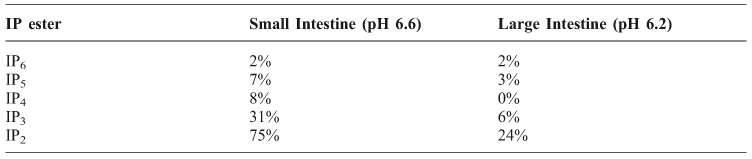
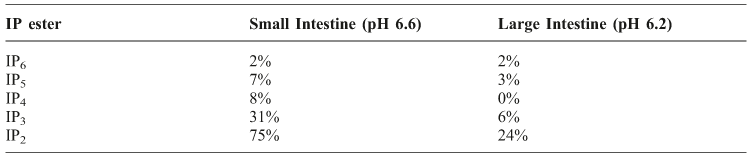
McCollum and Hart (Reference McCOLLUM and HART1908) were among the first authors to report phytase activity in animal tissues and this has been confirmed in virtually every decade since (Nelson, Reference NELSON1967). Thus, the problem with phytate digestion is not a lack of compatible endogenous enzymes but poor substrate solubility in the small intestine, and this hinges on luminal cation (notably Ca) concentrations. Schlemmer et al. (Reference SCHLEMMER, JANY, BERK, SCHULZ and RECHKEMMER2001) assessed the solubility of various IP esters in the small and large intestine of other monogastrics (Table 1). Interestingly the solubility of IP6, IP5, IP4, IP3 and IP2 in the small intestine of pigs (pH6.6) were 2%, 7%, 8%, 31% and 75%, respectively. However, it is also important to note that the relative concentrations of these esters may be low in the luminal contents as some are only present transiently as phytate is dephosphorylated (Wyss et al., Reference WYSS, BRUGGER, KRONENBERGER, REMY, FIMBEL, OESTERHELT, LEHMANN and VAN LOON1999). Persson et al. (Reference PERSSON, TURK, NYMAN and SANDBERG1998) also noted that in addition to the increased solubility of the lower IP esters, the complexes formed with minerals were proportionately much weaker suggesting that in order to encourage the persistence of solubility of both the minerals and IP esters at higher pH, gastric reduction to at least IP3 is necessary.
Solubility of various inositol phosphates in the intestinal chyme of pigs (adapted from Schlemmer et al., Reference SCHLEMMER, JANY, BERK, SCHULZ and RECHKEMMER2001).
With regards to Ca, it is known that decreasing dietary Ca concentrations to around 5 g/kg results in an increase in phytate-P digestibility to >70% by the terminal ileum (Harms et al., Reference HARMS, WALDROUP, SHIRLEY and AMMERMAN1962; Nahapetian and Young, Reference NAHAPETIAN and YOUNG1980; Nelson and Kirby, Reference NELSON and KIRBY1987; Tamim and Angel, Reference TAMIM and ANGEL2003; Tamim et al., Reference TAMIM, ANGEL and CHRISTMAN2004). This is of interest in itself and it shows that phytate-P can be digested by poultry provided it remains soluble in the small intestine. That said, if the only nutritional consequence of phytate ingestion was a dilution of digestible P it would be a relatively simple matter to formulate around. In fact the presence of phytate in the gut has a range of extra-phosphoric consequences that extend to mineral, amino acid, vitamin and energy metabolism and ultimately to animal viability, health and efficiency. Care must be taken when interpreting such results since reducing Ca levels below requirement also puts pressure on the efficiency of utilization of digestible P since by definition, some of the digested P will become excess to needs if Ca becomes increasingly deficient. Several papers suggest that the Ca:P ratio is important in description of the response to phytase, particularly in diets which are deficient in one of these nutrients, as is clear from the data, if not the conclusions, of Driver et al. (Reference DRIVER, PESTI, BAKALLI and EDWARDS2005).
Super-dosing phytase
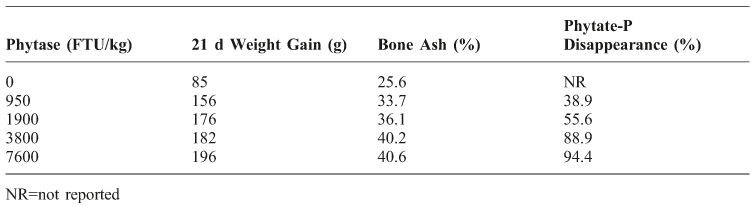
Early phytase trials in monogastrics (1960s/70s) used rather crude phytase preparations, often from various Aspergillus species and units of activity were not always disclosed. However, based on extensive literature review, the earliest report of ‘super-dosing’ may be Nelson et al. (Reference NELSON, SHIEH, WODZINSKI and WARE1971) where 1-8g of an Aspergillus ficuum phytase with 950 FTU/g was used per kg of diet in a broiler chick experiment. These doses would add between 950 and 7,600 FTU/kg of feed. Nelson and colleagues found that apparent phytate-P disappearance was increased from 38.9% with 950 FTU/kg to 94.4% with 7,600 FTU/kg. The response to phytase for 21 d weight gain and bone ash was log-linear but maximized at 7,600 FTU/kg where gain and bone ash were increased by 131% and 59%, respectively compared with the phytase-free control (Table 2).
Effect of supplemental phytase on the utilization of phytate phosphorus by chicks (adapted from Nelson et al., Reference NELSON, SHIEH, WODZINSKI and WARE1971).
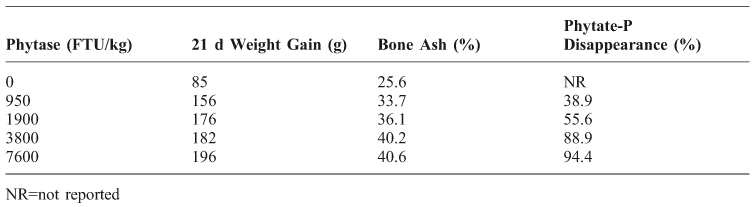
NR=not reported
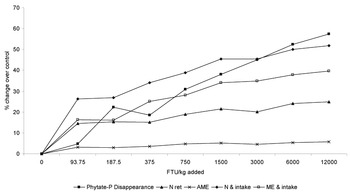
Following the pioneering work by Nelson and colleagues there was a notable lag in interest in phytase until the late 1980s in lieu of commercialisation of phytase as a feed additive in 1991. More recently, as phytase has enjoyed incumbent status in the vast majority of pig and poultry diets interest in phytase generally, and super-dosing specifically, has gained traction. Shirley and Edwards (2003) supplemented corn-based diets with up to 12,000FTU/kg and observed a quadratic increase in phytate-P disappearance with increasing log phytase dose from around 42% at 93 FTU/kg to almost 95% at 12,000FTU. Whilst similar responses in AME and N retention were observed up to 12,000FTU, the scale of the response to increased dose was very much muted compared with that of phytate destruction. The apparent dislocation of the effect of super-dosing on P digestibility and other nutrient matrices is instructive and will feature later. Whilst Shirley and Edwards (2003) may have been the first to report the effectiveness of particularly high doses of phytase there were a few prior papers where doses of up to and including 2,500 FTU/kg were employed (Simons et al., Reference SIMONS, VERSTEEGH, JONGBLOED, KEMME, SLUMP, BOS, WOLTERS, BEUDEKER and VERSCHOOR1990; Huyghebaert et al., Reference HUYGHEBAERT, DE GROOTE and GEERSE1992; Zhang et al., Reference ZHANG, KORNEGAY, RADCLIFFE, DENBOW, VEIT and LARSEN2000) and where continued advantages of these higher doses were observed. Such effects have also been confirmed quite recently by Augspurger and Baker (Reference AUGSPURGER and BAKER2004), Cowieson et al. (Reference COWIESON, ACAMOVIC and BEDFORD2006), Brana et al. (Reference BRANA, ELLIS, CASTANEDA and SANDS2006), Kies et al. (Reference KIES, KEMME, SEBEK, DIEPEN and JONGBLOED2006) and Pirgozliev et al. (Reference PIRGOZLIEV, ODUGUWA, ACAMOVIC and BEDFORD2007), all of which involved studies where doses up to or beyond 10,000 FTU/kg were used. Though these reports clearly show advantages of using unconventionally high doses of phytase there was no clear understanding of the mechanism. Indeed, Shirley and Edwards (2003) submit that though there are opportunities for high doses of phytase to confer significant value, the mechanisms warrant further elucidation. On reflection there may be three principle mechanisms whereby using high doses of phytase may elicit beneficial effects:
1. More liberated phosphate or restoration of P/Ca proportionate release.
2. Less residual phytate i.e. destruction of the antinutritive effect and increased generation of more (persistently) soluble lower esters.
3. Generation of myo-inositol with vitamin-like/lipotropic effects.
Phosphate responses
It is not in doubt that given an excess of soluble phytate, adding more phytase results in release of additional phosphate, indeed this is the basis of the current AOAC phytase assay. Most monogastric animal diets contain phytate-P concentrations of between 2-4 g/kg and so notionally this is the maximum increase in digestible phosphate possible by the use of phytase. However, phytate-P is not entirely indigestible in the absence of phytase and, largely depending on dietary Ca concentrations, phytate-P digestibility in the absence of phytase will be in the region of 20-30%. Thus, phytate-P digestibility response to increasing phytase inclusion is likely to be maximised at between 1.5 and 3 g/kg depending on the dose of phytase and the concentration of dietary phytate. Importantly, improvements in digestible P associated with high doses of phytase would only be expected to improve performance if P is limiting as a nutrient. In the vast majority of the ‘super-dose’ phytase trials mentioned above, digestible P concentrations in the negative control diets were not unusually low and achieving P requirement should not have taken more than 500-750 FTU/kg. The question then is why would liberation of P beyond the animals requirement for digestible P continue to improve performance parameters? This question does not have a satisfactory answer and it is more reasonable to conclude that liberation of P in excess of requirement is not the principle mechanism by which high doses of phytase improve performance. Angel and Applegate (Reference ANGEL and APPLEGATE2002) have shown that use of phytase in diets sufficient in available P results in an increase in soluble P in the manure, principally through urinary excretion, confirming such a tenet that excess phosphorus is not directly of benefit. However, one area of obscurity does persist in this area and that is asynchronicity in P and Ca ‘release’ by phytase.
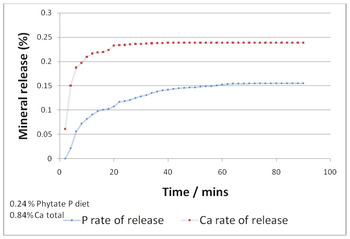
Currently, most phytase products have a 1:1 relationship between Ca and P matrices e.g. 0.1% Ca, 0.1% P and this regardless of dose employed (both increase in synchrony following a log-linear curve). However, as clearly demonstrated by Wyss et al. (Reference WYSS, BRUGGER, KRONENBERGER, REMY, FIMBEL, OESTERHELT, LEHMANN and VAN LOON1999) and Greiner and Farouk (Reference GREINER and FAROUK2007), bacterial phytases preferentially ‘target’ the higher molecular weight esters of IP and so destroy proportionately more IP6 and IP5 than IP4 and IP3 per unit of P release in the initial reactive phase. Luttrell (Reference LUTTRELL1992) and Persson et al. (Reference PERSSON, TURK, NYMAN and SANDBERG1998) have demonstrated that IP6/5 have a much greater chelation capacity for Ca than IP4/3. Indeed, IP3 has only 10% of the chelation capacity of IP6 (not 50% as stoichiometry may suggest). Thus, the release of the first 0.1% digestible P from phytate through the use of 500 FTU/kg is likely to be associated with destruction of the more malignant esters and so a disproportionately high response for Ca (Figure 1).
Theoretical relationship between phosphorus release from phytate and associated calcium value showing disproportionate ‘extra-phosphoric’ effect with initial destruction of the higher esters.

Effect of increasing phytase dose on phytate-P disappearance, N retention, AME, digestible N intake and metabolisable energy intake as expressed as a proportion of the negative control (adapted from Shirley and Edwards, 2003). The figure illustrates the dislocated nature of phytate destruction and the extra-phosphoric effects.

It may be the case that the use of 500 FTU releases Ca to P in the ratio of greater than 2:1 rather than 1:1 that is assumed when matrix values are applied. As a result, the use of higher doses of phytase is restorative of balance i.e. P release continues in a more linear fashion whereas Ca is closer to the asymptote. This would explain why high doses of phytase give performance responses beyond associated lower doses, and perhaps even beyond positive controls where there is considerable obscurity surrounding digestible Ca to digestible P ratios. Thus, dislocation of phytase matrices for P from other nutrients may be justified (as illustrated by Figure 2). In fact, Shirley and Edwards (2003) show clearly that phytate-P disappearance may be linearly influenced by phytase dose whereas improvements in N retention and AME are linearly correlated with the logarithm of dose. However, when the effect of phytase on feed intake is considered, the effects of this enzyme on nutrient intake seems to remain constant, suggesting that phytase effects are bimodal, with an initial improvement in digestibility and a second stage improvement in digestible nutrient intake (with expected net energy effects). In releasing P, phytase increases intake in P deficient diets until the requirement is met, but further increments in phytase continue to stimulate intake. Thus, it may be speculated that phytate, per se may be an appetite suppressant, with super-doses further encouraging responses intake.
Phytate destruction
It is beyond the scope of this article to discuss the antinutritive effects of phytate exhaustively and for more information the reader is referred to Cowieson et al. (Reference COWIESON, BEDFORD, SELLE and RAVINDRAN2009). The detrimental effect of phytate on mineral bioavailability has been understood for decades (Harland and Morris, Reference HARLAND and MORRIS1995). However, this work has focussed primarily on human nutrition and been restricted to trace minerals such as Fe and Zn, and on specific human conditions such as anaemia. The effect of phytate on energy and protein metabolism has been more obscure and the first paper to confirm that phytate could alter endogenous protein balance in chickens was Cowieson et al. (Reference COWIESON, ACAMOVIC and BEDFORD2004).
In feed, phytate is usually present as salt of Mg and K (sometimes Ca is also implicated) known as ‘phytin’ (Lott et al., Reference LOTT, OCKENDEN, RABOY and BATTEN2000). Once ingested and exposed to acidic conditions, phytate is solubilised as a partially protonated moiety. Since the pKa values on six of the 12 ionisable orthophosphate groups are too low to be fully protonated at around pH 2-3 (Costello et al., Reference COSTELLO, GLONEK and MYERS1976) phytate retains a net negative charge, even at the low pH encountered in the gastric phase of digestion. The interaction between phytate and protein is not entirely clear but it may be that phytate, at intermediate concentrations (10 g/kg IP6 to 200 g/kg protein), alters the thermodynamics of water such that protein:protein aggregation is encouraged, reducing the solubility of dietary protein (Cowieson and Cowieson, Reference COWIESON and COWIESON2011). At higher concentrations of IP6 (>20 g/kg) a rapid electrostatic attraction between basic amino acid residues of dietary protein, which are positively charged at gastric pH (pH below their isoelectric point) and phytate occurs, pulling protein back into solution (Mothes et al., Reference MOTHES, SCHWENKE, ZIRWER and GAST1990; Cowieson et al., Reference COWIESON, BEDFORD, SELLE and RAVINDRAN2009). This process is partially dependent on the nature of the dietary protein and the concentration of phytate ingested. For example there is some evidence to suggest that it is a critical phytate:protein ratio which is needed to minimise the solubility of the protein (perhaps around 0.05:1 i.e. 10 g of phytic acid and 200 g of protein (Mothes et al., Reference MOTHES, SCHWENKE, ZIRWER and GAST1990). This ratio is marginally less than that of a typical corn-soy broiler starter ration which suggests that prior to use of phytase, the industry has been unwittingly dealing with an unrecognised problem of compromised and variable gastric digestion. Moreover, this raises the possibility of generating negative responses to xylanase if fed in the absence of phytase because solubilisation of previously encapsulated phytate may push the phytate:protein ratio further into the critical zone. Regardless of this cautionary note, it is the reduction in protein solubility which is responsible for the compromising effect of phytate on Na, Ca, amino acids and energy digestion as hyper-secretion of HCl, mucin, pepsin, bile and NaHCO3 results, increasing energy, specific amino acid and Na flow into the lumen, the latter interfering with active transport (Cowieson et al., Reference COWIESON, ACAMOVIC and BEDFORD2004; Cowieson and Ravindran, Reference COWIESON and RAVINDRAN2007; Liu et al., Reference LIU, RU, LI and COWIESON2008). Further, though phytate:protein complexes will be partially recovered by the time the feed reaches the terminal ileum (due to changing pH and secretory accommodation) intact phytate (i.e. fully phosphorylated) which reaches the duodenum will rapidly scavenge divalent cations, especially Ca, forming insoluble precipitates, effectively removing these valuable ions from the digestive milieu. Thus, the ingestion of modest concentrations of phytate (<1% of the diet) has a profound impact on endogenous processes and the solubility and digestibility of dietary nutrients.
The extra-phosphoric nutrients that are most detrimentally influenced by the ingestion of phytate (and so axiomatically benefit most from high doses of phytase) are the amino acids glycine, serine, threonine and proline and the minerals calcium, zinc, iron, sodium and magnesium (Cowieson and Ravindran, Reference COWIESON and RAVINDRAN2007; Peter et al., Reference PETER, PARR, PARR, WEBEL and BAKER2009; Schlegel et al., Reference SCHLEGEL, NYS and JONDREVILLE2009). There are also energetic effects, both direct via improved solubility and digestibility of dietary nutrients (e.g. release of metal co-factors for endogenous enzymes or inositol liberation), indirect via reduced endogenous loss, or net effects delivered via reduced synthesis of endogenous protein (be it gut or support organ mass, enzymes or mucin) (Cowieson et al., Reference COWIESON, RAVINDRAN and SELLE2008; Onyango et al., Reference ONYANGO, ASEM and ADEOLA2008; Pirgozliev et al., Reference PIRGOZLIEV, ODUGUWA, ACAMOVIC and BEDFORD2007).
Thus, the ingestion of phytate as part of a feed matrix has a cascade of physiological consequences that serve to reduce efficiency. The obvious solution is to dephosphorylate IP6 as quickly as possible in the proximal GI tract to lower molecular weight esters of IP. This approach will release P from IP6, causing a commensurate decline in IP6/5 concentrations, and so reduce the net antinutritive effect as the lower esters are less malignant (Lutrell, 1992; Persson et al., Reference PERSSON, TURK, NYMAN and SANDBERG1998). Further, as the lower esters of IP have a disproportionately lower capacity to chelate divalent cations, the solubility of such esters in the small intestine will be improved allowing access to these by the endogenous phytase/phosphatase array. So, the primary responsibility for exogenous microbial phytase is not so much to dephosphorylate IP6 into inositol and free phosphate, but to minimise the ‘leakage’ of IP6, IP5, IP4 and IP3 into the duodenum. If this can be achieved then endogenous phosphatases will be presented with soluble substrate that can be further processed systemically.
Myo-Inositol
If there is one wild card in phytase and phytate nutrition, it is the relevance of myo-inositol in phytase response. Myo-inostiol (henceforth referred to as inositol), a hexahydroxycyclohexane isomer (Holub, Reference HOLUB1986), is widely distributed in animal and vegetable tissues (Clements and Darnell, Reference CLEMENTS and DARNELL1980) and is found in poultry and swine diets between 1.4 and 6.8 g/kg. In these diets it may be found in its free form and as inositol-containing phospholipid but will mainly be present as a component of inositol hexaphosphate (IP6) and so is less likely to be an immediate participant in metabolic process.
The earliest observation that inositol may be a metabolically important nutrient was Eastcott (Reference EASTCOTT1928) who found a growth promoting effect of meso-inositol in yeast cultures. Subsequently Woolley (Reference WOOLLEY1944) observed a curative effect of inositol for alopecia in mice and Gavin and McHenry (Reference GAVIN and McHENRY1941) found that inositol could prevent fatty liver and improve growth in rats and this was confirmed by Katayama (Reference KATAYAMA1997). However, the alleviating effects of inositol on fatty liver syndrome were not replicated in a more recent study by Pearce (Reference PEARCE1975) though in that study both choline and inositol were used simultaneously and it has been previously shown that choline and inositol are antagonistic (Agranoff, 1959). The first article to show growth promoting effects of inositol in chickens was Hegsted et al. (Reference HEGSTED, MILLS, ELVEHJEM and HART1941), and Dam (Reference DAM1944) suggested that inositol assists in ameliorating the detrimental effects of tocopherol deficiency in chicks. Lance and Hogan (Reference LANCE and HOGAN1948) found that inositol improved leucocyte numbers in turkeys. There have been few contemporary articles which present the effect of inositol on the performance, physiology or nutrition of poultry or swine. However, from the classical work in the 1940s/50s it seems reasonable that an increase in inositol concentrations, either by direct addition, diet modification (e.g. more animal/fish by-products) or phytase supplementation may have a growth promoting effect. Further, due to the lipotropic effect of inositol it is possible that super-dosing phytase may have an indirect protective effect against fatty liver syndrome. Of importance here is that phytic acid (IP6) has been shown to prevent fatty liver syndrome (Katayama, Reference KATAYAMA1997; Reference KATAYAMA1999) and so its removal via the use of phytase may expose animals to greater risk unless sufficient phytase is used to allow inositol synthesis and the commensurate restoration in hepatic lipid export.
When microbial phytases are added to monogastric diets phytate is partially dephosphorylated in the gastric phase. In the small intestine the residual lower molecular weight esters are either absorbed or they precipitate with cations and are subsequently excreted from the animal. The extent of absorption of these lower esters is dictated by both the degree of phosphorylation and ambient cation concentration (Nahapetian and Young, Reference NAHAPETIAN and YOUNG1980; Schlemmer et al., Reference SCHLEMMER, JANY, BERK, SCHULZ and RECHKEMMER2001). If the lower esters are absorbed they will be further dephosphorylated in the mucosa, blood and liver, and yet lower esters, free phosphate and inositol are rendered available for systemic distribution and secondary metabolic processes (such as assembly of secondary messengers via phosphorylation with endogenous kinases and indeed reassembly to IP6 (Verbsky et al., Reference VERBSKY, WILSON, KISSELEVA, MAJERUS and WENTE2002). The rate and extent of hydrolysis of dietary IP6 and absorption of lower esters depends on dietary Ca concentration, ambient pH, source of phytate and the presence or absence and source of phytase. Nahapetian and Young (Reference NAHAPETIAN and YOUNG1980) demonstrated that feeding a low-Ca diet resulted in substantial (94%) absorption of 14C-labelled phytate from the small intestine of rats. Interestingly, 60% of the radioactivity was recovered over the subsequent 48 h in CO2 indicating a substantial degree of metabolism of the inositol ring. More recently, synthesis of inositol by phytase addition was inferred by Karadas et al. (Reference KARADAS, PIRGOZLIEV, PAPPAS, ACAMOVIC and BEDFORD2010) where the addition of 12,500FTU/kg of a bacterial phytase resulted in significant increases in vitamin E, A and coenzyme Q10 in the liver of chickens. Thus it seems likely that though exogenous phytase is not capable of generating inositol in the lumen, it may present the mucosa with soluble IP esters which may be absorbed and further dephosphorylated systemically. Inositol genesis in the liver or elsewhere in the body may play an important, if yet to be quantified, role in the growth promoting effects of high doses of phytase, but presumably through its role in facilitating transport of fats and fat soluble nutrients. The implications for fat soluble vitamins and colorants need to be investigated further
Conclusions
It can be concluded that there is considerable opportunity to add value with unconventionally high doses of microbial phytase. It is apparent that performance effects can be substantial and extend to meat yield, reduced FCR and improved weight gain, both in pigs and poultry. The exact mechanisms remain elusive but are likely to involve restoration of balance of nutrient release, particularly for Ca and P, more complete and rapid destruction of phytate with concomitant benefits for endogenous losses. Further, the generation of lower molecular weight esters of IP with more persistent solubility in the small intestine that permits absorption, complete dephosphorylation and generation of myo-inositol may be involved. The beneficial effects of super-doses of phytase are consistent, substantial and have implications not only for animal performance but for health and welfare and possibly meat and egg quality.