Introduction
Seasonal influenza, more commonly known as the flu, is an infection of the airways caused by various influenza viral strains (Butler-Jones, Reference Butler-Jones2008). Approximately 15–20 per cent of Canadians develop the infection each year (Statistics Canada, 2008). Despite its being preventable, between 4,000 and 8,000 Canadians die every year from influenza and its complications (Canadian Coalition for Immunization Awareness and Promotion, 2009). The illness can be more harmful to high-risk individuals including adults over the age of 65 and people with weakened immune systems (World Health Organization [WHO], 2009). In industrialized countries, 90 per cent of deaths caused by influenza occur in older adults (Wilson, Reference Wilson1994). Statistics Canada (2008) reported that between 70,000 and 75,000 hospitalization admissions in 2008 were for influenza complications alone. Jefferson, Wegmuller, and Ward (Reference Jefferson, Wegmüller and Ward1999) reported that the total cost of influenza in Canada is approximately one billion dollars per year accounting for both productivity loss and higher health care costs.
The most effective way to prevent contracting the disease is to receive the seasonal influenza vaccination (Centers for Disease Control and Prevention, 2011). The vaccine can prevent between 70 per cent and 90 per cent of influenza-specific illness at any age if the correct viral strains are chosen for inclusion in the vaccine (WHO, 2009). Specifically among older adults, the vaccine is highly effective in preventing severe influenza by up to 60 per cent and death by influenza-associated complications by up to 80 per cent (Dean et al., Reference Dean, Moffatt, Rosewell, Dwyer, Lindley and Booy2010). According to the Centers for Disease Control and Prevention (CDCP, 2011), side effects are possible and may include soreness, redness, or swelling at the vaccine site, a low-grade fever, or body aches. Life-threatening allergic reactions are rare but may include breathing problems, hives, paleness, or weakness (CDCP, 2011).
It is important to consider the consequences of influenza for elders since the Canadian population experiences yearly influenza epidemics. In an effort to prevent or slow such epidemics, the Public Health Agency of Canada (2012) recommends that all Canadians over the age of 65 receive the seasonal influenza vaccine. Despite strong evidence from research, on average, 35 per cent of elderly Canadians fail to receive their annual vaccination (Statistics Canada, 2008). Given the rapidly aging Canadian population, current vaccine coverage rates for older adults are a cause for concern. Although scientists in the United States (Santibanez et al., Reference Santibanez, Nowalk, Zimmerman, Jewell, Bardella and Wilson2002) and Australia (Ridda, MacIntyre, & Lindley, Reference Ridda, MacIntyre and Lindley2009) have explored this important topic, contemporary research within a Canadian context is lacking. Consequently, we designed our study with the objective of exploring the self-perceived influences among older Canadian adults in deciding whether to take or not take the seasonal influenza vaccine.
Methods
A qualitative cross-sectional design was used with focus groups as the method of data collection. Ethical approval for this project was obtained from the Research Ethics Board of Western University. Eleven males and 26 females (n = 37) took part in six focus groups conducted at five locations (four retirement homes and one condominium building) between August and November 2010. The average age of participants was 82 years (SD = 6.6, range: 67–91 years). Support services such as housekeeping and laundry services, social programs, and in-house dining were offered at all sites except one. Four of the residences had paid staff (e.g., a registered nurse) working on-site, and the older adults were considered community-dwelling but living with assistance. Participants in one focus group lived entirely independently. All participants met the study inclusion criteria of (a) living in the community without extensive assistance with activities of daily living, (b) being over age 65, and (c) being fluent in English. The researchers had no previous contact and no relationship with participants.
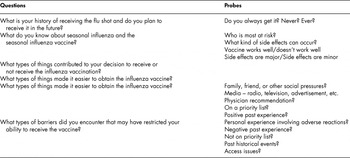
Focus group meetings, conducted by the first author, lasted approximately 60 minutes and were digitally audio-recorded. One note taker was present, and when the conversation stalled, the author minimally probed participants for more discussion. A consent form and demographic questionnaire (with questions on age, gender, marital status, income, living situation, and current status of influenza vaccination receipt) were completed in advance. Focus group questions were guided by existing literature which indicated the most prominent barriers to and facilitators in receiving the vaccine (Andrew, McNeil, Merry, & Rockwood, Reference Andrew, McNeil, Merry and Rockwood2004; Evans, Prout, Prior, Tapper-Jones, & Butler, Reference Evans, Prout, Prior, Tapper-Jones and Butler2006; Santibanez et al., Reference Santibanez, Nowalk, Zimmerman, Jewell, Bardella and Wilson2002 – see Table 1 for a list of specific focus group questions). With simultaneous data collection and analysis, data saturation was reached after the sixth focus group when no new themes emerged.
Focus group questions and probes

Focus group sessions were transcribed verbatim and organized using QSR International’s NVivo 8 software. Three research members coded one transcript independently and then compared transcript codes for consensus. The fully coded dataset was analysed using inductive content analysis, a process by which a set of codes are created from the data and then organized into patterns and themes (Elo & Kyngas, Reference Elo and Kyngas2008). To ensure rigor, we used member checking, a process whereby data are shown to the individuals from whom they were originally obtained to ensure they were an accurate reflection of their thoughts and feelings. The researcher did her best to adhere to focus group protocol and to take detailed debriefing notes; participants were encouraged to ask questions about influenza or its vaccine during the debriefing session. Finally, data were triangulated to ensure an adequate mixing of data such that diverse viewpoints could validate the topic (Olsen, Reference Olsen and Holborn2004). If there was any discrepancy in the identification of themes, it was resolved through discussion with all of the authors.
Results
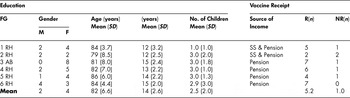
Participants’ personal attributes from the demographic questionnaire are presented in Table 2. Overall, the study group was relatively homogeneous, particularly in terms of age and education. Regarding vaccine receipt, 6 participants were identified as those not receiving the vaccine (non-receivers), and 31 participants as those receiving the vaccine (receivers). All recruited participants remained in the study until its completion.
Participant demographic information categorized by focus group designation

AB = apartment building
F = females
FG = focus group
M = males
NR = non-receiver
R = receiver
RH = retirement home
SD = standard deviation
SS = social security
Participants provided rich information about their experiences and described factors that influenced their decision-making process regarding vaccine receipt. Content analysis produced 15 codes from which five overarching themes emerged (see Table 3). The five themes were moderators, beliefs, prevention, accessibility, and knowledge. Moderators and beliefs were the two most influential themes while prevention, accessibility, and knowledge played smaller roles in the decision-making process.
Major themes uncovered in the focus groups with their respective codes relating to why individuals choose to receive or not receive the seasonal influenza vaccination

Moderators
The three coded categories encompassed by the moderators theme were general practitioners, intimate relationships, and fear of adverse events. Overwhelming response from receivers indicated that their family doctors had the strongest influence on their decisions to receive the vaccine. Receivers made comments such as, “If the doctor recommends it, I just take his or her word for it,” and “I just trust my doctor; when he said I needed it, I took it.” Receivers expressed extensive trust in the health care system and the willingness to put the ownership of their health into their physicians’ hands. One participant said, “The doctor recommended [the vaccine], and we have full confidence in our doctor’s recommendation to follow his advice.”
Intimate relationships functioned as both a facilitator and barrier for influenza vaccine receipt, with spousal influence stronger than influences by children or friends. One woman said, “My husband always got the flu shot so I figured I better get it too.” The vast majority of the older adults’ children reportedly did not advise their older parents to get the influenza vaccine. However, one participant said: “If we’re all sitting around here and the person next to me is coughing their head off I think […] oh geez maybe I’m going to get what she has,” and would then be reminded to take the vaccine. The influence of friends also acted as a barrier in receiving the vaccine; as one non-receiver said: “My friends got so sick [after getting the vaccine], I didn’t want any part of the vaccine.”
Adverse events were described as side effects that should not normally occur after receiving a vaccine. Nearly all of the study participants had heard of others (e.g., friends, family) who had experienced adverse events that were attributed to the influenza vaccine; however, only 4 of 37 participants had personally experienced an adverse event post-receipt. Half of the non-receivers indicated that adverse events were the primary reason that they did not take the influenza vaccine. One fearful non-receiver said, “That’s the reason I don’t take it, […] I don’t want to get sick from someone giving me a needle.”
Beliefs
The three codes encompassed by the beliefs theme were choice, risk, and vaccine efficacy. Participants provided insight into their perceptions of the freedom they had in choosing to take or not take the influenza vaccine. About half of the individuals in this study verbally expressed their belief that they had the freedom to choose. Four individuals reported that their original decision may not have been their choice, or that their decision was strongly influenced by others.
Risk described how vulnerable participants believed they were in contracting seasonal influenza. All of the study participants agreed that older adults are more at risk. One older man said: “Because of our age, our immune systems are lower and if you catch a cold, before you know it you’re in the hospital: you got pneumonia.” Participants also believed that some people might be more vulnerable to contracting the illness than others. All of the non-receivers indicated that they were not in need of the vaccine because they were not vulnerable and not at risk of contracting the disease. One non-receiver said, “so far I’m okay, I never get any [influenza], I never get [it].”
Participants were asked how effective they believed the vaccine was in preventing influenza. All 37 participants indicated that they did not know for sure that the vaccine was effective but that they “believe in it. ” All 31 receivers agreed that past positive experiences with the vaccine was all the proof that they needed. One participant said, “My wife does [believe], and she has never had the flu.” While non-receivers also believed that the vaccine was effective, this was not a sufficient motivator for them to take it.
Prevention
The two codes encompassed by the prevention theme were health behaviours and protection. Participants were asked to describe how they attempted to remain healthy in later life. Similarities and differences in health behaviours existed between receivers and non-receivers. All of the receivers said that taking the influenza vaccine was part of the way they tried to stay healthy. One participant said, “I think it’s just something you do as part of your health, just like you try to eat properly.” Only two non-receivers specifically reported using preventive health behaviours.
For some participants, the primary reason for receiving the vaccine was for the protection of others. Many receivers reported that they took the influenza vaccine because they wanted to protect their spouse or “those with a compromised illness or who is elderly.”
Accessibility
The five codes encompassed by the accessibility theme were cost, location, transportation, wait time, and availability. The accessibility theme described factors affecting older adults’ decisions either prior to or during vaccination. Participants frequently indicated that they were grateful that they lived in Canada where the vaccine is free, always available, and relatively easy to get. One participant said, “You just go, give him your OHIP [Ontario Health Insurance Plan] card, and that’s it.” In the experiences of these participants, the location of the vaccine clinic, transportation to the clinic, wait time, and availability of the vaccine were not particularly influential in older adults` decisions to get vaccinated.
Knowledge
The two codes encompassed by the knowledge theme were flu symptoms and vaccine attributes. With the exception of two retired nurses, the study participants overall lacked even basic knowledge about seasonal influenza and the vaccine. Some participants said, “I really don’t know anything about [vaccine] other than it helps you from the flu” and “I don’t understand the flu shot, I don’t know how they make [vaccine].” Their limited amount of knowledge was not related to the identity of a receiver or non-receiver.
Discussion
Similar to the findings of previous studies (Burns, Ring, & Carroll, Reference Burns, Ring and Carroll2005; Chi & Neuzil, Reference Chi and Neuzil2004; Evans & Watson, Reference Evans and Watson2003; Nexøe, Reference Nexøe1998; Sengupta, Corbie-Smith, Thrasher, & Strauss, Reference Sengupta, Corbie-Smith, Thrasher and Strauss2004; Ward & Draper, Reference Ward and Draper2008), the most influential decision-making factor for receivers in this study was the recommendation by a general practitioner (GP). This suggests the crucial influence of GP prompts in the decision-making process. The patient-physician relationship ought to be built on trust, respect, and knowledge. The stronger the relationship, the more likely a patient would be willing to take a physician’s advice on all health aspects including preventive health measures (Goldring, Taylor, Kemeny, & Anton (Reference Goldring, Taylor, Kemeny and Anton2002). As demonstrated by the current study and validated by literature, familial relationships between spouses, children, other family members, and friends also influence older adults’ decision to receive the influenza vaccine (Andrew et al., Reference Andrew, McNeil, Merry and Rockwood2004; Evans et al., Reference Evans, Prout, Prior, Tapper-Jones and Butler2006; Santibanez et al, Reference Santibanez, Nowalk, Zimmerman, Jewell, Bardella and Wilson2002; Burns et al., Reference Burns, Ring and Carroll2005).
Both receivers and non-receivers believed the vaccine was effective, contrary to the findings of Evans et al. (Evans et al., Reference Evans, Prout, Prior, Tapper-Jones and Butler2006) who found that a belief in vaccine efficacy was closely related to receipt only in those receiving the vaccine. Although non-receivers believed that the vaccine was effective, the fear of adverse events was sufficient to overcome the perceived benefits. In other studies (Burns et al., Reference Burns, Ring and Carroll2005; Chi & Neuzil, Reference Chi and Neuzil2004; Cornford & Morgan, Reference Cornford and Morgan1999; Evans et al., Reference Evans, Prout, Prior, Tapper-Jones and Butler2006; Harris, Chin, Fiscella, & Humiston, Reference Harris, Chin, Fiscella and Humiston2006; Mangtani et al., Reference Mangtani, Breeze, Stirling, Hanciles, Kovats and Fletcher2006; Sengupta et al., Reference Sengupta, Corbie-Smith, Thrasher and Strauss2004), non-receivers were also fearful of contracting influenza or other diseases from the vaccine itself. While all participants in this study were aware that adults over age 65 should be vaccinated annually, the study’s non-receivers thought that they personally were immune to influenza infection. Andrew et al. (Reference Andrew, McNeil, Merry and Rockwood2004) and Evans and Watson (Reference Evans and Watson2003) also found that a belief in having resilience by virtue of being an older adult plays a critical role in the decision-making process. Similar to studies conducted in Europe and North America where access issues did not impede individuals’ receiving the vaccine (Santibanez et al., Reference Santibanez, Nowalk, Zimmerman, Jewell, Bardella and Wilson2002; Mangtani et al., Reference Mangtani, Breeze, Stirling, Hanciles, Kovats and Fletcher2006), the cost of the vaccine, location of administration, transportation, and availability were not impediments in this study. Whereas most of the current study’s participants were fairly well-educated (on average, 14 years of formal education), it is unclear why they had relatively little vaccine and influenza knowledge. However, similar findings were reported by Santibanez et al. (Reference Santibanez, Nowalk, Zimmerman, Jewell, Bardella and Wilson2002) and Raftopoulos (Reference Raftopoulos2007).
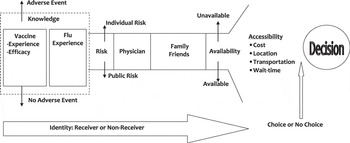
Clearly, a multitude of factors play a role in the decision-making process. It appears that these factors are time dependent and occur in a step-wise fashion. We used the study’s findings to create an original chronological model for conceptualization of the decision-making process for the receipt of the influenza vaccine in older adults (see Figure 1). The horizontal arrow represents a time-continuum whereby factors influencing the decision-making process evolve over the lifetime. Through this time continuum, an individual develops a particular identity: that of a receiver or a non-receiver. Factors that may impact decision making are aligned above the arrow. Factors prevalent early in life are located towards the left side, and influences that affect one’s decision shortly before vaccine administration are located towards the right side of the model.
Model explaining time-dependent factors influencing the decision-making experience by older adults for the receipt of the influenza vaccine. Factors are (a) vaccine and influenza knowledge; (b) risk; and (c) direct and indirect influences by physician, family, friends, media, availability, accessibility, and choice

The findings of this study should be considered in relation to its limitations. Participants were recruited from a regional centre and health care hub located in Southwestern Ontario, Canada, where everyone has free access to influenza vaccinations. Participants were recruited from both residents in retirement facilities and individuals living independently in the community. In Canada, influenza vaccines are frequently offered in retirement homes, which may have accounted for greater uptake of the vaccine in the study sample. It is unknown whether data from persons who are living entirely independently in the community would be different or similar. The authors did not intend to make broad generalizations regarding the transferability of the research findings; hence, the study findings are not meant to represent the experiences of the majority of community-dwelling older adults.
The individuals selected for this study were, on average, 82 years old; therefore, the opinions expressed were those from the middle-old sub-group of the elderly population. It is also possible that status as a receiver or non-receiver may have been culturally influenced; however, information on ethnicity was not gathered from participants, which we acknowledge is a limitation of our study. The ratio of receivers to non-receivers in the study was approximately five to one, which was an underrepresentation of non-receivers since in Canada this ratio is typically two to one. The small number of non-receivers may have prevented emergence of richer detail in experiences of non-receivers. Additionally, combining receivers and non-receivers in the same focus group may be a concern since there was an imbalance in numbers. Social desirability could have been an issue; since participants did not know one another, they may have felt pressured to conform. Finally, some caution is needed as participants self-reported their vaccination status.
Findings from this study have a potential to better inform public health policy makers about specific factors that influence the decision-making process of older adults regarding preventive health behaviours: in particular, receipt of influenza vaccine. Future initiatives to improve vaccine intake should consider the powerful role of family physicians, a need for greater knowledge about influenza, how the vaccine works, and education about adverse events. We also propose a model that chronologically orders the factors that influence the decision-making process of older adults for the receipt of the influenza vaccine. Future research should be longitudinal in nature and should involve a larger number of participants.