Introduction
Prader–Willi syndrome (PWS) is a neurodevelopmental disorder, with an estimated birth incidence of 1 in 22 000 (Whittington et al. Reference Whittington, Holland, Webb, Butler, Clarke and Boer2001). It results from the absence of expression of unknown maternally imprinted/paternally expressed gene(s) in the critical region (PWSCR) at 15q11–q13. The two main causes are a deletion at 15q11–q13 (delPWS) of paternal origin (70%) and maternal uniparental disomy (mUPD) of chromosome 15 (25%). Less commonly, unbalanced chromosomal translocations or imprinting defects occur (<5%). The phenotypic features include hypotonia, hypogonadism, difficulty feeding at birth, followed by hyperphagia, mild learning disability (LD), small hands and feet, short stature, and an increased propensity to temper outbursts and skin-picking. Individuals with mUPD have superior verbal skills compared with those with delPWS (Roof et al. Reference Roof, Stone, MacLean, Feurer, Thompson and Butler2000), and individuals with delPWS better visuospatial skills than those with mUPD (Whittington & Holland, Reference Whittington and Holland2004). There are no other differences in the non-psychiatric phenotype between delPWS and mUPD genetic subtypes (Holland et al. Reference Holland, Whittington, Butler, Webb, Boer and Clarke2003).
Studies have suggested an association of PWS with co-morbid psychiatric illness (Clarke, Reference Clarke1993; Beardsmore et al. Reference Beardsmore, Dorman, Cooper and Webb1998; Verhoeven et al. Reference Verhoeven, Curfs and Tuinier1998). Several diagnostic labels have been applied including schizophrenia, bipolar disorder, and cycloid psychosis, suggesting a lack of consensus on the likely psychiatric diagnosis. However, a variety of clinical features have been reported including anxiety, agitation, confusional states, persecutory delusions, disturbed sleep, acute onset with no clear precipitant, shifting symptomatology, and a strong affective component. However, older studies are limited by small samples and a lack of genetically confirmed diagnoses for all participants. Other psychopathology often seen in individuals with PWS includes obsessive-compulsive symptoms (not fulfilling defined criteria for obsessive-compulsive disorder) (Clarke et al. Reference Clarke, Boer, Whittington, Holland, Butler and Webb2002) and autism (Veltman et al. Reference Veltman, Thompson, Roberts, Thomas, Whittington and Bolton2004), both of which develop in childhood.
In our previous population-based study (Whittington et al. Reference Whittington, Holland, Webb, Butler, Clarke and Boer2001), we found that individuals with the mUPD subtype were at a significantly greater risk of developing co-morbid psychotic illness with increasing age (100% of those aged over 27 years had had at least one psychotic episode) than individuals with delPWS in whom the rate was similar to that found in the general LD population (∼11%) (Boer et al. Reference Boer, Holland, Whittington, Butler, Webb and Clarke2002). Subsequent studies supported this finding (Verhoeven et al. Reference Verhoeven, Tuinier and Curfs2003; Vogels et al. Reference Vogels, Matthijs, Legius, Devriendt and Fryns2003). These observations indicate that the risk of developing a psychotic illness is not associated with PWS per se but rather with having the mUPD genetic subtype.
The study described in this paper is the first large-scale, systematic study investigating the precise nature of psychiatric illness in people with PWS. We had four main aims: first, to confirm or refute the previous finding of the increased prevalence of major psychiatric illness in those with mUPD compared to those with delPWS; second, to investigate the features of psychiatric illness in terms of phenomenology, course of psychiatric illness and diagnosis, and to compare these across the two main genetic subtypes of PWS; and third, to investigate the influence of factors which are known to contribute to an increased risk of psychopathology in the general population, namely family psychiatric history and the impact of life events. The fourth, more theoretical, aim was to consider how the aetiology of psychiatric illness in general, and psychotic illness specifically, might best be explained.
Method
Recruitment
Adults with PWS were contacted on our behalf by the Prader–Willi Syndrome Association (UK) and through services for people with LD. These methods led to the identification of 117 adults with possible PWS. Thirty-nine adults who had taken part in the previous population study (Whittington et al. Reference Whittington, Holland, Webb, Butler, Clarke and Boer2001) and three children identified during the course of the study were also recruited. In total, 159 individuals participated in the initial screening. The study was approved by the UK Multi-Regional Ethics Committee. Where possible, participants gave informed written consent. For those unable to consent, information was provided and permission was obtained from their main relative or carer.
Screening
A semi-structured, informant-based telephone interview was carried out for all 159 potential participants to establish: (a) demography and the presence or not of clinical criteria for PWS; (b) evidence of a possible history of psychopathology (specifically affective disorders and psychotic illness) as observed by informants, using the Psychiatric Assessment Schedule for Adults with Developmental Disability (PAS-ADD) checklist (Moss et al. Reference Moss, Prosser, Costello, Simpson, Patel, Rowe, Turner and Hatton1998) and ICD-10 (WHO, 1992) criteria; and (c) family psychiatric history using the Family History Method (FH-RDC) (Andreasen et al. Reference Andreasen, Endicott, Spitzer and Winokur1977). Individuals with evidence of past or present psychiatric disorder were subsequently interviewed at their homes (see below). Individuals with only a history of characteristic PWS behaviour problems (obsessional and compulsive behaviours or brief mood swings not fulfilling criteria for a defined affective disorder) were not assessed further.
Psychiatric assessment of individuals screening positive for psychopathology
A detailed clinical history was taken from the participant and at least one informant using: the PAS-ADD (Moss et al. Reference Moss, Goldberg, Patel, Prosser, Ibbotson, Simpson and Rowe1996) (a semi-structured interview schedule for examining psychopathology in people with LD); the Operational Criteria Checklist for psychotic and affective illness (OPCRIT 4) (McGuffin et al. Reference McGuffin, Farmer and Harvey1991; Williams et al. Reference Williams, Farmer, Ackenheil, Kaufmann and McGuffin1996) (a 90-item checklist for psychopathology); and a modified Life Events Questionnaire adapted from the Interview for Recent Life Events (Paykel, Reference Paykel1996). Wechsler Scales of Intelligence (Wechsler, Reference Wechsler1997, Reference Wechsler1999) were used to determine IQ. Screening and clinical assessments were carried out by the first author.
Phenomenology and diagnostic methods
The individual items in the PAS-ADD and OPCRIT tools covered most phenomenological features; an additional item of episodes of confusion was added.
Case vignettes describing the clinical history and psychiatric phenomenology were used to make ICD-10 diagnoses by D.C. and H.B. (psychiatrists experienced in the field of LD and blind to the genetic subtype of participants), and S.S. (also a LD psychiatrist and blind to genetic subtype unless the participant had a previously confirmed genetic diagnosis).
It is recognised that there are difficulties in applying standard criteria, such as those in ICD-10, in diagnosing psychopathology in individuals with LD (Sturmey, Reference Sturmey1995). This may be for several reasons: individuals with LD may not have sufficiently sophisticated language to describe the subtleties of the phenomena they are experiencing at the time of a mental state examination; their memory for past mental experiences may be poor; and sometimes judgements about mental phenomena have to be made second hand on the basis of informant reports. Therefore, from a diagnostic perspective, we decided that broader diagnostic categories than ICD-10 or DSM-IV-R describe would be reported.
Genetic testing
Genetic testing was undertaken on individuals who did not have a previously confirmed genetic diagnosis of PWS. The presence of PWS was confirmed by the absence of a paternally inherited, non-methylated band at the SNRPN locus, and complete non-expression of SNRPN (a gene coding for a small nuclear ribosomal protein located at 15q11–q13). DelPWS and mUPD genetic subtypes were determined by microsatellite analysis at loci inside and at a distance from the PWSCR.
The identification of unbalanced translocations and imprinting defects was considered unnecessary for the purposes of this study for the following reasons. It was previously found that the inheritance of a familial balanced translocation is inherited in unbalanced form in the proband resulting in a 15q11–q13 deletion (Webb et al. Reference Webb, Clarke, Hardy, Kilpatrick, Corbett and Dahlitz1995). Furthermore, other reports have demonstrated that unbalanced translocations causing PWS can result in monosomy of the PWSCR (Smith et al. Reference Smith, Lindeman, Volpato, Kearney, White, Haan and Trent1991; Horsthemke et al. Reference Horsthemke, Maat-Kievit, Sleegers, van den Ouweland, Buiting, Lich, Mollevanger, Beverstock, Gillessen-Kaesbach and Schwanitz1996; Klein et al. Reference Klein, Cotter, Albertson, Pinkel, Tidyman, Moore and Rauen2004) and therefore are effectively similar to deletions at this region. The genetic configurations of PWS caused by mUPD and PWS caused by an imprinting defect are also similar: in individuals with an imprinting defect, the imprinting centre fails to reset as paternal the imprint on the chromosome 15 homologue inherited from the father's mother, giving apparent maternal disomy, although non-imprinted genes from the father are still present (Buiting et al. Reference Buiting, Saitoh, Gross, Dittrich, Schwartz, Nicholls and Horsthemke1995). Therefore, for further analysis, those with an unbalanced translocation or an imprinting defect are subsumed into the delPWS and mUPD groups, respectively.
Statistical analysis
The two-tailed χ2 test of association or Fisher's exact test was used for categorical data. Effect sizes and odds ratios (OR) with 95% confidence intervals (CI) are given. The Mann–Whitney U test was used for comparison of non-parametric, continuously distributed data. Bonferroni corrections for multiple testing were not carried out as the statistical tests were independent of each other. Each variable was examined in its own right to avoid the possibility of a Type II error (Perneger, Reference Perneger1998).
Results
Demography
A total of 156 adults with PWS agreed to participate. During the course of the study we also recruited three individuals aged less than 18 years as the phenomenology of their psychopathology was felt to be informative for the purposes of this study. Of the total of 159, 119 (74.8%) were confirmed as having PWS: 82 (68.9%) had a 15q11–q13 deletion, 33 (27.7%) had mUPD, three (2.5%) a translocation and one (0.8%) an imprinting defect (the latter two diagnoses were made prior to participation in this study). Of the remaining 40, 14 (8.8% of the entire sample) had no detectable genetic abnormality at 15q11–q13, and in 26 (21.8%) genetic testing was not possible for reasons including being unable or unwilling to provide a blood sample.
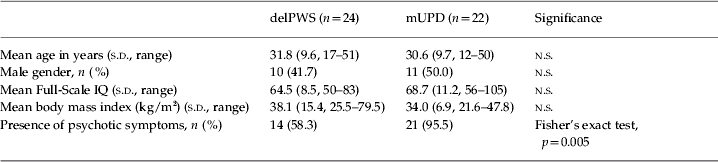
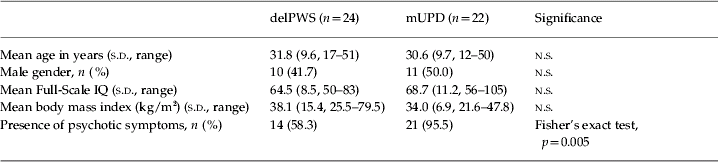
We estimate that the 116 adults (excluding the three children) comprise approximately one quarter of the adult PWS population of the UK (Whittington et al. Reference Whittington, Holland, Webb, Butler, Clarke and Boer2001). The demography of these individuals is presented in Table 1.
Demographic and phenotypic data of all participants who screened positive for psychopathology
delPWS, Deletion subtype; mUPD, maternal uniparental disomy subtype; s.d., standard deviation; IQ, intelligence quotient; n.s., not significant.
Inter-rater reliability
As described below the psychiatric phenomena seen were predominantly affective in nature and could be divided into three characteristic groups: symptoms of depression, symptoms of hypomania/mania and symptoms of psychosis. The variety of diagnoses given was found to correspond broadly with the division of phenomenology given above, and encompassed four main diagnostic categories of psychopathology:
(1) a depressive illness without psychotic symptoms;
(2) a depressive illness with psychotic symptoms;
(3) an affective psychotic illness with both depressive and manic episodes;
(4) a psychotic illness that resembled a schizophrenia-spectrum disorder.
Inter-rater reliability between the three clinicians for the collapsed psychiatric diagnoses above was found to be moderate (κ=0.69). (However, there was full agreement on the occurrence, or not, of psychotic symptoms.) For the purposes of further analysis where disagreement occurred, the vignettes were re-examined (by A.J.H., a LD psychiatrist who was blind to genetic subtype) and assigned a diagnosis based on a consensus agreement from all those who had rated the vignettes. Eleven of 46 PWS cases (24%) required re-examination.
Prevalence
Individuals with mUPD were significantly more likely than individuals with delPWS to have a history of psychiatric symptoms in general [22/34 (64.7%) v. 24/85 (28.2%); χ2(1)=13.6, p<0.001, OR 4.7 (CI 2.0–10.9)]. A specific history of psychotic symptoms was present in 14/85 (16.5%) individuals with a deletion and 21/34 (61.8%) individuals with mUPD. Hence, where a history of psychopathology was present, almost all individuals with mUPD reported a history of psychotic symptoms (21/22, 95.5%) compared with individuals with delPWS (14/24, 58.3%). Unlike the findings of Boer and colleagues, we found four individuals with mUPD over the age of 27 years who had no history of psychotic symptoms.
Phenomenology
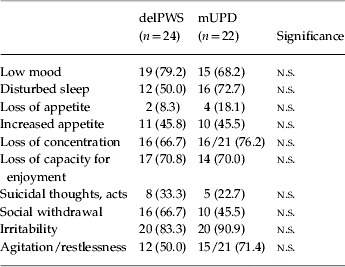
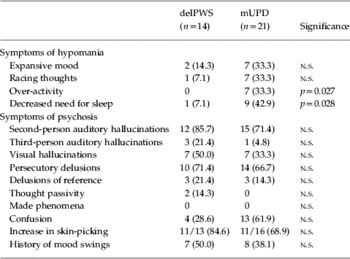
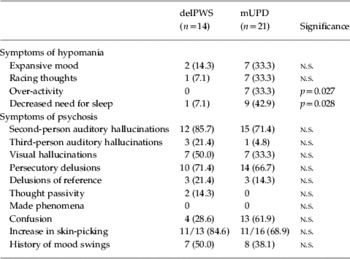
Specific symptoms of psychiatric illness are presented in Tables 2 and 3. Those phenomena which were not experienced by any of the sample are omitted and include items such as guilt, made phenomena and depersonalization. In broad terms, psychotic symptoms were more prevalent in those with mUPD than in those with delPWS [21/34 v. 14/85; χ2(1)=24.0, p<0.001, OR 8.2 (CI 3.3–20.1)]. More specifically, significant phenomenological differences between the genetic subtypes included symptoms of hypomania, namely overactivity and decreased need for sleep, which were reported more frequently in those with mUPD.
Symptoms of depression in individuals with psychopathology

n.s., Not significant.
All values n (%).
Symptoms of hypomania and psychosis in individuals with psychotic symptoms
n.s., Not significant.
All values n (%).
Symptoms of depression were broadly similar whether or not psychotic symptoms were present. However, rates of confusion were higher in those with a history of psychotic symptoms (p=0.05); and rates of mood swings, which are characteristic of PWS but do not fulfil criteria for an affective disorder, were higher in those without a history of psychotic symptoms (p=0.00029).
The clinical course of illness in individuals with psychotic symptoms
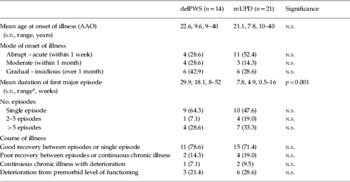
The clinical course of psychotic illness was similar in both genetic subtypes: the age at onset of illness was generally in the early twenties but with wide variation (9–40 years), the mode of onset was slightly more likely to be acute than insidious, and individuals were more likely to experience good recovery between episodes and no deterioration from their premorbid level of functioning (Table 4). However, individuals with delPWS were significantly more likely to experience a longer duration of first major psychotic episode than individuals with mUPD.
Clinical course of illness in individuals with psychotic symptoms

n.s., Not significant.
All values n (%) unless otherwise stated.
a Excluding outliers.
Diagnosis
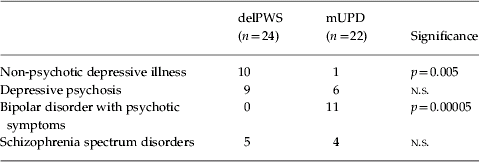
The 46 individuals with possible psychopathology on screening were all given an ICD-10 diagnosis by raters. The distribution of collapsed diagnoses among the genetic subtypes is given in Table 5. Most individuals had a diagnosis of affective disorder (diagnoses 1–3 above) rather than a schizophrenia-spectrum disorder, with those with mUPD being more likely to be diagnosed with bipolar disorder and those with delPWS being more likely to be diagnosed with a non-psychotic depression. It is of note that all individuals who fulfilled criteria for a bipolar affective disorder also experienced psychotic symptoms.
Distribution of diagnoses in individuals with psychopathology
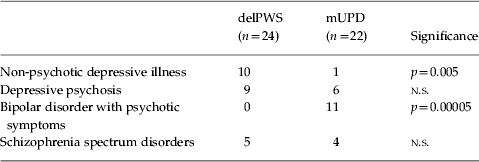
n.s., Not significant.
Risk factors
Family history
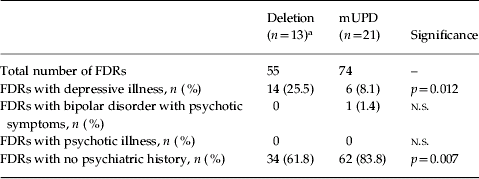
Out of the whole sample (n=119), individuals with delPWS had a total of 307 first-degree relatives (FDRs) and individuals with mUPD had 119 FDRs. Of those with psychotic symptoms, individuals with delPWS (n=14) had 55 FDRs and individuals with mUPD (n=21) had 72 FDRs. Psychopathology in FDRs was categorized into depressive illness, bipolar disorder with psychotic symptoms, and schizophrenia-spectrum disorders.
In addition to the results given in Table 6, a family history of depression was more frequently found in probands with delPWS with psychosis [n=13; 14/55 FDRs affected (25.5%)] than probands with delPWS without psychosis [n=67; 16/252 affected FDRs (6.3%)] [χ2(1)=18.7, p<0.001, OR 5.0 (CI 2.3–11.0)]; this difference did not hold for probands with mUPD. In probands with delPWS and a psychotic illness, any parental history of depression was only seen in the mother (7/13 mothers v. 0/13 fathers, p=0.006). However, affective disorders (if present) were equally likely in the mother or father of individuals with mUPD with psychosis (3/21 mothers v. 2/21 fathers, p=1).
Rates of psychopathology in first-degree relatives of probands with psychotic symptoms
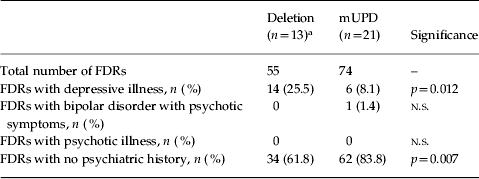
FDR, First-degree relative; n.s., not significant.
All values n (%).
a Family history data missing for one individual.
Life events
In 71.4% (10/14) of those with delPWS and 81.0% (17/21) of those with mUPD (p=0.69) the first episode of psychotic illness was preceded by at least one life event. The types of precipitating event were numerous and in some cases could be seen to be related to the characteristic features of the PWS phenotype. For example, being caught stealing food is an indirect consequence of their drive to eat. Other events were more general in nature such as being assaulted, bereavement and academic failure. Dosage changes in medication such as appetite suppressants (sibutramine, fenfluramine) and testosterone, and physical illness also precipitated psychopathology in 19 individuals, suggesting that their mental state may be sensitive to physiological variation. Individuals whose psychotic illness was precipitated by a life event were less likely to have a continuous chronic illness than those individuals whose psychotic illness had occurred spontaneously (2/27 v. 4/8, p=0.016, ϕ=0.47).
Discussion
This is the first study to investigate systematically the characteristic psychiatric phenomenology associated with this rare neurodevelopmental disorder and to compare the profile of psychiatric illnesses, specifically psychotic illness, between the two main genetic subtypes of PWS. The strengths of the study are the sample size (PWS is a rare disorder), the use of established assessment methodologies, and confirmed genetic diagnoses on all those with PWS included in the study. The main limitations include, first, the fact that there was the potential for selection bias in recruitment. Individuals with PWS and psychiatric illness may have been more motivated to participate, although it was stressed at the recruitment stage that participants without a history of psychosis were also required. However, any bias towards selection for psychosis would be independent of the genetic subtype. Second, as the screening questionnaire was informant-based, individuals whose psychopathology was overlooked by the informants, through being milder or atypical, would have been excluded from the full assessment. However, the four older individuals with mUPD with no history of psychotic symptoms on screening were each visited, interviewed directly, and a full clinical history was taken; none was found to have psychiatric symptoms that had been overlooked, providing some validity to the method of screening used in this study. Third, the family study method is more reliable than the family history method used here, and conclusions drawn from the family data must therefore be treated with caution. Fourth, the inter-rater reliability for diagnoses in this study was only moderate. This may be explained by the difficulty in applying standard criteria, such as those in ICD-10, in diagnosing psychopathology in individuals with LD (Sturmey, Reference Sturmey1995) or that psychiatric illness in people with PWS may be atypical and not correspond with established diagnostic systems. Examples of this atypicality include the presence of symptoms such as confusion, and hyperphagia over and above that seen normally. However, there was complete agreement between all raters on the presence or not of psychotic phenomena. Fifth, SS was not blind to genetic subtype for a minority of participants who had a previously confirmed genetic subtype, which may also have introduced an element of bias.
With respect to the first aim of the study, we found, in line with previous studies, that whilst affective disorder in general was common in both genetic subtypes, the prevalence of psychotic illness in individuals with mUPD was significantly higher than that in individuals with delPWS. However, contrary to the findings of Boer et al. (Reference Boer, Holland, Whittington, Butler, Webb and Clarke2002), four individuals with mUPD aged over 27 years in this study had not experienced psychotic symptoms; this finding is consistent with that of Vogels et al. (Reference Vogels, Matthijs, Legius, Devriendt and Fryns2003). However, whether these four with PWS due to mUPD are atypical from the rest with mUPD with respect to psychosis is uncertain as it is possible to explain this freedom from psychotic illness in various ways: one individual was aged 28 years and therefore may yet develop symptoms; one had been taking antipsychotic medication for problem behaviours which may have prevented the onset of psychotic symptoms; one was found to have additional genetic material on chromosome 15 which may, in some way, have reduced his risk of developing psychosis; and one was found to have an unusually mild PWS phenotype, possibly suggesting mosaicism. However, none of these theories has been confirmed. These four are being investigated further as any exception to this apparent very high risk of psychosis in those with mUPD may provide important clues to underlying aetiological mechanisms.
Our second aim was to compare the profile of illness across the two main genetic subtypes. The main phenomenological findings of this study are threefold. First, where psychopathology occurred in individuals with PWS, it was broadly affective in nature, although those with mUPD were more likely to have a history of psychotic symptoms. Second, where psychotic illness was present in those with PWS, those with mUPD were more likely to have a diagnosis of bipolar disorder whereas this diagnosis was not seen in those with delPWS. Third, in terms of prevalence, diagnosis, and phenomenology (with the exception of duration of first, major, psychotic episode), more severe affective co-morbidity was observed in those with mUPD. The broad similarities in phenomenological findings and the diagnostic category of affective disorder in both groups suggest a similar aetiology for psychiatric illness in those with either mUPD or with delPWS, but the differences that do occur suggest that illness in those with mUPD is more severe and more prevalent.
We propose that the main diagnoses for the psychiatric illnesses seen in PWS are atypical affective disorders with or without psychotic symptoms. It is important to note that a minority of individuals (n=9) were given a diagnosis of schizophrenia-spectrum disorders. It may be that, in this subset of participants, affective disorder has been modified by other genetic or environmental events resulting in an illness with more severe psychopathology and a poorer prognosis. However, we have considered two other diagnoses. The first is that of cycloid psychosis, the main features of which are a sudden onset of illness, hallucinations, mood-congruent persecutory delusions, anxiety and confusion, often with a good prognosis (Perris & Brockington, Reference Perris and Brockington1981). This is a common diagnosis in the literature, although it was rarely applied by clinicians in this study. This may be partly because it is not commonly used in clinical practice in the UK. Cycloid psychosis is found in the section on ‘schizophrenia, schizotypal and delusional disorders’ in the ICD-10 and is considered as qualitatively different from an affective psychosis. Also, during data collection we observed that features of psychotic illness such as the bipolarity and confusional states appeared similar to those of postpartum psychosis. This raises the question of whether the underlying biochemical and hormonal mechanisms that predispose to postnatal psychosis (Russell et al. Reference Russell, Douglas and Ingram2001) and to psychotic illness in PWS might be similar, particularly given that levels of sex hormones in people with PWS are likely to be abnormal (Swaab, Reference Swaab1997).
Family history of psychiatric illness was of negligible influence in the development of psychosis in individuals with mUPD. However, in those with delPWS with psychosis, the reported parental history of depression was, in this study, only on the maternal side. This might suggest that any genetic influence on the propensity to psychotic illness in that group arises from the maternal line. This idea is put forward with caution: the overall sample size is small because of the rarity of PWS, and it may be argued that depression is commoner in females compared with males (Regier et al. Reference Regier, Boyd, Burke, Rae, Myers, Kramer, Robins, George, Karno and Locke1988), and in mothers caring for a child with LD (Olsson & Hwang, Reference Olsson and Hwang2001). However, this would also then be reflected in the parents of those with mUPD, which was not the case.
Life events as precipitants for psychopathology in people with PWS have not been widely studied. We found, in agreement with Vogels et al. (Reference Vogels, De Hert, Descheemaeker, Govers, Devriendt, Legius, Prinzie and Fryns2004), that life events were associated with the development of psychiatric illness. However, contrary to their findings that psychosis in PWS is triggered by loss or threatening loss events, this study showed that episodes were more likely to be associated with interpersonal problems, changes in routine and physical illness. In some individuals, such as those in whom psychotic illness was associated with appetite suppressants, this may represent further disturbance of already dysfunctional neurotransmitter systems, particularly involving serotonin (Soni et al. Reference Soni, Whittington, Holland, Webb, Maina, Boer and Clarke2007). A large proportion of first episodes of psychiatric illness were found to be precipitated by an event, adverse or not, suggesting that their avoidance (e.g. altering doses of medication by very small increments, being alert to minor physical illness such as urinary tract infection, especially given that people with PWS have a high pain threshold, or preparing the individual for changes in routine) may reduce the likelihood of developing an episode of illness.
With respect to the more conceptual fourth aim of the study, we have considered how these findings might best be explained and how they might relate to aetiologic mechanisms. The main observations that are central to our proposal are that affective disorder in general is common in PWS regardless of genetic subtype. However, the two main genetic subtypes can be discriminated in terms of a greater prevalence and severity of illness in those with mUPD. We suggest a ‘two-hit’ model for further consideration for the development of affective psychosis in people with PWS and, because of the genetic basis of PWS and the predominance of psychotic illness in those with PWS due to mUPD, we propose that this is best explained by the effects of imprinted genes. Genomic imprinting is a phenomenon whereby the expression of a gene is dependent on the gender of the parent from whom it was inherited; the allele that is not expressed is ‘imprinted’, and thus the gene is essentially functionally haploid. We propose that two separate genetic events on chromosome 15, both of which relate to imprinted genes, each result in an increased liability to non-psychotic affective disorder. However, when both genetic events are present in the same person the effect is synergistic, leading to the development of affective psychotic illness. The first genetic event we propose is that of having the genotype of PWS per se [i.e. the absence of expression of a maternally imprinted/paternally expressed ‘PWS’ gene(s)]. The second genetic event we propose is consequent upon the unbalanced excess expression of a putative paternally imprinted/maternally expressed gene on chromosome 15. This gene would be expressed from both chromosomes in those with mUPD (as both chromosomes are maternally derived) but only a single chromosome in those with delPWS. However, in a proportion of individuals with delPWS, allelic variation in this single maternally derived gene might up-regulate its function and lead to its over-expression. Our family history findings fit with this part of the model: in the mothers of probands with delPWS and psychosis, over-expression of a paternally imprinted/maternally expressed allele leads to non-psychotic affective illness but when inherited by the offspring with delPWS, psychotic illness develops.
The occurrence of the two genetic events together would increase the risk that non-psychotic affective disorders become affective psychotic disorders. This model can account not only for the differences in prevalence of affective psychosis between the genetic subtypes, but also for the increased severity of affective disorder in those with mUPD.
Despite the limitations set out above, several important implications have emerged. Clinically, the knowledge that people with PWS are at an increased risk of developing psychotic illness can aid early detection and diagnosis, and consequently, early treatment with psychotropic medication may improve prognosis. Symptoms such as the increase in food-seeking and confusion, which may be dismissed as problem behaviours could, in fact, herald the onset of illness. These findings are analogous to the findings of high rates of schizophrenia in people with velo-cardio-facial syndrome (Murphy et al. Reference Murphy, Jones and Owen1999), which prompted a search for susceptibility genes at the 22q11 locus. Similarly, future work may identify allelic variation of imprinted genes at 15q11–q13, and eventually determine whether a proportion of cases of affective illness in the general population are due to abnormalities at this locus.
Acknowledgements
This research was supported by grants from the Wellcome Trust and The Health Foundation. We are grateful to the participants with PWS and their carers, to Jackie Waters at the PWSA (UK) for facilitating access to people with PWS, and to the psychiatrists who responded to requests for patients with PWS. We also thank Dr Peter Watson for statistical advice.
Declaration of Interest
None.