

In August 1998 the German archaeological world was stunned when two amateur archaeologists found decorated gold-sheet ornaments on a hill in Bavaria north of Munich, near a farm named Bernstorf, in the commune of Kranzberg. A Bronze Age fortified enclosure was known there, local amateurs having excavated it earlier in the 1990s; later, permission was granted for gravel extraction, trees were cleared and it was in this disturbed area that the gold appeared. The authorities were quickly alerted. Both the Staatssammlung in Munich (Bavarian State Archaeological Museum) and the Bayerisches Landesamt für Denkmalpflege (BLfD, Bavarian State Office for Monument Care) took part in inspections and, subsequently, excavations. More gold, including a ‘diadem’, appeared and, in late September 1998, perforated lumps of amber. Then in November 2000, on the edge of an area under excavation by the BLfD, came the sensational discovery of two incised pieces of amber hailed as Mycenaean.
Were these finds genuine or fake? Heated debate began quickly (with much attention in the public media), initially conducted along collegial academic lines, but becoming increasingly personal and emotional. Divisions were very obvious at a meeting in Munich in October 2014, which one of us attended, generously invited by the authors of the volume under review here. This volume presents the range of specialist studies that they have commissioned, along with detailed discussion of the finds and find circumstances, in order that authenticity or otherwise can be demonstrated, and readers who remain sceptical are challenged to justify their opinion. In particular, the analyses of the gold conducted by Ernst Pernicka in Mannheim have created two camps: ‘believers’ (the authors, supported by, among others, the late lamented Bernhard Hänsel) and ‘sceptics’ (principally Pernicka and Harald Meller, director of the State Museum for Prehistory in Halle/Saale). We cannot cover this debate in detail but must make readers aware of it, as Pernicka's views are repeatedly criticised in the book. Meanwhile, for amber, the problem is that amber bearing Linear B signs is unparalleled in Greece (strangely, Harding and Hughes-Brock (Reference Harding and Hughes-Brock1974) is nowhere cited); could it really turn up in Germany?
Part A gives archaeological and scientific analyses by Gebhard and Krause; Part B, 18 specialist contributions. After a brief introduction, Chapter A2 discusses the question of puzzling finds, and fakes, with reference to the Nebra Sky Disc—a surprising inclusion, but intended to show that when certain unknown or controversial aspects are compared (tab. 2, p. 43), Bernstorf comes off better than Nebra. There are indeed uncertainties about Nebra, but most scholars accept the Disc and its association with the accompanying swords as genuine, despite divergent statements from the two finders. Why, then, we are asked, accept Nebra but not Bernstorf?
Chapter A3 outlines the topography, the location of the various excavations and the findspots of the gold and amber. Bernstorf has three sets of ramparts: medieval, Hallstatt and an extensive Middle Bronze Age occupation, initially unfortified and later enclosed by a timber-framed rampart (with the felling date of the timbers placed at 1340 BC), which was extensively burned some time later (comparisons with vitrified forts in ʻEnglandʼ (recte Scotland) are mentioned). The full excavation report awaits publication.
Chapter A4 details the find circumstances, listing the dates and finders. The contribution by Claudia Rohde and BLfD colleagues (part of B5) reproduces all the relevant documents as preserved in the archive. As Krause and Gebhard admit, almost all the controversial finds were made in the absence of professional archaeologists, mostly by a local doctor, Manfred Moosauer, and the late Traudl Bachmeier, both members of the Freising Archaeological Society. The former president of the society and district Heimatpfleger (unpaid local history curator), Erwin Neumair, believed from the start, and said openly, that the gold had been planted by Moosauer. There are plainly suspicious elements: one of the documents, a memo by M. Pietsch from the BLfD (also mentioned by Krause and Gebhard, to their credit), describes how a ‘clairvoyant’ brought along by Moosauer ‘found’ gold within seconds, and later a volunteer found amber just where Moosauer had told him to dig. Almost all the gold-sheet objects, and much of the amber—most notably the two engraved pieces—were found over a period of years by Moosauer and Bachmeier working alone (pp. 272–73).
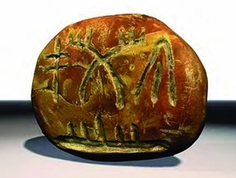
Questions about the amber were expounded, sceptically, by Hughes-Brock (Reference Hughes-Brock and Vianello2011). Gebhard (Reference Gebhard1999: 11–18) originally mentioned Mycenae only as part of a sober parallel hunt for the gold diadem and did not include the six pieces of perforated amber found lying nearby. The sensational ‘Mycenaean’ amber was not unearthed until 2000, when Moosauer and Bachmaier, working on a Saturday when BLfD staff were not present, were entrusted by the director, Karl Heinz Rieder, with going over the disturbed area. Some 0.59m from the earlier findspot of the gold, they came upon two amber objects: a “triangular amber plate engraved on both sides” with a face and three “magic signs”; and an “amber seal” bearing three Linear B signs and a schematic depiction of the 1998 diadem (pp. 51–53, 71–72; ‘Object A’ and ‘Object B’ in previous publications).
Scientific investigations began at once (Chapter A7). Infra-red spectroscopy predictably showed a Baltic origin. Weathering and marks of working are more complicated, amber being very sensitive to age and micro-environment. Fluorescence tests on the ‘seal’ are interpreted as revealing an original object with secondary ancient working. The photographs of modern and ancient perforations solve nothing, as ancient perforated pieces were certainly present. Microscopic analysis and digital enlargements can lead to misunderstanding, hence the sharp criticism (p. 123) of an unpublished report based on detailed examination of the amber by Katharine Verkooijen (it seems strange to criticise a document that is still unknown to the scholarly world). Questions remain about scraps of gold detected inside the perforation and about an unidentified material in the incisions.
Gebhard and Rieder, in unfamiliar territory, consulted specialists about the Linear B but missed some significant points. Thus, in earlier work, the face engraved on the triangular amber plate, compared repeatedly to Schliemann's gold ‘Mask of Agamemnon’, was coupled with the Linear B—generations too late. That mistake has now been rectified and here the authors compare the face with the later ‘Lady of Phylakopi’ (p. 129, fig. 85), the two amber pieces supplying background to a proposed wooden cult statue that might have worn the gold diadem. Moreover, close examination reveals one corner of the mouth to have been re-incised to create a more pronounced smile, and as smiling faces predominate on Mycenaean idols (so we are told), this is another proof of authenticity. This is a desperate argument—there is no ʻMycenaean smileʼ. The ‘magic signs’ on the reverse of the amber plate were discussed by Janko (Reference Janko2015: 58–59, fig. 2), but offered him no obvious reading. The ‘seal’, so called because it is perforated, is likened to two Minoan seals from the Cretan seal workshop at Mallia, destroyed in Middle Minoan IIB (late seventeenth century BC; p. 128, fig. 83). The observation that beaked jugs (Schnabelkannen), of the shape depicted on one of the seals, were still well known in the fourteenth century BC is irrelevant.
It is telling that the only study of the Linear B by a philologist (Janko Reference Janko2015) could not find a place in an international journal that covers Mycenaean subjects. Reading right to left, seal-impression-wise, and by altering one sign (explained as a scribal aberration!), Janko arrives at a hypothetical (reconstructed) place-name in the Linear B archive at Pylos, and constructs a tortuous and far-fetched story to get the objects from Pylos to Bernstorf. It is telling, too, that Gebhard and Krause are happy to present this as a plausible explanation.
Not that amber in Bronze Age Germany is unusual: Christa Stahl (Reference Stahl2006) lists many find-places in Central Europe. Bernstorf, between 1997 and 2005, yielded 56 pieces altogether (some perforated): the largest quantity from a settlement in southern Germany (pp. 53 note 134, 138, 272–73). Incidentally, regarding Tutankhamun's amber-looking beads, it was Sinclair Hood (Reference Hood, Beck and Bouzek1993) who first suggested a Tumulus Culture link; the substance still awaits analysis (Serpico Reference Serpico, White, Nicholson and Shaw2000: 451–54; with Niwiński (Reference Niwiński, Kosmowska-Ceranowicz and Paner1999) suggesting copal; and with Sarpaki (Reference Sarpaki, Michailidou, Kalogerakou and Voutsa2001: 210 note 119, 213 note 150) suggesting ladanum). Other evidence for long-distance contacts is summarised in Chapter A8.
The longest chapter, A6, covers various aspects of ancient gold production and the analysis of gold, and should be read in conjunction with Chapters B1 and B2. Part of B1, by Barbara Armbruster, considers the technical aspects of the Bernstorf gold, concluding that while the techniques identified exclude the use of modern tools (as Gebhard in A6 also demonstrates), they differ from anything known from Bronze Age Europe. She believes further work is needed, notably experimental work.
Realistically one must also read the papers by Pernicka (Reference Pernicka, Meller, Risch and Pernicka2014a & Reference Pernickab), frequently alluded to, which present the results of laser ablation ICP-MS analysis. These results suggested to Pernicka that the Bernstorf gold is too pure (99.99 per cent) to come from the Bronze Age (unless achieved by the cementation process, repeated several times; cementation is not otherwise known from the period, and the multiple repetition would serve no obvious purpose); hence Pernicka argued that it is modern electrolytic gold. Analyses conducted in Frankfurt (no author stated) and in Munich by K.T. Fehr and R. Hochleitner, using electron microprobe analysis, confirm the high purity, while new XRF analyses conducted in Berlin by the Federal Office for Materials Research and Analysis are presented summarily here; a full report elsewhere (Radtke et al. Reference Radtke, Reinholz and Gebhard2016) confirms extreme purity. Gebhard goes to considerable lengths to demonstrate that very pure gold (meaning >99.9 per cent gold, not what ore geologists are inclined to call ‘pure’ gold) can be readily achieved through simple cementation techniques (in B1 he recounts an experiment), as shown also in Babylonian texts (contribution by Paola Paoletti); and that objects of such pure gold are known from the Bronze Age world. These are few; one is the coffin of Akhenaten (KV55), often cited, another the gold disc from Moordorf in Lower Saxony (the subject of a day meeting in Hannover in 2016), now itself under suspicion, although still hard to see as a forgery—but how then can its gold be so pure? We must wait for more analyses and more finds with good contexts—and be prepared for surprises.
We ourselves cannot adjudicate about the gold. The workmanship is completely atypical for Bronze Age Europe, but not done with modern instruments. If the objects are fakes, then the forger was careful to use convincing tools—but might also have been expected to use a convincing metal type! If genuine, then either they are a unique example in Europe, or they come from elsewhere (e.g. the Eastern Mediterranean) and were planted. The find circumstances and the amber (see above) must be taken into account here.
There are further problems. Some of the gold pieces, and the amber ‘seal’, were enclosed in an ‘envelope’ of sediment. This sediment is local, analysed by Astrid Ropke (B4). It contains uncarbonised plant residues, as do samples of the upper (i.e. recent) soil levels at the site, but small modern roots can find their way into older deposits. A mineralised conifer needle from the envelope of the ‘seal’ was submitted as part of a mixed sample and produced a date in the calibrated range AD 1100–1500, but the amount of material was small and contamination could not be excluded (p. 120, specialist report pp. 213–14). Analysis of dark adhesions to the gold (B3) suggests some modern contamination, perhaps from the application of fire or heat. A piece of oak stick found enclosed in one of the gold spirals produced good radiocarbon dates in the fourteenth century cal BC (pp. 112–16, 213–14), but as there was much charcoal around, not least in the burnt rampart, it could have been intentionally inserted there.
Bernstorf is the largest Bronze Age fortified site north of the Alps; Krause and his team have done invaluable fieldwork and we look forward to the definitive excavation report. Bernstorf was not, however, in our opinion, the entrepôt for Aegean connections that he and Gebhard suppose. They try hard to persuade us that the finds are genuine, attempting to confirm the long-distance contacts between the Eastern Mediterranean and Central Europe that other recent finds increasingly suggest, but they seem to scramble desperately for arguments, and their polemical style does not inspire confidence. Future discoveries may tell us more; for now we suggest that archaeologists leave Bernstorf out of debates about long-distance contacts. It is always possible to change one's mind, as has, for example, Kristian Kristiansen (Reference Kristiansen, Kiriatzi and Knappett2016: 165–66 note 1, 170). If one day your reviewers should need to eat their words, we shall, and we hope gracefully.
Finally, the site and its finds have an unexpected and delightful spin-off, a novel for younger readers by Alix Hänsel (Reference Hänsel2007; see Hughes-Brock Reference Hughes-Brock and Vianello2011: 107). It deserves translations.


