China's market-oriented reforms have revitalized the nation's private economic sector. The number of private businesses increased from 0.14 million in 1978 to 27 million individual businesses and 5.5 million private enterprises in 2007.Footnote 1 In rural areas, self-employment has been the fastest growing off-farm sector, accounting for 40 per cent of all new off-farm jobs from 1988 to 1995.Footnote 2 However, along with the massive flow of labour into self-employment, a growing pattern of gender segregation has also been noted. In the 1990s, women were disproportionately affected by state sector layoffs in the cities, and many were pushed into low-end self-employment.Footnote 3 In rural areas, women were estimated to account for 30 per cent of the self-employed labour force by 2000.Footnote 4 Their involvement in this sector, however, has not been sufficiently studied.
Rural women have faced particular challenges with regards to job hierarchies and family dynamics. The Maoist rural economy was primarily agricultural. However, the share of the rural labour force in off-farm work grew from 15 per cent in 1981 to 43 per cent in 2000, and within that share, the wage sector rose from 11 per cent to 27 per cent and the self-employment sector increased from 4 per cent to 16 per cent.Footnote 5 Rural employers, however, have failed to provide the benefits or care services provided by their urban counterparts, and rural families have been left to cope with various difficulties on their own.Footnote 6 This pattern has accompanied the long-standing exclusion of peasants from state welfare benefits and the recent retreat of state power from the provision of public goods. In addition, rural self-employment has become more capital-intensive over time.Footnote 7 In general, rural women have approached self-employment with a different balance of priorities to urban women who commonly wanted to stay in redistributive salaried jobs which provide care services.
Developments in rural self-employment provide an important perspective on the key issue of whether women have lost out in the market economy. Despite the Maoist ideology of gender equality, gendered work was a constant principle of organization in the countryside.Footnote 8 Village women tended to concentrate on the less valued farm workFootnote 9 but also participated in rural-to-urban migrationFootnote 10 and rural enterprises (TVEs).Footnote 11 However, women's roles in self-employment have remained vague – commonly falling into the “courtyard economy”Footnote 12 or being hidden within male-led family businesses.Footnote 13 Self-employment for women is often referred to as an extension of domestic sideline production, a classification that may devalue their actual entrepreneurial activities.Footnote 14 However, alternative gendered meanings for the private sector have also emerged that relate achievement and competition with masculinity.Footnote 15 Because of the vague gendered meanings of self-employment in job hierarchies, this study focuses on the types of work women perform in the self-employed sector. Just as the Maoist gender paradox of both encouraging and devaluing women's work suggests, it is not only the sheer numbers of women working but also the type of work they do that matters.
A related debate concerns how women grapple with the contention between work and the new ideological pressures to be good wives and mothers. The gender gap in off-farm work has narrowed among the younger generation,Footnote 16 and Yunxiang Yan has highlighted the emergence of “girl power” that results from the new opportunities to work and experience a different life.Footnote 17 This direction appears to promise greater gender equality; however, Harriet Evans suggests that it can also be compromised owing to a “market-supported naturalization of women's roles.”Footnote 18 Women's household responsibilities were not called into question by the socialist regime, and since the market reforms, rural decollectivization has often meant that women have returned to family farms.Footnote 19 There, they re-experience the traditional obstacles to rural women's participation in public life.Footnote 20 Both the rising “girl power” and the resistant gender role expectations call for an examination of women's work as something continuously negotiated and subject to family dynamics. Although women may have made inroads into this new sector, because self-employment often entails a fusion of family and work, their work is often mixed with or disguised as family labour.Footnote 21 Admittedly, women's labour continues to be identified with passivity and appears to “blend in” with housework. But, rural self-employment provides alternative ways to women's self-fulfilment, ways which are shaped by the job hierarchies and family dynamics that are particular to rural China.Footnote 22
Data and Method
This study uses in-depth interviews from Bei village in Zhejiang province, conducted between 2004 and 2010.Footnote 23 This village has a long history of reliance on grain-farming and traditional sidelines such as wine-making. Private economic activities were depressed in the Maoist era until the dissolution of collective farms in 1980–1981. Collective industries then mushroomed in the 1980s, and were mostly privatized in the 1990s. Meanwhile, many factory employees became traders, retailers, entrepreneurs or contractors.
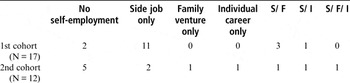
The in-depth interviews that form the basis of this study involved 29 women who were recruited using a snowball sampling procedure. The respondents were divided into two cohorts, depending on whether they were above or below age 18 in 1980, the year of decollectivization. At that time, the women of the first cohort (N = 17) were in the age range of 22–41 years old. They had been adult labourers on collective farms, and many of them had multitasked in collective farming and other earning opportunities. The women of the second cohort (N = 12) were aged between 2 and 17 years old in 1980. Therefore, they had a limited memory of collective farming, and they came of age and entered the labour force after the rise of private sector work. I coded the data from the interviews using a grounded theory approach and extracted codes for the women's various interpretations of “self-employment.”
Self-employment has multiple meanings. Nascent self-employment emerged during the Maoist era in the form of informal economic activities that were considered “private” and “domestic” because such work occurred outside of the state or collective economic sector (the “public” sector). This work often involved sideline activities conducted by women at home. As the economic reforms unfolded, the term “self-employment” was used in a wider sense.Footnote 24 It included more formal and professional types of work, including private entrepreneurship, and was increasingly applied to either full-time jobs or roles involving family investment. This study therefore categorizes self-employment into three types, rather than using the common dichotomy of skilled or unskilled work.Footnote 25 These three types are “side jobs,” “individual careers” and “family ventures.” In the rural setting, a “side job” was once considered an equivalent term to “self-employment,” which commonly referred to an extension of domestic work for women who multitasked in farming or wage jobs. However, as the market reforms accelerated, the term self-employment was applied to more diverse categories, including individual or family private business, which were often riskier but more rewarding than wage employment. Many women now pursue self-employment as an “individual career” with full-time devotion, or join “family ventures” in various forms, such as husband–wife partnerships. The distribution of self-employment types is given in Tables 1, 2 and 3.
Interviewees by Cohort

Interviewees by Cohort (continued)

Note:
The same person may switch from one to another type of self-employment, so the numbers do not add up to 17 for the 1st cohort and 12 for the 2nd.
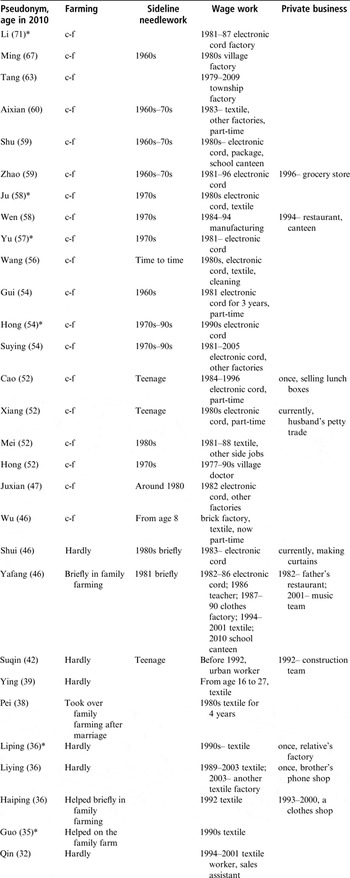
Work Trajectories of Interviewees

Notes:
*indicates multiple visits; c-f indicates collective farming and family farming before and after 1980.
Self-employment as a Side Job
Generally, the older generation of women had multitasked in collective farming and sideline activities. During the 1970s, sideline needlework involved 60 per cent of the women in Bei village.Footnote 26 This work consisted of stitching cloth to designs specified by customers in urban manufacturing or sales centres. As Cao recalled, “We girls sewed in our spare time when we did not farm, and the communes chose to ignore us. It was for private money, and we transacted [our business] with city agents directly when they came to the village. We could earn four yuan per week, much more than agricultural income. Women could earn five work units in a maximum of ten from farming. Because of needlework, people realized that girls could earn extra cash for the family.” Although most of this income was allocated for family needs, the proceeds from the sales came to the women themselves first, and their economic contributions were well recognized by other family members.
Needlework had been an important source of cash income in the 1970s and 1980s but was feminized and became less attractive when more formal jobs became available.Footnote 27 In the 1980s, the village collective established several textile and wine-making factories. In a pattern of local state corporatism, the village collective was deeply involved in capital accumulation and revenue distribution.Footnote 28 Under the local-based structures of economic management and ownership, many young women became textile workers. Income from needlework was sidelined, and seven out of 12 in the second cohort never engaged in sideline needlework. Most older women were pulled into full-time farm labour and no longer had the time to make money by doing needlework.Footnote 29 This new trend interrupted as well as continued some of the gender labour politics of the Maoist era that directed young women towards more financially rewarding sectors but meant that older women were concentrated in the less valued farm work. When the women transitioned from self-employed needlework to wage employment, they also relinquished a degree of autonomy over their work.
Women's self-employment expanded again when the wage sector was privatized in the 1990s. Unable to afford extra expenditures in the face of stiff competition, employers no longer offered welfare or benefits to employees. Rather than offer maternity or sick leave, employers simply replaced pregnant and ill female workers. This happened to Cao in 1996, because “the machine could not wait there.” At the same time as the urban state sector layoffs were forcing “women [to] return home” (nüren huijia 女人回家),Footnote 30 rural wage employment also became increasingly insecure. Cao lost her full-time job, and then found it difficult to resume her former side job. Owing to stiffer competition, traditional sidelines such as needlework now had a more limited market and a narrower profit margin. Meanwhile, more capital-intensive types of self-employment emerged in the village, including trade, transportation and construction businesses. These continuously restructured job hierarchies required women to adapt with each wave of change.
Self-employment as an Individual Career
Four of the older women and five of the younger women in the study made the transition from salaried employment to self-employment, and some even dreamed of becoming private bosses. Yu was a factory vice-manager in 1990. She struggled between “being satisfied as long as the wage is increasing over time,” and dreaming of renting a salesroom for the textile trade. Eventually, Yu's employer persuaded her to stay with better rewards. However, when I interviewed her, she was in her fifties and regretted not becoming her own boss.
Compared with urban professional women, who were generally reluctant to leave their jobs and the accompanying welfare provision, Yu was more ready to embrace the emerging opportunities in the private sector. However, her husband, who had been a sent-down youth, had an urban wage job and he believed in the socialist work hierarchy wholeheartedly. Family battles ensued and were intensified when Yu's daughter entered the labour market in 1997. According to Yu, the father preferred work units “that would never go bankrupt,” whereas Yu no longer believed in such an “iron rice bowl.” She preferred a “rubber rice bowl” that allowed more elasticity for economic rewards in an era when higher income came with taking risks and stability was an obstacle to success.Footnote 31 In fact, Yu became the family's major breadwinner and won support from her daughter. Despite her father's objections, Yu's daughter used Yu's connections to find work in a rural textile factory. She later negotiated a contract with the sales department and set up an independent trade business in 2001. She met her future husband in the factory and together the young couple went on to turn a profit of one million yuan from their private business in 2004.
Yu's case illustrates the particular rural job hierarchies that have applied to women. Urban women generally preferred the security of waged work to less secure jobs in the private sector.Footnote 32 However, rural women, rather than rely on employers, commonly took greater responsibility for their own welfare and care arrangements. Yu intentionally transmitted her social capital in the wage sector to the self-employment sector, and her daughter went on to fulfil Yu's dreams of “taking big risks and making big money.” As found in other studies, the children of entrepreneurs were brought into the transport and commercial sides of the business rather than in the manufacturing side.Footnote 33 Yu's own valuable experience and knowledge expanded the horizons of the next generation.
Haiping was also among the younger women who sought rewarding and interesting work. She had been a factory worker, but disliked the restrictive workplace discipline. She established her own clothes store in 1993 at the age of 20. According to Haiping, “I am so different from my parents and older sisters. They valued wage work. I wanted to have greater control over my work and have a life of my own.” However, when Haiping married a private contractor in 2000, she closed her store because “family life will be ruined if both spouses are work-obsessed, and I want to take care of my child, who is the only one. I should be in charge, not the grandma.” For Haiping, running a business and being a housewife were both integral parts of her life aspirations, and she planned to return to her business when her child had reached school age. In line with Yan Yunxiang's arguments about “girl power,” young women experience the world in a way which has made them feel that they have more freedom, but the new gender politics has naturalized such that young women regard the investment in their precious children's needs as part of their own self-fulfilment. Haiping's ability to move back and forth between these ambitions highlights the quest for personal satisfaction among young women, which was denied to the older women who spent their younger years “eating bitterness”Footnote 34 under an ethic of hard work and self-sacrifice.Footnote 35
The negotiation of women's individual careers has altered, but also continued, the old Maoist gender politics. The socialist regime promoted women's work outside the home, but women had to respond to multiple demands as workers, wives and mothers. As for post-Maoist-era women, their career ambitions for self-developmentFootnote 36 challenged male authority in their families; at the same time, good motherhood assumed a greater importance with the revival of women's emotional attributes,Footnote 37 and this re-affirmation of parental roles reinforced the importance of women's family responsibilities. In contrast to the older women who used to multitask between family and work duties, effectively working double shifts, more of the younger women chose to work “on and off.” Haiping held that it was her “right” to bring up her only child,Footnote 38 just as older women used to claim a right to “take over men's work.”
Self-employment as a Family Venture
Unlike the pursuit of individual careers, family ventures do not require women to be independent breadwinners. The six respondents involved in family ventures (which included trade, restaurant and construction businesses) accepted no personal remuneration. The three older women in these businesses regarded their labour as just “helping out” and as secondary and supportive. Wen quit a salaried job she had held for ten years in 1994 and opened a restaurant with her husband. She was happy to run errands as long as the business gave them a good income. The older women's unpaid involvement in family ventures seems to reflect the re-formation of women's subordination in a vein similar to the acceptance by women that agricultural tasks formed part of a housewife's work.Footnote 39 Via the offer of important help to their husbands, their work involvement fit gender role expectations of ideal women as “virtuous wives and good mothers.”Footnote 40
The three younger women in family ventures, however, expected to have more control over the business, even though they received no payment. For example, Suqin quit her factory job when she got married to a private contractor in 1992, and migrated to the city to cook for her husband's construction team. Suqin perceived her work to be of actual importance and considered herself to be overseeing the construction site for her husband. According to Suqin, “every small piece we save, it is in our pocket.” Compared with her former salaried job that allowed little career advancement, her family venture enabled Suqin to find her “self” because she could work for a business that she “belonged to.” She had felt “rootless” whilst working in factories that would not give her permanent employment, knowing that they would eventually abandon her when her labour was no longer needed. As a mere cog in the machine, she believed that her factory work was meaningless and could not generate personal satisfaction. In contrast, her family venture gave her more autonomy. This illustrates the trend in the post-Mao era of more women turning away from the supposedly glorious aspects of working outside the home and instead looking to the domestic arena to renegotiate power with other family members.Footnote 41 Based on the perceptions of what women could achieve with their labour, the ideal of an honourable woman working outside the domestic sphere was seen as less desirable and instead it was supplanted with that of a woman actively responding to the economic needs of the family business.
Although the Bei village women who worked in family ventures were unpaid, they found a way to join in the risk-taking private sector and to challenge the association between venture creation and masculinity.Footnote 42 Over time, family ventures became more capital-intensive and faced stiffer competition. Such ventures attracted younger women, who were less risk-averse, rather than those who simply “helped out.”Footnote 43 Instead of directly challenging the “natural” gender division of labour, these women found niches of autonomy and authority within family businesses. Women could bring the qualities of sympathy and understanding to the businessesFootnote 44 and gain a sense of self-determination.
The younger women also balanced family and work life differently. Although the younger cohort were able to enter self-employment because they could count on the older generation of women to continue doing unpaid household labour, the different generations also began to pursue distinct and incompatible paths towards personal happiness.Footnote 45 When Suqin had her son in 1993, her mother-in-law refused to give up her factory job to look after her grandson for no salary. Suqin had to wait until her son went to school to resume work, but then she returned to the venture better prepared. She had learned how to drive and transported workers to the construction site. She also brought her own brother into the business, which enabled her to exercise greater control over the family venture.Footnote 46 Because she was not the head of family, she could not serve as the family's public face. However, Suqin manoeuvred to make herself the “family manager.”Footnote 47 Although often constrained by customary rights that govern access to productive capital,Footnote 48 some women managed to oversee family economic and financial affairs and overcome the obstacle of traditional gender role expectations.
Younger women's motivations and the pressures of working intermittently were mediated by the expectations of husbands and in-laws. In many cases, their choices were not based on economic necessity but influenced by the attitudes of family members. Both Haiping and her husband favoured Haiping's withdrawal from employment and longed for a cultivated family environment. Suqin was less willing to give up her work but could not persuade her mother-in-law to forego her own earning opportunities to take on unpaid grandparenting.Footnote 49 Compared with the older generation who were used to a double shift of work and family duties, the younger generation tended to grapple with a different ideology about motherhood via working on and off again. Although the market economy creates opportunities for women to participate in new market-oriented activities,Footnote 50 attitudes towards women's work remain ambiguous and leave room for the continuous negotiation of employment for women in the family.
Conclusion
This study addresses the debates on whether market reforms have meant progress or regression for women's labour participation and how women's labour fits in with the balance between work and family life, with a particular reference to self-employment. Women's self-employment emerged first with sideline jobs that fitted in with their daily routines. Women were then drawn away from sideline work by the opportunities offered by the rural industries which sprang up in the 1980s. Then, in the 1990s, the privatizing wage sector tended to squeeze out both low-end female workers and high-end professional women. Meanwhile, self-employment became more capital-intensive with the participation of better educated individuals.Footnote 51 Owing to the lack of welfare benefits in wage sector jobs, the older and less skilled women were pulled into farming work or forced into low-end self-employment, while professional women were attracted to high-end self-employment. This development was the reverse of what happened in the 1980s, when salaried work drew women away from self-employment. Although self-employment continued to reflect the unpaid and “helping out” characteristic of women's work, as seen in the village's family businesses, the young women who were attracted to self-employment tended to be more dynamic and less risk-averse. Femininity was still commonly linked with a preference for job security,Footnote 52 but rural employers generally did not offer this security.
Regarding family dynamics, rural self-employment has continued to reflect women's greater household responsibilities. Traditional gender expectations persisted in the domestic sphere during the Maoist period.Footnote 53 In the reform era, young women grew more self-confident and powerful when pursuing individual interests and in keeping property under their control.Footnote 54 At the same time, however, the ideals of “virtuous wives and good mothers” were revived.Footnote 55 The rise of “girl power” put young women on a more equal footing with their marriage partners and altered the traditional expectations of virtuous daughters-in-law.Footnote 56 These young working women often left household chores to the older women. However, the work of younger women was still contingent on the expectations of their husbands and in-laws, as working outside the home was now considered more of an option than an ideological norm for women. Although young women often feel that they have more freedom than their mothers' generation, they face stiffer market competition while feeling ideologically bound to be a “good wife and mother.” The new gender politics is naturalized in a way that young women regard the pursuit of independence and their investment in child care as integral to their personal satisfaction.
In short, women's engagement in self-employment reflects the diversification of their positions in the job hierarchies and the inside–outside home dichotomy. Compared with urban women, rural women are more ready to become self-employed because they have always been responsible for the provision of their own family welfare benefits, which have not been provided by rural employers. Given the different family–work contours over time, young women face a different set of opportunities and constraints than the older generation, but do not necessarily find the juggling of family and work any easier. Some young and dynamic women have been attracted to self-employment to “take big risks and make big money.” Others balance work and family by working intermittently rather than by continually multitasking. Instead of being simply optimistic or pessimistic, this study points out the ambiguous attitudes towards women's work of the women themselves and of their family members, despite the new market opportunities in self-employment. Women are no longer obligated to be a necessary agent of socialist modernization by “eating bitterness” and working double shifts, but their choices are constrained by new challenges imposed by an increasingly harsh and competitive market. Despite the inroads into high-end self-employment made by women, their career pursuits are complicated by the desire to be good mothers.