Introduction
Phenol pollution has become a critical global problem that seriously threatens the environment and human health due to the large amount of it produced and its complex structure and biological toxicity (Reference Han, Xia, Haider, Jiang, Tao and LiuHan et al., 2018; Reference Kong, Li, Xue, Yang and LiKong et al., 2019). Phenol, therefore, is considered, by the American Environmental Protection Agency (Reference Zhang, Qin, Yang and LiuZhang et al., 2021) to be one of the 129 priority pollutants because of its wide use in commercial production (e.g. epoxy resins, adhesives, and polyamide) and because of the severe harm posed to human health, aquatic life, and plants, even at low concentrations. The World Health Organization recommends that phenol content in wastewater should be <1 mg·L–1, and the development of an efficient approach for the removal of phenol is required. The treatment of phenol in solution currently includes biodegradation (Reference Papazi, Karamanli and KotzabasisPapazi et al., 2019), biofilm formation (Reference Chen, Yao, Li, Wang, Liang and ZhangChen et al., 2018), highly advanced oxidation processes (Reference Gaidoumi, Loqman, Benadallah, Bali and KherbecheGaidoumi et al., 2019a, Reference Gaidoumi, Doña-Rodríguez, Melián, González-Díaz, Navío, Bali and Kherbeche2019b, Reference Gaidoumi, Doña-Rodríguez, Melián, González-Díaz, Bali, Navío and Kherbeche2019c), adsorption (Reference Adebayo and AreoAdebayo & Areo, 2021), and other techniques. Adsorption technology offers numerous potential advantages such as simple design, low price, easy operation, efficiency, etc. (Reference Gupta and KhatriGupta & Khatri, 2019; Reference Liu, Tian, Li, Sun, Mi, Xie and ChenLiu et al., 2019; Uddin, Reference Uddin2017; Reference Zhang, Li and LiaoZhang et al., 2020).
Clay minerals are aluminosilicates and are porous in nature, have large surface areas, are abundant in nature, and are of low cost (Reference Mehdi, Susmita, Krishna and DhrubaMehdi et al., 2022); thus they are used extensively in a variety of applications (e.g. as raw materials to prepare zeolites (Reference Gaidoumi, Benabdallah, Bali and KherbecheGaidoumi et al., 2018). According to published reports, clay minerals are commonly used as adsorbents for the removal of pollutants because of their significant adsorption ability (Reference Battas, El Gaidoumi, Ksakas and KherbecheBattas et al., 2019; Reference Loqman, El Bali, El Gaidoumi, Boularbah, Kherbeche and LützenkirchenLoqman et al., 2022). Montmorillonite (Mnt) as a low-cost natural clay mineral is regarded as a proper candidate for the removal of contaminants from wastewater, such as heavy metals (Reference Jiang, Liu, Peng and ZhouJiang et al., 2021; Reference Liu and YangLiu & Yang, 2022), dyes (Reference Minisy, Salahuddin and AyadMinisy et al., 2021; Reference Rashidi, Omidi-Khaniabadi and GhaderpooriRashidi et al., 2023), and phenols (Reference He, Xu, Qiu, Wu, Wang, Lu and ChenHe et al., 2022; Reference Li, Yao, Yang, Zhou, Lei and HeLi et al., 2022), which is attributed to its unique layered (tetrahedral-octahedral-tetrahedral (TOT) sandwich) structure, excellent cation exchange capacity (CEC), and high mechanical stability (Reference Xu, Chen, Zhang and LiXu et al., 2019). Mnt is an abundant natural resource, so its study is meaningful for environmental remediation. Mnt is usually hydrophilic with large surface energy, which makes it difficult to disperse in organic phases. As a result, the performance of Mnt in the removal of organic contaminants is weakened (Reference Ren, Tian, Zhu, Zhao, Li and MaRen et al., 2018). Surface modification is, therefore, often applied to Mnt in order to improve its adsorption capability for organic pollutants. Numerous studies have shown that organic modifiers, including cationic surfactants (Reference Zhu, Wang, Zhu, Ge, Yuan and HeZhu et al., 2011), anionic surfactants (Reference Rahmani, Zeynizadeh and KaramiRahmani et al., 2020; Reference Sanqin, Zepeng, Yunhua, Libing and JianshengSanqin et al., 2014), and nonionic surfactants (Reference Nourmoradi, Nikaeen and KhiadaniNourmoradi et al., 2012; Reference Silvano, Mello, Silva, Riella and FioriSilvano et al., 2017), enable organic cations introduced into Mnt. With an increase in intercalated organic species, the surfactant cations arranged inside the Mnt interlayer may be changed from lateral monolayer to lateral bilayer, pseudo-trilayer, paraffin-type monolayer, and finally a paraffin-type bilayer. As a result, the organic modifiers not only change the Mnt from a hydrophilic form to a hydrophobic form but also enlarge its interlayer space, which is beneficial for the improvement of its adsorption performance (Reference Das, Sypu, Paumo, Bhaumik, Maharaj and MaityDas et al., 2019; Reference Han, Lee, Jeong, Kim, Raghu and ReddyHan et al., 2014; Reference Li, Mao, Li, Ma and LiuLi et al., 2009a; Reference Liu, Dai and SiLiu et al., 2018; Reference Reddy, Gomes and HassanReddy et al., 2014; Reference Ren, Zhang, Luo, Hu, Dang, Yang and LiRen et al., 2014). At present, surfactants with various charge characteristics co-intercalated into Mnt have attracted much attention. Organic cationic octadecyltrimethylammonium (ODTMA+) with nonionic species erucamide, and ODTMA+ with nonionic species oleamide were introduced separately into Mnt to generate co-intercalation complexes (Reference Zhou, Cun, Gates, Zhu and WeiZhou et al., 2019). The final results showed that the basal spacing (d 001) of co-intercalated organo-Mnt was larger than those of only ODTMA+-intercalated organo-Mnt. The largest basal spacing of co-intercalated organo-Mnt was 4.2 nm. Using a mixed solution of dodecyl dimethyl benzyl ammonium chloride and sodium dodecyl sulfate (Reference Cheng, Chen, Li, Zuo and YangCheng et al., 2018) also modified Mnt successfully by ion exchange. This means that the co-intercalation of surfactants is an important strategy for modifying Mnt.
In practice, the separation and recovery of adsorbents are important in order to avoid recontamination. Inspired by magnetic separation technology, the adsorbents decorated with superparamagnetic nanoparticles were investigated here because of their quick and effective separation performance in external magnetic fields. An Fe3O4-graphene composite was developed by Yao et al. (Reference Yao, Miao, Liu, Ma, Sun and Wang2012) for the removal of cationic and anionic dyes from a water medium. An Fe3O4-activated Mnt composite was developed by Chang et al. (Reference Chang, Ma, Ma, Zhang, Qiao, Hu and Ma2016) for the removal of methylene blue (MB) from an aqueous solution. About 99.47% of the MB could be removed by Fe3O4/Mnt within 25 min. After five cycles, Fe3O4/Mnt still exhibited good stability and reusability and its adsorption efficiency for MB was maintained at 83.73%. Similar results were also found in the synthesis of Fe3O4-chitosan-bentonite adsorbent, which performed well in the removal of heavy metals from acid-mine drainage (Reference Feng, Ma, Zhang, Zhang, Xiao, Ma and WangFeng et al., 2019).
The present study aimed to develop an efficient and easily recyclable Ca-Mnt-based adsorbent for phenol removal, to understand the adsorption mechanism, and to optimize adsorption performance. The hypothesis was that this aim could be accomplished by co-intercalating two surfactants, namely, cetyltrimethylammonium bromide (CTAB) and erucic acid amide (EA), and then decorating the composite with Fe3O4 nanoparticles to form an Fe3O4-C/E-Mnt composite in which the presence of Fe3O4 would render the products responsive to magnetic separation.
Experimental
Materials
Ca-Mnt with 200 mesh and a cation exchange capacity (CEC) of 97.8 mmol·100 g–1 was purchased from Heishan (Liaoning, China). Cetyltrimethylammonium bromide (CTAB, A.R.), erucic acid amide (EA, A.R.), ferric chloride (FeCl3·6H2O, A.R.), ferrous chloride (FeCl2·4H2O, A.R.), and polyethylene glycol 200 (PEG-200, A.R.) were obtained from Sinopharm Chemical Reagent Co., Ltd (Shanghai, China). The phenol used was a model adsorbate, supplied by Tianjin Guangfu Fine Chemical Research Institute (Tianjin, China). All the chemicals used were of analytical grade.
Preparation of C/E-Mnt
Ca-Mnt (5 g) was dispersed uniformly in distilled water (150 mL) at 25°C. CTAB (1.02 g) and EA (0.7 g) were dissolved in 35 mL of anhydrous ethanol and were added to the Mnt dispersion with continuous stirring for 1 h. The sample was rinsed thoroughly with anhydrous ethanol and deionized water. Finally, C/E-Mnt was obtained after drying at 80°C for 6 h.
Preparation of Fe 3O 4-C/E-Mnt
Ca-Mnt (5 g) was dispersed uniformly in distilled water (150 mL) at 25°C for 1 h. CTAB (1.02 g) and EA (0.7 g) were dissolved with 30 mL of ethanol and then mixed with Mnt suspension. A mixture of 125 mL of Fe2+/Fe3+ mixed solution (Fe2+:Fe3+ = 1:2, 18.79 g·L–1) and 10 mL PEG-200 in modifier was added and stirred at 50°C for 30 min with N2 passing through it. Then, the Mnt suspension was stirred in the mixed solution for 0.5 h. NH3·H2O was added dropwise to pH 10–11, stirring for 0.5 h. Fe3O4-C/E-Mnt was produced by cooling, washing with alcohol and water until neutral, collecting with an external magnetic field, and drying at 80°C for 6 h.
Characterization
The XRD patterns of Fe3O4-C/E-Mnt were detected using a DX-2700 X-ray diffractometer (Haoyuan, Liaoning, China) under the following conditions: CuKα (λ=0.15406 nm), voltage=40 kV, current=100 mA, fast scan speed=4°2θ/min, scanning range=5–85°2θ; the slow scan scanning speed was 1°2θ/min, and the scanning range was 0.5–10°2θ. The samples used for the determination of FTIR were dried under vacuum at 105°C and then pressed into tablets with KBr for analysis, and the measurement wavelength was 4000–400 cm–1. The surface morphology of the samples was characterized using a JSM-7800F SEM (JEOL Corporation, Kyoto, Japan). Before transfer to the microscope, the dried samples without magnetic extraction, were anchored tightly on the surface of conducting tape, and then coated with a layer of Au/Pd using a Sputter Coater (FPMRC-SPT-20, Fuguang, Shanghai, China). The detection conditions were: voltage 220 V (±10%), temperature setting 20±5°C, relative humidity <80%. The element valence change was obtained by XPS (Amicus, Kyoto, Japan). The detection conditions were: AlKα as the light source, voltage = 12 kV, and current = 6 mA. Calibration was performed based on the binding energy of the C 1 s peak of the contaminated carbon (BE=284.8 eV), and the binding energy error was ± 0.2 eV. The BET was obtained using a Micromeritics ASAP2020HD88 instrument (Norcross, Georgia, USA). Under conditions of <1000 Pa, the material was heated to 120°C for 4 h and degassed at 20°C/min to 300°C for 8 h. The pore structure of the material was determined at low-temperature liquid nitrogen (77 K). The CEC was determined via the ammonium chloride–ethanol method (Reference Gao, Dai, Zhang, Diao, Hou and DongGao et al., 2014, Reference Liu, Chen, Cao, Li, Zhang and LiLiu et al., 2020). The magnetic property of the as-prepared Fe3O4-C/E-Mnt sample was measured using a Lake Shore 7404 vibrating sample magnetometer (VSM) (Lake Shore Corporation, Columbus, USA) at room temperature.
Adsorption Procedures
Typically, 0.08 g of Fe3O4-C/E-Mnt was added to 30 mL of 100 mg·L–1 phenol solution at 25°C, pH = 7, and stirred for 120 min. An Agilent 1260 II high-performance liquid chromatograph (HPLC) (Agilent Corporation, California, USA) was used to detect the change in phenol content. The determination conditions were as follows: the mobile phase consisted of methanol and water (V/V = 50:50), the residence time was 15 min, and the inlet volume was 20 μL. The adsorption rate η and adsorption capacity q (mg g–1) were calculated according to Eqs. 1 and 2:


where C 0 (mg·L–1) is the initial concentration of phenol in the solution before adsorption, C t (mg·L–1) is the equilibrium concentration of phenol in the solution after adsorption, m (g) is the mass of the adsorbent, and V (L) is the volume of phenol solution.
Adsorption Kinetics
In order to study the kinetics mechanism of Fe3O4-C/E-Mnt of the adsorption process of phenol, the adsorption results were fitted with pseudo-first order kinetics Eq. 3 (Lagergren, Reference Lagergren1898) and pseudo-second order kinetics Eq. 4 (Reference Ho and McKayHo & McKay, 1999), respectively.

where q e (mg·g–1) and q t (mg·g–1) represent the amount of phenol adsorbed at the time of adsorption equilibrium and at time t, respectively, and k1 (min–1) is the pseudo-first order kinetics adsorption rate constant.

where k2 (g·mg–1·min–1) is the pseudo-second order kinetics adsorption rate constant.
Adsorption Isotherm Models
Adsorption isotherm models, including the Langmuir and Freundlich models, were used to study the adsorption mechanism between the Fe3O4-C/E-Mnt and the phenol. The Langmuir adsorption isotherm model can be expressed as Eq. 5 (Langmuir, Reference Langmuir1916):

where C e is the equilibrium concentration of phenol, q e represents the equilibrium adsorption amount of phenol, q m (mg·g–1) is the monolayer saturated adsorption capacity of Fe3O4-C/E-Mnt, and KL (L·mg–1) is the Langmuir adsorption equilibrium constant.
The Freundlich adsorption isotherm model can be expressed as Eq. 6 (Freundlich, Reference Freundlich1907).

where KF is the constant that can reflect the adsorption capacity of phenol. The value of n can reflect the adsorption strength of Fe3O4-C/E-Mnt to phenol.
Adsorption Thermodynamics
The thermodynamic state functions (i.e. ∆H 0, ∆S 0, and ∆G 0) of phenol adsorption onto Fe3O4-C/E-Mnt were calculated from adsorption isotherms at different temperatures (Eqs. 7–9).


where R (8.314 J·mol–1·K–1) is the ideal gas constant, T (K) is the temperature in Kelvin, and Kc is the adsorption equilibrium constant. ∆H 0 (J·mol–1) is the standard enthalpy change and ∆S 0 (J·mol–1·K–1) is the standard entropy change. ∆G 0 (J·mol–1) is the Gibbs free energy.
Results and Discussion
Characterization
The XRD patterns of Ca-Mnt, C/E-Mnt, and Fe3O4-C/E-Mnt (Fig. 1) revealed that the Ca-Mnt sample exhibited the strongest (001) reflection at 5.74°2θ, which corresponded to a basal spacing of 1.51 nm. Meanwhile, the diffraction peaks at 19.85, 35.30, and 61.88°2θ were also observed, matching well with the Ca-Mnt phase (JCPDS card No. 13–0135). Therefore, the main composition of the sample was Ca-Mnt. For the C/E-Mnt sample (Fig. 1a), the basal spacing was increased to 4.26 nm, implying successful intercalation of the surfactants. The decreased intensity of the diffraction peaks reflected the adhesion of surfactants on the surface of Ca-Mnt. For the Fe3O4-C/E-Mnt sample, the characteristic diffraction peaks observed at 42.90 and 54.11°2θ were attributed to the (400) and (511) planes of Fe3O4, respectively (Reference Fan, Pan and ZhangFan et al., 2011). The existence of Fe3O4 was confirmed. Moreover, the basal spacing of Fe3O4-C/E-Mnt increased to only 3.78 nm and became narrower than that of C/E-Mnt (Fig. 1b). This suggested that a small amount of Fe3O4 may have entered the interlayer, while most of Fe3O4 was dispersed on the external surfaces of C/E-Mnt. Comparing the CEC with that of Ca-Mnt (97.8 mmol/100 g) showed that the CEC of Fe3O4-C/E-Mnt (111.5 mmol/100 g) was greater than that of Ca-Mnt. Surfactants over-exchanged the exchangeable cations in Ca-Mnt (Reference Lawal and MoodleyLawal & Moodley, 2015; Barraqué et al., Reference Barraqué, Montes, Fernández, Candal, Sánchez and Marco-Brown2021).
a Wide-angle and b low-angle XRD patterns of Ca-Mnt, C/E-Mnt, and Fe3O4-C/E-Mnt

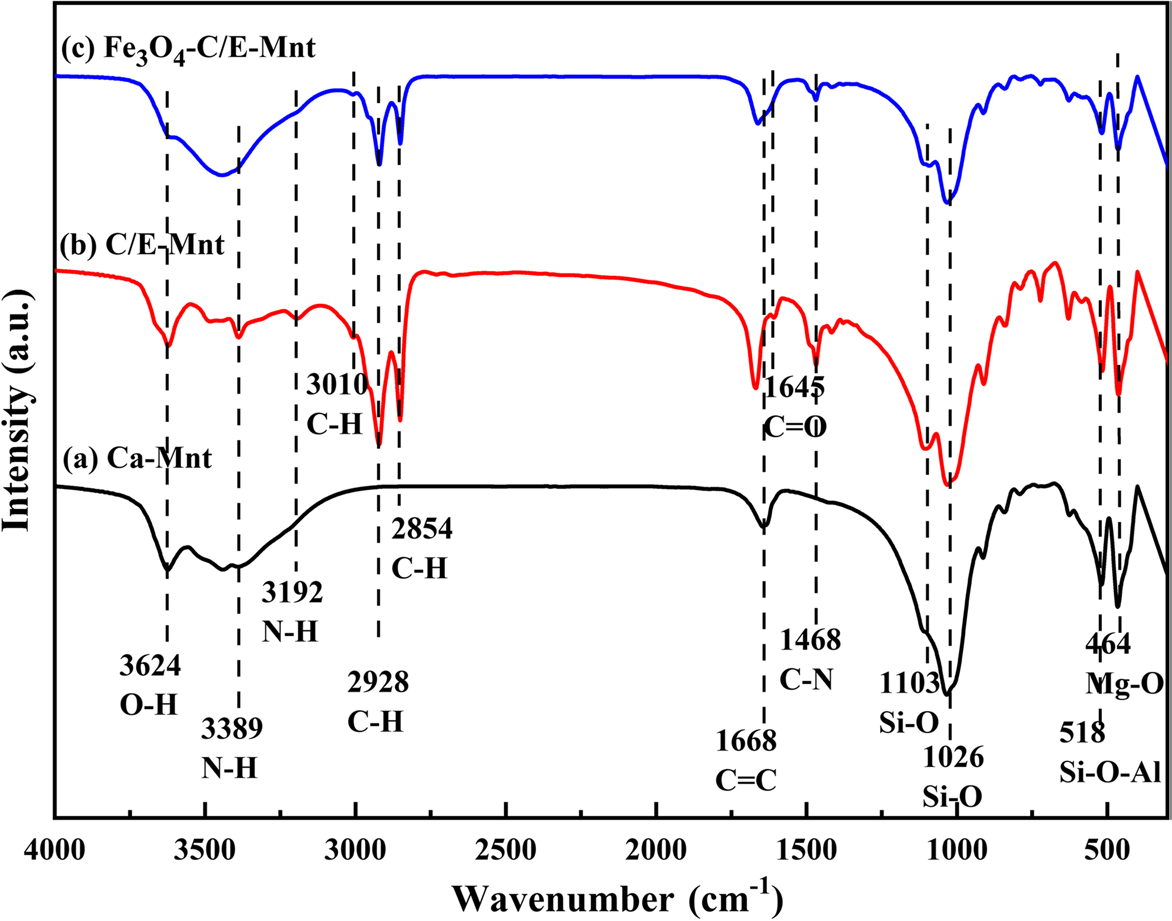
The FTIR spectra of Ca-Mnt, C/E-Mnt, and Fe3O4-C/E-Mnt were examined (Fig. 2). The strongest band at ~ 1026 cm–1 was related to Si–O bands of Ca-Mnt. The bands located at 518 and 464 cm–1 were assigned to the stretching vibrations of Si–O–Al and Mg–O bonds, respectively (Reference Zhou, Cun, Gates, Zhu and WeiZhou et al., 2019). Because the wavelengths of these bands were < 600 cm–1, they were attributed to the absorption bands of octahedral and tetrahedral sites in the Ca-Mnt lattice (Reference Zhou, Cun, Gates, Zhu and WeiZhou et al., 2019). The bands at 2928, 2854, and 1468 cm–1 corresponded to the stretching and bending vibrations of the alkyl chain of CTAB, suggesting the existence of CTAB in Ca-Mnt. The transformational band at 1645 cm–1 corresponded to the amide carbonyl stretch of EA. The band at ~3389 cm–1 was assigned to the stretching vibration of N–H groups, which were adsorbed on Ca-Mnt layers (Reference Feng, Ma, Zhang, Zhang, Xiao, Ma and WangFeng et al., 2019). Furthermore, the band centered at 1026 cm–1 in intercalated organo-Ca-Mnt was split into two bands at 1026 cm–1 (in-plane Si–O stretch) and 1103 cm–1 (out-of-plane Si–O stretch). When CTAB and EA were intercalated in Ca-Mnt, the N+ cations polarized the surface oxygen because it was the closest charge site. The polarization of the out-of-plane Si–O stretch was increased, and as a result, the IR adsorption was stronger. These results confirmed convincingly the successful intercalation of CTAB and EA into the Ca-Mnt. The Si–O bonds in the Fe3O4-C/E-Mnt composite were weaker than those in Ca-Mnt and C/E-Mnt, which implied that the Fe–O bonds might interact with the Si–O bonds in the Fe3O4-C/E-Mnt (Reference Park, Jung, Seo and KwonPark et al., 2009). Therefore, Fe3O4 was probably bound to the surface of Ca-Mnt during the preparation process.
FTIR spectra of Ca-Mnt, C/E-Mnt, and Fe3O4-C/E-Mnt

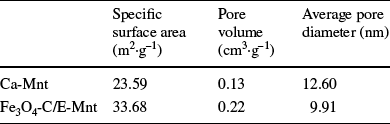
The N2 adsorption–desorption isotherm and pore-diameter distribution of Ca-Mnt and Fe3O4-C/E-Mnt were examined (Fig. 3). Both Ca-Mnt and Fe3O4-C/E-Mnt exhibited type IV isotherms. Such isotherms were linked to capillary condensation in mesopores, indicating the existence of mesopores in both materials (Sing, Reference Sing1985). Moreover, the hysteresis loop observed in the isotherm of Ca-Mnt (Fig. 3a) belonged to type H3, based on its geometry (Reference Tong, Wu, Adebajo, Jin, Yu, Ji and ZhouTong et al., 2018). According to the reports, type H3 hysteresis with adsorption–desorption isotherms overlapped at low pressures is observed commonly in materials that have a layered structure, wedge shape, and random slits (Reference Karaca, Önal, Açışlı and KhataeeKaraca et al., 2021). This means that the measured result was very consistent with the layered structure of Ca-Mnt. The isotherm of Fe3O4-C/E-Mnt was similar to that of Ca-Mnt with a type H3 hysteresis, which means that Fe3O4-C/E-Mnt retained the lamellar structure of Ca-Mnt. The pore characteristics of Fe3O4-C/E-Mnt within the range 3–30 nm were more obvious than those of Ca-Mnt (Fig. 3b), implying a certain amount of mesopores. The mesopores are beneficial to the adsorption of large organic molecules and facilitate intrapore diffusion (Reference Ma, Li, Hou, Lv, Li and ChengMa et al., 2022), which means the Fe3O4-C/E-Mnt tends to have a positive effect on phenol removal. The pore-size distribution of different samples was evaluated by the Barrett-Joyner-Halenda (BJH) method, shown in Table 1. The average pore diameters of Ca-Mnt and Fe3O4-C/E-Mnt were 12.60 and 9.91 nm, suggesting that both materials comprised mainly mesopores. The surface area and pore volume of Ca-Mnt were 23.59 m2·g–1 and 0.13 cm3·g–1, respectively. For Fe3O4-C/E-Mnt, they increased to 33.68 m2·g–1 and 0.22 cm3·g–1, respectively, implying that more active adsorption sites might exist in Fe3O4-C/E-Mnt, which will help to improve the adsorption performance (Reference Liu, Chen, Liu, Liu and DongLiu et al., 2014).
a N2 adsorption–desorption isotherm and b pore-diameter distribution of Ca-Mnt and Fe3O4-C/E-Mnt

BET analysis and pore-size distribution analysis for Ca-Mnt and Fe3O4-C/E-Mnt

Surface morphological features of Ca-Mnt and Fe3O4-C/E-Mnt were confirmed further by SEM. Ca-Mnt (Fig. 4a,c) displayed a large flake structure mixed with some blocks. The flat surface and curl edge of the Ca-Mnt layer were observed. After modification, the flake-like morphology of the raw material was well preserved in Fe3O4-C/E-Mnt, but the curled edge was not apparent (Fig. 4b,c), which could be due to the coverage of surfactants on the surface of Ca-Mnt (Reference Mao, Liu, Yang, Li, Chen and ZhongMao et al., 2014). Moreover, Fe3O4-C/E-Mnt showed more fragments in irregular shapes with smaller sizes than raw Ca-Mnt. Thus, the SEM results were consistent with a deduction from the N2 adsorption–desorption isotherm.
SEM images of a, c Ca-Mnt and b, d Fe3O4-C/E-Mnt

The VSM cure analysis was also performed to investigate the Fe3O4-C/E-Mnt (Fig. 5). The curve obtained crossed the zero point at room temperature, which exhibited the superparamagnetic property of Fe3O4-C/E-Mnt (Reference Maleki and SadatiMaleki & Sadati, 2022). The corresponding saturation magnetization value was 30.60 emu·g–1 which was attributed to the contribution of Fe3O4, confirming its successful decoration.
VSM magnetization curve of Fe3O4-C/E-Mnt

Adsorption of Phenol
Optimization of the Adsorption Conditions
Temperature had an effect on the adsorption of phenol onto Fe3O4-C/E-Mnt (Fig. 6a). The removal efficiency of Fe3O4-C/E-Mnt to phenol was greatest at 25°C. It reached 85.46%. With the increase in temperature from 25 to 65°C, the removal efficiency decreased from 85.46% to 71.82%, which may be due to the weak physical interactions between the adsorbent and the adsorbate at high temperatures (Reference Cottet, Almeida, Naidek, Viante, Lopes and DebacherCottet et al., 2014). Therefore, 25°C was determined to be the ideal temperature and was used for subsequent experiments. pH is an important parameter for the successful removal of phenol so the adsorption of phenol onto Fe3O4-C/E-Mnt over the pH range of 1 to 13 was studied (Fig. 6b). The results indicated that the efficiency of phenol removal was enhanced slightly as the pH increased to 7.0, and then it decreased with a further increase in pH. The possible reason for acid solutions may be ascribed to the presence of H+ ions (pH ˂ 7.0) inhibiting the ionization of phenol.
a Temperature, b pH, c contact time, d phenol dosage, and e adsorbent dosage effects on phenol adsorption of Fe3O4-C/E-Mnt

Under pH neutral conditions, phenol in solution existed mainly in a molecular form and the polarization was relatively small. The organic distribution of phenol between Fe3O4-C/E-Mnt layers reached the maximum with the best adsorption efficiency observed. As the solution pH was further increased (pH > 7.0), the decrease in adsorption capacity was attributed to the increased polarization of the phenol and its dissociation, which could lead to it having an anionic charge (Reference Li, Meng, Hu and DuLi et al., 2009b; Reference Liu, Zheng, Wang, Jiang and LiLiu et al., 2010; Reference Luo, Gao, Yang and YangLuo et al., 2015). Thus, pH = 7.0 was the proper condition for subsequent experiments.
The impact of contact time on the phenol adsorption onto Fe3O4-C/E-Mnt (Fig. 6c) revealed that the removal efficiency of phenol increased quickly in the first 5 min, and then increased gradually with time until a plateau was reached. The rapid uptake of phenol was followed by a slow uptake, which may be attributed to an initial adsorption onto the external surfaces of the sample, followed by a slower diffusion into the interior. With the appearance of the plateau, the adsorption equilibrium was achieved (Reference Luo, Gao, Yang and YangLuo et al., 2015; Reference Wu, Wu, Li, Xing, Zhu and LiWu et al., 2009). In order to achieve full adsorption equilibrium in the adsorption experiment of Fe3O4-C/E-Mnt for phenol, the optimal adsorption time was selected as 120 min in the subsequent batch trials.
To verify the effect of phenol dosage, adsorption experiments were conducted at various phenol concentrations with the addition of the same amount of Fe3O4-C/E-Mnt. The phenol-removal efficiency declined from 85.46 to 78.00% as phenol concentration was increased from 100 to 1000 mg·L–1 (Fig. 6d), ascribed to the lack of the active adsorption sites at high phenol concentrations (Reference Hameed and RahmanHameed & Rahman, 2008). Thus, 100 mg·L–1 of phenol was chosen as the initial dose to ensure a good degree of removal.
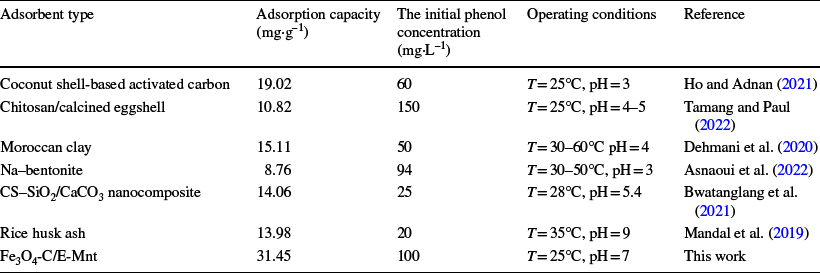
The effect of adsorbent dosage on the removal of phenol was then investigated (Fig. 6e). The results showed that increasing the amount of Fe3O4-C/E-Mnt used could enhance the removal efficiency of phenol but decreased the adsorption ratio of adsorbent per unit amount, which indicated a reduction in the adsorption efficiency. The main reason was that the interactions of the electrostatic adsorption sites or the overlap of the adsorption sites reduced the effective specific surface area of Fe3O4-C/E-Mnt and increased the length of the diffusion path. Taking into account the cost, an Fe3O4-C/E-Mnt dosage of 2.67 g·L–1 was deemed a suitable choice. Optimized experimental conditions for removal of the maximum amount possible of phenol was given for the addition of 2.67 g·L–1 of adsorbent: 100 mg·L–1 phenol at 25°C, and pH = 7.0 with an interaction time of 120 min. Under these conditions, the adsorption capacity of Fe3O4-C/E-Mnt reached 31.45 mg·g–1, and the phenol-removal efficiency reached 85.46%. By comparison, consider that Ho and Adnan (Reference Ho and Adnan2021) evaluated the phenol-removal ability of coconut shell-based activated carbon and reported a maximum adsorption capacity of 19.02 mg·g–1. A chitosan/calcined eggshell adsorbent was used by Tamang and Paul (Reference Tamang and Paul2022) to remove phenol from aqueous solutions with a maximum adsorption capacity of 10.82 mg·g–1. A collection of some of these works is listed in Table 2. Fe3O4-C/E-Mnt is, therefore, a potential adsorbent for phenol from aqueous solutions.
Adsorption capacity of phenol using various adsorbents reported in the literature

Adsorption Kinetics
The adsorption kinetics of phenol were analyzed using the pseudo-first order and pseudo-second order kinetics models in order to acquire a better understanding of the adsorption behavior of Fe3O4-C/E-Mnt. The results for various initial phenol concentrations (100, 150, 200, and 300 mg·L–1) are shown in Fig. 7a,b, and summarized in Table 3. The correlation coefficients, R2, obtained from the pseudo-second order kinetics model were greater (R22 > 0.99) than those (R12 ≤ 0.90) from the pseudo-first order kinetics model for all phenol concentrations, indicating that the pseudo-second order kinetics model was a better fit. Meanwhile, the experimental q e values for all phenol concentrations agreed well with the corresponding theoretical q e values calculated from the pseudo-second order kinetics model. This means that the adsorption of Fe3O4-C/E-Mnt for phenol was attributed to the chemisorption (Reference Park, Sun, Ayoko and FrostPark et al., 2014). Moreover, the q e values grew with the initial phenol concentration, but the pseudo-second order rate constants (k2) declined, which implied that the affinity between phenol and Fe3O4-C/E-Mnt weakened gradually (Reference Karaca, Önal, Açışlı and KhataeeKaraca et al., 2021), and the initial concentration of phenol affects the adsorption rate (Reference Yousef and El-EswedAla’a HYousef et al., 2011).
a The pseudo-first order and b the pseudo-second order kinetics models of phenol adsorption

Kinetics parameters of the pseudo-first order and pseudo-second order models for the adsorption of phenol onto Fe3O4-C/E-Mnt

Adsorption Isotherm
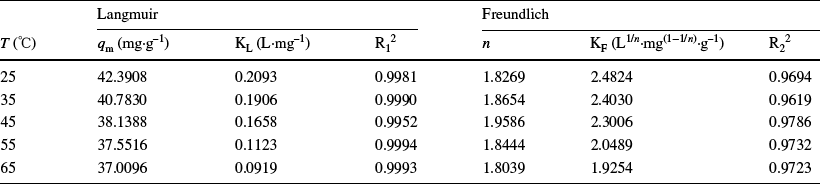
The adsorption isotherm was studied at various temperatures from 25 to 65°C (Fig. 8). The adsorption data were fitted by Langmuir and Freundlich models, respectively. The correlation coefficients, R2, and constants computed from the two models were obtained (Table 4). The results showed that the adsorption of phenol onto Fe3O4-C/E-Mnt could be better fitted by the Langmuir model as its R2 value was greater than that of the Freundlich model, indicating that the adsorption of Fe3O4-C/E-Mnt for phenol is a monolayer adsorption process (Reference Su, Lin, Wang, Xie and ChenSu et al., 2011). Moreover, the q m values decreased from 42.39 to 37.00 mg g–1 while the temperature increased from 25 to 65°C, suggesting that the phenol adsorption onto Fe3O4-C/E-Mnt was favored at lower temperatures, because the increase of temperature may weaken the adsorption force between the active site of the adsorbent and the adsorbed species (Reference Li, Hu, Liu, Zhang, Zhao, Ning and TianLi et al., 2018). Thus, the Fe3O4-C/E-Mnt exhibited good performance for phenol removal at room temperature, which is suitable for practical applications due to the low energy consumption.
Langmuir and Freundlich model isotherms for the adsorption of phenol onto Fe3O4-C/E-Mnt

Langmuir and Freundlich adsorption parameters for phenol onto Fe3O4-C/E-Mnt

Thermodynamics
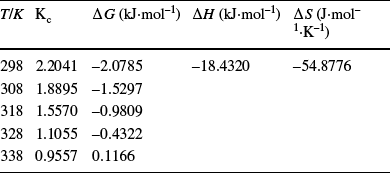
The adsorption thermodynamics of phenol onto Fe3O4-C/E-Mnt was investigated in order to obtain an understanding of the adsorption behavior. The values of thermodynamic state functions obtained from Eqs. 7–9 are given in Table 5. The results showed that the values of ∆H were negative, indicating that the adsorption process was exothermic. This was consistent with the decreased phenol adsorption with increased temperature (Fig. 6a). As expected, a negative ΔG value was obtained, revealing a spontaneous adsorption process. The more negative the ΔG value, the easier the adsorption occurs. Moreover, the ΔS value was also negative, which indicated a process of decreasing entropy, so the order degree of phenol on the solid–liquid surface may have been enhanced.
Thermodynamics parameters of phenol adsorbing onto Fe3O4-C/E-Mnt

Reusability of Fe3O4-C/E-Mnt
The adsorbent reusability was tested using the Fe3O4-C/E-Mnt. For an initial phenol concentration of 100 mg·L–1 and Fe3O4-C/E-Mnt dosage of 2.67 g·L–1, the recyclability results for Fe3O4-C/E-Mnt are shown (Fig. 9). Fe3O4-C/E-Mnt could still remove >78.32% of phenol after five cycles, indicating the excellent adsorption stability of Fe3O4-C/E-Mnt.
Reusability of Fe3O4-C/E-Mnt

Adsorption Mechanism
To investigate the adsorption mechanism, the surface chemical compositions and electronic states of Fe3O4-C/E-Mnt before and after phenol adsorption were examined by XPS analysis. The XPS survey spectrum of Fe3O4-C/E-Mnt and the high-resolution XPS spectra of C 1 s, O 1 s, N 1 s, and Fe 2p are shown in Fig. 10. The sample contained mainly Fe, O, C, N, Si, and Al, which agreed well with the composition of Fe3O4-C/E-Mnt. The C 1 s spectrum was deconvoluted into four peaks located at binding energies (BE) of 284.52, 284.80, 285.42, and 286.64 eV. They were attributed to the presence of different chemical forms of carbon (C–H, C–C, C–N, and C–O) in the sample (Reference Vanzetti, Pasquardini, Potrich, Vaghi, Battista, Causa and PederzolliVanzetti et al., 2016). In the O 1 s region, the peaks located at 530.05 and 531.55 eV were due to the presence of Fe–O and C = O (Reference Xiong, Li and XiaXiong et al., 2016). The peaks at 531.23 eV were caused by the oxygen of OH– adsorbed on the surface (Reference Piumetti, Fino and RussoPiumetti et al., 2015). The positions of the C 1 s and O 1 s peaks did not change significantly before and after phenol adsorption, which means that those atoms were not involved in the adsorption process (Reference Feng, Ma, Zhang, Zhang, Xiao, Ma and WangFeng et al., 2019). On the other hand, peaks for N 1 s and Fe 2p did shift. Before adsorption, the high-resolution N 1 s peak was resolved into three components located at 399.15, 399.75, and 402.44 eV, ascribed to the presence of amino (–NH2), Fe–N, and tetra-alkylammonium head groups (Reference An, Zhang, He, Zhu and LuoAn et al., 2020; Reference Kamiya, Hashimoto and NakanishiKamiya et al., 2012; Reference Kaur and BakshiKaur & Bakshi, 2020). After adsorption, the peaks at 399.15 and 399.75 eV shifted slightly to 399.35 and 400.04 eV, respectively. The changes in BE for N 1 s suggested the possible hydrogen bonding between the nitrogen atom of the amine group of the adsorbent and the hydrogen atom of the hydroxyl group of phenol (Reference Zhou, Huang and ManZhou et al., 2018). In the Fe 2p spectrum, five individual peaks were detected before adsorption. Among them, four peaks at 710.64, 712.46, 723.95, and 725.05 eV corresponded to Fe2+ 2p3/2, Fe3+ 2p3/2, Fe2+ 2p1/2, and Fe3+ 2p1/2, respectively (Reference Li, Cui, Guo, Yang, Cao and XiangLi et al., 2020). The peak located at 715.55 eV was the satellite peak of Fe(III) (Reference Xia, Huang, Yuan, Wang, Wu and JiangXia et al., 2018). The slight shift of the peak from 725.05 to 726.04 eV was observed after adsorption, which suggested the possible isomorphic substitution of a small amount of Fe3+ complexed with phenol (Reference Cheng, Song, Wu, Peng, Yang and LuoCheng et al., 2020; Reference He, Yuan, Huang, Wang, Jiang, Huang, Tan and LiHe et al., 2019). Based on the results above, a possible adsorption mechanism was proposed. In addition to the complexation of Fe3+ with phenol, hydrogen bonding was the main driving force for the adsorption of phenol onto Fe3O4-C/E-Mnt. This may have been attributed to the interactions between the amine groups on Fe3O4-C/E-Mnt and the hydroxyl group of phenol. Similar results were reported in the adsorption of phenol onto acylamino-modified polystyrene resins in which the hydrogen bonding was mainly responsible for the adsorption (Reference Zhou, Huang and ManZhou et al., 2018).
Full survey and high-resolution XPS spectra of C 1 s, O 1 s, N 1 s, and Fe 2p for Fe3O4-C/E-Mnt before and after phenol adsorption

Conclusions
Magnetic Fe3O4-C/E-Mnt was prepared by one-step co-precipitation. The interlayer spacing of Fe3O4-C/E-Mnt increased to 3.78 nm, which was more than twice that of Ca-Mnt, due to the successful intercalation of the surfactants. The N2 adsorption–desorption isotherm of Fe3O4-C/E-Mnt indicated that it retained the lamellar structure of Ca-Mnt with mesopores. The surface area and pore volume increased compared to those of Ca-Mnt, however, implying the formation of more adsorption sites. Under ideal conditions, the adsorption capacity of Fe3O4-C/E-Mnt for phenol could reach 31.45 mg·g–1 with a removal efficiency of 85.46%. The adsorption of Fe3O4-C/E-Mnt for phenol followed the pseudo-second order kinetics model, indicating a chemisorption of Fe3O4-C/E-Mnt for phenol. Its adsorption isotherm was better suited to the Langmuir model than to the Freundlich model, indicating a monolayer adsorption process for Fe3O4-C/E-Mnt removing phenol, with a maximal adsorption of 42.39 mg·g–1 at 25°C. The adsorption process was spontaneous and exothermic with a decrease in entropy. The reusability investigation indicated the excellent adsorption stability of Fe3O4-C/E-Mnt. The hydrogen bonds between the amine groups on Fe3O4-C/E-Mnt and the hydroxyl group of phenol were most likely to be the driving force of the adsorption. So Fe3O4-C/E-Mnt is a promising and stable adsorbent in the application of organic-pollutant removal.
Acknowledgements
This work was supported financially by the National Program on Key Basic Research Project of China (No. 2019YFC0408604-4), Shanxi Key Research and Development Program (Social Development, 201903D321053), the Natural Science Foundation of Shanxi Province (No. 201901D111110), Shanxi Scholarship Council of China (No. HGKY2019017), and Shanxi Provincial Foundation for Leaders of Disciplines in Science, China.
Funding
Funding sources are as stated in the Acknowledgments.
Declarations
Competing of Interests
The authors declare that they have no known competing financial interests or personal relationships that could have appeared to influence the work reported in this paper.