Over the past 20 years, Clostridioides difficile infection (CDI) has emerged as a major public health burden. Classified by the Centers for Disease Control and Prevention (CDC) as an “urgent threat,” it is the most common nosocomial infection, resulting in high morbidity and mortality. Reference Leffler and Lamont1,Reference Lofgren, Cole and Weber2 The annual associated costs in the United States are >$5 billion. Reference Lessa, Mu and Bamberg3
Because the most well-known cause of CDI is antibiotic treatment, and pneumonia is the most common reason for antimicrobials in the hospital, Reference Pfuntner, Wier and Stocks4 there is an obvious nexus between these 2 infections. Surprisingly, few studies have explored this association, and even fewer have addressed whether some recommended drug classes are more likely to cause CDI than others. The prevalence of secondary CDI in patients with pneumonia has been estimated at 1%, and CDI increases mortality, but comparisons of antimicrobial regimens are rare. Reference Becerra, Becerra and Banta5–Reference Slimings and Riley7
Prescribing guidelines for community-acquired pneumonia (CAP) recommend either a β-lactam plus macrolide or fluoroquinolone monotherapy. Notably, only a single randomized trial has compared these 2 regimens with respect to CDI risk. Reference Gopal Rao, Mahankali Rao and Starke8 In that study, treatment with a β-lactam put patients at significantly higher risk of CDI than treatment with levofloxacin. Unfortunately, subsequent literature has tied the overuse of fluoroquinolones to rapid proliferation of a new C. difficile strain linked to colectomy and death worldwide. Reference Gaynes, Rimland and Killum9–Reference Pepin, Saheb and Coulombe11 Lending credence to this association are published stewardship efforts that have curbed the spread of CDI by reducing fluoroquinolone use. Reference Chalmers, Al-Khairalla and Short12
The question of whether one recommended CAP treatment puts patients at greater risk for developing CDI than another remains open. Given the overall annual volumes of both CAP and CDI in the United States, even a small difference in incident CDI between cephalosporin plus macrolide and fluoroquinolone-based regimens could result in a meaningful reduction in attendant morbidity and costs. Therefore, we analyzed a large multicenter cohort to determine whether these 2 treatments differ in their association with CDI.
Patients and methods
Data source
The Premier Healthcare database is a large, US hospital-based, service-level, all-payer database containing information on inpatient discharges from a diverse sample of hospitals. Participating hospitals submit administrative, healthcare utilization, and financial data. The database captures standard hospital discharge billing files and contains patient demographics, International Classification of Disease, Ninth Revision (ICD-9) discharge diagnoses and discharge status. It also contains date-stamped records of charges for medications, laboratory tests, and diagnostic and therapeutic services. Microbiology results are available for a subset of hospitals that subscribe to an infection control and prevention software system. Larger urban facilities and hospitals in the Southern US Census region are overrepresented; otherwise, the data are representative of most hospitals in the United States. 13 Because all Premier data are deidentified, this study was categorized as exempt by the Cleveland Clinic Institutional Review Board.
Study population
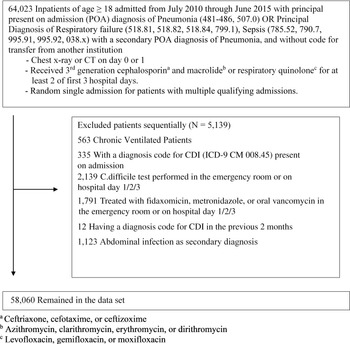
We identified hospital discharges between July 2010 and June 2015 of patients who were aged >18 years with a principal diagnosis of pneumonia (ICD-9 Clinical Modification [CM] codes 481, 482.0–482.9, 483.0, 483.8, 484.0–484.8, 485, 486, and 507.0) or a principal diagnosis of sepsis or respiratory failure with a secondary diagnosis of pneumonia, who had a chest radiograph or computed tomography scan, and who received antibiotics beginning in the emergency department or on hospital day 1. We limited the study to those treated for at least 2 of the first 3 hospital days with a respiratory quinolone (levofloxacin, gemifloxacin, or moxifloxacin) or with a third-generation cephalosporin (ceftriaxone, cefotaxime, or ceftizoxime) plus a macrolide (azithromycin, clarithromycin, erythromycin, or dirithromycin). We included only 1 randomly selected hospitalization for patients with multiple admissions. We excluded patients with chronic mechanical ventilation or diagnosis of any abdominal infection that was present on admission. We also excluded those who received empiric therapy with other antibiotics for >1 of the first 3 days of hospitalization, to ensure that subsequent hospital-acquired CDI could be reliably associated with the initial empiric regimen. Hospital-onset CDI (HO-CDI) was defined as CDI detected by a stool assay performed ≥72 hours after admission to the facility. Reference McDonald, Gerding and Johnson14 Because we were interested only in HO-CDI, we excluded any patients diagnosed with CDI within 2 months prior to the index admission or present on admission, as well as patients tested for CDI or given medications used for treatment of CDI (oral vancomycin, fidaxomicin or metronidazole) on hospital days 0–3 (Fig. 1). To identify patients who could have developed CDI after discharge from the hospital, we examined CDI codes present on admission if patients were readmitted within 2 months after the index admission. Reference Dubberke, McMullen and Mayfield15
Inclusion/exclusion flow chart.

Outcomes
Our primary outcome was development of HO-CDI on hospital day 4 or later. Because ICD-9 codes for CDI may not be reliable, Reference Redondo-Gonzalez16 we defined CDI as either (1) a diagnosis code (ICD-9 CM 008.45) that was not present on admission, together with a positive stool EIA, PCR or culture performed on day 4 or later, Reference Dubberke, Butler and Yokoe17 or (2) the presence of positive test or a diagnosis code present on admission in a subsequent hospitalization within 2 months of discharge. Reference Dubberke, McMullen and Mayfield15 In a sensitivity analysis, we also considered 2 alternative, more liberal definitions: (1) either a diagnosis code, a positive test, or readmission with CDI and (2) the presence of a diagnosis code alone. Lastly, we measured the testing rate for CDI following each regimen.
Baseline variables
To reduce the possibility of confounding, we collected variables that could be associated with the choice of antibiotic regimen, as well as CDI. These included demographics (age, sex, race, insurance status, and marital status); comorbid conditions (eg, diabetes, malignancy, and immunocompromised states that increase risk for hospital-acquired conditions); Reference Haessler, Lindenauer and Zilberberg18 and risk factors for colonization, including admission from a skilled nursing facility, requirement for dialysis and prior hospitalizations within the last 3 months. Reference Eze, Balsells and Kyaw19 We assessed illness severity on admission through proxy variables including admission to ICU and need for vasopressors or mechanical ventilation. We also collected medications associated with CDI, such as proton-pump inhibitors. Reference Kwok, Arthur and Anibueze20 Hospital characteristics such as US Census region, rurality, size (≤200, 201–400, and >400 beds), and teaching status were included.
Statistical analysis
We compared baseline characteristics of patients treated with a fluoroquinolone in the first 3 hospital days with those of patients treated with a cephalosporin plus macrolide, using frequencies and proportions for categorical variables and quartiles for continuous variables. Propensity scores for fluoroquinolone versus cephalosporin plus macrolide were estimated from the baseline factors in the preceding section using a mixed multiple logistic regression model with random hospital effects. Inverse propensity-weighted mixed logistic regression, with random hospital effects to account for statistical dependence induced by clustering of patients within hospitals, was used to estimate the average effect on CDI of initial fluoroquinolone versus cephalosporin plus macrolide treatment among fluoroquinolone-treated patients (ie, the average treatment effect among the treated, ATT). This approach was used for the primary definition of CDI and, as sensitivity analyses, for both alternative operational definitions. Because the definition based on CDI diagnosis code only does not require laboratory data, analysis with that definition was conducted using patients meeting our inclusion and exclusion criteria in all Premier hospitals, without restricting to hospitals reporting microbiological data. Prior to fitting these propensity-weighted models, we checked covariate balance after ATT-weighting by assessing the absolute standardized differences between patients treated with fluoroquinolones and those treated with cephalosporin plus macrolide, and accepted balance as sufficient when this statistic was below 10%. Supplementary Figure 1 shows the factors included in the model and the absolute standardized differences before and after ATT weighting. All analyses were performed using SAS version 9.4 software (SAS Institute, Cary, NC).
Results
After applying the exclusion criteria, our sample consisted of 58,060 patients of 638 hospitals, including 36,796 (63.4%) treated with a cephalosporin plus a macrolide, and 21,264 (36.6%) treated with fluoroquinolone monotherapy for the first 3 hospital days (Fig. 1).
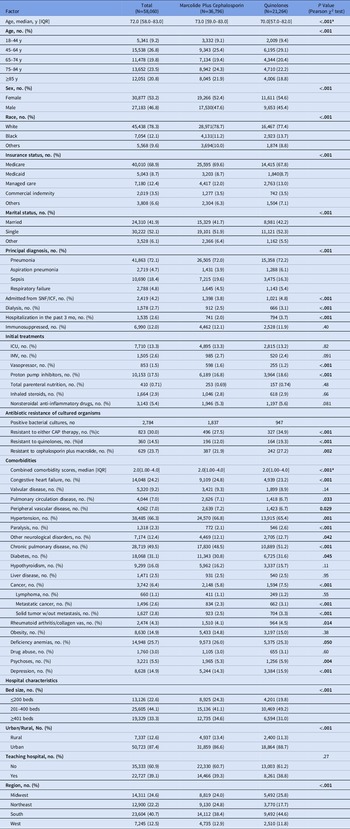
Patient characteristics appear in Table 1. The median age was 72 years; 53.2% were female; and 78.3% were white. Most patients had a principal diagnosis of pneumonia (41,863, 72%). On admission, 7,710 patients (13.3%) required ICU-level care, 1,505 patients (2.6%) received mechanical ventilation, and 583 patients (1.5%) received vasopressor support.
Baseline Characteristics of Patients Admitted With Pneumonia to 177 Hospitals Contributing to the Premier Healthcare Database, July 2010–June 2015, and Treated Empirically With Either Macrolide Plus Cephalosporin or Quinolone, and of Their Admitting Hospitals

Note. ICU, intensive care unit; IMV, intermittent mandatory ventilation.
a Wilcoxon test.
b See subsequent footnotes for sample sizes for each cell below.
c Resistant to quinolones and/or both cephalosporin and macrolides. Sample sizes: 2,740 overall, 1,804 for macrolide plus cephalosporin, 936 for quinolones.
d Sample sizes 2,484overall, 1,635 for macrolide plus cephalosporin, 849 for quinolones.
e Resistant to both cephalosporin and macrolides. Sample sizes: 2,655 overall, 1,766 for macrolide plus cephalosporin, 889 for quinolones.
Patients treated with cephalosporin plus macrolide were, on average, older and slightly more often male than those treated with fluoroquinolones. They were also less likely to be admitted from a SNF (3.8% vs 4.8%; P < .001), to be on hemodialysis (2.5% vs 3.1%; P < .001), or to have been hospitalized in the 3 months prior to the index admission (2.0% vs 3.7%; P < .001). The groups were similar with respect to race, insurance payor, and marital status, and they had similar acute illness severity. Among those treated with cephalosporin plus macrolide a diagnosis of sepsis was more common and aspiration pneumonia was less common than among those treated with a fluoroquinolone. After inverse probability of treatment weighting (IPTW) using ATT weights, all standardized differences of characteristics used in the propensity model were <3%.
In the 177 hospitals reporting microbiological data, using the most conservative definition, 192 (0.33%) patients developed HO-CDI, including 127 (0.35%) patients who received a cephalosporin plus a macrolide and 65 (0.31%) patients who received a fluoroquinolone (Table 2). After propensity weighting, the odds ratio of HO-CDI for a quinolone versus a cephalosporin plus a macrolide was 0.98 (95% confidence interval [CI], 0.70–1.38). Using the alternative definition of diagnosis code alone, HO-CDI occurred in 0.27% of those taking cephalosporin versus 0.21% of those on quinolones. With the broadest definition, either diagnosis code or positive test in current admission or in the following 2 months, rates of HO-CDI were 0.47% and 0.41%, respectively. However, differences in the propensity-weighted comparisons using the alternative operational outcome definitions were negligible, nor was there a substantive change when using diagnosis code alone in the much larger group of 638 Premier hospitals (Table 3). Patients treated with cephalosporin plus macrolide were more likely to be tested than those treated with fluoroquinolones (4.0% vs 2.8%; P < .001), but the proportions of tests that were positive were similar in both groups (7.2% vs 8.0%; P = .53).
Clostridioides difficile Testing, Results, and Classification by Alternative Diagnostic Criteria, of Patients Admitted With Pneumonia to Hospitals Contributing to the Premier Healthcare Database, July 2010–June 2015, and Treated Empirically With Either Macrolide Plus Cephalosporin or Quinolone

Note. ICD-9, International Classification of Disease, Ninth Revision.
a Pearson χ2 test.
b Each of the definitions includes readmission for C. difficile within 2 mo.
Adjusted Effects of Initial Empiric Treatment With Quinolones, Relative to Treatment With Cephalosporin Plus Macrolide, on Diagnoses of C. difficile Infection Among Those Treated With Quinolones by Alternative Diagnostic Criteria, From Inverse Probability of Treatment Weighted (IPTW) Multiple Logistic Regression Models

Note. CI, confidence interval; POA, present on admission; ICD-9, International Classification of Disease, Ninth Revision.
a Each of the definitions includes readmission for C. difficile within 2 mo.
Discussion
In this large retrospective cohort study, among patients hospitalized with CAP and treated with 1 of the 2 guideline-recommended therapies, the overall incidence of HO-CDI was 0.33%. Although treatment with a cephalosporin plus a macrolide was nearly twice as common as that with a fluoroquinolone, there was no difference between the 2 regimens with respect to development of CDI either in the hospital or within 2 months after discharge. Although varying levels of definitional sensitivity and specificity resulted in a range of estimates for CDI incidence between 0.21% and 0.47%, the relationship between the rates in the cephalosporin-plus-macrolide and fluoroquinolone groups remained stable regardless of definition. Interestingly, CDI testing was performed more frequently in the group exposed to cephalosporin plus macrolide than to a fluoroquinolone, though rates of positivity were similar in both.
In the past 20 years, several C. difficile strains responsible for high morbidity and mortality have emerged. One strain in particular, the hypervirulent BI/NAP1/027, was first detected in 2000–2001 at the University of Pittsburgh, following a spike in CDI-related colectomies and deaths. Reference Muto, Pokrywka and Shutt10 Because this event occurred on the heels of a decade of rising CDI and fluoroquinolone overuse, leading to the emergence of resistance among C. difficile isolates, one hospital adopted a comprehensive bundle approach to reducing CDI: education, infection control audits, and restrictions on prescribing fluoroquinolones, clindamycin and cephalosporins. Reference Muto, Blank and Marsh21 Following implementation of these restrictions, the incidence of CDI decreased from 7.2 per 1,000 discharges in 2000 to 3 per 1,000 by 2006. Similarly, a study from the United Kingdom, a nation afflicted with particularly high rates of BI/NAP1/027 strain infections, confirmed that stewardship practices that included fluoroquinolone restrictions result in a dramatic reduction in CDI. Reference Dingle, Didelot and Quan22 These circumstantial findings, along with the long-standing comfort with cephalosporins despite their strong association with CDI, pushed clinicians to reduce fluoroquinolone use in order to control the escalating CDI epidemic. Reference Kabbani, Hersh and Shapiro23 Our finding of ∼2:1 predominance of cephalosporin-based treatment over fluoroquinolones reflects this trend.
Little evidence supports this approach. The only randomized trial of these antibiotic regimens that compared CDI outcomes was conducted in the United Kindgom >20 years ago, just before the BI/NAP1/027 strain of C. difficile outbreaks began to plague healthcare institutions. In this trial, conducted from 1999 to 2001, Rao et al Reference Gopal Rao, Mahankali Rao and Starke8 randomized 938 patients to receive either levofloxacin or a β-lactam (specifically amoxicillin or cefuroxime) for treatment of their CAP. CDI occurred in 2.2% of those who received levofloxacin versus 5.6% of those who received a β-lactam (P < .01).
Since then, multiple meta-analyses of observational studies have confirmed the directionality, albeit with far smaller magnitude of differences. For example, one meta-analysis reported third-generation cephalosporins (odds ratio [OR], 1.97; 95% CI, 1.21–3.23) to be slightly riskier than quinolones (OR, 1.66; 95% CI, 1.17–2.35). Reference Slimings and Riley7 More recently, an analysis by Teng et al. Reference Teng, Reveles and Obodozie-Ofoegbu24 of the Food and Drug Administration’s Adverse Events Report System revealed fluoroquinolones (OR, 4.94; 95% CI, 4.20–5.81) to have a far weaker association with CDI than cephalosporins (OR, 15.33; 95% CI, 12.60–18.65). Reference Teng, Reveles and Obodozie-Ofoegbu24 Though fraught with potential reporting bias, this study did not support the hypothesis that fluoroquinolones are more harmful than cephalosporins. Our study comports with most previous studies, suggesting that CDI risk with fluoroquinolones is not higher than with cephalosporins. This may be good news, given that in our cohort resistance of the pneumonia pathogens to cephalosporins exceeded that to fluoroquinolones by ∼50%.
Some may be surprised that our observed rate of CDI was so low, especially compared to studies from the United Kingdom. However, our rates are consistent with previous US-based reports for patients with pneumonia. Using the National Inpatient Sample 2009–2011, Becerra et al Reference Becerra, Becerra and Banta5 reported the prevalence of CDI as a secondary diagnosis to be 1.1%. In contrast to our study, they were unable to differentiate HO-CDI from CDI that was present on admission. Including the 335 patients we excluded for CDI present on admission brought the prevalence in the current analysis to 0.9%. In a single-center study from 2010 to 2014 by Brown et al, Reference Brown, Khanafer and Daneman6 the incidence density of CDI was 5.95 per 10,000 patient days, similar to our finding of 3.65 per 10,000 patient days. The small difference is likely due to how the 2 studies defined cases; Brown’s definition was more sensitive and less specific than ours.
Several other possible explanations for our low CDI incidence should be considered. First, we included only patients who received guideline-specific therapy for CAP. CDI is more common among patients with severe disease, who are likely to receive broader-spectrum antibiotics and have longer lengths of stay, both of which increase the risk of CDI. Reference Chalmers, Akram and Singanayagam25 Second, our definition for HO-CDI included the CDC time frame of 3 or more days. 26 Studies that relied on the 2-day window recommended by the IDSA and Society for Healthcare Epidemiology of America (SHEA) would have found higher rates. Reference McLure, Clements and Kirk27 We chose 3 days to maximize the specificity of our definition. Lastly, testing and reporting requirements established in 2013 by the Centers for Medicare and Medicaid services (CMS) as part of value-based purchasing may have discouraged some hospitals from testing for C. difficile, thereby decreasing diagnosis rates. 28
Our study had a number of strengths. Our large, nationally representative data set is well suited to address questions about narrow populations, such as patients with CAP who receive specific therapies and develop a rare outcome. With almost 60,000 patients, we had sufficient power to exclude clinically meaningful differences in CDI risk between the 2 regimens. The date-stamped billing charges allowed us to carefully adjust for both diagnoses and treatments associated with the development of CDI. Whereas most studies have relied solely on diagnostic codes, the presence of microbiology test data allowed us to confirm the diagnosis. Several sensitivity analyses varying the stringency of the definition did not alter the substantive results.
This study had several limitations. We may have underestimated the actual incident CDI cases because data on outpatient diagnoses after discharge were not available unless a patient was readmitted to the same hospital. Similarly, we may have overestimated cases if some patients had a positive test but did not have diarrhea or had diarrhea on admission and the test was not sent until day 4. Such misclassification is unlikely to be related to the antibiotic regimen, and it should not affect our main finding. Second, we could not assess antibiotics given prior to admission, which may have contributed to the development of CDI. Also, our comparison of outcomes based only on the choice of CAP antibiotic regimen in the first 3 days did not capture length of treatment, changes of antibiotics in response to culture results, or use of antibiotics given later for other infections. We accepted this limitation because it allowed us to compare the antibiotics directly. Because patients who stay in the hospital longer are both more likely to get CDI and to receive more antibiotics, the relationship between antibiotic duration and CDI is likely confounded. In principle, marginal structural or structural nested modeling could address such evolution in treatments during hospitalization, but these strategies seem to be precluded by the complexity of possible treatment adjustments as the hospitalization proceeds, the stringency of model assumptions required, and potentially by specification and computational issues. Moreover, they can also fail to adequately control confounding. Reference Cole and Hernan29–Reference Williamson and Ravani33 Because we based the diagnosis of CDI on hospital discharge codes and tests, our primary outcome could not capture CDI patients who were treated presumptively without testing. Only a prospective study that tests all patients could confirm such cases. However, our results did not materially change when we looked at diagnosis alone in a much larger data set. Finally, we did not examine the risks of other potential quinolone-related adverse events, such as tendon rupture and delirium in the elderly, Reference Chowdhry, Padhi and Mohanty34 which may alter the risk-benefit trade-offs at the bedside. However, such risks should be balanced against quinolones’ advantages, such as equivalent oral and IV bioavailability, allowing for earlier transition to per-oral treatment. Reference Postma, van Werkhoven and van Elden35
In summary, in this large multicenter cohort of patients with CAP, we found that the risk of developing CDI is low irrespective of empiric treatment with a fluoroquinolone or a cephalosporin plus a macrolide. The fact that cephalosporin resistance was 50% more prevalent than quinolone resistance is likely related to cephalosporins’ more frequent use in this population. Despite a plethora of data to the contrary, because the early years of BI/NAP1/027 CDI focused so narrowly on fluoroquinolones as a risk, clinicians may continue to be reluctant to use them, even for an appropriate indication. We found no evidence that risk for CDI development should suggest one treatment strategy over the other.
Supplementary material
To view supplementary material for this article, please visit https://doi.org/10.1017/ice.2022.60
Acknowledgments
Conflicts of interest
No authors have existing or potential conflict(s) of interest to declare relevant to this study. A.D., P.Y., P.I., P.L., M.Z., S.H., and M.R. were supported by funds provided by the supporting grant. A.D. received research funding (to institution) from The Clorox Company and received consultant fees from Merck. M.Z. received research support from Tetraphase Pharmaceuticals, Astellas, Lungpacer, Merck, Spero, The Medicines Co., and Melinta; she has also received consulting fees from Paratek, Arasanis, Shionogi, Pfizer, Nabriva, and Melinta.
Financial support
A.D., P-C.Y., P.B.I., P.L., M.Z., S.H., and M.R. were partially supported by a grant from the Agency for Healthcare and Research and Quality (grant no. R01HS024277). The funder had no role in the design, conduct, analysis or reporting. A.D. has also received research funding (to institution) from The Clorox Company and received consultant fees from Merck. M.Z. received research support from Tetraphase Pharmaceuticals, Astellas, Lungpacer, Merck, Spero, The Medicines Co., and Melinta; she has also received consulting fees from Paratek, Arasanis, Shionogi, Pfizer, Nabriva, and Melinta.