It is well established that alcohol use disorders are highly comorbid with internalizing disorders (depression and anxiety disorders) in adults. This has been shown both in population-level studies (Hasin, Stinson, Ogburn, & Grant, Reference Hasin, Stinson, Ogburn and Grant2007; Kessler et al., Reference Kessler, Crum, Warner, Nelson, Schulenberg and Anthony1997) and in clinical samples (Kushner et al., Reference Kushner, Abrams, Thuras, Hanson, Brekke and Sletten2005; Schneider et al., Reference Schneider, Altmann, Baumann, Bernzen, Bertz, Bimber and Wittfoot2001). Multiple etiologic models exist that speak to this association, including the self-medication model (Khantzian, Reference Khantzian1997) and the stress-response dampening model (Sher, Reference Sher, Blane and Leonard1987). These models have been studied extensively in adults (e.g., Carrigan & Randall, Reference Carrigan and Randall2003; Levenson, Sher, Grosman, Newman, & Newlin, Reference Levenson, Sher, Grossman, Newman and Newlin1980; Swendsen et al., Reference Swendsen, Tennen, Carney, Affleck, Willard and Hromi2000) and to a lesser extent in adolescents (e.g., Colder, Reference Colder2001), but few studies have attempted to understand how these co-occurring problems evolve over the course of human development and over the course of various stages of involvement with alcohol.
Broadly speaking, there are three possible ways in which this comorbidity might develop. The first possibility is that internalizing problems lead to the onset of alcohol problems. Second, alcohol problems may lead to the onset of internalizing problems. In contrast to these competing causal models, the other possibility is that a third variable causes both alcohol problems and internalizing problems (see Kushner, Abrams, & Borchardt, Reference Kushner, Abrams and Borchardt2000, for a discussion of these three models of comorbidity). Although there is some evidence to support each of these models, this study focuses on the first. Because internalizing problems onset for many individuals before the onset of alcohol use (e.g., Schneier et al., Reference Schneier, Roose, Hasin, Heimberg, Liu, Grant and Blanco2010), it is important to understand how early internalizing symptoms impact the course of alcohol use and the progression to alcohol use disorders. Much of the research on this pathway from internalizing to alcohol use disorders has used the standard prospective methodology of predicting rates of alcohol use and problems or incidence of alcohol use disorders from childhood and adolescent internalizing symptoms. These investigations have returned mixed results.
With respect to positive findings, prior research has demonstrated that internalizing problems in childhood and early adolescence prospectively predict any alcohol use (Costello, Erkanli, Federman, & Dalton, Reference Costello, Erkanli, Federman and Angold1999; Henry et al., Reference Henry, Feehan, McGee, Stanton, Moffitt and Silva1993), regular and hazardous use of alcohol (Sihvola et al., Reference Sihvola, Rose, Dick, Pulkkinen, Marttunen and Kaprio2008; Zimmerman et al., Reference Zimmermann, Wittchen, Hofler, Pfister, Kessler and Lieb2003), and the prospective development of an alcohol use disorder (Buckner et al., Reference Buckner, Schmidt, Lang, Small, Schlauch and Lewinsohn2008; Guo, Hawkins, Hill, & Abbott, Reference Guo, Hawkins, Hill and Abbott2001; Sartor, Lynskey, Heath, Jacob, & True, Reference Sartor, Lynskey, Heath, Jacob and True2007). However, some studies have found that internalizing problems in childhood and adolescence do not predict drinking outcomes (Englund, Egelund, Oliva, & Collins, Reference Englund, Egeland, Oliva and Collins2008; Steele, Forehand, Armistead, & Brody, Reference Steele, Forehand, Armistead and Brody1995), while other studies have found mixed results (Kaplow, Curran, Angold, & Costello, Reference Kaplow, Curran, Angold and Costello2001; King, Iacono, & McGue, Reference King, Iacono and McGue2004; Maggs, Patrick, & Feinstein, Reference Maggs, Patrick and Feinstein2008; Pitkänen, Kokko, Lyyra, & Pulkkinen, Reference Pitkänen, Kokko, Lyyra and Pulkkinen2008). For example, King et al. (Reference King, Iacono and McGue2004) found that neither separation anxiety nor overanxious disorder at age 11 predicted subsequent alcohol use or regular alcohol use, but depression at age 11 predicted both outcomes. Given these conflicting findings, it is clear that internalizing problems cannot simply be classified as a prospective risk factor for alcohol use and alcohol use disorders. More careful consideration of the relationship between these two variables over the course of development is needed.
In a 2011 review of the literature, Hussong, Jones, Stein, Baucom, and Boeding articulated a novel conceptual approach to the comorbidity question that is grounded in developmental psychology. They argue that a developmentally focused approach could help make sense of some of the conflicting findings in the literature while also laying the groundwork for new, more nuanced investigations into the “internalizing pathway” to alcohol use disorders. A key component of their argument is that the development of alcohol use disorders is a multistaged, dynamic process that differs across individuals. Consequently, alcohol use disorders cannot be considered a unitary categorical outcome of interest. This idea is certainly not without precedent, as many researchers have proposed different typologies of alcohol use disorders, such as Cloninger's (Reference Cloninger1987) Type I and Type II alcoholics, with the Type I categorization corresponding most closely to the internalizing pathway to alcoholism (Type I alcoholics being characterized by an anxious personality, loss of control over drinking once it has been initiated, guilt over drinking, and later onset of drinking). Conrod, Pihl, Stewart, and Dongier's (Reference Conrod, Pihl, Stewart and Dongier2000) model of personality-based vulnerability to substance use disorder is another example of a model containing concepts relevant to the internalizing pathway to alcohol use disorder (i.e., anxiety sensitivity and depression proneness as potential pathways to alcohol problems). Although models articulating various typologies of alcohol dependence can be helpful, they tend to be focused on characterization of the fully developed dependence syndrome in adults, rather than focusing on articulating how various risk factors might differentially impact the development of alcohol dependence over time.
Fortunately, researchers have recently begun to identify subtypes of problematic alcohol use that are characterized by differing levels of involvement with alcohol over the course of development, and internalizing symptoms seem to differentiate among some of these developmental subtypes. For example, Meier et al. (Reference Meier, Caspi, Houts, Slutske, Harrington, Jackson and Moffitt2013) found that high adolescent negative affectivity as well as family history of anxiety disorder was associated with early-onset, persistent alcohol dependence (vs. developmentally limited dependence that remits in adulthood). Chassin, Pitts, and Prost (Reference Chassin, Pitts and Prost2002) found that adolescent depression increased the odds of adolescents following an early-onset binge drinking trajectory (compared to a nonbinge drinking trajectory), but only among females. Such evidence suggests that comorbid internalizing problems may influence the course and trajectory of alcohol use disorders, but the precise nature of the relationship remains unclear.
A developmentally focused approach to the comorbidity question has the potential to elucidate the relationship between internalizing problems and alcohol use disorders, but testing nuanced hypotheses concerning multiple stages of alcohol involvement is a challenge. One approach that has yielded interesting results in preliminary studies involves examining the influence of internalizing psychopathology on the speed of transition between various alcohol use milestones (e.g., initiation of use, initiation of binge drinking, and onset of alcohol use disorders). If internalizing problems have a dynamic impact on the course of alcohol use and the eventual development of alcohol use disorders, internalizing problems should be associated with acceleration (or slowing) of transitions between specific stages of involvement with alcohol. Data with this degree of temporal resolution would allow for the construction of a more detailed picture of how internalizing problems influence the development of alcohol use disorders.
Three recent studies illustrate the potential of this method. In a 2007 study, Sartor et al. found that the presence of childhood or adolescent generalized anxiety disorder (assessed retrospectively in adulthood) predicted a faster transition from first drink to the onset of alcohol dependence. In other words, those with childhood or adolescent generalized anxiety disorder reported less time between taking their first drink and developing alcohol dependence. These results, while limited due to their retrospective nature, illustrate the potential utility of studying the impact of internalizing problems on alcohol use disorders in a developmental context. In another example of this kind of retrospective analysis, Kushner, Maurer, Menary, and Thuras (Reference Kushner, Maurer, Menary and Thuras2011) examined speed of transition between various alcohol use milestones in an inpatient sample of alcohol-dependent adults. They found that the presence of a current anxiety disorder (in adulthood) was associated with a faster transition from both onset of regular drinking and onset of regular intoxication to the onset of alcohol dependence. However, current anxiety disorder did not predict a faster transition from first drink to the onset of dependence. These findings suggest that later stages of alcohol involvement may be the critical stages at which internalizing problems exert their influence (in this case, after the onset of regular or heavy drinking). Finally, Marmorstein, White, Loeber, and Stouthamer-Loeber (Reference Marmorstein, White, Loeber and Stouthamer-Loeber2010) utilized a large, prospective data set (the Pittsburgh Youth Study) to investigate whether early internalizing problems (in this case, symptoms of generalized anxiety disorder and social anxiety disorder) predicted an earlier age of onset of alcohol use as well as a faster transition from first use to the onset of first alcohol abuse or alcohol dependence symptom. The authors found that both social anxiety and generalized anxiety predicted an earlier age of first use of alcohol, but did not predict a faster transition from first use to first abuse or dependence symptom. Although this study is methodologically superior due to its prospective nature, it is also limited in that the sample only consisted of males, and the outcome of first abuse or dependence symptom does not necessarily represent significant alcohol-related problems, as a participant only had to endorse a single symptom, not the full abuse or dependence syndrome. In addition, the assessment window ended on average at age 18, meaning that some participants who would go on to develop problems were not captured.
Given that the endpoint in Marmorstein et al. (Reference Marmorstein, White, Loeber and Stouthamer-Loeber2010) was not particularly severe, these null results may correspond with those of Kushner et al. (Reference Kushner, Maurer, Menary and Thuras2011), which suggest that speed of transition through earlier stages of alcohol involvement may not be affected by internalizing problems (or may even be slowed down), but that transitions through more severe stages of alcohol use are sped up among those with internalizing problems. Such a pattern would suggest that internalizing symptoms could even be protective against alcohol use during early stages of alcohol involvement, but once a certain level of exposure (e.g., regular or heavy drinking) has been reached, alcohol may become more negatively reinforcing. This idea is illustrated in a conceptual example from Hussong et al. (Reference Hussong, Jones, Stein, Baucom and Boeding2011). The authors point out that separation anxiety has been shown to delay the onset of alcohol use (Kaplow et al., Reference Kaplow, Curran, Angold and Costello2001), which upon first impression would seem to be protective against the development of alcohol use disorders. However, this delay in onset of use could theoretically be due to social withdrawal, and the negative affect associated with social withdrawal could act as a risk factor for alcohol use disorders, especially if solitary drinking is initiated. A similar case could be made for social anxiety, which might initially be protective due to less likelihood of associating with deviant peers, but may become a risk factor for alcohol problems later in development when alcohol is available in social situations. Again, these are conceptual rather than empirical examples, but they illustrate some ways in which internalizing symptoms could have varying effects on alcohol use behaviors at different points in development and at different stages of involvement with alcohol. Given the potential for internalizing to differentially affect speed of transition through various stages of alcohol use, a data analytic approach that offers high temporal resolution is needed to test these stage-specific hypotheses.
With that goal in mind, the current study aimed to provide a comprehensive investigation of the influence of early internalizing problems on the speed of transitions between various stages of alcohol involvement in a sample of males and females. This study utilized data from a large longitudinal study of children of parents with alcohol use disorders and demographically matched children of parents without alcohol use disorders. Effects of childhood/adolescent internalizing symptoms (collected at approximately ages 13 through 15) on age of first use of alcohol as well as speed of transition through various alcohol involvement milestones were examined. The fact that data was collected prospectively at multiple waves is an improvement over some previous studies using retrospective data, but it should be noted that internalizing symptoms were not always assessed prior to the occurrence of drinking milestones, especially early milestones like first use and first binge.
It was hypothesized that individuals with higher levels of childhood/adolescent internalizing symptoms would consume their first alcoholic drink at a later age than those with lower levels of internalizing and would also transition more slowly from first drink to first binge (i.e., this interval of time would be longer among individuals higher in internalizing). Delayed onset due to internalizing problems has been found in at least one study (Kaplow et al., Reference Kaplow, Curran, Angold and Costello2001), although Marmorstein et al. (Reference Marmorstein, White, Loeber and Stouthamer-Loeber2010) found the opposite in an all-male sample. A slower transition through early milestones has not been explicitly tested in previous studies, but it was implied by Kushner et al.’s (2011) finding that the transition through later stages of alcohol use was accelerated among those with anxiety disorders despite no difference in speed of transition through the overall interval from first use to onset of dependence (thus, transition through the early part of the interval may have been slower). It was also hypothesized that individuals with greater early internalizing symptoms would transition more quickly from first binge to first dependence symptom (later stages of use) relative to those who were lower on early internalizing. No directional hypotheses were made about the effect of internalizing symptoms on the length of the total interval from first drink to first dependence symptom given that the hypothesized effects of internalizing on the early and later parts of this interval were in the opposite direction.
Because previous studies (including studies using this data set) have shown that family history of alcohol problems and externalizing symptoms predict both an earlier age of first use of alcohol (Dawson, Reference Dawson2000; King et al., Reference King, Iacono and McGue2004) and an accelerated transition to alcohol use disorders once use has begun (Hussong, Bauer, & Chassin, Reference Hussong, Bauer and Chassin2008), both of these variables were included as covariates in all analyses. Some previous studies have also failed to account for the timing of prior milestones when examining the effects of internalizing problems on transitions through later milestones; thus, the current study addressed this by controlling for age of first drink when predicting speed of transition from first drink to first binge and when predicting speed of transition from first drink to first dependence symptom. Age of first binge was included as a covariate when predicting the speed of transition from first binge to first dependence symptom.
Finally, possible moderating effects of gender were explored due to a number of studies reporting gender differences in speed of transition between alcohol use milestones. Specifically, early studies of gender differences in the progression and time course of alcohol dependence found that women tended to begin drinking at a later age compared to men and progressed to treatment more quickly once drinking was initiated (Piazza, Vrbka, & Yeager, Reference Piazza, Vrbka and Yeager1989; Schuckit, Daeppen, Tipp, Hesselbock, & Bucholz, Reference Schuckit, Daeppen, Tipp, Hesselbrock and Bucholz1998). Randall et al. (Reference Randall, Roberts, Del Boca, Carroll, Connors and Mattson1999) also found that women progressed more quickly than men from regularly drinking to intoxication to first experiencing alcohol problems and from experiencing a loss of control over drinking to experiencing their “worst” alcohol problems. However, a more recent study by Keyes, Martins, Blanco, and Hasin (Reference Keyes, Martins, Blanco and Hasin2010) presented convincing evidence that this “telescoping” effect among women has been diminishing in more recent age cohorts, to the point where men are transitioning more quickly to alcohol dependence compared to women in younger general population samples. Given these conflicting findings and the fact that no studies have directly examined the moderating effect of gender on the relationship between internalizing symptoms and transition speed among alcohol milestones, no specific hypotheses were made about the nature of gender moderation effects in the current study.
Method
Sample characteristics
The sample for the current study was drawn from a larger prospective study of children of alcoholics (COAs) and demographically matched control children (the Adult and Family Development Project; see Chassin, Rogosch, & Barrera, Reference Chassin, Rogosch and Barrera1991). The total size of the sample at Wave 1 of data collection was 454, with 246 children of parents who met criteria for an alcohol use disorder (at least one parent met DSM-III criteria for alcohol abuse or dependence) and 208 controls. Some of the original target children had siblings who were recruited into the study at later waves, but the current study only utilized the original 454 target children because of the lack of early internalizing measures for the siblings. In order to be eligible for the study, participants were required to be 10.5–15 years old at Wave 1 (average age was approximately 13) with parents who had Arizona residency and were either non-Hispanic Caucasian (70.3%) or Hispanic. The sample included 214 females (47.1%) and 240 males.
Procedure
Participants were recruited from the community, with parents who met criteria for alcohol use disorders identified through court and arrest records, community health organizations, and telephone screening. Matched control parents were identified via telephone screening in the neighborhoods from which parents with alcohol use disorders were recruited. Data were collected from children and parents using in-person, computer-assisted interviews and questionnaires at the family residence (participants were also offered the option of coming into the laboratory if they were uncomfortable with researchers visiting their home, but fewer than 1% of families ever utilized this option). For more information regarding recruitment of the original sample, see Chassin, Barrera, Bech, and Kossak-Fuller (Reference Chassin, Barrera, Bech and Kossak-Fuller1992). Retention through multiple follow-ups was high (90%–99% at each wave). Data from Waves 1 through 6 was utilized in analyses. Waves 1, 2, and 3 of data collection were separated by approximately 1 year, and Waves 4, 5, and 6 were collected at 5- to 6-year intervals after Wave 3.
Measures
Achenbach Child Behavior Checklist (CBCL): Internalizing items
At Waves 1, 2 and 3, parents responded to a set of 28 items from the CBCL (Achenbach, Reference Achenbach1979) assessing past 3-month internalizing behavior in their child. These 28 items were selected because they loaded on the internalizing factor for 12- to 16-year-old boys or girls (Achenbach, Reference Achenbach1979; Chassin et al., Reference Chassin, Rogosch and Barrera1991). Children reported on a smaller subset of 7 of these items that loaded on the internalizing factor for both boys and girls aged 12–16 (Achenbach, Reference Achenbach1979; Chassin et al., Reference Chassin, Rogosch and Barrera1991). The parent items were scored on a 3-point scale whereas the child items were scored on a 5-point scale (with the purpose of increasing variability in responses). Scores from the child reports were used to create internalizing factor scores for each participant (see Data Analytic Plan for more information regarding factor scores). The Cronbach α values for the child reports of internalizing were in the acceptable range of 0.762, 0.785, and 0.786 at Waves 1, 2, and 3, respectively.
Achenbach CBCL: Externalizing items
At Waves 1, 2, and 3, parents responded to a set of 22 items from the CBCL (Achenbach, Reference Achenbach1979) assessing past 3-month externalizing behavior in their child. These 22 items were selected because they loaded on the externalizing factor for 12- to 16-year-old children of both genders (Achenbach, Reference Achenbach1979). Both children and parents reported on these 22 items. Parent items were again scored on a 3-point scale and child items were scored on a 5-point scale. Scores from the parent reports were used to create externalizing factor scores for each participant (see Data Analytic Plan). Cronbach αs for the composite mother–father reports of externalizing were in the good to excellent range at 0.894, 0.911, and 0.907 at Waves 1, 2, and 3, respectively.
Onset of first drink and first binge
At Waves 1, 2, and 3 of data collection (approximately ages 13, 14, and 15, respectively), participants were asked at what age did they “first try an alcoholic beverage—more than just a few sips” and at what age did they “first drink five alcoholic drinks in a row.” This information was used to create the “first drink” and “first binge” milestones for each participant (see Alcohol Involvement Milestones section below). At Waves 4, 5, and 6 participants were also asked if they had consumed any alcohol and if they had consumed five or more drinks on a single occasion in the time between the current wave of data collection and the previous wave. This information from Waves 4, 5, and 6 was used to estimate the age at which these milestones occurred for those who did not report any drinking or any binge drinking at Waves 1 through 3.
Onset of first alcohol dependence symptom
At Waves 4, 5, and 6 of data collection (approximately ages 20, 26, and 31.5, respectively), current DSM-III-R (Waves 4 and 5) and DSM-IV (Wave 6) diagnoses of alcohol dependence were determined using computerized versions of the Diagnostic Interview Schedule (Robins, Helzer, Croughan, & Ratcliff, Reference Robins, Helzer, Croughan and Ratcliff1981). If a participant met criteria for alcohol dependence at a given wave, the earliest age at which any dependence symptom was experienced was recorded. This information was used to create the “first dependence symptom” milestone (see Alcohol Involvement Milestones section below).
Data analytic plan
Creation of internalizing and externalizing factor scores
As is typical in research with children and adults, correlations between parent and child ratings of internalizing behavior in the current sample were quite low (e.g., correlation of .23, p < .001, for child–mother reports of the same seven internalizing items at Wave 1). Correlations between parent and child ratings of externalizing behavior were low to moderate (e.g., correlation of .42, p < .001, for child–parent reports at Wave 1). Given these modest correlations, composite measures utilizing both parent and child reports were not created. Instead, only child reports of internalizing were used to create the internalizing variable, and only parent reports of externalizing were used to create the externalizing variable. Supporting this approach, prior research has shown that children and adolescents self-report higher levels of internalizing problems compared to parent and teacher reports (Youngstrom, Loeber, & Stouthamer-Loeber, Reference Youngstrom, Loeber and Stouthamer-Loeber2000) and that observer agreement is lower for ratings of child/adolescent internalizing problems compared to externalizing problems (De Los Reyes & Kazdin, Reference De Los Reyes and Kazdin2005). Further, prior research has suggested that outside observers may be more reliable reporters of externalizing behavior in children and adolescents because externalizing behavior is overt and is highly salient to caregivers who are attempting to manage behavior (Stanger & Lewis, Reference Stanger and Lewis1993).
The internalizing and externalizing variables took the form of factor scores, which were created using information from the first three waves at which internalizing and externalizing were assessed. Specifically, factor scores were computed for each subject by creating two separate three-level confirmatory factor analytic models in Mplus (Muthén & Muthén, Reference Muthén and Muthén2010), one model for internalizing and one model for externalizing. Maximum likelihood estimation with robust standard errors was used as the estimation approach. Individual CBCL items (7 items at each wave for internalizing, 22 items at each wave for externalizing) loaded on three higher order latent factors (one for each wave of data collection). These three latent factors loaded on a single superordinate latent factor that represented symptoms across all three waves. Correlations between error terms for scores at adjacent time points (e.g., Wave 1 with Wave 2) were included in the models. Factor scores for these superordinate latent variables were utilized in all analyses involving internalizing or externalizing symptoms. Analyses were also replicated after splitting the internalizing measure into an anxiety subscale that contained 3 items assessing perfectionism, fearfulness/anxiety, and worrying, and a depression subscale that contained 4 items assessing guilt, chronic fatigue, unhappiness/sadness, and excessive crying. Internal consistency values for these separate subscales were lower than for the general internalizing subscale at each wave, especially for anxiety (Cronbach αs for anxiety at Waves 1, 2, and 3 = 0.523, 0.576, and 0.537 and for depression = 0.666, 0.692, and 0.700, respectively). In addition, due to the small number of items used in the initial internalizing measure, we did not create factor scores for these subscales; rather, we averaged the mean score for each subscale across Waves 1 through 3 and used this single score in place of the original internalizing factor score.
Alcohol involvement milestones
Three alcohol involvement milestones were identified for each participant in the current study: (a) first drink, (b) first binge, and (c) first symptom of alcohol dependence (only for those who met criteria for alcohol dependence at Wave 4, 5, or 6). The age at which these milestones occurred was assessed at multiple waves (e.g., “At what age did you first try an alcoholic beverage?” was asked at Waves 1, 2, and 3), so many participants had multiple values for the same milestone. In order to reduce potential recall bias, the milestone value was taken from the earliest wave at which a given behavior was reported.
Approximately 33% of participants did not report the occurrence of their first drink or first binge at Waves 1 through 3 (i.e., this milestone had not yet occurred by Wave 3). For these participants, data from Waves 4, 5, and 6 were utilized to estimate age of first drink and/or first binge. For example, if a participant did not report consuming an alcoholic drink at Waves 1, 2, or 3, but at Wave 4 reported consuming at least one drink in the past 5 years, that participant received a value for the “first drink” milestone equal to their age halfway between Waves 3 and 4 of data collection (if this hypothetical participant was 15 years old at Wave 3 and 20 years old at Wave 4, they would have received 17.5 for their first drink value). Age of onset of first dependence symptom was assessed at Waves 4, 5, and 6, and again, the value for this milestone was taken from the earliest available wave.
The length of the intervals between alcohol use milestones was calculated by subtracting the age value of the “earlier” milestone in an interval from the age value of the “later” milestone. In the event that a participant reported a later milestone as occurring before an earlier milestone (e.g., first symptom of alcohol dependence reported as occurring at age 19 and first binge reported as occurring at age 20), the interval value was entered as 0. These reversed milestones made up approximately 9% of all intervals calculated for all participants. A previous study employed a similar strategy with retrospective data from a single time point and found that the results were not affected (Kushner et al., Reference Kushner, Maurer, Menary and Thuras2011), providing some confidence that use of this approach with prospective data collected at multiple time points would not affect results. Analyses were also replicated excluding cases in which the later milestone was reported as occurring more than 2 years before the earlier milestone in order to confirm that this strategy did not substantively change the results.
Primary analyses
First, COA status, gender, and externalizing symptoms were entered simultaneously into a Cox regression (survival analysis) predicting the length of time from birth to first drink (shorter interval = earlier age of first drink). Internalizing symptoms were then added to the model to assess whether internalizing was a significant predictor of age of first drink above and beyond the effects of the covariates. Cox regression was used here (and in all primary analyses) rather than traditional OLS regression because it allows for the maximum number of individuals to be included in the analysis, even if the event/endpoint of interest never occurs for a given participant (e.g., a person who never reports drinking can be included in the analysis of time to first drink). Individuals for whom the event of interest does not occur are treated as “censored” cases, and their age at the last available wave of data collection is used as the endpoint of the interval of “risk” for the event in question.
Second, these same covariates were entered into a series of Cox regressions as predictors of (a) length of the total interval of time between first drink and first alcohol dependence symptom, (b) length of the interval between first drink and first binge, and (c) length of the interval between first binge and first dependence symptom. Internalizing symptoms were then added to these models to determine whether internalizing was a significant predictor of speed of transition through these intervals above and beyond the effects of covariates. Next, age at the first milestone in each interval was added as a time-dependent covariate to determine whether internalizing remained a significant predictor of transition speed after accounting for age/developmental stage effects. It should be noted that these analyses (vs. age of first use analyses) were performed on reduced samples, as only individuals who reported an age of first drink (n = 414) were used when first drink was the beginning point of the interval, and only individuals who reported an age of first binge were used when first binge was the beginning point of the interval (n = 360).
Third, gender was examined as a potential moderator of the effect of internalizing on transition speed. An interaction term of Gender × Internalizing Symptoms was added to the Cox regression models predicting the transition from first drink to first dependence symptom as well as the transitions from first drink to first binge and first binge to first dependence symptom. Although the Gender × Internalizing interaction was of primary substantive interest, for completeness all possible two-way interactions between gender and the covariates were included. If p values for these interactions were >.10, they were dropped from the model. In the event that interactions between gender and internalizing were significant, the interactions were decomposed by running the models separately by gender.
Results
Descriptive statistics
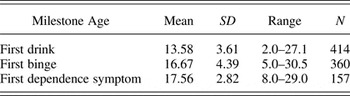
See Table 1 for descriptive information regarding alcohol involvement milestones.
Alcohol milestone descriptive statistics

Model fit results for internalizing and externalizing factor scores
Adequate model fit was achieved in the CFA for the internalizing model (root mean square error of approximation = 0.046, comparative fit index = 0.934, standard root mean square residual = 0.049). The initial externalizing model fit the data somewhat less well, so correlations between error terms for the same items at Waves 1 and 3 were added. After adding these correlations, 1 item (“runs away from home”) was found to have substantially lower loadings on the higher order externalizing factors, particularly at Waves 1 and 2 (standardized loadings = .11 at Waves 1 and 2) compared to the other 21 items. Further examination revealed that this item was only endorsed by 1%–3% of parents at each wave. Based on the low factor loadings and the infrequent endorsement, this item was removed from the factor model. The resulting model demonstrated improved fit (root mean square error of approximation = 0.043, comparative fit index = 0.856, standard root mean square residual = 0.067). After this change, modification indices indicated that there were no major structural problems with the model (i.e., fit could only be improved by dropping more items), so the model was retained.
Internalizing symptoms predicting age of first drink
The covariates of COA positive status (odds ratio [OR] = 1.370, p = .002) and greater early externalizing (OR = 1.600, p = .010) were found to significantly predict an earlier age of first drink. Gender did not significantly predict age of first drink (OR = 1.073, p = .497). Contrary to hypotheses, greater early internalizing did not predict a later age of first drink after accounting for the effects of the covariates. Rather, greater internalizing symptoms predicted an earlier age of first drink (OR = 1.367, p = .012)
Early stages of alcohol involvement: Internalizing symptoms predicting speed of transition from first drink to first binge
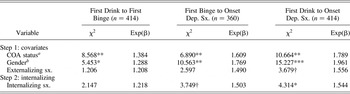
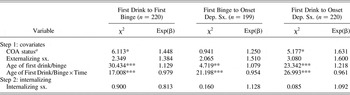
As shown in Table 2 (Step 1), the covariates of COA positive status (OR = 1.384, p = .003) and male gender (OR = 1.288, p = .020) were found to significantly predict a faster transition from first drink to first binge, but greater early externalizing did not significantly predict a faster transition through this interval (OR = 1.208, p = .272). Contrary to hypotheses, greater early internalizing did not predict a slower transition from first drink to first binge (OR = 1.218, p = .143). The direction of the effect was such that internalizing was a nonsignificant predictor of a faster transition through this interval.
Cox regression models for transitions among first drink, first binge, and first dependence symptom

Note: Dep., dependence; Sx., symptoms; COA, children of alcoholics.
a COA status was coded 0 = control, 1 = child of alcohol-dependent parent(s).
b Gender was coded 1 = female, 2 = male.
†p < .10. *p < .05. **p < .01. ***p < .001.
Later stages of alcohol involvement: Internalizing symptoms predicting speed of transition from first binge to first dependence symptom
As shown in Table 2 (Step 1), the covariates of COA positive status (OR = 1.609, p = .009) and male gender (OR = 1.769, p = .001) were found to significantly predict a faster transition from first binge to first dependence symptom, but greater early externalizing again was not a significant predictor (OR = 1.490, p = .107). In partial accordance with hypotheses, early internalizing was found to marginally predict a faster transition from first binge to first dependence symptom (OR = 1.503, p = .053).
Full interval: Internalizing symptoms predicting speed of transition from first drink to first dependence symptom
As shown in Table 2 (Step 1), the covariates of COA positive status (OR = 1.789, p = .001) and male gender (OR = 1.961, p < .001) were found to significantly predict a faster transition from first drink to first dependence symptom. Greater early externalizing marginally predicted a faster transition from first drink to first dependence symptom (OR = 1.556, p = .055). As shown in Table 2 (Step 2), greater early internalizing was found to significantly predict a faster transition from first drink to first dependence symptom (OR = 1.544, p = .038) after accounting for the effects of the covariates. The OR of 1.544 for internalizing indicates that for every one-unit change in internalizing symptoms, the hazard for first dependence symptom was multiplied by 1.544. This means that as internalizing symptoms increased, survival time from first drink to the onset of first dependence symptom decreased (i.e., transition speed increased).
Test of proportionality of hazards assumption for effects of age of first drink and age of first binge
Cox regression assumes that the effect of a given covariate/predictor on the survival function is constant over the time interval of interest (proportionality of hazards assumption). This assumption was tested for each covariate and was found to be violated when age of first drink and age of first binge were included in the above models, so these variables were included as time-dependent covariates. The inclusion of age of first drink and age of first binge at the covariate step of the above models did not change the nature of the findings (i.e., no significant internalizing effects became nonsignificant or vice versa). The largest change was in the analysis of the transition from first binge to first dependence symptom, where the OR for internalizing symptoms dropped from 1.503 to 1.430, and the p value changed from .053 to .099 after inclusion of age of first binge.
Moderation by gender
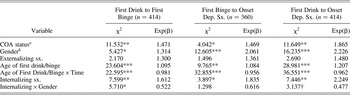
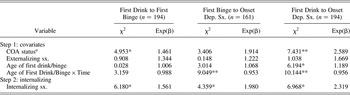
As shown in Table 3, when a Gender × Internalizing interaction term was included in the above models (which included COA status, gender, externalizing symptoms, internalizing symptoms, and age of first drink/first binge), the interaction significantly predicted the transition from first drink to first binge (p = .017), did not significantly predict the transition from first binge to first dependence symptom (p = .255), and marginally predicted the transition from first drink to first dependence symptom (p = .077). None of the other Gender × Covariate interactions were significant; thus, they were dropped from the models (all ps > .2). Given the presence of a significant Gender × Internalizing interaction for the transition from first drink to first binge and a marginally significant interaction for the transition from first drink to first dependence symptom, simple main effects of internalizing symptoms on these transitions were examined separately by gender. Among females, greater early internalizing was a significant predictor of a more rapid transition from first drink to first binge (see Table 4; OR = 1.561, p = .013) and through the entire interval from first drink to first dependence symptom (see Table 4; OR = 2.319, p = .008). For males, internalizing symptoms were not a significant predictor of the speed of transition from first drink to first binge (see Table 5; OR = 0.813, p = .343) or from first drink to first dependence symptom (see Table 5; OR = 1.092, p = .770).
Cox regression models including gender by internalizing interactions

Note: Dep., dependence; Sx., symptoms; COA, children of alcoholics.
a COA status was coded 0 = control, 1 = child of alcohol-dependent parent(s).
b Gender was coded 1 = female, 2 = male.
†p < .10. *p < .05. **p < .01. ***p < .001.
Cox regression models for females only

Note: Dep., dependence; Sx., symptoms; COA, children of alcoholics.
a COA status was coded 0 = control, 1 = child of alcohol-dependent parent(s).
*p < .05. **p < .01. ***p < .001.
Cox Regression Models for Males Only

Note: Dep., dependence; Sx., symptoms; COA, children of alcoholics.
a COA status was coded 0 = control, 1 = child of alcohol-dependent parent(s).
*p < .05. **p < .01. ***p < .001.
The nonsignificant interaction between gender and internalizing for the later part of the interval (first binge to first dependence symptom) indicates that the effect of internalizing on the speed of this transition was not significantly different for men and women. However, given that greater early internalizing predicted a more rapid transition through the full interval from first drink to first dependence symptom as well as the early part of the interval (first drink to first binge) among females and not among males, the effect of internalizing on the transition through the later part of the interval (first binge to first dependence symptom) was also examined separately by gender in a post hoc analysis. This was done in order to determine whether the observed effect of internalizing on transition speed through the entire interval in women was driven by the observed effect in the early part of the interval or whether the effect of internalizing was significant in both parts of the interval, and to determine whether internalizing had any effect in men on transition speed through any part of the interval. As shown in Table 4, greater early internalizing was a significant predictor of a faster transition through the later part of the interval among females (from first binge to first dependence symptom, OR = 1.980, p = .037). As shown in Table 5, among males, internalizing was again not a significant predictor of transition speed through the later part of the interval (OR = 1.128, p = .689).
Replicating analyses after excluding negative transitions between milestones
A total of 14 participants reported a later alcohol milestone as having occurred more than 2 years before an earlier milestone. All above analyses were replicated after excluding these negative transitions of more than 2 years. One result was affected: specifically, internalizing no longer significantly predicted a more rapid transition from first binge to first dependence symptom among women, though the OR remained substantial and the effect was in the same direction (OR = 1.775, p = .10).
Replicating analyses after separating internalizing into anxiety versus depression
All above analyses were replicated using a depression subscale of the internalizing measure and an anxiety subscale of the internalizing measure as separate predictors (see Data Analytic Plan). When using the depression subscale, the only affected outcome was speed of transition from first drink to first dependence symptom in the full sample. Specifically, depression was only a marginally significant predictor of a faster transition through this interval (OR = 1.27, p = .076) rather than a significant predictor. When using the anxiety subscale, the only affected result was speed of transition from first binge to first dependence symptom among women. Specifically, anxiety was no longer a significant predictor of a faster transition through this interval, though the effect was again in the same direction (OR = 1.435, p = .11).
Discussion
The current study aimed to provide a comprehensive investigation of the effects of early internalizing symptoms on speed of transition through multiple stages of alcohol involvement from late childhood to adulthood. In addition to being the first study to investigate a large developmental range from late childhood to adulthood in both genders, another novel aspect of the current study was that the effects of internalizing were investigated after accounting for the effects of gender, family history of alcohol use disorders (which was intentionally oversampled), and externalizing symptoms, all of which have been shown to be independent predictors of speed of transition to alcohol dependence (Hussong et al., Reference Hussong, Bauer and Chassin2008; Keyes et al., Reference Keyes, Martins, Blanco and Hasin2010). In addition, age/developmental stage was included as a covariate in all analyses by controlling for the timing of the first milestone in each interval of interest (and when age/developmental stage was found to violate the proportionality of hazards assumption, it was included as a time-dependent covariate in all analyses in order to ensure that findings were not affected). This was the first study to control for the influences of all of these variables simultaneously, thus providing a rigorous test of the independent effects of internalizing symptoms on speed of transition through stages of alcohol involvement. Finally, this study also examined moderation of internalizing effects on transition speed by gender, a question that prior studies have not investigated.
It was hypothesized that greater early internalizing symptoms would predict a later age of first use of alcohol, a slower transition from first drink to first binge, and a faster transition from first binge to first dependence symptom. In general, these stage-specific hypotheses concerning the effects of internalizing were not supported. Rather, a pattern of results emerged suggesting that internalizing may be a more general risk factor that exerts its effects at all stages of alcohol involvement, leading to an earlier onset of drinking and a more rapid transition through all stages of alcohol use. The results were qualified by gender differences. In general, greater early internalizing significantly predicted a more rapid transition through alcohol use milestones among women, but not among men. Although previous studies of the effects of internalizing on transition speed have not addressed the question of gender moderation, the results of the current study may explain why the only other study utilizing prospective data did not find an effect of internalizing symptoms on transition speed, as Marmorstein et al. (Reference Marmorstein, White, Loeber and Stouthamer-Loeber2010) utilized an all-male sample of children and adolescents.
Further, the results of the current study may help to clarify some of the conflicting findings regarding the main effect of gender on speed of transition through alcohol use milestones. Most studies that have found a “telescoping” of the transition to alcohol dependence among women utilized treatment-seeking samples of male and female drinkers (Piazza et al., Reference Piazza, Vrbka and Yeager1989; Randall et al., Reference Randall, Roberts, Del Boca, Carroll, Connors and Mattson1999), whereas a more recent study that did not find a telescoping effect among women (Keyes et al., Reference Keyes, Martins, Blanco and Hasin2010) utilized two general population samples. Because the prevalence of comorbid internalizing problems in samples of treatment-seeking drinkers has been shown to be higher than in population-level studies (Tomasson & Vaglum, Reference Tomasson and Vaglum1995), and given that internalizing problems are more prevalent in women than in men (Strine et al., Reference Strine, Mokdad, Balluz, Gonzalez, Crider, Berry and Kroenke2008), perhaps previous findings of rapid progression from initial alcohol use to dependence (and/or treatment) among women can be accounted for by elevated rates of internalizing problems among females in these samples. If this is the case, this has particularly important implications for targeting of preventive interventions for alcohol use disorders (see below).
The finding that greater early internalizing symptoms predicted an earlier age of first drink was contrary to hypotheses, but consistent with results from some other studies showing that various forms of early internalizing problems predict an earlier age of first alcohol use (Costello et al., Reference Costello, Erkanli, Federman and Angold1999; King et al., Reference King, Iacono and McGue2004; Marmorstein et al., Reference Marmorstein, White, Loeber and Stouthamer-Loeber2010). This hypothesis was based in part on Hussong et al.'s (Reference Hussong, Jones, Stein, Baucom and Boeding2011) observation that some forms of internalizing could delay onset of use via social isolation (as in Kaplow et al., Reference Kaplow, Curran, Angold and Costello2001). Because the measure of internalizing problems used in the current study combined items that span both the anxiety and the depression spectra, it is possible that differential effects of anxiety versus depression on age of first use and transition speed through stages of alcohol involvement were obscured. However, when analyses were rerun using anxiety and depression versions of the internalizing measure as predictors, there were minimal changes in results (despite a likely decrease in power due to less predictor variability). Thus, the finding that early internalizing symptoms in general are associated with a faster transition from the very first use of alcohol to the first experience of a dependence symptom is noteworthy, because it suggests that a predisposition to experiencing negative affect in general may prime individuals to begin drinking earlier and to progress more quickly through all stages of alcohol involvement (which is contrary to some well-established ideas regarding typologies of alcoholism, such as Cloninger, Reference Cloninger1987). This finding is noteworthy given that the present study also controlled for externalizing symptoms, which are highly correlated with internalizing symptoms (Costa, Weems, Pellerin, & Dalton, Reference Costa, Weems, Pellerin and Dalton2006) and have been established as an independent risk factor for rapid transition through stages of alcohol use (Hussong et al., Reference Hussong, Bauer and Chassin2008). However, it should also be noted that some internal consistency values for these relatively short scales were in the poor range (e.g., Cronbach αs as low as 0.523), so future studies that more fully characterize different types of internalizing are needed.
Although the results of the current study support internalizing symptoms as a risk factor for rapid transition through all stages of alcohol involvement (at least among women), they do not speak to what mechanism(s) might underlie this effect. Fortunately, general models of addiction offer a helpful framework for interpreting the results of the current study and guiding future research in this area. For instance, viewed through the lens of the incentive-sensitization model (Robinson & Berridge, Reference Robinson and Berridge1993), these findings have interesting potential implications for the salience of alcohol-related cues and alcohol-related learning among those higher in negative affect. It has been shown that negative mood states increase the desire to drink when presented with alcohol-related cues (Cooney, Litt, Morse, Bauer, & Gaupp, Reference Cooney, Litt, Morse, Bauer and Gaupp1997; Litt, Cooney, Kaden, & Gaupp, Reference Litt, Cooney, Kadden and Gaupp1990), so perhaps this increased salience of cues among those who frequently experience negative affect facilitates the learning of associations between alcohol use and the reinforcing effects of alcohol (effects that could be either positively reinforcing, such as stimulation, or negatively reinforcing, such as relief from internalizing symptoms). If this is the case, the crucial transition from passively “liking” the effects of alcohol to actively “wanting” or craving the positive effects of alcohol may happen more quickly among these individuals. Future studies could test this possibility by measuring relevant mediating variables of the effect of internalizing on increased transition speed during both early and later stages of use.
Koob's (Reference Koob2003) neurobiological model of addiction also offers an intriguing framework for interpreting the results of the current study and guiding future research. Koob's model emphasizes the importance of withdrawal in the transition from nonpathological substance use to addiction. Specifically, the point at which substance use becomes primarily motivated by the goal of avoiding the unpleasant effects of withdrawal (vs. the goal of obtaining the positive effects of the substance) is identified as the threshold for addiction (Koob, Reference Koob2003). This model seems especially well positioned to explain rapid transitions through later stages of alcohol use among those high in internalizing, such as the transition from first binge to first dependence symptom in the current study (and it is likely not as helpful in explaining rapid transition through early stages of use, when withdrawal symptoms are less prevalent or nonexistent). It has been observed that the state of alcohol withdrawal involves symptoms quite similar to those found in some internalizing disorders, such as trembling, excessive sweating, and anxiety (Roelofs, Reference Roelofs1985), and that dysregulation in the same brain stress systems (such as the hypothalamus–pituitary–adrenal axis) underlies both alcohol withdrawal and internalizing disorders (see Kushner et al., Reference Kushner, Maurer, Menary and Thuras2011). Perhaps internalizing symptoms predict a more rapid transition through later stages of use because individuals high in internalizing are predisposed to experiencing more severe alcohol withdrawal due to preexisting dysregulation in these brain systems. If this is the case, motivation for alcohol use might shift more quickly from obtaining the positive effects of alcohol to avoiding the negative effects of withdrawal in these individuals. Future studies could investigate this hypothesis by comparing the onset and severity of withdrawal symptoms after the initiation of alcohol use between those high in internalizing symptoms and those lower in internalizing. However, such studies would also have to account for the fact that certain traits among those high in internalizing, like anxiety sensitivity, could predispose individuals to experience the same withdrawal symptoms as more aversive.
In addition to possible theoretical implications, the results of the current study have the potential to inform prevention and intervention efforts in high-risk populations. Some existing interventions already target adults with both internalizing and alcohol use disorders (e.g., Kushner et al., Reference Kushner, Maurer, Thuras, Donahue, Frye, Menary and Van Demark2013; Najavitis, Schmitz, Gotthardt, & Weiss, Reference Najavits, Schmitz, Gotthardt and Weiss2005), but the finding in the current study that internalizing can speed up the transition even through very early stages of use speaks to the need to address internalizing symptoms as a risk factor for alcohol problems early on in development, before alcohol use has progressed to more pathological levels. Given that substance use often onsets quite early in development (e.g., mean age of onset in the current study was 13.58), interventions targeting parents of children at high risk for internalizing (possibly via family history of internalizing) seem promising.
Parent-focused interventions for adolescents at risk for externalizing problems have been shown to positively impact substance use outcomes (Dishion, Kavanagh, Schneiger, Nelson, & Kaufman, Reference Dishion, Kavanagh, Schneiger, Nelson and Kaufman2002; Dishion, Nelson, & Kavanagh, Reference Dishion, Nelson and Kavanagh2003), but there do not seem to be corresponding interventions targeting children with internalizing problems with the goal of reducing alcohol use (Austin, Macgowan, & Wagner, Reference Austin, Macgowan and Wagner2005). Interventions incorporating psychoeducation for parents about internalizing symptoms as a risk factor for subsequent alcohol problems may be helpful in preventing the development of pathological alcohol use in this population. Personality-based interventions that target traits related to internalizing problems also seem promising, such as Conrod, Stewart, Comeau, and Maclean's (Reference Conrod, Stewart, Comeau and Maclean2006) coping skills interventions. Traits such as anxiety sensitivity and negative affectivity can predispose adolescents to engage in risky behavior like alcohol consumption via negative reinforcement-based drinking motives, and building up adaptive coping skills in adolescents with these personality traits has been shown to reduce risk for alcohol-related problems (Conrod et al., Reference Conrod, Stewart, Comeau and Maclean2006).
The finding that internalizing symptoms are a particularly potent risk factor for rapid transition to problematic use among women is also potentially important, especially given the higher prevalence of internalizing disorders among women compared to men (Strine et al., Reference Strine, Mokdad, Balluz, Gonzalez, Crider, Berry and Kroenke2008). If it is the case that women are at unique risk for a rapid transition to alcohol dependence due to internalizing symptoms, prevention and intervention efforts like the ones outlined above should be targeted and/or tailored to females when possible in order to achieve greater effectiveness and greater cost efficiency.
While the results of the current study have important theoretical and practical implications, several limitations should be noted. Findings regarding gender differences ought to be treated as somewhat preliminary given that no a priori hypotheses were made about the moderating effects of gender. In addition, although data were collected prospectively, internalizing symptoms were assessed after onset of alcohol use and/or binge drinking for some participants (e.g., the latent internalizing variable was composed of data collected at approximately ages 13, 14, and 15, but 14% of participants reported first binge drinking prior to age 13). Although it would have been possible to exclude all participants who reported any drinking or binge drinking prior to the assessment of internalizing symptoms in order to establish temporal precedence, this would have resulted in a biased sample that does not reflect the typical developmental progression of alcohol use. Utilizing three assessments of late childhood/early adolescent internalizing symptoms allowed for a more stable measure of traitlike internalizing, and utilizing the maximum possible number of subjects in analyses resulted in greater power to detect effects. That being said, it is important to acknowledge that the results of the present study cannot be interpreted as “causal” in the sense that early internalizing symptoms lead directly to onset of drinking and faster progression through alcohol use milestones. Rather, the relationship between internalizing and progression of alcohol use is likely a dynamic, reciprocal process in which both behaviors influence each other over time.
Another limitation of the present study is that some retrospection was still required on the part of participants, especially regarding age of first dependence symptom. That being said, the prospective nature of the data reduced retrospection compared to fully retrospective studies, which should lead to greater accuracy of findings overall. A further limitation of the current study is that the “first binge” milestone was defined as first occasion of five or more drinks in a row for both men and women, which is not reflective of the National Institute on Alcohol Abuse and Alcoholism's (2015) definition of a “binge” as approximately 5 drinks in a single occasion for males and approximately 4 drinks for females. This could have affected the results of the current study because this may be a more severe milestone for women than for men (i.e., five drinks would result in reaching a higher blood alcohol count on average for women). In addition, the “first dependence symptom” milestone was defined as age of first dependence symptom among those who ever met criteria for alcohol dependence. It would have been informative to examine age of first dependence symptom among all participants, or to examine the age at which the full dependence syndrome onset as an endpoint of interest, but this information was unfortunately not available in the present sample.
Other limitations involve methods used to estimate timing of the alcohol use milestones. Specifically, for participants who did not report an age of first drink or first binge at Waves 1 through 3, data from Waves 4 through 6 was used to estimate the age at which these milestones occurred. This estimation strategy introduced some error into the milestone estimates, although any error present should not have been systematic, given that the same estimation strategy was used for all participants without drinking or binge data at Waves 1 through 3. Lending confidence to the estimation strategy used in the current study, the average ages of first drink and first binge in the sample were comparable to results obtained from multiple epidemiological studies of adolescents and young adults (e.g., Hingson, Heeren, Winter, & Wechsler, Reference Hingson, Heeren, Winter and Wechsler2003; Johnson & Mott, Reference Johnson and Mott2001; Young et al., Reference Young, Corley, Stallings, Rhee, Crowley and Hewitt2002). Finally, there were some cases in the current study where a participant reported a later milestone as having occurred before an earlier milestone (e.g., reporting age of first dependence symptom as 14 and age of first binge as 16). The majority of these “negative transitions” represented reversals of 2 years or less, and the general strategy employed in the current study was to set these negative transitions to zero and include these cases in analyses. Supporting the use of this strategy, a recent study used this method of dealing with negative transitions and found that results were unaffected (Kushner et al., Reference Kushner, Maurer, Menary and Thuras2011), and when results in the current study were replicated after excluding all negative transitions of 2 years or more (n = 14), only the significance of one result was affected (internalizing no longer significantly predicted a more rapid transition from first binge to first dependence symptom among women, though the effect size remained substantial).
In summary, the current study represents the first use of a prospective data set including both genders to investigate the effects of early internalizing problems on speed of transition through various stages of alcohol involvement. Multiple variables known to affect speed of transition to alcohol dependence were included as covariates in analyses, and internalizing symptoms still emerged as a significant predictor of a more rapid transition from first use of alcohol to the onset of first dependence symptom. This effect was found to be moderated by gender, such that internalizing was a significant risk factor for rapid transition to dependence symptoms among women but not among men. Further, when the interval was broken down into early and late stages, internalizing predicted a more rapid transition through both stages among women (but not among men). These findings have important implications for our theoretical understanding of the relationship between internalizing disorders and alcohol use disorders as well as for prevention and intervention efforts targeting these problems. Future studies should seek to identify mechanisms through which early internalizing leads to faster transitions and should also seek to replicate the current gender-specific findings. Such studies may be helpful in identifying targets for prevention and intervention efforts. Additional studies examining potential interactions between internalizing and other risk factors (including those examined as covariates in the current study) also seem warranted, as internalizing symptoms likely do not act in isolation in speeding up transitions through various stages of alcohol involvement.